Trip Planning
The TakeYourBackpack guidebooks are your all-in-one travel companion, featuring the best cities, national parks, hikes, beaches, and unique sites, along with essential tips on when to go, how to get around, exchanging money, and even local phrases to get you started — everything you need for a smooth, unforgettable backpacking adventure.
Stop researching. Start exploring.Discover all 105 highlights,ranked
and organized into practical routes.
Get instant access
Planning a backpacking route through Ghana can be tricky — you need to balance must-see places, travel times, budget, and how long to stay in each destination. Our free personalized Ghana itinerary planner creates a route based on your travel style, trip duration, and interests, so you can spend less time researching and more time exploring.
Personal tip: I normally search on good rating for atmosphere (for meeting people) and location (for easy exploring). Cleanliness as a bonus.
Travel Essentials
A yellow fever vaccination certificate is mandatory to enter Ghana for all travelers aged 9 months and older. Recommended vaccines include hepatitis A, typhoid, hepatitis B and up-to-date routine shots (MMR, tetanus-diphtheria, polio), plus rabies for long stays or rural travel and meningococcal meningitis for the northern regions during the dry season (December to June). Malaria is present year-round throughout the country, so antimalarial tablets are strongly advised; see a travel clinic 6 to 8 weeks before departure.
vaccination requirementsWhen I first started traveling, I often spent part of my first day in a new country hunting for a local SIM card. While this can still be slightly cheaper, it also takes time and planning.
These days, it's much simpler to install an eSIM before leaving home. Once you arrive in Ghana, you can activate it immediately and have mobile data from the moment you land — which is especially useful for ordering transport or navigating away from busy airports.
There are many providers nowadays, and price differences are usually small. I personally go with
Holafly, as it offers excellent network coverage throughout the country and strong global coverage, so you can manage multiple countries from a single app.
HolaFly eSimCulture & Customs
Use your right hand to eat, pay, give or receive anything, as the left hand is considered unclean; if you have to use it, apologize. Show visible respect to elders and chiefs by letting them speak first and standing when they arrive, and when visiting a village it is customary to pay your respects to the chief and offer a small gift such as a bottle of schnapps or GHS 50 to 100. Do dress modestly away from beach towns, especially in the largely Muslim north and in places of worship, remove your shoes before entering a mosque, and always ask before photographing people, markets or shrines. Don’t lose your temper in public, refuse offered food bluntly or haggle aggressively, because patience and humour resolve far more than raised voices. Public displays of affection are frowned upon for everyone and especially risky for same-sex couples, and women will draw less unwanted attention in knee-length skirts or trousers outside Accra.
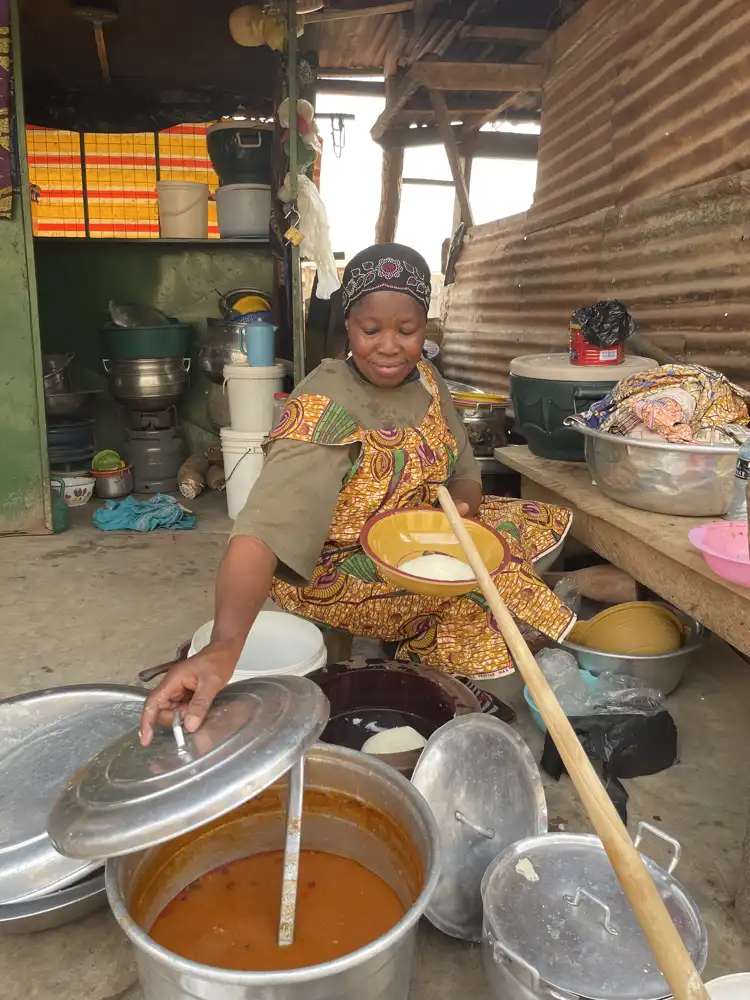
Trying traditional food is always a great way to experience the culture. Here are some must-try dishes for Ghana.
- Jollof rice: rice cooked in a spiced tomato, onion and pepper sauce, served with chicken or fish. It is the centre of every party and the subject of a long, loud rivalry with Nigeria over who makes it best.
- Fufu with light soup: pounded cassava and plantain shaped into a soft, stretchy ball and eaten by hand with a peppery tomato soup of goat or fish. The rhythmic thud of fufu pounding is the soundtrack of Asante kitchens.
- Banku and tilapia: a sour, fermented corn and cassava dough served with a whole grilled tilapia, raw pepper sauce and onions. It is the classic evening meal at coastal drinking spots.
- Waakye: rice and beans cooked with sorghum leaves that turn them reddish brown, topped with spaghetti, boiled egg, gari and shito (black pepper sauce). Ghana’s favourite breakfast, sold from roadside pans wrapped in leaves.
- Kelewele: ripe plantain cubes spiced with ginger, chili and cloves, then deep-fried. The go-to night-time street snack, often eaten with roasted peanuts.
- Red red: black-eyed bean stew cooked in red palm oil and served with fried plantain. Cheap, filling and a reliable vegetarian choice.
- Kenkey with fried fish: fermented corn dough boiled in corn husks or plantain leaves, eaten with fried fish and hot pepper sauce. A staple of the Ga people of Accra and the fishing coast.
Tap water in Ghana is not safe for travelers to drink, and most locals avoid it too, buying 500 ml plastic sachets of filtered “pure water” for about GHS 1 to 2 or bottled water instead. Stick to sealed bottles or sachets from established brands, or carry a filter bottle to cut down on plastic waste.
The main language in Ghana is
Akan. Backpacking is way more rewarding if you know a bit of the local language, so I'd suggest brushing up on the basics just in case your Akan skills have become a bit rusty.
Want to understand locals better?The complete Travel Guide for Ghana includes 52 essential words and phrases — greetings, thank-yous, ordering food, transport, numbers, and common local expressions you'll actually hear.
Get your local basic phrases 👉
Get the Travel Guide - is Ghana’s official language, and in Accra, Kumasi, Cape Coast and the beach towns taxi drivers, traders and guides all speak it, often mixed with Ghanaian Pidgin. Younger Ghanaians and hostel staff are fluent, while in rural villages, especially in the north, older people may speak only Twi, Ewe, Dagbani or another local language. Twi, the Akan language used across the south and centre, helps most, and even a simple “medaase” (thank you) earns big smiles. Download an offline translator that includes Twi, or ask a local to write your destination down for trotro mates.
Money & Payments
The local currency of Ghana is GHS (₵).
Ghana uses the cedi (GHS), and ATMs are easy to find in Accra, Kumasi, Cape Coast, Takoradi and Tamale but scarce in rural areas and around Mole National Park, so withdraw enough before heading out. Visa cards work at most machines from banks such as Ecobank, GCB, Stanbic and Absa, Mastercard less reliably, and local fees usually run GHS 10 to 25 per withdrawal on top of your home bank’s charges, with per-transaction limits often between GHS 1,000 and 3,000. Cards are accepted at upscale hotels, malls, supermarkets and some restaurants in Accra, but trotros, markets, chop bars and most guesthouses outside the cities are cash only, and mobile money (MoMo) handles many small payments. Bring some US dollars or euros as backup: crisp, newer US$50 and US$100 notes get the best rates, while old or torn notes are often refused. Change money at banks or licensed forex bureaus in shopping areas, never with street changers at borders or lorry stations.
Tipping in Ghana is appreciated but not mandatory: in sit-down restaurants leave about 10 percent if no service charge is on the bill, while at chop bars and street stalls nobody expects one. Round up taxi fares, give guides at sites such as Kakum or Mole around GHS 20 to 50 per group, and offer porters GHS 5 to 10 per bag; a small tip or favour is known locally as a “dash”.
v2.webp)

 Best Backpacking
.jpg) Over the years, I've learned the importance of packing minimally. It's so much easier to jump on the back of a truck or squeeze yourself into the last spot of a minibus without that supersized backpack. If you're headed to a warm destination, leave your winter jacket at home; for colder regions, opt for thin thermal underlayers. Instead of packing your entire wardrobe, bring just three sets of clothes, as laundry facilities are available everywhere.
Over the years, I've learned the importance of packing minimally. It's so much easier to jump on the back of a truck or squeeze yourself into the last spot of a minibus without that supersized backpack. If you're headed to a warm destination, leave your winter jacket at home; for colder regions, opt for thin thermal underlayers. Instead of packing your entire wardrobe, bring just three sets of clothes, as laundry facilities are available everywhere.
















.jpg) Hi, I’m Johan (Netherlands 🇳🇱), the creator of TakeYourBackpack. Over the past 3 decades, I’ve backpacked through 90+ countries across six continents, gaining extensive experience with independent travel, long-term trips, and overland routes.
Hi, I’m Johan (Netherlands 🇳🇱), the creator of TakeYourBackpack. Over the past 3 decades, I’ve backpacked through 90+ countries across six continents, gaining extensive experience with independent travel, long-term trips, and overland routes.