Trip Planning
The TakeYourBackpack guidebooks are your all-in-one travel companion, featuring the best cities, national parks, hikes, beaches, and unique sites, along with essential tips on when to go, how to get around, exchanging money, and even local phrases to get you started — everything you need for a smooth, unforgettable backpacking adventure.
Stop researching. Start exploring.Discover all 100 highlights,ranked
and organized into practical routes.
Get instant access
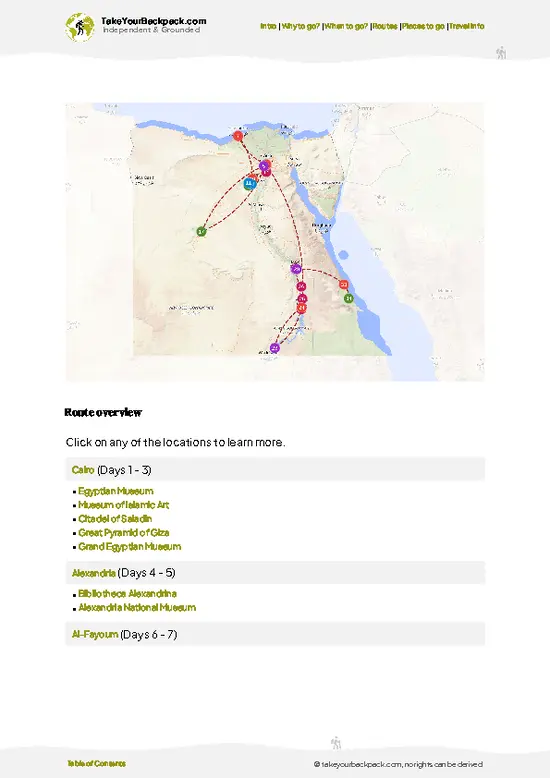
Planning a backpacking route through Egypt can be tricky — you need to balance must-see places, travel times, budget, and how long to stay in each destination. Our free personalized Egypt itinerary planner creates a route based on your travel style, trip duration, and interests, so you can spend less time researching and more time exploring.
Personal tip: I normally search on good rating for atmosphere (for meeting people) and location (for easy exploring). Cleanliness as a bonus.
Travel Essentials
No vaccinations are required to enter Egypt unless you arrive from a country with yellow fever risk, in which case a yellow fever certificate is mandatory. Make sure routine vaccines (MMR, tetanus-diphtheria, polio) are up to date, and get hepatitis A and typhoid shots, since both spread through food and water. Hepatitis B and rabies vaccines are worth considering for longer stays, rural travel or contact with animals, as stray dogs and cats are common. Check with a travel clinic six to eight weeks before departure.
vaccination requirementsWhen I first started traveling, I often spent part of my first day in a new country hunting for a local SIM card. While this can still be slightly cheaper, it also takes time and planning.
These days, it's much simpler to install an eSIM before leaving home. Once you arrive in Egypt, you can activate it immediately and have mobile data from the moment you land — which is especially useful for ordering transport or navigating away from busy airports.
There are many providers nowadays, and price differences are usually small. I personally go with
Holafly, as it offers excellent network coverage throughout the country and strong global coverage, so you can manage multiple countries from a single app.
HolaFly eSimCulture & Customs
Egyptian culture is conservative and religion shapes daily life, so dress modestly with shoulders and knees covered outside beach resorts, and remove your shoes and cover your hair (women) when entering a mosque. Do eat, pass items and shake hands with your right hand, accept offered tea when you can, and bring sweets or pastries if invited into a home. Don’t photograph police, soldiers, bridges or government buildings, and ask before photographing people, especially women. During Ramadan, avoid eating, drinking or smoking in public during daylight hours. Public displays of affection are frowned upon for all couples; women should expect occasional unwanted attention and can firmly decline conversations without seeming rude, and LGBTQ+ travelers should keep relationships private in public spaces and in hotels.
Trying traditional food is always a great way to experience the culture. Here are some must-try dishes for Egypt.
- Koshari: A layered bowl of rice, lentils, macaroni and chickpeas topped with spicy tomato sauce, garlic vinegar and crispy fried onions. It is Egypt’s national dish in all but official title, sold at dedicated koshari shops that serve it fast, filling and cheap to students and office workers alike.
- Ful medames: Fava beans stewed slowly overnight, then mashed with cumin, oil, lemon and sometimes tahini or egg, eaten with baladi bread. It has been the Egyptian working breakfast for centuries, ladled from huge copper pots on carts across Cairo every morning.
- Ta’ameya: Egyptian falafel made from fava beans rather than chickpeas, which gives it a bright green center and a lighter texture. Stuffed into a pita with tahini and salad, it is the default street sandwich and costs very little.
- Molokhia: A silky, garlicky green soup of finely chopped jute leaves, usually served over rice with chicken or rabbit. Many Egyptians consider it their ultimate home-cooked comfort food, and the slippery texture divides first-timers.
- Mahshi: Vegetables such as zucchini, peppers, eggplant, cabbage and grape leaves stuffed with herbed rice and simmered in tomato broth. It is labor-intensive family cooking, the dish served at big gatherings and holiday tables.
- Fattah: Layers of toasted bread and rice soaked in garlic-vinegar tomato sauce, crowned with boiled lamb or beef. It is the traditional feast dish of Eid al-Adha and other celebrations.
- Feteer meshaltet: A flaky, buttery layered pastry, eaten sweet with honey and cream or savory with cheese and meat. Rural families have baked it for generations, and specialist feteer bakeries now turn it out fresh to order.
- Om Ali: A warm bread pudding of pastry, milk, nuts, coconut and raisins, baked until bubbling on top. It is the country’s best-loved dessert and a staple after big meals.
Tap water in Egypt is treated and many locals in Cairo and Alexandria drink it, but its chlorine taste and aging pipes mean it is not recommended for travelers, whose stomachs are not used to it. Stick to sealed bottled water, widely sold for about EGP 10 to 20 per 1.5 liters, or use a filter bottle. Brushing your teeth with tap water is generally fine, but be cautious with ice and raw salads washed in tap water at cheap places.
The main language in Egypt is
Arabic. Backpacking is way more rewarding if you know a bit of the local language, so I'd suggest brushing up on the basics just in case your Arabic skills have become a bit rusty.
Want to understand locals better?The complete Travel Guide for Egypt includes 52 essential words and phrases — greetings, thank-yous, ordering food, transport, numbers, and common local expressions you'll actually hear.
Get your local basic phrases 👉
Get the Travel Guide - In Egypt,
English is widely spoken by anyone working in tourism in Cairo, Luxor, Aswan and the Red Sea towns, from hotel staff to felucca captains and shop owners. Younger, university-educated Egyptians and hostel crews usually speak it well, but bus drivers, microbus conductors and people in villages of the Delta and Upper Egypt often know only a few words. Egyptian Arabic is the language that helps most, and learning the Eastern Arabic numerals (٠ to ٩) pays off right away for reading prices, bus numbers and train seats. Download Arabic for offline use in Google Translate and learn “shukran” (thank you) and “bikam?” (how much), which open plenty of doors.
Money & Payments
The local currency of Egypt is EGP (£).
ATMs are easy to find in Egypt’s cities and tourist towns, at banks like Banque Misr, National Bank of Egypt and CIB, though they are scarce in villages and parts of the Western Desert. Expect a local fee of roughly EGP 25 to 60 per foreign-card withdrawal on top of your own bank’s charges, with per-transaction limits of about EGP 5,000 to 10,000, so withdraw larger amounts less often. Cards work at hotels, malls, chain restaurants, supermarkets and many major archaeological sites, whose ticket offices now take cards only, while street food, taxis, microbuses, markets and small shops are cash only. Bring some US dollars or euros in clean, undamaged notes as a backup and for the visa on arrival. Exchange money only at banks or licensed exchange offices, never with street changers, and always ask for small denominations.
Tipping, known as baksheesh, is woven into everyday life in Egypt, and small tips of EGP 10 to 50 are expected for services like restroom attendants, luggage help, temple guards who unlock a chamber and drivers. In restaurants, leave around 10% in cash even when a 12% service charge appears on the bill, since that charge rarely reaches the staff. Private guides usually receive EGP 200 to 400 (US$4 to 8) per day, and felucca or cruise crews about the same per person per day, so carry a stash of small notes.
v2.webp)
 Best Backpacking
.jpg) Over the years, I've learned the importance of packing minimally. It's so much easier to jump on the back of a truck or squeeze yourself into the last spot of a minibus without that supersized backpack. If you're headed to a warm destination, leave your winter jacket at home; for colder regions, opt for thin thermal underlayers. Instead of packing your entire wardrobe, bring just three sets of clothes, as laundry facilities are available everywhere.
Over the years, I've learned the importance of packing minimally. It's so much easier to jump on the back of a truck or squeeze yourself into the last spot of a minibus without that supersized backpack. If you're headed to a warm destination, leave your winter jacket at home; for colder regions, opt for thin thermal underlayers. Instead of packing your entire wardrobe, bring just three sets of clothes, as laundry facilities are available everywhere.


.jpg) Hi, I’m Johan (Netherlands 🇳🇱), the creator of TakeYourBackpack. Over the past 3 decades, I’ve backpacked through 90+ countries across six continents, gaining extensive experience with independent travel, long-term trips, and overland routes.
Hi, I’m Johan (Netherlands 🇳🇱), the creator of TakeYourBackpack. Over the past 3 decades, I’ve backpacked through 90+ countries across six continents, gaining extensive experience with independent travel, long-term trips, and overland routes.