×
Kazakhstan 🇰🇿

backpacking Asia Kazakhstan 🇰🇿Cross vast steppes where distance dominates every journey.

Explore JordanExplore Kuwait

Backpacking Kazakhstan in 2026

A complete guide including when and where to go, costs, transport, itineraries, and practical travel advice.
Traveling in Kazakhstan: what to expect

Backpacking Kazakhstan
By Johan Kruseman 🇳🇱 | Updated June 2, 2026

In Kazakhstan, your trade-off is time versus access. The country sprawls like an ocean of grass and stone; buses and trains are cheap, but the hours run long. That cadence—big distances, bigger payoff—matches its character: steady, elemental, built for travelers who take the long way.

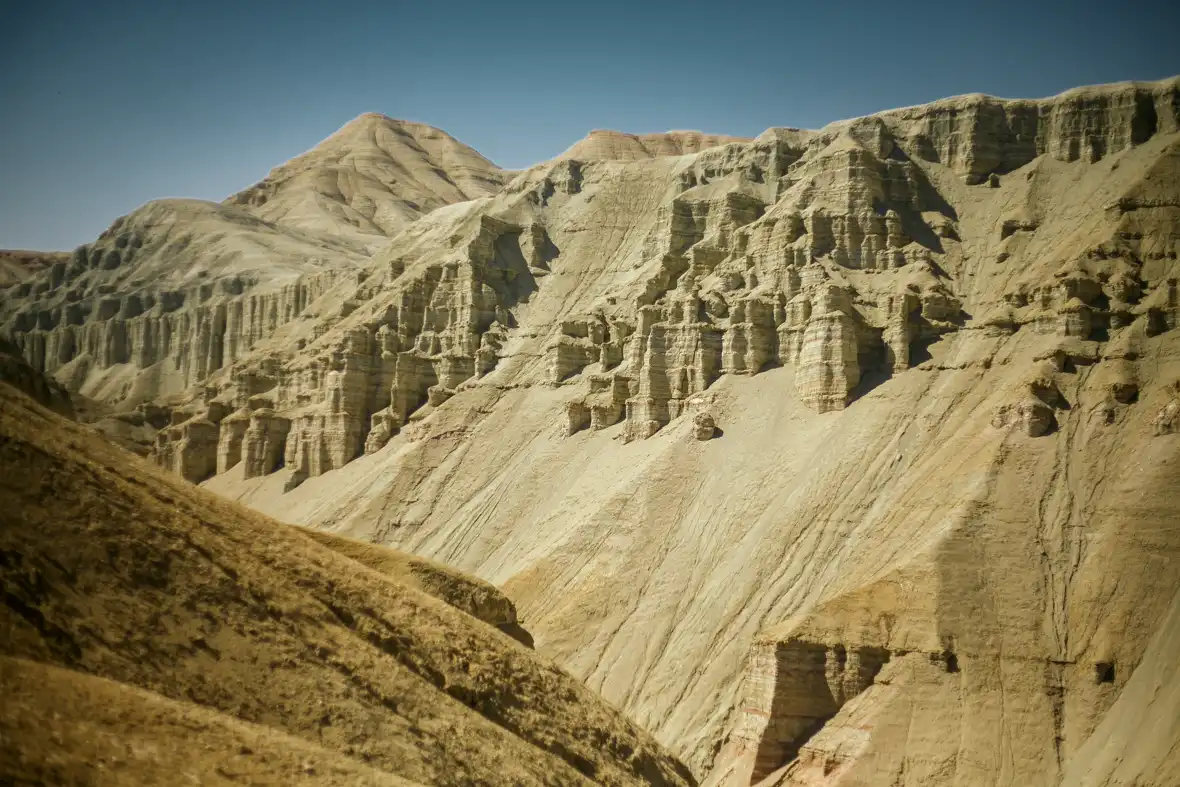
Almaty slings you straight into the Tien Shan: spruce shade, meltwater roar, calves burning on the staircase above Medeu, then ridge views that hush the city to a blur. Push out and the scale swells—Charyn’s rust-red walls, Altyn-Emel’s singing dunes humming under your feet, Big Almaty Lake flashing turquoise when the wind drops, Mangystau’s white cliffs and lunar valleys where the map goes quiet. On the steppe, saiga antelope flicker like mirages; in towns, dombra strings carry through courtyards while tandoor samsa grease your fingers and endless tea keeps the conversation warm. Astana throws glass and geometry at the sky; Karaganda’s coal-town grit and Soviet mosaics keep the story grounded; out east, horse culture still sets the pace. Challenges exist: Cyrillic menus test you, train tickets vanish without warning, winters bite hard, summers bake the edges, marshrutkas fold your knees, dust gets in your teeth. Then sunrise bleaches Bozzhyra white, a stranger shoves bread into your hand, and the first cold beer in Almaty tastes like you earned it.

Kyrgyzstan gives tight-knit alpine trekking; Uzbekistan concentrates its beauty in ornate cities; Mongolia goes lonelier and slower. Kazakhstan sits in between—vast, workable, rewarding—best for travelers who love horizons, railcar rhythms, and the satisfaction of arriving the hard way.

👉 Get the 📖 Travel Guide of Kazakhstan

Almaty & Tian Shan Spine

Base yourself in Almaty and punch straight into the mountains. City bus 12 grinds up to Medeu; from there you climb stairs, scree, and switchbacks into Ile-Alatau where altitude hits your lungs quick. Cable cars run to Shymbulak, but the payoff comes from hiking past the lift tops, where the noise dies and the ridge opens to rock and ice. Day-run Charyn Canyon and the Kolsai–Kaindy lakes via marshrutkas from Sairan bus station or shared taxis; it’s a long, dusty loop with real legs-on-the-line hours. Back in town, rinse the salt off at a banya and wrap your hands around a cold draft and hot shashlik. This corridor rewards fit travelers who like city comforts but earn their views by foot.

Mangystau & Ustyurt

Fly or rail into Aktau, re-pack for desert, then drive till the asphalt quits. Mangystau is tracks, not roads; Bozzhyra’s chalk cliffs, the Torysh stone spheres, Sherkala’s lone mesa, and the descent to Beket-Ata all demand a 4x4, spare water, and the nerve to follow a GPS line across emptiness. Heat smashes you by noon in summer and wind scours the camp by night, but dawn at Bozzhyra turns the world white and silent. You earn tea and samsa at a truck-stop chaikhana with dust in your teeth. Best for self-reliant crews who enjoy problem-solving more than signage.

Turkistan & Shymkent Corridor

If your legs need a break but your head wants story, ride the overnight train to Shymkent, then hop a marshrutka to Turkistan. The Yasawi complex hums with pilgrims, not selfie sticks, and the tilework glows after dark when families stroll and vendors hawk sunflower seeds. Add Otrar’s ruins and a half-day in Aksu-Zhabagly for wild tulips in spring and birdlife. Transport is easy, cheap, and social: shared taxis fill fast, buses run often, and every seatmate has an opinion on the best plov. This suits travelers who like conversations, courtyards, and slow, steady days.

East Kazakhstan: Altai & Katon-Karagay

From Öskemen, the road thins toward Ridder and Katon-Karagay, where taiga, rivers, and weather mood swings rule. Border-zone permits take a couple days and keep you honest; after that it’s gravel to Rakhmanovskie hot springs, footpaths to alpine meadows, and real bear-country campcraft. Villages offer simple beds and tea; timber trucks will give you a lift if you’re stuck. Bring DEET, a tarp, and knee-friendly boots. The reward lands in small moments: steam rising off a hot pool while cold rain ticks on your cap, fried grayling, and a brick stove pushing heat into tired bones.

Aral Sea & Kyzylorda Line

Ride a sleeper to Kyzylorda or Aralsk, then hire a 4x4 to the North Aral shoreline near Tastubek. The land is flat, salty, and honest. Wind cuts through clothing, salt dust stings eyes, and distances mock low fuel gauges, so carry extra and move early. Aralsk’s ship skeletons sit like a warning and a lure. Night drops hard; the sky looks bigger than it should. You come back gritty, eat fried sazan and hot bread, and feel the story more than you photograph it. This is for travelers who want context with their miles and don’t mind coming home crusted with salt.
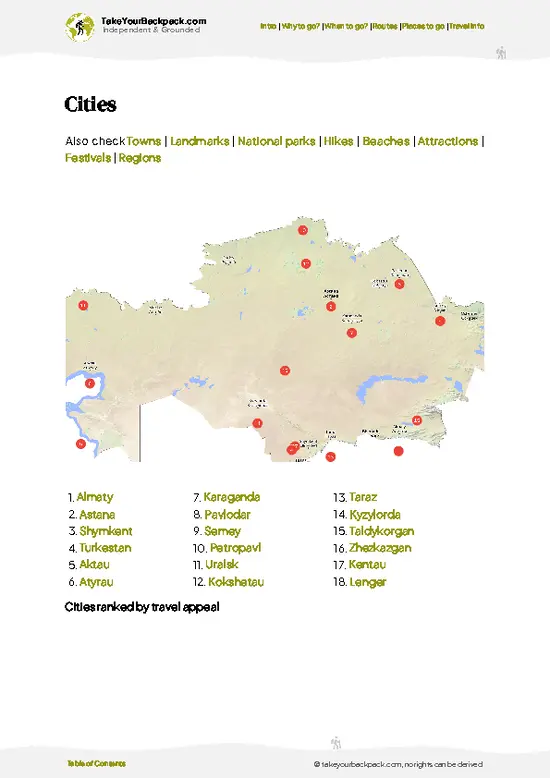
Map of Kazakhstan
Loading the map 🌍
CLICK TO FILTER
city
town
village
unique site
national park
hike
beach
attraction
festival
region
SHOW COUNTRY’S BESTSHOW ALL
film
0
0
0a
Almaty
film
1
1
1a
Aktau
film
2
2
2a
Kolsai Lakes Trek
film
3
3
3a
Big Almaty Lake
film
4
4
4a
Butakovsky Waterfall
film
5
5
5a
Shymbulak
film
6
6
6a
Tamgaly Petroglyphs Trail
film
7
7
7a
Kolsai Lakes
film
8
8
8a
Ile-Alatau
film
9
9
9a
Bayanaul
film
10
10
10a
Karkaraly
film
11
11
11a
Lake Kaindy
film
12
12
12a
Singing Dunes
film
13
13
13a
Petroglyphs of Tamgaly
film
14
14
14a
Turgen Waterfall

Why go?What makes this country worth the trip

Mountains

Kazakhstan rewards hikers who like big country and honest elevation. From Almaty, a city bus drops you at Medeu; two hours later you’re grinding switchbacks under larch and scree toward Tuyuksu, thunderheads building, meltwater … read more 👉
Kazakhstan rewards hikers who like big country and honest elevation. From Almaty, a city bus drops you at Medeu; two hours later you’re grinding switchbacks under larch and scree toward Tuyuksu, thunderheads building, meltwater biting your teeth. Trails run clean and direct—no boardwalks, no fences—so you earn every ridge of the Zailiyskiy Alatau, and you get it: glaciers hanging over you, Kyrgyz peaks stacked on the horizon, the city a toy down-valley. Push farther and the Altai and Dzungarian Alatau stretch for days: cold passes, wolf tracks, campfire smoke that sticks to your jacket. The payoff isn’t complicated: a blue lake at dusk, horses snorting by your tent, and back in town a plate of lagman and a cold beer, legs humming, dust on your boots.

Low cost

Kazakhstan stretches your money without making you live on instant noodles. Ride what locals ride: marshrutkas that rattle across town, and long, Soviet-style night trains that move you a country’s width while also covering your … read more 👉
Kazakhstan stretches your money without making you live on instant noodles. Ride what locals ride: marshrutkas that rattle across town, and long, Soviet-style night trains that move you a country’s width while also covering your bed. Eat in stolovaya canteens—ladles of lagman, plov, and hot tea refills—priced like bus fare back home. Dorm beds in Almaty and Astana land closer to Balkan rates than Western Europe, and taxis via apps undercut city buses in some places I’ve lived. Skip flights and you keep control; distances are huge, but the rails are cheap. A lean backpacker can run on roughly $30–40 a day, less if you wild camp and cook, more if you chase comfort. Dusty boots, full plate, night train lullaby, then a kiosk beer at sunset—the reward-to-cost ratio is lopsided in your favor.
Want the complete picture of Kazakhstan?
The offline Travel Guide brings everything together — routes, highlights & planning.

See what's included in the guide 👉

Get the Travel Guide -

⭐ HighlightsKey places and experiences

  • Charyn Canyon (Valley of Castles): Drop from the rim and your calves light up as the trail slants through red grit and shattered rock, heat bouncing off the walls like a furnace door. The wind dies at the bottom and the river takes over—cold, jade, fast enough to numb your ankles in seconds. Dust sticks to your sweat, jackdaws heckle from ledges, and you keep moving because the shade shifts. The payoff: boots in the Charyn, a tin kiosk selling ice-cold beer, and your first gulp cutting through the canyon dust like a knife.
  • Altyn-Emel National Park’s Singing Dune: It’s a long run-out on washboard tracks from Basshi, then a slog straight up the dune’s spine as the sun loads your shoulders. Every step slips half a step back, quads burn, and the wind hits like a hair dryer. Sit, slide, and the dune answers with a deep bass hum you feel in your ribs more than hear. Beetle tracks stitch the slope, Ili valley opens wide, and your mouth tastes like chalk until you drain the last warm sip from your
read more 👉
  • Charyn Canyon (Valley of Castles): Drop from the rim and your calves light up as the trail slants through red grit and shattered rock, heat bouncing off the walls like a furnace door. The wind dies at the bottom and the river takes over—cold, jade, fast enough to numb your ankles in seconds. Dust sticks to your sweat, jackdaws heckle from ledges, and you keep moving because the shade shifts. The payoff: boots in the Charyn, a tin kiosk selling ice-cold beer, and your first gulp cutting through the canyon dust like a knife.
  • Altyn-Emel National Park’s Singing Dune: It’s a long run-out on washboard tracks from Basshi, then a slog straight up the dune’s spine as the sun loads your shoulders. Every step slips half a step back, quads burn, and the wind hits like a hair dryer. Sit, slide, and the dune answers with a deep bass hum you feel in your ribs more than hear. Beetle tracks stitch the slope, Ili valley opens wide, and your mouth tastes like chalk until you drain the last warm sip from your bottle and grin anyway.
  • Kolsai & Kaindy Lakes: The trail to Kolsai 2 rises steady through spruce, roots acting like rungs, and the air thins just enough to make you respect the pace. Resin hangs sweet and heavy, horses clink past with gas cans and sacks, and the lake appears blue-black and still, like glass you shouldn’t touch. Kaindy is the switch: milky-turquoise, drowned trunks poking up like a drowned forest’s ribs. Stick a hand in and it burns with cold, pins-and-needles to the wrist, proof that mountain water doesn’t care how tough you feel.
  • Turkistan’s Mausoleum of Khoja Ahmed Yasawi: The approach runs through a flat city of dust and diesel where market onions and cumin ride the air, then the Timurid brickwork rises like a ship hull. Inside, the temperature drops and sound rounds off; murmurs echo under the dome and the giant copper kazan anchors the hall with its green sheen. Pilgrims press foreheads to tile; your palm picks up cool grit from a glazed wall edge. Walk out squinting into the glare and the call to prayer threads through the traffic like a steady hand on your shoulder.
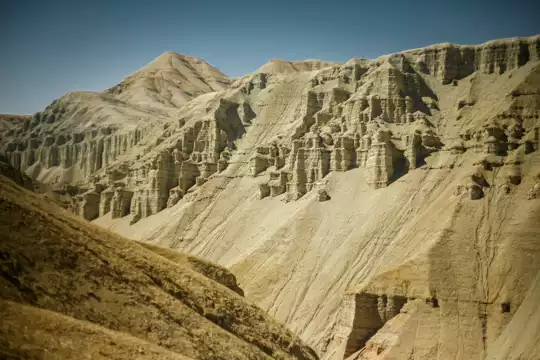
  • Bozzhyra Cliffs, Mangystau: The Ustyurt Plateau doesn’t hand anything over—just endless steppe, oil trucks, and corrugated tracks that rattle your ribs until the white spires spring up out of flatness. Heat beats your hat brim, salt crusts crunch under boots, and chalk dust climbs your legs. Wind whines across the lip, no trees, no shade, only scale. Wait for evening: the cliffs blush, shadows carve new faces in the rock, and your water tastes like warm plastic but you drink anyway because the silence is total and it’s earned. For off-the-map detours: Aksu-Zhabagly’s spring tulip bloom, Tamgaly’s Bronze Age petroglyphs, and the ruined walls of Sauran beyond Turkistan.
Spotted a mistake or missing a highlight? Contact us.

But Kazakhstan offers more...

Discover and compare all of its highlights per category

🧭 RoutesSuggested travel routes through Kazakhstan

The 7-Day Almaty Mountains Escape

The Vibe: One region, zero FOMO—this week focuses on Almaty’s café-filled streets and the nearby Tian Shan, with just enough hiking to feel adventurous without needing expedition gear. Expect short transfers, cozy guesthouses, and big days outside rather than constant city-hopping.
The Highlights:
  • Using Almaty as a soft landing pad before heading into the mountains.
  • Day trips into Ile-Alatau National Park, including Big Almaty Lake and waterfall hikes.
  • Staying in Saty village to explore Kolsai Lakes and the surreal flooded forest of Lake Kaindy.
  • Evenings of Kazakh food and tea after long days on the trail.

The 14-Day Canyons, Dunes & Capitals Route

The Vibe: Two weeks to connect the dots between Almaty’s mountains, the canyons and dunes of the southeast, and the sharp skyline of Astana, moving at a steady but not rushed pace. You’ll mix trekking days with 4x4 park drives and one domestic hop to keep distances manageable.
The Highlights:
  • Urban time in Almaty, from
read more 👉

The 7-Day Almaty Mountains Escape

The Vibe: One region, zero FOMO—this week focuses on Almaty’s café-filled streets and the nearby Tian Shan, with just enough hiking to feel adventurous without needing expedition gear. Expect short transfers, cozy guesthouses, and big days outside rather than constant city-hopping.
The Highlights:
  • Using Almaty as a soft landing pad before heading into the mountains.
  • Day trips into Ile-Alatau National Park, including Big Almaty Lake and waterfall hikes.
  • Staying in Saty village to explore Kolsai Lakes and the surreal flooded forest of Lake Kaindy.
  • Evenings of Kazakh food and tea after long days on the trail.

The 14-Day Canyons, Dunes & Capitals Route

The Vibe: Two weeks to connect the dots between Almaty’s mountains, the canyons and dunes of the southeast, and the sharp skyline of Astana, moving at a steady but not rushed pace. You’ll mix trekking days with 4x4 park drives and one domestic hop to keep distances manageable.
The Highlights:
  • Urban time in Almaty, from markets and museums to a night at the Abay Opera and Ballet Theatre.
  • Multi-day exploration of Kolsai Lakes, Lake Kaindy, and Charyn Canyon’s sculpted valleys.
  • A 4x4-based adventure into Altyn Emel National Park and its Singing Dunes.
  • Finishing in Astana with Bayterek Tower, the National Museum, and the Hazret Sultan Mosque.

The 21-Day Grand Kazakhstan Traverse

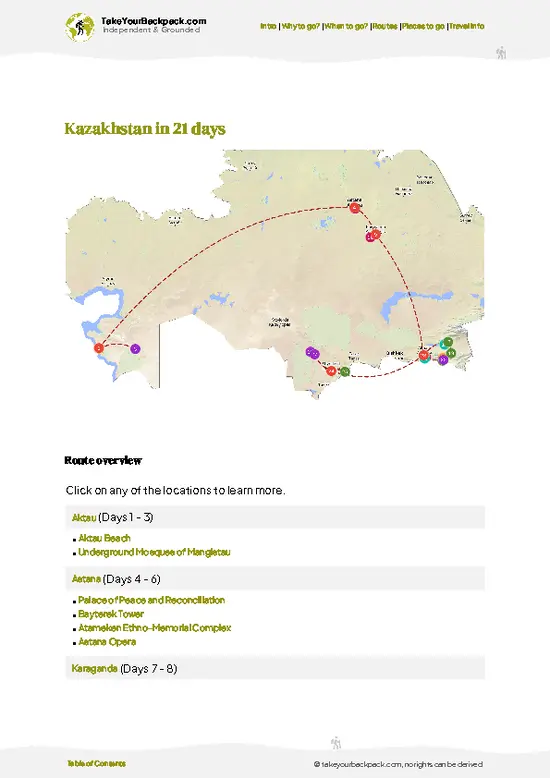
The Vibe: Three weeks to chase the full arc of Kazakhstan—from Almaty’s green streets and high peaks to Silk Road mausoleums, space-age launchpads, and the modern capital—at a thoughtful, immersive pace. This is for travelers who like long train rides, big horizons, and having time to sit with what they see.
The Highlights:
  • Deep time in Almaty and the Tian Shan, including Ile-Alatau, Kolsai Lakes, Lake Kaindy, and Charyn Canyon.
  • Desert days in Altyn Emel National Park, hiking the Singing Dunes and exploring steppe landscapes.
  • Southern detours to Shymkent and Turkestan to visit the Mausoleum of Khoja Ahmed Yasawi and nearby ruins.
  • Space and steppe: Astana’s futuristic core, Korgalzhyn or Burabay nature escapes, and a pilgrimage to Baikonur and its Cosmodrome.
🌍 Want a ready-to-use travel plan for Kazakhstan?
The overview above compares different route options based on your travel time and style. The complete Travel Guide breaks each itinerary down in detail, including maps, stops, highlights, and transport information.

Explore all route details 👉

Get the Travel Guide -

🌤️ When to go?A month-by-month overview

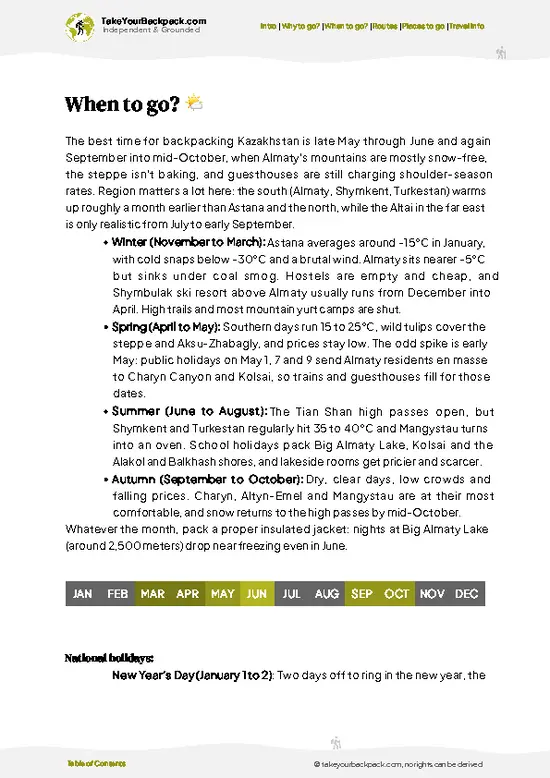
The sweet spot for Kazakhstan backpacking lands in late May to mid-June and again from mid-September to early October. The thaw has finished its messy work, rivers drop from brown to clear, and high passes in the Tien Shan finally open without demanding an ice axe. The steppe holds a soft green in spring, then a dry gold in fall—both far kinder than July’s heat hammer. Domestic holiday traffic hasn’t hit full roar, so guesthouses quote shoulder rates, marshrutkas still have seats, and you can snag a quiet midweek trail even near Almaty. Early summer brings some crackling afternoon storms; autumn trades that for crisp nights and clean, stable days. In the Altai, larch go torch-gold late September, worth timing a loop when the air tastes like frost and apples.
  • Peak (July-August): The sun turns the steppe into a griddle and queues snake at Kolsai and Borovoe; beds jump in price and Alakol books out, but long light lets you push dawn-to-dusk miles, then drop to Charyn’s rim for a wind-cooled sunset and the coldest beer in the valley. Heat takes its tax; alpine meadows pay you back in bloom.
  • Shoulder (Late May-June; Sept-early Oct): Trails shed snow, rivers clear, and the country shifts into gear—cafes drag tables onto sidewalks, basecamps raise yurts, drivers start running regular park shuttles. You move faster, spend less energy on logistics, and catch mountains breathing between seasons; note the anomaly: late-September weekends near Almaty spike with leaf-chasers, so go midweek.
  • Off-Peak Winter (Nov-March): The land goes quiet and blue; breath crystals, bus doors freeze, and the steppe feels endless. Cities glow with banyas and cheap beds. Survival hack: microspikes for icy sidewalks, a wide-mouth bottle stashed inside your jacket, and move at midday when the cold loosens its grip.
  • Spring Thaw (March-April): Wind, slush, and clay that eats boots—great prices, rough footing. Pack gaiters and a hard-shell, stick to paved approaches, and work city festivals; March flips oddly busy during Nauryz, even as trails stay muddy.

Tactical tip: For the shoulder window, lock in long-haul train berths and weekend park shuttles 5-10 days out; buy everything else on arrival.

source: climatestotravel.comJANJanuary: fair for travelingFEBFebruary: fair for travelingMARMarch: good for travelingAPRApril: good for travelingMAYMay: highly recommended for travelingJUNJune: excellent for travelingJULJuly: fair for travelingAUGAugust: fair for travelingSEPSeptember: highly recommended for travelingOCTOctober: highly recommended for travelingNOVNovember: fair for travelingDECDecember: fair for traveling
📅 Traveling in a specific month?
Get a full month-by-month breakdown of weather, crowds, costs, festivals, and seasonal highlights in the complete travel guide.

Get full details when to go 👉

Get the Travel Guide -
pixabay-kazakhstan - visitalmaty-3457125

💰 Costs (as of 2025)What things cost day to day

$30-45 per day (14,000-20,000 KZT) if you ride 3rd-class trains, eat in canteens, and skip packaged tours.
  • dorm accommodation: 3,000-6,000 KZT in provincial towns; 5,000-9,000 KZT in Almaty/Astana, higher in summer and on weekends. Compared with Kyrgyzstan and Uzbekistan, beds run 20-40% more, but still half what you’d pay in Eastern Europe. System tip: book the first night online to land the bed, then extend in cash—most hostels quietly drop the platform fee, and Telegram messages get faster results than email. Overnight trains double as a bed and save you a night’s rent.
  • meals: Supermarket Survival: bread, eggs, instant noodles, and local dairy keep you to 800-1,500 KZT per meal; imported cheese, chocolate, and “healthy” snacks spike the bill fast. Street food reality: stolovaya/canteen plates (plov, lagman, manty) hit 1,200-2,200 KZT and actually fill you; samsa 300-500 KZT; shashlik 1,000-1,800 KZT a stick. Coffee 700-1,200 KZT; a half-liter beer 600-1,000 KZT in shops, 1,000-2,000 KZT in bars. Pricier than Uzbekistan, a touch more than Kyrgyzstan, still cheaper than Russia’s big cities.
  • local transport: City moves are cheap: buses/metro 90-150 KZT with a card (cash costs more); use
read more 👉
$30-45 per day (14,000-20,000 KZT) if you ride 3rd-class trains, eat in canteens, and skip packaged tours.
  • dorm accommodation: 3,000-6,000 KZT in provincial towns; 5,000-9,000 KZT in Almaty/Astana, higher in summer and on weekends. Compared with Kyrgyzstan and Uzbekistan, beds run 20-40% more, but still half what you’d pay in Eastern Europe. System tip: book the first night online to land the bed, then extend in cash—most hostels quietly drop the platform fee, and Telegram messages get faster results than email. Overnight trains double as a bed and save you a night’s rent.
  • meals: Supermarket Survival: bread, eggs, instant noodles, and local dairy keep you to 800-1,500 KZT per meal; imported cheese, chocolate, and “healthy” snacks spike the bill fast. Street food reality: stolovaya/canteen plates (plov, lagman, manty) hit 1,200-2,200 KZT and actually fill you; samsa 300-500 KZT; shashlik 1,000-1,800 KZT a stick. Coffee 700-1,200 KZT; a half-liter beer 600-1,000 KZT in shops, 1,000-2,000 KZT in bars. Pricier than Uzbekistan, a touch more than Kyrgyzstan, still cheaper than Russia’s big cities.
  • local transport: City moves are cheap: buses/metro 90-150 KZT with a card (cash costs more); use the Onai card in Almaty. App taxis (Yandex/inDriver) kill haggling and keep cross-town rides in the 600-1,500 KZT range if you avoid surge. To unlock the country on the cheap, ride trains: 3rd-class (platzkart) is the sweet spot—long hauls like Almaty-Shymkent or Almaty-Astana usually 6,000-12,000 KZT, clean sheets, and you arrive downtown. Marshrutkas work under 300 km but beat you up on rough roads. Hitching is doable in the steppe; carry small bills as many “lifts” expect token cash.
  • activities: Museum entries are pocket change (500-1,500 KZT). National parks charge 500-1,000 KZT per person plus 200-500 KZT per car. Cost spikes come from distance and engines: Charyn/Kolsai day tours 12,000-20,000 KZT; 4x4 add-ons push higher. Shymbulak gondola 4,000-6,000 KZT round-trip; ski rentals bump that again. DIY with public transport and shared taxis cuts costs by half versus tours but eats time. Relative to neighbors, guides and vehicles cost more here; the payoff is big landscapes you actually have room to breathe in.
  • miscellaneous: SIM + data is a bargain: 500-1,000 KZT for the SIM, 10-20 GB at 1,200-2,500 KZT; buy at official kiosks with your passport. ATMs often add a flat 1,000-1,500 KZT or 1-3%—use fee-free cards and pull larger amounts. Water 100-250 KZT/1.5L; laundry 1,000-2,000 KZT per load. Budget leaks: craft coffee (1,500-2,500 KZT), bars with “service” fees, gear rental at ski areas (5,000-10,000 KZT/day), and paying for convenience rides to trailheads instead of stitching buses and shared taxis. Kazakhstan bleeds you slowly, not suddenly—watch the small repeats.
⚠️ Prices can change and everyone travels differently, so take this as a rough guide. Hope it helps you plan your adventure!

✈️ The backpacker research shortcutKazakhstan Travel Guide

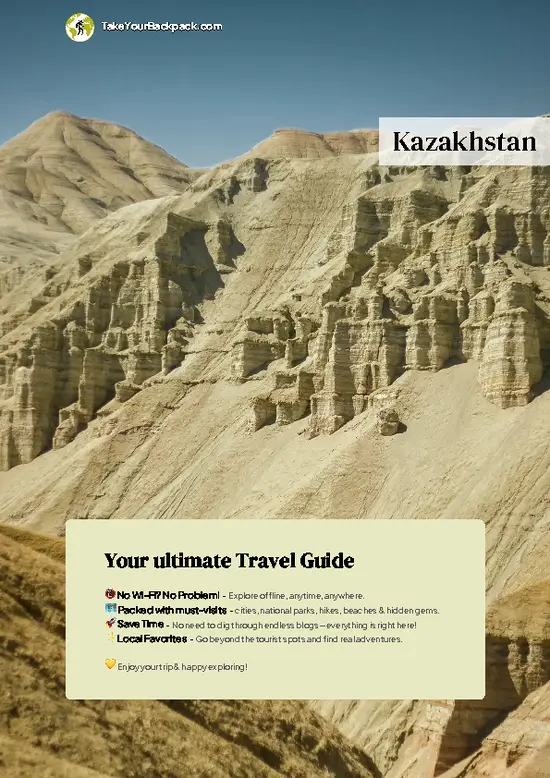
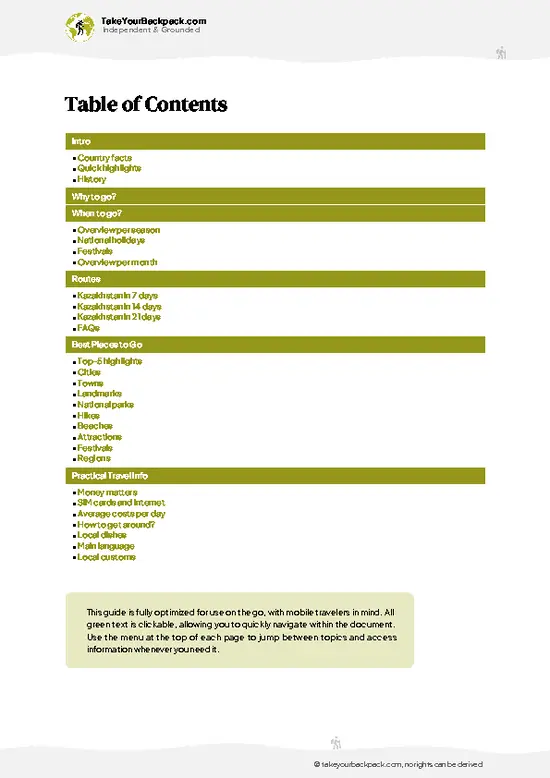
An offline-friendly backpacking guide with optimized travel routes, ranked highlights, transport advice, and the best areas to stay.
example page 0 from our offline Travel Guide for Kazakhstanexample page 1 from our offline Travel Guide for Kazakhstanexample page 2 from our offline Travel Guide for Kazakhstanexample page 3 from our offline Travel Guide for Kazakhstanexample page 4 from our offline Travel Guide for Kazakhstanexample page 5 from our offline Travel Guide for Kazakhstanexample page 6 from our offline Travel Guide for Kazakhstanexample page 7 from our offline Travel Guide for Kazakhstan
The digital guide (445 pages) contains:
118 highlights, ranked by travel appeal
Optimized 7, 14 & 21-day travel routes
Cities, national parks, beaches, historical sites, ...
How to get around
Offline-friendly for travel without Wi-Fi
👉 Click to see all 30+ guide features

📅 Plan smarter in minutes, not weeks
Month by month travel advice
Festivals & national holidays
Budget expectations

🗺️ Go to the right places, skip the overrated ones
Honest pros & cons of destinations
Top hikes, parks & viewpoints
Lesser-known places most travelers miss
Clear “worth it vs skip it” guidance

🛏️ Travel smoothly without rookie mistakes
Best areas to stay
Transport systems explained simply
Common scams & safety advice
SIM cards, money & practical tips

🌍 Understand the country, not just visit it
Culture & traditions
52 Essential phrases & customs
Festivals worth planning around
Traveler-friendly historical context
Insights that make places more meaningful

📱 Built for real travel conditions
Fully downloadable PDF
Works completely offline
Optimized for phone use
Useful in remote areas & buses
Everything in one place
Save weeks of stressful planning
Get instant access to the full guide directly. 30-day money-back guarantee.


Sent to your inbox immediately after payment • 100% Secure Checkout
Best Backpacking Travel Advisor 2025 tourism awardBest Backpacking
Travel Advisor
2025
What others say about Take Your Backpack Guides:
⭐⭐⭐⭐⭐
Fantastic, amazing amount of information!
⭐⭐⭐⭐⭐
My goodness this is amazing, it's what I've been looking for hats off too you!
⭐⭐⭐⭐⭐
I think this is absolutely BRILLIANT
⭐⭐⭐⭐
Very complete and informative. It's still missing places, but I gotta to commend you
⭐⭐⭐⭐⭐
This is truly amazing, thank you, can't wait to explore it with my kids!
⭐⭐⭐⭐⭐
Awesome resource, thank you!
⭐⭐⭐⭐⭐
This is amazing! Can't wait to explore the ones I haven't seen
⭐⭐⭐⭐
I love this! Well done, great idea.
⭐⭐⭐⭐⭐
Thanks for taking the time to make this gem!
⭐⭐⭐⭐⭐
This might be the best website I've ever seen.
⭐⭐⭐⭐⭐
Congratulations, and thank you so much for your work; it's incredibly valuable.
⭐⭐⭐⭐
In all seriousness I think you did a great job pointing out the important spots
⭐⭐⭐⭐⭐
10/10 very good
⭐⭐⭐⭐⭐
As someone who's only just starting to visit regularly this is awesome, thank you.
⭐⭐⭐⭐
Thank you very much! I'm going to visit my dad, it's going to be very useful!
⭐⭐⭐⭐⭐
This is really cool! We'll be travelling for the first time and this definitely come in handy.
⭐⭐⭐⭐⭐
You are now our minister of culture, congratulations 👨‍💼
⭐⭐⭐⭐⭐
Just wanted to tell you that this is a pearl! Going to follow your recommendations.
⭐⭐⭐⭐⭐
This is so cool. I'll definitely be using the resource for my travels soon.
⭐⭐⭐⭐⭐
This is very impressive! Good work.
⭐⭐⭐⭐⭐
This is an amazing and informative site. Very well done!

🛏️ Where to stay?Where to stay in Kazakhstan

Yes—budget hostels and guesthouses exist across Kazakhstan, with the largest concentration in Almaty (city centre/Panfilov Park and the Medeu foothills), followed by Nur-Sultan (riverfront/city-centre/Expo area) and a smaller cluster in Shymkent (central market and old town).
Central Almaty offers the widest choice of cheap accommodation with easy access to nightlife, restaurants, public transport and mountain day trips, but it is noisier and slightly more expensive than smaller towns.
Nur-Sultan’s riverfront/city-centre is modern, very safe and quieter at night though farther from natural … read more 👉
Yes—budget hostels and guesthouses exist across Kazakhstan, with the largest concentration in Almaty (city centre/Panfilov Park and the Medeu foothills), followed by Nur-Sultan (riverfront/city-centre/Expo area) and a smaller cluster in Shymkent (central market and old town).
Central Almaty offers the widest choice of cheap accommodation with easy access to nightlife, restaurants, public transport and mountain day trips, but it is noisier and slightly more expensive than smaller towns.
Nur-Sultan’s riverfront/city-centre is modern, very safe and quieter at night though farther from natural highlights, while Shymkent centre is the cheapest and best for regional travel but has fewer hostel options and less tourist infrastructure.

If you enjoy meeting fellow travelers, consider choosing hostels with high ratings for atmosphere. On the other hand, if you prefer having your own space, a hotel might be a better option.

🚌 Getting aroundHow to travel within the country

Kazakhstan runs on two tempos: steel-clocked rails and seat-filled roads. Trains leave like metronomes, conductors counting seconds with gloved hands, while buses and shared cars move on gut feel and the driver’s calculus of fuel, fares, and headcount. You travel far here. The steppe teaches patience. Dust kicks under big skies, then the payoff lands hard: sunrise through a carriage window, hot tea off the samovar, a canyon opening after a rattling village bus. If you lean into the country’s rhythm—booked … read more 👉
Kazakhstan runs on two tempos: steel-clocked rails and seat-filled roads. Trains leave like metronomes, conductors counting seconds with gloved hands, while buses and shared cars move on gut feel and the driver’s calculus of fuel, fares, and headcount. You travel far here. The steppe teaches patience. Dust kicks under big skies, then the payoff lands hard: sunrise through a carriage window, hot tea off the samovar, a canyon opening after a rattling village bus. If you lean into the country’s rhythm—booked trains for the long hauls, hustled road rides for the last miles—you move fast enough without burning your wallet.
  • Long-distance trains (KTZ, platzkart/Talgo) The speed vs. cost deal is blunt. Almaty-Astana by air eats 90 minutes and most of your budget; the fast “Talgo” does it in roughly half a day for a fraction; the regular sleepers take longer but cost even less. In platzkart (open bunks), you pay the least, sleep horizontal, and ride with the country. Sheets, hot water, and a rigid schedule—departures to the minute, five-minute station halts you don’t miss. Bring noodles, tea, and earplugs. Conductor checks passport and ticket at the door; board fast, the steps are high and the whistle doesn’t wait.
  • Marshrutka minibuses This is the social glue. You squeeze in, pass cash forward, and someone counts change like an abacus. Elders get priority seats without debate. Bags go on laps, doors slam hard, and the driver’s playlist sets the tone—pop one hour, Qur’an recitation the next. They leave when full, not when the sign says, and they’ll stop anywhere if you call out early. No seatbelts, lots of shared inconvenience, and steady kindness: a stranger will hold your bag while you fumble coins at a lurching turn.
  • Regional buses to district towns and parks Geometry wins here. Rails shoot between big cities; buses stitch the map’s empty triangles—Kegen, Saty for Kolsai, turnoffs for Charyn, dusty district centers where trails begin. From Almaty’s Sairan you rattle east, hop out at a crossroads tea house, and finish by village taxi or a short hitch. The ride is slower, the road patched, but it gets you to the gate the trains can’t touch. Start at dawn; afternoon departures evaporate with the wind.
  • Shared taxis (poputka) and in-app rides The budget hack when you miss a bus or want speed without full private fare. Near stations, drivers call out routes; you pay per seat, agree before doors shut, and leave as soon as the last seat sells. It’s usually 20-50% more than a bus, hours faster, and still far under a charter. Cash only, small bills. Expect smoking unless you set terms early; call shotgun if you get carsick.

Master tactical tip: Sleep while moving—book overnight platzkart for the long legs, then step off at first light and grab the earliest marshrutka or shared taxi to finish the last 50-150 km before the day’s headwinds and empty departures strand you.
Quick overview
Astana International Airport (NQZ) — still often called “Nur-Sultan airport” — sits about 17 km (11 miles) south-east of the city center (near Baiterek).

Main public transport options
  • City buses (Routes 10 and 12)

    Runs from the terminal to central areas and major hubs. Daytime frequency is roughly every 10-20 minutes.

    Travel time: 30-50 minutes depending on traffic and where you hop off.

    Cost: about 120-180 KZT with a transport card/app (ASTRA Plat). Cash, if accepted, is usually a bit higher (around 180-250 KZT). Many buses also accept contactless bank cards, but have a backup in case a validator is offline.
  • Airport express bus

    An express service (often shown as Express 100) operates in some seasons/periods with fewer stops toward the center.

    Travel time: 20-35 minutes.

    Cost: typically 250-400 KZT.

    Note: Schedules can change—check the Astana LRT/ASTRA Plat app or the airport website on the day you travel.

Taxi and ride-hailing
Yandex Go and inDrive are the go-to apps; pickup is right outside Arrivals. Airport-counter taxis are also available inside the terminal.
  • Travel time: 20-35 minutes (longer in rush hour or during snowstorms).
  • Cost: ride-hailing usually 2,500-5,000 KZT to the center; airport-counter taxis 4,000-7,000 KZT. Prices surge late at night or in bad weather.

Tips
- There’s no metro or train from the airport. If you land late, buses thin out—plan on a taxi.

- For buses, the ASTRA Plat card/app is the easiest way to pay; keep small cash as a fallback.

- Ignore unofficial touts in the arrivals hall; use the taxi desk or an app for a clear fare.
⚠️ Prices and routes can change, so take this as a rough guide and ask for local advice when you arrive.

🔒 Safety (risk Level: low)What first-time visitors should know

Safety for solo travelers, including women and LGBTQ+ individuals
Kazakhstan is generally safe for solo travelers, including women and LGBTQ+ individuals, although some caution is advised. Women should feel comfortable traveling alone, but it’s wise to avoid empty streets at night. LGBTQ+ travelers might encounter conservative attitudes, so discretion is recommended in rural areas. Always stay updated on local laws and cultural norms to ensure a smooth trip.


Full official government travel advisory (live updates)
View details 👉

✈️ VisaEntry requirements and paperwork

Most travelers, including those from the US, EU, and several other countries, can enter Kazakhstan visa-free for up to 30 days. If you do need a visa, apply through the Kazakhstan embassy or consulate in your country, or check if you’re eligible for an e-visa on the official e-visa website. Always double-check the latest entry requirements before your trip, as policies can change.
⚠️ Visa requirements can change over time, so always check the latest visa requirements with the official embassy or government website before you travel.

🎒 What to pack?Packing essentials for the trip

Kazakhstan is a land of extremes, so pack smart! In summer, you might face intense heat in the south, while the north can get chilly, even in July. Winters are brutally cold, especially in places like Astana. If you’re hitting the mountains, be ready for quick weather changes—layers are your best friend. Cultural note: cities tend to be pretty modern, but when visiting rural areas or religious sites, modest clothing is appreciated.

Apart from this country specific advice, I have also crafted a general packing list that should help on any trip. authorOver the years, I've learned the importance of packing minimally. It's so much easier to jump on the back of a truck or squeeze yourself into the last spot of a minibus without that supersized backpack. If you're headed to a warm destination, leave your winter jacket at home; for colder regions, opt for thin thermal underlayers. Instead of packing your entire wardrobe, bring just three sets of clothes, as laundry facilities are available everywhere.
View the full list 👉
🎒 Planning the practical side of your trip?
Get detailed information on transport, daily budgets, internet access, local customs, food, language, and other essentials in the complete Travel Guide.

Get detailed practical information 👉

Get the Travel Guide -

🙋 FAQTravel questions about Kazakhstan

Trip Planning


Personal tip: I normally search on good rating for atmosphere (for meeting people) and location (for easy exploring). Cleanliness as a bonus.


Travel Essentials

Routine vaccinations are recommended for Kazakhstan, including MMR (measles, mumps, rubella), DPT (diphtheria, pertussis, tetanus), and varicella (chickenpox).

Consider Hepatitis A and B, as they’re transmitted via contaminated food and water.

Typhoid is recommended if you’re planning on exploring rural areas. Rabies is suggested if you plan on outdoor activities or direct contact with animals.

Always consult with a healthcare provider for the most current advice.


vaccination requirements
When I first started traveling, I often spent part of my first day in a new country hunting for a local SIM card. While this can still be slightly cheaper, it also takes time and planning.

These days, it's much simpler to install an eSIM before leaving home. Once you arrive in Kazakhstan, you can activate it immediately and have mobile data from the moment you land — which is especially useful for ordering transport or navigating away from busy airports.

There are many providers nowadays, and price differences are usually small. I personally go with Airalo, as it offers excellent network coverage throughout the country and strong global coverage, so you can manage multiple countries from a single app.


Get your e-sim for Kazakhstan

Culture & Customs

Do: Remove shoes when entering homes. Offer and accept items with your right hand. Be punctual but flexible; plans may change. Toasts are common during meals, so be ready to participate.

Don’t: Avoid discussing politics or making negative comments about the president. Don’t point your finger at others; it’s seen as rude.

Kazakhstan is generally safe for women travelers, but dress modestly in rural areas. LGBTQ+ travelers should be discreet, as public displays of affection might attract unwanted attention.
Trying traditional food is always a great way to experience the culture. Here are some must-try dishes for Kazakhstan.
  • Beshbarmak: This is the national dish of Kazakhstan, consisting of boiled meat (usually lamb or beef) served over large noodles. It’s a staple at festive gatherings and a true taste of Kazakh hospitality.
  • Kumis: A traditional drink made from fermented mare’s milk. It’s slightly sour and fizzy, and drinking it is a cultural experience that connects you with the nomadic heritage of the Kazakh people.
  • Kazy: A horse meat sausage seasoned with garlic and black pepper. It’s often served during special occasions and is a testament to the importance of horses in Kazakh culture.
  • Baursak: These are fried dough balls, often served with tea. They’re a comforting snack and popular at family meals, highlighting the warmth of Kazakh hospitality.
  • Lagman: A noodle dish with a savory broth, vegetables, and meat, influenced by the Uyghur community. It’s a tasty fusion of Central Asian flavors that’s hearty and satisfying.
In Kazakhstan, locals often drink tap water without issues, but it might not be the best choice for tourists due to varying water quality standards. It’s safer to stick with bottled or filtered water to avoid any potential stomach troubles. Consider using a portable water filter if you want to be eco-friendly.
The main language in Kazakhstan is Kazakh. Backpacking is way more rewarding if you know a bit of the local language, so I'd suggest brushing up on the basics just in case your Kazakh skills have become a bit rusty.

Want to understand locals better?
The complete Travel Guide for Kazakhstan includes 52 essential words and phrases — greetings, thank-yous, ordering food, transport, numbers, and common local expressions you'll actually hear.

Get your local basic phrases 👉

Get the Travel Guide -


In Kazakhstan, English proficiency varies significantly depending on the region and the demographic. In major cities like Almaty and Nur-Sultan (Astana), English is more commonly spoken, especially among younger people, professionals, and those in the tourism and service sectors. Many hotels, restaurants, and attractions in these urban areas often have staff who can communicate in English.

However, in rural areas and smaller towns, English may not be as widely understood, and communication could be challenging. Russian and Kazakh are the primary languages, so having a translation app or learning a few basic phrases in either language can be helpful.

Overall, while English is increasingly being taught and used, especially among the younger generation, travelers may encounter varying levels of proficiency. It’s advisable to be patient and open-minded, as many locals are eager to assist despite potential language barriers.

Money & Payments

The local currency of Kazakhstan is KZT (₸).

When backpacking in Kazakhstan, cash is still king in many places, especially outside major cities. ATMs are fairly common in urban areas like Almaty and Nur-Sultan, but less so in rural parts, so it’s smart to carry some cash. Local currency is the tenge (KZT), and you’ll want to have some on hand for small purchases and in areas where card payment isn’t an option.

ATMs: Stick to ATMs at reputable banks for safety and usually better exchange rates. Halyk Bank and Kaspi Bank ATMs are reliable options.

Currency: Though dollars and euros are widely accepted at exchange offices, it’s best to convert to tenge to avoid unfavorable rates when making purchases. Carrying U.S. dollars for emergency exchanges can be handy but always aim to keep small denominations of tenge for daily expenses.

Cards: Credit and debit cards are becoming more accepted in larger cities and at upscale venues. Visa and MasterCard are your best bet, but don’t count on them being accepted everywhere, especially in smaller towns and local eateries.

Exchanging Money: Exchange offices are plentiful in cities and offer competitive rates. Avoid airport exchanges due to typically higher fees. Always double-check the rate before confirming the transaction, and count your cash on the spot.

In Kazakhstan, tipping isn’t as common as in some Western countries, but it’s appreciated. In restaurants, leaving a tip of 5-10% is a nice gesture if service isn’t already included in the bill. For taxis and small services, rounding up the fare is usually sufficient.

🧩 Nearby countriesNearby backpacking alternatives

We 💚 feedbackThe bottom line on traveling here

Go for the scale. Kazakhstan pays sweat back with outsized scenes: dawn glazing Kolsai Lake like glass, a lung-burner up Kok-Zhailau into big sky, Charyn’s cliffs glowing as the wind sandblasts your shins, then the clank of a night train and a cold platform beer. The drawback is distance and friction. Routes sprawl, buses vanish for a day, Cyrillic timetables and cash-only quirks slow every move, and you’ll wait—often. Best for hikers and rail rats who carry their own food, navigate offline, and enjoy silence. Not ideal for checklist travelers on tight clocks, folks hunting a plug-and-play hostel circuit, or anyone who hates uncertainty more than they love a horizon.

✍️ Help improve this page!
The information on this page is based on in-depth research, insights shared by experienced travelers, and feedback from the local travel community in Kazakhstan. While every effort is made to keep the information accurate and current, conditions can change — so if you spot anything incorrect or outdated, please get in touch.


🙋‍♂️ Give feedback

👋 Meet the founderWho’s Behind Take Your Backpack?

Johan, backpacker and founder of TakeYourBackpackHi, I’m Johan (Netherlands 🇳🇱), the creator of TakeYourBackpack. Over the past decade, I’ve backpacked through 80+ countries across six continents, gaining extensive experience with independent travel, long-term trips, and overland routes.

This site is built on a combination of firsthand travel experience and carefully curated insights from other backpackers. Many guides are based on places I’ve personally visited, while others bring together tips, observations, and practical advice shared by trusted travelers I’ve met along the way.

The goal is to provide realistic, experience-driven guidance — not generic itineraries — so you can explore destinations with better context, clearer expectations, and more confidence.

Get full Kazakhstan guide •
Instant download • 118 highlights • Full Offline guide