Trip Planning
The TakeYourBackpack guidebooks are your all-in-one travel companion, featuring the best cities, national parks, hikes, beaches, and unique sites, along with essential tips on when to go, how to get around, exchanging money, and even local phrases to get you started — everything you need for a smooth, unforgettable backpacking adventure.
Stop researching. Start exploring.Discover all 67 highlights,ranked
and organized into practical routes.
Get instant access
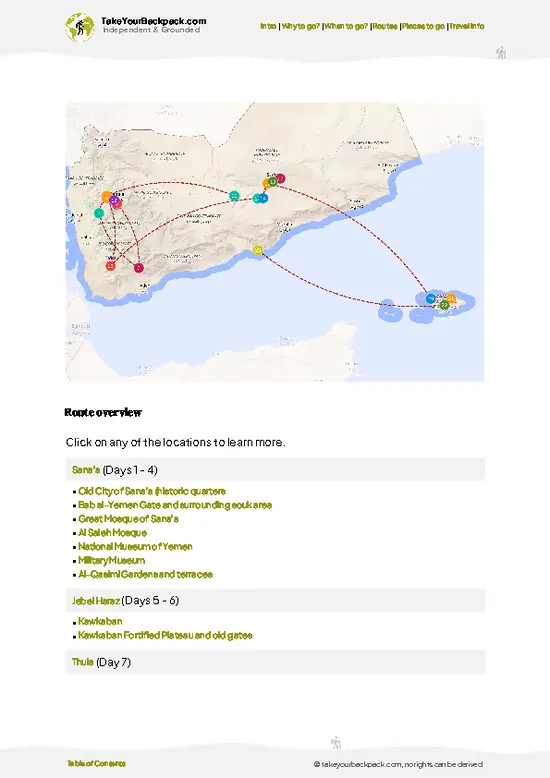
Planning a backpacking route through Yemen can be tricky — you need to balance must-see places, travel times, budget, and how long to stay in each destination. Our personalized Yemen itinerary planner creates a route based on your travel style, trip duration, and interests, so you can spend less time researching and more time exploring.
Personal tip: I normally search on good rating for atmosphere (for meeting people) and location (for easy exploring). Cleanliness as a bonus.
Travel Essentials
You should consider the following vaccinations for Yemen:
- **Hepatitis A**: Recommended for most travelers.
- **Hepatitis B**: Consider if you might have sexual contact, get a tattoo, or need medical treatment.
- **Typhoid**: Important if you’re staying with friends or eating outside major hotels and restaurants.
- **Cholera**: For specific travelers, especially if working in healthcare or with refugees.
- **Rabies**: If you plan on spending a lot of time outdoors or around animals.
- **Meningitis**: Particularly during the dry season (December to June).
- **Routine vaccines**: Make sure you’re up-to-date on MMR, Diphtheria-Tetanus-Pertussis, Varicella (chickenpox), Polio, and your yearly flu shot.
Consult a healthcare provider for personalized advice.
vaccination requirementsWhen I first started traveling, I often spent part of my first day in a new country hunting for a local SIM card. While this can still be slightly cheaper, it also takes time and planning.
These days, it's much simpler to install an eSIM before leaving home. Once you arrive in Yemen, you can activate it immediately and have mobile data from the moment you land — which is especially useful for ordering transport or navigating away from busy airports.
There are many providers nowadays, and price differences are usually small. I personally go with
Holafly, as it offers excellent network coverage throughout the country and strong global coverage, so you can manage multiple countries from a single app.
HolaFly eSimCulture & Customs
Avoid public displays of affection and dress modestly; women should wear headscarves. Always use your right hand for eating or passing items. Remove shoes when entering homes or mosques. LGBTQ+ travelers should exercise caution due to conservative views. Photography of military or government buildings is a no-go. Be mindful of local sensitivities, particularly around political discussions.
Trying traditional food is always a great way to experience the culture. Here are some must-try dishes for Yemen.
- Saltah: This is Yemen’s national dish, a hearty stew made from meat, potatoes, and vegetables, topped with a dollop of fenugreek froth. It’s traditionally served in a stone pot and represents the comfort and warmth of Yemeni hospitality.
- Mandi: A fragrant rice and meat dish, typically lamb or chicken, cooked with a blend of spices. It’s often served during special occasions and gatherings, symbolizing celebration and community.
- Fahsa: A comforting stew featuring shredded lamb or beef, cooked with a mix of spices and herbs, and served with a side of Yemeni bread. It’s a staple in many households, reflecting the rustic, home-cooked flavors of Yemeni cuisine.
- Bint Al-Sahn: A delightful honey cake, layered with thin dough and glazed with honey and butter. Often enjoyed with tea, it highlights the sweet side of Yemeni culinary traditions and is a must-try for anyone with a sweet tooth.
- Shafout: A refreshing dish made with lahoh (a type of Yemeni bread) soaked in buttermilk and topped with herbs and spices. It’s a popular choice during Ramadan and offers a cool, tangy break from the heat.
Tap water in Yemen is generally not safe for tourists to drink; even locals often prefer bottled or filtered water. It’s strongly recommended to stick to bottled water, which is widely available, or use a reliable water filter if you’re staying longer. Be cautious with ice and raw foods washed in tap water.
The main language in Yemen is
Arabic. Backpacking is way more rewarding if you know a bit of the local language, so I'd suggest brushing up on the basics just in case your Arabic skills have become a bit rusty.
Want to understand locals better?The complete Travel Guide for Yemen includes 52 essential words and phrases — greetings, thank-yous, ordering food, transport, numbers, and common local expressions you'll actually hear.
Get your local basic phrases 👉
Get the Travel Guide - In Yemen,
English is not widely spoken, especially outside major urban areas like Sana’a and Aden. While some educated individuals, particularly in business, tourism, and higher education, may have a good command of English, the general population primarily speaks Arabic. In tourist areas, you might find some locals who can communicate in basic English, but fluency is rare.
In rural regions, English proficiency diminishes significantly, and travelers may encounter challenges in communication. It is advisable to learn a few basic Arabic phrases or carry a translation app to facilitate interaction. Additionally, hiring a local guide who speaks English can enhance your experience and help bridge any language barriers.
Overall, while you may find some English speakers in Yemen, especially in specific contexts, it is not a reliable means of communication throughout the country.
Money & Payments
The local currency of Yemen is YER (﷼).
When backpacking through Yemen, it’s crucial to plan your finances carefully. While there are some ATMs in major cities like Sana’a and Aden, they’re not always reliable due to frequent cash shortages. It’s wise to carry enough cash to cover your needs, especially if you’re heading to more remote areas.
U.S. dollars are the most widely accepted foreign currency, so bringing some along can be very handy. Euros are less common but still usable. Make sure you have a mix of small and large denominations for flexibility.
Card acceptance is pretty limited even in the cities, so don’t rely on your credit or debit card for everyday purchases. Cash is definitely king here.
For exchanging money, stick to official exchange bureaus or banks to avoid getting ripped off. Rates are generally better than at the airport, so exchange just enough there to get you into town. Keep an eye out for street exchangers; they might offer tempting rates, but it’s a risky game.
Tipping in Yemen isn’t obligatory but is appreciated given the local wages. In restaurants, leaving a 10% tip is considered generous; for smaller services like taxis or porters, rounding up the fare or giving a few hundred Yemeni rials is welcomed. Always tip in cash, as credit card tipping isn’t common.
v2.webp)

 Best Backpacking
.jpg) Over the years, I've learned the importance of packing minimally. It's so much easier to jump on the back of a truck or squeeze yourself into the last spot of a minibus without that supersized backpack. If you're headed to a warm destination, leave your winter jacket at home; for colder regions, opt for thin thermal underlayers. Instead of packing your entire wardrobe, bring just three sets of clothes, as laundry facilities are available everywhere.
Over the years, I've learned the importance of packing minimally. It's so much easier to jump on the back of a truck or squeeze yourself into the last spot of a minibus without that supersized backpack. If you're headed to a warm destination, leave your winter jacket at home; for colder regions, opt for thin thermal underlayers. Instead of packing your entire wardrobe, bring just three sets of clothes, as laundry facilities are available everywhere.


.jpg) Hi, I’m Johan (Netherlands 🇳🇱), the creator of TakeYourBackpack. Over the past decade, I’ve backpacked through 80+ countries across six continents, gaining extensive experience with independent travel, long-term trips, and overland routes.
Hi, I’m Johan (Netherlands 🇳🇱), the creator of TakeYourBackpack. Over the past decade, I’ve backpacked through 80+ countries across six continents, gaining extensive experience with independent travel, long-term trips, and overland routes.