×
Libya 🇱🇾

backpacking Africa Libya 🇱🇾
Cross desert distances connecting forgotten ancient cities.

Explore LiberiaExplore Madagascar

Backpacking Libya in 2026

A complete guide including when and where to go, costs, transport, itineraries, and practical travel advice.
A first look at the country

Backpacking Libya
By Johan Kruseman 🇳🇱 | Updated May 23, 2026

The biggest myth: Libya is a total no-go for travelers. It’s not casual or simple, but it isn’t blank space. Beyond the headlines lives a country where desert culture and monumental ruins still set the tempo.

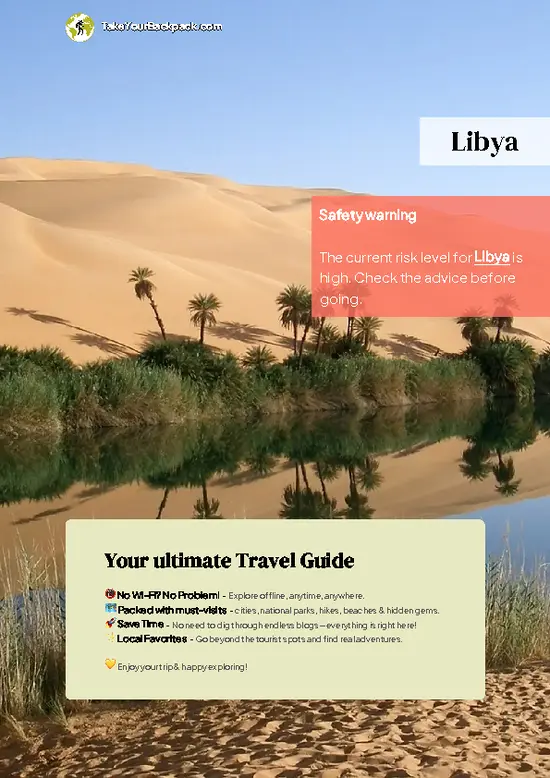
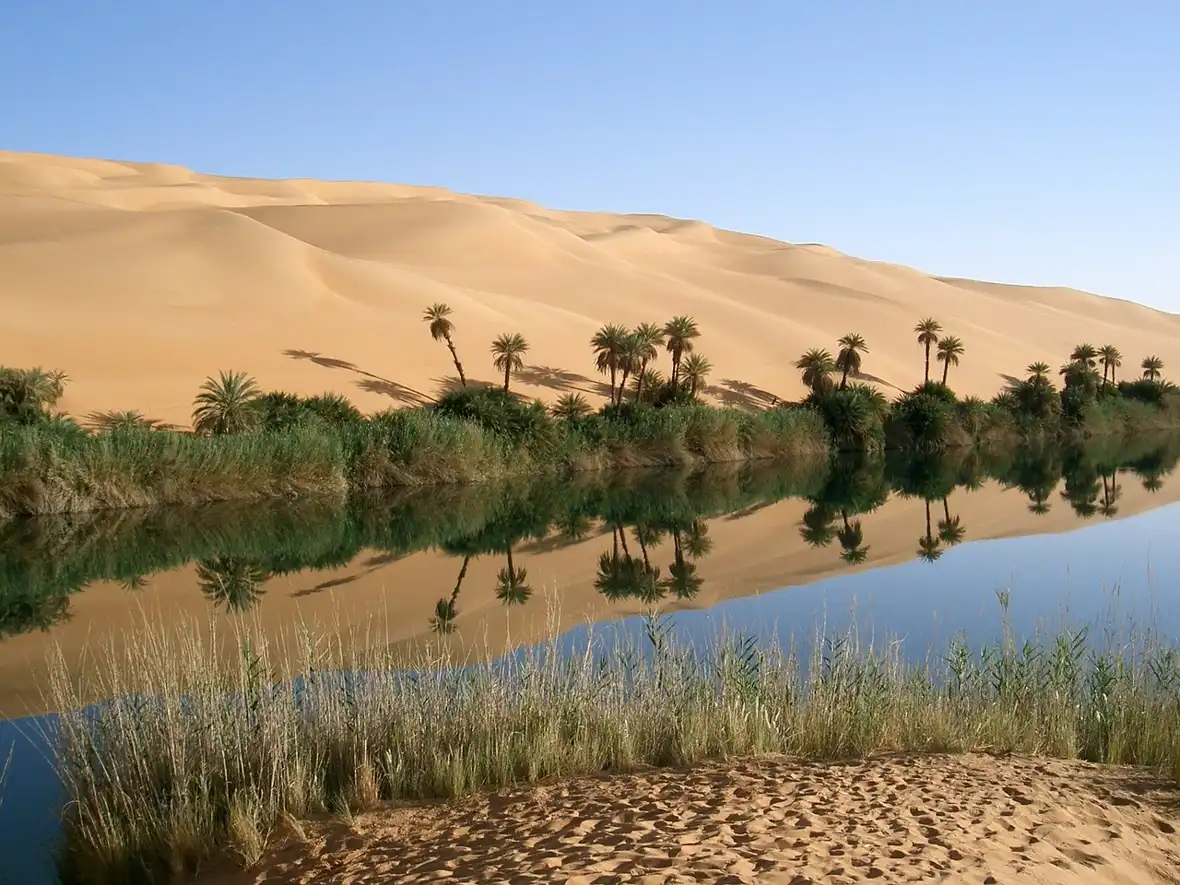
Tripoli’s medina hums under Italian arches and Ottoman doors, then the coast vaults you to Leptis Magna and Sabratha—Roman cities so intact you hear the sea in their theaters. East, Cyrene sits high and austere, a Greek city with views that explain empire. South, the Sahara takes over: the Akakus’ rock art, the dunes and palm-ringed lakes of Ubari, caravan towns like Ghadames purpose-built for heat and hospitality. You come for silence, mint tea, and the feeling of walking alone through centuries. Challenges exist—permits, changing security controls, cash-only realities, brutal summer heat—but they’re logistics, not the story, and owning them buys you space and calm.

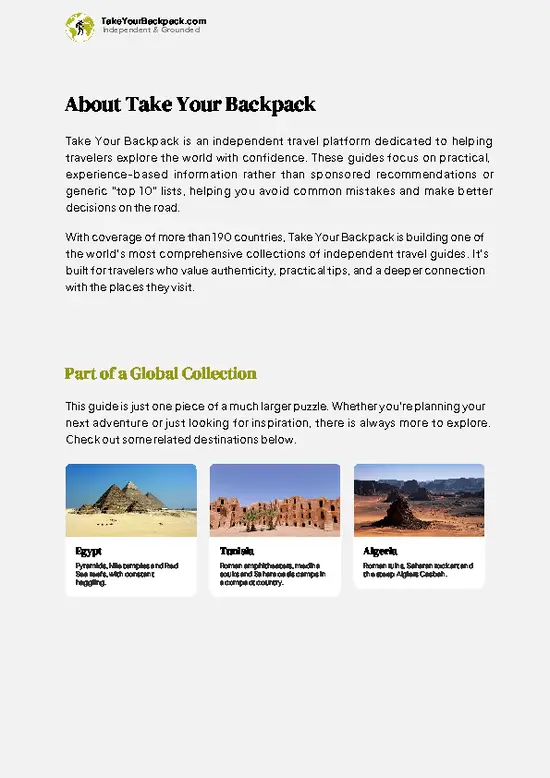
Compared with Tunisia’s easy polish, Egypt’s crowds, and Algeria’s heavier paperwork, Libya trades comfort for solitude and scale. It’s for the prepared traveler who values big history, desert horizons, and the quiet privilege of being the only person in the forum at sunrise.

👉 Get the 📖 Travel Guide of Libya

Tripoli & Western Coastal Corridor (Sabratha–Leptis Magna)

Base yourself in Tripoli if you value control over chaos. It’s the hub for permits, drivers, and working ATMs when they decide to work. Day-run the coastal highway to Sabratha (west) and Leptis Magna (east); both are doable with a predawn start and a vetted driver. This rewards travelers who can stomach admin and want world-class ruins without the circus. Gotchas: multiple checkpoints, site access can shift, and casual street photography near ports or ministries will get you questioned. Carry paper copies of passport/visa, pay in small cash, and use hotel cars over random taxis.

Benghazi & Jebel Akhdar (Cyrene–Apollonia)

Cooler air, piney hills, and Greek-era stones that feel like they were left out just for you. The catch is getting there: flights are fickle; the coastal drive is long and checkpoint-heavy. Arrive with a local sponsor and a guide who knows which gates actually open. This suits patient ruin-hunters and road pragmatists. Expect fuel hiccups outside the city, early starts to beat bureaucratic drift, and layers—wind bites on the plateau even when Tripoli bakes.

Nafusa Mountains & Ghadames Spine

A tight loop into Amazigh granaries and cliffside villages, then a long push to the desert outpost of Ghadames. Roads are mostly paved, but side tracks and village approaches reward high-clearance and restraint. Paperwork matters here; Ghadames can require permits or an escort. This is for cultural travelers who move respectfully and don’t mind tea stops becoming security checks. Dress conservatively, plan cash-only overnights, and build slack for “five minutes” that turn into an hour.

Fezzan Desert: Ubari Lakes & Tadrart Akakus

This is the deep field. Multi-day 4x4 with Tuareg drivers, tyre deflation to 16–18 psi, and sand ladders ready. Access via Sabha (unreliable flights) or a convoy south; permits list passengers and vehicle VINs, and checkpoints will read them. Season is November–March; outside that, heat punishes mistakes. Carry at least 5 liters of water per person per day for drinking, plus extra for cooking, two jerrycans of fuel per vehicle, and a satphone. Rewards expedition minds; not for schedule-chasers.
Safety warning

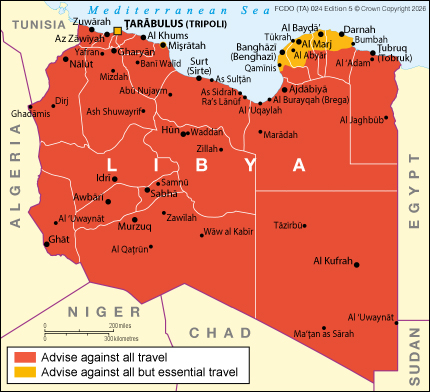
The current risk level for Libya is high. Check the advice before going.
Get your Libya Travel Guide
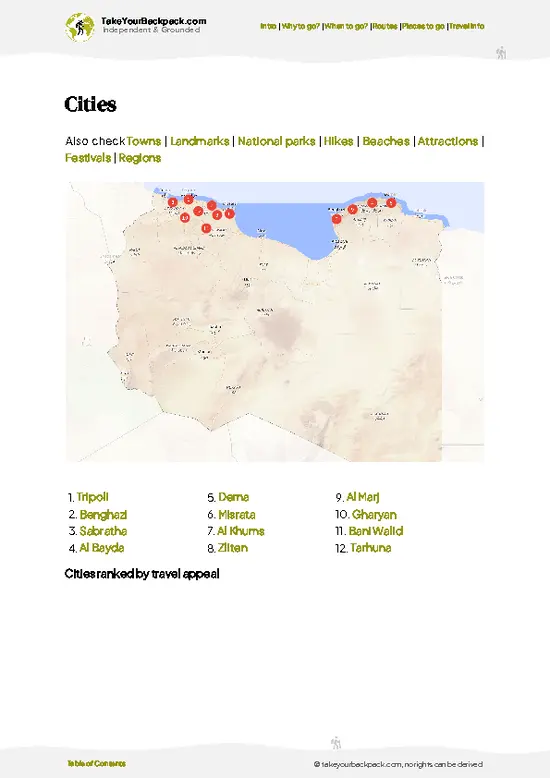
Seeing the layout at a glance
Loading the map 🌍
CLICK TO FILTER
city
town
unique site
national park
hike
beach
attraction
festival
region
SHOW COUNTRY‘S BESTSHOW ALL
film
0
0
0a
Cyrene Archaeological Site
film
1
1
1a
Ghadames Old Town
film
2
2
2a
Jebel Nafusa Cave Dwellings and Granaries
film
3
3
3a
Qasr al-Haj Fortified Granary
film
4
4
4a
Zuwara Beach
film
5
5
5a
Jebel Akhdar
film
6
6
6a
Jebel Nafusa
film
7
7
7a
Archaeological Site of Leptis Magna
film
8
8
8a
Archaeological Site of Cyrene
film
9
9
9a
Qasr al-Hajj

Why go?What sets this destination apart

Architecture

Libya rewards architecture hunters who can do the work. Leptis Magna isn’t a ruin, it’s a city you walk—forums, basilicas, a jaw-dropping theater—often with nobody else in sight. Sabratha glows at sunset; Cyrene’s Greek lines … read more 👉
Libya rewards architecture hunters who can do the work. Leptis Magna isn’t a ruin, it’s a city you walk—forums, basilicas, a jaw-dropping theater—often with nobody else in sight. Sabratha glows at sunset; Cyrene’s Greek lines still read clean. In the south, ksour and troglodyte houses cling to the Nafusa, while Tripoli flips between Ottoman alleys, the Red Castle, and crisp Italian modernism. It’s a rare place where you can trace empires in a single day and actually hear the wind through the colonnades.

Scenery

Libya rewards effort. Big, clean horizons, and landscapes that don’t repeat. The Ubari lakes shine like coins in the sand, with salt crust biting your lips. Tadrart Acacus throws arches, canyons, and rock art at sunrise. Waw … read more 👉
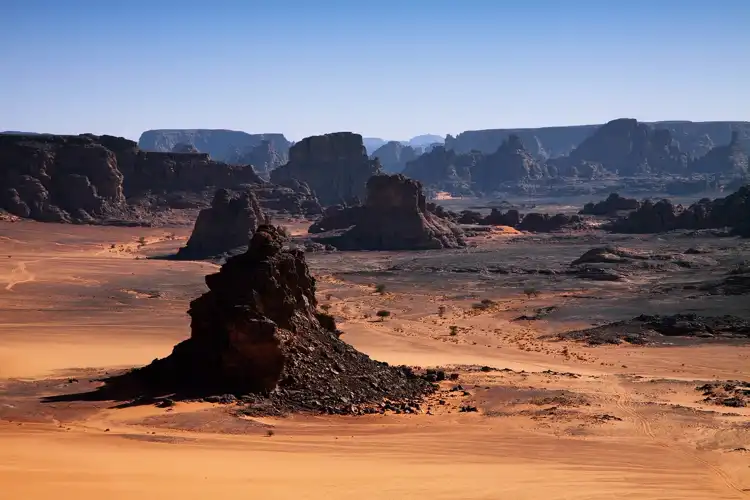
Libya rewards effort. Big, clean horizons, and landscapes that don’t repeat. The Ubari lakes shine like coins in the sand, with salt crust biting your lips. Tadrart Acacus throws arches, canyons, and rock art at sunrise. Waw an Namus looks alien—black ash ringed by blue pools. Up north, Jebel Akhdar’s scrub forests and limestone caves break the desert spell, before sea cliffs crash into the Med near Leptis Magna. Push south and the dunes thin into acacia plains. If you want raw scenery without crowds, this is honest mileage.
Want the complete picture of Libya?
The offline Travel Guide brings everything together — routes, highlights & planning.

See what's included in the guide 👉

Get the Travel Guide -

⭐ HighlightsUnmissable destinations

  • Leptis Magna: The Roman city sprawls beside the sea, wind pushing salt through colonnades and broken marble like it still owns the place. Walk the Severan Forum to the Hadrianic Baths, then drop to the amphitheater cut into sand—your must-do for the “how did they build this here?” hit. Be at the gate at opening, carry water, and buy only the official ticket; wave off “guides” who appear out of nowhere and double your day’s costs.
  • Sabratha: The three-tiered theater rises over surf and gulls, a backdrop so clean it feels staged until you hear waves slap the stones. Climb the backstage stairs for the full sweep of columns and sea—do that and your camera earns its keep. Afternoon light is best; park on firm ground, keep small change for optional tips, and don’t let anyone unlock a door you didn’t ask for.
  • Tripoli Old City & Red Castle: The medina smells of cumin and diesel, alleys narrowing until you pop into Martyrs’ Square under the fortress walls. Your must-do is the Assaraya al-Hamra museum—layers
read more 👉
  • Leptis Magna: The Roman city sprawls beside the sea, wind pushing salt through colonnades and broken marble like it still owns the place. Walk the Severan Forum to the Hadrianic Baths, then drop to the amphitheater cut into sand—your must-do for the “how did they build this here?” hit. Be at the gate at opening, carry water, and buy only the official ticket; wave off “guides” who appear out of nowhere and double your day’s costs.
  • Sabratha: The three-tiered theater rises over surf and gulls, a backdrop so clean it feels staged until you hear waves slap the stones. Climb the backstage stairs for the full sweep of columns and sea—do that and your camera earns its keep. Afternoon light is best; park on firm ground, keep small change for optional tips, and don’t let anyone unlock a door you didn’t ask for.
  • Tripoli Old City & Red Castle: The medina smells of cumin and diesel, alleys narrowing until you pop into Martyrs’ Square under the fortress walls. Your must-do is the Assaraya al-Hamra museum—layers of Libya under one roof when it’s open. Dress modestly, keep the camera low around checkpoints, carry cash and a passport copy, and use a licensed guide if you want fewer questions and more doors opened.
  • Cyrene & Apollonia: Up on Jebel Akhdar, cypress and sea air run through a city of columns and goats. Stand at the Temple of Zeus for scale, then drop to Apollonia’s harbor ruins for the sea-worn mosaics—one clean, two-part day. The site sprawls; pay a local car to shuttle between gates, pack a windbreaker, and start early before haze and school groups flatten the views.
  • Tadrart Acacus & Ghat: Sandstone cathedrals and cold, star-punched nights—this is why you flew this far. Sleep under a cliff overhang and watch rock art glow at first light in Wadi Tashwinat: that’s the must-do that rewires your sense of time. Permits and a Tuareg guide aren’t optional, fuel and water are prepaid realities, and you never touch the art—ever. If you want to push farther: Nalut’s hilltop granary and Qasr al-Hajj in the Nafusa, or the black caldera of Waw an Namus if you’ve got the logistics and grit.
Spotted a mistake or missing a highlight? Contact us.

But Libya offers more...

Discover and compare all of its highlights per category

🧭 RouteLogical itineraries covering the highlights

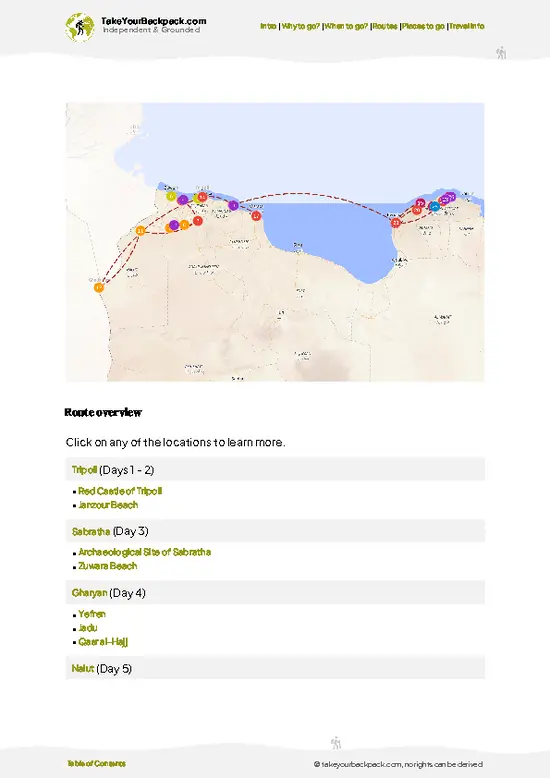
The 5-Day Coast & Ruins Taster

The Vibe: A compact, coastal-focused hit of Libya built around Roman ruins and easy day trips, ideal if you want depth over distance. You’ll base yourself mostly in one region, using short drives to keep the pace relaxed while still feeling like you’ve seen something big.
The Highlights:
  • Exploring Tripoli’s old city streets and the Tripoli Red Castle and National Museum.
  • Wandering the monumental Roman remains of Leptis Magna near Al Khums.
  • Day-tripping to Sabratha’s sea-facing Roman theatre.
  • Unwinding with a swim and seaside time at Janzour Beach.

The 10-Day Coast, Highlands & History Loop

The Vibe: A balanced journey that links Libya’s western coast, mountain villages, and the green eastern highlands without rushing from one end of the country to the other. You’ll mix big-name ruins with lived-in towns, using a combination of coastal drives and one longer hop east.
The Highlights:
  • Soaking up Tripoli’s urban energy and the museum inside the Red Castle.
  • Visiting both
read more 👉

The 5-Day Coast & Ruins Taster

The Vibe: A compact, coastal-focused hit of Libya built around Roman ruins and easy day trips, ideal if you want depth over distance. You’ll base yourself mostly in one region, using short drives to keep the pace relaxed while still feeling like you’ve seen something big.
The Highlights:
  • Exploring Tripoli’s old city streets and the Tripoli Red Castle and National Museum.
  • Wandering the monumental Roman remains of Leptis Magna near Al Khums.
  • Day-tripping to Sabratha’s sea-facing Roman theatre.
  • Unwinding with a swim and seaside time at Janzour Beach.

The 10-Day Coast, Highlands & History Loop

The Vibe: A balanced journey that links Libya’s western coast, mountain villages, and the green eastern highlands without rushing from one end of the country to the other. You’ll mix big-name ruins with lived-in towns, using a combination of coastal drives and one longer hop east.
The Highlights:
  • Soaking up Tripoli’s urban energy and the museum inside the Red Castle.
  • Visiting both Sabratha and Leptis Magna for two very different Roman city experiences.
  • Heading into Jebel Nafusa for cave dwellings, granaries, and Berber heritage.
  • Finishing in the Jebel Akhdar region with Cyrene and Apollonia framed by green hills and sea.

The 15-Day Libya Grand Traverse

The Vibe: A full-spectrum adventure that stitches together coast, mountains, oases, and deep Sahara, designed for travelers who want to see how Libya’s landscapes and histories connect. The pace is deliberate, with long drives spaced out by multi-night stays in key hubs.
The Highlights:
  • Starting on the Mediterranean with Tripoli, Sabratha, and time at Janzour Beach.
  • Climbing into Jebel Nafusa and exploring Ghadames’ old town on the edge of the desert.
  • Venturing by 4x4 into Ghat, Tadrart Acacus, and the rock art of the Libyan Sahara.
  • Closing the loop in the east with Benghazi, the green plateau of Jebel Akhdar, and the ruins of Cyrene and Apollonia.
🌍 Want a ready-to-use travel plan for Libya?
The overview above gives a quick comparison of route options based on your travel time and style. The full Travel Guide shows each route in detail, with maps, stops, highlights, and transport types.

Explore all route details 👉

Get the Travel Guide -

🌤️ When to go?When to go for the best experience

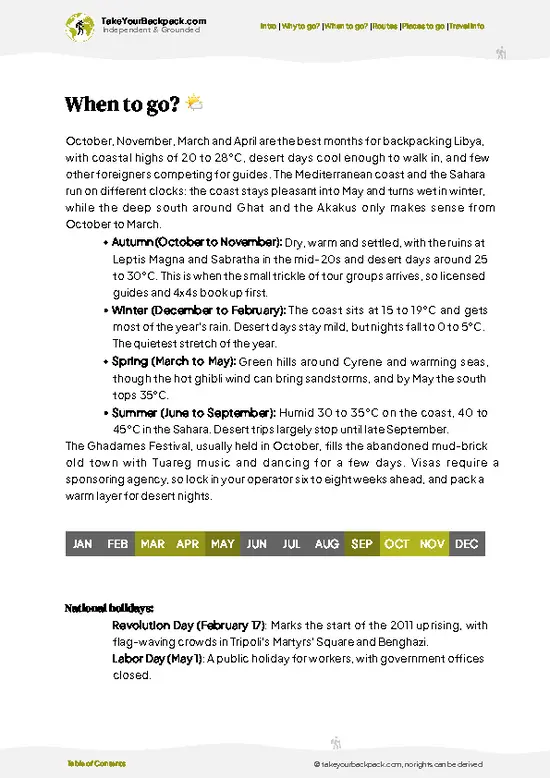
The real window for Libya is late October through November, with a secondary shot in March-April. In autumn, the coast cools without turning soggy, the desert drops from dangerous to doable, and drivers haven’t started charging “heat tax” for long hauls. Spring feels good too, but ghibli winds can sandblast a day’s plan. Autumn also slips you a bonus: Roman sites in golden light, the Mediterranean still swimmable, and oasis towns busy with date harvest—more doors open, more tea poured, fewer dead ends. You spend energy on the good stuff, not on fighting the sun or the wind.
  • Heat Peak (Jun-Aug): Everything is harder and pricier—4x4s run hot, drivers pad time, and the coast swells with domestic breaks. But if you can take the furnace, dawn in the Acacus turns dunes into moving sculpture and the night sky crushes you with scale. You’ll earn every view.
  • Autumn/Spring Shoulder (Oct-Nov, Mar-Apr): Streets wake up, desert tracks reopen, and border-town supply chains start moving. You string together ruins, oases, and canyon hikes without sprinting. In late October, you can wade Roman harbors in warm water and catch date harvest invites that vanish fast.
  • Off-Peak Winter (Dec-Feb): The interior goes quiet. Cold, clean air, long shadows, and lonely forts. Nights bite hard—carry a real sleep system and brew up at first light. Hike midday, drive early afternoon, and let frost lift before you commit to sand.

Tactical tip: For the Oct-Nov window, book desert 4x4s at least two weeks ahead; walk-up hires get the overheated rigs and the “maybe tomorrow” shrug.

source: climatestotravel.comJANJanuary: fair for travelingFEBFebruary: fair for travelingMARMarch: highly recommended for travelingAPRApril: highly recommended for travelingMAYMay: good for travelingJUNJune: below average for travelingJULJuly: below average for travelingAUGAugust: below average for travelingSEPSeptember: good for travelingOCTOctober: excellent for travelingNOVNovember: excellent for travelingDECDecember: fair for traveling
Traveling in a specific month?
This page covers the best seasons to visit. For a complete month-by-month breakdown — including weather, crowds, costs, national holidays, and festivals — download the full Travel Guide.

Get the Travel Guide -
Lybia - pixabay - oasis-67549 1280

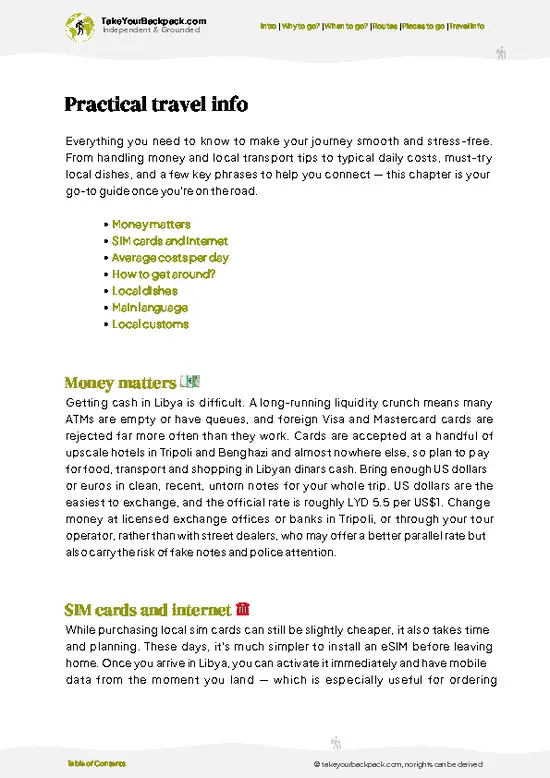
💰 Costs (as of 2026)Prices, expenses, and money tips

Expect $45-70 per day if you share rooms, eat local, and use shared transport; solo and private rides push you into $70-100 without trying.
  • dorm accommodation: True dorms are scarce; where a hostel or worker’s lodge exists, a bed runs $10-20. Most nights you’ll end up in a basic guesthouse or no-frills hotel at $25-45 for a twin. System tip: treat “dorm” as “split a twin” — two travelers halve the cost, ask for “economy room, no breakfast,” pay cash, and negotiate a multi-night rate. Compared to Tunisia or Egypt, beds here run 20-60% higher for the same quality because supply is thin.
  • meals: Supermarket Survival: $4-7/day gets you bread, cheese, olives, tuna, tomatoes, and fruit — solid calories for bus days. Street food reality: shawarma/falafel $1-2, stuffed breads and börek under $1, a big plate of couscous or grilled chicken $4-8; coastal fish jumps to $8-15. Eating like a local keeps costs roughly on par with Tunisia and a notch above Egypt; sit-down cafés with table service add a quiet 20-40% to the bill.
  • local transport: City minibuses and shared taxis are cents-on-the-dollar cheap — figure $0.20-0.60 per ride in town if you start from the proper stands. Intercity “service” taxis
read more 👉
Expect $45-70 per day if you share rooms, eat local, and use shared transport; solo and private rides push you into $70-100 without trying.
  • dorm accommodation: True dorms are scarce; where a hostel or worker’s lodge exists, a bed runs $10-20. Most nights you’ll end up in a basic guesthouse or no-frills hotel at $25-45 for a twin. System tip: treat “dorm” as “split a twin” — two travelers halve the cost, ask for “economy room, no breakfast,” pay cash, and negotiate a multi-night rate. Compared to Tunisia or Egypt, beds here run 20-60% higher for the same quality because supply is thin.
  • meals: Supermarket Survival: $4-7/day gets you bread, cheese, olives, tuna, tomatoes, and fruit — solid calories for bus days. Street food reality: shawarma/falafel $1-2, stuffed breads and börek under $1, a big plate of couscous or grilled chicken $4-8; coastal fish jumps to $8-15. Eating like a local keeps costs roughly on par with Tunisia and a notch above Egypt; sit-down cafés with table service add a quiet 20-40% to the bill.
  • local transport: City minibuses and shared taxis are cents-on-the-dollar cheap — figure $0.20-0.60 per ride in town if you start from the proper stands. Intercity “service” taxis are the country unlock: $0.03-0.05 per km when full, so Tripoli-Leptis Magna or Sabratha is budget-friendly if you find a seat. Private taxis bleed you dry; a short city hop can be $5-10, and intercity quotes quickly exceed your room rate. Best play: learn the shared taxi stations, move hub to hub, and only hire a driver for the last-mile to ruins, splitting the car with others.
  • activities: Entry fees are modest; logistics are the wallet-punch. Leptis Magna, Sabratha, and Cyrene are cheap to enter compared with big-name sites in Egypt, but getting there costs: expect $25-60 for a car and driver for a half-day if you split it, more solo. Desert and Acacus-style trips explode costs — 4x4, fuel, food, and guide easily hit $80-120 per person per day with a small group; still less than Sahara packages next door in Algeria/Tunisia, but only if you fill the seats.
  • miscellaneous: Budget Leaks: visas (amortize $8-12/day on short trips), SIM + data $6-12, bottled water $0.20-0.50, coffee $0.50-1.50, hotel “service” add-ons 5-10%, currency conversion spreads if you swap money poorly, and surprise taxi markups when you hail from hotels. Cash wins prices; ATMs can be temperamental. Relative value: food and coffee are Egypt-cheap, fuel is cheaper than anywhere nearby, but every private car minute and every empty hotel room drags your daily burn above Tunisia in a hurry.
⚠️ Prices can change and everyone travels differently, so take this as a rough guide. Hope it helps you plan your adventure!

✈️ The backpacker research shortcutLibya Travel Guide

An offline-friendly backpacking guide with optimized travel routes, ranked highlights, transport advice, and the best areas to stay.
example page 0 from our offline Travel Guide for Libyaexample page 1 from our offline Travel Guide for Libyaexample page 2 from our offline Travel Guide for Libyaexample page 3 from our offline Travel Guide for Libyaexample page 4 from our offline Travel Guide for Libyaexample page 5 from our offline Travel Guide for Libya
The digital guide (226 pages) contains:
61 highlights, ranked by travel appeal
Optimized 5, 10 & 15-day travel routes
Best neighborhoods to stay
How to get around
Offline-friendly for travel without Wi-Fi
👉 See all 30+ guide features

📅 Plan smarter in minutes, not weeks
Month by month travel advice
Festivals & national holidays
Budget expectations

🗺️ Go to the right places, skip the overrated ones
Honest pros & cons of destinations
Top hikes, parks & viewpoints
Lesser-known places most travelers miss
Clear “worth it vs skip it” guidance

🛏️ Travel smoothly without rookie mistakes
Best areas to stay
Transport systems explained simply
Common scams & safety advice
SIM cards, money & practical tips

🌍 Understand the country, not just visit it
Culture & traditions
52 Essential phrases & customs
Festivals worth planning around
Traveler-friendly historical context
Insights that make places more meaningful

📱 Built for real travel conditions
Fully downloadable PDF
Works completely offline
Optimized for phone use
Useful in remote areas & buses
Everything in one place
Save weeks of stressful planning
Get instant access to the full guide directly. 30-day money-back guarantee.


Sent to your inbox immediately after payment • 100% Secure Checkout
Best Backpacking Travel Advisor 2025 tourism awardBest Backpacking
Travel Advisor
2025
What others say about Take Your Backpack Guides:
⭐⭐⭐⭐⭐
Fantastic, amazing amount of information!
⭐⭐⭐⭐⭐
My goodness this is amazing, it's what I've been looking for hats off too you!
⭐⭐⭐⭐⭐
I think this is absolutely BRILLIANT
⭐⭐⭐⭐
Very complete and informative. It's still missing places, but I gotta to commend you
⭐⭐⭐⭐⭐
This is truly amazing, thank you, can't wait to explore it with my kids!
⭐⭐⭐⭐⭐
Awesome resource, thank you!
⭐⭐⭐⭐⭐
This is amazing! Can't wait to explore the ones I haven't seen
⭐⭐⭐⭐
I love this! Well done, great idea.
⭐⭐⭐⭐⭐
Thanks for taking the time to make this gem!
⭐⭐⭐⭐⭐
This might be the best website I've ever seen.
⭐⭐⭐⭐⭐
Congratulations, and thank you so much for your work; it's incredibly valuable.
⭐⭐⭐⭐
In all seriousness I think you did a great job pointing out the important spots
⭐⭐⭐⭐⭐
10/10 very good
⭐⭐⭐⭐⭐
As someone who's only just starting to visit regularly this is awesome, thank you.
⭐⭐⭐⭐
Thank you very much! I'm going to visit my dad, it's going to be very useful!
⭐⭐⭐⭐⭐
This is really cool! We'll be travelling for the first time and this definitely come in handy.
⭐⭐⭐⭐⭐
You are now our minister of culture, congratulations 👨‍💼
⭐⭐⭐⭐⭐
Just wanted to tell you that this is a pearl! Going to follow your recommendations.
⭐⭐⭐⭐⭐
This is so cool. I'll definitely be using the resource for my travels soon.
⭐⭐⭐⭐⭐
This is very impressive! Good work.
⭐⭐⭐⭐⭐
This is an amazing and informative site. Very well done!

🛏️ Where to stay?Choosing the right base for your trip

Hostels in Libya and budget guesthouses exist but are limited and concentrated in major cities, with the best choice in Tripoli, some options in Benghazi, and sparse guesthouses around historic oases.
In Tripoli the Medina/old city places you within walking distance of museums and souks but brings crowds, noise and less predictable security, while the Gargaresh/coastal suburbs are quieter, more used to foreign visitors, nearer beaches and transport hubs but farther from historic highlights.
Benghazi downtown/Corniche gives proximity to key sights and light nightlife but offers few true hostels … read more 👉
Hostels in Libya and budget guesthouses exist but are limited and concentrated in major cities, with the best choice in Tripoli, some options in Benghazi, and sparse guesthouses around historic oases.
In Tripoli the Medina/old city places you within walking distance of museums and souks but brings crowds, noise and less predictable security, while the Gargaresh/coastal suburbs are quieter, more used to foreign visitors, nearer beaches and transport hubs but farther from historic highlights.
Benghazi downtown/Corniche gives proximity to key sights and light nightlife but offers few true hostels and variable safety; remote towns and desert oases can be scenic budget choices but require advance planning, reliable transport and contingency for sudden closures.

If you enjoy meeting fellow travelers, consider choosing hostels with high ratings for atmosphere. On the other hand, if you prefer having your own space, a hotel might be a better option.

🚌 Getting aroundTransportation options and logistics

Libya moves by daylight and consent. Schedules are a rumor; departures happen when enough seats fill or a driver gets restless. Checkpoints, prayer times, and heat set the tempo. The coastal highway is the spine: long, flat, and deceptively slow when sand, fuel queues, or an officer’s whim pull your day apart. Win by starting at dawn, staying flexible, and reading the current—not the timetable.
  • Shared taxis (service cars) Fastest way city to city along the coast. You buy a seat; car leaves when full
read more 👉
Libya moves by daylight and consent. Schedules are a rumor; departures happen when enough seats fill or a driver gets restless. Checkpoints, prayer times, and heat set the tempo. The coastal highway is the spine: long, flat, and deceptively slow when sand, fuel queues, or an officer’s whim pull your day apart. Win by starting at dawn, staying flexible, and reading the current—not the timetable.
  • Shared taxis (service cars) Fastest way city to city along the coast. You buy a seat; car leaves when full (often four in back), then runs direct with fewer meal stops than coaches. Costs more than a bus but far less than hiring a private driver. Drivers push speed; pick a calm one, wear a seatbelt. Confirm fare before loading bags; big luggage can mean paying another seat.
  • City microbuses Routes are oral and flexible; flag palm-down, state your landmark, and squeeze in. Pay exact or close; pass coins forward, change returns eventually. Seats reshuffle to put women with women when possible; keep your bag on your lap. To get off, tap metal or say ’henna’ firmly. Quiet courtesy beats volume. Main clusters sit by markets and mosques, not on maps.
  • Intercity coaches Cheapest long-haul option when counting dinars. Tickets undercut service cars; big luggage rides below without argument. The cost is time: slow boarding, meal-and-prayer halts, and depots on the edge of town that force a taxi if you arrive late. Choose morning departures to stay in daylight. Buy at the window a day ahead; keep ticket and passport copy ready at gates.
  • 4x4 desert transport Anything beyond the coastal belt—Ghadames, Ghat, Ubari—demands a real 4x4, local driver, and sometimes a permit or local escort. Convoys are common; fuel is cash; distances punish optimism. This is how you reach rock art, dunes, and stony wadis buses can’t touch. Pay for experience; breaking down out here burns days, not hours, and your water stock with it.

Master tip: Stack your journey in dawn legs along the coast, buy tomorrow’s seat the moment you arrive, carry small bills and a passport photocopy for checkpoints, and you’ll keep momentum without bleeding cash or daylight.
If you’re flying to Tripoli in 2025, you’ll land at Mitiga International Airport (MJI). The city center (around Martyrs’ Square) is about 9 km (5.6 miles) west of the airport.

Main ways to get into the city
  • Taxi (on the spot) — 15-30 minutes, depending on traffic. Expect 30-60 LYD in daytime; late night or heavy traffic can push it to 50-80 LYD. Taxis aren’t metered, so agree the fare before you get in. Cash only.
  • Prearranged private transfer (hotel/agency) — 15-30 minutes. More reliable for first-time visitors and late arrivals. Typical prices run 80-200 LYD depending on vehicle, time of day, and whether your hotel is handling it.
  • Shared minibus (local microbus) — About 25-45 minutes. There’s no official airport bus, but local minibuses run along the coastal road outside the airport perimeter toward the center. You’ll need to walk out to the main road and flag one going to Martyrs’ Square/Dahra. Fares are cheap, usually 2-5 LYD. Cash only; runs roughly daylight hours; basic comfort.

Good to know
  • There is no official airport bus or train service as of 2025, and no Uber/Careem. Taxis and private transfers are the straightforward options.
  • Traffic can spike around rush hours (roughly 08:00-10:00 and 15:00-19:00) and at checkpoints, which may add time.
  • Have small bills in LYD and confirm your drop-off point (e.g., Martyrs’ Square, Algeria Square, Dahra) before you set off.

Quick taxi summary: From Mitiga to central Tripoli, budget 30-60 LYD in the day, 50-80 LYD late at night, and 15-30 minutes in normal traffic.
⚠️ Prices and routes can change, so take this as a rough guide and ask for local advice when you arrive.

🔒 Safety (risk Level: high)Is Libya safe to visit?

Safety for solo travelers, including women and LGBTQ+ individuals
Traveling to Libya as a solo traveler, especially for women or LGBTQ+ individuals, is generally not recommended due to ongoing conflict, a volatile security situation, and limited consular assistance. The country is currently considered high-risk, with frequent reports of civil unrest and violent crime. Women and LGBTQ+ travelers may face additional cultural and legal challenges, as societal norms can be conservative and discriminatory. Always check the latest travel advisories and consider safer alternatives if possible.


Full official government travel advisory (live updates)
View details 👉
safety image

source: www.gov.uk

✈️ VisaEntry requirements and paperwork

Yes, most travelers need a visa to visit Libya, and you must obtain it before arrival as visas on arrival are not available. Apply through the Libyan embassy or consulate in your home country, providing necessary documents like a valid passport, invitation letter, and possibly a hotel booking. Always check for the latest travel advisories before planning your trip.
⚠️ Visa requirements can change over time, so always check the latest visa requirements with the official embassy or government website before you travel.

🎒 What to pack?What you'll need while traveling

Libya’s climate can be a mixed bag, with scorching hot summers and mild winters, so pack accordingly. Be ready for sandstorms in the desert areas, especially if you’re planning on exploring the Sahara. While Libya isn’t a beach paradise, the Mediterranean coast can be surprisingly pleasant, so a swimsuit might come in handy. However, remember that Libya is a conservative country, so dress modestly, especially in rural areas and smaller towns. Long sleeves and trousers for both men and women will keep you respectful and comfy.

Apart from this country specific advice, I have also crafted a general packing list that should help on any trip. authorOver the years, I've learned the importance of packing minimally. It's so much easier to jump on the back of a truck or squeeze yourself into the last spot of a minibus without that supersized backpack. If you're headed to a warm destination, leave your winter jacket at home; for colder regions, opt for thin thermal underlayers. Instead of packing your entire wardrobe, bring just three sets of clothes, as laundry facilities are available everywhere.

View the full list 👉

🙋 FAQThings travelers often ask

Trip Planning


Personal tip: I normally search on good rating for atmosphere (for meeting people) and location (for easy exploring). Cleanliness as a bonus.


Travel Essentials

You should consider the following vaccinations for Libya:

- Hepatitis A
- Hepatitis B
- Typhoid
- Tetanus
- Rabies (especially if planning to explore rural areas or work with animals)

Make sure your routine vaccinations, like MMR (measles, mumps, rubella) and diphtheria-pertussis-tetanus (DPT), are up to date. Consult your healthcare provider for personalized advice.


vaccination requirements
When I first started traveling, I often spent part of my first day in a new country hunting for a local SIM card. While this can still be slightly cheaper, it also takes time and planning.

These days, it's much simpler to install an eSIM before leaving home. Once you arrive in Libya, you can activate it immediately and have mobile data from the moment you land — which is especially useful for ordering transport or navigating away from busy airports.

There are many providers nowadays, and price differences are usually small. I personally go with Airalo, as it offers excellent network coverage throughout the country and strong global coverage, so you can manage multiple countries from a single app.


Get your e-sim for Libya

Culture & Customs

Dress modestly, especially women; cover shoulders and knees. Public displays of affection are frowned upon. Remove shoes when entering a home. Always use your right hand for eating and giving items. Avoid discussing politics or religion openly.

For LGBTQ+ travelers, discretion is advised as homosexuality is illegal. Women may face restrictions; it’s wise to travel with a male companion or in a group. Always ask permission before taking photos of people, especially women.
Trying traditional food is always a great way to experience the culture. Here are some must-try dishes for Libya.
  • Bazeen: A staple in Libyan cuisine, Bazeen is a doughy dish made from barley flour dough, boiled to a dense consistency, and often served with a spicy lamb or beef sauce. It’s traditionally eaten by hand and is a communal meal, reflecting the Libyan emphasis on family and community.
  • Couscous: This North African classic is a must-try in Libya, where it’s typically served with lamb, beef, or chicken, and a mix of vegetables like carrots and zucchini. It’s more than just a meal; it’s often at the center of gatherings and celebrations.
  • Shakshuka: Originally from the region, this dish features poached eggs in a spicy tomato and bell pepper sauce. It’s a popular breakfast or brunch option and highlights the Mediterranean influence on Libyan food.
  • Usban: A unique dish made of lamb intestines stuffed with a mixture of rice, herbs, and sometimes minced meat. It’s often prepared during festive occasions, showcasing traditional cooking methods and flavors.
  • Libyan Tea: While not a dish, the tea ritual is an integral part of Libyan culture. Served strong and sweet, often with peanuts or mint, it’s about taking a break, socializing, and enjoying life’s simple pleasures.
Tap water in Libya is generally not recommended for tourists to drink, as it’s often not treated to the same standards as in Western countries. Locals might drink it, but it’s safer for travelers to stick with bottled or well-filtered water. Bottled water is widely available and cheap, so it’s the best bet to avoid any digestive misadventures.
The main language in Libya is Arabic. Backpacking is way more rewarding if you know a bit of the local language, so I'd suggest brushing up on the basics just in case your Arabic skills have become a bit rusty.

Want to understand locals better?
The complete Travel Guide for Libya includes 52 essential words and phrases — greetings, thank-yous, ordering food, transport, numbers, and common local expressions you'll actually hear.

Get your local basic phrases 👉

Get the Travel Guide -


In Libya, English is not widely spoken, especially outside major cities like Tripoli and Benghazi. While younger generations and professionals in urban areas may have a basic understanding of English, fluency is limited. English is often used in business and education, but many Libyans primarily communicate in Arabic, with some regional dialects.

Tourists may encounter English-speaking individuals in hotels, restaurants, and tourist attractions, but outside these areas, language barriers can be common. It’s advisable for travelers to learn a few basic Arabic phrases or use translation apps to facilitate communication.

In summary, while English is understood to some extent, especially in urban centers, travelers should be prepared for limited proficiency and consider language resources to enhance their experience in Libya.

Money & Payments

The local currency of Libya is LYD (ل.د).

Traveling in Libya with a budget mindset? Here’s the lowdown on handling money:

ATMs: They’re available in major cities like Tripoli and Benghazi, but can be unreliable. Don’t count on them in smaller towns or rural areas.

Cash is King: Always carry Libyan dinars. Small shops and street vendors won’t take cards. Keep some smaller bills handy for day-to-day expenses.

Currency to Bring: Euros are a safe bet, but US dollars work too. Both are easy to exchange at banks and exchange bureaus.

Card Acceptance: Credit cards are only accepted at some larger hotels and a few high-end restaurants. Don’t expect to use them much elsewhere.

Exchanging Money: Stick to banks and official exchange bureaus. Avoid street exchangers to dodge scams and bad rates.

Keep your cash secure, and you’ll have a smoother journey through Libya!

Tipping in Libya is not mandatory but appreciated in most service settings. In restaurants, rounding up the bill or leaving around 10% is considered polite. For taxis and small services, rounding up to the nearest convenient amount is sufficient.

🧩 Nearby countriesOther countries to combine with Libya

We 💚 feedbackWhat to know before planning your trip

Libya rewards prep, not bravado. Lock permits, transport, and a fixer before you land, carry enough clean cash for the whole trip, and move in daylight; checkpoints drain hours after dark. That discipline saves energy for Leptis Magna and Sabratha, which justify the hassle. Small upside: street tea is dirt‑cheap and jet‑sweet; it keeps morale high. On the horizon, more sites are reopening and guide networks are getting formalized; if momentum holds, visas and intercity links should get less punishing.

✍️ Help improve this page!
The information on this page is based on in-depth research, insights shared by experienced travelers, and feedback from the local travel community in Libya. While every effort is made to keep the information accurate and current, conditions can change — so if you spot anything incorrect or outdated, please get in touch.


🙋‍♂️ Give feedback

👋 Meet the founderWho’s Behind Take Your Backpack?

Johan, backpacker and founder of TakeYourBackpackHi, I’m Johan (Netherlands 🇳🇱), the creator of TakeYourBackpack. Over the past decade, I’ve backpacked through 80+ countries across six continents, gaining extensive experience with independent travel, long-term trips, and overland routes.

This site is built on a combination of firsthand travel experience and carefully curated insights from other backpackers. Many guides are based on places I’ve personally visited, while others bring together tips, observations, and practical advice shared by trusted travelers I’ve met along the way.

The goal is to provide realistic, experience-driven guidance — not generic itineraries — so you can explore destinations with better context, clearer expectations, and more confidence.

Get Full Country Guide |
Instant download • 61 highlights • Full Offline guide