Trip Planning
The TakeYourBackpack guidebooks are your all-in-one travel companion, featuring the best cities, national parks, hikes, beaches, and unique sites, along with essential tips on when to go, how to get around, exchanging money, and even local phrases to get you started — everything you need for a smooth, unforgettable backpacking adventure.
Stop researching. Start exploring.Discover all 42 highlights,ranked
and organized into practical routes.
Get instant access
Planning a backpacking route through Seychelles can be tricky — you need to balance must-see places, travel times, budget, and how long to stay in each destination. Our free personalized Seychelles itinerary planner creates a route based on your travel style, trip duration, and interests, so you can spend less time researching and more time exploring.
Personal tip: I normally search on good rating for atmosphere (for meeting people) and location (for easy exploring). Cleanliness as a bonus.
Travel Essentials
Seychelles has no mandatory vaccinations for most travelers. The exception is a yellow fever certificate, which is required if you are arriving from, or have transited through, a country with yellow fever risk. Make sure your routine vaccines are up to date, and doctors commonly recommend hepatitis A, hepatitis B and typhoid. There’s no malaria, but dengue and chikungunya occur, so insect repellent is your main protection.
vaccination requirementsWhen I first started traveling, I often spent part of my first day in a new country hunting for a local SIM card. While this can still be slightly cheaper, it also takes time and planning.
These days, it's much simpler to install an eSIM before leaving home. Once you arrive in Seychelles, you can activate it immediately and have mobile data from the moment you land — which is especially useful for ordering transport or navigating away from busy airports.
There are many providers nowadays, and price differences are usually small. I personally go with
Holafly, as it offers excellent network coverage throughout the country and strong global coverage, so you can manage multiple countries from a single app.
HolaFly eSimCulture & Customs
Seychellois culture is laid-back but mostly Catholic and fairly conservative. Do cover your shoulders and knees in Victoria, in villages and in churches, and save swimwear for the beach. Nudity is illegal and topless sunbathing is frowned upon on public beaches. Don’t collect shells, coral or coco de mer nuts, since exporting coco de mer requires an official permit, and leave giant tortoises and nesting turtles alone. Ask before photographing people, especially at markets, and expect a slower pace of service without showing impatience. Women and LGBTQ+ couples should keep public affection discreet, as locals tend to be reserved about it.
Trying traditional food is always a great way to experience the culture. Here are some must-try dishes for Seychelles.
- Kari koko (coconut curry): fish, octopus or chicken simmered in coconut milk with turmeric, ginger and local spices. It’s the everyday heart of Creole cooking and shows up on almost every takeaway menu.
- Grilled fish: red snapper, jobfish or bourzwa grilled whole with lime, garlic and chili, served with rice and Creole sauce. On islands surrounded by reef, fresh fish is the national staple.
- Satini reken (shark chutney): boiled shark meat mashed with bilimbi, lime, onion and turmeric. It’s a classic side dish that feels very Seychellois.
- Ladob: ripe plantain or breadfruit cooked in coconut milk with nutmeg, vanilla and sugar, usually eaten as dessert. There’s also a savory version made with salted fish.
- Salad palmis (palm heart salad): the tender core of a palm tree, sliced raw. It’s nicknamed “millionaire’s salad” because a whole tree is cut to make it.
- Breadfruit: roasted, fried as chips or mashed. Local lore says anyone who eats it will return to Seychelles.
Tap water in Seychelles is treated and generally safe to drink, especially on Mahé, and many locals drink it straight from the tap. It can taste strongly of chlorine, and supply on Praslin and La Digue can turn cloudy after heavy rain. For that reason, many travelers prefer bottled water or a filter bottle, which also cuts down on plastic waste.
The main language in Seychelles is
Seychellois Creole. Backpacking is way more rewarding if you know a bit of the local language, so I'd suggest brushing up on the basics just in case your Seychellois Creole skills have become a bit rusty.
Want to understand locals better?The complete Travel Guide for Seychelles includes 52 essential words and phrases — greetings, thank-yous, ordering food, transport, numbers, and common local expressions you'll actually hear.
Get your local basic phrases 👉
Get the Travel Guide - is one of Seychelles’ three official languages, so you’ll manage easily in Victoria, at the airport, at guesthouses and on the main beaches of Mahé, Praslin and La Digue. Younger Seychellois and anyone working in tourism speak it fluently. In quieter villages, older people may switch to Seselwa Creole first, but most still understand basic English. French is the most useful second language, and learning a few Creole words like “bonzour” (hello) and “mersi” (thank you) earns you real smiles.
Money & Payments
The local currency of Seychelles is SCR (₨).
The currency in Seychelles is the Seychelles rupee (SCR), roughly 13 to 15 to the US dollar. ATMs are easy to find at the airport, in Victoria and around Beau Vallon. On Praslin you’ll find them mainly in Grand Anse and Baie Sainte Anne, and on La Digue only at La Passe, so withdraw enough before heading to the smaller islands. Expect your home bank’s foreign withdrawal fee, plus a local charge at some machines. Visa and Mastercard work at hotels, larger restaurants, supermarkets, dive centers and ferry offices, but buses, takeaways, market stalls and bike rentals are cash only. Euros and US dollars are both easy to exchange, and many guesthouses quote prices in euros. Change money only at banks, the airport or licensed bureaux de change, because street exchange is illegal.
Tipping in Seychelles is appreciated but not expected, and many hotels and restaurants already add a 10% service charge to the bill. If service is not included, leaving 5 to 10% at a sit-down restaurant or rounding up a taxi fare is a kind gesture. There’s no need to tip at takeaway counters or on buses.

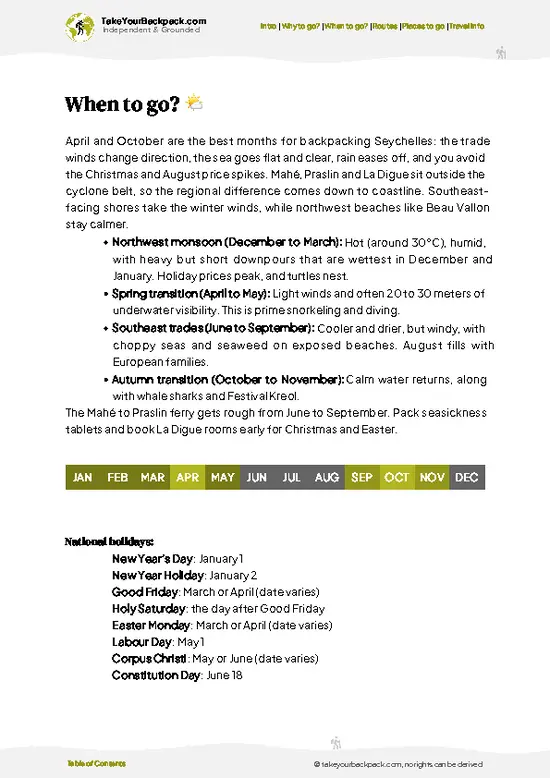
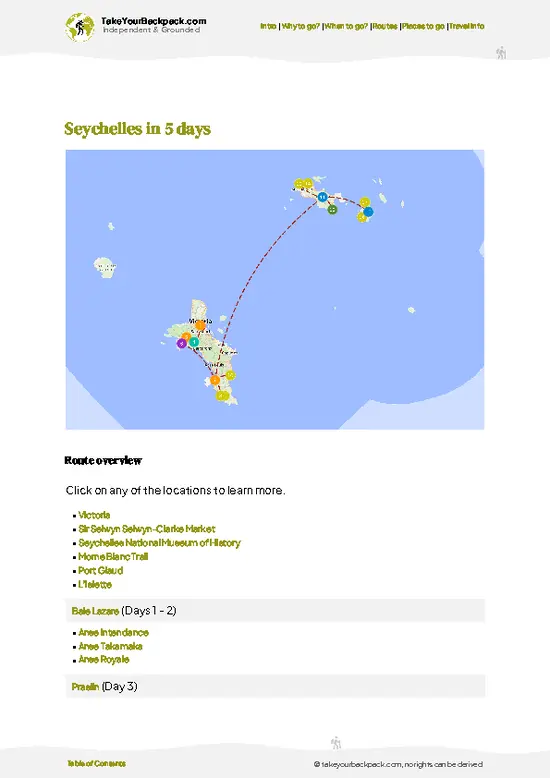
 Best Backpacking
 Over the years, I've learned the importance of packing minimally. It's so much easier to jump on the back of a truck or squeeze yourself into the last spot of a minibus without that supersized backpack. If you're headed to a warm destination, leave your winter jacket at home; for colder regions, opt for thin thermal underlayers. Instead of packing your entire wardrobe, bring just three sets of clothes, as laundry facilities are available everywhere.


 Hi, I’m Johan (Netherlands 🇳🇱), the creator of TakeYourBackpack. Over the past 3 decades, I’ve backpacked through 90+ countries across six continents, gaining extensive experience with independent travel, long-term trips, and overland routes.