Trip Planning
The TakeYourBackpack guidebooks are your all-in-one travel companion, featuring the best cities, national parks, hikes, beaches, and unique sites, along with essential tips on when to go, how to get around, exchanging money, and even local phrases to get you started — everything you need for a smooth, unforgettable backpacking adventure.
Stop researching. Start exploring.Discover all 57 highlights,ranked
and organized into practical routes.
Get instant access
Planning a backpacking route through Jordan can be tricky — you need to balance must-see places, travel times, budget, and how long to stay in each destination. Our free personalized Jordan itinerary planner creates a route based on your travel style, trip duration, and interests, so you can spend less time researching and more time exploring.
Personal tip: I normally search on good rating for atmosphere (for meeting people) and location (for easy exploring). Cleanliness as a bonus.
Travel Essentials
No vaccinations are required to enter Jordan unless you arrive from a country with yellow fever risk, in which case a yellow fever certificate is needed. Make sure routine vaccines (MMR, tetanus-diphtheria-pertussis, polio) are up to date, and hepatitis A and typhoid are commonly recommended because of street food and variable hygiene. Hepatitis B and rabies are worth considering for long stays, rural trips or close contact with animals such as stray dogs and camels.
vaccination requirementsWhen I first started traveling, I often spent part of my first day in a new country hunting for a local SIM card. While this can still be slightly cheaper, it also takes time and planning.
These days, it's much simpler to install an eSIM before leaving home. Once you arrive in Jordan, you can activate it immediately and have mobile data from the moment you land — which is especially useful for ordering transport or navigating away from busy airports.
There are many providers nowadays, and price differences are usually small. I personally go with
Holafly, as it offers excellent network coverage throughout the country and strong global coverage, so you can manage multiple countries from a single app.
HolaFly eSimCulture & Customs
In Jordan, dress modestly, covering shoulders and knees, and both women and men should be more covered in rural towns and at religious sites, where women also need a headscarf for mosques. Do accept the tea or coffee offered to you, as refusing outright can come across as cold, and do eat, pass money and shake hands with your right hand. Don’t eat, drink or smoke in public during daylight in Ramadan, avoid public displays of affection, and always ask before photographing people, especially women and Bedouin families. Criticizing the King or royal family is illegal and taken seriously, so keep political opinions to yourself. Women traveling alone usually sit in the back of taxis and in the family sections of local restaurants, and LGBTQ+ couples will find discretion is expected everywhere outside a few liberal Amman spaces.
Trying traditional food is always a great way to experience the culture. Here are some must-try dishes for Jordan.
- Mansaf: Lamb slow-cooked in jameed, a tangy sauce made from dried fermented goat yogurt, served over rice and thin flatbread with toasted almonds and pine nuts. It is the national dish, served at weddings, funerals and reconciliations, and traditionally eaten from a shared platter with the right hand.
- Maqluba: Rice, fried eggplant or cauliflower and chicken or lamb cooked in one pot, then flipped upside down onto a tray at the table. The name means “upside down,” and the flip is a family ritual, often met with applause.
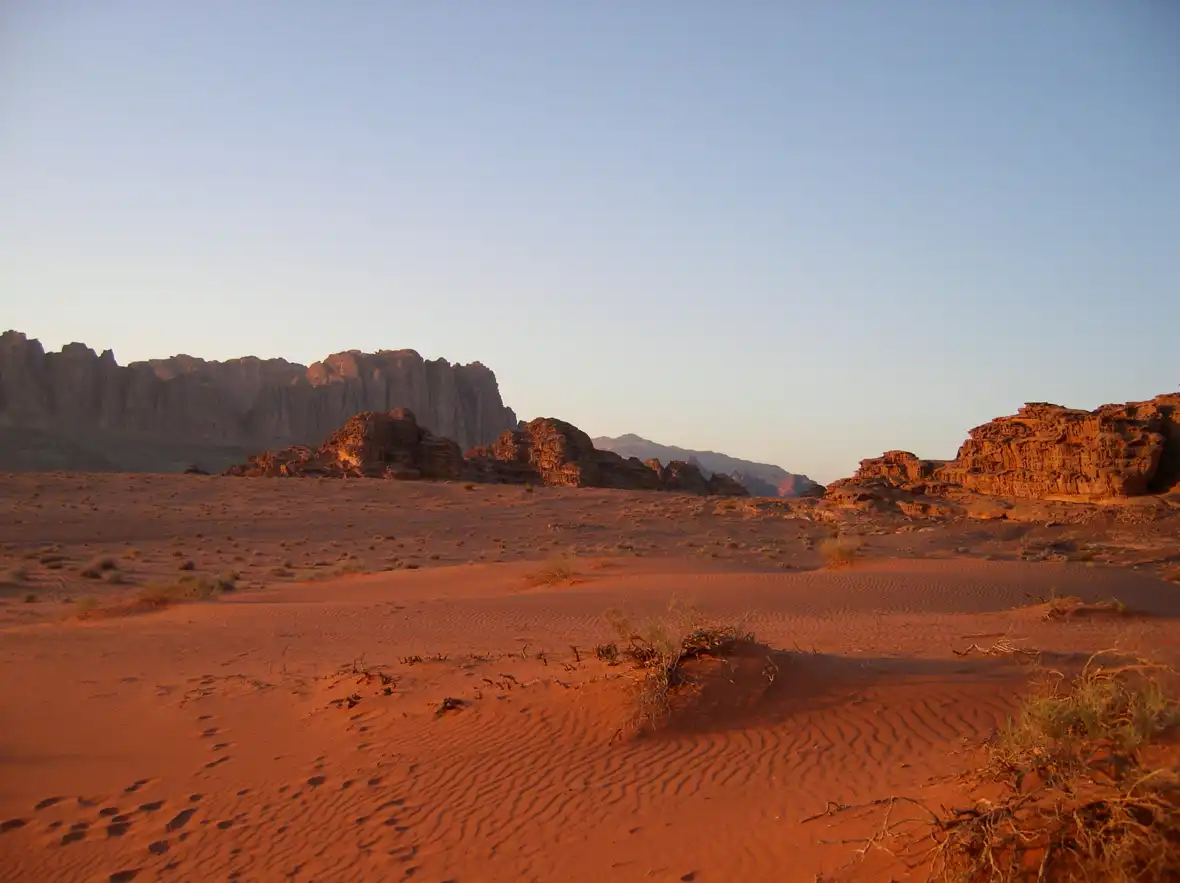
- Zarb: The Bedouin barbecue of Wadi Rum, where lamb or chicken and vegetables are cooked on tiers in a sealed pit under the sand for a couple of hours. It is the classic dinner at desert camps, smoky and falling off the bone.
- Musakhan: Taboon flatbread soaked in olive oil and piled with roast chicken, caramelized onions and plenty of sumac. It celebrates the olive harvest and is a staple of Palestinian-Jordanian home cooking.
- Falafel and hummus: The everyday breakfast of Amman, eaten with warm bread, pickles and sweet tea at downtown counters. Cheap, fast and a fixture of daily life across the country.
- Knafeh: Warm, stretchy white cheese under a layer of crisp shredded or semolina pastry, drenched in sugar syrup and dusted with pistachios. Jordanians eat it at any hour, and queues at Amman’s sweet shops stretch out the door in the evening.
Tap water in Jordan is treated and officially considered safe, but it is stored in rooftop tanks that are not always well maintained, so many locals filter it or buy bottled water for drinking. Travelers are best off avoiding tap water and sticking to bottled or filtered water, which is cheap at around JOD 0.3 to 0.5 (US$0.40 to 0.70) for a 1.5-liter bottle. A filter bottle cuts plastic waste and is handy on long days at Petra and in Wadi Rum.
The main language in Jordan is
Arabic. Backpacking is way more rewarding if you know a bit of the local language, so I'd suggest brushing up on the basics just in case your Arabic skills have become a bit rusty.
Want to understand locals better?The complete Travel Guide for Jordan includes 52 essential words and phrases — greetings, thank-yous, ordering food, transport, numbers, and common local expressions you'll actually hear.
Get your local basic phrases 👉
Get the Travel Guide - is widely spoken in Jordan’s tourist circuit: in Amman, Wadi Musa, Aqaba and Wadi Rum, hotel staff, guides and drivers usually handle it comfortably. Younger Jordanians and hostel workers tend to speak it well, often with a mix of British and American slang picked up from school and screens. In rural villages and with older minibus drivers, it drops off sharply, so Arabic is the language that helps most. Learn shukran (thank you), kam? (how much?) and la, shukran (no, thanks), and keep Google Translate with the offline Arabic pack downloaded for the gaps.
Money & Payments
The local currency of Jordan is JOD (د.ا).
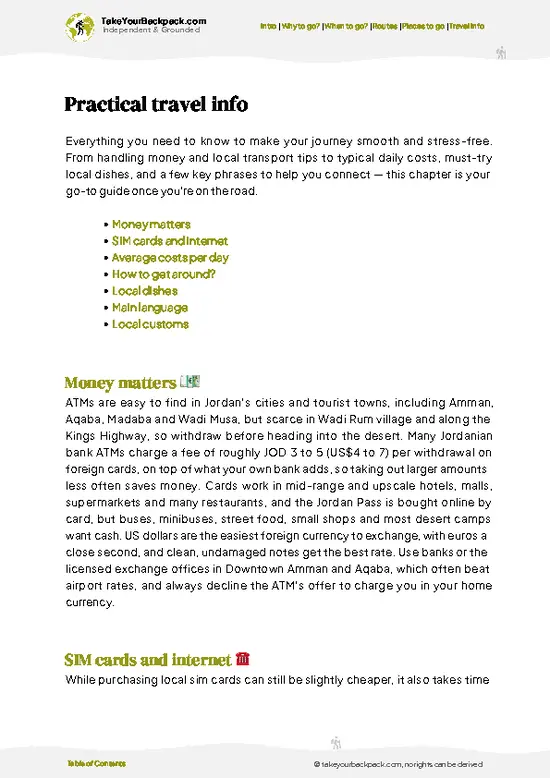
ATMs are easy to find in Jordan’s cities and tourist towns, including Amman, Aqaba, Madaba and Wadi Musa, but scarce in Wadi Rum village and along the Kings Highway, so withdraw before heading into the desert. Many Jordanian bank ATMs charge a fee of roughly JOD 3 to 5 (US$4 to 7) per withdrawal on foreign cards, on top of what your own bank adds, so taking out larger amounts less often saves money. Cards work in mid-range and upscale hotels, malls, supermarkets and many restaurants, and the Jordan Pass is bought online by card, but buses, minibuses, street food, small shops and most desert camps want cash. US dollars are the easiest foreign currency to exchange, with euros a close second, and clean, undamaged notes get the best rate. Use banks or the licensed exchange offices in Downtown Amman and Aqaba, which often beat airport rates, and always decline the ATM’s offer to charge you in your home currency.
Tipping in Jordan is customary but modest: many restaurants add a 10% service charge, and where they don’t, leaving 10% is standard. Round up taxi fares to the nearest dinar, give hotel porters JOD 1 (about US$1.40), and tip guides and drivers around JOD 5 to 10 (US$7 to 14) per day for good service. Bedouin hosts in Wadi Rum and horse handlers at Petra also expect a small tip, so keep some small notes and coins on hand.

 Best Backpacking
 Over the years, I've learned the importance of packing minimally. It's so much easier to jump on the back of a truck or squeeze yourself into the last spot of a minibus without that supersized backpack. If you're headed to a warm destination, leave your winter jacket at home; for colder regions, opt for thin thermal underlayers. Instead of packing your entire wardrobe, bring just three sets of clothes, as laundry facilities are available everywhere.



 Hi, I’m Johan (Netherlands 🇳🇱), the creator of TakeYourBackpack. Over the past 3 decades, I’ve backpacked through 90+ countries across six continents, gaining extensive experience with independent travel, long-term trips, and overland routes.