Trip Planning
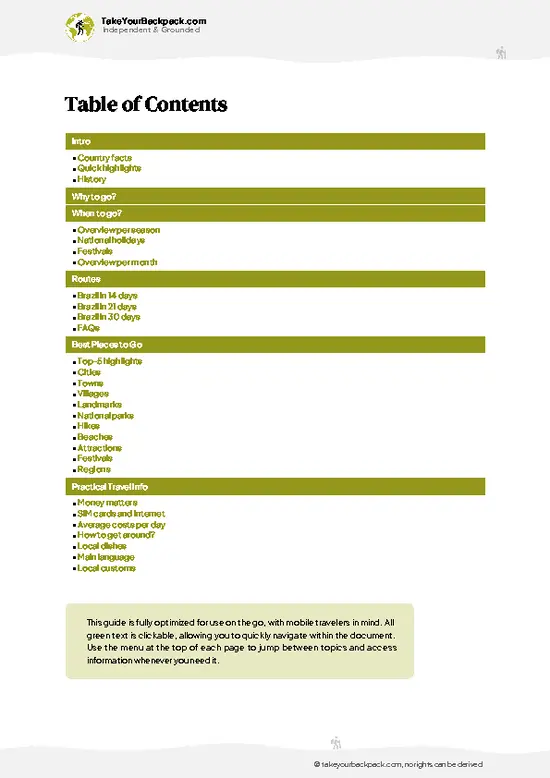
The TakeYourBackpack guidebooks are your all-in-one travel companion, featuring the best cities, national parks, hikes, beaches, and unique sites, along with essential tips on when to go, how to get around, exchanging money, and even local phrases to get you started — everything you need for a smooth, unforgettable backpacking adventure.
Stop researching. Start exploring.Discover all 146 highlights,ranked
and organized into practical routes.
Get instant access
Planning a backpacking route through Brazil can be tricky — you need to balance must-see places, travel times, budget, and how long to stay in each destination. Our free personalized Brazil itinerary planner creates a route based on your travel style, trip duration, and interests, so you can spend less time researching and more time exploring.
Personal tip: I normally search on good rating for atmosphere (for meeting people) and location (for easy exploring). Cleanliness as a bonus.
Travel Essentials
No vaccinations are mandatory to enter Brazil for most travelers, but make sure routine shots (MMR, tetanus, diphtheria, polio) are up to date and consider hepatitis A, hepatitis B and typhoid. Yellow fever vaccination is strongly recommended for the Amazon, the Pantanal, Iguaçu Falls and much of the interior, and outbreaks have also reached rural parts of Rio de Janeiro, São Paulo and Minas Gerais states. Rabies vaccination is worth considering for long stays in remote areas, and dengue, Zika and chikungunya are widespread, so reliable mosquito protection matters year-round.
vaccination requirementsWhen I first started traveling, I often spent part of my first day in a new country hunting for a local SIM card. While this can still be slightly cheaper, it also takes time and planning.
These days, it's much simpler to install an eSIM before leaving home. Once you arrive in Brazil, you can activate it immediately and have mobile data from the moment you land — which is especially useful for ordering transport or navigating away from busy airports.
There are many providers nowadays, and price differences are usually small. I personally go with
Holafly, as it offers excellent network coverage throughout the country and strong global coverage, so you can manage multiple countries from a single app.
HolaFly eSimCulture & Customs
Brazilians are warm, tactile and stand close when talking, so don’t read touching on the arm or shoulder as anything more than friendliness. Do dress neatly in cities and save swimwear for the beach; walking into a shop or restaurant in just a bikini or shirtless is frowned upon. Don’t use the OK hand sign (thumb and forefinger in a circle), which is an obscene gesture here, and don’t assume Brazilians speak Spanish or lump the country in with the rest of Latin America. Punctuality is relaxed at social gatherings, where arriving 30 minutes late is normal, but business meetings and tours run closer to on time. Toilet paper often goes in the bin rather than the toilet, and in churches you should cover shoulders and knees. Football is close to religion, so tread carefully with jokes about local clubs. Women may face machismo and unwanted attention, and a firm, clear no works better than politeness; same-sex couples can show affection freely in areas like Ipanema or São Paulo’s Frei Caneca and Rua Augusta, but keeping it low-key in rural areas and the conservative interior is advisable.
Trying traditional food is always a great way to experience the culture. Here are some must-try dishes for Brazil.
- Feijoada: a slow-cooked black bean stew with pork cuts and sausage, served with rice, collard greens, orange slices and farofa (toasted cassava flour). It’s Brazil’s unofficial national dish, traditionally eaten as a long lunch on Wednesdays and Saturdays.
- Moqueca: fish or shrimp stewed in a clay pot with tomatoes, onions and cilantro. The Bahian version adds coconut milk and dendê (palm) oil, while the Espírito Santo version skips them, and locals in each state will defend theirs loudly.
- Acarajé: black-eyed pea fritters deep-fried in dendê oil and split open with vatapá (a shrimp and peanut paste), dried shrimp and hot sauce. Sold by baianas in white dresses on Salvador’s streets, it has West African roots and is a sacred offering in Candomblé.
- Churrasco: Brazilian barbecue, with picanha (top sirloin cap) as the star cut. At a rodízio churrascaria, waiters carve skewers at your table until you flip your card to red, and the gaúcho tradition from the far south shapes the whole ritual.
- Pão de queijo: chewy cheese bread rolls made with cassava starch, naturally gluten-free. Originating in Minas Gerais, they’re eaten at breakfast and with coffee everywhere.
- Coxinha: a teardrop-shaped fritter of dough filled with shredded chicken and creamy cheese. It’s the top-selling snack in Brazilian lanchonetes (snack bars) and a cheap, filling meal on the go.
- Brigadeiro: a fudge ball of condensed milk, cocoa and butter rolled in chocolate sprinkles. No birthday party in the country happens without a tray of them.
Tap water in Brazil’s major cities is treated, but most locals don’t drink it straight from the tap and instead use household filters or bottled water. Drinking tap water isn’t recommended for travelers, especially in rural areas and the north, where treatment and old pipes are less reliable. Stick to bottled water (a 1.5-liter bottle costs about R$3 to 5) or a filter bottle, and you can safely accept the filtered water and ice served in restaurants and hostels.
The main language in Brazil is
Portuguese. Backpacking is way more rewarding if you know a bit of the local language, so I'd suggest brushing up on the basics just in case your Portuguese skills have become a bit rusty.
Want to understand locals better?The complete Travel Guide for Brazil includes 52 essential words and phrases — greetings, thank-yous, ordering food, transport, numbers, and common local expressions you'll actually hear.
Get your local basic phrases 👉
Get the Travel Guide - is not widely spoken in Brazil: you’ll find it at upscale hotels, tour agencies and some restaurants in Rio, São Paulo and Florianópolis, but even in big cities most shop staff, drivers and police speak only Portuguese. Younger, university-educated Brazilians and hostel staff are your best bet for English, while in rural areas and small towns in the north and northeast you should expect none at all. Spanish helps more than you’d think, since Brazilians often understand it when spoken slowly, even if they reply in Portuguese. Download Google Translate with the offline Portuguese pack and learn obrigado/obrigada (thank you), quanto custa (how much) and a conta, por favor (the bill, please), which carry you through most daily situations.
Money & Payments
The local currency of Brazil is BRL (R$).
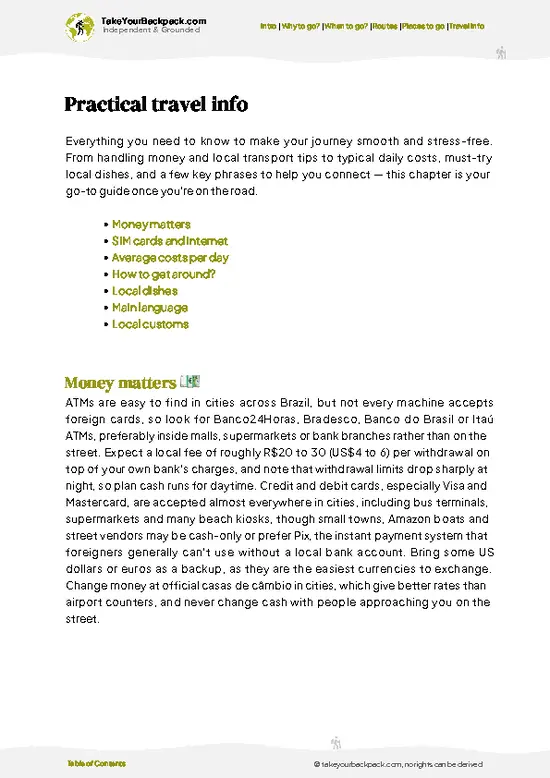
ATMs are easy to find in cities across Brazil, but not every machine accepts foreign cards, so look for Banco24Horas, Bradesco, Banco do Brasil or Itaú ATMs, preferably inside malls, supermarkets or bank branches rather than on the street. Expect a local fee of roughly R$20 to 30 (US$4 to 6) per withdrawal on top of your own bank’s charges, and note that withdrawal limits drop sharply at night, so plan cash runs for daytime. Credit and debit cards, especially Visa and Mastercard, are accepted almost everywhere in cities, including bus terminals, supermarkets and many beach kiosks, though small towns, Amazon boats and street vendors may be cash-only or prefer Pix, the instant payment system that foreigners generally can’t use without a local bank account. Bring some US dollars or euros as a backup, as they are the easiest currencies to exchange. Change money at official casas de câmbio in cities, which give better rates than airport counters, and never change cash with people approaching you on the street.
Tipping in Brazil is simple: most restaurants and bars add a 10% service charge (“serviço”) to the bill, which is technically optional but customarily paid, and there’s no need to leave extra unless service was exceptional. Taxi and Uber drivers don’t expect tips, though rounding up is appreciated. Small tips of R$5 to 20 (US$1 to 4) for hotel porters, tour guides and beach chair attendants are welcome but not obligatory.
v2.webp)
 Best Backpacking
.jpg) Over the years, I've learned the importance of packing minimally. It's so much easier to jump on the back of a truck or squeeze yourself into the last spot of a minibus without that supersized backpack. If you're headed to a warm destination, leave your winter jacket at home; for colder regions, opt for thin thermal underlayers. Instead of packing your entire wardrobe, bring just three sets of clothes, as laundry facilities are available everywhere.
Over the years, I've learned the importance of packing minimally. It's so much easier to jump on the back of a truck or squeeze yourself into the last spot of a minibus without that supersized backpack. If you're headed to a warm destination, leave your winter jacket at home; for colder regions, opt for thin thermal underlayers. Instead of packing your entire wardrobe, bring just three sets of clothes, as laundry facilities are available everywhere.






.jpg) Hi, I’m Johan (Netherlands 🇳🇱), the creator of TakeYourBackpack. Over the past 3 decades, I’ve backpacked through 90+ countries across six continents, gaining extensive experience with independent travel, long-term trips, and overland routes.
Hi, I’m Johan (Netherlands 🇳🇱), the creator of TakeYourBackpack. Over the past 3 decades, I’ve backpacked through 90+ countries across six continents, gaining extensive experience with independent travel, long-term trips, and overland routes.