×
Samoa 🇼🇸

backpacking Oceania Samoa 🇼🇸Live village-centered days shaped by ocean rhythms.

Explore Papua New GuineaExplore Solomon Islands

Backpacking Samoa in 2026

A complete guide including when and where to go, costs, transport, itineraries, and practical travel advice.
Traveling in Samoa: what to expect

Backpacking Samoa
By Johan Kruseman 🇳🇱 | Updated June 7, 2026

Your biggest expense in Samoa isn’t money—it’s patience. Flights can sting, but once you land, fales, buses, and plates of oka are cheap; ATMs thin out beyond Apia and Sundays go quiet. That unhurried pulse is fa’a Samoa—life timed by church bells and family.

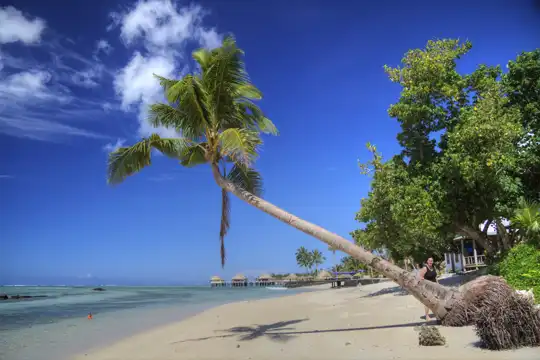
You come for salt-sweet mornings on Lalomanu, for To Sua’s turquoise drop, for waterfalls pounding jungle and black lava fields breathing heat on Savai‘i. By dusk, breadfruit smoke from umu fires threads the villages, choirs lift from open-walled churches, and flying foxes wheel overhead. Heat sticks, dogs bark, ferries shrug at schedules, and rain goes sideways—but the first plunge, a fiafia’s drumbeat, and an ice-cold Vailima at sunset make the friction worth it.

Compared with Fiji’s resorts, Tonga’s hush and whales, the Cooks’ polish, and American Samoa’s red tape, Samoa is for travelers who trade convenience for culture—happy with simple digs, slow roads, and nights scored by surf.

👉 Get the 📖 Travel Guide of Samoa

Apia & Palolo Deep

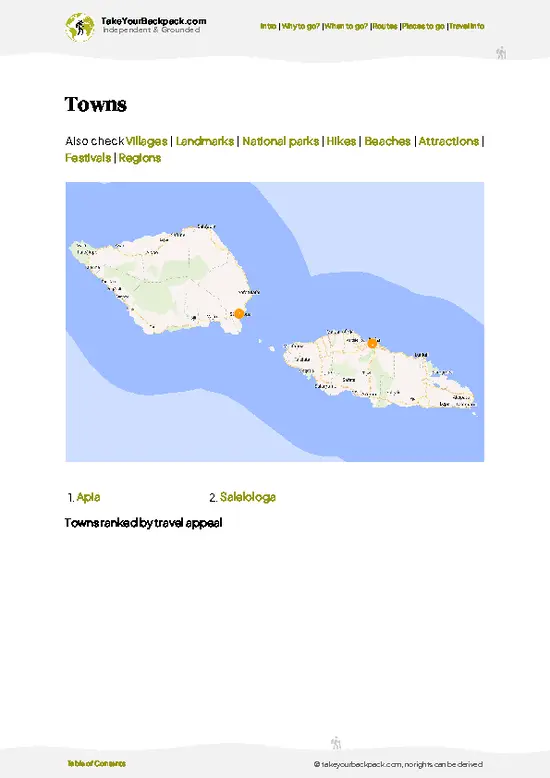
Apia is a working port: humid air, fish scales at the market, aiga buses from dawn. Base here for cash and SIMs. Snorkel Palolo Deep at high tide, then a Vailima on the seawall.

Upolu South Coast (Lalomanu–To Sua)

South Upolu runs on one coastal road. Buses drift; a car buys time. Sleep in beach fales. Climb the ladder into To Sua at midday light, snorkel Lalomanu reefs, then a cold shop beer and smoky fish.

Upolu Interior (Cross-Island)

Upolu’s interior is sweat and mud. O le Pupu-Pue tracks and Lake Lanoto’o turn to slick red clay after rain. Bring water and grip. Togitogiga Falls is your rinse; Papapapaitai lookout is your breath-back.

Savai’i Coastal Loop

Savai‘i is the slow loop. Ferry to Salelologa, then ring-road: Manase fales, Saleaula’s lava church, Alofaaga blowholes, Afu Aau’s cold pool. Buses circle, but a car saves daylight. Nights are black, the sky crowded with stars.

Manono Island

Manono is car-free and conversational. Small boat from Manono-uta, then a 7 km footpath around the island. Dress modestly in villages. Walk, swim off the wharf, wait for sunset over Apolima. For walkers who like quiet.
Map of Samoa
Loading the map 🌍
CLICK TO FILTER
town
village
unique site
national park
hike
beach
attraction
festival
region
SHOW COUNTRY’S BESTSHOW ALL
film
0
0
0a
Robert Louis Stevenson Museum
film
1
1
1a
Samoa Cultural Village
film
2
2
2a
Museum of Samoa
film
3
3
3a
Lalomanu Beach
Christian Backhaus
film
4
4
4a
Vavau Beach
Gesa Backhaus
film
5
5
5a
Afu Aau Waterfall Hike
Blessing Une Passi
film
6
6
6a
Papapapaitai Falls Hike
Maria Alvarenga
film
7
7
7a
O Le Pupu-Puʿe
film
8
8
8a
Falealupo Rainforest Reserve
Tanner Manwaring
film
9
9
9a
Lake Lanoto’o
film
10
10
10a
Apia
film
11
11
11a
To Sua Ocean Trench
Alfahad91
film
12
12
12a
Taga Blowholes
Jim Braun
film
13
13
13a
Papaseea Sliding Rocks
Francis Togia

Why go?Why Samoa is worth visiting

Beach life

Samoa makes you earn your beach days: sticky bus rides, reef-stubbed toes, a sun that bites by 10 a.m. Then the lagoon opens—glass-warm water over living … read more 👉
Samoa makes you earn your beach days: sticky bus rides, reef-stubbed toes, a sun that bites by 10 a.m. Then the lagoon opens—glass-warm water over living coral, giant clams blinking blue, turtles cruising the drop-off. You nap in a fale with the trade wind in the thatch, rinse the salt, and chase sunset with a cold Vailima before drums pull you into Apia’s night.

People

Heat on your neck, salt on your skin, and a stranger whistles you under a fale. Kids shout talofa; aunties fix your lavalava knot and laugh kindly at … read more 👉
Heat on your neck, salt on your skin, and a stranger whistles you under a fale. Kids shout talofa; aunties fix your lavalava knot and laugh kindly at your Samoan. You get teased first, helped second, fed third—taro, fish, palusami. When the evening bell rings for sa, they gesture you to sit quiet. Later, a cold Vailima appears.

Scenery

Expect sweat-soaked climbs through O Le Pupu-Pu’e, ankles in red mud. Lava fields of Savai’i fry your soles. Then: To Sua’s cool drop, Alofaaga blowholes … read more 👉
Expect sweat-soaked climbs through O Le Pupu-Pu’e, ankles in red mud. Lava fields of Savai’i fry your soles. Then: To Sua’s cool drop, Alofaaga blowholes pound your ribs, Lake Lanoto’o cups the sky, and from Mount Silisili’s shoulder you read the reef like a map. Rinse off with a bucket behind a village fale, crack a cold Vailima, and let the day hum.
Want the complete picture of Samoa?
The offline Travel Guide brings everything together — routes, highlights & planning.

See what's included in the guide 👉

Get the Travel Guide -

⭐ HighlightsKey places and experiences

  • To Sua Ocean Trench: The wooden ladder flexes and your hands come away slick with algae as you drop into a cool, turquoise hole cut by old lava. Down below, the air smells like salt and wet fern; the water is glassy until your kick scuffs it to silver, and the steep green walls swallow sound.
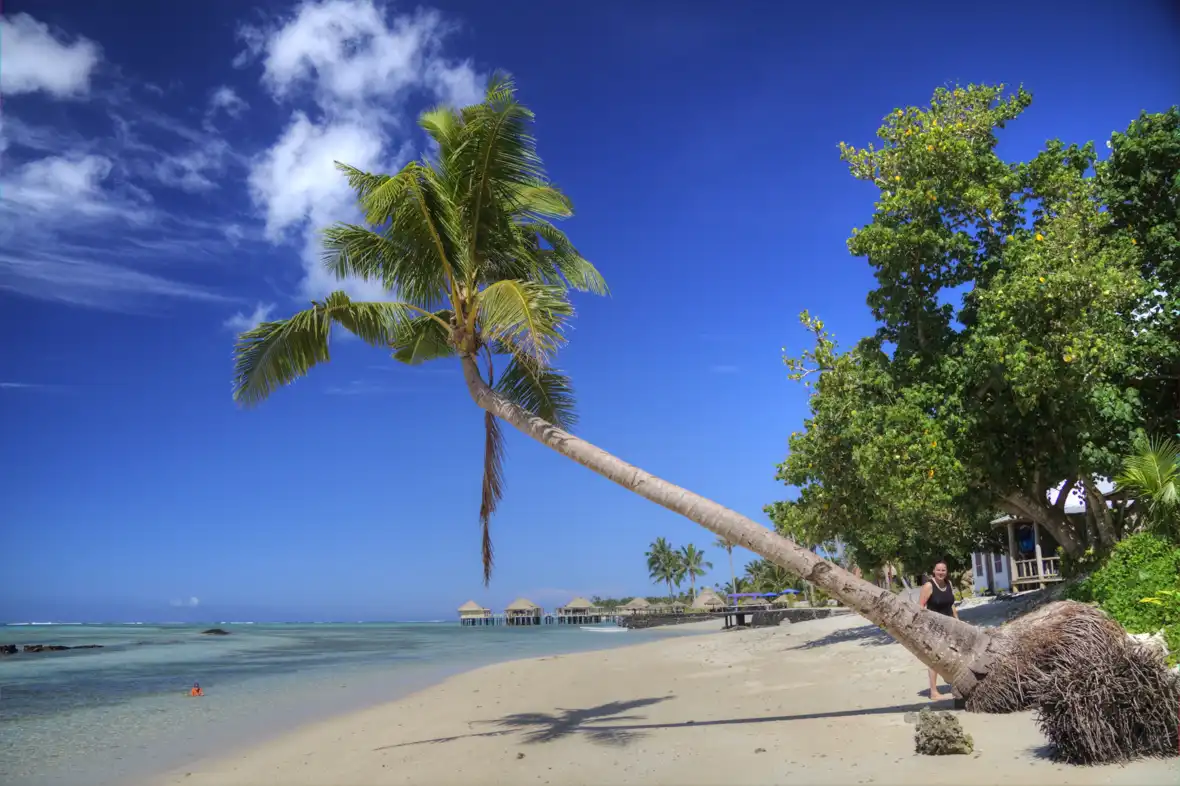
  • Lalomanu Beach: Afternoon light goes white-hot on squeaky coral sand, and the trade wind carries coconut smoke from a roadside umu. You step into a fale’s shade, toes still gritty, crack a cold Vailima from the esky, and the first swallow bulldozes through the salt on your lips.
  • Alofaaga Blowholes (Savai‘i): Basalt plates glare with heat and the ocean rams the tubes, blasting columns that salt your eyelashes and thump your ribs. The ground hums under your soles; a villager launches a coconut like a mortar round, and you learn exactly how far back “safe” feels.
  • Papaseea Sliding Rocks: Concrete steps drop you to a river cut smooth as bone; you sit, commit, and the rock scoots you into a cold bowl that
read more 👉
  • To Sua Ocean Trench: The wooden ladder flexes and your hands come away slick with algae as you drop into a cool, turquoise hole cut by old lava. Down below, the air smells like salt and wet fern; the water is glassy until your kick scuffs it to silver, and the steep green walls swallow sound.
  • Lalomanu Beach: Afternoon light goes white-hot on squeaky coral sand, and the trade wind carries coconut smoke from a roadside umu. You step into a fale’s shade, toes still gritty, crack a cold Vailima from the esky, and the first swallow bulldozes through the salt on your lips.
  • Alofaaga Blowholes (Savai‘i): Basalt plates glare with heat and the ocean rams the tubes, blasting columns that salt your eyelashes and thump your ribs. The ground hums under your soles; a villager launches a coconut like a mortar round, and you learn exactly how far back “safe” feels.
  • Papaseea Sliding Rocks: Concrete steps drop you to a river cut smooth as bone; you sit, commit, and the rock scoots you into a cold bowl that bites the breath from your chest. When you scramble out, hips pink and laughing, the air is leaf-mold and clean water.
  • Saleaula Lava Fields: Midday heat radiates off ropey black flows that swallowed a village; the church’s stone ribs still stand, altar bright against ash. Volcanic glass crunches under your sandals and soot dusts your toes, while a quiet stall sells ice blocks from a creaking cooler; for extra edges: the Falease‘ela River trek, Matavanu Crater’s caretaker perch, and Savaia’s giant clam sanctuary.
Spotted a mistake or missing a highlight? Contact us.

But Samoa offers more...

Discover and compare all of its highlights per category

🧭 RoutesHow to structure a trip

The 2-Day Upolu Taster

The vibe: A quick-hit island escape that keeps you mostly on Upolu’s east and south coasts, mixing culture and coast with minimal transit and maximum swim time. You’ll base around Apia and Lalomanu, trading big distances for deep moments in a few key spots.
  • Apia’s historic core and the Robert Louis Stevenson Museum
  • Hands-on fa’a Samoa experiences at Samoa Cultural Village
  • Lagoon life and village walks around Lalomanu Beach
  • A signature swim at To Sua Ocean Trench

The 3-Day Culture & Coast Circuit

The vibe: A balanced long weekend that layers Apia’s markets and museums with the drama of Upolu’s south coast, moving at a steady but not rushed pace. You’ll feel the shift from town energy to village rhythm and back again, with time to actually linger at the big-name sights.
  • Apia’s museums, markets, and cultural performances
  • Cross-island drive with interior viewpoints and waterfalls
  • Extended time at To Sua Ocean Trench and nearby coast
  • Sunrise-to-sunset beach life in Lalomanu

The 5-Day

read more 👉

The 2-Day Upolu Taster

The vibe: A quick-hit island escape that keeps you mostly on Upolu’s east and south coasts, mixing culture and coast with minimal transit and maximum swim time. You’ll base around Apia and Lalomanu, trading big distances for deep moments in a few key spots.
  • Apia’s historic core and the Robert Louis Stevenson Museum
  • Hands-on fa’a Samoa experiences at Samoa Cultural Village
  • Lagoon life and village walks around Lalomanu Beach
  • A signature swim at To Sua Ocean Trench

The 3-Day Culture & Coast Circuit

The vibe: A balanced long weekend that layers Apia’s markets and museums with the drama of Upolu’s south coast, moving at a steady but not rushed pace. You’ll feel the shift from town energy to village rhythm and back again, with time to actually linger at the big-name sights.
  • Apia’s museums, markets, and cultural performances
  • Cross-island drive with interior viewpoints and waterfalls
  • Extended time at To Sua Ocean Trench and nearby coast
  • Sunrise-to-sunset beach life in Lalomanu

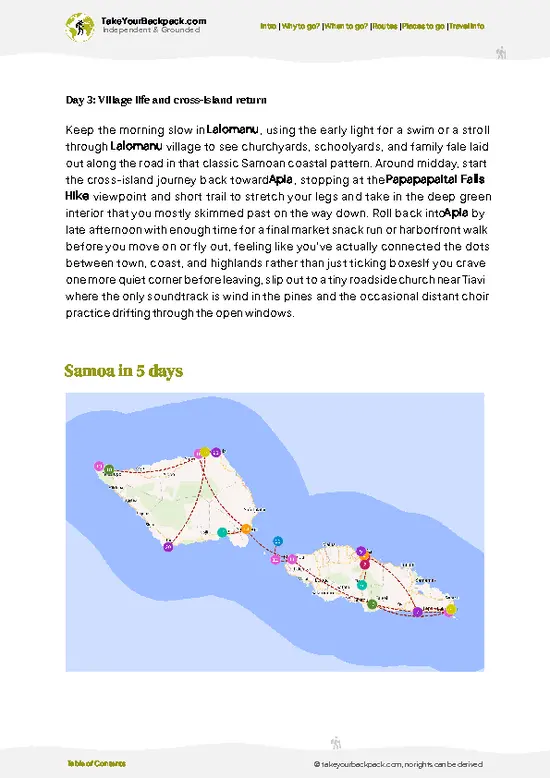
The 5-Day Two-Island Explorer

The vibe: A fuller loop that connects Apia, Upolu’s wild south, and Savai’i’s slower, more elemental side, using one ferry crossing and a mix of short hikes and beach time. It’s for travelers who want both the headline icons and the quieter corners where Samoa really breathes.
  • Historical and political heart of Samoa around Apia and Mulinu’u Peninsula
  • O Le Pupu-Puʿe National Park, To Sua Ocean Trench, and Lalomanu Beach
  • Car-free island life on Manono and village stays near Mulifanua
  • Savai’i’s Afu Aau Waterfall, Manase Beach, Falealupo Rainforest Reserve, and Taga Blowholes
🌍 Want a ready-to-use travel plan for Samoa?
The overview above compares different route options based on your travel time and style. The complete Travel Guide breaks each itinerary down in detail, including maps, stops, highlights, and transport information.

Explore all route details 👉

Get the Travel Guide -

🌤️ When to go?Choosing the right months to travel

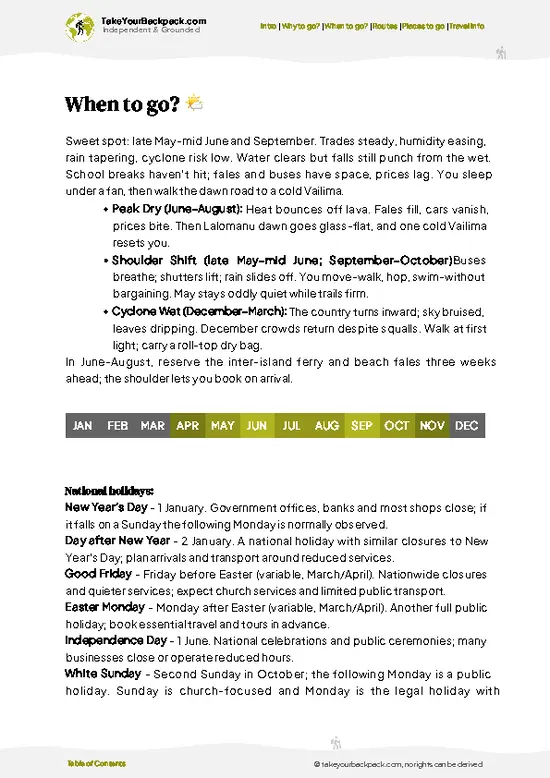
Sweet spot: late May-mid June and September. Trades steady, humidity easing, rain tapering, cyclone risk low. Water clears but falls still punch from the wet. School breaks haven’t hit; fales and buses have space, prices lag. You sleep under a fan, then walk the dawn road to a cold Vailima.
  • Peak Dry (June-August): Heat bounces off lava. Fales fill, cars vanish, prices bite. Then Lalomanu dawn goes glass-flat, and one cold Vailima resets you.
  • Shoulder Shift (late May-mid June; September-October): Buses breathe; shutters lift; rain slides off. You move—walk, hop, swim—without bargaining. May stays oddly quiet while trails firm.
  • Cyclone Wet (December-March): The country turns inward; sky bruised, leaves dripping. December crowds return despite squalls. Walk at first light; carry a roll-top dry bag.

In June-August, reserve the inter-island ferry and beach fales three weeks ahead; the shoulder lets you book on arrival.

source: climatestotravel.comJANJanuary: fair for travelingFEBFebruary: fair for travelingMARMarch: fair for travelingAPRApril: good for travelingMAYMay: highly recommended for travelingJUNJune: excellent for travelingJULJuly: highly recommended for travelingAUGAugust: highly recommended for travelingSEPSeptember: excellent for travelingOCTOctober: highly recommended for travelingNOVNovember: good for travelingDECDecember: fair for traveling
📅 Traveling in a specific month?
Get a full month-by-month breakdown of weather, crowds, costs, festivals, and seasonal highlights in the complete travel guide.

Get full details when to go 👉

Get the Travel Guide -
Samoa - |Samoa|pixabay-213157

💰 Costs (as of 2026)Travel costs in Samoa

Expect to spend WST 120-180 (US$45-70) per day if you ride the buses, sleep simple, and choose just one paid sight most days.
  • dorm accommodation: In Apia, basic dorm beds run WST 35-70; outside the capital you’re often in beach fales at WST 60-100 per person including dinner and breakfast (count that into your food math). System tip: call or walk in, ask for “fan room/dorm” and weekly rates—Samoa still rewards cash and direct bookings, and a shared fale drops fast when you split it.
  • meals: “Supermarket Survival” is bread, tins of tuna/mackerel, ramen, bananas, and instant coffee for WST 15-25/day if you skip imports (cheese/cereal punish you). Street food reality: outside Apia, hot plates and BBQ pop up at dusk for WST 8-15; in villages you’ll default to fale or resort kitchens at WST 25-40. Compared with Fiji, you’ll find fewer cheap eats and pay a little more; still far kinder than French Polynesia or American Samoa.
  • local transport: The painted wooden aiga buses are the unlock: WST 2-5 in town, 7-12 cross-island, no service late or on Sundays. The Savai‘i ferry is WST 12-16 one-way, then another bus on the other side. Hitching is normal and polite; offer WST 2-5. Cars run WST 120-160/day
read more 👉
Expect to spend WST 120-180 (US$45-70) per day if you ride the buses, sleep simple, and choose just one paid sight most days.
  • dorm accommodation: In Apia, basic dorm beds run WST 35-70; outside the capital you’re often in beach fales at WST 60-100 per person including dinner and breakfast (count that into your food math). System tip: call or walk in, ask for “fan room/dorm” and weekly rates—Samoa still rewards cash and direct bookings, and a shared fale drops fast when you split it.
  • meals: “Supermarket Survival” is bread, tins of tuna/mackerel, ramen, bananas, and instant coffee for WST 15-25/day if you skip imports (cheese/cereal punish you). Street food reality: outside Apia, hot plates and BBQ pop up at dusk for WST 8-15; in villages you’ll default to fale or resort kitchens at WST 25-40. Compared with Fiji, you’ll find fewer cheap eats and pay a little more; still far kinder than French Polynesia or American Samoa.
  • local transport: The painted wooden aiga buses are the unlock: WST 2-5 in town, 7-12 cross-island, no service late or on Sundays. The Savai‘i ferry is WST 12-16 one-way, then another bus on the other side. Hitching is normal and polite; offer WST 2-5. Cars run WST 120-160/day plus a WST 20 temp license—only worth it if you share.
  • activities: The big drains are entry fees (To Sua WST 20; waterfalls WST 5-10; beach day fees WST 5-20), boat hops (Namua etc. WST 20-30 plus day fee), and any diving or guided tours. Car days masquerade as “activities” and add the most. Cheaper than Cook Islands tours; more than Tonga’s DIY hikes.
  • miscellaneous: Budget leaks: ATM fees, bottled water outside Apia, sunscreen, Sunday taxis when buses stop, and data (SIM WST 5-10; usable weekly bundles WST 10-20). Beer: Vailima WST 5-10; happy to be your reward, costly as a habit. Cash rules at village gates—carry small notes or you’ll overpay.
⚠️ Prices can change and everyone travels differently, so take this as a rough guide. Hope it helps you plan your adventure!

✈️ The backpacker research shortcutSamoa Travel Guide

An offline-friendly backpacking guide with optimized travel routes, ranked highlights, transport advice, and the best areas to stay.
example page 0 from our offline Travel Guide for Samoaexample page 1 from our offline Travel Guide for Samoaexample page 2 from our offline Travel Guide for Samoaexample page 3 from our offline Travel Guide for Samoaexample page 4 from our offline Travel Guide for Samoaexample page 5 from our offline Travel Guide for Samoaexample page 6 from our offline Travel Guide for Samoaexample page 7 from our offline Travel Guide for Samoa
The digital guide (163 pages) contains:
37 highlights, ranked by travel appeal
Optimized 2, 3 & 5-day travel routes
Cities, national parks, beaches, historical sites, ...
How to get around
Offline-friendly for travel without Wi-Fi
👉 Click to see all 30+ guide features

📅 Plan smarter in minutes, not weeks
Month by month travel advice
Festivals & national holidays
Budget expectations

🗺️ Go to the right places, skip the overrated ones
Honest pros & cons of destinations
Top hikes, parks & viewpoints
Lesser-known places most travelers miss
Clear “worth it vs skip it” guidance

🛏️ Travel smoothly without rookie mistakes
Best areas to stay
Transport systems explained simply
Common scams & safety advice
SIM cards, money & practical tips

🌍 Understand the country, not just visit it
Culture & traditions
52 Essential phrases & customs
Festivals worth planning around
Traveler-friendly historical context
Insights that make places more meaningful

📱 Built for real travel conditions
Fully downloadable PDF
Works completely offline
Optimized for phone use
Useful in remote areas & buses
Everything in one place
Save weeks of stressful planning
Get instant access to the full guide directly. 30-day money-back guarantee.


Sent to your inbox immediately after payment • 100% Secure Checkout
Best Backpacking Travel Advisor 2025 tourism awardBest Backpacking
Travel Advisor
2025
What others say about Take Your Backpack Guides:
⭐⭐⭐⭐⭐
Fantastic, amazing amount of information!
⭐⭐⭐⭐⭐
My goodness this is amazing, it's what I've been looking for hats off too you!
⭐⭐⭐⭐⭐
I think this is absolutely BRILLIANT
⭐⭐⭐⭐
Very complete and informative. It's still missing places, but I gotta to commend you
⭐⭐⭐⭐⭐
This is truly amazing, thank you, can't wait to explore it with my kids!
⭐⭐⭐⭐⭐
Awesome resource, thank you!
⭐⭐⭐⭐⭐
This is amazing! Can't wait to explore the ones I haven't seen
⭐⭐⭐⭐
I love this! Well done, great idea.
⭐⭐⭐⭐⭐
Thanks for taking the time to make this gem!
⭐⭐⭐⭐⭐
This might be the best website I've ever seen.
⭐⭐⭐⭐⭐
Congratulations, and thank you so much for your work; it's incredibly valuable.
⭐⭐⭐⭐
In all seriousness I think you did a great job pointing out the important spots
⭐⭐⭐⭐⭐
10/10 very good
⭐⭐⭐⭐⭐
As someone who's only just starting to visit regularly this is awesome, thank you.
⭐⭐⭐⭐
Thank you very much! I'm going to visit my dad, it's going to be very useful!
⭐⭐⭐⭐⭐
This is really cool! We'll be travelling for the first time and this definitely come in handy.
⭐⭐⭐⭐⭐
You are now our minister of culture, congratulations 👨‍💼
⭐⭐⭐⭐⭐
Just wanted to tell you that this is a pearl! Going to follow your recommendations.
⭐⭐⭐⭐⭐
This is so cool. I'll definitely be using the resource for my travels soon.
⭐⭐⭐⭐⭐
This is very impressive! Good work.
⭐⭐⭐⭐⭐
This is an amazing and informative site. Very well done!

🛏️ Where to stay?Accommodation types and options

Yes — Samoa has hostels and budget accommodation, mostly on Upolu and Savai’i with the greatest supply around Apia and the main ferry hubs.

Apia/central Upolu offers the most choices, easy access to markets, museums and transport and the liveliest nightlife but is busier and less quiet; Lalomanu and other south‑east Upolu villages give cheap beachfront stays with direct reef access and relaxed evenings but limited services and basic facilities; Salelologa on Savai’i has affordable options close to the ferry and natural highlights but fewer beds overall, and remote inland or west‑coast spots are … read more 👉
Yes — Samoa has hostels and budget accommodation, mostly on Upolu and Savai’i with the greatest supply around Apia and the main ferry hubs.

Apia/central Upolu offers the most choices, easy access to markets, museums and transport and the liveliest nightlife but is busier and less quiet; Lalomanu and other south‑east Upolu villages give cheap beachfront stays with direct reef access and relaxed evenings but limited services and basic facilities; Salelologa on Savai’i has affordable options close to the ferry and natural highlights but fewer beds overall, and remote inland or west‑coast spots are very quiet and safe yet require reliable transport and bring fewer accommodation choices.

If you enjoy meeting fellow travelers, consider choosing hostels with high ratings for atmosphere. On the other hand, if you prefer having your own space, a hotel might be a better option.

🚌 Getting aroundPublic transport and other ways to get around

Samoa runs on church bells and tide tables. Schedules are suggestions; patience is currency. Buses idle with island reggae until they’re full, ferries wait for trucks that turn up when they turn up. Sunday hush grips the roads. Tropical squalls hammer, then steam lifts off the blacktop. Ride the rhythm—wave, wait, ride.
  • Public buses (aiga) Windows down, plywood benches, island reggae loud. You pay when you get off; coins in a warm palm. Wave them down anywhere; knock the roof to stop. Share space
read more 👉
Samoa runs on church bells and tide tables. Schedules are suggestions; patience is currency. Buses idle with island reggae until they’re full, ferries wait for trucks that turn up when they turn up. Sunday hush grips the roads. Tropical squalls hammer, then steam lifts off the blacktop. Ride the rhythm—wave, wait, ride.
  • Public buses (aiga) Windows down, plywood benches, island reggae loud. You pay when you get off; coins in a warm palm. Wave them down anywhere; knock the roof to stop. Share space without fuss—yes, laps happen. Modest dress earns smiles. Cheap, slow, wonderfully human.
  • Upolu-Savai‘i ferry The geometric unlock: one slab of steel turns two islands into one day’s reach. Buy a ticket at Mulifanua for Salelologa, board early for shade. Trucks load first; schedules flex with cargo and squalls. Open deck beats cabin if you get queasy; spray tastes of diesel and salt.
  • Taxis and private cars The speed tax. Door-to-door in a third of the time, but 10-20x the bus fare unless you split three ways. Agree the price before doors close. Essential for late nights, airport runs, or the Cross-Island dash.
  • Roadside lifts in utes The budget disruptor that locals actually use. Stand relaxed, palm low. Beds are bouncy; grip the rail. Offer a few tala for fuel or fruit from your pack. You’ll leapfrog villages fast, especially outside Apia.

Sleep near a wharf or bus depot and take the day’s first bus to the earliest ferry, then another bus on the far side—one clean chain saves hours and cash.
Distance: Faleolo International Airport (APW) is about 32 km (20 miles) west of central Apia.

Main ways to get into town:
  • Public bus (local “aiga” buses): About 60-90 minutes depending on stops and traffic. Typical fare WST 3-5. Runs roughly Monday-Saturday in daylight hours (about 06:30-18:00) and is very limited or not running on Sundays and late nights. Buses usually stop outside the terminal area when in service; ask airport staff where to wait. Pay cash on board; small change helps.
  • Pre-booked shared shuttle: About 45-60 minutes. Usually WST 30-40 per person to central Apia, with door-to-door drop-offs for popular hotels/guesthouses. Operates to match most flights but best booked in advance (your accommodation can arrange, or use a local shuttle operator).
  • Taxi (no ride-hailing like Uber/Lyft in Samoa): About 40-60 minutes. Expect WST 70-100 in daytime, WST 80-120 late evening/overnight. Taxis aren’t metered—agree the fare before you go. Cash is standard.

Good to know:
- If you land late or on a Sunday, don’t count on the bus—plan a shuttle or taxi.
- There’s a taxi rank just outside arrivals; shuttle drivers usually hold name boards.
- ATMs are available at the airport, but it’s smart to have some small tala for fares.
⚠️ Prices and routes can change, so take this as a rough guide and ask for local advice when you arrive.

🔒 Safety (risk Level: low)What first-time visitors should know

Safety for solo travelers, including women and LGBTQ+ individuals
Samoa is generally safe for solo travelers, including women and LGBTQ+ individuals, but basic precautions are advised. While crime rates are low, petty theft can occur, so keep belongings secure. Women should dress modestly, particularly in rural areas, to respect local customs. LGBTQ+ travelers should be aware that while Samoa is welcoming, public displays of affection might attract attention due to conservative views.


Full official government travel advisory (live updates)
View details 👉

✈️ VisaUnderstanding entry rules

Most travelers, including those from the U.S., EU, and many other countries, do not need a visa for stays up to 60 days in Samoa. Ensure your passport is valid for at least six months beyond your planned departure date. Always check the latest entry requirements before traveling as policies can change.
⚠️ Visa requirements can change over time, so always check the latest visa requirements with the official embassy or government website before you travel.

🎒 What to pack?What you'll need while traveling

Expect it to be hot and humid in Samoa, with a mix of sunny beaches and lush jungles. Pack light, breathable clothing, but remember that modesty is key, especially in villages—cover shoulders and knees when you’re not on the beach. If you’re planning to visit any churches or temples, it’s extra important to dress respectfully. The terrain can be pretty rugged, so sturdy footwear is a must for exploring. Also, be ready for sudden rain showers; a lightweight rain jacket or poncho can be a lifesaver.

Apart from this country specific advice, I have also crafted a general packing list that should help on any trip. authorOver the years, I've learned the importance of packing minimally. It's so much easier to jump on the back of a truck or squeeze yourself into the last spot of a minibus without that supersized backpack. If you're headed to a warm destination, leave your winter jacket at home; for colder regions, opt for thin thermal underlayers. Instead of packing your entire wardrobe, bring just three sets of clothes, as laundry facilities are available everywhere.

View the full list 👉
🎒 Planning the practical side of your trip?
Get detailed information on transport, daily budgets, internet access, local customs, food, language, and other essentials in the complete Travel Guide.

Get detailed practical information 👉

Get the Travel Guide -

🙋 FAQQuick answers to practical concerns

Trip Planning


Personal tip: I normally search on good rating for atmosphere (for meeting people) and location (for easy exploring). Cleanliness as a bonus.


Travel Essentials

Hepatitis A and B, typhoid, and routine vaccines (MMR, tetanus, diphtheria, and pertussis) are recommended for Samoa. Consider rabies if you’re planning extended stays or animal interactions. Check current health advisories for updates.


vaccination requirements
When I first started traveling, I often spent part of my first day in a new country hunting for a local SIM card. While this can still be slightly cheaper, it also takes time and planning.

These days, it's much simpler to install an eSIM before leaving home. Once you arrive in Samoa, you can activate it immediately and have mobile data from the moment you land — which is especially useful for ordering transport or navigating away from busy airports.

There are many providers nowadays, and price differences are usually small. I personally go with Airalo, as it offers excellent network coverage throughout the country and strong global coverage, so you can manage multiple countries from a single app.


Get your e-sim for Samoa

Culture & Customs

Respect the **Fa’a Samoa** (The Samoan Way), which emphasizes community and respect. Remove shoes before entering homes and always ask permission before taking photos of people or villages. Dress modestly; women should wear skirts or dresses below the knee, and men should avoid going shirtless.

On Sundays, many activities pause for church and family time; it’s best to follow suit. Avoid public displays of affection, which can be frowned upon. For LGBTQ+ travelers, discretion is advised as homosexuality is not widely accepted in traditional settings. Women, particularly solo travelers, should be mindful of their surroundings and consider dressing conservatively to respect local customs.
Trying traditional food is always a great way to experience the culture. Here are some must-try dishes for Samoa.
  • Oka I’a: This is Samoa’s take on ceviche, featuring raw fish marinated in coconut cream, lime juice, and a bit of salt. It’s refreshing, creamy, and a perfect way to beat the island heat.
  • Palusami: A rich dish made from taro leaves wrapped around coconut cream, onions, and sometimes corned beef, then baked. It’s often served during traditional feasts and is a comforting staple that’s both savory and slightly sweet.
  • Fa’ausi: This dessert combines taro or breadfruit with a sweet coconut caramel sauce. It’s a beloved treat that highlights the importance of coconut in Samoan cuisine.
  • Sapasui: Samoa’s version of chop suey, this dish is a flavorful mix of vermicelli noodles, soy sauce, and typically beef or chicken. It reflects the multicultural influences in Samoan cooking due to Chinese immigration.
  • Pani Popo: Soft buns baked in sweet coconut cream. It’s a popular snack or dessert and showcases the Samoan love for all things coconut.
The tap water in Samoa is generally not recommended for tourists. While locals might drink it, it’s safer for travelers to stick with bottled or filtered water to avoid any digestive issues. Always opt for sealed bottled water, especially in more rural areas.
The main language in Samoa is Samoan. Backpacking is way more rewarding if you know a bit of the local language, so I'd suggest brushing up on the basics just in case your Samoan skills have become a bit rusty.

Want to understand locals better?
The complete Travel Guide for Samoa includes 52 essential words and phrases — greetings, thank-yous, ordering food, transport, numbers, and common local expressions you'll actually hear.

Get your local basic phrases 👉

Get the Travel Guide -


In Samoa, English is widely spoken, especially in urban areas and among the younger population. It is one of the official languages, alongside Samoan, and is commonly used in government, education, and business. Most Samoans are bilingual, and you’ll find that many locals, particularly those working in the tourism industry, are fluent in English.

In rural areas, English proficiency may vary, with some older generations primarily speaking Samoan. However, basic English phrases are generally understood, making communication manageable for travelers. Road signs, menus, and public information are often available in both languages, enhancing accessibility for English-speaking visitors.

While English is prevalent, embracing some Samoan phrases can enrich your experience and foster goodwill with locals. Overall, travelers will find it relatively easy to navigate and communicate in Samoa due to the widespread use of English.

Money & Payments

The local currency of Samoa is WST (Tala).

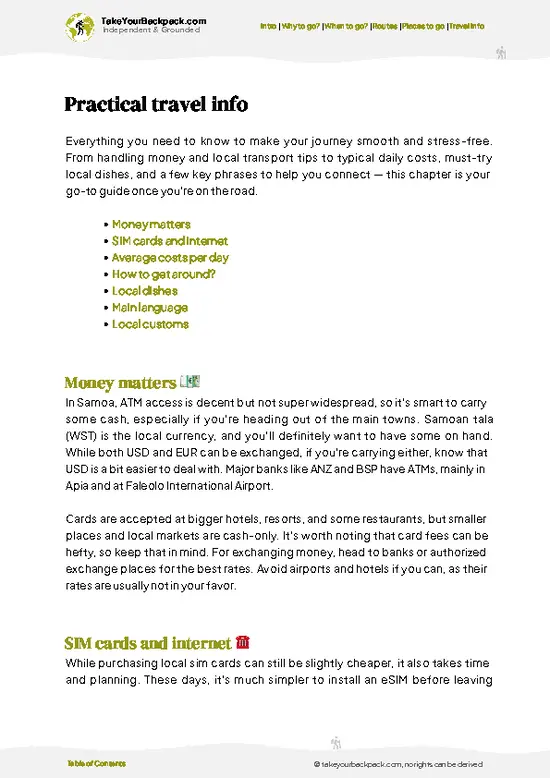
In Samoa, ATM access is decent but not super widespread, so it’s smart to carry some cash, especially if you’re heading out of the main towns. Samoan tala (WST) is the local currency, and you’ll definitely want to have some on hand. While both USD and EUR can be exchanged, if you’re carrying either, know that USD is a bit easier to deal with. Major banks like ANZ and BSP have ATMs, mainly in Apia and at Faleolo International Airport.

Cards are accepted at bigger hotels, resorts, and some restaurants, but smaller places and local markets are cash-only. It’s worth noting that card fees can be hefty, so keep that in mind. For exchanging money, head to banks or authorized exchange places for the best rates. Avoid airports and hotels if you can, as their rates are usually not in your favor.

Tipping in Samoa isn’t a common practice, as it’s not part of the local culture. While service charges are often included in bills at hotels and restaurants, a small token of appreciation is warmly accepted if you feel you’ve received exceptional service. Always check your bill first to see if a service charge is already included.

🧩 Nearby countriesNearby backpacking alternatives

We 💚 feedbackThe bottom line on traveling here

Samoa rewards patience. You’ll sweat through cotton on slow, reggae-blaring buses, tiptoe over hot black lava, and learn that Sundays mean silence and no transport. But sleeping in an open fale as the lagoon hisses, waking to salt on your lips and breadfruit smoke, then dropping into To Sua’s blue bowl and the first cold Vailima—worth it. Best for travelers who move slow, respect village rules, and don’t need Wi‑Fi. Not ideal for nightlife hunters or planners who panic when timetables shrug. Small downside: dogs bark all night.

✍️ Help improve this page!
The information on this page is based on in-depth research, insights shared by experienced travelers, and feedback from the local travel community in Samoa. While every effort is made to keep the information accurate and current, conditions can change — so if you spot anything incorrect or outdated, please get in touch.


🙋‍♂️ Give feedback

👋 Meet the founderWho’s Behind Take Your Backpack?

Johan, backpacker and founder of TakeYourBackpackHi, I’m Johan (Netherlands 🇳🇱), the creator of TakeYourBackpack. Over the past decade, I’ve backpacked through 80+ countries across six continents, gaining extensive experience with independent travel, long-term trips, and overland routes.

This site is built on a combination of firsthand travel experience and carefully curated insights from other backpackers. Many guides are based on places I’ve personally visited, while others bring together tips, observations, and practical advice shared by trusted travelers I’ve met along the way.

The goal is to provide realistic, experience-driven guidance — not generic itineraries — so you can explore destinations with better context, clearer expectations, and more confidence.

Get full Samoa guide •
Instant download • 37 highlights • Full Offline guide