Trip Planning
The TakeYourBackpack guidebooks are your all-in-one travel companion, featuring the best cities, national parks, hikes, beaches, and unique sites, along with essential tips on when to go, how to get around, exchanging money, and even local phrases to get you started — everything you need for a smooth, unforgettable backpacking adventure.
Stop researching. Start exploring.Discover all 96 highlights,ranked
and organized into practical routes.
Get instant access
Planning a backpacking route through Madagascar can be tricky — you need to balance must-see places, travel times, budget, and how long to stay in each destination. Our free personalized Madagascar itinerary planner creates a route based on your travel style, trip duration, and interests, so you can spend less time researching and more time exploring.
Personal tip: I normally search on good rating for atmosphere (for meeting people) and location (for easy exploring). Cleanliness as a bonus.
Travel Essentials
For Madagascar, make sure your routine vaccines are up to date, and get hepatitis A and typhoid shots. Hepatitis B and rabies are also recommended, especially for long trips or rural travel near animals. A yellow fever vaccination certificate is only required if you arrive from or have transited through a country with yellow fever risk. Malaria is present across most of the island, especially on the coasts, so talk to a travel clinic about antimalarial tablets and pack a strong DEET repellent.
vaccination requirementsWhen I first started traveling, I often spent part of my first day in a new country hunting for a local SIM card. While this can still be slightly cheaper, it also takes time and planning.
These days, it's much simpler to install an eSIM before leaving home. Once you arrive in Madagascar, you can activate it immediately and have mobile data from the moment you land — which is especially useful for ordering transport or navigating away from busy airports.
There are many providers nowadays, and price differences are usually small. I personally go with
Holafly, as it offers excellent network coverage throughout the country and strong global coverage, so you can manage multiple countries from a single app.
HolaFly eSimCulture & Customs
Respecting fady, the local taboos that vary from village to village, is the most important custom in Madagascar. Depending on the area, a fady might forbid pointing at tombs with a straight finger (use a bent finger instead), swimming in a certain lake, or bringing pork into a sacred place, so ask your guide what applies before you enter forests, tombs or sacred sites. Ask before photographing people, ceremonies like the famadihana (the reburial of ancestors) and tombs. Don’t hand out sweets, pens or money to children, as it encourages begging. Patience goes a long way, since rushing or raising your voice is considered rude in a culture that runs on “mora mora” (slowly, slowly). Women should dress modestly outside beach areas to avoid unwanted attention, and same-sex couples should avoid public displays of affection.
Trying traditional food is always a great way to experience the culture. Here are some must-try dishes for Madagascar.
- Romazava: Madagascar’s national dish is a light, gingery broth of zebu beef simmered with mixed leafy greens, including brèdes mafana. Its leaves make your lips tingle. It is served over a mound of rice and eaten across the island at family tables and roadside hotely.
- Ravitoto sy henakisoa: This is pounded cassava leaves slow-cooked with fatty pork until dark and rich. It is the classic Sunday and celebration dish in the highlands and a source of real pride for Merina cooks.
- Vary amin’anana: Rice is cooked soft with chopped greens, often with bits of meat or shrimp. It is the traditional breakfast and a cheap, filling bowl at markets for 1,000 to 2,000 MGA.
- Zebu brochettes and steak: Grilled zebu is the meat of Madagascar. You will find smoky skewers at every taxi-brousse stop and thick steaks in town restaurants. Zebu also carry deep cultural weight as a measure of wealth and as sacrificial animals.
- Mofo gasy and koba: Mofo gasy are slightly sweet rice-flour cakes cooked in clay molds at dawn street stalls. Koba is a dense log of ground peanuts, banana and rice flour wrapped in banana leaves and sold by the slice.
- Sakay: This is a fiery red chili paste with ginger and garlic that sits on almost every table. A small spoonful brings plain rice and broth to life.
Tap water in Madagascar is not safe for travelers to drink. Many locals boil it or use it only for washing, and in rural areas water often comes from wells and rivers. Stick to sealed bottled water, which costs about 1,500 to 3,000 MGA for 1.5 liters, or carry a filter bottle or purification tablets to cut costs and plastic waste.
The main language in Madagascar is
Malagasy. Backpacking is way more rewarding if you know a bit of the local language, so I'd suggest brushing up on the basics just in case your Malagasy skills have become a bit rusty.
Want to understand locals better?The complete Travel Guide for Madagascar includes 52 essential words and phrases — greetings, thank-yous, ordering food, transport, numbers, and common local expressions you'll actually hear.
Get your local basic phrases 👉
Get the Travel Guide - is not widely spoken in Madagascar. You will find it at mid-range hotels, tour agencies and with national park guides in Antananarivo, Nosy Be and along the RN7, and some younger people and hostel staff speak a little. In rural areas almost nobody speaks English, and Malagasy is the everyday language. French is far more useful, so download an offline French pack in a translation app and learn a few Malagasy words like “salama” (hello) and “misaotra” (thank you), which get warm smiles everywhere.
Money & Payments
The local currency of Madagascar is MGA (Ar).
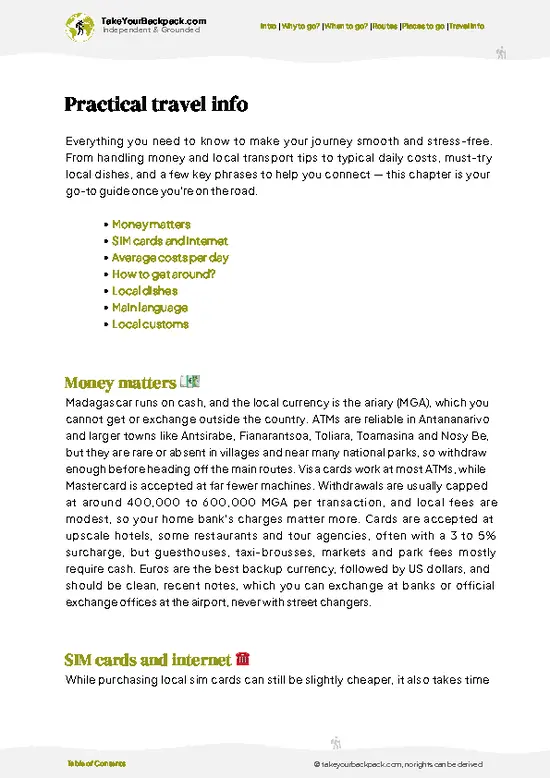
Madagascar runs on cash, and the local currency is the ariary (MGA), which you cannot get or exchange outside the country. ATMs are reliable in Antananarivo and larger towns like Antsirabe, Fianarantsoa, Toliara, Toamasina and Nosy Be, but they are rare or absent in villages and near many national parks, so withdraw enough before heading off the main routes. Visa cards work at most ATMs, while Mastercard is accepted at far fewer machines. Withdrawals are usually capped at around 400,000 to 600,000 MGA per transaction, and local fees are modest, so your home bank’s charges matter more. Cards are accepted at upscale hotels, some restaurants and tour agencies, often with a 3 to 5% surcharge, but guesthouses, taxi-brousses, markets and park fees mostly require cash. Euros are the best backup currency, followed by US dollars, and should be clean, recent notes, which you can exchange at banks or official exchange offices at the airport, never with street changers.
Tipping in Madagascar is not obligatory but is appreciated, as wages are very low. In sit-down restaurants, leaving 5 to 10% or rounding up is common, while national park guides typically get 10,000 to 30,000 MGA (US$2 to 7) per day, and private drivers a bit more. Porters and hotel staff are happy with 2,000 to 5,000 MGA for help with bags.
v2.webp)
 Best Backpacking
.jpg) Over the years, I've learned the importance of packing minimally. It's so much easier to jump on the back of a truck or squeeze yourself into the last spot of a minibus without that supersized backpack. If you're headed to a warm destination, leave your winter jacket at home; for colder regions, opt for thin thermal underlayers. Instead of packing your entire wardrobe, bring just three sets of clothes, as laundry facilities are available everywhere.
Over the years, I've learned the importance of packing minimally. It's so much easier to jump on the back of a truck or squeeze yourself into the last spot of a minibus without that supersized backpack. If you're headed to a warm destination, leave your winter jacket at home; for colder regions, opt for thin thermal underlayers. Instead of packing your entire wardrobe, bring just three sets of clothes, as laundry facilities are available everywhere.







.jpg) Hi, I’m Johan (Netherlands 🇳🇱), the creator of TakeYourBackpack. Over the past 3 decades, I’ve backpacked through 90+ countries across six continents, gaining extensive experience with independent travel, long-term trips, and overland routes.
Hi, I’m Johan (Netherlands 🇳🇱), the creator of TakeYourBackpack. Over the past 3 decades, I’ve backpacked through 90+ countries across six continents, gaining extensive experience with independent travel, long-term trips, and overland routes.