×
Republic of the Congo 🇨🇬

backpacking Africa Republic of the Congo 🇨🇬Navigate jungle waterways defining true travel routes.

Explore NigeriaExplore Réunion

Backpacking Congo in 2026

A complete guide including when and where to go, costs, transport, itineraries, and practical travel advice.
What a trip here is really like

Backpacking Congo
By Johan Kruseman 🇳🇱 | Updated May 22, 2026

The biggest myth: Congo (the Republic of the Congo, also known as Congo-Brazzaville) is just the chaos across the river. On the ground it’s calmer and greener. Move at river pace and doors open.

Brazzaville runs on rumba and river light: red laterite on your ankles, charcoal from the maquis, sapeurs in pressed color as the Congo River flashes at Malebo Pool. Then the forest takes over; at Odzala‑Kokoua, fog lifts off bais as forest elephants slip by and trackers guide you, shin‑deep in mud, to the cough of western lowland gorillas. Your shirt is soaked, your calves burn, and the beer at camp tastes earned; transport is slow and rains chew the roads, but that friction keeps it honest and sharpens every quiet breath.

Compared with Gabon, Congo is less packaged; compared with the DRC, it’s easier to breathe; Cameroon brings more road miles and peaks, but here it’s deep forest and river culture. Go if patience thrills you and you prefer sweat-earned moments over guarantees.

👉 Get the 📖 Travel Guide of Congo

Brazzaville & the Congo Riverfront

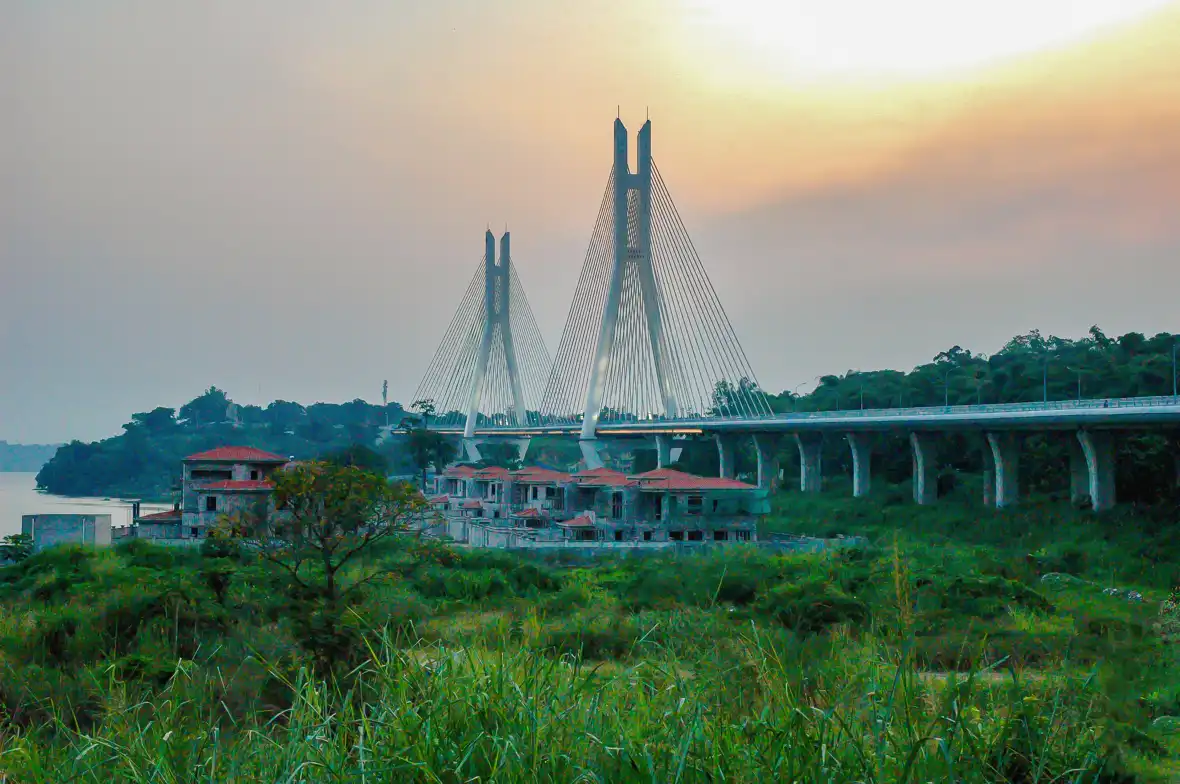
Red dust on your cuffs, diesel on the air, and a bassline of Congolese rumba leaking from courtyard bars. This is the softest landing in Congo: ATMs that work, decent guesthouses, SIMs that activate without drama. Walk the river corniche at dusk when the current turns pewter. Markets are busy but courteous; keep cash small and your phone deep. Reward: grilled fish and a cold Ngok as barges slide past like dark islands.

Léfini–Lesio-Louna (N2 north of Brazzaville)

Cracked tarmac gives way to laterite and military checkpoints; smiles help, paperwork helps more. Heat sticks your shirt to your back by 9 a.m. Boat the green tunnel of the Léfini River, then watch forest edge open into savanna cliffs. Gorilla sanctuary visits are structured and brief but honest. It’s the best wildlife taste on a budget—easy overnight, 4x4 recommended, patience mandatory.

Congo–Ocean Corridor: Brazzaville to Pointe-Noire (CFCO line)

The train is a character, not a schedule. Swaying cars, shouted lists of stops, and sometimes a night stalled under warm rain. Road works too—shared taxis, gendarmes, and long coffee pauses. Pointe-Noire hits you with salt air and generator hum. Oil workers and hustling fishermen share the maquis; you eat capitaine with fingers and lick charcoal from them. Diösso Gorges burn orange at late light. This run rewards rail romantics and street eaters.

Conkouati–Douli National Park (Atlantic coast)

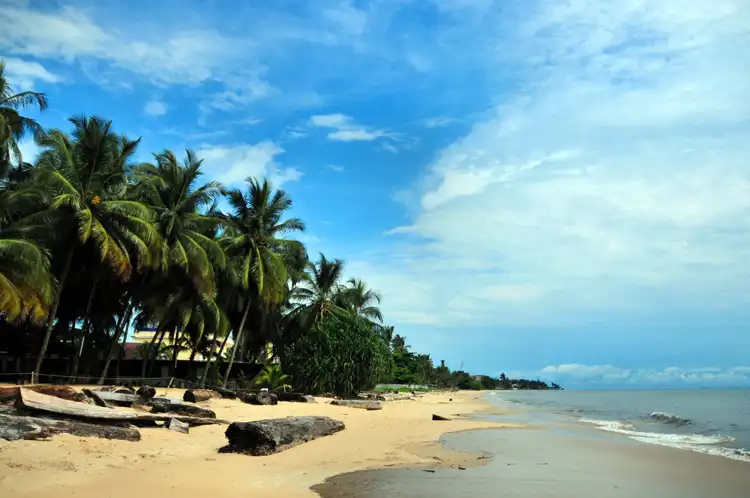
Sand tracks, tidal creeks, and a steering wheel that never sits straight. Humidity wraps your neck like a wet scarf. Rangers know the tides; go with them. In turtle season the beach becomes a dark runway of slow-moving domes; in the lagoons, dolphins roll like gray commas. Nights are insect loud and moon-bright. For travelers who like mud on the ankles and salt in the hair.

Odzala–Kokoua National Park (northwest rainforest)

Getting here is the tax: charter flights if your wallet is thick, long logging roads if your spine is. Boots sink to the ankle, and sweat bees test your patience at the bais. Then it lands—the silver brush of a lowland gorilla in the understory, forest elephants ghosting out to the mineral lick, rain drumming the canopy like applause. Costly, yes, but for patient naturalists, it’s the payoff you’ll measure other forests against.
Geography and where places are located
Loading the map 🌍
CLICK TO FILTER
city
town
unique site
national park
hike
beach
attraction
festival
region
SHOW COUNTRY’S BESTSHOW ALL

Why go?What makes this country worth the trip

Low cost

Congo rewards tight budgets. You eat well on street smoke: grilled fish, saka-saka, plantains, a ladle of chili oil that bites back. Shared taxis and battered minibuses are cheap if you squeeze in and name your price before the door slams. Fan rooms with thin mattresses and cold showers keep the heat manageable. Skip imported menus and you’ll watch coins stretch. Most backpackers keep days in the low double digits; upcountry can drop lower. The payoff … read more 👉
Congo rewards tight budgets. You eat well on street smoke: grilled fish, saka-saka, plantains, a ladle of chili oil that bites back. Shared taxis and battered minibuses are cheap if you squeeze in and name your price before the door slams. Fan rooms with thin mattresses and cold showers keep the heat manageable. Skip imported menus and you’ll watch coins stretch. Most backpackers keep days in the low double digits; upcountry can drop lower. The payoff hits at dusk: dust rinsed off, a cold beer sweating in your hand, river breeze in Brazzaville telling you tomorrow will be possible.
Want the complete picture of Congo?
The offline Travel Guide brings everything together — routes, highlights & planning.

See what's included in the guide 👉

Get the Travel Guide -

⭐ HighlightsWhat not to miss along the way

  • Odzala-Kokoua National Park: The forest eats sound here—until a gorilla chest-beats from the marantaceae and the air vibrates in your sternum, sweat bees stippling your forearms while your boots slurp through black-brown bai mud. When the sun drops, the deck above a tea-colored stream turns gold and the first cold beer tastes like permission to exhale. Off the map: Mboko’s red-dirt airstrip at sunset, the Lekoli River ford at low water, and Lango Bai at first light.
  • Lesio-Louna Gorilla Reserve (Léfini): You paddle a flat, tannin-stained river while fish flick silver and grasshoppers rasp in the heat; a juvenile gorilla on an island watches, lips working sugarcane, and the smell is wet earth and crushed leaf. Later the savannah opens—honey grass, hard light, a motor purring back to camp. Off the map: Lac Bleu near Ngabé, Loufoulakari Falls foaming into the Pool, and the quiet bamboo groves around Iboubikro.
  • Brazzaville River Rapids: The Congo river hammers basalt in broad daylight and throws
read more 👉
  • Odzala-Kokoua National Park: The forest eats sound here—until a gorilla chest-beats from the marantaceae and the air vibrates in your sternum, sweat bees stippling your forearms while your boots slurp through black-brown bai mud. When the sun drops, the deck above a tea-colored stream turns gold and the first cold beer tastes like permission to exhale. Off the map: Mboko’s red-dirt airstrip at sunset, the Lekoli River ford at low water, and Lango Bai at first light.
  • Lesio-Louna Gorilla Reserve (Léfini): You paddle a flat, tannin-stained river while fish flick silver and grasshoppers rasp in the heat; a juvenile gorilla on an island watches, lips working sugarcane, and the smell is wet earth and crushed leaf. Later the savannah opens—honey grass, hard light, a motor purring back to camp. Off the map: Lac Bleu near Ngabé, Loufoulakari Falls foaming into the Pool, and the quiet bamboo groves around Iboubikro.
  • Brazzaville River Rapids: The Congo river hammers basalt in broad daylight and throws mist across your face; sand gets between your teeth, vendors flip tilapia over coals, and a sweating bottle of Mützig cuts through the diesel and charcoal haze. Across the water, Kinshasa shimmers, close enough to smell the storm. Off the map: the Poto-Poto School of Painting’s sunbaked courtyards, Ile Mbamou’s reed beds, and the smoky grills of Marché Total after dark.
  • Conkouati-Douli National Park: Tracks run out and the coast begins—salt on your lips, mangroves breathing in and out, and turtle tracks scribbled across night-cooled sand; inland, a forest elephant prints your path in soft clay and you taste the metallic tang of humidity. The reward is a sky so wide you feel small in the right way. Off the map: Tchimpounga sanctuary viewpoints (with permission), the wind-bent ridges of the Mayombe, and Sounda Gorge on the Kouilou.
  • Diosso Gorges: Red earth drops away in scalloped walls and the wind lifts dust that tastes like iron; you walk the edge carefully, shoes stained ochre, Atlantic haze smudging the horizon while swifts carve the heat. Late light turns the canyon into a kiln and your shirt sticks to your back. Off the map: Dimonika Biosphere Reserve’s old forest tracks, Tchissanga Beach for raw surf, and Pointe-Noire’s Pointe-Indienne headland at dusk.
Spotted a mistake or missing a highlight? Contact us.

But Congo offers more...

Discover and compare all of its highlights per category

🧭 RoutesSuggested travel routes through Congo

The 5-Day Brazzaville & Falls Escape

The Vibe: A relaxed city-and-countryside sampler built around Brazzaville’s churches, markets, and one classic waterfall day trip, perfect if you want depth over distance. You’ll stay mostly in one place, using short taxi rides and a single road excursion to keep logistics easy.
The Highlights:
  • Brazzaville’s core neighborhoods and riverfront atmosphere.
  • Architectural contrasts at Basilique Sainte-Anne-du-Congo and Cathédrale Sacré-Cœur de Brazzaville.
  • Immersive bargaining and people-watching at Marché Poto-Poto and Marché Total de Bacongo.
  • A countryside escape to the Chutes de Loufoulakari.

The 10-Day Coast & Rainforest Circuit

The Vibe: A balanced loop that links Brazzaville’s culture with Pointe-Noire’s beaches and the deep forests of Odzala-Kokoua, ideal if you want both downtime and serious wildlife time. Expect a couple of big travel hops, then long, unhurried days in each region.
The Highlights:
  • Capital flavors and markets in Brazzaville.
  • Seafood, sand,
read more 👉

The 5-Day Brazzaville & Falls Escape

The Vibe: A relaxed city-and-countryside sampler built around Brazzaville’s churches, markets, and one classic waterfall day trip, perfect if you want depth over distance. You’ll stay mostly in one place, using short taxi rides and a single road excursion to keep logistics easy.
The Highlights:
  • Brazzaville’s core neighborhoods and riverfront atmosphere.
  • Architectural contrasts at Basilique Sainte-Anne-du-Congo and Cathédrale Sacré-Cœur de Brazzaville.
  • Immersive bargaining and people-watching at Marché Poto-Poto and Marché Total de Bacongo.
  • A countryside escape to the Chutes de Loufoulakari.

The 10-Day Coast & Rainforest Circuit

The Vibe: A balanced loop that links Brazzaville’s culture with Pointe-Noire’s beaches and the deep forests of Odzala-Kokoua, ideal if you want both downtime and serious wildlife time. Expect a couple of big travel hops, then long, unhurried days in each region.
The Highlights:
  • Capital flavors and markets in Brazzaville.
  • Seafood, sand, and sunsets around Pointe-Noire and Plage de Loango.
  • Exploring the Kouilou Region as a bridge between coast and forest.
  • Guided bai walks and forest trails inside Odzala-Kokoua National Park.

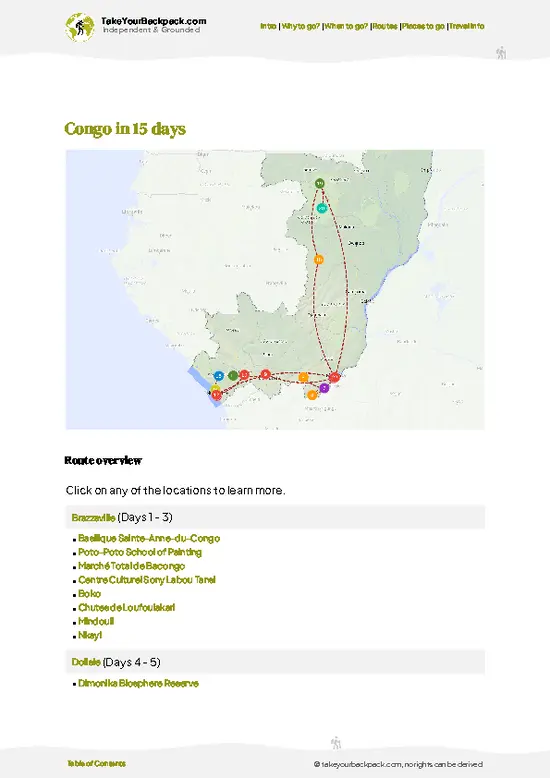
The 15-Day Congo Deep-Dive Expedition

The Vibe: A full-country adventure that threads from Brazzaville through northern river towns to Odzala-Kokoua and Nouabalé-Ndoki, then down to the Atlantic coast, designed for travelers who want the Republic of the Congo to be their main trip, not a side note. The pace is steady, with time to actually feel each region before moving on.
The Highlights:
  • Capital days in Brazzaville paired with a classic Loufoulakari Falls outing.
  • Overland journeys through Gamboma, Owando, and Makoua into the forested north.
  • Extended wildlife tracking in Odzala-Kokoua and Nouabalé-Ndoki National Parks.
  • Beach recovery and market wandering around Pointe-Noire and the Kouilou Region.
🌍 Want a ready-to-use travel plan for Congo?
The overview above compares different route options based on your travel time and style. The complete Travel Guide breaks each itinerary down in detail, including maps, stops, highlights, and transport information.

Explore all route details 👉

Get the Travel Guide -

🌤️ When to go?A month-by-month overview

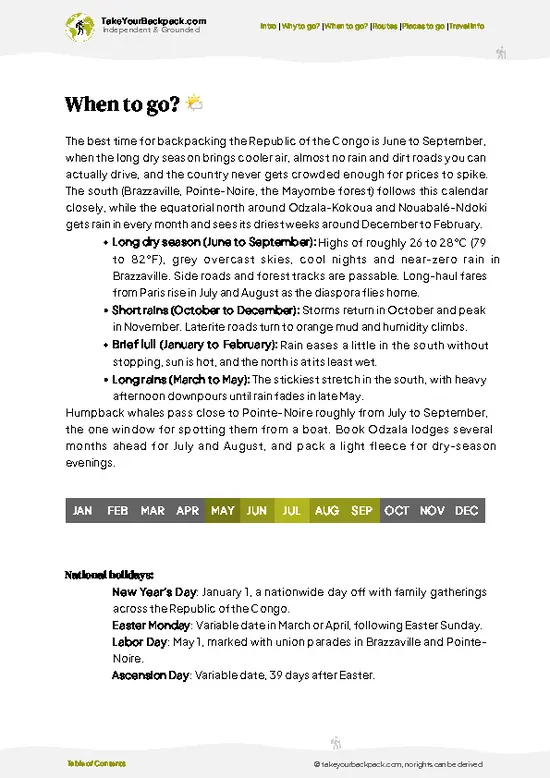
Late June through July, then again in September, is the sweet spot for Congo. The big rains have backed off, laterite roads knit into firm red corrugations, and the air loses that wet-wool heaviness that makes you sweat standing still. Transport runs more predictably when the tracks and bush pistes are dry; malaria pressure eases with fewer biting hours; and beds price lower than the holiday spike of December and the oil-worker weekends of August in Pointe-Noire. Wildlife pushes to bais as puddles shrink, so the forest actually shows itself, and the coast brings a bonus: humpback whales roll close to shore between July and September. You feel like you earned every view because you didn’t wade through knee-deep clay to get it.
  • Peak Dry: July-August brings the busiest weeks and the tightest seats on the Brazzaville-Pointe-Noire line; rooms near the beach jump, and you’ll queue for a bush taxi at dawn. The payoff is crisp, blue mornings, gorilla-tracking on firm trails, and whales breaching off Pointe-Noire—you sip a lukewarm beer that suddenly tastes cold because the air finally isn’t.
  • Shoulder Shift: May-June and September move—shops drag racks into the sun, graders chew at potholes, dust puffs underfoot, and drivers start promising “today” and meaning it. Fares soften, park tracks reopen, and river runs settle into a steady, readable flow perfect for long pirogue days.
  • Long Rains: October-April turns the forest inward. Low cloud, diesel on wet asphalt, frogs loud enough to rattle the tarp. Solitude comes easy. Survival hack: buy knee-high rubber boots in a market, line your pack with a contractor bag, and move at first light before the storms reload.

If you’re aiming for whales, lock in Pointe-Noire beds and a train berth two weeks out; otherwise pack a tiny umbrella year-round—it’s shade in the dry and salvation in the squalls.

source: climatestotravel.comJANJanuary: fair for travelingFEBFebruary: fair for travelingMARMarch: fair for travelingAPRApril: fair for travelingMAYMay: good for travelingJUNJune: highly recommended for travelingJULJuly: excellent for travelingAUGAugust: highly recommended for travelingSEPSeptember: highly recommended for travelingOCTOctober: fair for travelingNOVNovember: fair for travelingDECDecember: fair for traveling
📅 Traveling in a specific month?
Get a full month-by-month breakdown of weather, crowds, costs, festivals, and seasonal highlights in the complete travel guide.

Get full details when to go 👉

Get the Travel Guide -
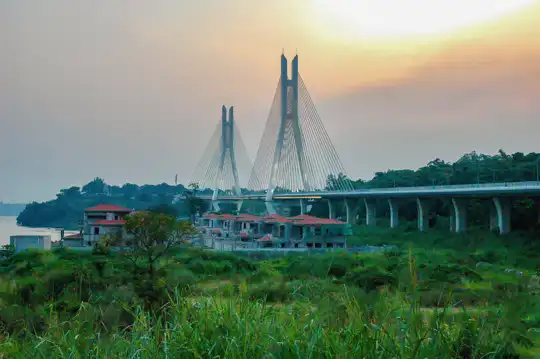
Republic of the congo - istockphoto

💰 Costs (as of 2026)Typical budget expectations

Expect $55-70 per day if you keep it lean and stay urban; costs jump the moment you start moving or eye the parks.
  • dorm accommodation: Dorms are rare; think basic guesthouses instead. In Brazzaville and Pointe-Noire, true dorms (when they exist) run $10-18 (6,000-11,000 XAF); more often you’ll land a fan room with shared bath for $15-25 (9,000-15,000 XAF). Smaller towns see $12-20 for a clean “chambre” if you arrive before dusk. System tip: ask for “chambre sans clim” and pay cash for a 10-20% cut, or target Catholic/mission guesthouses (“centre d’accueil”) which keep predictable prices and don’t gouge on busy nights.
  • meals: Supermarket Survival: bread, sardines, bananas, peanuts, instant noodles and a tomato will keep you at $5-8/day, but imports (cheese, cereal, chocolate) are Gabon-level pricey. Street food reality: grilled fish or chicken with manioc, brochettes with onions, beignets, and piles of rice sit in the heat but taste right when fresh—$1-3 a plate in neighborhoods, $3-5 near bus stations. A 650 ml Ngok or Primus beer runs 800-1,200 XAF ($1.30-2), cheaper than Gabon, pricier than Cameroon. Eat where the smoke and crowd are; avoid pre-cooked trays congealing under dust.
  • local
read more 👉
Expect $55-70 per day if you keep it lean and stay urban; costs jump the moment you start moving or eye the parks.
  • dorm accommodation: Dorms are rare; think basic guesthouses instead. In Brazzaville and Pointe-Noire, true dorms (when they exist) run $10-18 (6,000-11,000 XAF); more often you’ll land a fan room with shared bath for $15-25 (9,000-15,000 XAF). Smaller towns see $12-20 for a clean “chambre” if you arrive before dusk. System tip: ask for “chambre sans clim” and pay cash for a 10-20% cut, or target Catholic/mission guesthouses (“centre d’accueil”) which keep predictable prices and don’t gouge on busy nights.
  • meals: Supermarket Survival: bread, sardines, bananas, peanuts, instant noodles and a tomato will keep you at $5-8/day, but imports (cheese, cereal, chocolate) are Gabon-level pricey. Street food reality: grilled fish or chicken with manioc, brochettes with onions, beignets, and piles of rice sit in the heat but taste right when fresh—$1-3 a plate in neighborhoods, $3-5 near bus stations. A 650 ml Ngok or Primus beer runs 800-1,200 XAF ($1.30-2), cheaper than Gabon, pricier than Cameroon. Eat where the smoke and crowd are; avoid pre-cooked trays congealing under dust.
  • local transport: Shared taxis are the unlock in cities—flag a seat, not the whole car: 300-500 XAF ($0.50-0.90) by day, often double at night. Moto-taxis cover the last mile for similar money; ride with long pants and a firm price. Intercity? Bush taxis/minibuses are the cheapest way: 6,000-15,000 XAF ($10-25) for long hauls that smell like diesel and roasted peanuts. The Congo-Ocean Railway (Brazzaville-Pointe-Noire) in 3rd class is the budget backbone when it runs—rough seats, big savings versus flying. It’s cheaper than Angola or Gabon, a touch higher than Cameroon.
  • activities: The country’s big-ticket draw—lowland gorillas in Odzala—hits wallets like a hammer; most access is via lodge packages priced for luxury travelers, not dirtbags. Conkouati-Douli needs a 4x4, fuel, and a paid guide/boat. These are your major cost drivers. Cheap days exist: beaches near Pointe-Noire, markets, riverfront sunsets, small museums at $1-3. Compared to neighbors, Congo parks are costlier and less DIY than Cameroon, closer to Gabon pricing, and nowhere near the backpack scale of East Africa.
  • miscellaneous: Budget leaks: visas (front-loaded but brutal if you’re short-stay), ATM fees and bad exchange spreads, bottled water at 300-600 XAF a liter, data (SIM ~1,000 XAF; 1-3 GB for $3-7), photocopies and passport photos for checkpoints, and “night rates” for taxis after 10 pm. Police stops are calmer than DRC but keep documents handy and your tone polite. Small notes vanish fast—hoard change or you’ll “tip” in round-ups. Your cold beer tastes better when you’ve bargained the taxi down first.
⚠️ Prices can change and everyone travels differently, so take this as a rough guide. Hope it helps you plan your adventure!

✈️ The backpacker research shortcutCongo Travel Guide

An offline-friendly backpacking guide with optimized travel routes, ranked highlights, transport advice, and the best areas to stay.
example page 0 from our offline Travel Guide for Republic of the Congoexample page 1 from our offline Travel Guide for Republic of the Congoexample page 2 from our offline Travel Guide for Republic of the Congoexample page 3 from our offline Travel Guide for Republic of the Congoexample page 4 from our offline Travel Guide for Republic of the Congoexample page 5 from our offline Travel Guide for Republic of the Congoexample page 6 from our offline Travel Guide for Republic of the Congoexample page 7 from our offline Travel Guide for Republic of the Congo
The digital guide (256 pages) contains:
57 highlights, ranked by travel appeal
Optimized 5, 10 & 15-day travel routes
Cities, national parks, beaches, historical sites, ...
How to get around
Offline-friendly for travel without Wi-Fi
👉 Click to see all 30+ guide features

📅 Plan smarter in minutes, not weeks
Month by month travel advice
Festivals & national holidays
Budget expectations

🗺️ Go to the right places, skip the overrated ones
Honest pros & cons of destinations
Top hikes, parks & viewpoints
Lesser-known places most travelers miss
Clear “worth it vs skip it” guidance

🛏️ Travel smoothly without rookie mistakes
Best areas to stay
Transport systems explained simply
Common scams & safety advice
SIM cards, money & practical tips

🌍 Understand the country, not just visit it
Culture & traditions
52 Essential phrases & customs
Festivals worth planning around
Traveler-friendly historical context
Insights that make places more meaningful

📱 Built for real travel conditions
Fully downloadable PDF
Works completely offline
Optimized for phone use
Useful in remote areas & buses
Everything in one place
Save weeks of stressful planning
Get instant access to the full guide directly. 30-day money-back guarantee.


Sent to your inbox immediately after payment • 100% Secure Checkout
Best Backpacking Travel Advisor 2025 tourism awardBest Backpacking
Travel Advisor
2025
What others say about Take Your Backpack Guides:
⭐⭐⭐⭐⭐
Fantastic, amazing amount of information!
⭐⭐⭐⭐⭐
My goodness this is amazing, it's what I've been looking for hats off too you!
⭐⭐⭐⭐⭐
I think this is absolutely BRILLIANT
⭐⭐⭐⭐
Very complete and informative. It's still missing places, but I gotta to commend you
⭐⭐⭐⭐⭐
This is truly amazing, thank you, can't wait to explore it with my kids!
⭐⭐⭐⭐⭐
Awesome resource, thank you!
⭐⭐⭐⭐⭐
This is amazing! Can't wait to explore the ones I haven't seen
⭐⭐⭐⭐
I love this! Well done, great idea.
⭐⭐⭐⭐⭐
Thanks for taking the time to make this gem!
⭐⭐⭐⭐⭐
This might be the best website I've ever seen.
⭐⭐⭐⭐⭐
Congratulations, and thank you so much for your work; it's incredibly valuable.
⭐⭐⭐⭐
In all seriousness I think you did a great job pointing out the important spots
⭐⭐⭐⭐⭐
10/10 very good
⭐⭐⭐⭐⭐
As someone who's only just starting to visit regularly this is awesome, thank you.
⭐⭐⭐⭐
Thank you very much! I'm going to visit my dad, it's going to be very useful!
⭐⭐⭐⭐⭐
This is really cool! We'll be travelling for the first time and this definitely come in handy.
⭐⭐⭐⭐⭐
You are now our minister of culture, congratulations 👨‍💼
⭐⭐⭐⭐⭐
Just wanted to tell you that this is a pearl! Going to follow your recommendations.
⭐⭐⭐⭐⭐
This is so cool. I'll definitely be using the resource for my travels soon.
⭐⭐⭐⭐⭐
This is very impressive! Good work.
⭐⭐⭐⭐⭐
This is an amazing and informative site. Very well done!

🛏️ Where to stay?Best areas to base yourself

Yes — basic hostels and budget guesthouses exist in Congo, mainly in the two main cities of Brazzaville and Pointe‑Noire; options outside urban centres are sparse and national‑park access typically requires pricier lodges or arranged camps.
In Brazzaville the Plateau (central) and riverside Bacongo have the most choices — Plateau gives fastest access to markets, museums and nightlife but is busier and a bit costlier, while Bacongo is quieter and cheaper with fewer late‑night services and limited transport.
In Pointe‑Noire the city centre and beachfront neighbourhoods offer safer walking, better … read more 👉
Yes — basic hostels and budget guesthouses exist in Congo, mainly in the two main cities of Brazzaville and Pointe‑Noire; options outside urban centres are sparse and national‑park access typically requires pricier lodges or arranged camps.
In Brazzaville the Plateau (central) and riverside Bacongo have the most choices — Plateau gives fastest access to markets, museums and nightlife but is busier and a bit costlier, while Bacongo is quieter and cheaper with fewer late‑night services and limited transport.
In Pointe‑Noire the city centre and beachfront neighbourhoods offer safer walking, better transport links and more guesthouse options, whereas outlying districts are cheaper but darker after sundown, less tourist‑oriented and may lack reliable public transport; don’t expect a backpacker‑hostel network and plan for small hotels or guesthouses.

If you enjoy meeting fellow travelers, consider choosing hostels with high ratings for atmosphere. On the other hand, if you prefer having your own space, a hotel might be a better option.

🚌 Getting aroundHow to travel within the country

Congo moves on heat and patience. Clocks exist, but departures obey a different weather—seats filling, rain easing, a driver’s mood after strong coffee. Diesel hangs in the air with fried plantain. Red dust sticks to your forearms. The flow is intuitive: you drift to the right corner, you listen for the bark of a conductor, you move when the crowd swells. When it clicks, it feels earned.
  • CFCO train (Brazzaville-Pointe-Noire) The Efficiency Trade-off: When it runs, it’s the cheapest long leg worth
read more 👉
Congo moves on heat and patience. Clocks exist, but departures obey a different weather—seats filling, rain easing, a driver’s mood after strong coffee. Diesel hangs in the air with fried plantain. Red dust sticks to your forearms. The flow is intuitive: you drift to the right corner, you listen for the bark of a conductor, you move when the crowd swells. When it clicks, it feels earned.
  • CFCO train (Brazzaville-Pointe-Noire) The Efficiency Trade-off: When it runs, it’s the cheapest long leg worth trusting—often a fraction of a flight and less wear on your spine than a night bus. It’s not fast. It’s steady. Expect a full day that expands if rain, repairs, or paperwork slow the Mayombe crossings. Second class buys a hard seat, a lazy fan, and open windows that breathe when the power drops; first class is calmer but still human. Vendors surge at stops with grilled corn, peanuts, and lukewarm sodas. Tie your pack to the seat frame and keep small bills handy. The payoff: tunnels spit you into green, the air turns salty, and a cold Mützig never tastes better.
  • Shared taxis and minibuses The Social Fabric: This is how cities breathe. You slide into a row built for three and make room for four. Greet the car—bonjour—then keep your bag on your lap, not the aisle. Fares are small, exact, and paid forward; big bills stall the ride and earn sighs. Tap the roof bar or say “arrêt” with a chin-nod when your junction appears. Music rattles the windows—rumba, ndombolo—and no one slams the sliding door. Elders get the corner seat, sunglasses come off at checkpoints, and the front passenger helps with change. You learn routes by listening to the shouted quartiers more than reading signs.
  • River pirogues and barges The Geometric Unlock: North of the asphalt, water is the road. Long hulls with outboards stitch together villages that the map pretends have highways. You wait under corrugated shade while sacks of cassava, jerrycans, and crates of smoked fish climb aboard. Pay per space, pay extra for a heavy pack, and bring a real life jacket—the boat’s foam is for show. Rain squalls sting, sun burns, and the engine’s thrum drills hours flat. Then the river bends wide, egrets lift, and you step onto a sandbank market where no bus can reach.
  • Cargo trucks and bush pickups The Budget Disruptor: At the town’s gare routière, tarpaulin rigs take riders cheap when money beats speed. Half a bus fare, twice the time. You sit on rice sacks, share shade with goats, and help heave barrels at police posts. Dust is a meal; a scarf and headlamp earned their space in your pack. Trucks stop where food is real—maquis ladling bouillon and foufou by kerosene light—and start again at first rooster. It’s uncomfortable, but it stitches broken routes for pocket change.

Master tip: Move at first light and buy the “trigger seat”—paying for one extra spot on a half-full taxi-bus or pickup is cheaper than losing a day; use the train for the long spine, then glue the last miles with a moto or pirogue.
Distance: Maya-Maya International Airport (BZV) sits about 4 km (2.5 miles) northwest of Brazzaville’s city center.

Main ways to get into town
  • Taxi (private) — The simplest door-to-door option from the terminal.

    Time: 10-20 minutes, longer in rush hour.

    Cost: about 3,000-6,000 XAF (roughly US$5-10) by day; up to 8,000 XAF (≈ US$13) late at night or in heavy traffic.

    Notes: Agree the fare before you get in and carry small bills.
  • Shared taxi or minibus (“taxi collectif”/bus) — Budget option used by locals. You may need to walk to the airport gate or the main road to catch one heading toward Centre-ville.

    Time: 20-40 minutes depending on stops and traffic.

    Cost: about 300-500 XAF per seat (≈ US$0.50-0.85).

    Notes: Limited luggage space; services run mainly in daytime and early evening. There’s no official airport-branded shuttle.
  • Hotel transfer (pre-arranged) — Offered by some mid-range and upscale hotels.

    Time: 10-20 minutes.

    Cost: typically 8,000-20,000 XAF (≈ US$13-33), sometimes included in room rates.

    Notes: Book ahead and confirm the pickup point at arrivals.

Taxis: You’ll find licensed city taxis outside the arrivals area. Typical one-way fares to the center are 3,000-6,000 XAF by day, 4,000-8,000 XAF at night. Always confirm the price before departing; meters are uncommon.

Good to know: There’s no train link, and no officially operated airport bus as of 2025. Cash is king (XAF), and mobile payments aren’t widely accepted for short rides.
⚠️ Prices and routes can change, so take this as a rough guide and ask for local advice when you arrive.

🔒 Safety (risk Level: medium)Is Congo safe to visit?

Safety for solo travelers, including women and LGBTQ+ individuals
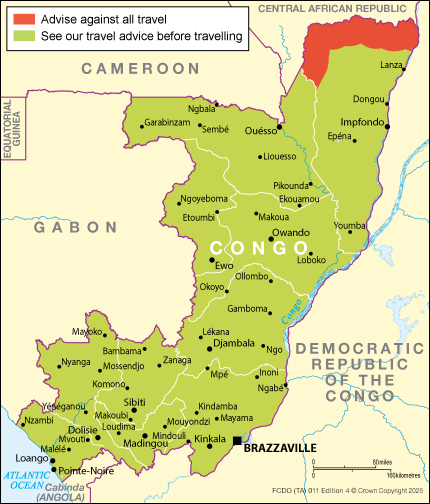
Safety in the Republic of the Congo can vary, so it’s crucial for solo travelers, especially women and LGBTQ+ individuals, to stay vigilant. While larger cities like Brazzaville are generally safer, rural areas might pose more risks. It’s advisable to dress conservatively and avoid public displays of affection, particularly for LGBTQ+ travelers, due to societal attitudes. Always keep an eye on local news and consider connecting with local expat communities for real-time advice.
safety image

source: www.gov.uk

✈️ VisaWhat travelers should know about visas

Most travelers need a visa to visit the Republic of the Congo. You can apply at a Congolese embassy or consulate in your country; some embassies might offer an electronic visa service, so check their website. Ensure your passport has at least six months’ validity and a couple of blank pages.
⚠️ Visa requirements can change over time, so always check the latest visa requirements with the official embassy or government website before you travel.

🎒 What to pack?A practical packing list

If you’re heading to the Republic of the Congo, keep in mind it’s a land of lush rainforests and humid weather, so lightweight, breathable clothing is a must. The terrain can be a mix of muddy trails and dense jungle, especially if you’re exploring places like Odzala-Kokoua National Park, so sturdy footwear is key. While the vibe is generally laid-back, modest clothing is appreciated, especially in villages; think longer sleeves and pants. Also, prepare for sudden rain showers—it’s the tropics after all!

Apart from this country specific advice, I have also crafted a general packing list that should help on any trip. authorOver the years, I've learned the importance of packing minimally. It's so much easier to jump on the back of a truck or squeeze yourself into the last spot of a minibus without that supersized backpack. If you're headed to a warm destination, leave your winter jacket at home; for colder regions, opt for thin thermal underlayers. Instead of packing your entire wardrobe, bring just three sets of clothes, as laundry facilities are available everywhere.
View the full list 👉
🎒 Planning the practical side of your trip?
Get detailed information on transport, daily budgets, internet access, local customs, food, language, and other essentials in the complete Travel Guide.

Get detailed practical information 👉

Get the Travel Guide -

🙋 FAQCommon questions before visiting

Trip Planning


Personal tip: I normally search on good rating for atmosphere (for meeting people) and location (for easy exploring). Cleanliness as a bonus.


Travel Essentials

Yellow fever vaccination is mandatory for entry into the Republic of the Congo. It’s also recommended to get vaccines for hepatitis A, hepatitis B, typhoid, and rabies if you plan to spend time in rural areas or with animals. Consider an updated tetanus shot as well. Always check with a healthcare provider for the latest travel health advice.


vaccination requirements
When I first started traveling, I often spent part of my first day in a new country hunting for a local SIM card. While this can still be slightly cheaper, it also takes time and planning.

These days, it's much simpler to install an eSIM before leaving home. Once you arrive in Congo, you can activate it immediately and have mobile data from the moment you land — which is especially useful for ordering transport or navigating away from busy airports.

There are many providers nowadays, and price differences are usually small. I personally go with Airalo, as it offers excellent network coverage throughout the country and strong global coverage, so you can manage multiple countries from a single app.


Get your e-sim for Congo

Culture & Customs

Respect elders by greeting them first and using polite titles like ”Monsieur” or ”Madame.” Always offer a handshake with the right hand. Dress modestly, especially outside urban areas, as it’s appreciated.

Photography can be sensitive; ask for permission before snapping photos of people or certain places. Gift-giving is common; if invited to someone’s home, bring a small gift like fruit or sweets.

Homosexuality is illegal; LGBTQ+ travelers should exercise caution and discretion. Women should be mindful of conservative dress codes and avoid traveling alone at night. Public displays of affection are frowned upon.

When eating, wait for the host to invite you to begin and avoid eating with your left hand.
Trying traditional food is always a great way to experience the culture. Here are some must-try dishes for Congo.
  • Saka-Saka: This dish is a staple in Congolese cuisine, made from cassava leaves cooked with palm oil, peanut butter, and sometimes fish or meat. It’s a must-try for experiencing the earthy and rich flavors central to local meals.
  • Moambe Chicken: Often considered the national dish, this is chicken simmered in a thick, rich sauce made from palm nuts. It’s a comfort food that showcases the traditional use of palm oil in Congolese cooking.
  • Poulet à la Moambé: Similar to Moambe Chicken but with slight regional variations, this dish is beloved for its flavorful blend of spices and creamy texture. It’s a great way to taste the fusion of local ingredients with colonial influences.
  • Fufu: A starchy side dish made from pounded cassava or yams, Fufu is a cornerstone of many meals. It’s all about the texture, and it pairs perfectly with savory stews and soups.
  • Liboké de Poisson: Fish cooked in banana leaves, often with aromatic herbs and spices. This dish is popular for its fresh taste and the unique technique of wrapping and steaming in banana leaves, which infuses the fish with a subtle, earthy flavor.
Tap water in the Republic of the Congo is generally not safe for tourists, even if locals might drink it. It’s best to stick to bottled or filtered water to avoid any unpleasant surprises. Always check the seal on bottled water to ensure it’s not been tampered with.
The main language in Republic of the Congo is French. Backpacking is way more rewarding if you know a bit of the local language, so I'd suggest brushing up on the basics just in case your French skills have become a bit rusty.

Want to understand locals better?
The complete Travel Guide for Congo includes 52 essential words and phrases — greetings, thank-yous, ordering food, transport, numbers, and common local expressions you'll actually hear.

Get your local basic phrases 👉

Get the Travel Guide -


In the Republic of the Congo, English is not widely spoken. The official language is French, which is used in government, education, and media. While some urban areas, particularly in Brazzaville, may have individuals who speak English, especially among younger generations and in tourist sectors, fluency is limited.

In rural areas, English proficiency is even less common. Travelers should expect to encounter primarily French speakers and may benefit from learning basic French phrases to facilitate communication. Additionally, local languages such as Lingala and Kituba are prevalent, and knowing a few words in these languages can enhance interactions with locals.

For those planning to visit, it’s advisable to have a translation app or a phrasebook handy, as this will help bridge communication gaps and enrich the travel experience. Overall, while English is gradually becoming more recognized, it remains a secondary language in the Republic of the Congo, making French the primary means of communication for most interactions.

Money & Payments

The local currency of Congo is CDF (₣).

First off, ATMs can be a bit unpredictable in the Republic of the Congo, especially outside major cities like Brazzaville and Pointe-Noire. It’s smart to carry a mix of cash and cards. Visa is more widely accepted than Mastercard, but don’t rely solely on cards.

Cash is king here, so always have some local currency (CFA francs) on you. For larger expenses, bringing USD is usually better than euros, as they’re easier to exchange. When changing money, stick to official exchange bureaus or banks for the best rates and security. Avoid street exchangers unless you want to risk getting scammed with bad rates or counterfeit bills.

For peace of mind, keep a reserve stash of USD tucked away in case of emergencies. Just be cautious and avoid flashing it around.

In the Republic of the Congo, tipping is not a widespread custom, but it is appreciated. In restaurants, leaving 5-10% of the bill as a tip is considered polite if you receive good service. For porters or taxi drivers, rounding up the fare or offering a small extra amount is a nice gesture.

🧩 Nearby countriesNearby backpacking alternatives

We 💚 feedbackIs Congo worth visiting?

Congo makes you earn it. Red laterite dust in your teeth, humidity like a wet towel, checkpoints that eye your papers twice. But at first light in a forest bai, elephants stir the mist and a lowland gorilla coughs from the raffia—payoff, clear and primal, followed by a cold Ngok in camp. Drawback: logistics and fees skew upscale; it’s pricier than Cameroon and patience-hungry. The shift: graded RN2 stretches and new community-run camps near Odzala/Nouabalé‑Ndoki are slowly opening the door to backpackers.

✍️ Help improve this page!
The information on this page is based on in-depth research, insights shared by experienced travelers, and feedback from the local travel community in Congo. While every effort is made to keep the information accurate and current, conditions can change — so if you spot anything incorrect or outdated, please get in touch.


🙋‍♂️ Give feedback

👋 Meet the founderWho’s Behind Take Your Backpack?

Johan, backpacker and founder of TakeYourBackpackHi, I’m Johan (Netherlands 🇳🇱), the creator of TakeYourBackpack. Over the past decade, I’ve backpacked through 80+ countries across six continents, gaining extensive experience with independent travel, long-term trips, and overland routes.

This site is built on a combination of firsthand travel experience and carefully curated insights from other backpackers. Many guides are based on places I’ve personally visited, while others bring together tips, observations, and practical advice shared by trusted travelers I’ve met along the way.

The goal is to provide realistic, experience-driven guidance — not generic itineraries — so you can explore destinations with better context, clearer expectations, and more confidence.

Get full Congo guide •
Instant download • 57 highlights • Full Offline guide