×
Nauru 🇳🇷

backpacking Oceania Nauru 🇳🇷Walk the entire island before lunchtime.

Explore Marshall IslandsExplore New Caledonia

Backpacking Nauru in 2026

A complete guide including when and where to go, costs, transport, itineraries, and practical travel advice.
A first look at the country

Backpacking Nauru
By Johan Kruseman 🇳🇱 | Updated June 7, 2026

Your whole plan rides on the scarce Nauru Airlines schedule. Seats are limited, fares jump, and one cancellation can pinball your week—route via Brisbane or Tarawa, build buffers, and book a room early. Do that, and this pocket republic opens—phosphate scars, WWII relics, and a coast road you can lap before breakfast.

The draw is intimacy: dawn at Anibare Bay with reef fishers, the jagged Topside, cool Buada Lagoon, and rusted guns on Command Ridge. You come for scale but stay for conversations—history, land, resilience—over tuna and taro. It’s hot, options are thin, supplies vary, and inland needs permission; leaning in slows you to island tempo.

Where Kiribati and the Marshalls offer classic atolls and wrecks, Nauru rewards travelers who prize story over resorts and like the idea of circling a country before lunch, then talking late with the people who run it.

👉 Get the 📖 Travel Guide of Nauru

Yaren–Aiwo Corridor

If you want a smooth landing, base here. Airport, port, fuel, immigration, and canteens cluster within minutes. AUD cash rules. Hitching is normal. Do errands 8–11am, weekdays. SIM/top-ups and photocopies sit by the runway.

Anibare Bay

Safest ocean entry. Long sand arc, fewer reef teeth. Swim at sunrise or after 4pm; UV bites. Use the boat harbour as anchor. Ask fishermen about currents. Reef shoes mandatory. Menen area has shade and rides.

Command Ridge & Topside

Sweaty, short climb from the ring road to the high point and the mined interior. WWII relics and wind. Stay on obvious tracks; some zones are off-limits. Closed shoes, 2L water. Clean views to plan your loop.

Buada Lagoon

Shaded inland bowl. Walk the rim—fruit bats, birds, village life. Don’t swim; water and custom say no. No shops, weak signal. Bring water, exit before dusk; mosquitoes own it.

Anetan–Ewa North Coast

Resupply run. Capelle & Partners covers groceries, ATM, hardware. Pick up wheels if you missed the airport. Reef platform tempts; only dabble at dead low tide when locals do. Breezy sunset benches for a cheap dinner.
Seeing the layout at a glance
Loading the map 🌍
CLICK TO FILTER
village
unique site
national park
hike
beach
attraction
festival
SHOW COUNTRY’S BESTSHOW ALL
film
0
0
0a
Command Ridge WWII Relics
film
1
1
1a
Nauru Civic Center and Parliament House
film
2
2
2a
Anibare Beach
Fature 10k
film
3
3
3a
Buada Lagoon Beach
Jonas Oeschger
film
4
4
4a
Osmar Beach
黃瑞揚
film
5
5
5a
Buada Lagoon Walk
Jonas Oeschger
film
6
6
6a
Nauru‘s Historic Sites Trail
Yan Fei Zhao
film
7
7
7a
Anibare Bay Trail
Victor Bernabei
film
8
8
8a
Moqua Well
film
9
9
9a
Nauru’s Lighthouse
Yan Fei Zhao

Why go?What sets this destination apart

People

People here default to helping. Wave with your whole hand; wait a minute roadside and a car stops. Offer fuel money once; better is a cold drink or phone credit. Smiles open doors, jokes seal them. Ask before photos, shoes off … read more 👉
People here default to helping. Wave with your whole hand; wait a minute roadside and a car stops. Offer fuel money once; better is a cold drink or phone credit. Smiles open doors, jokes seal them. Ask before photos, shoes off indoors, modest on Sundays. Seawall evenings = easy chats—bring snacks. Don’t critique the island. Names stick; gossip moves faster than you.

Beach life

Beach time in Nauru is about space and timing. Hit Anibare Bay at sunrise: glassy water, no one around, turtles if you’re lucky. Snorkel the fringing reef on a mid-to-high tide when the surge settles; bring reef shoes. No beach … read more 👉
Beach time in Nauru is about space and timing. Hit Anibare Bay at sunrise: glassy water, no one around, turtles if you’re lucky. Snorkel the fringing reef on a mid-to-high tide when the surge settles; bring reef shoes. No beach clubs—just warm evenings, stars, and a low‑key beer at Menen. It’s simple, quiet, and wildly rewarding.
Want the complete picture of Nauru?
The offline Travel Guide brings everything together — routes, highlights & planning.

See what's included in the guide 👉

Get the Travel Guide -

⭐ HighlightsWhat not to miss along the way

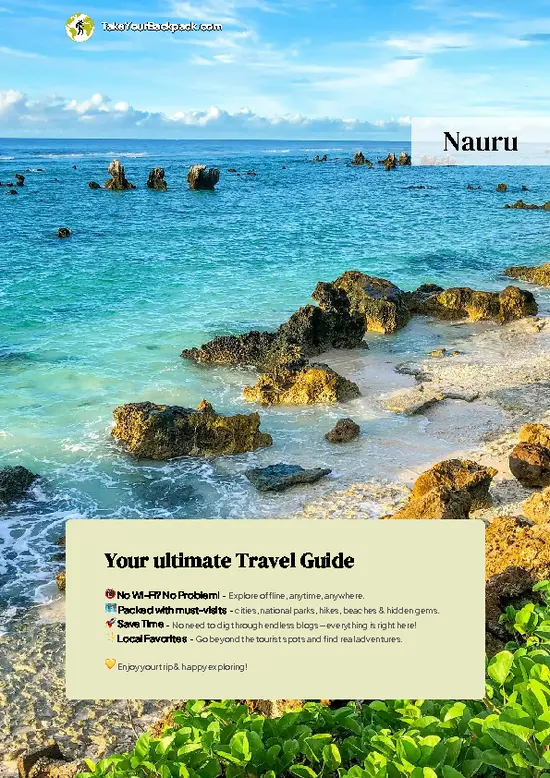
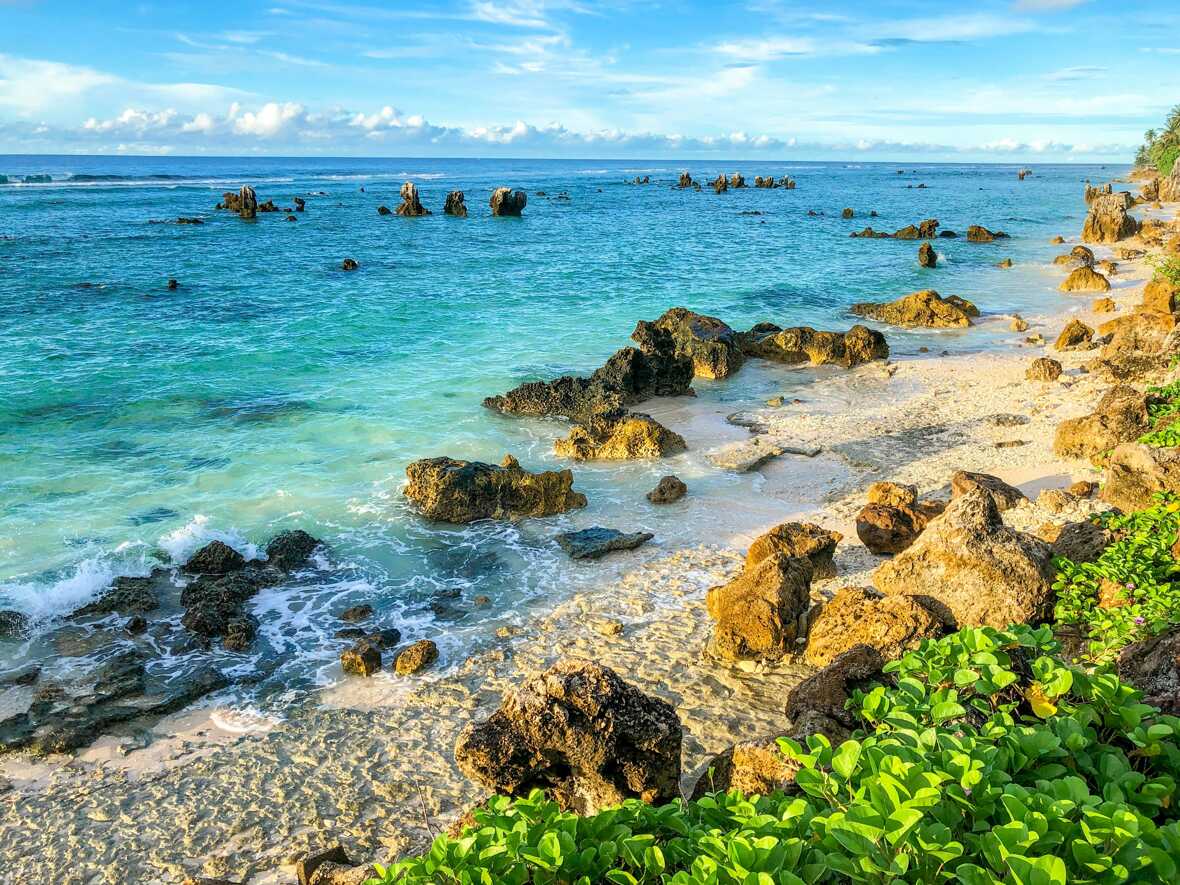
  • Anibare Bay: Sunrise wakes the east coast—fishermen hauling handlines, the reef throwing a steady growl. Sand is coarse coral; reef shoes save your feet. Sit under the ironwoods, then swim the gentler boat-harbour side, never across the channel.
  • Buada Lagoon: In the island’s hot, green heart, the air sits heavy and sweet with pandanus. Dragonflies skim black water; mosquitoes love ankles. Don’t swim—locals treat it as a water source. Walk slow, keep to tracks, and bring repellent.
  • Command Ridge: The highest knob of limestone and war. Rusting Japanese guns, bunker mouths, and a 360 that takes in runway, reef, and Topside scars. Late light is best; the wind tastes metallic, and limestone teeth demand closed shoes.
  • Moqua Well (Moqua Caves): A short scramble drops you into cool cave breath and drip-sound. Bring a headlamp and grippy sandals; the limestone is slick. The lake is ink-dark and cold—no diving. Midday sun throws clean light shafts through the mouth.
  • Aiwo Phosphate Cantilevers: Industrial
read more 👉
  • Anibare Bay: Sunrise wakes the east coast—fishermen hauling handlines, the reef throwing a steady growl. Sand is coarse coral; reef shoes save your feet. Sit under the ironwoods, then swim the gentler boat-harbour side, never across the channel.
  • Buada Lagoon: In the island’s hot, green heart, the air sits heavy and sweet with pandanus. Dragonflies skim black water; mosquitoes love ankles. Don’t swim—locals treat it as a water source. Walk slow, keep to tracks, and bring repellent.
  • Command Ridge: The highest knob of limestone and war. Rusting Japanese guns, bunker mouths, and a 360 that takes in runway, reef, and Topside scars. Late light is best; the wind tastes metallic, and limestone teeth demand closed shoes.
  • Moqua Well (Moqua Caves): A short scramble drops you into cool cave breath and drip-sound. Bring a headlamp and grippy sandals; the limestone is slick. The lake is ink-dark and cold—no diving. Midday sun throws clean light shafts through the mouth.
  • Aiwo Phosphate Cantilevers: Industrial Nauru laid bare—dead conveyors over surf, rust flaking like ochre snow. Stay outside fences; swells boom under the girders and the air smells of salt and grease. Golden hour flatters the ruin. For off-the-map: a dawn lap of the 19 km ring road by bike, a low-tide soak in Anibare Boat Harbour rock pools, and plane-spotting from the roadblock when the island’s flight drops in.
Spotted a mistake or missing a highlight? Contact us.

But Nauru offers more...

Discover and compare all of its highlights per category

🧭 RoutesPlanning a route that makes sense

The 2-Day Nauru Essentials Loop

The Vibe: A relaxed, history-meets-beach sampler that gives you Nauru’s core stories and landscapes without rushing, ideal for a stopover or first-time Pacific island hop. You’ll split your time between inland viewpoints, a crater lagoon, and easy-access beaches using short taxi hops and plenty of walking.
The Highlights:
  • Climbing Command Ridge for island-wide views and WWII relics
  • Circling Buada Lagoon on a gentle walk through Nauru’s green interior
  • Swimming and sunset time at Yaren Beach
  • Slow, sandy hours on Anibare Beach’s east-coast arc

The 3-Day Story & Coastline Circuit

The Vibe: A deeper dive that layers Nauru’s political and phosphate history with its inland lagoon and classic beaches, perfect if you want context as well as coastline. Expect easy days built around a few anchor sites, with time to linger at museums, wells, and swimming spots.
The Highlights:
  • Exploring the Nauru Civic Center, Parliament House, and Nauru Museum in Yaren
  • Walking the rim of Buada
read more 👉

The 2-Day Nauru Essentials Loop

The Vibe: A relaxed, history-meets-beach sampler that gives you Nauru’s core stories and landscapes without rushing, ideal for a stopover or first-time Pacific island hop. You’ll split your time between inland viewpoints, a crater lagoon, and easy-access beaches using short taxi hops and plenty of walking.
The Highlights:
  • Climbing Command Ridge for island-wide views and WWII relics
  • Circling Buada Lagoon on a gentle walk through Nauru’s green interior
  • Swimming and sunset time at Yaren Beach
  • Slow, sandy hours on Anibare Beach’s east-coast arc

The 3-Day Story & Coastline Circuit

The Vibe: A deeper dive that layers Nauru’s political and phosphate history with its inland lagoon and classic beaches, perfect if you want context as well as coastline. Expect easy days built around a few anchor sites, with time to linger at museums, wells, and swimming spots.
The Highlights:
  • Exploring the Nauru Civic Center, Parliament House, and Nauru Museum in Yaren
  • Walking the rim of Buada Lagoon and pausing at its quiet shoreline
  • Descending to Moqua Well, Nauru’s underground freshwater pool
  • Finishing with Command Ridge panoramas and an afternoon at Anibare Beach

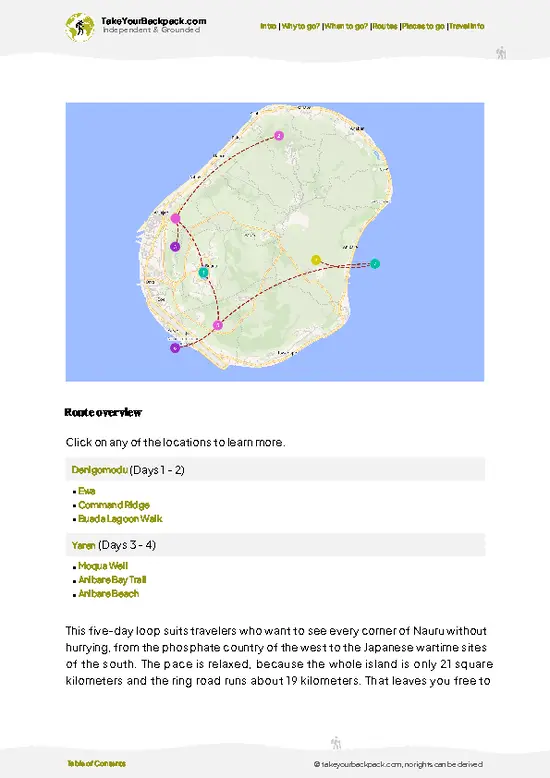
The 5-Day Full-Island Immersion Route

The Vibe: A slow, observant circuit for travelers who want to feel Nauru’s everyday rhythm—village life, historic trails, and coastal walks—rather than just ticking off viewpoints. You’ll mix short transfers with long pauses in inland and coastal districts, using walking trails to connect the dots.
The Highlights:
  • Two days in Yaren exploring the civic core, museum, and Yaren District Trail
  • Overnighting by Buada Lagoon and looping its tranquil crater walk
  • Linking Command Ridge and Nauru‘s Historic Sites Trail for a fuller WWII and phosphate story
  • Walking the Anibare Bay Trail, relaxing on Anibare Beach, and capping it at Nauru’s Lighthouse
🌍 Want a ready-to-use travel plan for Nauru?
The overview above compares different route options based on your travel time and style. The complete Travel Guide breaks each itinerary down in detail, including maps, stops, highlights, and transport information.

Explore all route details 👉

Get the Travel Guide -

🌤️ When to go?Weather, seasons, and timing

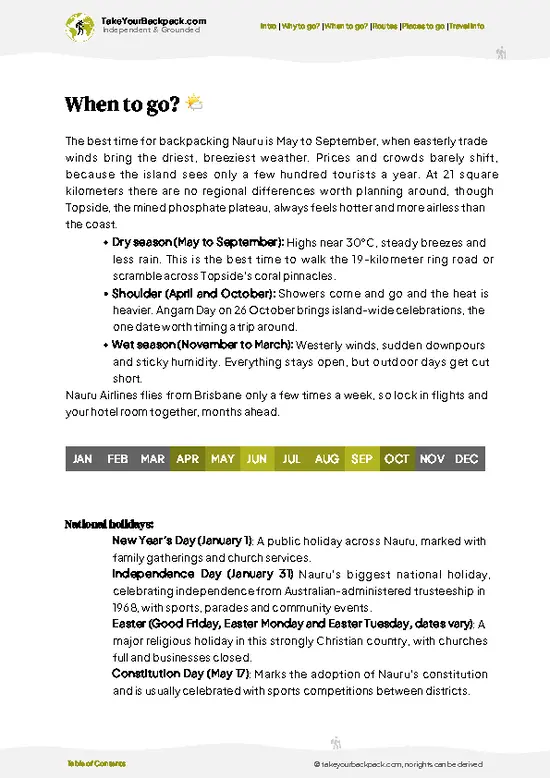
Late May-June and late Aug-Sept are the sweet spots. The northwest monsoon has switched off, the southeast trades steady the air, nights ease a notch, and reef entries stop feeling like a dare. Weather delays drop compared with Nov-Mar, but you’ve slipped past the tiny mid-year seat/room squeeze. Costs don’t plunge; they just stop punishing you for storms and cancellations.
  • The Crowd/Heat Peak: July-August. Seats get snapped by contractors and the few hotels play hardball, and midday heat bites—but dawn gives glassy water at Anibare Bay and the clearest snorkeling you’ll get all year.
  • The Transition/Shoulder: April-May and September-October. Clouds thin, puddles vanish, shops open early, and the island moves again; hit neap-tide mornings in late May for easy shore snorkels without getting rag-dolled by swell.
  • The Off-Peak/Extreme: November-March. Monsoon squalls, hot nights, empty roads; Buada Lagoon feels private. Survival hack: run your day 5-9 a.m., stash electronics in double dry-bags, and wear reef shoes plus a light umbrella for sideways rain.

Book flights 6-10 weeks ahead and pad one extra night to absorb schedule shuffles without paying panic prices.

source: climatestotravel.comJANJanuary: below average for travelingFEBFebruary: below average for travelingMARMarch: below average for travelingAPRApril: good for travelingMAYMay: highly recommended for travelingJUNJune: excellent for travelingJULJuly: highly recommended for travelingAUGAugust: highly recommended for travelingSEPSeptember: excellent for travelingOCTOctober: good for travelingNOVNovember: below average for travelingDECDecember: below average for traveling
📅 Traveling in a specific month?
Get a full month-by-month breakdown of weather, crowds, costs, festivals, and seasonal highlights in the complete travel guide.

Get full details when to go 👉

Get the Travel Guide -
Nauru - |Nauru|unsplash-winston-chen-bjJU61GHALI-unsplash

💰 Costs (as of 2025)Typical budget expectations

Expect AUD 130-180 per day on a true budget; you’re paying Pacific-island scarcity prices without resort subsidies.
  • dorm accommodation: There are effectively no dorms; the “budget” floor is a basic room in small hotels or worker lodgings at AUD 70-120. Expect aging AC and occasional shared bathrooms. System: email ahead, ask for “contractor/weekly rates,” pay cash, and confirm airport pickup to dodge taxi drift.
  • meals: Supermarket Survival: AUD 10-20/day if you live on bread, tinned tuna, noodles, UHT milk, instant coffee. Street food reality: there isn’t much “street”—it’s Chinese takeaways at AUD 8-15/plate; hotel meals run AUD 20-35. Compared to Fiji/Samoa, food is 30-80% pricier for the same calories.
  • local transport: Cheapest unlock is your feet plus hitching the 21 km ring road; start at dawn, carry 2-3 L water, and step into shops for shade. Taxis are scarce and quote-y: AUD 10-20 short hops, 40-60 for a full lap. Car hire AUD 60-90/day (+ fuel ~AUD 1.7-2.2/L); split three ways and it beats taxis. Bicycles exist sporadically—ask hotels and pay a deposit.
  • activities: Most highlights are free: WWII relics, coastal swims, Buada Lagoon circuit, sunrise at Anibare. The wallet-burners
read more 👉
Expect AUD 130-180 per day on a true budget; you’re paying Pacific-island scarcity prices without resort subsidies.
  • dorm accommodation: There are effectively no dorms; the “budget” floor is a basic room in small hotels or worker lodgings at AUD 70-120. Expect aging AC and occasional shared bathrooms. System: email ahead, ask for “contractor/weekly rates,” pay cash, and confirm airport pickup to dodge taxi drift.
  • meals: Supermarket Survival: AUD 10-20/day if you live on bread, tinned tuna, noodles, UHT milk, instant coffee. Street food reality: there isn’t much “street”—it’s Chinese takeaways at AUD 8-15/plate; hotel meals run AUD 20-35. Compared to Fiji/Samoa, food is 30-80% pricier for the same calories.
  • local transport: Cheapest unlock is your feet plus hitching the 21 km ring road; start at dawn, carry 2-3 L water, and step into shops for shade. Taxis are scarce and quote-y: AUD 10-20 short hops, 40-60 for a full lap. Car hire AUD 60-90/day (+ fuel ~AUD 1.7-2.2/L); split three ways and it beats taxis. Bicycles exist sporadically—ask hotels and pay a deposit.
  • activities: Most highlights are free: WWII relics, coastal swims, Buada Lagoon circuit, sunrise at Anibare. The wallet-burners are wheels and boats: ad-hoc boat/snorkel charters can be AUD 150-300+ if you find one, and a local guide-with-car runs ~AUD 40-80/half-day. Access to interior tracks sometimes needs local permission—bring a resident, not bravado.
  • miscellaneous: Budget Leaks: SIM/data is costly and slow (think AUD 20-50 for a few GB); hotel Wi-Fi vouchers sting. Bottled water AUD 2-4/1.5 L. Many shops are cash-only; ATM reliability varies—bring AUD and avoid card fees. Laundry AUD 10-20. Beer AUD 5-8. Sundays go quiet—stock up Saturday. Compared to Kiribati/Tuvalu, similar pain; pricier than Fiji.
⚠️ Prices can change and everyone travels differently, so take this as a rough guide. Hope it helps you plan your adventure!

✈️ The backpacker research shortcutNauru Travel Guide

An offline-friendly backpacking guide with optimized travel routes, ranked highlights, transport advice, and the best areas to stay.
example page 0 from our offline Travel Guide for Nauruexample page 1 from our offline Travel Guide for Nauruexample page 2 from our offline Travel Guide for Nauruexample page 3 from our offline Travel Guide for Nauruexample page 4 from our offline Travel Guide for Nauruexample page 5 from our offline Travel Guide for Nauruexample page 6 from our offline Travel Guide for Nauruexample page 7 from our offline Travel Guide for Nauru
The digital guide (114 pages) contains:
24 highlights, ranked by travel appeal
Optimized 2, 3 & 5-day travel routes
Cities, national parks, beaches, historical sites, ...
How to get around
Offline-friendly for travel without Wi-Fi
👉 Click to see all 30+ guide features

📅 Plan smarter in minutes, not weeks
Month by month travel advice
Festivals & national holidays
Budget expectations

🗺️ Go to the right places, skip the overrated ones
Honest pros & cons of destinations
Top hikes, parks & viewpoints
Lesser-known places most travelers miss
Clear “worth it vs skip it” guidance

🛏️ Travel smoothly without rookie mistakes
Best areas to stay
Transport systems explained simply
Common scams & safety advice
SIM cards, money & practical tips

🌍 Understand the country, not just visit it
Culture & traditions
52 Essential phrases & customs
Festivals worth planning around
Traveler-friendly historical context
Insights that make places more meaningful

📱 Built for real travel conditions
Fully downloadable PDF
Works completely offline
Optimized for phone use
Useful in remote areas & buses
Everything in one place
Save weeks of stressful planning
Get instant access to the full guide directly. 30-day money-back guarantee.


Sent to your inbox immediately after payment • 100% Secure Checkout
Best Backpacking Travel Advisor 2025 tourism awardBest Backpacking
Travel Advisor
2025
What others say about Take Your Backpack Guides:
⭐⭐⭐⭐⭐
Fantastic, amazing amount of information!
⭐⭐⭐⭐⭐
My goodness this is amazing, it's what I've been looking for hats off too you!
⭐⭐⭐⭐⭐
I think this is absolutely BRILLIANT
⭐⭐⭐⭐
Very complete and informative. It's still missing places, but I gotta to commend you
⭐⭐⭐⭐⭐
This is truly amazing, thank you, can't wait to explore it with my kids!
⭐⭐⭐⭐⭐
Awesome resource, thank you!
⭐⭐⭐⭐⭐
This is amazing! Can't wait to explore the ones I haven't seen
⭐⭐⭐⭐
I love this! Well done, great idea.
⭐⭐⭐⭐⭐
Thanks for taking the time to make this gem!
⭐⭐⭐⭐⭐
This might be the best website I've ever seen.
⭐⭐⭐⭐⭐
Congratulations, and thank you so much for your work; it's incredibly valuable.
⭐⭐⭐⭐
In all seriousness I think you did a great job pointing out the important spots
⭐⭐⭐⭐⭐
10/10 very good
⭐⭐⭐⭐⭐
As someone who's only just starting to visit regularly this is awesome, thank you.
⭐⭐⭐⭐
Thank you very much! I'm going to visit my dad, it's going to be very useful!
⭐⭐⭐⭐⭐
This is really cool! We'll be travelling for the first time and this definitely come in handy.
⭐⭐⭐⭐⭐
You are now our minister of culture, congratulations 👨‍💼
⭐⭐⭐⭐⭐
Just wanted to tell you that this is a pearl! Going to follow your recommendations.
⭐⭐⭐⭐⭐
This is so cool. I'll definitely be using the resource for my travels soon.
⭐⭐⭐⭐⭐
This is very impressive! Good work.
⭐⭐⭐⭐⭐
This is an amazing and informative site. Very well done!

🛏️ Where to stay?Where to stay in Nauru

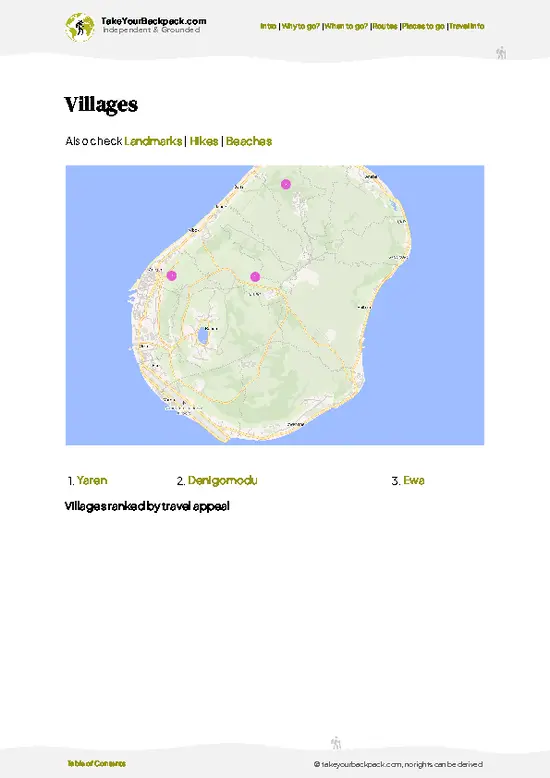
No backpacker hostels exist in Nauru and budget lodging is very limited; expect a handful of simple guesthouses or basic rooms concentrated in Yaren, Aiwo and Denigomodu rather than dorm-style hostels.
Yaren is best for airport access and government services but is very quiet with almost no nightlife; Aiwo sits by the wharf and light commercial areas so it’s slightly more active but industrial; Denigomodu offers the best beach/coastal access and the quietest stays but has minimal amenities—bring supplies and book ahead.

If you enjoy meeting fellow travelers, consider choosing hostels with high … read more 👉
No backpacker hostels exist in Nauru and budget lodging is very limited; expect a handful of simple guesthouses or basic rooms concentrated in Yaren, Aiwo and Denigomodu rather than dorm-style hostels.
Yaren is best for airport access and government services but is very quiet with almost no nightlife; Aiwo sits by the wharf and light commercial areas so it’s slightly more active but industrial; Denigomodu offers the best beach/coastal access and the quietest stays but has minimal amenities—bring supplies and book ahead.

If you enjoy meeting fellow travelers, consider choosing hostels with high ratings for atmosphere. On the other hand, if you prefer having your own space, a hotel might be a better option.

🚌 Getting aroundPublic transport and other ways to get around

Nauru moves on ring-road logic, not timetables. One loop, a handful of chokepoints, and a lot of neighborly favors. If you can read the heat, the school run, and where the shade falls, the island opens up. Miss that rhythm and you’ll cook on a shoulder-less verge, watching empty utes blast by.
  • Hire car The Efficiency Trade-off: Fastest way to “do the lap.” Figure 25-35 minutes nonstop around the island, but you’ll stop a lot. Day rates are higher than you expect for such a small place, and fuel isn’t
read more 👉
Nauru moves on ring-road logic, not timetables. One loop, a handful of chokepoints, and a lot of neighborly favors. If you can read the heat, the school run, and where the shade falls, the island opens up. Miss that rhythm and you’ll cook on a shoulder-less verge, watching empty utes blast by.
  • Hire car The Efficiency Trade-off: Fastest way to “do the lap.” Figure 25-35 minutes nonstop around the island, but you’ll stop a lot. Day rates are higher than you expect for such a small place, and fuel isn’t cheap; in return you control timing, dodge midday heat, and reach Topside detours. Night driving is dicey—patchy lighting, dogs, walkers, and coral-edge potholes—so bank daylight.
  • Hitching rides The Social Fabric: Stand on the ocean side, visible, hand low with a small wave. People will help if there’s space; hop in the tray if offered. Always greet, state area not exact address, and offer a coin or cold drink—refusals are common but the gesture matters. Sundays are quieter; school runs mean quick, short lifts. Don’t slam doors; don’t talk politics unless they start it.
  • Bicycle The Geometric Unlock: Cheap day rentals from bigger shops/lodges let you stitch the whole loop and slip into lanes cars skip—coastal bunkers, Anibare stops, short climbs to Command Ridge. Go at dawn, clockwise for easier roadside pull-offs. No bike lanes, sun is savage, and trucks own Topside; carry 2L water and lights.
  • Walking the Ring Road The Budget Disruptor: Free, obvious, and surprisingly efficient if you leapfrog. Walk cool hours, use shops as shade-and-water nodes, and accept short lifts when offered. Four to six hours for a full loop if you keep moving; flip-flops work, but real shoes save feet on sharp coral grit.

Master tip: Start at first light, go clockwise, and chain the island via shops—buy water, ask for the next lift, and you’ll cross Nauru in one cool, efficient sweep.
Nauru International Airport (INU) sits inside Yaren District. There isn’t a formal “city center” on Nauru, but most visitors head to Yaren’s government area (about 1 km/0.6 mi from the terminal) or to the shops and services in Aiwo (roughly 3-4 km/2-2.5 mi northwest).

As of 2025, there’s no public bus network. Getting from the airport is straightforward but low-frills — think walking, a prearranged hotel transfer, a taxi, or a rental car.
  • Walk — If you’re staying in Yaren, it’s an easy 10-15 minutes on foot (about 1 km/0.6 mi). To Aiwo, plan 40-60 minutes (3-4 km/2-2.5 mi). Cost: free.
  • Taxi — Small fleet, no meters; pay cash in AUD. 3-5 minutes to central Yaren (AUD 10-15). 8-12 minutes to Aiwo (AUD 12-20). To Meneng/Anibare areas, usually AUD 15-25. Best to arrange through your hotel or call ahead, especially for late flights.
  • Hotel transfer/shuttle — Many accommodations will meet flights if you book in advance. 5-10 minutes to most places in Yaren/Aiwo. Often included with your stay or around AUD 5-10 per person.
  • Car rental — Handy if you plan to loop the island (about 19 km/12 mi around). 5-10 minutes’ drive to Yaren/Aiwo. Typical rates are AUD 70-100 per day, fuel extra. Book ahead — availability is limited.
  • Informal lifts — Locals sometimes offer rides; it’s common and usually free or a small contribution (AUD 2-3). Only if you’re comfortable.

Taxi quick take: Limited supply, not metered, pay in Australian dollars. Expect roughly AUD 10-20 for most airport-to-town rides depending on distance and time of day. Arranging in advance is wise.
⚠️ Prices and routes can change, so take this as a rough guide and ask for local advice when you arrive.

🔒 Safety (risk Level: low)What first-time visitors should know

Safety for solo travelers, including women and LGBTQ+ individuals
Nauru is generally safe for solo travelers, including women and LGBTQ+ individuals. The crime rate is low, but solo travelers should still exercise common sense, especially at night. While the local culture may not be as openly accepting of LGBTQ+ lifestyles as some other destinations, incidents are rare. Respect local customs and stay informed about any advisories for the best experience.

✈️ VisaWhat travelers should know about visas

Most travelers need a visa to visit Nauru, with the exception of citizens from a few Pacific island nations. Apply for a visa through Nauru’s official government website or contact their nearest consulate, ensuring you have a valid passport, proof of accommodation, and a return ticket.
⚠️ Visa requirements can change over time, so always check the latest visa requirements with the official embassy or government website before you travel.

🎒 What to pack?Packing essentials for the trip

Nauru might be small, but it’s got some big humidity, so pack light and breathable clothes. The sun’s out in full force, so you’ll want to bring plenty of sun protection. Beaches are a big draw, but remember that modesty is appreciated, especially away from the sand—opt for attire that covers your shoulders and knees when exploring local areas. The terrain is mostly flat with plenty of coastal charm, so sensible footwear will help you navigate the coral-filled beaches and rocky shores. Oh, and don’t forget, there’s not a ton of shopping options, so bring what you need!

Apart from this country specific advice, I have also crafted a general packing list that should help on any trip. authorOver the years, I've learned the importance of packing minimally. It's so much easier to jump on the back of a truck or squeeze yourself into the last spot of a minibus without that supersized backpack. If you're headed to a warm destination, leave your winter jacket at home; for colder regions, opt for thin thermal underlayers. Instead of packing your entire wardrobe, bring just three sets of clothes, as laundry facilities are available everywhere.
View the full list 👉
🎒 Planning the practical side of your trip?
Get detailed information on transport, daily budgets, internet access, local customs, food, language, and other essentials in the complete Travel Guide.

Get detailed practical information 👉

Get the Travel Guide -

🙋 FAQQuick answers to practical concerns

Trip Planning


Personal tip: I normally search on good rating for atmosphere (for meeting people) and location (for easy exploring). Cleanliness as a bonus.


Travel Essentials

You typically need routine vaccinations like MMR (measles, mumps, rubella) and DPT (diphtheria, pertussis, tetanus) for Nauru. Consider hepatitis A and B, especially if you’re planning to stay longer or have specific travel plans. Typhoid vaccination is recommended if you plan to eat or drink outside major hotels and restaurants. Check the latest health advisories before you go.


vaccination requirements
When I first started traveling, I often spent part of my first day in a new country hunting for a local SIM card. While this can still be slightly cheaper, it also takes time and planning.

These days, it's much simpler to install an eSIM before leaving home. Once you arrive in Nauru, you can activate it immediately and have mobile data from the moment you land — which is especially useful for ordering transport or navigating away from busy airports.

There are many providers nowadays, and price differences are usually small. I personally go with Airalo, as it offers excellent network coverage throughout the country and strong global coverage, so you can manage multiple countries from a single app.


Get your e-sim for Nauru

Culture & Customs

Respect local customs by dressing modestly; avoid wearing swimsuits or revealing clothing in public areas. When visiting villages, ask for permission before taking photos, especially of people. Always greet others with a smile and a nod; handshakes are common.

Avoid discussing politics, as it’s a sensitive topic. Public displays of affection are frowned upon, and LGBTQ+ travelers might want to exercise discretion, as Nauru is conservative regarding LGBTQ+ issues.

For women, travel in groups where possible and be mindful of social norms. Always show respect for elders and avoid raising your voice in public settings. If invited to a local’s home, it’s customary to bring a small gift, like food or handicrafts.
Trying traditional food is always a great way to experience the culture. Here are some must-try dishes for Nauru.
  • Ikan Bilis: This dish features small dried anchovies that are often fried. It’s a staple because it’s easy to preserve and full of flavor, making it a go-to snack or meal accompaniment.
  • Coconut Fish: Fish wrapped in banana leaves and cooked with coconut cream. It’s popular for its simplicity and the rich, tropical flavor that showcases the island’s abundant natural resources.
  • Fried Taro: Taro root is a common staple in Nauru, often served fried as a side dish. Its cultural significance stems from its historical role as a primary food source.
  • Coconut Crabs: These massive crabs are a delicacy due to their rich, distinctive taste. They’re culturally important as they reflect the traditional island lifestyle and reliance on local resources.
Tap water in Nauru isn’t safe to drink for anyone, including locals, who mostly rely on rainwater tanks or imported bottled water. Tourists should stick to bottled or properly filtered water to avoid any potential health issues. If you’re staying awhile, consider investing in a reliable water filter to cut costs and reduce plastic waste.
The main language in Nauru is Nauruan. Backpacking is way more rewarding if you know a bit of the local language, so I'd suggest brushing up on the basics just in case your Nauruan skills have become a bit rusty.

Want to understand locals better?
The complete Travel Guide for Nauru includes 52 essential words and phrases — greetings, thank-yous, ordering food, transport, numbers, and common local expressions you'll actually hear.

Get your local basic phrases 👉

Get the Travel Guide -


English is widely spoken in Nauru, primarily as a second language. The official languages are Nauruan and English, with English being used in government, education, and business. Most Nauruans, especially the younger population and those involved in tourism, have a good command of English. In urban areas and among professionals, communication in English is generally effective. However, in more remote regions or among older generations, proficiency may vary, and Nauruan is often the primary language spoken.

Visitors to Nauru will find that basic English is sufficient for navigating daily interactions, such as asking for directions, dining, and shopping. Signs and information are typically available in English, making it easier for travelers to get around. While some local dialects and phrases may be encountered, English serves as a common bridge for communication. Overall, English is a key language in Nauru, facilitating interactions for tourists and expatriates alike.

Money & Payments

The local currency of Nauru is AUD (A$).

Nauru isn’t exactly bustling with ATMs—there’s just one at the Bank of Nauru, and it’s not known for being super reliable. So, carrying some cash is wise. The official currency here is the Australian Dollar (AUD), so come prepared with that. Forget about euros, they won’t do you much good.

When it comes to credit cards, don’t count on widespread acceptance. Most places prefer cash, and even if you find a spot that takes cards, there might be extra charges. If you need to exchange money, your best bet is the bank; just be ready for limited hours and potential queues.

Tipping in Nauru is not a common practice, and service charges are typically included in the bill. While you won’t be expected to tip, small gestures of appreciation, like rounding up the bill, are always welcomed if you feel you’ve received exceptional service.

🧩 Nearby countriesNearby backpacking alternatives

We 💚 feedbackWhat to know before planning your trip

Bring AUD cash; ATMs run dry. Book a bed before you land—rooms get snapped by contractors. Nauru Airlines shifts schedules, so keep a spare day on each end. Dawn bike lap is the win; Anibare is swimmable on calm days, but coral bites back. Sunday shutdown is real. Hitching works if you’re polite. Small downside: heat is furnace-level by 10 a.m. Forward look: the submarine cable and port upgrades are rolling in, so internet and supplies should stabilize, and planning won’t feel like roulette.

✍️ Help improve this page!
The information on this page is based on in-depth research, insights shared by experienced travelers, and feedback from the local travel community in Nauru. While every effort is made to keep the information accurate and current, conditions can change — so if you spot anything incorrect or outdated, please get in touch.


🙋‍♂️ Give feedback

👋 Meet the founderWho’s Behind Take Your Backpack?

Johan, backpacker and founder of TakeYourBackpackHi, I’m Johan (Netherlands 🇳🇱), the creator of TakeYourBackpack. Over the past decade, I’ve backpacked through 80+ countries across six continents, gaining extensive experience with independent travel, long-term trips, and overland routes.

This site is built on a combination of firsthand travel experience and carefully curated insights from other backpackers. Many guides are based on places I’ve personally visited, while others bring together tips, observations, and practical advice shared by trusted travelers I’ve met along the way.

The goal is to provide realistic, experience-driven guidance — not generic itineraries — so you can explore destinations with better context, clearer expectations, and more confidence.

Get full Nauru guide •
Instant download • 24 highlights • Full Offline guide