Trip Planning
The TakeYourBackpack guidebooks are your all-in-one travel companion, featuring the best cities, national parks, hikes, beaches, and unique sites, along with essential tips on when to go, how to get around, exchanging money, and even local phrases to get you started — everything you need for a smooth, unforgettable backpacking adventure.
Stop researching. Start exploring.Discover all 27 highlights,ranked
and organized into practical routes.
Get instant access
Planning a backpacking route through Mayotte can be tricky — you need to balance must-see places, travel times, budget, and how long to stay in each destination. Our free personalized Mayotte itinerary planner creates a route based on your travel style, trip duration, and interests, so you can spend less time researching and more time exploring.
Personal tip: I normally search on good rating for atmosphere (for meeting people) and location (for easy exploring). Cleanliness as a bonus.
Travel Essentials
No vaccinations are mandatory for most travelers to Mayotte, but a yellow fever certificate is required if you arrive from a country with yellow fever risk. Make sure routine vaccines (MMR, tetanus-diphtheria, polio) are up to date, and hepatitis A and typhoid are recommended because of food and water hygiene. Hepatitis B and rabies are worth discussing for longer stays, and recent cholera outbreaks make an oral cholera vaccine an option to raise with a travel clinic. Dengue and chikungunya circulate, so mosquito protection matters year-round.
vaccination requirementsWhen I first started traveling, I often spent part of my first day in a new country hunting for a local SIM card. While this can still be slightly cheaper, it also takes time and planning.
These days, it's much simpler to install an eSIM before leaving home. Once you arrive in Mayotte, you can activate it immediately and have mobile data from the moment you land — which is especially useful for ordering transport or navigating away from busy airports.
There are many providers nowadays, and price differences are usually small. I personally go with
Holafly, as it offers excellent network coverage throughout the country and strong global coverage, so you can manage multiple countries from a single app.
HolaFly eSimCulture & Customs
Life in Mayotte follows Muslim customs, so do dress modestly in villages and Mamoudzou, covering shoulders and knees, and keep swimwear for the beach. Do remove your shoes before entering a mosque or home, use your right hand to give and receive, and always ask before photographing people, especially women, many of whom wear the traditional salouva and the sandalwood face paste called msindzano. During Ramadan, avoid eating, drinking or smoking openly in public during daylight. Don’t drink alcohol on the street or show public affection. Women will be more comfortable with loose, covering clothes, and same-sex couples should stay discreet given conservative attitudes.
Trying traditional food is always a great way to experience the culture. Here are some must-try dishes for Mayotte.
- Mataba: Pounded cassava leaves slow-cooked in coconut milk, often with fish or meat. It is the everyday taste of Mahoran home cooking and appears at family meals and ceremonies alike.
- Mabawa: Grilled, marinated chicken wings sold from roadside barbecues, especially around the Mamoudzou waterfront at dusk. They are cheap, smoky and the island’s favorite street food.
- Poisson au coco: Fresh reef fish simmered in a coconut sauce with tomato, onion and spices. It reflects how central the lagoon and the coconut palm are to local life.
- Pilao: Spiced rice cooked with meat, cardamom, clove and cinnamon. It shows the Swahili and Indian Ocean trading roots of the cuisine and is a staple of weddings and festive gatherings.
- Bananes et manioc au coco: Green plantains or cassava boiled in coconut milk. This is a filling, humble dish that has fed generations and often comes with grilled fish.
- Ambrevades au coco: Pigeon peas stewed in coconut milk. They are a common, protein-rich side served with rice in nearly every local snack bar.
Tap water in Mayotte is treated and many locals drink it, but repeated shortages, supply cuts and contamination after Cyclone Chido have made its quality unreliable. Travelers are advised not to drink it straight from the tap. Stick to bottled water or use a good filter or purifier, especially in the south and in rural villages.
The main language in Mayotte is
Shimaore. Backpacking is way more rewarding if you know a bit of the local language, so I'd suggest brushing up on the basics just in case your Shimaore skills have become a bit rusty.
Want to understand locals better?The complete Travel Guide for Mayotte includes 52 essential words and phrases — greetings, thank-yous, ordering food, transport, numbers, and common local expressions you'll actually hear.
Get your local basic phrases 👉
Get the Travel Guide - is rarely spoken in Mayotte, even in Mamoudzou, where you might find a few hotel receptionists, dive center staff or students who manage basic conversation. Younger people who studied in mainland France or Réunion sometimes speak a little, but in villages almost everyone uses Shimaore or Kibushi, with French as the shared language. French is by far the most useful second language here, and even a handful of polite phrases will soften every interaction. Download offline French in Google Translate, and learn the Shimaore greeting “jéjé” for an instant smile.
Money & Payments
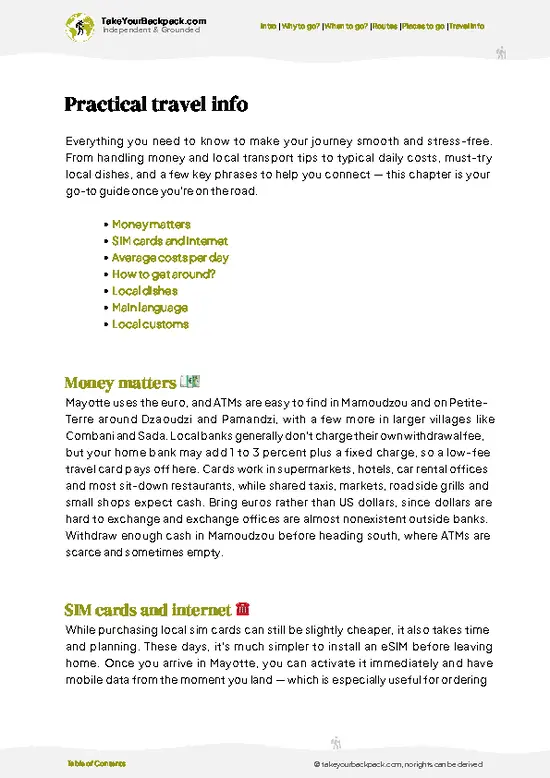
The local currency of Mayotte is EUR (€).
Mayotte uses the euro, and ATMs are easy to find in Mamoudzou and on Petite-Terre around Dzaoudzi and Pamandzi, with a few more in larger villages like Combani and Sada. Local banks generally don’t charge their own withdrawal fee, but your home bank may add 1 to 3 percent plus a fixed charge, so a low-fee travel card pays off here. Cards work in supermarkets, hotels, car rental offices and most sit-down restaurants, while shared taxis, markets, roadside grills and small shops expect cash. Bring euros rather than US dollars, since dollars are hard to exchange and exchange offices are almost nonexistent outside banks. Withdraw enough cash in Mamoudzou before heading south, where ATMs are scarce and sometimes empty.
Tipping in Mayotte follows French custom: service is included in restaurant prices, so a tip is never expected. Rounding up the bill or leaving €1 to 2 for friendly service at a sit-down restaurant is appreciated, and dive guides or private drivers welcome a little extra after a good day. Shared taxis and snack stalls get no tip at all.
v2.webp)

 Best Backpacking
.jpg) Over the years, I've learned the importance of packing minimally. It's so much easier to jump on the back of a truck or squeeze yourself into the last spot of a minibus without that supersized backpack. If you're headed to a warm destination, leave your winter jacket at home; for colder regions, opt for thin thermal underlayers. Instead of packing your entire wardrobe, bring just three sets of clothes, as laundry facilities are available everywhere.
Over the years, I've learned the importance of packing minimally. It's so much easier to jump on the back of a truck or squeeze yourself into the last spot of a minibus without that supersized backpack. If you're headed to a warm destination, leave your winter jacket at home; for colder regions, opt for thin thermal underlayers. Instead of packing your entire wardrobe, bring just three sets of clothes, as laundry facilities are available everywhere.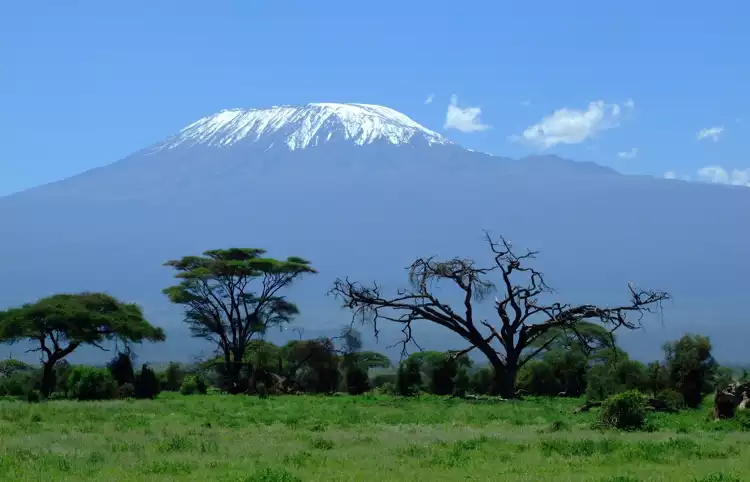

.jpg) Hi, I’m Johan (Netherlands 🇳🇱), the creator of TakeYourBackpack. Over the past 3 decades, I’ve backpacked through 90+ countries across six continents, gaining extensive experience with independent travel, long-term trips, and overland routes.
Hi, I’m Johan (Netherlands 🇳🇱), the creator of TakeYourBackpack. Over the past 3 decades, I’ve backpacked through 90+ countries across six continents, gaining extensive experience with independent travel, long-term trips, and overland routes.