Trip Planning
The TakeYourBackpack guidebooks are your all-in-one travel companion, featuring the best cities, national parks, hikes, beaches, and unique sites, along with essential tips on when to go, how to get around, exchanging money, and even local phrases to get you started — everything you need for a smooth, unforgettable backpacking adventure.
Stop researching. Start exploring.Discover all 35 highlights,ranked
and organized into practical routes.
Get instant access
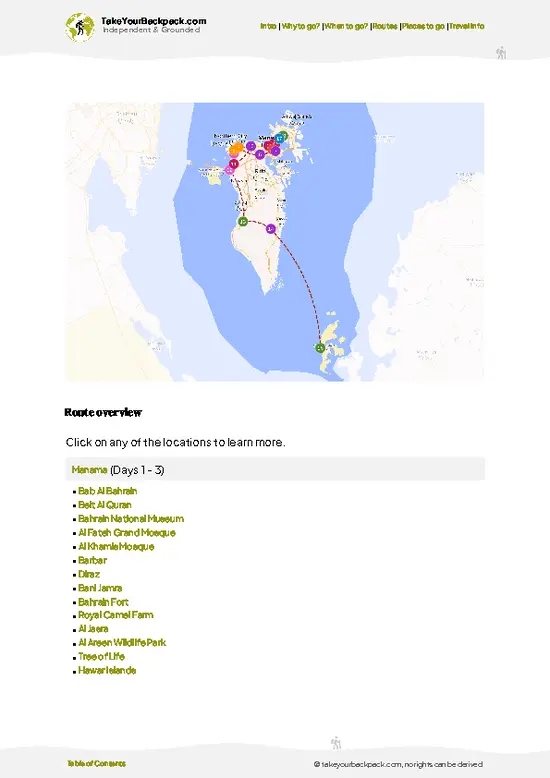
Planning a backpacking route through Bahrain can be tricky — you need to balance must-see places, travel times, budget, and how long to stay in each destination. Our free personalized Bahrain itinerary planner creates a route based on your travel style, trip duration, and interests, so you can spend less time researching and more time exploring.
Personal tip: I normally search on good rating for atmosphere (for meeting people) and location (for easy exploring). Cleanliness as a bonus.
Travel Essentials
No vaccinations are required to enter Bahrain, except a yellow fever certificate if you arrive from a country with yellow fever risk. Make sure your routine vaccines are up to date, including MMR, tetanus-diphtheria and polio. Hepatitis A and typhoid are commonly recommended for travelers to Bahrain, and hepatitis B is advised for longer stays. Check with a travel clinic 4 to 6 weeks before departure.
vaccination requirementsWhen I first started traveling, I often spent part of my first day in a new country hunting for a local SIM card. While this can still be slightly cheaper, it also takes time and planning.
These days, it's much simpler to install an eSIM before leaving home. Once you arrive in Bahrain, you can activate it immediately and have mobile data from the moment you land — which is especially useful for ordering transport or navigating away from busy airports.
There are many providers nowadays, and price differences are usually small. I personally go with
Holafly, as it offers excellent network coverage throughout the country and strong global coverage, so you can manage multiple countries from a single app.
HolaFly eSimCulture & Customs
Bahrain is relaxed by Gulf standards, but respect for Islam and the royal family shapes public behavior. Dress modestly in public, covering shoulders and knees, especially in souqs, villages and mosques. Women entering mosques such as Al Fateh Grand Mosque must cover their hair, and abayas are provided there. Remove your shoes before entering mosques and homes, and use your right hand for eating, giving and receiving. During Ramadan, don’t eat, drink or smoke in public during daylight hours. Ask before photographing people, and never photograph local women without permission. Alcohol is legal in licensed hotels and bars, but public drunkenness is punishable. Avoid public displays of affection, which is especially important for same-sex couples. Don’t criticize the government or ruling family, even casually. If you’re invited for gahwa, accept at least one cup, and shake the small cup gently when you’ve had enough.
Trying traditional food is always a great way to experience the culture. Here are some must-try dishes for Bahrain.
- Machboos: Bahrain’s national dish. It is spiced basmati rice cooked with chicken, lamb or fish (often hamour), flavored with loomi (dried black lime), cardamom and baharat. It is the centerpiece of family Friday lunches, and every household swears its version is the right one.
- Muhammar: Sweet rice cooked with date syrup or sugar, cardamom and saffron, traditionally served alongside grilled or fried fish. The sweet-and-salty pairing dates back to pearl-diving days and is a distinctly Bahraini combination.
- Balaleet: Sweet vermicelli scented with saffron, rosewater and cardamom, topped with a thin omelet. It is a classic breakfast, especially during Eid, and the contrast of sugary noodles and savory egg surprises first-timers.
- Harees: Slow-cooked wheat and meat beaten into a smooth, porridge-like dish, finished with ghee. It is a staple of Ramadan iftars and weddings, and is often cooked in huge pots and shared with neighbors.
- Bahraini halwa: A glossy, jelly-like sweet made with cornstarch, sugar, saffron, rosewater and nuts, sold by family-run shops in Muharraq. It is served with gahwa (cardamom coffee) whenever guests visit.
- Mahyawa: A pungent fermented fish sauce brought over from southern Iran, spread on thin, crispy bread with egg or cheese. It is a beloved street breakfast and a direct taste of the island’s old trade links across the Gulf.
Tap water in Bahrain is mostly desalinated and treated to government standards, but many residents avoid drinking it because of its flat, salty taste and concerns about older building pipes and rooftop storage tanks. Most locals drink bottled water or use home filters, and travelers are advised to do the same, using tap water for brushing teeth only. Bottled water is cheap at around 100 to 200 fils (US$0.25 to 0.55) per small bottle in groceries, and large refill jugs are sold everywhere.
The main language in Bahrain is
Arabic. Backpacking is way more rewarding if you know a bit of the local language, so I'd suggest brushing up on the basics just in case your Arabic skills have become a bit rusty.
Want to understand locals better?The complete Travel Guide for Bahrain includes 52 essential words and phrases — greetings, thank-yous, ordering food, transport, numbers, and common local expressions you'll actually hear.
Get your local basic phrases 👉
Get the Travel Guide - is spoken almost everywhere in Bahrain. It is the working language of hotels, malls, restaurants and taxis in Manama, and most signs are bilingual. Younger Bahrainis and the large South Asian and Filipino workforce use it daily, and it remains common even in smaller towns and villages, though older residents there may stick to Arabic. Learning a few Arabic words such as “shukran” (thank you) and “salaam alaikum” earns real warmth, and Google Translate’s offline Arabic pack covers the rare menu or sign that isn’t translated.
Money & Payments
The local currency of Bahrain is BHD (ب.د).
Bahrain uses the Bahraini dinar (BD), divided into 1,000 fils and pegged at about US$2.65 per dinar, which makes it one of the world’s highest-valued currencies. ATMs are everywhere in Manama, Seef, Juffair and Muharraq, including in malls and petrol stations. Most dispense dinars without local fees, though your home bank’s foreign transaction charges still apply, and some machines add a fee of BD 1 to 2 on foreign cards. Visa and Mastercard are accepted in nearly all hotels, malls, supermarkets and restaurants, and contactless payment is widespread. You’ll still want cash for souq stalls, small cafeterias, karak tea stands and some taxis. US dollars are the easiest foreign currency to exchange, with euros close behind and Saudi riyals also widely accepted. Licensed exchange houses in Manama Souq and the malls give better rates than the airport or hotels.
Tipping in Bahrain is appreciated but not obligatory. Many hotels and upscale restaurants already add a service charge, so check the bill before adding more. Where no charge is included, leaving around 10 percent in restaurants is standard. Rounding up taxi fares and giving porters or hotel staff 500 fils to BD 1 is common courtesy.
v2.webp)


 Best Backpacking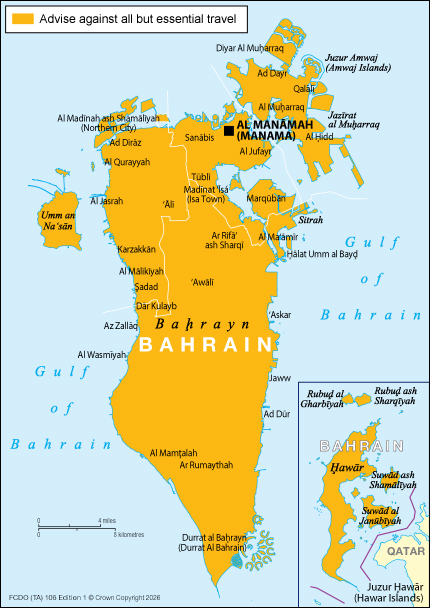
.jpg) Over the years, I've learned the importance of packing minimally. It's so much easier to jump on the back of a truck or squeeze yourself into the last spot of a minibus without that supersized backpack. If you're headed to a warm destination, leave your winter jacket at home; for colder regions, opt for thin thermal underlayers. Instead of packing your entire wardrobe, bring just three sets of clothes, as laundry facilities are available everywhere.
Over the years, I've learned the importance of packing minimally. It's so much easier to jump on the back of a truck or squeeze yourself into the last spot of a minibus without that supersized backpack. If you're headed to a warm destination, leave your winter jacket at home; for colder regions, opt for thin thermal underlayers. Instead of packing your entire wardrobe, bring just three sets of clothes, as laundry facilities are available everywhere.


.jpg) Hi, I’m Johan (Netherlands 🇳🇱), the creator of TakeYourBackpack. Over the past 3 decades, I’ve backpacked through 90+ countries across six continents, gaining extensive experience with independent travel, long-term trips, and overland routes.
Hi, I’m Johan (Netherlands 🇳🇱), the creator of TakeYourBackpack. Over the past 3 decades, I’ve backpacked through 90+ countries across six continents, gaining extensive experience with independent travel, long-term trips, and overland routes.