Trip Planning
The TakeYourBackpack guidebooks are your all-in-one travel companion, featuring the best cities, national parks, hikes, beaches, and unique sites, along with essential tips on when to go, how to get around, exchanging money, and even local phrases to get you started — everything you need for a smooth, unforgettable backpacking adventure.
Stop researching. Start exploring.Discover all 20 highlights,ranked
and organized into practical routes.
Get instant access
Planning a backpacking route through Monaco can be tricky — you need to balance must-see places, travel times, budget, and how long to stay in each destination. Our free personalized Monaco itinerary planner creates a route based on your travel style, trip duration, and interests, so you can spend less time researching and more time exploring.
Personal tip: I normally search on good rating for atmosphere (for meeting people) and location (for easy exploring). Cleanliness as a bonus.
Travel Essentials
No vaccinations are required to visit Monaco. Make sure your routine vaccines are up to date, including measles-mumps-rubella, tetanus-diphtheria and seasonal flu, and many doctors also suggest hepatitis A for travel in Europe. Health standards in Monaco are high, with modern hospitals and well-stocked pharmacies.
vaccination requirementsWhen I first started traveling, I often spent part of my first day in a new country hunting for a local SIM card. While this can still be slightly cheaper, it also takes time and planning.
These days, it's much simpler to install an eSIM before leaving home. Once you arrive in Monaco, you can activate it immediately and have mobile data from the moment you land — which is especially useful for ordering transport or navigating away from busy airports.
There are many providers nowadays, and price differences are usually small. I personally go with
Holafly, as it offers excellent network coverage throughout the country and strong global coverage, so you can manage multiple countries from a single app.
HolaFly eSimCulture & Customs
Monaco is formal and image-conscious, and dressing neatly earns you better service and fewer looks. Do respect dress codes: the Casino de Monte-Carlo requires smart attire (no shorts, flip-flops or sportswear), checks ID and admits only those 18 and over, and jackets are expected in some areas in the evening. Don’t walk around town shirtless, barefoot or in swimwear away from the beach, as police can issue fines. Do cover shoulders and knees in the Cathedral and the chapels, and keep your voice down there. Don’t mock or criticize the Prince and his family, since locals hold the monarchy in high regard. Keep the volume low on public transport and in the old town on the Rock, where many residents live. Women face no specific dress or behavior restrictions beyond these general codes, and LGBTQ+ couples are best served by the same low-key discretion locals use.
Trying traditional food is always a great way to experience the culture. Here are some must-try dishes for Monaco.
- Barbagiuan: Monaco’s national dish, a fried pastry pocket stuffed with Swiss chard, ricotta, Parmesan and herbs. Locals eat it as a snack or aperitif, and it appears everywhere on National Day, November 19.
- Socca: A thin, crisp chickpea-flour pancake baked in a very hot oven and dusted with black pepper. It’s the cheap, filling street food of the Riviera, best eaten hot from the market stalls at La Condamine.
- Stocafi: Dried stockfish simmered for hours with tomatoes, black olives, garlic and white wine. It reflects Monaco’s old trade links with northern fishing ports and remains a family dish for special occasions.
- Fougasse monégasque: A sweet, flat bread flavored with orange blossom and topped with almonds and red and white aniseed sprinkles in the national colors. It’s traditionally eaten around Christmas and National Day.
- Pissaladière: An onion tart slow-cooked until sweet, topped with anchovies and black olives. It shows the shared Niçoise-Ligurian roots of Monégasque cooking and makes a solid budget lunch from a bakery.
Tap water in Monaco is safe to drink and meets strict European quality standards. Locals drink it daily, and tourists can do the same without worry, refilling bottles at public fountains across the city. Bottled or filtered water is unnecessary unless you prefer the taste.
The main language in Monaco is
French. Backpacking is way more rewarding if you know a bit of the local language, so I'd suggest brushing up on the basics just in case your French skills have become a bit rusty.
Want to understand locals better?The complete Travel Guide for Monaco includes 52 essential words and phrases — greetings, thank-yous, ordering food, transport, numbers, and common local expressions you'll actually hear.
Get your local basic phrases 👉
Get the Travel Guide - is widely spoken in Monaco wherever travelers spend money, from Monte-Carlo hotels and restaurants to shops around the port and the train station. Younger residents and hospitality staff usually switch to English easily, and since the whole country is urban, there are no rural pockets where you’ll struggle. French is the official language and the one that helps most, with Italian a close second because of the many Italian residents and workers. A polite “Bonjour” before your question and an offline French pack in Google Translate cover nearly every gap.
Money & Payments
The local currency of Monaco is EUR (€).
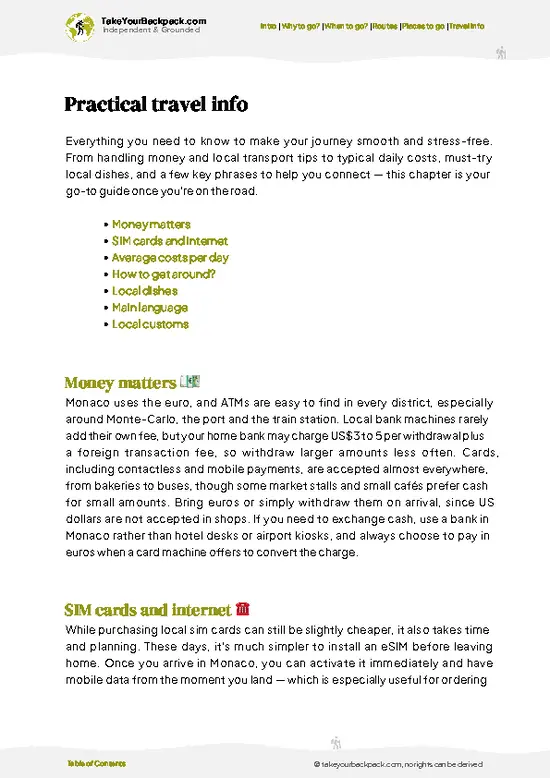
Monaco uses the euro, and ATMs are easy to find in every district, especially around Monte-Carlo, the port and the train station. Local bank machines rarely add their own fee, but your home bank may charge US$3 to 5 per withdrawal plus a foreign transaction fee, so withdraw larger amounts less often. Cards, including contactless and mobile payments, are accepted almost everywhere, from bakeries to buses, though some market stalls and small cafés prefer cash for small amounts. Bring euros or simply withdraw them on arrival, since US dollars are not accepted in shops. If you need to exchange cash, use a bank in Monaco rather than hotel desks or airport kiosks, and always choose to pay in euros when a card machine offers to convert the charge.
Tipping in Monaco is appreciated but not expected, because a service charge (“service compris”) is included in restaurant and café bills by law. Rounding up or leaving 5 to 10 percent for good service is generous, and leaving a couple of euros for a bartender, hotel porter or taxi driver is a polite gesture.
v2.webp)
 Best Backpacking
.jpg) Over the years, I've learned the importance of packing minimally. It's so much easier to jump on the back of a truck or squeeze yourself into the last spot of a minibus without that supersized backpack. If you're headed to a warm destination, leave your winter jacket at home; for colder regions, opt for thin thermal underlayers. Instead of packing your entire wardrobe, bring just three sets of clothes, as laundry facilities are available everywhere.
Over the years, I've learned the importance of packing minimally. It's so much easier to jump on the back of a truck or squeeze yourself into the last spot of a minibus without that supersized backpack. If you're headed to a warm destination, leave your winter jacket at home; for colder regions, opt for thin thermal underlayers. Instead of packing your entire wardrobe, bring just three sets of clothes, as laundry facilities are available everywhere.
.jpg) Hi, I’m Johan (Netherlands 🇳🇱), the creator of TakeYourBackpack. Over the past 3 decades, I’ve backpacked through 90+ countries across six continents, gaining extensive experience with independent travel, long-term trips, and overland routes.
Hi, I’m Johan (Netherlands 🇳🇱), the creator of TakeYourBackpack. Over the past 3 decades, I’ve backpacked through 90+ countries across six continents, gaining extensive experience with independent travel, long-term trips, and overland routes.