×
Azerbaijan 🇦🇿

backpacking Asia Azerbaijan 🇦🇿
Watch modern streets fade into timeless villages beyond the capital.

Explore ArmeniaExplore Bahrain

Backpacking Azerbaijan in 2026

A complete guide including when and where to go, costs, transport, itineraries, and practical travel advice.
An overview of visiting Azerbaijan

Backpacking Azerbaijan
By Johan Kruseman 🇳🇱 | Updated June 1, 2026

Azerbaijan is easier and cheaper to travel than its Baku skyline suggests. E-visas, shared taxis, and mountain homestays keep costs low and hops quick. That practicality matches the country’s split personality: efficient on top, ancient and elemental underneath.

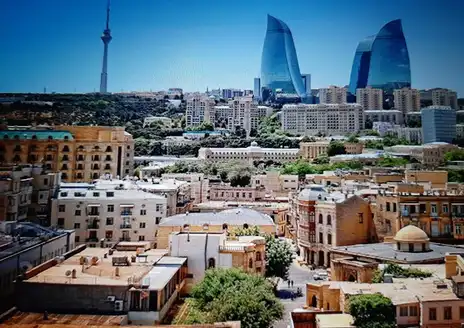
You move from Icherisheher’s stone lanes to the LED-lit Flame Towers, then out to Absheron’s wind, where Yanar Dag burns and Ateshgah recalls fire worship. Gobustan’s petroglyphs and mud volcanoes feel lunar; north, Khinalug and Lahij lean into the Greater Caucasus; west, Sheki’s khan palace glints with shebeke; south, Hyrcanian forests and tea gardens reset the mood. Heat and the khazri wind, thin English outside Baku, fluid marshrutka times, sensitive borders, and registration after longer stays are real; early starts, cash, and two Azeri phrases make them easy.

Georgia is looser with wine and trails; Armenia is monastic and rugged; Azerbaijan adds the Caspian, fire heritage, semi-desert oddities, and a sharper urban gloss. Go if you want clean logistics, real edges, and the switch from metro platform to shepherd village in one day.

👉 Get the 📖 Travel Guide of Azerbaijan

Baku & Absheron

Use Baku as your base. The city runs on BakıKart; load once and hop metro and buses. Ride-hailing is cheap; English is thin beyond the center, so pin destinations. Day-trip spine works cleanly: Ateshgah and Yanar Dag east; Gobustan rock art and mud volcanoes south (hire a driver for the rutted tracks). Rewards urban explorers, food hunters, and first-timers who want high yield with low faff.

Quba–Khinalig (Greater Caucasus)

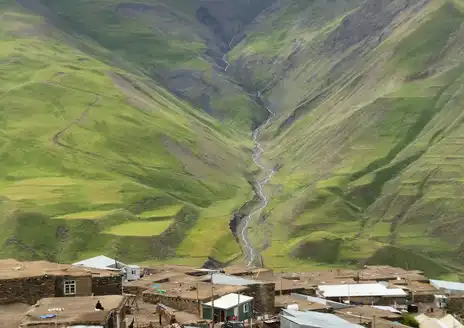
Three to four hours by bus to Quba, then shared taxi up the single road to Khinalig. Paved but exposed; snow and fog can shut it Nov–Apr. Homestays are warm, cash-only, with basic bathrooms; no ATMs. Trails leave from the village—carry layers, a power bank, and offline maps. Best for hikers who value effort, altitude air, and long table meals.

Sheki–Kish–Ilisu (Northwest Silk Road)

Buses from Baku (5–6 hours) drop you near walkable Sheki. Sleep in the old caravansaray for stone walls and quiet nights. Hit the Khan’s Palace at opening, then the Albanian church in nearby Kish; hire a taxi to Ilisu for waterfalls and ridge strolls. Eat piti stew and pakhlava. Rewards history-minded travelers who like gentle hill walking and intact craft traditions.

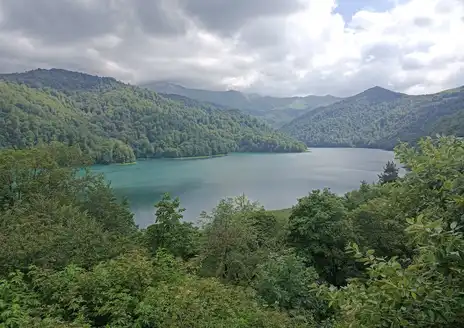
Ganja & Lake Goygol

Second-city grit with a student-heavy core, reached by overnight train or daytime bus. Day-trip spine: Ganja to Goygol town (old German Helenendorf) and on to Goygol National Park; taxis wait at the gate. Short lake-view trails, no swimming, carry ID. Best for urbanists who want a clean nature add-on without renting a car.

Lankaran–Lerik–Hirkan (Talysh South)

Straight-shot buses down the coastal highway. Expect humidity, rain any month, and mosquitoes. Base in Lankaran for tea houses and fish; hire a taxi to Hirkan’s Hyrcanian forests or up to Lerik’s cool high villages. Muddy trails, leeches in summer, conservative tea culture—dress modestly. Rewards forest walkers and anyone craving green after Absheron’s dust.
A visual overview of the country
Loading the map 🌍
CLICK TO FILTER
city
town
village
unique site
national park
hike
beach
attraction
festival
region
SHOW COUNTRY’S BESTSHOW ALL
film
0
0
0a
Novkhani Beach
film
1
1
1a
Shikhov Beach
film
2
2
2a
Baku
film
3
3
3a
Gobustan Rock Art
film
4
4
4a
Shahdag Mountain Trail
film
5
5
5a
Laza Village
film
6
6
6a
Tufandag Mountain Trail
film
7
7
7a
Goygol
film
8
8
8a
Shahdag
film
9
9
9a
Hirkan
film
10
10
10a
Absheron
film
11
11
11a
Lankaran
film
12
12
12a
Walled City of Baku
film
13
13
13a
Ashabi-Kahf
film
14
14
14a
Beshbarmag
film
15
15
15a
Duz-dagh
film
16
16
16a
Karabağ Kalesi
film
17
17
17a
Khinalug

Why go?What makes this country worth the trip

Low cost

Azerbaijan rewards tight budgets. Transit is cheap and predictable: Baku metro, intercity marshrutkas, … read more 👉
Azerbaijan rewards tight budgets. Transit is cheap and predictable: Baku metro, intercity marshrutkas, and the overnight train cut costs and save a night’s lodging. Street bakeries, qutab stalls, and canteens feed you well without ceremony; village guesthouses often roll dinner and breakfast into the bed price. Data SIMs and ride-hail rides are low-cost, so you avoid taxi games. Museum and site fees are modest; hikes, mud volcanoes, and Caspian rambles are basically free. Expect a backpacker daily average around $30–40, a bit higher in Baku if you chase bars or boutique coffee.

Mountains

Azerbaijan’s mountains reward effort with big relief, short approaches, and real village life. The Greater … read more 👉
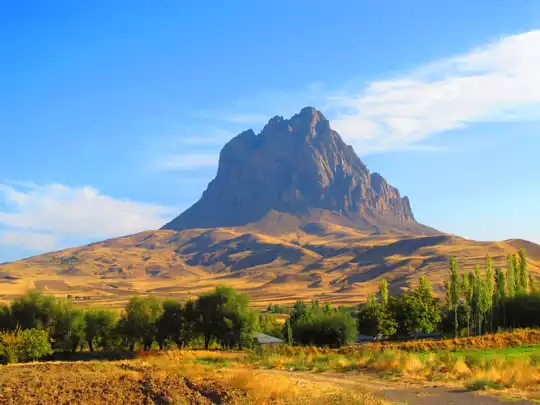
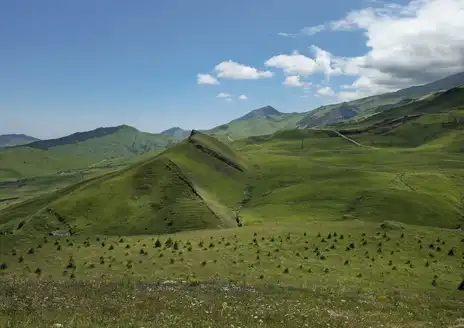
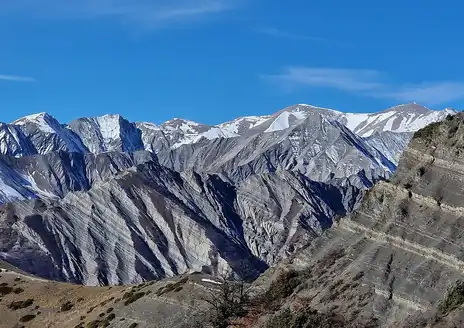
Azerbaijan’s mountains reward effort with big relief, short approaches, and real village life. The Greater Caucasus around Shahdag delivers airy limestone ridges, waterfalls at Laza, and the long pull toward Bazardüzü (4,466 m), while Khinalig at 2,200 m makes a solid base for high meadows and shoulder-season snow. South, the Talysh hills are greener and quieter. Trails are lightly marked; you follow sheep tracks and spurs. Weather turns on a dime. Border zones can need permits. Tea is hot, rides are cheap, and the terrain feels honest underfoot.

People

Expect unsolicited help at stations; someone will walk you to the right marshrutka and wave off your … read more 👉
Expect unsolicited help at stations; someone will walk you to the right marshrutka and wave off your thanks. Tea is the opening move. Accept at least one glass; refusal reads cold. In homes, shoes off, bring sweets, avoid praising objects you don’t want to be given. Conversation is frank: family, football, food. Politics is sensitive—skip the war. Humor is dry and teasing; give as good as you get. Women get respect but occasional stares outside cities; clear, polite boundaries work. A little Azeri—salam, çox sağ ol—opens doors.

Architecture

Azerbaijan rewards architecture hunters with a rare time-lapse in compact distances. Start inside Baku’s … read more 👉
Azerbaijan rewards architecture hunters with a rare time-lapse in compact distances. Start inside Baku’s UNESCO-listed Icherisheher—Maiden Tower, Shirvanshahs’ Palace, oil-boom façades, and Soviet relics—and then jump to Zaha Hadid’s Heydar Aliyev Center and the Flame Towers. Range out: the Ateshgah Fire Temple on Absheron, the petroglyphs and rock shelters of Gobustan, and the cliff-top Alinja Castle. In the Caucasus foothills, Sheki’s Khan’s Palace and caravanserais earn the detour; Lahij and Khinalug show stone vernacular that still works. Shamakhi’s Juma Mosque ties early Islam to today through careful restorations.

Uniqueness

Azerbaijan rewards effort. Oil-slicked modernity in Baku beside Soviet blocks; elsewhere mud volcanoes … read more 👉
Azerbaijan rewards effort. Oil-slicked modernity in Baku beside Soviet blocks; elsewhere mud volcanoes and a burning hillside; petroglyphs; high-altitude stone villages like Xinaliq reached by shepherd tracks and Ladas. Logistics: e-visa simple; police registration >10 days; carry passport for checkpoints near borders; cash rules outside Baku; Azeri/Turkish helps; Russian works with older drivers; English rare. Summer heat brutal in the lowlands; spring and autumn are best; winter snows isolate villages. Marshrutkas thin; expect hitching or private Lada hires. Tea tables open doors, but dress modestly in villages. Tourist numbers drop hard beyond Baku.
Want the complete picture of Azerbaijan?
The offline Travel Guide brings everything together — routes, highlights & planning.

See what's included in the guide 👉

Get the Travel Guide -

⭐ HighlightsHighlights of Azerbaijan

  • Icherisheher (Baku Old City): Stone alleys curl between caravanserais and the Maiden Tower, where limestone steps are polished like bone from a thousand years of feet. Copper hammers ring faintly, tea steam smells of bergamot, and the Caspian breeze carries a lick of salt and oil. Off-the-map nearby: Ramana Castle, Bibi-Heybat Mosque, and the Qala Archaeological and Ethnographic Museum.
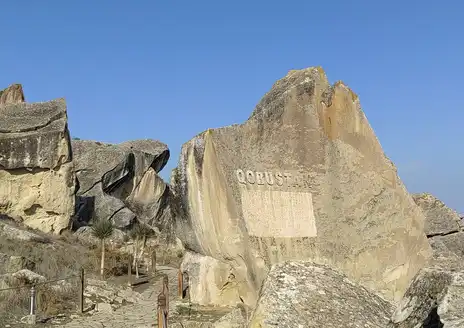
  • Gobustan Petroglyphs and Mud Volcanoes: On the wind-scoured plateau, antelope and dancers are scratched into dark rock, and you can taste salt on your lips while tankers crawl the horizon. A short hop away, cold mud blisters and burps under a skin of cracked clay—your boots come back dusted gray. Off-the-map nearby: Dashgil mud volcano field, Shikh Mountain ridge tracks, and Bandovan hill.
  • Ateshgah Fire Temple and Yanar Dag (Absheron): In Surakhani, blue gas flames lick from a stone altar, warm on your shins, with the faint metallic scent of sulfur in the courtyard. At Yanar Dag, the hillside burns in daylight,
read more 👉
  • Icherisheher (Baku Old City): Stone alleys curl between caravanserais and the Maiden Tower, where limestone steps are polished like bone from a thousand years of feet. Copper hammers ring faintly, tea steam smells of bergamot, and the Caspian breeze carries a lick of salt and oil. Off-the-map nearby: Ramana Castle, Bibi-Heybat Mosque, and the Qala Archaeological and Ethnographic Museum.
  • Gobustan Petroglyphs and Mud Volcanoes: On the wind-scoured plateau, antelope and dancers are scratched into dark rock, and you can taste salt on your lips while tankers crawl the horizon. A short hop away, cold mud blisters and burps under a skin of cracked clay—your boots come back dusted gray. Off-the-map nearby: Dashgil mud volcano field, Shikh Mountain ridge tracks, and Bandovan hill.
  • Ateshgah Fire Temple and Yanar Dag (Absheron): In Surakhani, blue gas flames lick from a stone altar, warm on your shins, with the faint metallic scent of sulfur in the courtyard. At Yanar Dag, the hillside burns in daylight, a steady hiss with heat that dries your knuckles in seconds. Off-the-map nearby: Mardakan Quadrangular Castle, Nardaran Fortress, and Amburan lighthouse coast.
  • Sheki Khan’s Palace: A wooden façade cut like lace hides rooms where colored light from shebeke glass spills across floorboards—no nails, just precision and patience. Cedar and old varnish linger in the air; outside, walnut trees throw deep shade and halva shops pull you by the nose. Off-the-map nearby: Kish Albanian Church, Gelersen-Gorersen fortress, and Sheki Caravanserai.
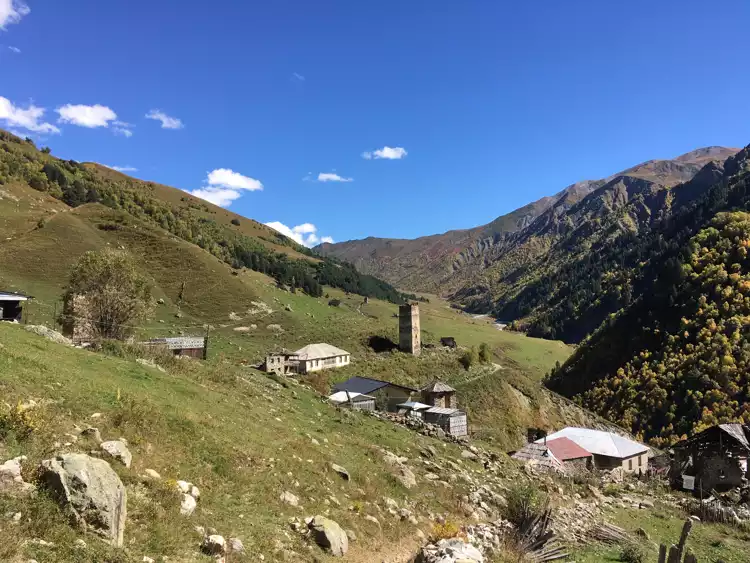
  • Khinalug (Xinaliq), Greater Caucasus: A stone village parked at cloud level, with sheep bells ticking on the wind and the clean smell of snow even in June. Dung-fire smoke threads from flat roofs while jagged ridgelines box the horizon; the road up tests brakes and resolve. Off-the-map nearby: Laza waterfalls, Griz village balcony trails, and the Tangaalti canyon.
Spotted a mistake or missing a highlight? Contact us.

But Azerbaijan offers more...

Discover and compare all of its highlights per category

🧭 RoutesLogical itineraries covering the highlights

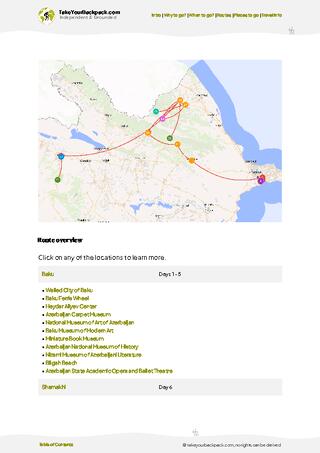
The 5-Day Baku & Caspian Snapshot

The Vibe: A relaxed city-and-sea escape built around Baku’s architecture, museums, and a single easy beach day, perfect if you want depth over distance. You stay put in the capital and use short hops to sample the Caspian coast without any long transfers.
The Highlights:
  • Exploring the alleys and ramparts of the Walled City of Baku.
  • Soaking up design and culture at the Heydar Aliyev Center and major museums.
  • Strolling Baku’s seafront and riding the Baku Ferris Wheel for city views.
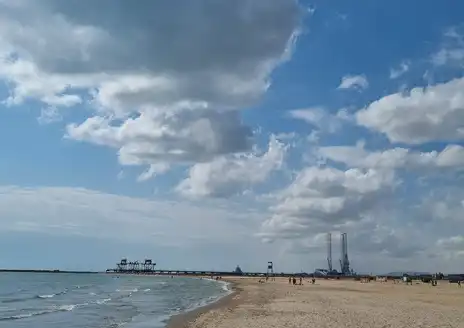
  • Unwinding on the sand at Bilgah Beach before heading home.

The 10-Day Caspian-to-Caucasus Circuit

The Vibe: A balanced loop that starts in Baku, swings through semi-desert rock art country, and finishes in the northern mountains, ideal if you want both culture and hiking without rushing. You’ll change bases a few times, using buses and private transfers to link city streets with highland villages.
The Highlights:
  • Three culture-rich days in Baku and the Walled City of Baku.
  • Ancient carvings
read more 👉

The 5-Day Baku & Caspian Snapshot

The Vibe: A relaxed city-and-sea escape built around Baku’s architecture, museums, and a single easy beach day, perfect if you want depth over distance. You stay put in the capital and use short hops to sample the Caspian coast without any long transfers.
The Highlights:
  • Exploring the alleys and ramparts of the Walled City of Baku.
  • Soaking up design and culture at the Heydar Aliyev Center and major museums.
  • Strolling Baku’s seafront and riding the Baku Ferris Wheel for city views.
  • Unwinding on the sand at Bilgah Beach before heading home.

The 10-Day Caspian-to-Caucasus Circuit

The Vibe: A balanced loop that starts in Baku, swings through semi-desert rock art country, and finishes in the northern mountains, ideal if you want both culture and hiking without rushing. You’ll change bases a few times, using buses and private transfers to link city streets with highland villages.
The Highlights:
  • Three culture-rich days in Baku and the Walled City of Baku.
  • Ancient carvings and stark landscapes at Gobustan National Park and the Gobustan Rock Art area.
  • Mountain village life in Khinalug reached via Quba.
  • Alpine scenery and trails around Shahdag National Park from a base in Gusar.

The 15-Day Azerbaijan Grand Traverse

The Vibe: A full-country journey that layers Baku’s urban energy with mountain villages, crafts towns, and western lakes, paced for travelers who want variety without turning the trip into a sprint. You’ll ride buses and shared taxis between hubs, with a couple of private transfers to reach more remote corners.
The Highlights:
  • Multiple days to really dig into Baku, its museums, and the Walled City of Baku.
  • Crafts and cobbled lanes in Lahij and foothill downtime in Gabala.
  • High Caucasus panoramas from Khinalug, plus time in Quba and Gusar.
  • A western finale in Ganja and lakeside walks in Goygol National Park within the Ganja-Gazakh region.
🌍 Want a ready-to-use travel plan for Azerbaijan?
The overview above compares different route options based on your travel time and style. The complete Travel Guide breaks each itinerary down in detail, including maps, stops, highlights, and transport information.

Explore all route details 👉

Get the Travel Guide -

🌤️ When to go?When to go for the best experience

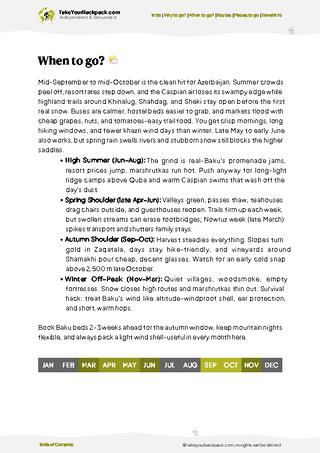
Mid-September to mid-October is the clean hit for Azerbaijan. Summer crowds peel off, resort rates step down, and the Caspian air loses its swampy edge while highland trails around Khinalug, Shahdag, and Sheki stay open before the first real snow. Buses are calmer, hostel beds easier to grab, and markets flood with cheap grapes, nuts, and tomatoes—easy trail food. You get crisp mornings, long hiking windows, and fewer khazri wind days than winter. Late May to early June also works, but spring rain swells rivers and stubborn snow still blocks the higher saddles.
  • High Summer (Jun-Aug): The grind is real—Baku’s promenade jams, resort prices jump, marshrutkas run hot. Push anyway for long-light ridge camps above Quba and warm Caspian swims that wash off the day’s dust.
  • Spring Shoulder (late Apr-Jun): Valleys green, passes thaw, teahouses drag chairs outside, and guesthouses reopen. Trails firm up each week, but swollen streams can erase footbridges; Nowruz week (late March) spikes transport and shutters family stays.
  • Autumn Shoulder (Sep-Oct): Harvest steadies everything. Slopes turn gold in Zaqatala, days stay hike-friendly, and vineyards around Shamakhi pour cheap, decent glasses. Watch for an early cold snap above 2,500 m late October.
  • Winter Off-Peak (Nov-Mar): Quiet villages, woodsmoke, empty fortresses. Snow closes high routes and marshrutkas thin out. Survival hack: treat Baku’s wind like altitude—windproof shell, ear protection, and short, warm hops.

Book Baku beds 2-3 weeks ahead for the autumn window, keep mountain nights flexible, and always pack a light wind shell—useful in every month here.

source: climatestotravel.comJANJanuary: fair for travelingFEBFebruary: fair for travelingMARMarch: good for travelingAPRApril: highly recommended for travelingMAYMay: highly recommended for travelingJUNJune: good for travelingJULJuly: fair for travelingAUGAugust: fair for travelingSEPSeptember: excellent for travelingOCTOctober: excellent for travelingNOVNovember: good for travelingDECDecember: fair for traveling
📅 Traveling in a specific month?
Get a full month-by-month breakdown of weather, crowds, costs, festivals, and seasonal highlights in the complete travel guide.

Get full details when to go 👉

Get the Travel Guide -
pixabay-azerbaijan-4558273

💰 Costs (as of 2025)What things cost day to day

Budget baseline: 45-70 AZN/day if you sleep in dorms, eat local, and ride buses; Baku pushes you toward the top end.
  • dorm accommodation: Baku hostels run 12-20 AZN (spikes to 25-40 AZN during events); regional towns 8-15 AZN. Beds are cleaner and safer outside the Old City premium. System tip: show up before noon and ask for a weekly rate in cash—managers often cut 10-20% rather than keep beds empty; verify lockers and a staffed reception to avoid “apartment hostels.” Compared with Georgia, rates are similar; slightly higher than Armenia; still cheaper than coastal Turkey.
  • meals: Supermarket Survival: 6-12 AZN/day if you live on bread, cheese, tomatoes, fruit, and yogurt; most hostels have a kettle for noodles/tea. Street food reality: döner 2.5-4 AZN, qutab 1-1.5 AZN each, piti/plov 5-8 AZN, tea is pocket change; espresso drinks jump to European pricing in Baku’s cafes. Watch for 5-10% service charges on bills in the capital. Eating local is cheaper than Georgia’s restaurants, pricier than Armenia’s mom-and-pop joints; Turkey still wins on value due to currency slide.
  • local transport: In-city: Baku Metro/buses require a BakıKart (2 AZN deposit; rides ~0.30 AZN). Bolt taxis are cheap
read more 👉
Budget baseline: 45-70 AZN/day if you sleep in dorms, eat local, and ride buses; Baku pushes you toward the top end.
  • dorm accommodation: Baku hostels run 12-20 AZN (spikes to 25-40 AZN during events); regional towns 8-15 AZN. Beds are cleaner and safer outside the Old City premium. System tip: show up before noon and ask for a weekly rate in cash—managers often cut 10-20% rather than keep beds empty; verify lockers and a staffed reception to avoid “apartment hostels.” Compared with Georgia, rates are similar; slightly higher than Armenia; still cheaper than coastal Turkey.
  • meals: Supermarket Survival: 6-12 AZN/day if you live on bread, cheese, tomatoes, fruit, and yogurt; most hostels have a kettle for noodles/tea. Street food reality: döner 2.5-4 AZN, qutab 1-1.5 AZN each, piti/plov 5-8 AZN, tea is pocket change; espresso drinks jump to European pricing in Baku’s cafes. Watch for 5-10% service charges on bills in the capital. Eating local is cheaper than Georgia’s restaurants, pricier than Armenia’s mom-and-pop joints; Turkey still wins on value due to currency slide.
  • local transport: In-city: Baku Metro/buses require a BakıKart (2 AZN deposit; rides ~0.30 AZN). Bolt taxis are cheap if you stick to the app—center hops 3-6 AZN. To unlock the country on the cheap: intercity buses/minibuses from Baku’s Avtovagzal; most routes cost 4-15 AZN (Sheki, Quba, Lankaran, Ganja tiers). Trains exist but are slower and not as comprehensive; use only if the timing suits. Fares are on par with Armenia and slightly cheaper than Georgia; more than Iran, less than Western Turkey coaches.
  • activities: Fees themselves are modest; the transfers kill you. Gobustan petroglyphs/museum and nearby mud volcanoes look like a bargain on paper, but solo taxis can run 30-70 AZN unless you share. Ateshgah and Yanar Dağ entries are reasonable; getting out there is the cost driver. Mountain villages (Xınalıq, Lahıc) are cheap once you arrive, but 4x4 legs add up unless you split a seat. Ski lifts at Shahdag/optimal season activities price above regional averages. Museums/palaces 2-10 AZN; guided day tours 40-120 AZN depending on headcount.
  • miscellaneous: Budget leaks: airport taxis; use the AeroExpress bus or Bolt curbside. SIM cards are cheapest in town (5-10 AZN + data); kiosks at arrivals overcharge. Cash is king outside Baku; ATMs sometimes push dynamic currency conversion—always decline. Bottled water 0.5-1 AZN; café coffee in Baku quietly empties wallets faster than meals. Event weeks (F1, conferences) inflate everything. The e-visa fee, if applicable, is a real per-day cost—spread it over your stay to see your true daily burn.
⚠️ Prices can change and everyone travels differently, so take this as a rough guide. Hope it helps you plan your adventure!

✈️ The backpacker research shortcutAzerbaijan Travel Guide

An offline-friendly backpacking guide with optimized travel routes, ranked highlights, transport advice, and the best areas to stay.
example page 0 from our offline Travel Guide for Azerbaijanexample page 1 from our offline Travel Guide for Azerbaijanexample page 2 from our offline Travel Guide for Azerbaijanexample page 3 from our offline Travel Guide for Azerbaijanexample page 4 from our offline Travel Guide for Azerbaijanexample page 5 from our offline Travel Guide for Azerbaijanexample page 6 from our offline Travel Guide for Azerbaijanexample page 7 from our offline Travel Guide for Azerbaijan
The digital guide (300 pages) contains:
76 highlights, ranked by travel appeal
Optimized 5, 10 & 15-day travel routes
Best neighborhoods to stay
How to get around
Offline-friendly for travel without Wi-Fi
👉 See all 30+ guide features

📅 Plan smarter in minutes, not weeks
Month by month travel advice
Festivals & national holidays
Budget expectations

🗺️ Go to the right places, skip the overrated ones
Honest pros & cons of destinations
Top hikes, parks & viewpoints
Lesser-known places most travelers miss
Clear “worth it vs skip it” guidance

🛏️ Travel smoothly without rookie mistakes
Best areas to stay
Transport systems explained simply
Common scams & safety advice
SIM cards, money & practical tips

🌍 Understand the country, not just visit it
Culture & traditions
52 Essential phrases & customs
Festivals worth planning around
Traveler-friendly historical context
Insights that make places more meaningful

📱 Built for real travel conditions
Fully downloadable PDF
Works completely offline
Optimized for phone use
Useful in remote areas & buses
Everything in one place
Save weeks of stressful planning
Get instant access to the full guide directly. 30-day money-back guarantee.


Sent to your inbox immediately after payment • 100% Secure Checkout
Best Backpacking Travel Advisor 2025 tourism awardBest Backpacking
Travel Advisor
2025
What others say about Take Your Backpack Guides:
⭐⭐⭐⭐⭐
Fantastic, amazing amount of information!
⭐⭐⭐⭐⭐
My goodness this is amazing, it's what I've been looking for hats off too you!
⭐⭐⭐⭐⭐
I think this is absolutely BRILLIANT
⭐⭐⭐⭐
Very complete and informative. It's still missing places, but I gotta to commend you
⭐⭐⭐⭐⭐
This is truly amazing, thank you, can't wait to explore it with my kids!
⭐⭐⭐⭐⭐
Awesome resource, thank you!
⭐⭐⭐⭐⭐
This is amazing! Can't wait to explore the ones I haven't seen
⭐⭐⭐⭐
I love this! Well done, great idea.
⭐⭐⭐⭐⭐
Thanks for taking the time to make this gem!
⭐⭐⭐⭐⭐
This might be the best website I've ever seen.
⭐⭐⭐⭐⭐
Congratulations, and thank you so much for your work; it's incredibly valuable.
⭐⭐⭐⭐
In all seriousness I think you did a great job pointing out the important spots
⭐⭐⭐⭐⭐
10/10 very good
⭐⭐⭐⭐⭐
As someone who's only just starting to visit regularly this is awesome, thank you.
⭐⭐⭐⭐
Thank you very much! I'm going to visit my dad, it's going to be very useful!
⭐⭐⭐⭐⭐
This is really cool! We'll be travelling for the first time and this definitely come in handy.
⭐⭐⭐⭐⭐
You are now our minister of culture, congratulations 👨‍💼
⭐⭐⭐⭐⭐
Just wanted to tell you that this is a pearl! Going to follow your recommendations.
⭐⭐⭐⭐⭐
This is so cool. I'll definitely be using the resource for my travels soon.
⭐⭐⭐⭐⭐
This is very impressive! Good work.
⭐⭐⭐⭐⭐
This is an amazing and informative site. Very well done!

🛏️ Where to stay?Where to stay in Azerbaijan

Yes — hostels and budget accommodation are widely available in Azerbaijan, concentrated in Baku and in popular tourist towns.
In Baku the biggest selection is around the Old City (Icherisheher) and Fountain Square/Nizami: Old City puts you within walking distance of main sights but is touristy, pricier and can be noisy; Fountain Square offers nightlife, restaurants and good transport links with many mid‑budget options; Nasimi/Khatai areas are generally cheaper and quieter, better for transit but farther from key attractions.
Outside the capital, Sheki and Gabala have affordable guesthouses … read more 👉
Yes — hostels and budget accommodation are widely available in Azerbaijan, concentrated in Baku and in popular tourist towns.
In Baku the biggest selection is around the Old City (Icherisheher) and Fountain Square/Nizami: Old City puts you within walking distance of main sights but is touristy, pricier and can be noisy; Fountain Square offers nightlife, restaurants and good transport links with many mid‑budget options; Nasimi/Khatai areas are generally cheaper and quieter, better for transit but farther from key attractions.
Outside the capital, Sheki and Gabala have affordable guesthouses close to historical sites and nature, making them quiet bases for day trips but with fewer dorm‑style hostels, limited nightlife and slower public transport.

If you enjoy meeting fellow travelers, consider choosing hostels with high ratings for atmosphere. On the other hand, if you prefer having your own space, a hotel might be a better option.

🚌 Getting aroundWhat moving around is really like

Azerbaijan runs on a split rhythm: Baku is clocks and turnstiles; the regions are steering wheels and “we leave when full.” If you accept both—metro punctuality for the city, marshrutka intuition for the rest—the country flows. Miss the first departures and you’ll spend hours watching drivers smoke and negotiate.
  • Baku Metro + BakuBus (BakıKart) The Social Fabric: Quiet cars, sharp elbows only at rush hour, and an unspoken rule to give up seats to elders and women with kids. Buy a BakıKart once, then
read more 👉
Azerbaijan runs on a split rhythm: Baku is clocks and turnstiles; the regions are steering wheels and “we leave when full.” If you accept both—metro punctuality for the city, marshrutka intuition for the rest—the country flows. Miss the first departures and you’ll spend hours watching drivers smoke and negotiate.
  • Baku Metro + BakuBus (BakıKart) The Social Fabric: Quiet cars, sharp elbows only at rush hour, and an unspoken rule to give up seats to elders and women with kids. Buy a BakıKart once, then top up at red kiosks (cash). Tap in at metro gates and bus validators; no cash on buses. Security scans at major metro entrances slow you a minute; filming on platforms draws frowns. Escalators: stand right, walk left. Trains run frequently and close to schedule; buses bunch, then come in waves. The Avtovağzal metro stop drops you inside the intercity bus terminal without crossing a single road.
  • Intercity Trains The Efficiency Trade-off: Slower than a shared taxi but a better use of time on long hauls. Overnight sleepers to hubs like Gəncə and the northwest line let you lie flat, stash your pack, and wake rested instead of wrung out. Third-class (platzkart) is cheapest and social; coupe berths are a small splurge for privacy. Tickets are named; you show a passport and pass a bag scan. Trains depart on time more often than not; stations are central, which saves the last-mile hassle that bus terminals create.
  • Marşrutka Minibuses The Budget Disruptor: The country’s price-performance king. They’re faster than big coaches, far cheaper than taxis, and they reach almost every district center. They leave when full, not by timetable—first departures around 7:30-9:00 are your golden window. Pay the driver in cash; carry small notes. Bags go in the back or under seats—keep valuables on you. To get off, say “Dayan, zəhmət olmasa” a block early. Afternoons thin out and drivers chase fares; don’t start a new route late in the day unless you’re fine overnighting en route.
  • Shared Taxis/4x4s to Mountain Villages The Geometric Unlock: Where buses stop, Nivas start. Quba-Xınalıq, Qusar-Laza, İsmayıllı-Lahıc, Qax-İlisu—these runs are per-seat pricing, leave when full, and can detour for landslides or snow. Agree on the destination and drop point before doors slam. Expect seasonal closures and midday storms; mornings are safer and more available. The last kilometers can be rough—pack your patience and a layer even in summer.

Master tip: Anchor your travel day to the first marşrutka out of Baku’s Avtovağzal, then finish the longest leg overnight by train—metro in, marshrutka across, sleeper out—three moves that turn Azerbaijan’s mixed rhythm into straight-line progress.
Baku Heydar Aliyev International Airport (GYD) sits about 20 km (12 mi) from central Baku (Fountain Square/Old City area).

Public transport
  • H1 Airport Express (BakuBus) - Nonstop to 28 May/“28 May” Metro at the Central Railway Station.
    • Time: 30-40 minutes, depending on traffic
    • Frequency: every ~30 minutes most of the day; hourly late night; runs 24/7
    • Cost: 1.50 AZN (paid with a BakıKart transport card)
    • How to pay: Buy a reusable BakıKart from vending machines in Arrivals (card itself 2 AZN) and top it up; then tap on boarding
    • Where: Bus stop is just outside the terminal; look for the red H1 buses
  • City bus 116 → Koroglu Metro - Cheaper but slower; you’ll connect to the metro for the center.
    • Time: 30-50 minutes to Koroglu, then ~15-20 minutes by metro to the center
    • Frequency: roughly every 20-30 minutes (typically daytime/evening service)
    • Cost: 0.40 AZN on the bus (BakıKart), metro 0.40 AZN more


Taxi and ride-hailing

- Time: usually 25-35 minutes door to door.
- Cost: App rides (Bolt, Yandex Go) typically 10-20 AZN to the center, depending on traffic and demand. Official airport taxis are more like 25-40 AZN.
- If you’re taking a street/stand taxi, agree the fare upfront or ensure the meter is on.

Quick tip

- Traffic on weekday evenings can add 10-15 minutes. For late-night arrivals, the H1 still runs, but if you’re tired or have big bags, an app taxi is the simplest option. Prices and times are current for 2025.
⚠️ Prices and routes can change, so take this as a rough guide and ask for local advice when you arrive.

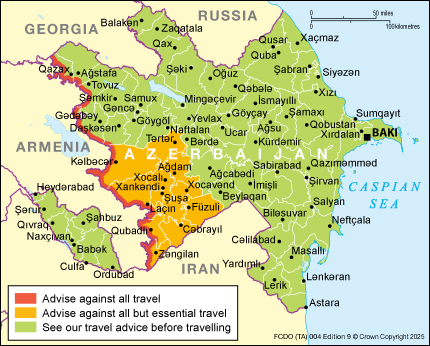
🔒 Safety (risk Level: medium)Staying safe while traveling

Safety for solo travelers, including women and LGBTQ+ individuals
Azerbaijan is generally safe for solo travelers, including women, but it’s advisable to stay alert in crowded areas and avoid political demonstrations. Dress modestly to respect local customs, especially in rural areas. For LGBTQ+ individuals, public displays of affection might attract unwanted attention, as societal attitudes can be conservative. Always check the latest travel advisories and connect with local LGBTQ+ community resources for current insights.


Full official government travel advisory (live updates)
View details 👉
safety image

source: www.gov.uk

✈️ VisaUnderstanding entry rules

Citizens of many countries, including the USA and EU member states, need an e-Visa to visit Azerbaijan. You can apply for an e-Visa easily through the official ”ASAN Visa” website, typically receiving approval within three business days. Make sure your passport is valid for at least three months after your planned departure date.

source: mfa.gov.az
⚠️ Visa requirements can change over time, so always check the latest visa requirements with the official embassy or government website before you travel.

🎒 What to pack?Packing essentials for the trip

Azerbaijan is a bit of a climate chameleon, with scorching summers and chilly winters, especially if you’re heading into the mountains. Plan for some layer action to stay comfy. If Baku’s on your list, remember that wind is a frequent companion—pack accordingly. The culture leans conservative, so keep it modest, especially in rural areas or when visiting mosques. A scarf or hat can be handy for both sun protection and cultural norms.

Apart from this country specific advice, I have also crafted a general packing list that should help on any trip. authorOver the years, I've learned the importance of packing minimally. It's so much easier to jump on the back of a truck or squeeze yourself into the last spot of a minibus without that supersized backpack. If you're headed to a warm destination, leave your winter jacket at home; for colder regions, opt for thin thermal underlayers. Instead of packing your entire wardrobe, bring just three sets of clothes, as laundry facilities are available everywhere.

View the full list 👉
🎒 Planning the practical side of your trip?
Get detailed information on transport, daily budgets, internet access, local customs, food, language, and other essentials in the complete Travel Guide.

Get detailed practical information 👉

Get the Travel Guide -

🙋 FAQThings travelers often ask

Trip Planning


Personal tip: I normally search on good rating for atmosphere (for meeting people) and location (for easy exploring). Cleanliness as a bonus.


Travel Essentials

Routine vaccines are essential for Azerbaijan. These include measles-mumps-rubella (MMR), diphtheria-tetanus-pertussis, chickenpox, polio, and your yearly flu shot.

Consider Hepatitis A and B vaccines since these diseases can be contracted through food, water, and contact with infected persons.

Typhoid is recommended if you’re planning to eat or drink outside major restaurants and hotels.

Rabies vaccination is optional but advised if you anticipate close contact with animals, especially in rural areas.

Ensure your travel insurance covers healthcare abroad. Always consult a healthcare professional for personalized advice.


vaccination requirements
When I first started traveling, I often spent part of my first day in a new country hunting for a local SIM card. While this can still be slightly cheaper, it also takes time and planning.

These days, it's much simpler to install an eSIM before leaving home. Once you arrive in Azerbaijan, you can activate it immediately and have mobile data from the moment you land — which is especially useful for ordering transport or navigating away from busy airports.

There are many providers nowadays, and price differences are usually small. I personally go with Airalo, as it offers excellent network coverage throughout the country and strong global coverage, so you can manage multiple countries from a single app.


Get your e-sim for Azerbaijan

Culture & Customs

Respecting Azerbaijan’s cultural customs is key. Dress modestly, especially in rural areas—cover shoulders and knees. Always remove shoes before entering a home. Use your right hand for handshakes and passing items.

Avoid discussing politics or conflicts. Public displays of affection are frowned upon. LGBTQ+ travelers should be discreet, as attitudes can be conservative. Women might experience some gender-specific norms; being assertive and confident usually helps.

When offered tea or food, accept graciously; refusing can be seen as rude. Tipping is appreciated but not mandatory—rounding up is common.
Trying traditional food is always a great way to experience the culture. Here are some must-try dishes for Azerbaijan.
  • Plov: This is Azerbaijan’s take on pilaf, a flavorful rice dish often infused with saffron and cooked with various ingredients like meat, vegetables, and dried fruits. It’s a staple at celebrations and reflects the country’s love for aromatic spices.
  • Dolma: Grape leaves or cabbage leaves stuffed with a mix of rice, herbs, and sometimes meat. Dolma is a testament to Azerbaijani hospitality and is often shared among family and friends during gatherings.
  • Lavangi: A unique dish hailing from the southern regions, typically made with chicken or fish stuffed with a mixture of walnuts, onions, and plums, then baked. It’s popular for its rich, nutty flavor.
  • Dushbara: Tiny dumplings filled with minced meat, served in a clear broth. They’re a comforting dish, especially in colder months, and showcase the local love for hearty soups.
  • Qutab: Thinly rolled dough filled with various ingredients like cheese, greens, potatoes, or meat, then folded and cooked on a griddle. It’s a popular street food and reflects the versatility of Azerbaijani cuisine.
Locals often drink tap water in Azerbaijan, especially in big cities like Baku, but it’s not always recommended for tourists due to varying water quality. It’s best to stick to bottled or filtered water to avoid any risk of stomach issues. If you’re staying long-term, consider using a portable water filter.
The main language in Azerbaijan is Azerbaijani. Backpacking is way more rewarding if you know a bit of the local language, so I'd suggest brushing up on the basics just in case your Azerbaijani skills have become a bit rusty.

Want to understand locals better?
The complete Travel Guide for Azerbaijan includes 52 essential words and phrases — greetings, thank-yous, ordering food, transport, numbers, and common local expressions you'll actually hear.

Get your local basic phrases 👉

Get the Travel Guide -


In Azerbaijan, English proficiency varies widely depending on the region and the demographic. In urban areas like Baku, particularly among younger people and those in the tourism and hospitality sectors, English is more commonly spoken. Many hotels, restaurants, and tourist attractions have staff who can communicate effectively in English.

However, in rural areas, English may be less prevalent, and you might encounter more people who speak Azerbaijani or Russian instead. While younger generations are increasingly learning English in schools, older individuals may not have had the same opportunities to learn the language.

Overall, travelers will find that English is sufficient for basic communication in major cities and tourist spots, but learning a few phrases in Azerbaijani can enhance the experience and help bridge any language gaps. Having a translation app or phrasebook can also be beneficial in less touristy areas.

Money & Payments

The local currency of Azerbaijan is AZN (₼).

Azerbaijan isn’t too tricky money-wise, but there are a few things to keep in mind. ATMs are pretty common in Baku and other major cities, but if you’re headed to rural areas, grab enough cash before you leave. The local currency is the Azerbaijani Manat (AZN), and while dollars and euros are sometimes accepted in bigger hotels or touristy spots, it’s not the norm. Carrying a bit of cash is wise, especially for small purchases or in less urban areas.

Credit cards are widely accepted in the cities, but don’t count on them in smaller towns or local markets. Visa and MasterCard are your best bets. For currency exchange, stick to banks or official exchange offices for decent rates, and avoid exchanging money with street vendors to steer clear of scams. It’s always smart to have a few small bills for public transport or street food. Oh, and keep an eye on your receipts; sometimes they’ll be needed to exchange money back when you leave the country.

Tipping in Azerbaijan isn’t mandatory but is appreciated, especially in restaurants where leaving around 5-10% is common. In taxis, rounding up the fare is a nice gesture, while hotel staff usually appreciate a small tip for good service. Always check your bill, as some upscale places might include a service charge.

🧩 Nearby countriesNearby backpacking alternatives

We 💚 feedbackIs Azerbaijan worth visiting?

Go for the contrast: tea-house mountain villages and fire-belching Absheron in the same week, with marshrutkas and cheap kebabs stringing it together. The hitch is logistics outside Baku—buses leave when full, signage in Azeri/Russian, and last rides roll out early, so plan daylight moves. Don’t overthink safety: avoid border zones and mine-marked hills, and the rest is calm, especially in towns where tea houses stay busy late. It’s a country that rewards patience more than money.

✍️ Help improve this page!
The information on this page is based on in-depth research, insights shared by experienced travelers, and feedback from the local travel community in Azerbaijan. While every effort is made to keep the information accurate and current, conditions can change — so if you spot anything incorrect or outdated, please get in touch.


🙋‍♂️ Give feedback

👋 Meet the founderWho’s Behind Take Your Backpack?

Johan, backpacker and founder of TakeYourBackpackHi, I’m Johan (Netherlands 🇳🇱), the creator of TakeYourBackpack. Over the past decade, I’ve backpacked through 80+ countries across six continents, gaining extensive experience with independent travel, long-term trips, and overland routes.

This site is built on a combination of firsthand travel experience and carefully curated insights from other backpackers. Many guides are based on places I’ve personally visited, while others bring together tips, observations, and practical advice shared by trusted travelers I’ve met along the way.

The goal is to provide realistic, experience-driven guidance — not generic itineraries — so you can explore destinations with better context, clearer expectations, and more confidence.

Get Full Azerbaijan Guide •
Instant download • 76 highlights • Full Offline guide