×
Canada 🇨🇦

backpacking North America Canada 🇨🇦Measure distance in forests, lakes, and epic overland routes.

Explore British Virgin IslandsExplore Cayman Islands

Backpacking Canada in 2026

A complete guide including when and where to go, costs, transport, itineraries, and practical travel advice.
An overview of visiting Canada

Backpacking Canada
By Johan Kruseman 🇳🇱 | Updated June 6, 2026

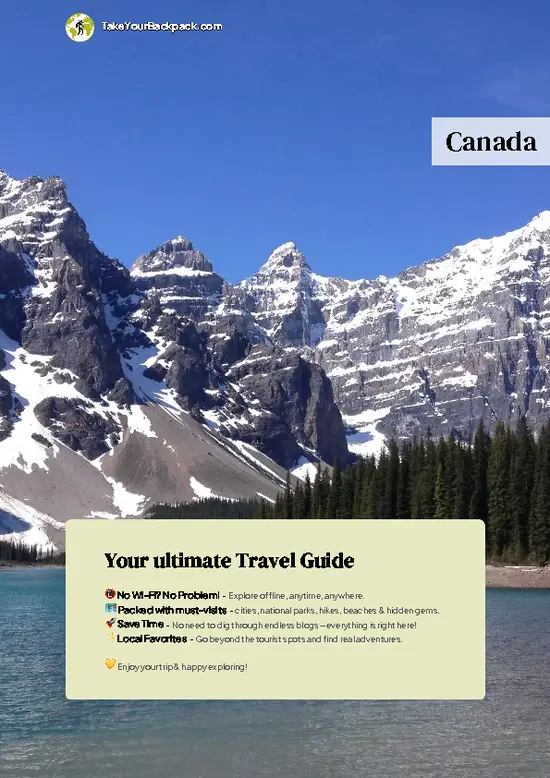
Walk onto a BC ferry with just a pack and camp at Ruckle or Sidney Spit for the price of a city lunch. Buses drop you at the terminal, deer browse by your tent, and dawn smells like salt and cedar. That blend—easy access layered over big horizons and quiet—captures how Canada rewards simple effort with outsized space.

This is a country that runs on light: a pink scrape of sunrise over the prairies that seems to go on forever, glacier glare bouncing off turquoise water in the Rockies, streetlamps pooling on wet cobblestones in Old Québec as a busker warms up a fiddle. You can paddle a tannin-dark lake while a loon calls, watch humpbacks roll in the Salish Sea from a bluff of wind-bent arbutus, catch northern lights that turn a small-town hockey rink parking lot into a theater. Cities feed you well—Punjabi sweets in Surrey, smoked meat in Montréal, bannock at a powwow—then spit you back out toward trailheads and river put-ins. The challenges are real: distances that eat days, buses that don’t always line up, blackflies that test your patience in June, wildfire smoke that can haze a skyline, reservation systems that reward early birds. But choosing a single region and leaning in—riding the slow train from Montréal to Québec City instead of chasing the cross-country dream, hiking the same coastal trail twice to watch tides flip, building a canoe loop with one good portage—turns those hassles into texture. When your fingers smell like spruce and your socks steam beside a cabin stove, you feel why people keep coming back.

Compared to the U.S., Canada often gives you the same scale with softer edges and more breathing room; compared to Alaska, it’s easier to stitch wilderness with actual towns and a bus timetable; compared to Greenland, you get Arctic flavor without the logistical gymnastics. Go if you crave room to move, value small comforts earned the hard way, and like your days to end with woodsmoke in your clothes and a sky big enough to quiet your head.

👉 Get the 📖 Travel Guide of Canada
Pacific Coast: Vancouver, Sea-to-Sky & Vancouver Island This spine rewards people who will trade money for time. Fly into YVR, hop the SkyTrain straight into the city, then rent a car only when you need it. The Sea-to-Sky’s trailheads fill early; a 6 a.m. start beats circling gravel lots in drizzle that smells of cedar and brake dust. Ferries to the Island run 1.5–2 hours; a reservation fee stings but saves you three hours of idling behind RVs, gulls screaming over the diesel and fryer smell on the car deck. Vancouver beds are pricey compared with Halifax or Winnipeg; camp or hostel and spend on movement. Payoff: warm granite at Squamish at sunset, low tide kelp popping under your boots at Sombrio.

Canadian Rockies: Banff, Yoho & Jasper (Icefields Parkway) This is where you trade comfort for payoff. Distances look short; they aren’t. The Parkway is 230 km of pullouts that turn a four-hour drive into a 12-hour day as cold glacier wind knifes through your jacket and the river runs chalky blue. Hotels in Banff can run double Calgary rates; camping is the sane option if you can live with 2 a.m. frost on the fly. You’ll need a car or to live by shuttle timetables; some roads now require them. Expect crowds noon to 4; hike at dawn when the parking lots are quiet and the resin smell hangs low. The price of convenience is high; the price of patience is early alarms and numb fingers.

The Corridor: Toronto–Ottawa–Montréal–Québec City If you value time and comfort over raw wilderness, the trains here are your friend. Union Station to Montréal in about five hours, Wi‑Fi, outlets, a seat you don’t have to defend; it costs more than the bus but gives you your day back. Cars are a liability—parking tickets, tight lanes, and hotels that charge downtown premiums. This is student-heavy, late-night, walkable. Eat well for less than Vancouver or Banff off neighborhood counters: steam rising from bagel ovens, gravy and malt vinegar in the air at 1 a.m., espresso knocked back standing up. Winter bites, summer sticks to your shirt. Bring a small bag and use subways. Payoff is social: conversations in two languages and museums you can actually reach without a car.

Atlantic Canada: Nova Scotia & Cape Breton Here you trade speed for atmosphere. Land in Halifax, grab a car, and slow down. The Cabot Trail is 300 km of grades and viewpoints; fog can erase an hour, then part to show cliffs with kittiwakes riding the wind. Rooms cost less than Banff, seafood by the pound is cheaper than Toronto, craft beer is not. Expect rain-lashed picnic tables, a damp hoodie that never quite dries, and midges at dusk in June. Drive, pull over, listen—fiddles through an open pub door, diesel from a lobster boat, salt spray on your lips. The loop works best for travelers who don’t need constant signal and are fine with a motel, a chowder, and an early night.

Yukon & the Western Arctic This is the time-and-comfort sacrifice writ large. Fly to Whitehorse, drive two hours to Kluane where the horizon is all ice and silence, then push north to Dawson and the Dempster’s gravel. Fuel stops are far apart, tires die on shale, and prices jump compared with the south. Camping is cheap; hotels are scarce. Expect dust in your teeth, mosquitoes thick enough to hum, outhouse doors that slam in crosswinds, and midnight sun that wrecks your sleep. Carry real layers and bear sense. Payoff: tundra lifting in the wind, caribou tracks in mud, a sky that just refuses to quit. This region rewards people who find comfort in self-reliance.
Geography and where places are located
Loading the map 🌍
CLICK TO FILTER
city
town
village
unique site
national park
hike
beach
attraction
festival
region
SHOW COUNTRY’S BESTSHOW ALL
film
0
0
0a
Banff Upper Hot Springs
film
1
1
1a
Royal Ontario Museum
Pixabay
film
2
2
2a
Canadian Museum for Human Rights
film
3
3
3a
Vancouver Aquarium
Pixabay
film
4
4
4a
Royal BC Museum
film
5
5
5a
National Gallery of Canada
film
6
6
6a
Casa Loma
film
7
7
7a
Ripley’s Aquarium of Canada
film
8
8
8a
Long Beach
Vivy Raj
film
9
9
9a
Cavendish Beach
film
10
10
10a
Sandbanks Beach
Lokyao Pon
film
11
11
11a
Kitsilano Beach
Inchang Hwang
film
12
12
12a
English Bay Beach
Amer Zaman
film
13
13
13a
Parksville Beach
Dong Lee
film
14
14
14a
Vancouver
Pixabay
film
15
15
15a
Montreal
Pixabay
film
16
16
16a
Quebec City
Marcelo Fernandez Mena
film
17
17
17a
Victoria
John Chu
film
18
18
18a
Toronto
Pixabay
film
19
19
19a
Halifax
Bill Conklin
film
20
20
20a
Ottawa
Cheng Betty
film
21
21
21a
West Coast Trail
iStockphoto
film
22
22
22a
Berg Lake Trail
Erin Martin
film
23
23
23a
Juan de Fuca Trail
Jay Doshi
film
24
24
24a
Long Range Traverse
iStockphoto
film
25
25
25a
Chilkoot Trail
film
26
26
26a
Sunshine Village to Mount Assiniboine
Jan Němec
film
27
27
27a
Bruce Trail
film
28
28
28a
East Coast Trail
film
29
29
29a
Banff
film
30
30
30a
Jasper
Pixabay
film
31
31
31a
Yoho
Magno Cidade
film
32
32
32a
Kootenay
Kenny Burger
film
33
33
33a
Waterton Lakes
Randy Peters
film
34
34
34a
Pacific Rim
Jose Domínguez
film
35
35
35a
Gros Morne
Martin Oliv
film
36
36
36a
Kluane  and Reserve
Monowar Hossain
film
37
37
37a
Nahanni
Ігор Плива
film
38
38
38a
Bruce Peninsula
film
39
39
39a
Fundy
film
40
40
40a
Cape Breton Highlands
Mike Corrigan
film
41
41
41a
Auyuittuq
Scott Elliott
film
42
42
42a
Wood Buffalo
Carol Faust
film
43
43
43a
Mount Robson Provincial Park
Christian Schütt
film
44
44
44a
Mount Assiniboine Provincial Park
Chad Porter
film
45
45
45a
Kejimkujik
Kaiyan Liang
film
46
46
46a
Dinosaur Provincial Park
Scott Perley
film
47
47
47a
Grasslands
Tom Dawson
film
48
48
48a
Hamber provincial park
Itai Leshniak
film
49
49
49a
Glacier Bay
Joseph Anderson
film
50
50
50a
Canadian Rockies
film
51
51
51a
Icefields Parkway
Shiun Lo
film
52
52
52a
Cape Breton Island (Nova Scotia)
Jon Eastman
film
53
53
53a
Okanagan Valley
film
54
54
54a
Canadian Maritimes
Chase M
film
55
55
55a
Yukon Territory
Reza Karami
film
56
56
56a
Baffin Island
Christopher Kraut
film
57
57
57a
Manitoulin Island
film
58
58
58a
Banff
Raffaele Imbroinise
film
59
59
59a
Whistler
film
60
60
60a
Canmore
film
61
61
61a
Nelson
film
62
62
62a
Whitehorse
film
63
63
63a
Charlottetown
film
64
64
64a
Niagara Falls
Pixabay
film
65
65
65a
Bay of Fundy
Abhishek Kumar
film
66
66
66a
Jasper SkyTram
James Gunn
film
67
67
67a
Tofino
Daniel Vogel
film
68
68
68a
Lunenburg
film
69
69
69a
Tadoussac
Photographysf

Why go?Reasons people choose to visit

Mountains

Canada rewards effort. Dawn comes slow over ice and larch; the air smells like cold spruce and river rock; your breath hangs while alpenglow crawls down … read more 👉
Canada rewards effort. Dawn comes slow over ice and larch; the air smells like cold spruce and river rock; your breath hangs while alpenglow crawls down a face of quartzite. The scale is real enough to quiet you mid-step. But the good stuff asks for a trade.

Time: early starts buy you empty ridgelines and bear-free choke points. Shoulder season gives you larches and firm snow, but eats daylight and toes. Long approaches—Assiniboine, Garibaldi, Kluane—cost hours; they pay back with silence. Money: you can burn it on a gondola, a shuttle-only valley, or a helicopter seat into the core, and skip two days of slog; or keep your cash and camp rough, cook your own, and earn every view with your knees. Comfort: July mosquitoes and horseflies, calf-deep scree, cold rain that turns to graupel at 2,200 meters, and the constant bear calculus. Trade a little comfort and you get a lot of country.

Pro tip: I hiked into Assiniboine twice and flew once. The flight was clever; the hike was better—the peaks reveal themselves step by step like a slow drumroll. Bring microspikes in June–October and keep bear spray on your hip, not in your pack.

Scenery

Canada rewards people who earn their views. The good stuff sits far apart, behind long drives, early alarms, and weather that can turn a polite hike into … read more 👉
Canada rewards people who earn their views. The good stuff sits far apart, behind long drives, early alarms, and weather that can turn a polite hike into a grit test. But when the light tilts low and the air smells like wet pine and cold stone, the place gets under your skin. I’ve watched a loon call across a milk-blue lake in the Yukon at 3 a.m., breath fogging, mosquitoes whining, and knew the effort paid.

Here’s the trade-off map in real terms:
- Time-rich: hike instead of paying for gondolas. Grind 1,000 meters and you’ll share the ridge with wind and ravens, not crowds. Camp on Crown land to stretch a budget, at the price of comfort and bugs.
- Money-rich: floatplane into an alpine lake or take a ferry cabin on the Inside Passage and buy back days. You trade cash for warmth and certainty.
- Comfort-first: midday viewpoints and drive-up lakes are easy, but the magic lives at dawn, in shoulder seasons, and after the rain.

Pro tip: late September in the Rockies, larches go gold. Pack microspikes, start before sunrise, and carry bear spray. The cold bites, the light bites back harder.

Wildlife

Canada pays out in wild moments because the habitat still breathes at full size: tide-slashed fjords, spruce that smell like sun-warmed pitch, musk on … read more 👉
Canada pays out in wild moments because the habitat still breathes at full size: tide-slashed fjords, spruce that smell like sun-warmed pitch, musk on a cold breeze that tells you a bear was here ten minutes ago. But you have to trade for it.

Time buys movement. Predawn is when elk ghost across the Athabasca and when a wolf might thread the ice fog. You’ll sit, quietly, longer than is comfortable. I once waited five hours in a salt drizzle in the Great Bear Rainforest; when the grizzly finally stepped out and flipped barnacled rocks for crabs, every minute felt earned.

Money buys access. Boats, zodiacs, and the odd floatplane shorten the odds. A guided skiff into a protected inlet can cost more than your rental car’s daily rate, but it puts you where the bears actually feed, not where the tour buses do. Same deal for Churchill tundra buggies when the ice forms.

Comfort is the tax. June blackflies, wet cuffs, diesel-and-kelp spray, numb fingers on binoculars. Pro tip: aim for first light, bring a thermos, and station yourself downwind on a river bend or estuary at low tide; fish and bears follow the same rules.
Want the complete picture of Canada?
The offline Travel Guide brings everything together — routes, highlights & planning.

See what's included in the guide 👉

Get the Travel Guide -

⭐ HighlightsHighlights of Canada

  • West Coast Trail, Vancouver Island: You earn every mile here through kelp-slick boulders, cedar ladder stacks, and campfires that smell like wet driftwood and salt. Time vs Money vs Comfort: five to seven days on foot, permits and shuttles that cost less than a weeklong car rental but more than a typical multi-day hike, and constant damp that chews at morale. The payoff is sea-lion barks at dawn and bioluminescence fizzing in the surf when you walk to pee at night. Backpacker Hack: Enter via Nitinaht Narrows for a three-to-four-day section if permits are tight, ride the West Coast Trail Express to avoid a car, and carry printed tide tables to hit Owen Point at a negative tide instead of grinding ladders.
  • Plain of Six Glaciers to Big Beehive, Lake Louise: The air tastes like glacier flour and pine, and the icefall’s distant thunder follows you up the moraine. Time vs Money vs Comfort: a half day becomes a full loop if you tack on Big Beehive, shuttle fees beat parking roulette, and a cold
read more 👉
  • West Coast Trail, Vancouver Island: You earn every mile here through kelp-slick boulders, cedar ladder stacks, and campfires that smell like wet driftwood and salt. Time vs Money vs Comfort: five to seven days on foot, permits and shuttles that cost less than a weeklong car rental but more than a typical multi-day hike, and constant damp that chews at morale. The payoff is sea-lion barks at dawn and bioluminescence fizzing in the surf when you walk to pee at night. Backpacker Hack: Enter via Nitinaht Narrows for a three-to-four-day section if permits are tight, ride the West Coast Trail Express to avoid a car, and carry printed tide tables to hit Owen Point at a negative tide instead of grinding ladders.
  • Plain of Six Glaciers to Big Beehive, Lake Louise: The air tastes like glacier flour and pine, and the icefall’s distant thunder follows you up the moraine. Time vs Money vs Comfort: a half day becomes a full loop if you tack on Big Beehive, shuttle fees beat parking roulette, and a cold dawn start keeps the crowds behind you. The tea house smells like warm flour, but signal-free card readers fail and cash still rules. Backpacker Hack: Start from the lakeshore before sunrise, climb to the Plain of Six Glaciers first, then loop the Highline and Beehive clockwise; bring microspikes in shoulder season and cash for a scone and tea that lands like a small miracle.
  • Gros Morne National Park, Newfoundland: Wind scrapes the heather, bog cotton flicks at your shins, and the Tablelands’ orange rock gives off a faint iron smell in the sun. Time vs Money vs Comfort: getting here means long drives and a ferry or flight, a rental car costs less than guided tours but more than bus hopping, and June blackflies will make you humble. The fjords look painted at golden hour, but weather shifts in minutes. Backpacker Hack: Camp at Green Point to save cash, hike the Big Lookout above Western Brook Pond for a free panorama if the boat tour is sold out, and pack a headnet so you can actually enjoy it.
  • Aurora on the edge of Great Slave Lake, Yellowknife: Snow squeaks at -30, breath crystals sting your nostrils, and green curtains drag across the sky so slowly you only notice when your toes go numb. Time vs Money vs Comfort: flights cost more than to Calgary but less than to the Arctic, the show usually happens 11 pm to 2 am, and you trade sleep and warmth for sky. The air smells like woodsmoke from Old Town stoves, and the silence has weight. Backpacker Hack: Skip pricey tours by walking from Old Town to the darker patches near Back Bay or Frame Lake, bring a closed-cell foam pad to stand on, and rotate hand warmers in your mitts to stretch your viewing window.
  • Fundy Footpath, New Brunswick: Tides thump like a heartbeat, fog lays a salt film on your cheeks, and spruce resin sticks to your fingers at camp. Time vs Money vs Comfort: four to five days with 3,000 meters of quad-burning ups and downs, negligible fees compared to most marquee routes, and rope-assist climbs that reward patience more than strength. Beach sections go twice as fast at low tide, and slick river rocks punish the hurried. Backpacker Hack: Print tide tables, plan days to hit beach traverses when the ocean gives you the road, cache nothing and carry a reliable filter for tannic streams, and arrange a car shuttle or ask rangers about seasonal rides along the Parkway. Off the map with huge payoff: Athabasca Sand Dunes in Saskatchewan for Martian dunes and jack pine, Tombstone Territorial Park in Yukon for razor-cut granite and caribou, and Gwaii Haanas by kayak if you can swing the logistics; my personal favorite is Tombstone in late August when the tundra turns red and the air smells like cold stone.
Spotted a mistake or missing a highlight? Contact us.

But Canada offers more...

Discover and compare all of its highlights per category

🧭 RoutesSuggested travel routes through Canada

The 14-Day Rockies Deep Dive

The Vibe: Two weeks of mountain immersion in the Canadian Rockies, built for hikers and scenery-lovers who want big landscapes without constant packing and unpacking. Expect a relaxed pace with plenty of time for trails, hot springs, and quiet evenings in small mountain towns.
The Highlights:
  • Base yourself in Banff and Canmore to explore Banff National Park and the surrounding Canadian Rockies.
  • Travel the Icefields Parkway to Jasper for lakes, canyons, and high-alpine viewpoints.
  • Soak in Banff Upper Hot Springs and hike the Plain of Six Glaciers Trail for classic turquoise-lake views.
  • Dip into Yoho and Kootenay for quieter, less crowded mountain days.

The 21-Day Coast-to-Coast Sampler

The Vibe: Three weeks that stitch together Canada’s biggest cultural hubs and both coasts, ideal for travelers who want cities, food, and nature in one balanced loop. The pace is steady but not rushed, with time to linger in neighborhoods and still catch the headline sights.
The Highlights:
  • Start
read more 👉

The 14-Day Rockies Deep Dive

The Vibe: Two weeks of mountain immersion in the Canadian Rockies, built for hikers and scenery-lovers who want big landscapes without constant packing and unpacking. Expect a relaxed pace with plenty of time for trails, hot springs, and quiet evenings in small mountain towns.
The Highlights:
  • Base yourself in Banff and Canmore to explore Banff National Park and the surrounding Canadian Rockies.
  • Travel the Icefields Parkway to Jasper for lakes, canyons, and high-alpine viewpoints.
  • Soak in Banff Upper Hot Springs and hike the Plain of Six Glaciers Trail for classic turquoise-lake views.
  • Dip into Yoho and Kootenay for quieter, less crowded mountain days.

The 21-Day Coast-to-Coast Sampler

The Vibe: Three weeks that stitch together Canada’s biggest cultural hubs and both coasts, ideal for travelers who want cities, food, and nature in one balanced loop. The pace is steady but not rushed, with time to linger in neighborhoods and still catch the headline sights.
The Highlights:
  • Start in Toronto for the CN Tower, Royal Ontario Museum, and a day trip to Niagara Falls.
  • Ride the rails to Montreal and Quebec City for French-Canadian culture, museums, and historic streets.
  • Fly west to Vancouver for beaches, Stanley Park, and the Vancouver Aquarium.
  • Finish on Vancouver Island in Victoria, exploring the Royal BC Museum and harborfront walks.

The 30-Day Canada Grand Traverse

The Vibe: A full-month odyssey from Great Lakes skyscrapers to Atlantic cliffs and Pacific surf, designed for travelers who want depth, variety, and time to breathe in each stop. You’ll weave together big-name icons with smaller towns and coastal detours that most visitors skip.
The Highlights:
  • Dig into Toronto, Ottawa, Montreal, and Quebec City with time for major museums and neighborhood wandering.
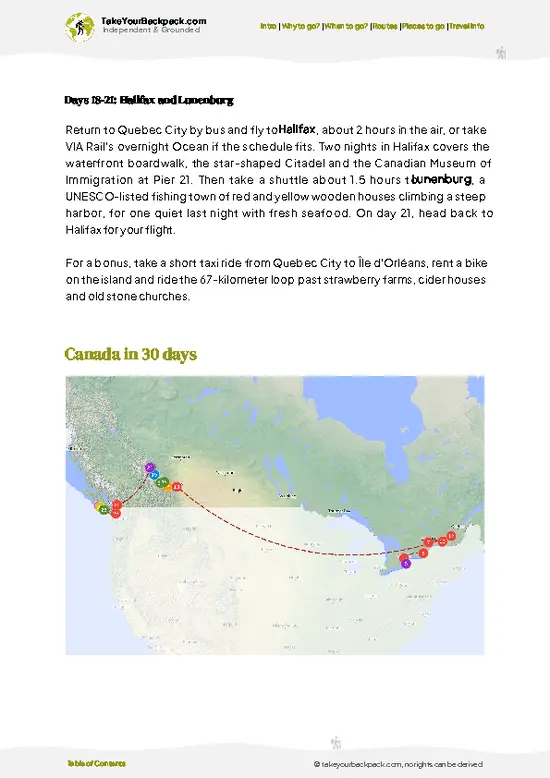
  • Curve through Quebec’s lower St. Lawrence to Rimouski and Gaspé before heading into the Canadian Maritimes and the Cabot Trail.
  • Explore Halifax and Cape Breton Highlands National Park for rugged Atlantic scenery.
  • Fly west to Vancouver and Vancouver Island for beaches, Pacific Rim National Park, and the long sands of Long Beach near Tofino.
🌍 Want a ready-to-use travel plan for Canada?
The overview above compares different route options based on your travel time and style. The complete Travel Guide breaks each itinerary down in detail, including maps, stops, highlights, and transport information.

Explore all route details 👉

Get the Travel Guide -

🌤️ When to go?Weather, seasons, and timing

The quiet sweet spot for backpacking Canada is early to mid-September. The logic: kids are back in school, so campgrounds and trailheads breathe again; rates drop from summer highs and last-minute walk-up sites actually exist; nights turn crisp enough for solid sleep without frostbite; mosquitoes fade from the boreal; wildfire smoke usually loosens its grip as cool nights and the first rains arrive; and the high country is still open—larch needles going gold in the Rockies, tundra going red in the North, maples lighting up the East. Daylight is still generous, but the sun is lower and kinder. The trade: you move faster and watch the forecast like a hawk, because the first skiffs of snow can ambush a pass. If you need a second window, late June works below true alpine—the snowline is retreating, ferries add sailings on the coasts, and prices haven’t hit the summer wall—just expect lingering snowfields and prime bug season.
  • High Summer (July-August): The grind is real—trailhead lots jam by sunrise, shuttle seats vanish days out, sticker prices jump, and heat shimmers off Interior gravel roads while mosquitoes whine at northern dusk. But the high is worth it: every pass is open, rivers are fordable by noon, meadows hum with bees, and there’s enough daylight to tag a summit and still cook dinner without a headlamp.
  • Shoulder Shift (Late May-June & September-Early October): The country exhales. Snowline retreats, rangers peel back seasonal closures, outfitters restock fuel, ferries add runs; later, crowds thin, buses run half-full, and hostel boards show actual availability. Prices ease, bugs taper, colors flare. Momentum favors you—just lace microspikes for early-season ice or a surprise September crust.
  • Deep Winter (December-March): Canada turns inward. The cold is dry and honest; snow squeaks, breath crystallizes, forests fall silent, and the sky can rip open with aurora. Trails become ski tracks and pulk lines. The solitude is absolute. Survival hack: keep water bottles upside down so the ice forms at the “top,” and sleep with tomorrow’s socks in your bag to dodge the morning sting.

Book backcountry permits the week systems open and pack a shoulder-season hedge: headnet and light fleece for June, microspikes and a 0°C-rated bag for September.

source: climatestotravel.comJANJanuary: fair for travelingFEBFebruary: fair for travelingMARMarch: fair for travelingAPRApril: good for travelingMAYMay: good for travelingJUNJune: highly recommended for travelingJULJuly: excellent for travelingAUGAugust: excellent for travelingSEPSeptember: excellent for travelingOCTOctober: highly recommended for travelingNOVNovember: fair for travelingDECDecember: fair for traveling
📅 Traveling in a specific month?
Get a full month-by-month breakdown of weather, crowds, costs, festivals, and seasonal highlights in the complete travel guide.

Get full details when to go 👉

Get the Travel Guide -
!2016-06-03 10.43.57

💰 Costs (as of 2026)Travel costs in Canada

Expect to spend CA$90-130 per day if you cook, sleep in dorms, and move long distances by rideshare; summer in the Rockies and coastal cities pushes you toward the top end.
  • dorm accommodation: Expect CA$35-55 in smaller towns and off-season university residences, CA$45-75 in Toronto/Vancouver/Calgary in summer, with tax added at checkout. The trade-off: cheap beds mean creaky bunks, laundry hum in the hallway, and 2 a.m. door-clicks—tolerable if you’ve got earplugs and an eye mask. System tip: Hostelling International membership usually knocks CA$4-10 off per night and often includes cheaper gear rentals; when campuses empty in May-August, book university housing for hotel-level privacy at hostel prices. Weekly rates and shoulder-season (late Sept/early May) slash costs. In Quebec, “auberge de jeunesse” listings are plentiful and competitive. Pay attention to linen/towel fees and card-key deposits—small drips that matter over a week. Compared with the U.S. northeast, dorms are slightly cheaper; compared with Mexico, they’re double.
  • meals: Supermarket Survival wins on price and control. A CA$4 bag of oats, “No Name” peanut butter, and a dozen bagels will carry breakfasts for days; rotisserie
read more 👉
Expect to spend CA$90-130 per day if you cook, sleep in dorms, and move long distances by rideshare; summer in the Rockies and coastal cities pushes you toward the top end.
  • dorm accommodation: Expect CA$35-55 in smaller towns and off-season university residences, CA$45-75 in Toronto/Vancouver/Calgary in summer, with tax added at checkout. The trade-off: cheap beds mean creaky bunks, laundry hum in the hallway, and 2 a.m. door-clicks—tolerable if you’ve got earplugs and an eye mask. System tip: Hostelling International membership usually knocks CA$4-10 off per night and often includes cheaper gear rentals; when campuses empty in May-August, book university housing for hotel-level privacy at hostel prices. Weekly rates and shoulder-season (late Sept/early May) slash costs. In Quebec, “auberge de jeunesse” listings are plentiful and competitive. Pay attention to linen/towel fees and card-key deposits—small drips that matter over a week. Compared with the U.S. northeast, dorms are slightly cheaper; compared with Mexico, they’re double.
  • meals: Supermarket Survival wins on price and control. A CA$4 bag of oats, “No Name” peanut butter, and a dozen bagels will carry breakfasts for days; rotisserie chicken + bagged salad feeds two for under CA$15; Dollarama stocks trail mix, tortillas, and instant coffee for less than the corner shop. Street food reality: Canada does food trucks and mall food courts more than true street stalls, and it’s not dirt cheap—poutine CA$9-14, shawarma CA$10-15, a “cheap” food-court combo CA$12-16, craft beer pint CA$8-10 before tip. Tim Hortons keeps you warm for CA$2-4, but pastries add up. The trade-off: cook and you smell like garlic in the hostel kitchen but keep dinner to CA$6-10; eat out and you buy time and warmth, at roughly U.S.-city prices and far above Mexico. I once burned half a day’s food budget on three beers in Vancouver—nice hops, dumb math.
  • local transport: To unlock the country on the cheap, stack city transit + rideshare. City buses/metros run CA$3-4 per ride; day passes land around CA$10-13 and save you if you’re bouncing between museums and lookouts. Intercity, distances are brutal and buses patchy; long-haul rail is gorgeous but pricey unless you snag a sale. Rideshare platforms (think Vancouver-Whistler for CA$15-25; Calgary-Banff CA$10-20; Toronto-Ottawa CA$30-50) are the budget workhorse, with better comfort than the bus if you pack light and stay flexible. Overnight coaches exist in some corridors but are scarce and not that cheap. ULCC flights on sale sometimes beat bus fares on routes like Vancouver-Calgary or Toronto-Halifax; comfort is a firm seat and a 7 kg bag limit, but the sunrise over the prairies from a window beats twelve hours of brake lights. Compared with the U.S., transit coverage is thinner and intercity costs higher; compared with Western Europe, slower and dearer; compared with Mexico, far pricier.
  • activities: Major cost drivers are nature access, big-ticket tours, and winter sports. Parks Canada day entry is about CA$10-12 per adult; if you’ll hit multiple parks (Banff, Yoho, Jasper, Fundy), the Discovery Pass pays off fast. Gondolas (Banff, Sea-to-Sky) run CA$60-80 and save time/legs at the cost of your lunch budget; the free alternative is a pre-dawn hike and a sweaty shirt for the same views. Whale watching sits around CA$120-180, glacier or wildlife tours similar; worth it if conditions are right, painful if fog swallows your day. Ski lift tickets in major resorts can crest CA$150-200; smaller hills are half that and friendlier. Museums in big cities tend to be CA$15-25, with occasional free evenings. Relative value: hiking is “pay once, feast daily;” guided tours mirror U.S. prices; skiing is cheaper than Colorado but far above Eastern Europe. Rent bear spray if offered (CA$10-15/day) instead of buying a can you can’t fly with.
  • miscellaneous: Budget leaks: tax + tip on dining (expect 13-15% tax depending on province, then 15-20% tip), pricey alcohol from provincial stores, ATM and foreign card fees, baggage storage, laundry, and data. Tap water is excellent—skip bottles—and carry a thermos; the steam from a hostel kettle on a cold morning is free comfort. Laundry is usually CA$3-4 per wash and the same to dry; plan around sunny days and hostel clotheslines. SIM/data can be painful; rely on hostel/cafe Wi-Fi or grab a regional eSIM before you land. Cannabis is legal but taxed like alcohol—novelty purchases nuke budgets fast. City parking tickets are merciless; if you rent a car, read the curb signs like a lawyer. Compared with the U.S., tipping culture is similar but taxes are often higher on the receipt; compared with Mexico, everyday “small stuff” is several multiples. Personal tip: keep a coin pouch for transit and laundry—once lost CA$8 in loonies to a couch crack and ate ramen for dinner.
⚠️ Prices can change and everyone travels differently, so take this as a rough guide. Hope it helps you plan your adventure!

✈️ The backpacker research shortcutCanada Travel Guide

An offline-friendly backpacking guide with optimized travel routes, ranked highlights, transport advice, and the best areas to stay.
example page 0 from our offline Travel Guide for Canadaexample page 1 from our offline Travel Guide for Canadaexample page 2 from our offline Travel Guide for Canadaexample page 3 from our offline Travel Guide for Canadaexample page 4 from our offline Travel Guide for Canadaexample page 5 from our offline Travel Guide for Canadaexample page 6 from our offline Travel Guide for Canadaexample page 7 from our offline Travel Guide for Canada
The digital guide (509 pages) contains:
131 highlights, ranked by travel appeal
Optimized 14, 21 & 30-day travel routes
Cities, national parks, beaches, historical sites, ...
How to get around
Offline-friendly for travel without Wi-Fi
👉 Click to see all 30+ guide features

📅 Plan smarter in minutes, not weeks
Month by month travel advice
Festivals & national holidays
Budget expectations

🗺️ Go to the right places, skip the overrated ones
Honest pros & cons of destinations
Top hikes, parks & viewpoints
Lesser-known places most travelers miss
Clear “worth it vs skip it” guidance

🛏️ Travel smoothly without rookie mistakes
Best areas to stay
Transport systems explained simply
Common scams & safety advice
SIM cards, money & practical tips

🌍 Understand the country, not just visit it
Culture & traditions
Local customs
Festivals worth planning around
Traveler-friendly historical context
Insights that make places more meaningful

📱 Built for real travel conditions
Fully downloadable PDF
Works completely offline
Optimized for phone use
Useful in remote areas & buses
Everything in one place
Save weeks of stressful planning
Get instant access to the full guide directly. 30-day money-back guarantee.


Sent to your inbox immediately after payment • 100% Secure Checkout
Best Backpacking Travel Advisor 2025 tourism awardBest Backpacking
Travel Advisor
2025
What others say about Take Your Backpack Guides:
⭐⭐⭐⭐⭐
Fantastic, amazing amount of information!
⭐⭐⭐⭐⭐
My goodness this is amazing, it's what I've been looking for hats off too you!
⭐⭐⭐⭐⭐
I think this is absolutely BRILLIANT
⭐⭐⭐⭐
Very complete and informative. It's still missing places, but I gotta to commend you
⭐⭐⭐⭐⭐
This is truly amazing, thank you, can't wait to explore it with my kids!
⭐⭐⭐⭐⭐
Awesome resource, thank you!
⭐⭐⭐⭐⭐
This is amazing! Can't wait to explore the ones I haven't seen
⭐⭐⭐⭐
I love this! Well done, great idea.
⭐⭐⭐⭐⭐
Thanks for taking the time to make this gem!
⭐⭐⭐⭐⭐
This might be the best website I've ever seen.
⭐⭐⭐⭐⭐
Congratulations, and thank you so much for your work; it's incredibly valuable.
⭐⭐⭐⭐
In all seriousness I think you did a great job pointing out the important spots
⭐⭐⭐⭐⭐
10/10 very good
⭐⭐⭐⭐⭐
As someone who's only just starting to visit regularly this is awesome, thank you.
⭐⭐⭐⭐
Thank you very much! I'm going to visit my dad, it's going to be very useful!
⭐⭐⭐⭐⭐
This is really cool! We'll be travelling for the first time and this definitely come in handy.
⭐⭐⭐⭐⭐
You are now our minister of culture, congratulations 👨‍💼
⭐⭐⭐⭐⭐
Just wanted to tell you that this is a pearl! Going to follow your recommendations.
⭐⭐⭐⭐⭐
This is so cool. I'll definitely be using the resource for my travels soon.
⭐⭐⭐⭐⭐
This is very impressive! Good work.
⭐⭐⭐⭐⭐
This is an amazing and informative site. Very well done!

🛏️ Where to stay?Best areas to base yourself

Yes — hostels and budget accommodation are common across Canada, with the biggest selections in Toronto (Downtown, Entertainment District, Queen West, Harbourfront), Vancouver (Downtown, Gastown, Yaletown), Montreal (Old Montreal, Plateau, Mile End, Quartier des Spectacles), Quebec City (Old Quebec, Saint‑Roch), Victoria (Downtown/Inner Harbour) and mountain towns like Banff/Canmore.
Downtown and harbourfront neighbourhoods give best transit access and nightlife but are noisier and pricier; artsy areas like Queen West, Plateau or Mile End offer cheaper beds and lively nights but can be busy … read more 👉
Yes — hostels and budget accommodation are common across Canada, with the biggest selections in Toronto (Downtown, Entertainment District, Queen West, Harbourfront), Vancouver (Downtown, Gastown, Yaletown), Montreal (Old Montreal, Plateau, Mile End, Quartier des Spectacles), Quebec City (Old Quebec, Saint‑Roch), Victoria (Downtown/Inner Harbour) and mountain towns like Banff/Canmore.
Downtown and harbourfront neighbourhoods give best transit access and nightlife but are noisier and pricier; artsy areas like Queen West, Plateau or Mile End offer cheaper beds and lively nights but can be busy and less polished; Gastown/Yaletown feel safer and more walkable yet cost more.
Mountain towns put you next to trails and parks but have fewer beds and much higher peak-season prices so book early; residential outskirts are quieter and cheaper but add transit time and limit late-night options.

If you enjoy meeting fellow travelers, consider choosing hostels with high ratings for atmosphere. On the other hand, if you prefer having your own space, a hotel might be a better option.

🚌 Getting aroundGetting around Canada

Canada moves like a long freight train at dusk: steady, quiet, and then suddenly held at a siding while the weather has its say. In big cities the minute hand matters; doors hiss open, people file in, and the system hums. Between provinces, patience buys you freedom. You feel it in the dry heat of a coach at 2 a.m., in the diesel tang on a ferry deck, in the way strangers share granola in a blizzard delay. The country rewards the traveler who learns when to sprint and when to settle in.
  • Intercity
read more 👉
Canada moves like a long freight train at dusk: steady, quiet, and then suddenly held at a siding while the weather has its say. In big cities the minute hand matters; doors hiss open, people file in, and the system hums. Between provinces, patience buys you freedom. You feel it in the dry heat of a coach at 2 a.m., in the diesel tang on a ferry deck, in the way strangers share granola in a blizzard delay. The country rewards the traveler who learns when to sprint and when to settle in.
  • Intercity Buses The real speed-vs.-cost hinge. They’re almost always cheaper than flying and usually cheaper than trains outside the Toronto-Ottawa-Montreal corridor, but they eat days if you try to cross provinces in one push. Expect a patchwork of companies—Rider Express, Ebus/Red Arrow, Ontario Northland, Orléans Express, Maritime Bus—each with its own booking quirks. Overnight runs save you a hostel night and deliver dawn over the Shield or the Prairies, but outlets and Wi-Fi are not a promise. Winter can add hours; bring layers, snacks, and accept gas-station dinners. It’s the baseline price, not the fast option.
  • City Transit (Subway, Bus, SkyTrain, Metro) This is where Canada’s social code shows. People queue without fuss, keep their voices low, and unshoulder big packs at rush hour. Tap systems rule—PRESTO in Ontario, OPUS in Quebec, Compass in Metro Vancouver—and proof-of-payment checks happen. Stand right, pass left on escalators. In the West and the Maritimes, you thank the driver when you step off; in Montreal’s rubber-tired metro the air smells faintly of warm brake pads and everyone moves with purpose. Don’t block doors, don’t eat hot food, and yield priority seats because someone will ask you to, gently but firmly.
  • Ferries (BC Ferries, Marine Atlantic, St. Lawrence crossings) Water redraws the map. Ferries unlock Vancouver Island, the Gulf Islands, and Newfoundland—places no bus or train can reach directly. As a foot passenger you pay far less: bus to the terminal, walk on, watch gulls ride the wind while the mountains fade blue. Weather is the referee; storms hold boats and the PA will tell you so. Book vehicles in advance, but on foot you usually just show up early. Food is pricey; bring your own. In Quebec, short river crossings stitch remote roads together, sometimes for free as part of the highway.
  • Poparide (Long-Distance Carpool) The budget disruptor that quietly outruns the bus. Drivers post seats on main corridors—Calgary-Banff, Vancouver-Kelowna, Toronto-Montreal—and you split costs that often beat a ticket while halving the time. Meet at park-and-rides or mall lots; be on time, carry a small pack, and confirm trunk space before you show. Ratings matter. In Quebec, winter tires are law; ask. No smelly food, offer gas money without being prompted, and don’t treat the car like a taxi—the front seat is a conversation, the back seat is for sleep masks.

My cross-Canada tactic: leapfrog the huge gaps with a midweek carry-on flight to the next major hub, then stitch the edges with Poparide or an overnight bus so the daylight hours belong to you, not the highway.
Toronto (YYZ) → Downtown (Union Station): About 27 km. Cheapest is TTC: grab the 900 Airport Express to Kipling Station, hop on Line 2, then switch to Line 1 for Union (or wherever downtown). Figure 50-70 minutes door to door. Cost is one TTC fare (about C$3.35 with PRESTO). UP Express is faster (25 min) but pricier (~C$12).

Vancouver (YVR) → Downtown (Waterfront): Roughly 13 km. Take the Canada Line SkyTrain from YVR-Airport straight to Waterfront. Trains every few minutes; about 25 minutes travel time. Fare is the regular 2-zone price plus the YVR AddFare, so about C$9-10 depending on time/payment method. No traffic, no fuss.

Montréal (YUL) → Centre-Ville: Around 20 km. Cheapest is regular STM routes: 204 to Dorval, transfer to 211 (or 405) to Lionel-Groulx, then métro downtown—one fare (about C$3.75), 50-70 minutes. Easiest is the 747 airport bus direct to downtown/Berri-UQAM: 45-70 minutes, C$11, and it doubles as a 24-hour STM pass.

Calgary (YYC) → Downtown: About 17 km. For the budget route, take Calgary Transit 100 to McKnight-Westwinds, then the Blue Line CTrain into downtown. Expect 45-60 minutes. One regular fare (about C$3.70, valid 90 minutes). Route 300 is quicker and runs direct, but costs ~C$11 (includes a day pass).
⚠️ Prices and routes can change, so take this as a rough guide and ask for local advice when you arrive.

🔒 Safety (risk Level: low)What first-time visitors should know

Safety for solo travelers, including women and LGBTQ+ individuals
Yes, Canada is generally safe for solo travelers, including women and LGBTQ+ individuals. Major cities like Toronto, Vancouver, and Montreal have vibrant LGBTQ+ communities and are considered LGBTQ+ friendly. While urban areas are generally safe, it’s wise to stay aware of your surroundings, especially at night or in unfamiliar areas. Use common sense, keep an eye on your belongings, and enjoy the welcoming atmosphere.


Full official government travel advisory (live updates)
View details 👉

✈️ VisaWhat travelers should know about visas

Visa requirements for Canada depend on your nationality. If you’re from a visa-exempt country, you might only need an Electronic Travel Authorization (eTA), which you can apply for online. If a visa is required, apply through the Canadian government’s official website by completing the necessary forms and providing required documents.

source: canada.ca
⚠️ Visa requirements can change over time, so always check the latest visa requirements with the official embassy or government website before you travel.

🎒 What to pack?A practical packing list

Canada’s climate is as varied as its landscapes, so pack smart. Summer can get surprisingly hot in the south, but nights might still be chilly, especially in the Rockies or near the coast. Winters are no joke—layers and a good pair of boots are your best friends. Remember, Canadians are pretty laid-back about fashion, but if you’re heading to smaller towns or religious sites, modest attire might be appreciated. Always be ready for rain, especially if you’re visiting the coastal regions like Vancouver or heading into the wilderness.

Apart from this country specific advice, I have also crafted a general packing list that should help on any trip. authorOver the years, I've learned the importance of packing minimally. It's so much easier to jump on the back of a truck or squeeze yourself into the last spot of a minibus without that supersized backpack. If you're headed to a warm destination, leave your winter jacket at home; for colder regions, opt for thin thermal underlayers. Instead of packing your entire wardrobe, bring just three sets of clothes, as laundry facilities are available everywhere.
View the full list 👉
🎒 Planning the practical side of your trip?
Get detailed information on transport, daily budgets, internet access, local customs, food, language, and other essentials in the complete Travel Guide.

Get detailed practical information 👉

Get the Travel Guide -

🙋 FAQCommon questions before visiting

Trip Planning


Personal tip: I normally search on good rating for atmosphere (for meeting people) and location (for easy exploring). Cleanliness as a bonus.


Travel Essentials

Canada doesn’t require specific vaccines for entry, but it’s wise to be up-to-date on routine vaccines like measles-mumps-rubella (MMR) and the seasonal flu shot. Check if your tetanus-diphtheria-pertussis booster is current. If you’re hiking or camping, consider a rabies vaccine, especially if you might encounter wildlife.


vaccination requirements
When I first started traveling, I often spent part of my first day in a new country hunting for a local SIM card. While this can still be slightly cheaper, it also takes time and planning.

These days, it's much simpler to install an eSIM before leaving home. Once you arrive in Canada, you can activate it immediately and have mobile data from the moment you land — which is especially useful for ordering transport or navigating away from busy airports.

There are many providers nowadays, and price differences are usually small. I personally go with Airalo, as it offers excellent network coverage throughout the country and strong global coverage, so you can manage multiple countries from a single app.


Get your e-sim for Canada

Culture & Customs

Respect personal space; Canadians value it. Be polite and use ”please” and ”thank you” often. Tipping in restaurants is customary, around 15-20%. Avoid discussing politics or religion unless invited to share your opinions.

For LGBTQ+ travelers, Canada is generally inclusive and safe. Same-sex marriage is legal nationwide, and there are vibrant LGBTQ+ communities, especially in cities like Toronto and Vancouver.

Women should feel safe traveling solo, but stay alert in unfamiliar areas as you would anywhere. Smoking is banned in most public places, so watch for signs. Always recycle when possible; environmental consciousness is a big deal.
Trying traditional food is always a great way to experience the culture. Here are some must-try dishes for Canada.
  • Poutine: Originating from Quebec, this dish is a savory mix of fries topped with cheese curds and smothered in gravy. It’s the ultimate comfort food and a staple in Canadian cuisine.
  • Butter Tart: A classic dessert consisting of a flaky pastry shell filled with a buttery, sugary filling, often with raisins or pecans. Essential for anyone with a sweet tooth and a staple at Canadian gatherings.
  • Nanaimo Bar: Named after the city of Nanaimo in British Columbia, this no-bake dessert features a layered bar with a crumbly base, custard-flavored middle, and chocolate topping. It’s a popular treat at potlucks and bake sales.
  • Tourtière: A traditional French Canadian meat pie usually made with minced pork and spices. Often served during the holidays, it reflects the rich culinary heritage of Quebec.
  • Bannock: A simple bread with Indigenous roots, bannock can be baked, fried, or cooked over an open fire. It’s versatile and has played a significant role in Canadian history and Indigenous diets.
Yes, tap water in Canada is generally safe to drink, and locals drink it without issues. Most cities have high-quality water treatment systems, so tourists can feel confident drinking from the tap. If you’re in rural areas or just cautious, bottled or filtered water can be a safe fallback.
English is one of the two official languages of Canada, alongside French. It is predominantly spoken in most provinces, particularly in the western provinces like British Columbia and Alberta, as well as in Ontario and the Atlantic provinces. In these areas, you will find that the majority of the population communicates fluently in English, making it easy for English-speaking travelers to navigate and interact.

In Quebec, however, French is the primary language, and while many residents, especially in urban areas like Montreal, are bilingual, English proficiency can vary. In parts of Quebec, particularly outside major cities, English speakers may encounter more challenges.

Overall, English is widely understood and spoken throughout Canada, including in tourist destinations, hotels, and restaurants. Signage, public announcements, and official documentation are generally available in English, ensuring that travelers can easily find their way and enjoy their experience. For those traveling to remote areas or indigenous communities, it’s advisable to learn a few basic phrases in the local language, as English may not be as commonly spoken.

Money & Payments

The local currency of Canada is CAD ($).

If you’re backpacking in Canada, here’s the lowdown on money:

ATMs: They’re everywhere, even in smaller towns, so you’ll rarely be stuck without access. Most international bank cards work fine, but your bank might slap on some fees.

Cash: It’s always smart to carry a little Canadian cash, especially for smaller shops and rural areas where cards might not be accepted. Forget about euros; they won’t do you any good here.

Card Acceptance: Credit and debit cards are widely accepted, especially Visa and Mastercard. American Express is less common. But keep an eye out for places that have a minimum spend for card use.

Currency Exchange: Avoid airport exchange counters if you can; they’re notorious for bad rates. Instead, use ATMs or head to a bank in the city. If you must exchange cash, look for a reputable exchange service in town.

In Canada, tipping is expected in most service industries, typically ranging from 15% to 20% of the total bill for good service. It’s customary to tip waitstaff, bartenders, taxi drivers, and hotel staff. Some places might add a service charge for larger groups, so check your bill to avoid double tipping.

🧩 Nearby countriesSimilar backpacking destinations

📸 PhotosTravel photos from Canada

Take your backpack - Canada - 0
Take your backpack - Canada - 1
Take your backpack - Canada - 2
Take your backpack - Canada - 3
Take your backpack - Canada - 4
Take your backpack - Canada - 5
Take your backpack - Canada - 6
Take your backpack - Canada - 7
Take your backpack - Canada - 8
Take your backpack - Canada - 9
Take your backpack - Canada - 10
Take your backpack - Canada - 11
Take your backpack - Canada - 12
Take your backpack - Canada - 13
Take your backpack - Canada - 14
Take your backpack - Canada - 15
Take your backpack - Canada - 16
Photographed by: Johan Kruseman

We 💚 feedbackIs Canada worth visiting?

Go for the scale of quiet. Long summer light sliding across granite at 10 p.m., the resin-sweet smell of pine warming after rain, a loon’s call rolling over a black lake. When it clicks, Canada feels like the dial turned up on space and silence.

The drawback: distance punishes. Iconic spots sit days apart, bus networks are thin, and many trailheads hide 30–80 km from town. You either pay in money (car) or in time and comfort (waiting, hitching, roadwalks). Summer gives endless daylight but blackflies and wildfire smoke can test your patience; shoulder seasons swap bites for frost and early storms.

Strategic tip that changes everything: team up with two other backpackers and split a compact rental. It turns a $90–120/day problem into $30–40 each, buys sunrise trailheads and mid-day grocery runs, and frees you from rare buses. You trade a bit of admin for more actual trail, warmer coffee at dawn, and the right to chase the light instead of the schedule.

✈️ When did I visit Canada?
As part of my 1.5 year travel around the world trip, I visited Canada in 2016. Since then, this guide is regularly updated based on feedback from locals and recent backpackers (last update: 14 January 2026)

✍️ Help improve this page!
The information on this page is based on my own backpacking experience in Canada, supplemented with up-to-date research and feedback from other travelers. Travel details can change, so if you notice anything outdated or incomplete, feel free to let me know.


🙋‍♂️ Give feedback

👋 Meet the founderWho’s Behind Take Your Backpack?

Johan, backpacker and founder of TakeYourBackpackHi, I’m Johan (Netherlands 🇳🇱), the creator of TakeYourBackpack. Over the past decade, I’ve backpacked through 80+ countries across six continents, gaining extensive experience with independent travel, long-term trips, and overland routes.

This site is built on a combination of firsthand travel experience and carefully curated insights from other backpackers. Many guides are based on places I’ve personally visited, while others bring together tips, observations, and practical advice shared by trusted travelers I’ve met along the way.

The goal is to provide realistic, experience-driven guidance — not generic itineraries — so you can explore destinations with better context, clearer expectations, and more confidence.

Get full Canada guide •
Instant download • 131 highlights • Full Offline guide