×
Kuwait 🇰🇼

backpacking Asia Kuwait 🇰🇼
Navigate car-centric life between desert edges and cities.

Explore KazakhstanExplore Kyrgyzstan

Backpacking Kuwait in 2026

A complete guide including when and where to go, costs, transport, itineraries, and practical travel advice.
Traveling in Kuwait: what to expect

Backpacking Kuwait
By Johan Kruseman 🇳🇱 | Updated June 6, 2026

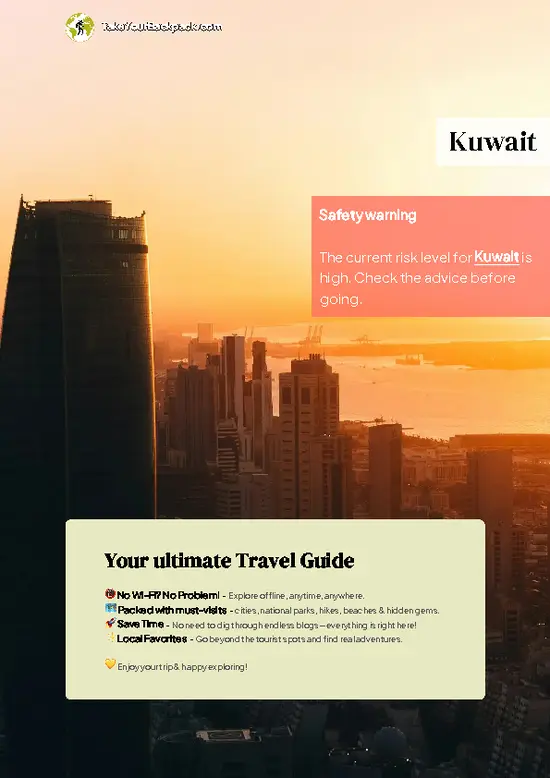
You step from icy AC into warm, salty corniche air, then into Souq Al‑Mubarakiya where a seller passes you dates and cardamom coffee. Kuwait leans on small courtesies and a measured rhythm, more conversation than spectacle. A seafaring port rebuilt by oil and resilience, it shows both in its skyline and in its living rooms.

The draw is the Gulf‑meets‑desert mix: dusk walks along the waterfront, families under the Kuwait Towers, then Sadu House tracing Bedouin craft and memory. Tour the Grand Mosque, catch a show at the Sheikh Jaber Al Ahmad Cultural Centre, and ferry to Failaka Island for Greek‑era ruins, Bronze Age mounds, and 1990s scars people still discuss. Machboos, hammour, and hot tea pace the day. Summer heat bites, dust can blow, alcohol is banned, and transit is thin; plan dawn and evening, dress modestly, use taxis, and the slower rhythm opens doors—and conversations—you’d miss at speed.

Compared with Dubai or Doha, Kuwait is lower‑key and more civic than showpiece; compared with Bahrain, it trades nightlife for community; compared with Saudi, it’s easier to navigate yet still conservative. Go if you want Gulf life without gloss: shoreline walks, clear‑eyed history, and time to sit, listen, and be welcomed.

👉 Get the 📖 Travel Guide of Kuwait

Kuwait City Core (Sharq–Qibla–Dasman)

Government blocks, old souk, and the seafront in one compact loop. Walk Souq Al-Mubarakiya, Sadu House, Grand Mosque, then taxi-hop to the Kuwait Towers and Shaheed Park. Weekdays pulse at lunch; dawn Fridays are empty. Brutal summer heat—plan indoor cooldowns. Rewards urban walkers and food hunters who don’t mind traffic-snarled crossings.

Salmiya + Gulf Road Corridor

Single coastal spine (Arabian Gulf Street) with constant buses and cheap taxis. Evening promenade culture, marinas, and the Scientific Center anchor it; backstreets run on expat eateries and late-night shawarma. Safe, busy, and practical for sunset walks and budget meals. Best if you like easy logistics and steady people-watching.

Southern Coast (Fahaheel–Mangaf–Al Khiran)

Oil-town grit, fishermen, and weekend chalet life. Al Kout’s fish market is worth an early stop; boats head out on calm days to Kubbar. Public beaches vary; modest swimwear plays better. Long distances—fine on Highway 30 buses, better with a car. Rewards thrifty travelers who prefer local scenes over polish.

Desert & Ridges (Mutla, Kabd, Wafra)

Winter “kashta” camping, wide sky, and silence. You need a 4x4, recovery points, and 4–6L water per person/day. No services; pack out everything. Cold nights, surprise sandstorms, and occasional checkpoints. Stick to tracks near farms. Built for self-sufficient campers, not first-timers.

The Causeway North & Jahra Bay

Drive the Sheikh Jaber Causeway to Subiyah for horizon therapy; exits are limited, wind is constant, and speed cameras are real. Jahra/Sulaibikhat mudflats reward patient birders at high tide. No shade or shops—bring water and leave no trace. Suits sunrise chasers with their own wheels.
Safety warning

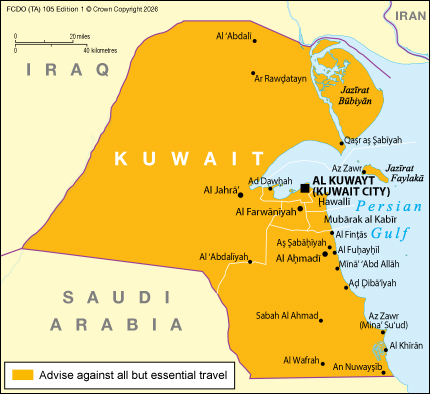
The current risk level for Kuwait is high. Check the advice before going.
Get your Kuwait guide
65 ranked highlights, routes & tips, works offline (256 pages)
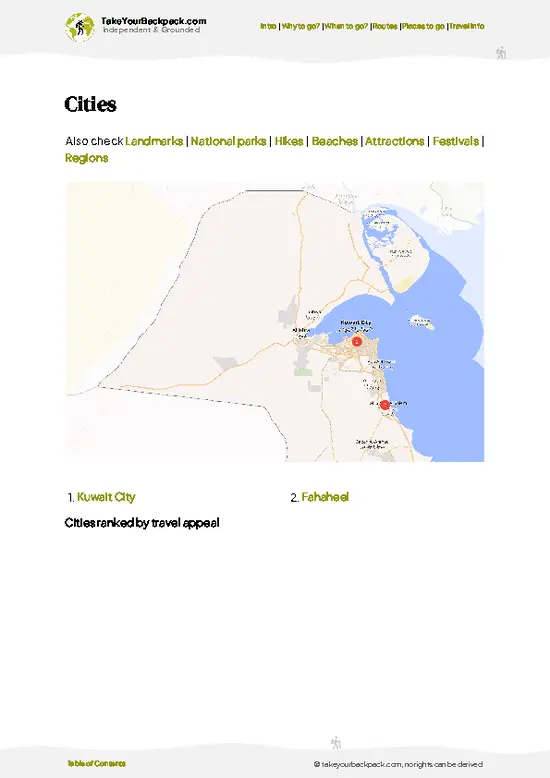
Geography and where places are located
Loading the map 🌍
CLICK TO FILTER
city
town
unique site
national park
hike
beach
attraction
festival
region
SHOW COUNTRY’S BESTSHOW ALL
film
0
0
0a
Marina Beach
film
1
1
1a
Messilah Beach
film
2
2
2a
Kuwait City
film
3
3
3a
Failaka Island Coastal Walk
film
4
4
4a
Kubbar Island
film
5
5
5a
Al Sulaibikhat Bay
film
6
6
6a
Failaka Island
film
7
7
7a
Mahboula
film
8
8
8a
Bneid Al Gar
film
9
9
9a
Al Riqqa
film
10
10
10a
Kuwait Towers
film
11
11
11a
Seif Palace

Why go?Why Kuwait is worth visiting

Low cost

Backpacking Kuwait stays cheap if you work with the city. Buses cover the sprawl for very little, and South Asian cafeterias feed you well for the same. Corniche walks, beaches, souqs, and many museums are free or close to it. Refill at public water coolers. Split business hotels on Fri–Sat. Skip airport taxis; ride the bus. Shoestring daily average: mid-$40s.
Want the complete picture of Kuwait?
The offline Travel Guide brings everything together — routes, highlights & planning.

See what's included in the guide 👉

Get the Travel Guide -

⭐ HighlightsHighlights of Kuwait

  • Kuwait Towers: Wind scours the Gulf and the blue spheres glare like fish eyes; from the viewing deck you get oil tankers lined on the horizon and neighborhoods stitched by flyovers. Salt crusts the glass, and your lips taste it.
  • Souq Al-Mubarakiya: Bare concrete lanes and canvas awnings knock back the heat; old men play cards, and the fish hall thumps with auction shouts. Your fingers turn yellow with turmeric, and smoke from kebabs sticks to your shirt.
  • Grand Mosque (Al-Masjid Al-Kabir): Scale humbles here—vaults of carved teak and Quranic script pulled across a hall the size of a hangar. The carpet grips your socks soft as moss, and a hint of oud hangs in the cool, conditioned air.
  • Failaka Island: Out on Failaka the city drops away; you walk between Greek-era stones and war-scarred houses, rust flaking off an old tank and goats picking at scrub. Diesel from the boat lingers in your sinuses while gulls knife the wind.
  • Al Shaheed Park: Inside the ring roads, Al Shaheed is Kuwait’s lung—desert
read more 👉
  • Kuwait Towers: Wind scours the Gulf and the blue spheres glare like fish eyes; from the viewing deck you get oil tankers lined on the horizon and neighborhoods stitched by flyovers. Salt crusts the glass, and your lips taste it.
  • Souq Al-Mubarakiya: Bare concrete lanes and canvas awnings knock back the heat; old men play cards, and the fish hall thumps with auction shouts. Your fingers turn yellow with turmeric, and smoke from kebabs sticks to your shirt.
  • Grand Mosque (Al-Masjid Al-Kabir): Scale humbles here—vaults of carved teak and Quranic script pulled across a hall the size of a hangar. The carpet grips your socks soft as moss, and a hint of oud hangs in the cool, conditioned air.
  • Failaka Island: Out on Failaka the city drops away; you walk between Greek-era stones and war-scarred houses, rust flaking off an old tank and goats picking at scrub. Diesel from the boat lingers in your sinuses while gulls knife the wind.
  • Al Shaheed Park: Inside the ring roads, Al Shaheed is Kuwait’s lung—desert plant beds, two small museums, and paths under cooling misters where runners thread dusk. Sprinkler mist beads on your forearms and the skyline lifts above palm fronds. Off the map: Jahra Pools Reserve birding, sunrise at Kazma Ridge, and Fahaheel fish market when the fleet offloads.
Spotted a mistake or missing a highlight? Contact us.

But Kuwait offers more...

Discover and compare all of its highlights per category

🧭 RoutesLogical itineraries covering the highlights

The 2-Day Kuwait City Core Route

The Vibe: A compact, culture-first city break that trades long drives for deep dives into mosques, markets, museums, and the seafront, all at a relaxed walking-and-taxi pace. You get Kuwait’s story in fast-forward without ever leaving the capital.
The Highlights:
  • Exploring the historic heart around the Grand Mosque and Souq Al-Mubarakiya.
  • Catching Gulf views and skyline shots from Kuwait Towers.
  • Unwinding in Al Shaheed Park and along the coastal Corniche.
  • Sampling modern café and beach life around Marina Beach.

The 3-Day City, Coast & Desert Route

The Vibe: A balanced first-timer’s route that mixes Kuwait City’s cultural anchors with a taste of coastal life and the open desert, using taxis and one day trip to stretch beyond the urban bubble. The pace is steady, with one big outing to the ridge and wetlands to keep it adventurous.
The Highlights:
  • Classic city icons like the Grand Mosque, Souq Al-Mubarakiya, and Kuwait Towers.
  • Hands-on science and aquarium time at the
read more 👉

The 2-Day Kuwait City Core Route

The Vibe: A compact, culture-first city break that trades long drives for deep dives into mosques, markets, museums, and the seafront, all at a relaxed walking-and-taxi pace. You get Kuwait’s story in fast-forward without ever leaving the capital.
The Highlights:
  • Exploring the historic heart around the Grand Mosque and Souq Al-Mubarakiya.
  • Catching Gulf views and skyline shots from Kuwait Towers.
  • Unwinding in Al Shaheed Park and along the coastal Corniche.
  • Sampling modern café and beach life around Marina Beach.

The 3-Day City, Coast & Desert Route

The Vibe: A balanced first-timer’s route that mixes Kuwait City’s cultural anchors with a taste of coastal life and the open desert, using taxis and one day trip to stretch beyond the urban bubble. The pace is steady, with one big outing to the ridge and wetlands to keep it adventurous.
The Highlights:
  • Classic city icons like the Grand Mosque, Souq Al-Mubarakiya, and Kuwait Towers.
  • Hands-on science and aquarium time at the Scientific Center.
  • Beachfront strolling and café-hopping around Marina Beach.
  • A desert-and-wetlands day taking in Mutla Ridge and Jahra Pools Nature Reserve.

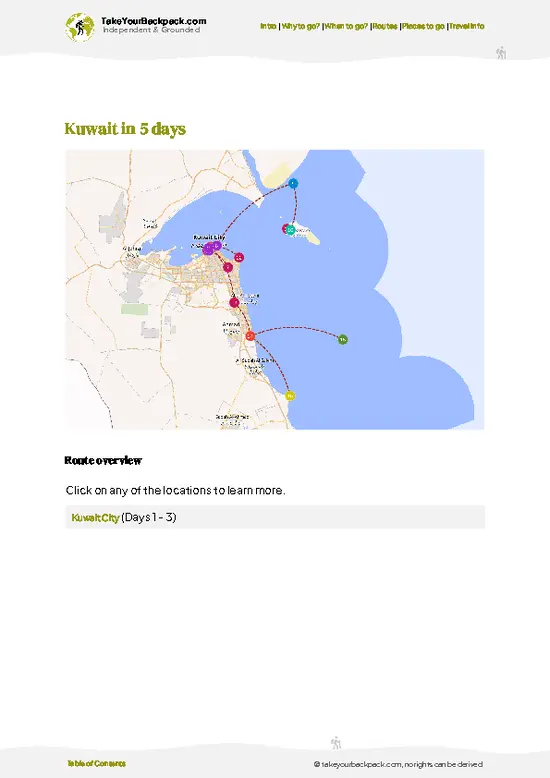
The 5-Day Kuwait Islands & Heartland Route

The Vibe: A fuller journey that layers Kuwait City’s culture with island history, southern beach suburbs, oil-town character, and protected nature, moving at a comfortable pace with a couple of longer but rewarding travel days. It’s for travelers who want to say they’ve really “done” Kuwait, not just its skyline.
The Highlights:
  • Two days of deep cultural time in Kuwait City’s mosques, museums, and parks.
  • Island exploring on Failaka, with heritage villages and coastal walks, plus the option of Kubbar.
  • Beach and oil-town contrasts around Fahaheel, Al Kout Beach, and Al Ahmadi.
  • Wildlife and big-sky views on Boubyan Island, Jahra Pools, and Mutla Ridge.
🌍 Want a ready-to-use travel plan for Kuwait?
The overview above compares different route options based on your travel time and style. The complete Travel Guide breaks each itinerary down in detail, including maps, stops, highlights, and transport information.

Explore all route details 👉

Get the Travel Guide -

🌤️ When to go?Choosing the right months to travel

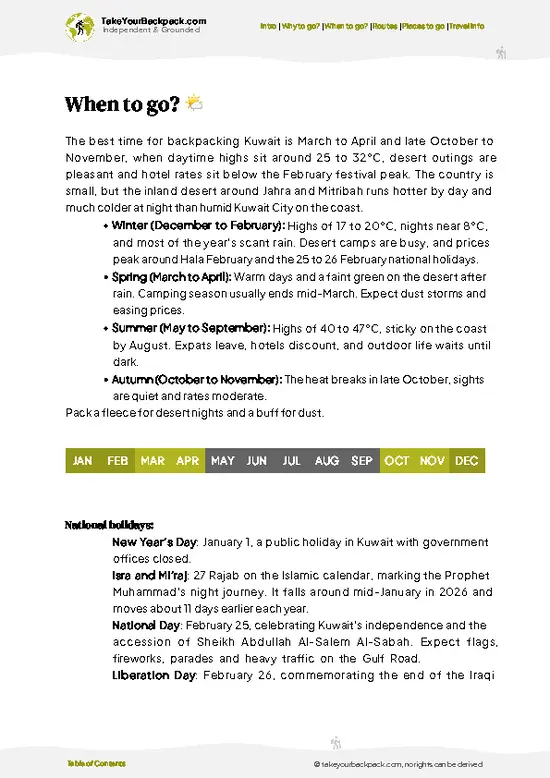
Late October-November and March-early April are the sweet spot: warm evenings, tolerable middays, and hotel rates between summer fire-sale and winter kashta spikes. Expect occasional short shamal bursts. If Ramadan overlaps, daytime dining narrows while prices and traffic ease.
  • Peak Winter (Dec-Feb): Prices rise on weekends and desert camps sell out, but the payoff: crisp kashta nights, sharp stars, corniche walks, and the souq in cool air.
  • Shoulder (Oct-Nov, Mar-Apr): Heat backs off, shops open earlier, sea days return, and crowds thin by dusk. Rates dip; Failaka boats feel local again; momentum without business-travel prices.
  • Off-Peak Extreme (Jun-Sep): City empties at midday; asphalt shimmers. Move at dawn and after sunset, ride AC at noon, carry electrolytes, and wet a shemagh when the shamal kicks.

Tactical tip: Book city hotels Thu-Sat; midweek rates jump with business demand.

source: climatestotravel.comJANJanuary: highly recommended for travelingFEBFebruary: highly recommended for travelingMARMarch: excellent for travelingAPRApril: excellent for travelingMAYMay: fair for travelingJUNJune: below average for travelingJULJuly: below average for travelingAUGAugust: below average for travelingSEPSeptember: fair for travelingOCTOctober: excellent for travelingNOVNovember: excellent for travelingDECDecember: highly recommended for traveling
📅 Traveling in a specific month?
Get a full month-by-month breakdown of weather, crowds, costs, festivals, and seasonal highlights in the complete travel guide.

Get full details when to go 👉

Get the Travel Guide -
Kuwait-jc-gellidon--XAphu7d5t0-unsplash

💰 Costs (as of 2025)Prices, expenses, and money tips

Expect 18-25 KWD/day if you land a dorm and ride buses; 25-35 KWD if you need a basic private room.
  • dorm accommodation: Dorms are scarce; where they exist (Kuwait City/Salmiya), expect 6-12 KWD/night; if none, the lowest private rooms run 18-25 KWD. System tip: book one night online, then negotiate in person (Sun-Wed) in Farwaniya/Salmiya—cash beats cards and “bachelor” floors are cheaper; be ready to share a twin to halve costs.
  • meals: Supermarket Survival: 2-3 KWD/day buys flatbread, labneh, hummus, fruit, canned tuna; water is cheap, but carry a bottle to avoid 0.15-0.25 KWD impulse buys. Street food reality: shawarma 0.5-1 KWD, South Asian cafeterias 1-2 KWD per plate, mall food courts 2-4 KWD; cheaper than UAE/Qatar, pricier than Egypt/Jordan.
  • local transport: Buses (KPTC/CityBus) are the backbone—0.25-0.35 KWD per ride with a stored-value card; cash works but slows boarding. No metro. Taxis bite (flagfall ~1-1.5 KWD), meters are flaky, and short hops add up. Cheapest way to unlock the country: split a small rental car (8-12 KWD/day) for desert sites and spreads; fuel is cheap by global standards and parking is easy.
  • activities: Museums and landmarks are cheap to free (Grand Mosque
read more 👉
Expect 18-25 KWD/day if you land a dorm and ride buses; 25-35 KWD if you need a basic private room.
  • dorm accommodation: Dorms are scarce; where they exist (Kuwait City/Salmiya), expect 6-12 KWD/night; if none, the lowest private rooms run 18-25 KWD. System tip: book one night online, then negotiate in person (Sun-Wed) in Farwaniya/Salmiya—cash beats cards and “bachelor” floors are cheaper; be ready to share a twin to halve costs.
  • meals: Supermarket Survival: 2-3 KWD/day buys flatbread, labneh, hummus, fruit, canned tuna; water is cheap, but carry a bottle to avoid 0.15-0.25 KWD impulse buys. Street food reality: shawarma 0.5-1 KWD, South Asian cafeterias 1-2 KWD per plate, mall food courts 2-4 KWD; cheaper than UAE/Qatar, pricier than Egypt/Jordan.
  • local transport: Buses (KPTC/CityBus) are the backbone—0.25-0.35 KWD per ride with a stored-value card; cash works but slows boarding. No metro. Taxis bite (flagfall ~1-1.5 KWD), meters are flaky, and short hops add up. Cheapest way to unlock the country: split a small rental car (8-12 KWD/day) for desert sites and spreads; fuel is cheap by global standards and parking is easy.
  • activities: Museums and landmarks are cheap to free (Grand Mosque tours, National Museum when open, Kuwait Towers deck a few dinars). Cost drivers: private beach-club day passes, boat trips to Failaka, and guided desert runs—think 5-20+ KWD each. Relative value: still lower than Dubai’s equivalents, higher than Bahrain’s public beaches or Jordan’s museums.
  • miscellaneous: Budget leaks: airport taxis (7-10 KWD into town—use the airport bus instead), chain coffee (1-2 KWD), delivery/app fees, foreign ATM charges, and bottled water bought one-by-one. SIMs are cheap (2-3 KWD starter; 3-5 KWD for weekly data) and save you on navigation. No VAT keeps shelf prices softer than UAE/SA, but imported snacks and dairy punch above Egypt/Jordan.
⚠️ Prices can change and everyone travels differently, so take this as a rough guide. Hope it helps you plan your adventure!

✈️ The backpacker research shortcutKuwait Travel Guide

An offline-friendly backpacking guide with optimized travel routes, ranked highlights, transport advice, and the best areas to stay.
example page 0 from our offline Travel Guide for Kuwaitexample page 1 from our offline Travel Guide for Kuwaitexample page 2 from our offline Travel Guide for Kuwaitexample page 3 from our offline Travel Guide for Kuwaitexample page 4 from our offline Travel Guide for Kuwaitexample page 5 from our offline Travel Guide for Kuwaitexample page 6 from our offline Travel Guide for Kuwaitexample page 7 from our offline Travel Guide for Kuwait
The digital guide (256 pages) contains:
65 highlights, ranked by travel appeal
Optimized 2, 3 & 5-day travel routes
Cities, national parks, beaches, historical sites, ...
How to get around
Offline-friendly for travel without Wi-Fi
👉 Click to see all 30+ guide features

📅 Plan smarter in minutes, not weeks
Month by month travel advice
Festivals & national holidays
Budget expectations

🗺️ Go to the right places, skip the overrated ones
Honest pros & cons of destinations
Top hikes, parks & viewpoints
Lesser-known places most travelers miss
Clear “worth it vs skip it” guidance

🛏️ Travel smoothly without rookie mistakes
Best areas to stay
Transport systems explained simply
Common scams & safety advice
SIM cards, money & practical tips

🌍 Understand the country, not just visit it
Culture & traditions
52 Essential phrases & customs
Festivals worth planning around
Traveler-friendly historical context
Insights that make places more meaningful

📱 Built for real travel conditions
Fully downloadable PDF
Works completely offline
Optimized for phone use
Useful in remote areas & buses
Everything in one place
Save weeks of stressful planning
Get instant access to the full guide directly. 30-day money-back guarantee.


Sent to your inbox immediately after payment • 100% Secure Checkout
Best Backpacking Travel Advisor 2025 tourism awardBest Backpacking
Travel Advisor
2025
What others say about Take Your Backpack Guides:
⭐⭐⭐⭐⭐
Fantastic, amazing amount of information!
⭐⭐⭐⭐⭐
My goodness this is amazing, it's what I've been looking for hats off too you!
⭐⭐⭐⭐⭐
I think this is absolutely BRILLIANT
⭐⭐⭐⭐
Very complete and informative. It's still missing places, but I gotta to commend you
⭐⭐⭐⭐⭐
This is truly amazing, thank you, can't wait to explore it with my kids!
⭐⭐⭐⭐⭐
Awesome resource, thank you!
⭐⭐⭐⭐⭐
This is amazing! Can't wait to explore the ones I haven't seen
⭐⭐⭐⭐
I love this! Well done, great idea.
⭐⭐⭐⭐⭐
Thanks for taking the time to make this gem!
⭐⭐⭐⭐⭐
This might be the best website I've ever seen.
⭐⭐⭐⭐⭐
Congratulations, and thank you so much for your work; it's incredibly valuable.
⭐⭐⭐⭐
In all seriousness I think you did a great job pointing out the important spots
⭐⭐⭐⭐⭐
10/10 very good
⭐⭐⭐⭐⭐
As someone who's only just starting to visit regularly this is awesome, thank you.
⭐⭐⭐⭐
Thank you very much! I'm going to visit my dad, it's going to be very useful!
⭐⭐⭐⭐⭐
This is really cool! We'll be travelling for the first time and this definitely come in handy.
⭐⭐⭐⭐⭐
You are now our minister of culture, congratulations 👨‍💼
⭐⭐⭐⭐⭐
Just wanted to tell you that this is a pearl! Going to follow your recommendations.
⭐⭐⭐⭐⭐
This is so cool. I'll definitely be using the resource for my travels soon.
⭐⭐⭐⭐⭐
This is very impressive! Good work.
⭐⭐⭐⭐⭐
This is an amazing and informative site. Very well done!

🛏️ Where to stay?Where to stay in Kuwait

Hostels are rare in Kuwait, but budget hotels, guesthouses and cheap furnished rooms cluster in Kuwait City, Sharq, Salmiya and Hawalli.
Kuwait City and Sharq put you by the Corniche, museums and central souqs—best for sightseeing and shopping but busier and generally pricier; Salmiya offers the best mix of inexpensive stays, restaurants, cafes and beach access for evening activity.
Hawalli gives the lowest nightly rates and a strong local food scene but is quieter at night and adds commute time, while airport/industrial districts are cheapest yet far from attractions; public transport is … read more 👉
Hostels are rare in Kuwait, but budget hotels, guesthouses and cheap furnished rooms cluster in Kuwait City, Sharq, Salmiya and Hawalli.
Kuwait City and Sharq put you by the Corniche, museums and central souqs—best for sightseeing and shopping but busier and generally pricier; Salmiya offers the best mix of inexpensive stays, restaurants, cafes and beach access for evening activity.
Hawalli gives the lowest nightly rates and a strong local food scene but is quieter at night and adds commute time, while airport/industrial districts are cheapest yet far from attractions; public transport is limited and social norms are conservative, so factor taxi costs and modest dress into your planning.

If you enjoy meeting fellow travelers, consider choosing hostels with high ratings for atmosphere. On the other hand, if you prefer having your own space, a hotel might be a better option.

🚌 Getting aroundTransportation options and logistics

Kuwait moves on asphalt and air-con. Clocks exist, but the road decides: heat at noon, heavy flows on the Ring Roads morning and late afternoon, and a quick glide after dark. It isn’t chaos; it’s a car-first rhythm where buses bend to traffic and taxis punch gaps when you pay for it.
  • City Buses (KPTC/CityBus/KGL) The Social Fabric: You’ll ride with workers, students, and a few budget diehards; locals mostly drive. Queue loosely, let families and elders board first, and don’t eat onboard. Fares hover
read more 👉
Kuwait moves on asphalt and air-con. Clocks exist, but the road decides: heat at noon, heavy flows on the Ring Roads morning and late afternoon, and a quick glide after dark. It isn’t chaos; it’s a car-first rhythm where buses bend to traffic and taxis punch gaps when you pay for it.
  • City Buses (KPTC/CityBus/KGL) The Social Fabric: You’ll ride with workers, students, and a few budget diehards; locals mostly drive. Queue loosely, let families and elders board first, and don’t eat onboard. Fares hover around 0.25-0.5 KD—pay small cash to the driver or tap a stored-value card if you have one. Air-con can be Arctic; bring a layer. Stops are signed in Arabic/English, but routes favor Ring Roads and the Gulf Road, so expect detours for the last mile.
  • Taxis & Ride-hail The Efficiency Trade-off: No rail here—speed costs. A taxi shrinks cross-town runs from an hour by bus to 20-30 minutes off-peak. Many drivers skip the meter; agree a fare first. Short hops 1-2.5 KD, cross-city 3-6 KD, airport 6-10 KD. Ride-hail apps remove haggling and mirror those prices, but rush hour will still pin you to the Rings.
  • Island Boats (Failaka/Kubbar) The Geometric Unlock: Water is the only line to the ruins and reefs. Weekend morning departures, weather-dependent, and cancellations when wind kicks up. Bring ID, cash for tickets, and assume sun exposure. No road alternative—this is how you reach the good stuff offshore.
  • Airport Bus The Budget Disruptor: Daytime routes link the terminals to Kuwait City for about 0.5 KD. Stops sit across the car park; luggage rides if it fits on your lap or under seat. Late-night frequencies thin out—after 22:00, your savings may evaporate in waits, so switch to a taxi.

Master tip: Move early. Ride a bus along a Ring/Gulf spine at dawn, then spend 2-3 KD on a short taxi for the last mile; this two-step beats traffic, heat, and budget bleed across the whole country.
Kuwait International Airport (KWI) sits about 16 km (10 miles) south of the city center (around Sharq/Murqab). By road, it takes roughly 20-35 minutes outside rush hour.

Main public transport
  • City bus (KPTC and CityBus) — Several routes connect the airport with central Kuwait City, including KPTC 13 and 99 toward Murqab/Murgab Bus Station and surrounding downtown stops.
    • Travel time: about 40-70 minutes, depending on traffic and where you hop off.
    • Frequency: roughly every 15-30 minutes during the day; services thin out in the late evening.
    • Cost: around KWD 0.30 per ride (cash to the driver; small change helps).
    • Where to catch it: the signed bus stops outside Arrivals. Look for “Bus/Transport” signs in your terminal.


Taxis and ride-hailing
  • Airport taxis: Available 24/7 from the official taxi desk/stand in Arrivals. Expect KWD 6-10 to the city center, depending on exact destination and traffic (20-35 minutes).
  • Ride-hailing: Careem operates in Kuwait; typical fares to central areas are KWD 5-8. Pickups are at designated app zones signed outside Arrivals.

Good to know (2025)
  • No metro or train yet; buses are the only public transport option from the airport.
  • Late-night arrivals may find limited bus service; plan on a taxi or ride-hail if landing after ~23:00.
  • Rush hour (roughly 07:00-09:30 and 16:30-19:30) can stretch road times noticeably.
⚠️ Prices and routes can change, so take this as a rough guide and ask for local advice when you arrive.

🔒 Safety (risk Level: high)Common concerns and things to watch out for

Safety for solo travelers, including women and LGBTQ+ individuals
Kuwait is generally safe for solo travelers, including women, with low crime rates, but cultural norms require modest dress and behavior. LGBTQ+ individuals should be cautious, as same-sex relationships are illegal and not socially accepted. Public displays of affection are discouraged, regardless of orientation. Always respect local customs and laws to ensure a smooth experience.


Full official government travel advisory (live updates)
View details 👉
safety image

source: www.gov.uk

✈️ VisaDo you need a visa to visit?

Most travelers need a visa to visit Kuwait. You can apply for an eVisa online through the official Kuwait eVisa portal, which is the most straightforward option. Ensure your passport is valid for at least six months from your arrival date.

source: moi.gov.kw
⚠️ Visa requirements can change over time, so always check the latest visa requirements with the official embassy or government website before you travel.

🎒 What to pack?Packing essentials for the trip

Kuwait is all about desert vibes, with scorching summers and mild winters. Pack light, breathable clothing for the heat, but remember that modesty is key—think loose, long-sleeved tops and pants. Kuwaitis appreciate respectful attire, especially in public places, so ditch the shorts and tank tops. The desert can get chilly at night, even in summer, so having a light jacket is smart. If you plan to visit any mosques, a scarf for women is a must to cover your hair.

Apart from this country specific advice, I have also crafted a general packing list that should help on any trip. authorOver the years, I've learned the importance of packing minimally. It's so much easier to jump on the back of a truck or squeeze yourself into the last spot of a minibus without that supersized backpack. If you're headed to a warm destination, leave your winter jacket at home; for colder regions, opt for thin thermal underlayers. Instead of packing your entire wardrobe, bring just three sets of clothes, as laundry facilities are available everywhere.

View the full list 👉
🎒 Planning the practical side of your trip?
Get detailed information on transport, daily budgets, internet access, local customs, food, language, and other essentials in the complete Travel Guide.

Get detailed practical information 👉

Get the Travel Guide -

🙋 FAQThings travelers often ask

Trip Planning


Personal tip: I normally search on good rating for atmosphere (for meeting people) and location (for easy exploring). Cleanliness as a bonus.


Travel Essentials

Before traveling to Kuwait, consider the following vaccinations:

- **Routine vaccines**: Make sure you’re up-to-date on standard vaccines like measles-mumps-rubella (MMR), diphtheria-tetanus-pertussis, varicella (chickenpox), polio, and your yearly flu shot.

- **Hepatitis A**: Recommended for most travelers as it can be contracted through contaminated food or water.

- **Hepatitis B**: Suggested if you might have intimate contact with locals, require medical treatment, or plan on getting a tattoo or piercing.

- **Typhoid**: Consider this if you plan to stay in rural areas or eat street food.

Always consult with a healthcare provider or a travel clinic a few weeks before your trip for personalized advice.


vaccination requirements
When I first started traveling, I often spent part of my first day in a new country hunting for a local SIM card. While this can still be slightly cheaper, it also takes time and planning.

These days, it's much simpler to install an eSIM before leaving home. Once you arrive in Kuwait, you can activate it immediately and have mobile data from the moment you land — which is especially useful for ordering transport or navigating away from busy airports.

There are many providers nowadays, and price differences are usually small. I personally go with Airalo, as it offers excellent network coverage throughout the country and strong global coverage, so you can manage multiple countries from a single app.


Get your e-sim for Kuwait

Culture & Customs

Dress modestly: Cover shoulders and knees, especially for women. In public, avoid tight or revealing clothing.

Greet with respect: Use the right hand for handshakes and present a warm smile. Men should wait for a woman to extend her hand first.

Photography: Ask for permission before taking photos of people or government buildings.

LGBTQ+ travelers: Be cautious as homosexuality is illegal; public displays of affection can lead to legal issues.

Public behavior: Avoid public displays of affection and keep voices at a moderate level.

During Ramadan: Don’t eat, drink, or smoke in public during daylight hours; it’s considered disrespectful.

Women travelers: Using a shawl or scarf can be helpful for entering mosques or more conservative areas.
Trying traditional food is always a great way to experience the culture. Here are some must-try dishes for Kuwait.
  • Machboos: This is Kuwait’s national dish and a must-try for anyone visiting. It’s a fragrant rice dish similar to biryani, often made with chicken, lamb, or fish, and cooked with a mix of spices like saffron and cardamom. It’s often served with a side of spiced tomato sauce called ”deqqa.”
  • Mutabbaq Samak: A staple along the Kuwaiti coastline, this dish features fish, typically zubaidi (pomfret), seasoned and cooked with rice. Its significance comes from Kuwait’s rich fishing traditions and its role as a staple dish for locals.
  • Jireesh: A comforting porridge made from crushed wheat and meat, often chicken or lamb. It’s slow-cooked with spices like cardamom and cinnamon, making it a hearty dish often served during festivals and family gatherings.
  • Gabout: Think dumplings Kuwaiti style. These are dough balls stuffed with minced meat and spices, cooked in a tomato-based stew. It’s a dish that showcases the blend of traditional flavors and the communal dining culture of Kuwait.
  • Harees: A popular dish during Ramadan, harees is made from wheat and meat, slow-cooked to a creamy consistency. Its simplicity and hearty nature make it a beloved dish during the holy month.
Most locals in Kuwait drink bottled or filtered water as the tap water, while treated, may not be up to everyone’s taste standards. For tourists, it’s safer to stick to bottled or filtered water to avoid any stomach upset. Bottled water is widely available and reasonably priced, so it’s a convenient option.
The main language in Kuwait is Arabic. Backpacking is way more rewarding if you know a bit of the local language, so I'd suggest brushing up on the basics just in case your Arabic skills have become a bit rusty.

Want to understand locals better?
The complete Travel Guide for Kuwait includes 52 essential words and phrases — greetings, thank-yous, ordering food, transport, numbers, and common local expressions you'll actually hear.

Get your local basic phrases 👉

Get the Travel Guide -


English is widely spoken in Kuwait, making it relatively easy for travelers to navigate the country. As a former British protectorate, English has a significant presence in both business and everyday life. Many Kuwaitis, especially in urban areas, are proficient in English, and it is commonly used in government, education, and media.

In hotels, restaurants, and shops, staff typically speak English, and menus and signs are often available in both Arabic and English. While older generations may have varying levels of English proficiency, younger Kuwaitis tend to be more fluent, as English is taught in schools from an early age.

Despite this, it is always appreciated when travelers make an effort to learn a few basic Arabic phrases, as it can enhance interactions with locals and show respect for the culture. Overall, English serves as a useful lingua franca in Kuwait, facilitating communication for tourists and expatriates alike.

Money & Payments

The local currency of Kuwait is KWD (د.ك).

ATMs: Kuwait is pretty modern when it comes to banking, so you’ll find ATMs in most urban areas, especially around shopping centers and malls. They’re usually reliable, but always good to have a backup plan in case one is out of service.

Cash: The Kuwaiti Dinar (KWD) is the local currency, and it’s wise to have some on hand for small purchases, street food, and tips. You don’t need to carry a huge amount, but having a little cash is useful. Most places in the city accept cards, but smaller establishments might not.

Currency: Stick to the local Dinar when you can. While major hotels and some stores might take USD or Euros, you usually won’t get a great rate. Better to exchange a small amount at the airport or a local exchange bureau when you arrive.

Card Acceptance: Credit and debit cards are widely accepted in Kuwait, especially in the cities. Visa and Mastercard are your best bets; Amex might not be as widely taken, so have alternatives.

Exchanging Money: Exchange bureaus and banks offer competitive rates. You’ll find them in malls and around the city. Avoid airport exchanges if possible because rates are generally lower. If you have to exchange at the airport, only do a small amount to get you started.

In Kuwait, tipping isn’t mandatory but appreciated. In restaurants, leaving around 10% of the bill as a tip is common if the service is good. Tipping taxi drivers and hotel staff is also appreciated but not expected, so rounding up the fare or giving a small amount is sufficient.

🧩 Nearby countriesOther countries to combine with Kuwait

We 💚 feedbackKey takeaways from the trip

Kuwait feels pragmatic and private—no tourist theater, just a city that works on its own terms. Best surprise: the casual hospitality; say yes to coffee and you’ll learn more in an hour than in any museum. Small warning: the heat is punishing, photographing oil sites or bases can cause trouble, and alcohol is illegal. Strategic tip: run a dawn–siesta–night schedule; walk the corniche early, hide in AC midday, then eat and move after dark when traffic and tempers cool.

✍️ Help improve this page!
The information on this page is based on in-depth research, insights shared by experienced travelers, and feedback from the local travel community in Kuwait. While every effort is made to keep the information accurate and current, conditions can change — so if you spot anything incorrect or outdated, please get in touch.


🙋‍♂️ Give feedback

👋 Meet the founderWho’s Behind Take Your Backpack?

Johan, backpacker and founder of TakeYourBackpackHi, I’m Johan (Netherlands 🇳🇱), the creator of TakeYourBackpack. Over the past decade, I’ve backpacked through 80+ countries across six continents, gaining extensive experience with independent travel, long-term trips, and overland routes.

This site is built on a combination of firsthand travel experience and carefully curated insights from other backpackers. Many guides are based on places I’ve personally visited, while others bring together tips, observations, and practical advice shared by trusted travelers I’ve met along the way.

The goal is to provide realistic, experience-driven guidance — not generic itineraries — so you can explore destinations with better context, clearer expectations, and more confidence.

Get full Kuwait guide •
Instant download • 65 highlights • Full Offline guide