Trip Planning
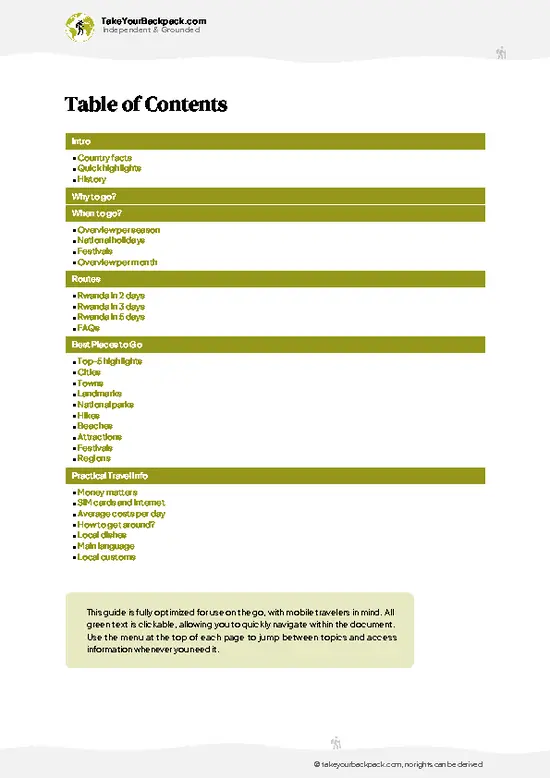
The TakeYourBackpack guidebooks are your all-in-one travel companion, featuring the best cities, national parks, hikes, beaches, and unique sites, along with essential tips on when to go, how to get around, exchanging money, and even local phrases to get you started — everything you need for a smooth, unforgettable backpacking adventure.
Stop researching. Start exploring.Discover all 57 highlights,ranked
and organized into practical routes.
Get instant access
Planning a backpacking route through Rwanda can be tricky — you need to balance must-see places, travel times, budget, and how long to stay in each destination. Our free personalized Rwanda itinerary planner creates a route based on your travel style, trip duration, and interests, so you can spend less time researching and more time exploring.
Personal tip: I normally search on good rating for atmosphere (for meeting people) and location (for easy exploring). Cleanliness as a bonus.
Travel Essentials
For Rwanda, you need a yellow fever vaccination certificate if you arrive from or have transited through a country with yellow fever risk, and the vaccine is widely recommended for all visitors. Make sure your routine vaccines are up to date. Hepatitis A and typhoid are also recommended, and hepatitis B and rabies are worth considering for longer stays or work around animals. Malaria is present below the highland areas, so ask a travel clinic about antimalarial tablets, ideally 4 to 6 weeks before departure.
vaccination requirementsWhen I first started traveling, I often spent part of my first day in a new country hunting for a local SIM card. While this can still be slightly cheaper, it also takes time and planning.
These days, it's much simpler to install an eSIM before leaving home. Once you arrive in Rwanda, you can activate it immediately and have mobile data from the moment you land — which is especially useful for ordering transport or navigating away from busy airports.
There are many providers nowadays, and price differences are usually small. I personally go with
Holafly, as it offers excellent network coverage throughout the country and strong global coverage, so you can manage multiple countries from a single app.
HolaFly eSimCulture & Customs
In Rwanda, avoid asking anyone whether they are Hutu or Tutsi. Ethnic labels are socially taboo and legally sensitive after the 1994 genocide, and the national identity is simply Rwandan. At genocide memorials, dress modestly, keep your voice low and follow any photography rules. Be especially respectful during the commemoration period that starts on April 7. Eating while walking down the street is considered rude, so sit down to eat your snack. Pass and accept things with your right hand, or with both hands as a sign of respect. Never photograph military sites, police, government buildings or people without asking first. Plastic bags are illegal, and littering is frowned upon in a country that prides itself on clean streets. Expect everything to pause during Umuganda, the community work morning on the last Saturday of each month. Modest dress is appreciated, particularly outside Kigali. Public displays of affection are uncommon for any couple and are best avoided, and same-sex couples should be especially discreet.
Trying traditional food is always a great way to experience the culture. Here are some must-try dishes for Rwanda.
- Isombe: Pounded cassava leaves stewed with eggplant, onion and peanut paste or palm oil. It is the most recognizably Rwandan dish on any lunch buffet, and people eat it with rice, plantains or ubugali.
- Brochettes: Grilled skewers of goat, beef or fish, usually served with grilled potatoes or plantains. They are the standard bar food across Rwanda, typically eaten with a cold Primus or Mützig beer.
- Agatogo: A one-pot stew of green plantains (ibitoke) simmered with tomatoes, onions and sometimes meat or fish. It is a filling everyday family meal, and plantains have long been a staple crop here.
- Ubugali: A stiff porridge of cassava or maize flour that you tear off by hand and use to scoop up stews and sauces. It comes as the starchy base for a huge share of home meals.
- Ibihaza: Pumpkin cooked with beans, a soft and slightly sweet side dish. Beans are eaten almost daily in Rwandan homes, so it is a good way to taste ordinary home cooking.
- Akabenz: Spicy fried or grilled pork, nicknamed after the Mercedes-Benz for its supposed luxury status. It is a weekend favorite in local bars, especially in Kigali.
- Ikivuguto: Thick fermented milk, drunk cold. Cattle carry deep cultural weight in Rwanda, and sharing milk has long been a sign of friendship and respect.
- Urwagwa: A traditional banana beer, slightly sour and fairly low in alcohol. It is brewed for ceremonies such as weddings and is shared from a communal pot in rural areas.
Tap water in Rwanda is not considered safe for travelers to drink, and most locals boil or filter it first. Stick to bottled or filtered water, which is sold everywhere. A filter bottle saves money and plastic on longer trips.
The main language in Rwanda is
Kinyarwanda. Backpacking is way more rewarding if you know a bit of the local language, so I'd suggest brushing up on the basics just in case your Kinyarwanda skills have become a bit rusty.
Want to understand locals better?The complete Travel Guide for Rwanda includes 52 essential words and phrases — greetings, thank-yous, ordering food, transport, numbers, and common local expressions you'll actually hear.
Get your local basic phrases 👉
Get the Travel Guide - is spoken well in Kigali, in hostels and at tour operators across Rwanda, and younger people speak it most confidently because the country switched its schools from French to English in 2008. In rural villages, conversations beyond basics are mostly in Kinyarwanda, which almost everyone speaks. French still helps with older, educated Rwandans, and Swahili is useful around markets and with traders. Learn muraho (hello) and murakoze (thank you), and download Kinyarwanda offline in a translation app before you leave the city.
Money & Payments
The local currency of Rwanda is RWF (Frw).
ATMs are easy to find in Kigali and in towns such as Musanze, Rubavu and Huye, with Bank of Kigali, Equity, I&M and Ecobank the most common, though they thin out quickly in rural areas and around the national parks. Visa cards work far more reliably than Mastercard, and local fees typically run around RWF 2,500 to 5,000 per withdrawal on top of whatever your home bank charges, so take out larger amounts less often. Cards are accepted at mid-range and upscale hotels, supermarkets, many Kigali restaurants and for park permits, but buses, markets, moto taxis and small eateries run on cash or MTN Mobile Money. US dollars are the most useful foreign currency to bring, in clean bills printed in 2013 or later, since older or torn notes are often refused or get a worse rate. Euros can also be exchanged in Kigali at a slightly weaker rate. Exchange at banks or licensed forex bureaus in central Kigali rather than with street changers, and keep some Rwandan francs on you before heading out of the capital.
Tipping in Rwanda is not a deep tradition but is appreciated, and rounding up or leaving 5 to 10 percent in sit-down restaurants in Kigali is normal if no service charge has been added. On gorilla and chimpanzee treks, guides and trackers commonly receive around US$10 to 20 per person, and porters are usually tipped on top of their hiring fee. Moto and taxi drivers do not expect a tip beyond the agreed fare.
v2.webp)
 Best Backpacking
.jpg) Over the years, I've learned the importance of packing minimally. It's so much easier to jump on the back of a truck or squeeze yourself into the last spot of a minibus without that supersized backpack. If you're headed to a warm destination, leave your winter jacket at home; for colder regions, opt for thin thermal underlayers. Instead of packing your entire wardrobe, bring just three sets of clothes, as laundry facilities are available everywhere.
Over the years, I've learned the importance of packing minimally. It's so much easier to jump on the back of a truck or squeeze yourself into the last spot of a minibus without that supersized backpack. If you're headed to a warm destination, leave your winter jacket at home; for colder regions, opt for thin thermal underlayers. Instead of packing your entire wardrobe, bring just three sets of clothes, as laundry facilities are available everywhere.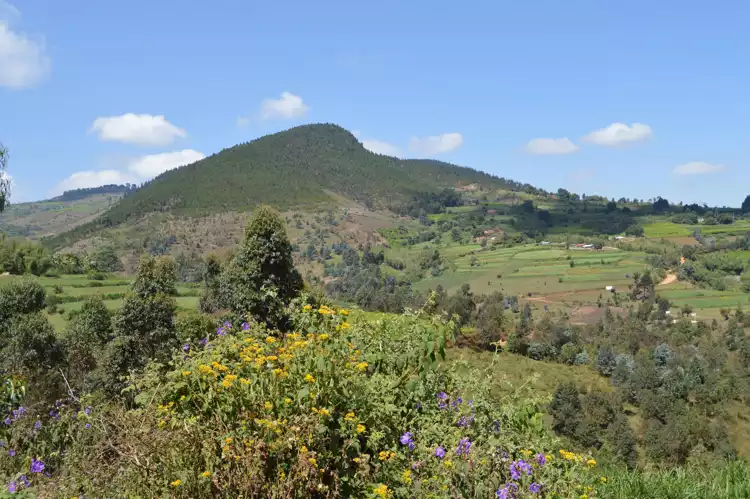




.jpg) Hi, I’m Johan (Netherlands 🇳🇱), the creator of TakeYourBackpack. Over the past 3 decades, I’ve backpacked through 90+ countries across six continents, gaining extensive experience with independent travel, long-term trips, and overland routes.
Hi, I’m Johan (Netherlands 🇳🇱), the creator of TakeYourBackpack. Over the past 3 decades, I’ve backpacked through 90+ countries across six continents, gaining extensive experience with independent travel, long-term trips, and overland routes.