×
Ireland 🇮🇪

backpacking Europe Ireland 🇮🇪Follow winding roads and pub-lit village evenings.

Explore IcelandExplore Italy

Backpacking Ireland in 2026

A complete guide including when and where to go, costs, transport, itineraries, and practical travel advice.
Traveling in Ireland: what to expect

Backpacking Ireland
By Johan Kruseman 🇳🇱 | Updated June 5, 2026

The weather changes its mind every ten minutes, and so will your plans. Forecasts are polite suggestions; locals just grab a jacket and head out. That shrug sets the rhythm here—flexible, quick to laugh, and always ending at a pub.

Come for cliffs that throw spray in your face, peat smoke curling from low-roof cottages, and music that gathers strangers into a chorus by the second round. Stare down the Atlantic from Slieve League, roll the Beara Peninsula, and catch puffins on Skellig Michael when boats are running. Yes, it rains, lanes are tight, manuals rule, and buses thin out beyond town; you’ll get damp, stuck behind sheep, and very good at patience. But the break in the cloud, the turf-fire heat on your shins, and that first pint settling after a squall make it feel earned.

Compared with Scotland’s peaks and whisky swagger, Ireland swaps height for softer folds and easier banter; Wales hoards castles, England does museums, but few mix coastline, chat, and music this well. Ideal for hikers, pub-lovers, and cheerful road-trippers.

👉 Get the 📖 Travel Guide of Ireland

Dublin & Wicklow

Dublin rewards walkers and talkers. You move fast on foot, then stall behind buses and delivery vans, which is fine because the point is pubs, small museums, and long conversations that eat whole afternoons. It’s the best hub—trains and coaches radiate everywhere, and the DART/buses jump you to Bray and Glendalough. Pair city nights with Wicklow days: boardwalk planks, boggy boots, steep pull-ups to wind-battered lookouts. It suits first-timers and weekenders who want easy wins and a guaranteed pint within 200 meters of any failure.

Galway, Connemara & the Aran Islands

Galway is compact, music-heavy, and friendly in a way that keeps you out later than planned. Buses shoot west along the N59, ferries hop from Rossaveal, and everything runs just often enough if you plan, not enough if you wing it. Connemara makes you earn it: Atlantic squalls, peat-scented air, Diamond Hill’s calf-burn payoff, and Sky Road’s wind that rips the cap off your head. The Arans are for slow walkers and stone-wall nerds. Best for travelers who like weather as a character.

Kerry: Killarney & Dingle

Killarney is the rail-in gateway; from the station you can rent a bike and be in the national park in minutes, gliding past lakes and deer while buses unload elsewhere. Dingle takes patience—two buses a day feels like a dare—but the Connor Pass and Slea Head repay with big sea and small pubs. Roads are narrow, tour groups are real, early starts solve most of it. Ideal for cyclists and drivers who can reverse uphill without panic.

Antrim Coast & Belfast

Belfast is candid and energetic, with guides who don’t sugarcoat history. Trains from Dublin are simple; onward Translink links trace the A2 like a bead string. The coast path pounds your legs between basalt and spray, with detours to a rope bridge and a distillery that fixes the chill. Suits urbanists who want heavy stories by day and cliff walks by evening.

Donegal

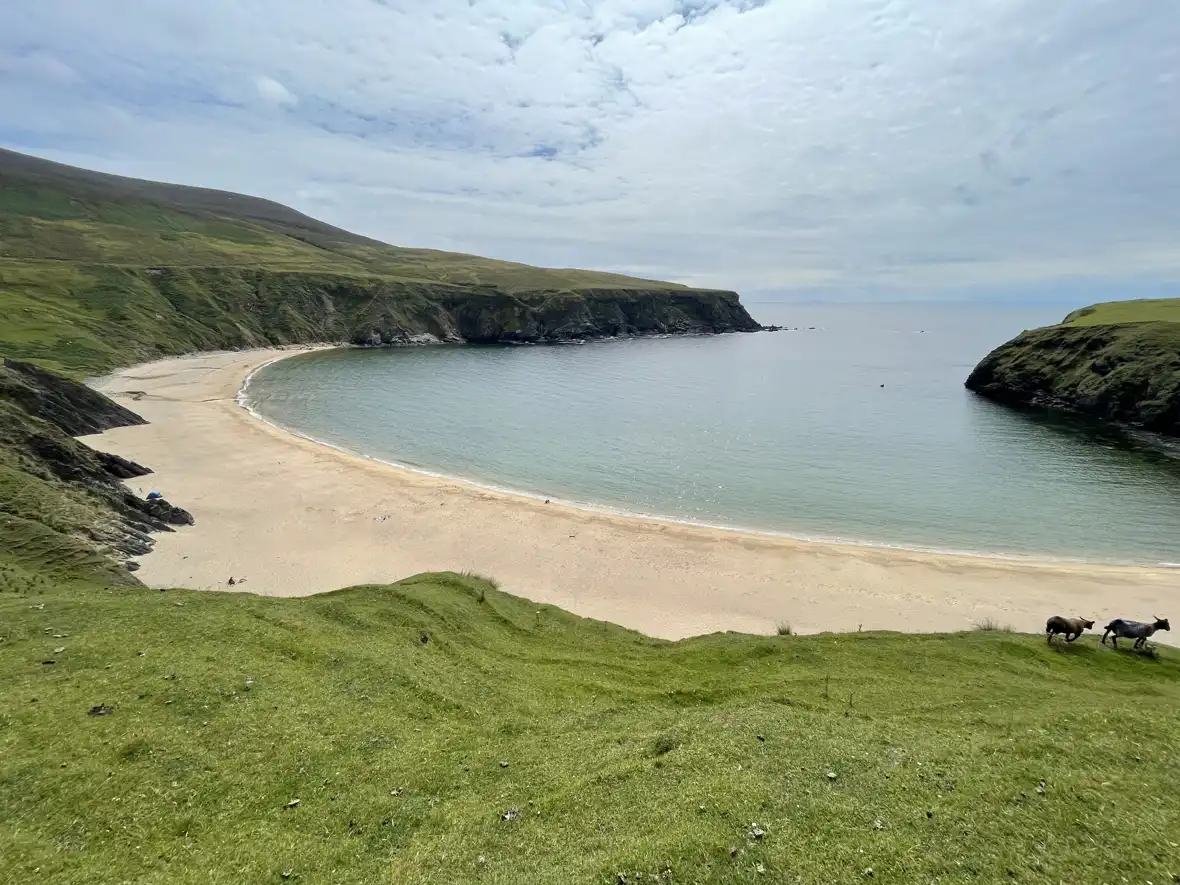
This is where timetables go to die. Buses exist, but a car unlocks Slieve League, Horn Head, and beaches where your footprints last all afternoon. Expect single-track lanes, sheep standoffs, and weather that changes mid-sandwich. The payoff is space and silence—and a peat-fire pint when you finally roll back into a village. For patient drivers and solitude chasers.
A visual overview of the country
Loading the map 🌍
CLICK TO FILTER
city
town
village
unique site
national park
hike
beach
attraction
festival
region
SHOW COUNTRY’S BESTSHOW ALL
film
0
0
0a
Trinity College & The Book of Kells
film
1
1
1a
Guinness Storehouse
film
2
2
2a
Kilmainham Gaol Museum
film
3
3
3a
Rock of Cashel Site Museums & Cathedral Complex
film
4
4
4a
Kylemore Abbey & Victorian Walled Garden
film
5
5
5a
Bunratty Castle & Folk Park
film
6
6
6a
National Gallery of Ireland
film
7
7
7a
National Museum of Ireland – Archaeology
film
8
8
8a
Keem Bay
film
9
9
9a
Dog’s Bay
film
10
10
10a
Inchydoney Beach
film
11
11
11a
Coumeenoole Beach
film
12
12
12a
Ballybunion Beach
Grace O'brien
film
13
13
13a
Curracloe Strand
film
14
14
14a
Inch Beach
film
15
15
15a
Derrynane Beach
film
16
16
16a
Ballymastocker Bay
film
17
17
17a
Lahinch Beach
film
18
18
18a
Banna Strand
film
19
19
19a
Achill Island
Stephen Byrne
film
20
20
20a
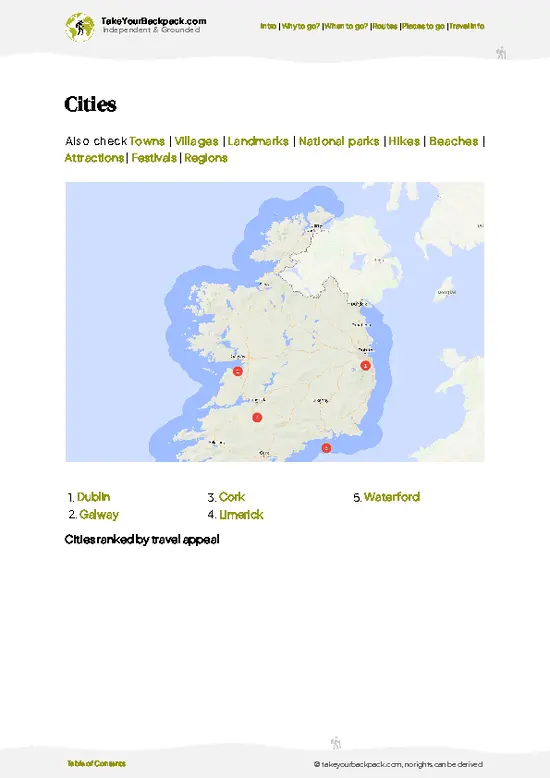
Dublin
Pixabay
film
21
21
21a
Cork
Anne P
film
22
22
22a
Limerick
film
23
23
23a
Donegal
film
24
24
24a
Dingle Way
Pixabay
film
25
25
25a
Wicklow Way
film
26
26
26a
Glendalough
Jelle Hogervorst
film
27
27
27a
Sheep’s Head Way
film
28
28
28a
Burren Way
Ilana Merlis
film
29
29
29a
Killarney
film
30
30
30a
Wicklow Mountains
Keiran Hansen
film
31
31
31a
Connemara
Karan Rao
film
32
32
32a
Glenveagh
Clélia Baudoin (cleliabaudoin_)
film
33
33
33a
Burren
David Heath Williams
film
34
34
34a
Ballycroy
film
35
35
35a
Gougane Barra Forest Park
film
36
36
36a
Lough Boora Parklands
film
37
37
37a
Slieve Bloom Mountains Nature Reserve
film
38
38
38a
Clara Bog Nature Reserve
film
39
39
39a
Wild Atlantic Way
Slobodan Popović
film
40
40
40a
Aran Islands
Louis Thd69
film
41
41
41a
Killarney
film
42
42
42a
Kilkenny
Mark
film
43
43
43a
Bantry
film
44
44
44a
Cobh
Wojtek P
film
45
45
45a
Birr
film
46
46
46a
Westport
film
47
47
47a
Waterford
film
48
48
48a
Sligo
film
49
49
49a
Wexford
film
50
50
50a
Ballina
film
51
51
51a
Ennis
film
52
52
52a
Dungarvan
film
53
53
53a
Cliffs of Moher
Pixabay
film
54
54
54a
Skellig Michael
David
film
55
55
55a
Slieve League
Arjun Nambiar
film
56
56
56a
Birr Castle
Uday Bhandarkar
film
57
57
57a
Lismore Castle
Alan Mahy
film
58
58
58a
Dingle
Chandan Raj
film
59
59
59a
Clifden
Ralph Pina
film
60
60
60a
Kenmare
film
61
61
61a
Inis Meain

Why go?What draws travelers here

People

They clock you fast: wet jacket, lost face, wrong bus stop. Expect a nod, then a joke to shave your … read more 👉
They clock you fast: wet jacket, lost face, wrong bus stop. Expect a nod, then a joke to shave your ego without drawing blood. Bus drivers narrate detours like stand-up. Bartenders remember your order, then your granny’s county. If you can handle slagging, you’re in. The weather is the password; say “grand” and doors open. I’ve been rescued by a farmer who refused petrol money but took a story. Pro tip: stand at the bar, not a corner table; buy the second round. For pure craic, a small-town GAA night beats any city centre.

Scenery

Ireland rewards patience: sideways rain, squelching bog, then a view that shuts you up. One minute it’s … read more 👉
Ireland rewards patience: sideways rain, squelching bog, then a view that shuts you up. One minute it’s mist and sheep; the next Connemara’s quartzite lights up, Lough Corrib flashes silver, and the Atlantic looks freshly sharpened. Climb Croagh Patrick and your calves will complain in four languages, but Clew Bay’s islands pay your debt. Swap the Moher scrum for Slieve League’s quieter cliffs. Duck into the Marble Arch Caves when the sky opens again. Pro tip: pack a cheap plastic bag for dry socks, then earn your pint by the peat fire.

Mountains

Ireland’s mountains aren’t high; they’re honest. Short climbs that go straight up, bog that tries to … read more 👉
Ireland’s mountains aren’t high; they’re honest. Short climbs that go straight up, bog that tries to eat your boots, and weather that cycles through all moods before lunch. But then—Atlantic light on the Twelve Bens, the Reeks ridge running like a backbone, sheep staring as if you owe them rent. Pro tip: skip the Devil’s Ladder on Carrauntoohil; take O’Shea’s Gully and carry actual map and gaiters. I’ve wrung socks in a Wicklow ditch, then earned a pint by a turf fire. Worth every squelch.

Backpackers

Ireland rewards the backpacker who doesn’t mind wet boots and late nights. Distances are short, buses … read more 👉
Ireland rewards the backpacker who doesn’t mind wet boots and late nights. Distances are short, buses hit absurdly remote villages, and hostel kitchens turn into instant crews over pasta and tea. You earn your pint on the Wicklow Way—squelch through bog, crest a pass, then coast downhill to a fire and a Guinness that tastes like finishing line. Pro tip: walk the Doolin-to-Cliffs-of-Moher path and skip the pay-per-view car park; finish in a pub session instead. Pints cost more than in the Balkans, but midweek dorms are fair, and radiators dry socks like saints.

Uniqueness

Ireland earns its remoteness in sideways rain and single-track lanes hemmed by gorse and suspicious … read more 👉
Ireland earns its remoteness in sideways rain and single-track lanes hemmed by gorse and suspicious sheep. You grind up bog roads in Connemara, shoes sucking, and then the Atlantic opens—Slieve League under your boots, spray in your teeth, and you take one careful step back. Pro tip: pick the Beara Peninsula over the Ring of Kerry; same drama, fewer buses. Buses end early anyway. I learned that on Inis Meáin and thumbed a tractor ride to the only pub, where my socks steamed by a peat fire and the first slow-poured pint tasted like rescue.
Want the complete picture of Ireland?
The offline Travel Guide brings everything together — routes, highlights & planning.

See what's included in the guide 👉

Get the Travel Guide -

⭐ HighlightsUnmissable destinations

  • Skellig Michael: The boat from Portmagee bucks like a rodeo and drops you at a stone stairway with no handrail and a lot of sky. Puffins blink at your clumsy ascent; monks’ beehive huts crown the ridge. Proof of presence: salt crust on your jacket and the ripe guano tang riding the wind.
  • Slieve League Cliffs: Park at Bunglass or take the shuttle past the sheep that stare like judges. The wind tries to edit your stride as the Atlantic slams the base 600 meters below. Proof of presence: peat splatter up your calves and lips tasting of spray you never saw coming.
  • Slea Head Drive, Dingle: The loop is technically one-way for buses, practically chaos for rentals, and worth every mirror-clenching corner. You pull over for sheep, for Coumeenoole Beach, for a sky that keeps changing its mind. Proof of presence: sand in your socks and hot chips warming cold hands on a cliff wall.
  • Diamond Hill, Connemara: A tidy loop from Letterfrack that turns feral on the summit ridge when the weather flips. Boardwalk
read more 👉
  • Skellig Michael: The boat from Portmagee bucks like a rodeo and drops you at a stone stairway with no handrail and a lot of sky. Puffins blink at your clumsy ascent; monks’ beehive huts crown the ridge. Proof of presence: salt crust on your jacket and the ripe guano tang riding the wind.
  • Slieve League Cliffs: Park at Bunglass or take the shuttle past the sheep that stare like judges. The wind tries to edit your stride as the Atlantic slams the base 600 meters below. Proof of presence: peat splatter up your calves and lips tasting of spray you never saw coming.
  • Slea Head Drive, Dingle: The loop is technically one-way for buses, practically chaos for rentals, and worth every mirror-clenching corner. You pull over for sheep, for Coumeenoole Beach, for a sky that keeps changing its mind. Proof of presence: sand in your socks and hot chips warming cold hands on a cliff wall.
  • Diamond Hill, Connemara: A tidy loop from Letterfrack that turns feral on the summit ridge when the weather flips. Boardwalk gives way to quartzite steps with bog cotton shivering below and turf smoke drifting from nowhere. Proof of presence: granite grit in your socks and midges orbiting like tiny, relentless satellites.
  • Glendalough’s Spinc Boardwalk: Arrive early or practice patience in the car-park waltz; then the sleepers and steel mesh yank you straight up to a ledge above two dark lakes and a ruined monastery that earns its silence. Proof of presence: resin on your palms from the rail and drizzle beading your eyelashes; off the map, try Beara’s Healy Pass, Achill’s Keem Bay ridge, or Inishbofin’s cliff loop, and my personal favorite is Healy Pass at dusk when the road glows like a blade.
Spotted a mistake or missing a highlight? Contact us.

But Ireland offers more...

Discover and compare all of its highlights per category

🧭 RoutesPlanning a route that makes sense

The 5-Day Southwest Sampler

The vibe: A relaxed, coastal-first escape built around small towns, big Atlantic views, and minimal travel days so you can actually settle in. Perfect if you want Ireland’s southwest highlights without renting a car or sprinting across the country.
  • Killarney as your easygoing base with direct access to Killarney National Park.
  • Dingle’s colorful harbor streets, live music, and local pubs.
  • Wind-whipped walks along the Dingle Peninsula and Coumeenoole Beach.
  • A smooth exit via Tralee without a frantic last-day dash.

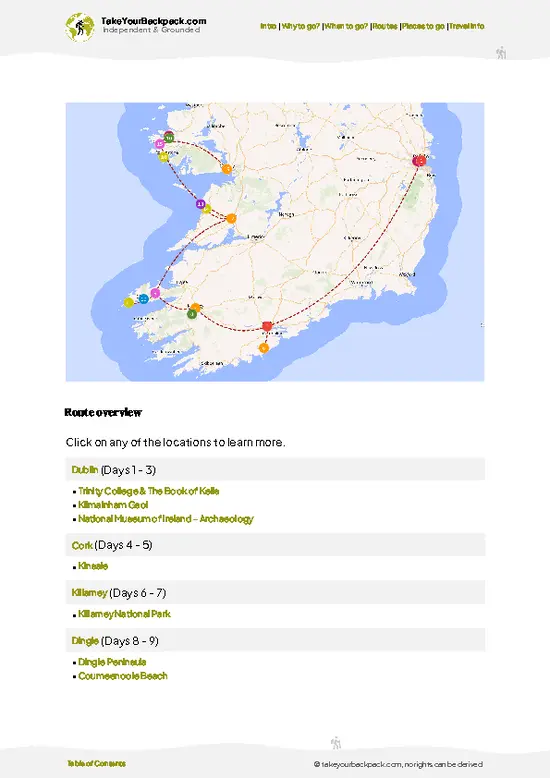
The 10-Day Classic Ireland Loop

The vibe: A balanced first-timer route that threads together Dublin’s culture, Wicklow’s valleys, medieval towns, and the southwest’s lakes and coastline. Ideal if you want a bit of everything—history, hikes, and pub nights—at a steady, unhurried pace.
  • Dublin’s headline sights, from Trinity College & The Book of Kells to the Guinness Storehouse and Kilmainham Gaol Museum.
  • Lakeside walks and monastery ruins around Glendalough in
read more 👉

The 5-Day Southwest Sampler

The vibe: A relaxed, coastal-first escape built around small towns, big Atlantic views, and minimal travel days so you can actually settle in. Perfect if you want Ireland’s southwest highlights without renting a car or sprinting across the country.
  • Killarney as your easygoing base with direct access to Killarney National Park.
  • Dingle’s colorful harbor streets, live music, and local pubs.
  • Wind-whipped walks along the Dingle Peninsula and Coumeenoole Beach.
  • A smooth exit via Tralee without a frantic last-day dash.

The 10-Day Classic Ireland Loop

The vibe: A balanced first-timer route that threads together Dublin’s culture, Wicklow’s valleys, medieval towns, and the southwest’s lakes and coastline. Ideal if you want a bit of everything—history, hikes, and pub nights—at a steady, unhurried pace.
  • Dublin’s headline sights, from Trinity College & The Book of Kells to the Guinness Storehouse and Kilmainham Gaol Museum.
  • Lakeside walks and monastery ruins around Glendalough in Wicklow Mountains National Park.
  • Kilkenny’s medieval streets paired with a day at the Rock of Cashel.
  • Killarney and Killarney National Park as your gateway into the Wild Atlantic Way.

The 15-Day Grand Ireland Circuit

The vibe: A deep-dive journey that loops through capital culture, quiet valleys, historic towns, and both south and west coasts, with time to linger and follow your curiosity. Best for travelers who want the big icons plus the slower, more local moments in between.
  • Dublin in depth, including Trinity, Guinness, Kilmainham, and EPIC The Irish Emigration Museum.
  • Wicklow Mountains National Park and Glendalough as your early nature reset.
  • A southern arc through Kilkenny, Rock of Cashel, Waterford, Cork, Kinsale, and Cobh.
  • A western finale linking Killarney, the Wild Atlantic Way, Dingle, Galway, the Cliffs of Moher, and Connemara National Park.
🌍 Want a ready-to-use travel plan for Ireland?
The overview above compares different route options based on your travel time and style. The complete Travel Guide breaks each itinerary down in detail, including maps, stops, highlights, and transport information.

Explore all route details 👉

Get the Travel Guide -

🌤️ When to go?Choosing the right months to travel

Late May to late June—and again in September—is Ireland’s sweet spot for backpackers. Daylight stretches without the full July-August price hike, ferries and rural buses run their summer schedules, and you’ll share trails with walkers instead of tour coaches. The weather tilts toward workable: showers pass, grass dries in the wind, and you get enough clear windows to commit to longer ridgelines without gambling your whole day. Midges haven’t fully mobilized in May-June and lose their nerve by September, which matters on west-coast bog and lakes. Kids are still in school (or just back), so accommodation doesn’t vanish by 4 p.m., and bar sessions feel local rather than staged. It’s the rare window where your budget, patience, and rain shell stay intact.
  • Peak (Jul-Aug): Prices jump, dorms fill, and the Ring of Kerry becomes a metal centipede. You queue for coffee like it’s a festival. But then you crest the ridge on Slieve League, catch sun on skin you forgot you owned, and your pint at dusk tastes earned because the light hangs around like an old friend.
  • Shoulder (Late May-Jun, Sep): Ferries resume, trails firm up, beer gardens drag out benches, and crowds thin week by week. You move—coast to hill to trad session—without friction. Narrow window: boat landings to Skellig Michael are most reliable now; calm seas and active permits line up if you plan ahead.
  • Off-Peak (Nov-Feb): Grey moods, empty hostels, Atlantic tantrums. The land feels private—peat smoke, silent lanes, ruins to yourself. Survival hack: wool next to skin, a real rain shell, and short-loop hikes you can bail from when gusts turn sidewalks into slipways.

Book key rural beds in the shoulder a few weeks out and bring a pack liner—Irish rain treats “waterproof” as a dare.

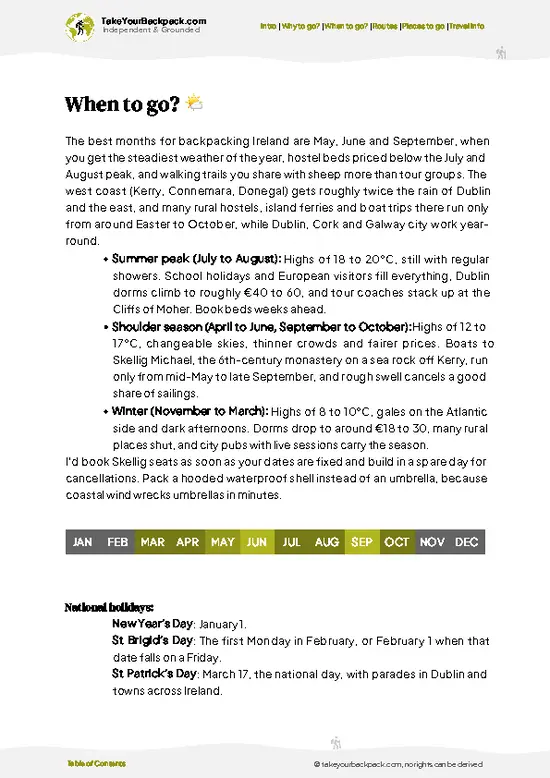
source: climatestotravel.comJANJanuary: fair for travelingFEBFebruary: fair for travelingMARMarch: good for travelingAPRApril: good for travelingMAYMay: highly recommended for travelingJUNJune: excellent for travelingJULJuly: good for travelingAUGAugust: good for travelingSEPSeptember: excellent for travelingOCTOctober: good for travelingNOVNovember: fair for travelingDECDecember: fair for traveling
📅 Traveling in a specific month?
Get a full month-by-month breakdown of weather, crowds, costs, festivals, and seasonal highlights in the complete travel guide.

Get full details when to go 👉

Get the Travel Guide -
!2023-07-25 13.29.15

💰 Costs (as of 2025)Typical budget expectations

€70-€95 per day if you cook, ride buses, and pick your battles with pints; €100+ if you let Dublin weekends run the show.
  • dorm accommodation: €25-€40 outside Dublin most of the year; €40-€65 in Dublin, and €70+ on summer weekends or during festivals. Expect pod bunks with curtains in newer places, creaky triples in older ones. System tip: avoid Friday-Saturday in Dublin, base in a secondary city (Galway, Cork, Kilkenny) midweek, and day-trip—beds are cheaper and kitchens are better. Book direct for last-minute cancellations; I’ve scored a €28 bunk at 10 a.m. when every app said “sold out.”
  • meals: Supermarket Survival: €5-€7 meal deals (sandwich, crisps, drink) from Tesco/Centra; €3 bakery rolls; €1-€2 fruit from Lidl/Aldi; hostel pasta dinner for €2-€4. Street-food reality: trucks and markets are quality but not cheap—€10-€14 for burritos, falafel, or fish-and-chips; pub mains hit €15-€22, add €6-€8 for a pint in Dublin. Ireland is pricier than Spain/Portugal by 20-40%, roughly on par with the UK outside London. Eat your “big meal” at lunch specials or early-bird menus (5-7 p.m.) and you’ll feel clever instead of hungry.
  • local transport: Buses unlock the country cheapest. Intercity promos
read more 👉
€70-€95 per day if you cook, ride buses, and pick your battles with pints; €100+ if you let Dublin weekends run the show.
  • dorm accommodation: €25-€40 outside Dublin most of the year; €40-€65 in Dublin, and €70+ on summer weekends or during festivals. Expect pod bunks with curtains in newer places, creaky triples in older ones. System tip: avoid Friday-Saturday in Dublin, base in a secondary city (Galway, Cork, Kilkenny) midweek, and day-trip—beds are cheaper and kitchens are better. Book direct for last-minute cancellations; I’ve scored a €28 bunk at 10 a.m. when every app said “sold out.”
  • meals: Supermarket Survival: €5-€7 meal deals (sandwich, crisps, drink) from Tesco/Centra; €3 bakery rolls; €1-€2 fruit from Lidl/Aldi; hostel pasta dinner for €2-€4. Street-food reality: trucks and markets are quality but not cheap—€10-€14 for burritos, falafel, or fish-and-chips; pub mains hit €15-€22, add €6-€8 for a pint in Dublin. Ireland is pricier than Spain/Portugal by 20-40%, roughly on par with the UK outside London. Eat your “big meal” at lunch specials or early-bird menus (5-7 p.m.) and you’ll feel clever instead of hungry.
  • local transport: Buses unlock the country cheapest. Intercity promos with Citylink/GoBus/Bus Éireann often run €6-€15 if you book ahead; trains are nicer but usually cost more unless you snag advance fares. In Dublin, grab a Leap Card (or visitor version) for tap-on savings and transfer caps; it’s faster than counting coins while a queue sighs behind you. For rural trailheads, TFI Local Link buses are slow but cheap—good for Connemara, Burren, Wicklow. Car rental only wins if you’re a full car splitting fuel and insurance; solo, it’s a wallet leak with tolls and deposit drama.
  • activities: The big hitters: brewery/distillery tours €18-€30, the Guinness mothership more; day tours (Cliffs, Giants Causeway, Ring of Kerry) €40-€70; Aran Islands ferries €30-€45 return. Castles and heritage sites are usually €5-€12; many museums are free or cheap. Hiking in national parks costs nothing, which is the correct price for rain. Compared to the UK, headline tickets feel similar; compared to Iberia, tours are dearer. If you’ll castle-hop, the Heritage Card pays for itself fast.
  • miscellaneous: Budget leaks: pints (they add up stealthily), coffees at €3-€4, laundry €6-€10 a load, festival surcharges, and late-night taxis when the last bus vanishes. Convenience-store snacks are a trap; buy in supermarkets. Tap water is safe—carry a bottle. Card payments are everywhere; use one with no foreign fees. Weather tax is real: last-minute umbrellas and “emergency” fleece purchases cost more than planning ahead. Personal tip: I once paid €18 for two coffees and a scone in Temple Bar; walk five minutes and it’s half that. Ireland isn’t Scandinavia-expensive, but it’s not Iberia-cheap—budget like the UK and you’ll be fine.
⚠️ Prices can change and everyone travels differently, so take this as a rough guide. Hope it helps you plan your adventure!

✈️ The backpacker research shortcutIreland Travel Guide

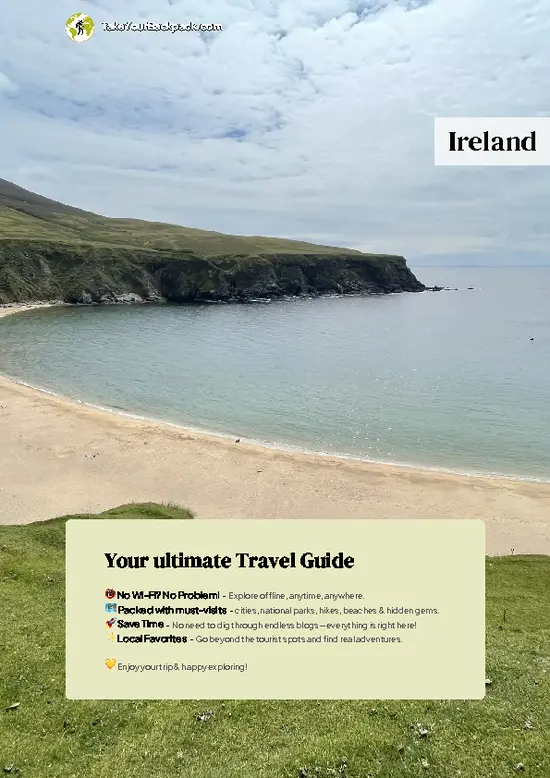
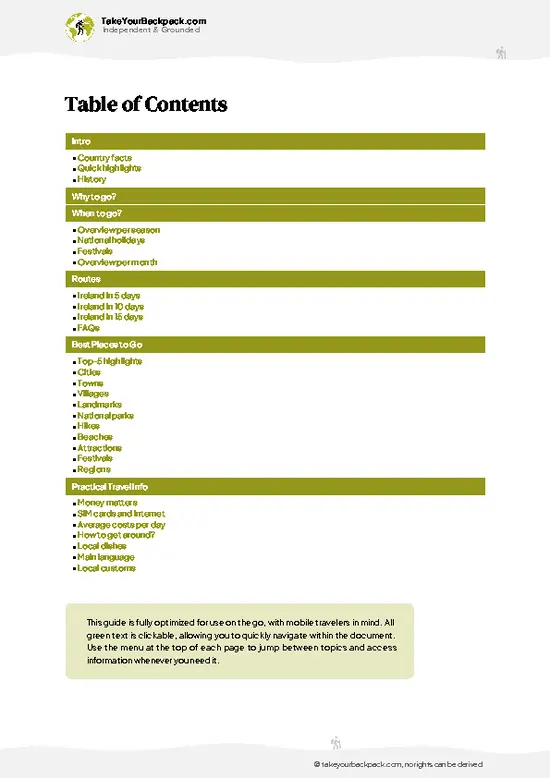
An offline-friendly backpacking guide with optimized travel routes, ranked highlights, transport advice, and the best areas to stay.
example page 0 from our offline Travel Guide for Irelandexample page 1 from our offline Travel Guide for Irelandexample page 2 from our offline Travel Guide for Irelandexample page 3 from our offline Travel Guide for Irelandexample page 4 from our offline Travel Guide for Irelandexample page 5 from our offline Travel Guide for Irelandexample page 6 from our offline Travel Guide for Irelandexample page 7 from our offline Travel Guide for Ireland
The digital guide (378 pages) contains:
104 highlights, ranked by travel appeal
Optimized 5, 10 & 15-day travel routes
Cities, national parks, beaches, historical sites, ...
How to get around
Offline-friendly for travel without Wi-Fi
👉 Click to see all 30+ guide features

📅 Plan smarter in minutes, not weeks
Month by month travel advice
Festivals & national holidays
Budget expectations

🗺️ Go to the right places, skip the overrated ones
Honest pros & cons of destinations
Top hikes, parks & viewpoints
Lesser-known places most travelers miss
Clear “worth it vs skip it” guidance

🛏️ Travel smoothly without rookie mistakes
Best areas to stay
Transport systems explained simply
Common scams & safety advice
SIM cards, money & practical tips

🌍 Understand the country, not just visit it
Culture & traditions
Local customs
Festivals worth planning around
Traveler-friendly historical context
Insights that make places more meaningful

📱 Built for real travel conditions
Fully downloadable PDF
Works completely offline
Optimized for phone use
Useful in remote areas & buses
Everything in one place
Save weeks of stressful planning
Get instant access to the full guide directly. 30-day money-back guarantee.


Sent to your inbox immediately after payment • 100% Secure Checkout
Best Backpacking Travel Advisor 2025 tourism awardBest Backpacking
Travel Advisor
2025
What others say about Take Your Backpack Guides:
⭐⭐⭐⭐⭐
Fantastic, amazing amount of information!
⭐⭐⭐⭐⭐
My goodness this is amazing, it's what I've been looking for hats off too you!
⭐⭐⭐⭐⭐
I think this is absolutely BRILLIANT
⭐⭐⭐⭐
Very complete and informative. It's still missing places, but I gotta to commend you
⭐⭐⭐⭐⭐
This is truly amazing, thank you, can't wait to explore it with my kids!
⭐⭐⭐⭐⭐
Awesome resource, thank you!
⭐⭐⭐⭐⭐
This is amazing! Can't wait to explore the ones I haven't seen
⭐⭐⭐⭐
I love this! Well done, great idea.
⭐⭐⭐⭐⭐
Thanks for taking the time to make this gem!
⭐⭐⭐⭐⭐
This might be the best website I've ever seen.
⭐⭐⭐⭐⭐
Congratulations, and thank you so much for your work; it's incredibly valuable.
⭐⭐⭐⭐
In all seriousness I think you did a great job pointing out the important spots
⭐⭐⭐⭐⭐
10/10 very good
⭐⭐⭐⭐⭐
As someone who's only just starting to visit regularly this is awesome, thank you.
⭐⭐⭐⭐
Thank you very much! I'm going to visit my dad, it's going to be very useful!
⭐⭐⭐⭐⭐
This is really cool! We'll be travelling for the first time and this definitely come in handy.
⭐⭐⭐⭐⭐
You are now our minister of culture, congratulations 👨‍💼
⭐⭐⭐⭐⭐
Just wanted to tell you that this is a pearl! Going to follow your recommendations.
⭐⭐⭐⭐⭐
This is so cool. I'll definitely be using the resource for my travels soon.
⭐⭐⭐⭐⭐
This is very impressive! Good work.
⭐⭐⭐⭐⭐
This is an amazing and informative site. Very well done!

🛏️ Where to stay?Best areas to base yourself

Yes — hostels and budget guesthouses are common across Ireland, with the most options in Dublin, Galway and Cork and strong choices in tourist towns like Killarney and Doolin, so plan city-centre stays for convenience or smaller towns for direct access to attractions.
Dublin city centre/Temple Bar: best transport and sightseeing with heavy nightlife and higher prices; Smithfield/Phibsborough: cheaper and quieter with short tram/bus into town; Galway Latin Quarter: walking distance to pubs and ferries but very busy, while Salthill is quieter and coastal for early departures; Cork centre/Shandon: … read more 👉
Yes — hostels and budget guesthouses are common across Ireland, with the most options in Dublin, Galway and Cork and strong choices in tourist towns like Killarney and Doolin, so plan city-centre stays for convenience or smaller towns for direct access to attractions.
Dublin city centre/Temple Bar: best transport and sightseeing with heavy nightlife and higher prices; Smithfield/Phibsborough: cheaper and quieter with short tram/bus into town; Galway Latin Quarter: walking distance to pubs and ferries but very busy, while Salthill is quieter and coastal for early departures; Cork centre/Shandon: compact and foodie-friendly with quieter outskirts; Killarney town: perfect for National Park access but touristy at night; Doolin/Cliffs area: closest to major sights but has limited beds that fill fast.

If you enjoy meeting fellow travelers, consider choosing hostels with high ratings for atmosphere. On the other hand, if you prefer having your own space, a hotel might be a better option.

🚌 Getting aroundHow to travel within the country

Ireland moves by timetable with a wink. Trains hit their marks better than you’d expect from a rain-soaked island, but nobody pretends it’s Swiss clockwork. Buses fan into the countryside on routes that feel designed by a committee of farmers and saints—reliable if you respect the rhythm, painful if you don’t. The trick is to surf the peaks: early runs, express services, and the occasional wind-battered bike. Earn the miles, then let the first pint of the day taste like victory instead of delay. … read more 👉
Ireland moves by timetable with a wink. Trains hit their marks better than you’d expect from a rain-soaked island, but nobody pretends it’s Swiss clockwork. Buses fan into the countryside on routes that feel designed by a committee of farmers and saints—reliable if you respect the rhythm, painful if you don’t. The trick is to surf the peaks: early runs, express services, and the occasional wind-battered bike. Earn the miles, then let the first pint of the day taste like victory instead of delay.
  • Irish Rail (InterCity) The Efficiency Trade-off: between Dublin and the big four (Cork, Galway, Limerick, Waterford), the train is the clean kill—about 2.5-3 hours, sockets at the seat, and a steady glide that shrugs at weather. Price is the sting: book early and it’s fair; rock up late and you’re paying pub-steak money for a ham sandwich. Cross-country without Dublin gets knotty—expect detours via Limerick Junction or Mallow that make a coach look smarter. Sundays thin the timetable, and the Wi-Fi is more hope than plan, so download before departure.
  • Dublin Bus + Luas The Social Fabric: you queue, you wave the bus like you mean it, you say “Thanks, driver” when you hop off. Upstairs is for quiet opinions, downstairs for prams and practicality. Tap your Leap on boarding the bus (exact cash is a museum piece), tap on/off at Luas platforms or enjoy a polite chat with inspectors. Press the stop button early and move down; blocking the aisle earns you a chorus of patient sighs. After midnight, Nitelink is mobile anthropology: chips, small dramas, and a ride that still gets you home.
  • Intercity Coaches (Citylink/GoBus/Dublin Coach/Bus Éireann Expressway) The Budget Disruptor: the coach beats the train on price nine days out of ten and often on time door-to-door, especially to/from the airport. Galway-Dublin Airport in around 2.5 hours, Cork-Dublin in about 3-3.5 if the gods of roadworks are kind. Book direct for the lowest fare; “express” means business, “all-stops” means stories. Wi-Fi works until the sheep outnumber people. Queue early, sit forward if you’re sensitive to the onboard toilet, and enjoy being dropped right in the town center.
  • Bikes + Greenways The Geometric Unlock: a rental opens the 40-odd km Great Western Greenway to Achill, the Waterford Greenway’s viaducts, and every wild detour buses can’t be bothered with. No timetable, just wind, salt, and legs. Trains take a few bikes with reservations; coaches generally don’t, so commit to the ride. Pack a cheap rain layer, a light, and chain lube; the payoff is rolling into a village for soup and brown bread with the Atlantic still in your teeth.

Personal tactical tip: book the earliest express of the day for your longest leg, and if your route touches Dublin, use the airport coach as your cross-city transfer—it skips the crawl and stitches the country together faster than anything else.
It’s about 10 km (6 mi) from Dublin Airport to the city centre.

Here are the main ways to get in:
  • Dublin Express (routes 782/784) — Direct coach to the city centre (quays/O’Connell Street, some services continue to Heuston).

    Time: roughly 25-45 minutes, longer at rush hour.

    Cost: about €8-€9 one-way, €12-€14 return (online usually cheaper).

    Frequency: very frequent by day, from early morning until late evening.
  • Aircoach 700 — Coach via the city centre toward the south side (also useful if you’re staying near O’Connell/Grafton areas).

    Time: roughly 25-45 minutes to the centre.

    Cost: about €9-€11 one-way online, €14-€17 return (on-board can be a bit more).

    Frequency: runs 24/7; every 15-30 minutes by day, 30-60 minutes overnight.
  • Dublin Bus 16 or 41 — Cheapest option, but makes more stops.

    Time: typically 35-55 minutes.

    Cost: €2.00 with a Leap Card (90-minute fare); cash is higher, around €3.00 (exact change only).

    Notes: Route 41 runs 24/7. Route 16 runs early till late. Expect crowding at peak times.

Small tip: If you’ll be using public transport around Dublin, the TFI Leap Visitor Card (1 day €8, 3 days €16, 7 days €32) can be good value for Dublin Bus/Luas/DART within the city. It doesn’t cover Dublin Express or Aircoach.

Taxi: There’s a large, well-managed taxi rank outside both terminals. To the city centre you’ll typically pay €25-€40, depending on traffic, time of day, and exact destination. Off-peak, it’s about 20-30 minutes; allow 30-60 minutes in rush hour. Card payment is widely accepted.

All buses and coaches pick up just outside Terminals 1 and 2—follow signs for “Buses/Coaches” and look for your operator. Times and fares above are typical and current for 2025.
⚠️ Prices and routes can change, so take this as a rough guide and ask for local advice when you arrive.

🔒 Safety (risk Level: low)Common concerns and things to watch out for

Safety for solo travelers, including women and LGBTQ+ individuals
Ireland is generally safe for solo travelers, including women and LGBTQ+ individuals. The Irish people are known for their friendliness and hospitality, which adds to the welcoming atmosphere for visitors. Like anywhere, stay aware of your surroundings, especially in crowded places or late at night. In urban areas, the LGBTQ+ community is widely accepted, but in rural spots, discretion might be wise.


Full official government travel advisory (live updates)
View details 👉

✈️ VisaDo you need a visa to visit?

Visitors from the EU, UK, US, Canada, Australia, and New Zealand typically do not need a visa for short stays in Ireland. If you’re from a country that requires a visa, apply through the Irish Naturalisation and Immigration Service (INIS) website. Always check the latest requirements before traveling as rules can change.

source: irishimmigration.ie
⚠️ Visa requirements can change over time, so always check the latest visa requirements with the official embassy or government website before you travel.

🎒 What to pack?A practical packing list

If you’re heading to Ireland, prepare for a four-seasons-in-a-day kind of weather. The climate is mostly cool with frequent rain, so think layers and waterproof gear. It’s not all rainbows and leprechauns; you’ll be dealing with rocky coastal paths and rolling hills that can get pretty muddy, so durable footwear is a must. The vibe is generally laid-back, but if you’re planning to hit the pubs or explore Dublin’s nightlife, having something a bit nicer than hiking boots might be handy. And remember, the Irish love a good chat, so be ready to mingle!

Apart from this country specific advice, I have also crafted a general packing list that should help on any trip. authorOver the years, I've learned the importance of packing minimally. It's so much easier to jump on the back of a truck or squeeze yourself into the last spot of a minibus without that supersized backpack. If you're headed to a warm destination, leave your winter jacket at home; for colder regions, opt for thin thermal underlayers. Instead of packing your entire wardrobe, bring just three sets of clothes, as laundry facilities are available everywhere.
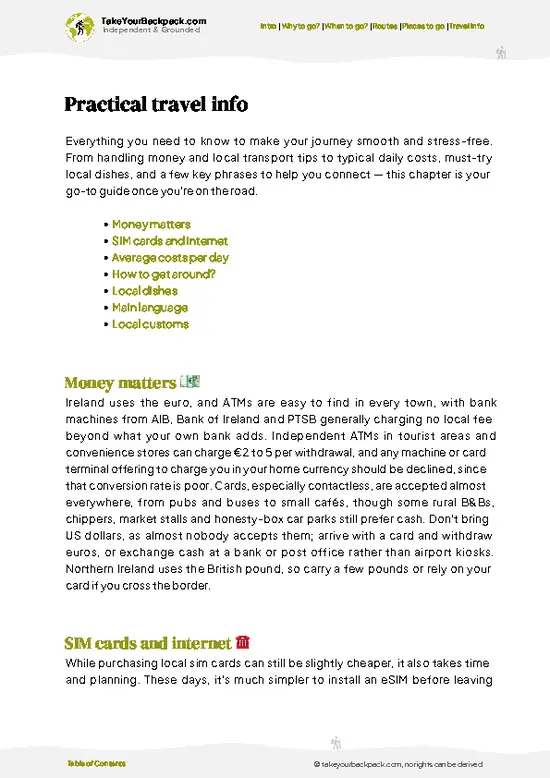
View the full list 👉
🎒 Planning the practical side of your trip?
Get detailed information on transport, daily budgets, internet access, local customs, food, language, and other essentials in the complete Travel Guide.

Get detailed practical information 👉

Get the Travel Guide -

🙋 FAQQuick answers to practical concerns

Trip Planning


Personal tip: I normally search on good rating for atmosphere (for meeting people) and location (for easy exploring). Cleanliness as a bonus.


Travel Essentials

For visiting Ireland, ensure you’re up-to-date on routine vaccines like measles-mumps-rubella (MMR) and diphtheria-tetanus-pertussis. No special vaccinations are needed for most travelers. However, consider flu shots if traveling during flu season. Always check with a healthcare provider for personalized advice.


vaccination requirements
When I first started traveling, I often spent part of my first day in a new country hunting for a local SIM card. While this can still be slightly cheaper, it also takes time and planning.

These days, it's much simpler to install an eSIM before leaving home. Once you arrive in Ireland, you can activate it immediately and have mobile data from the moment you land — which is especially useful for ordering transport or navigating away from busy airports.

There are many providers nowadays, and price differences are usually small. I personally go with Airalo, as it offers excellent network coverage throughout the country and strong global coverage, so you can manage multiple countries from a single app.


Get your e-sim for Ireland

Culture & Customs

Respect personal space—Irish people appreciate it. Punctuality isn’t strict, but a heads-up if running late is appreciated. In pubs, buy a round if it’s your turn—it’s a social norm. Tipping isn’t mandatory but 10% for good service is common. Dress casually in most situations, but smart casual is best for upscale places.

For LGBTQ+ travelers, major cities are generally friendly, but discretion is advised in rural areas. Women can travel safely, but as with anywhere, keep an eye on personal belongings and avoid isolated areas at night.
Trying traditional food is always a great way to experience the culture. Here are some must-try dishes for Ireland.
  • Irish Stew: A hearty and traditional dish made typically with lamb, potatoes, onions, and carrots. It’s the ultimate comfort food, embodying Ireland’s rich agricultural history.
  • Boxty: These are potato pancakes that highlight the love affair between the Irish and their potatoes. Often served with bacon or smoked salmon, they’re a staple in Irish breakfasts.
  • Colcannon: A creamy mash of potatoes mixed with kale or cabbage. It’s a staple side dish that reminds locals of their rural roots and is often enjoyed around Halloween with little prizes hidden inside for good luck.
  • Bacon and Cabbage: A simple dish of boiled bacon served with cabbage and potatoes. This is comfort food at its best, representing the resourcefulness of Irish cooking.
  • Black Pudding: A type of blood sausage, often part of a full Irish breakfast. It’s a taste of the traditional, emphasizing the no-waste approach of Irish cuisine.
Tap water in Ireland is generally safe to drink and locals consume it regularly. However, travelers with sensitive stomachs might prefer bottled or filtered water just to be cautious. In some rural areas, you might want to double-check or opt for bottled water if you’re unsure.
English is widely spoken throughout Ireland, making it easy for travelers to communicate. As the primary language, English is used in everyday life, from signs and menus to conversations. In urban areas like Dublin, Cork, and Galway, you’ll find that most people are fluent, and many have a distinct Irish accent that adds to the charm of the country.

In rural regions, while English remains predominant, you might encounter some Irish (Gaeilge) speakers, particularly in Gaeltacht areas where Irish is the first language. However, even in these regions, English is commonly spoken, and locals are typically very accommodating to English-speaking visitors.

Most Irish people are friendly and eager to help travelers, so you shouldn’t face any significant language barriers. Overall, you can expect a high level of English proficiency throughout Ireland, ensuring a smooth and enjoyable travel experience.

Money & Payments

The local currency of Ireland is EUR (€).

ATMs: Plentiful in cities and towns, but be cautious in rural areas where they can be scarce. Always have some cash handy when heading to the countryside.

Currency: Euro (€) is the currency you need. Leave your dollars at home unless you want to pay exchange fees.

Card Acceptance: Most places accept cards, but small pubs or rural accommodations might be cash-only. It’s always a good idea to ask first.

Cash: Carrying a small amount of cash is wise. €50 should cover you for a day or two if you find yourself in a cash-only spot.

Exchanging Money: Avoid airport exchange counters; they’re notorious for poor rates. Use local banks or ATMs for better rates, but check your bank’s foreign transaction fees first.

Tipping in Ireland isn’t mandatory, but leaving 10-15% in restaurants for good service is appreciated. In pubs, it’s not customary to tip for drinks, though rounding up a taxi fare or leaving a couple of euros for hotel staff is a nice gesture. Always check if a service charge is already included in your bill before tipping.

🧩 Nearby countriesOther countries to combine with Ireland

📸 PhotosWhat it looks like on the ground

Take your backpack - Ireland - 0
Take your backpack - Ireland - 1
Take your backpack - Ireland - 2
Take your backpack - Ireland - 3
Take your backpack - Ireland - 4
Take your backpack - Ireland - 5
Take your backpack - Ireland - 6
Take your backpack - Ireland - 7
Photographed by: Johan Kruseman

We 💚 feedbackIs Ireland worth visiting?

Ireland runs on weather, wit, and tea. You’ll get rained on, then someone will hand you a towel and a story. The streets feel safe, the banter is sharp, and the first pint that settles in two acts makes the drizzle worth it. Big surprise: the food—seafood on the west coast, farmhouse cheese, coffee that would shame capitals. Small warning: driving is slow-motion rallying; hedges bite. The country’s building greenways and beefing up rail/bus lanes—more ways to skip the car and still reach the good stuff.

✈️ When did I visit Ireland?
Ireland was the last country of my 1,5 year travel around the world trip, which was july 2016. In July 2023 I visited Ireland again. While my visit dates back, this guide is continuously refined using feedback from locals and current backpackers (last update: 5 May 2025)

✍️ Help improve this page!
The information on this page is based on my own backpacking experience in Ireland, supplemented with up-to-date research and feedback from other travelers. Travel details can change, so if you notice anything outdated or incomplete, feel free to let me know.


🙋‍♂️ Give feedback

👋 Meet the founderWho’s Behind Take Your Backpack?

Johan, backpacker and founder of TakeYourBackpackHi, I’m Johan (Netherlands 🇳🇱), the creator of TakeYourBackpack. Over the past decade, I’ve backpacked through 80+ countries across six continents, gaining extensive experience with independent travel, long-term trips, and overland routes.

This site is built on a combination of firsthand travel experience and carefully curated insights from other backpackers. Many guides are based on places I’ve personally visited, while others bring together tips, observations, and practical advice shared by trusted travelers I’ve met along the way.

The goal is to provide realistic, experience-driven guidance — not generic itineraries — so you can explore destinations with better context, clearer expectations, and more confidence.

Get full Ireland guide •
Instant download • 104 highlights • Full Offline guide