×
American Samoa 🇦🇸

backpacking Oceania American Samoa 🇦🇸Slow down among rainforest trails and ocean-swum island routines.

Explore United States Virgin IslandsExplore Australia

Backpacking American Samoa in 2026

A complete guide including when and where to go, costs, transport, itineraries, and practical travel advice.
Traveling in American Samoa: what to expect

Backpacking American Samoa
By Johan Kruseman 🇳🇱 | Updated May 29, 2026

You expect a mini‑Hawaii; you land in fierce, family‑first Polynesia draped over volcanic cliffs. It runs on fa‘a Samoa, not resort schedules. U.S. dollars meet village rules, church choirs, and ocean roads that dead‑end in jungle.

Come for knife‑edge ridges above Pago Pago Harbor, coral‑clear Ofu, and a national park that links rain forest, sea cliffs, and real villages. Flying foxes arc at dusk; morning brings canoes and hymns. ‘Aiga buses thump by, taro steams in umu pits, and the sea is the front yard. Flights are few, Sunday slows, modest dress matters, and the heat is real—but that friction keeps the place intact and your days deliberate. Move with respect, ask before you swim or cross a yard, and the welcome deepens.

Samoa next door is smoother and social; Fiji is resort‑rich; Tonga owns the whale swim. American Samoa is rawer, quieter, and cheaper to understand than to consume. It’s for hikers, reef lovers, and culture‑minded travelers who prefer earned moments to packaged ones.

Pago Pago + Harbor Spine (Fagatogo–Utulei)

Base yourself here first. Aīga buses funnel through, cheap lunches at Fagatogo Market, and the National Park office sits in Pago Plaza for maps and village etiquette. Knock out Blunts Point WWII guns at dawn, then the Mt. ‘Alava Ladder from above Utulei before heat builds. Cash is king; ATMs cluster near Tafuna, not up-coast. Rain comes fast—stash a poncho and dry bag.

North Coast Tutuila (Vatia & Mt. ‘Alava)

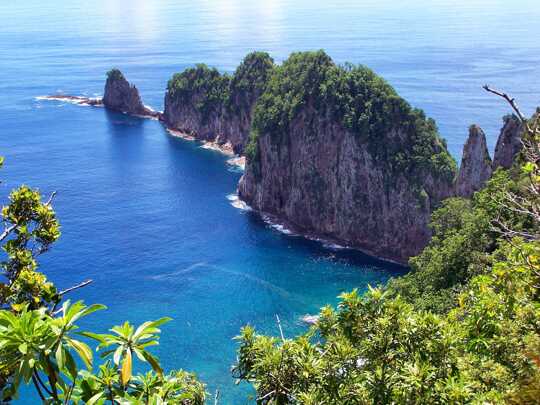
For legs and lungs. The Vatia spur is steep, buses thin after mid-afternoon, and the Pola Island viewpoint gets slick. Carry 2 liters and real tread; ladders and roots punish flimsy shoes. Swim only where locals do—channels rip hard. Ask before crossing village beaches; be off the road by sunset or you’ll be hitching.

West Tutuila & Tafuna Plain (Airport–Leone–Fagatele)

Do your errands here: car rental, SIM, groceries, cash. Then aim for Futiga and the Fagatele Bay rim—inspect swell before committing to the descent; it’s a climb back out. Leone is mellow but strict on Sundays; keep it quiet. Drive slow—kids, dogs, and blind curves are the norm.

Manu‘a Islands (Ta‘u + Ofu–Olosega)

High reward, twitchy logistics. Fly to Ta‘u, boat to Ofu; captains run on local schedules. Buffer two days each side, bring cash and staples, and have lodging locked. Ofu’s reef is unreal when trades ease—snorkel mid-tide, nowhere near passes. On Ta‘u, Mt. Lata is a serious, guide-needed pre-dawn push.

Aunu‘u Islet

Half-day micro-mission. Small boats leave Auasi when seas allow; mornings are calmer. Walk the loop to Pala Lake; stay on the obvious tracks—grey patches act like quicksand. Dress modestly through the village, pack out everything, and aim for an early return before the last boats vanish.
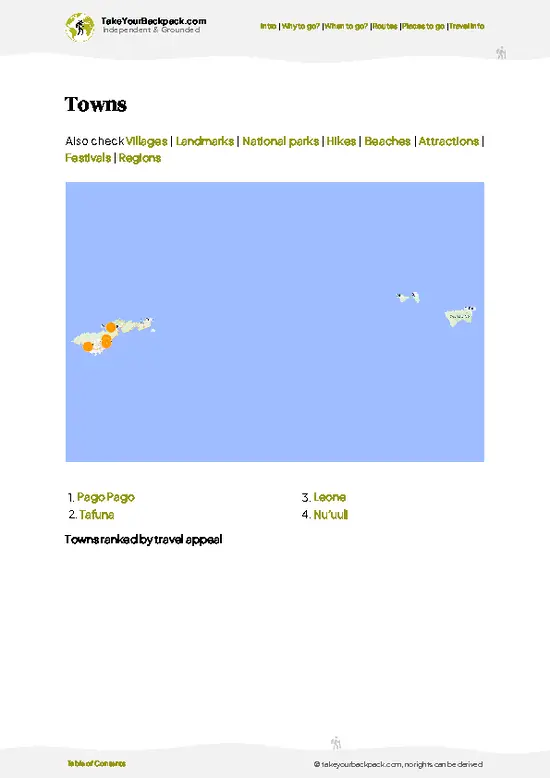
Seeing the layout at a glance
Loading the map 🌍
CLICK TO FILTER
town
village
unique site
national park
hike
beach
attraction
festival
region
SHOW COUNTRY’S BESTSHOW ALL
film
0
0
0a
Jean P. Haydon Museum
film
1
1
1a
Fagatogo Market
film
2
2
2a
Ofu Beach
Avichai Ben- Tzur
film
3
3
3a
Fagatele Bay Beach
Dave Wiltzius
film
4
4
4a
Fagasa Bay
Lucinda Wiley
film
5
5
5a
Tula Beach
Courtney Bohler
film
6
6
6a
Lauli‘i Beach
Katie Fa'aloua
film
7
7
7a
Pala Lagoon
Ruben Stemple
film
8
8
8a
Mount Alava Trail
Alexander Simo
film
9
9
9a
Pola Island Trail
Duggan Family
film
10
10
10a
Lower Sauma Ridge Trail
Alexander Simo
film
11
11
11a
Fagasa Pass
film
12
12
12a
of American Samoa
Sarah Gage-hunt
film
13
13
13a
Aunu’u Island Natural Reserve
film
14
14
14a
Le’ala Shoreline National Natural Landmark
film
15
15
15a
Ofu Island
film
16
16
16a
Pago Pago
Randolfo Santos
film
17
17
17a
Lata Mountain
Lim Joey (joey)
film
18
18
18a
Nu’uuli Falls
film
19
19
19a
Aunu‘u
Mark G

Why go?What makes this country worth the trip

Beach life

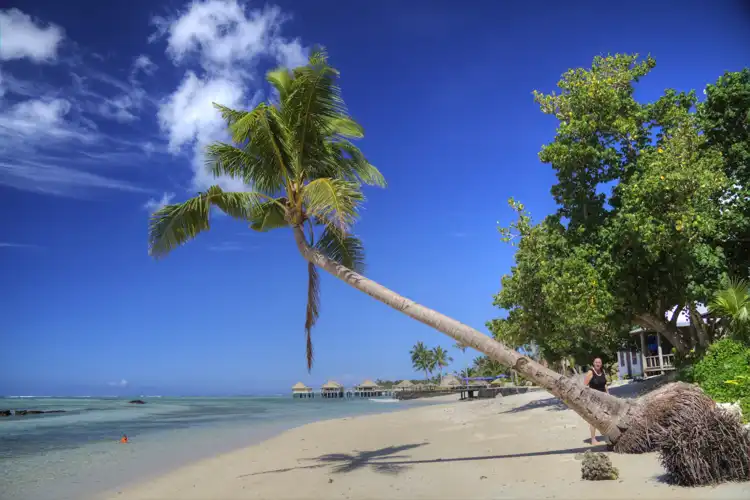
American Samoa is for people who actually use the beach. Volcanic ridges drop into bath‑warm water, and reefs start ten steps from your towel. Ofu’s lagoon hits aquarium‑clear days; drop‑offs, turtles, and blacktips on a lazy … read more 👉
American Samoa is for people who actually use the beach. Volcanic ridges drop into bath‑warm water, and reefs start ten steps from your towel. Ofu’s lagoon hits aquarium‑clear days; drop‑offs, turtles, and blacktips on a lazy drift. You get space—most bays empty, Sundays go quiet by custom—and nights stay low‑key, with bars around Pago when you want one, so the ocean remains the show.

Scenery

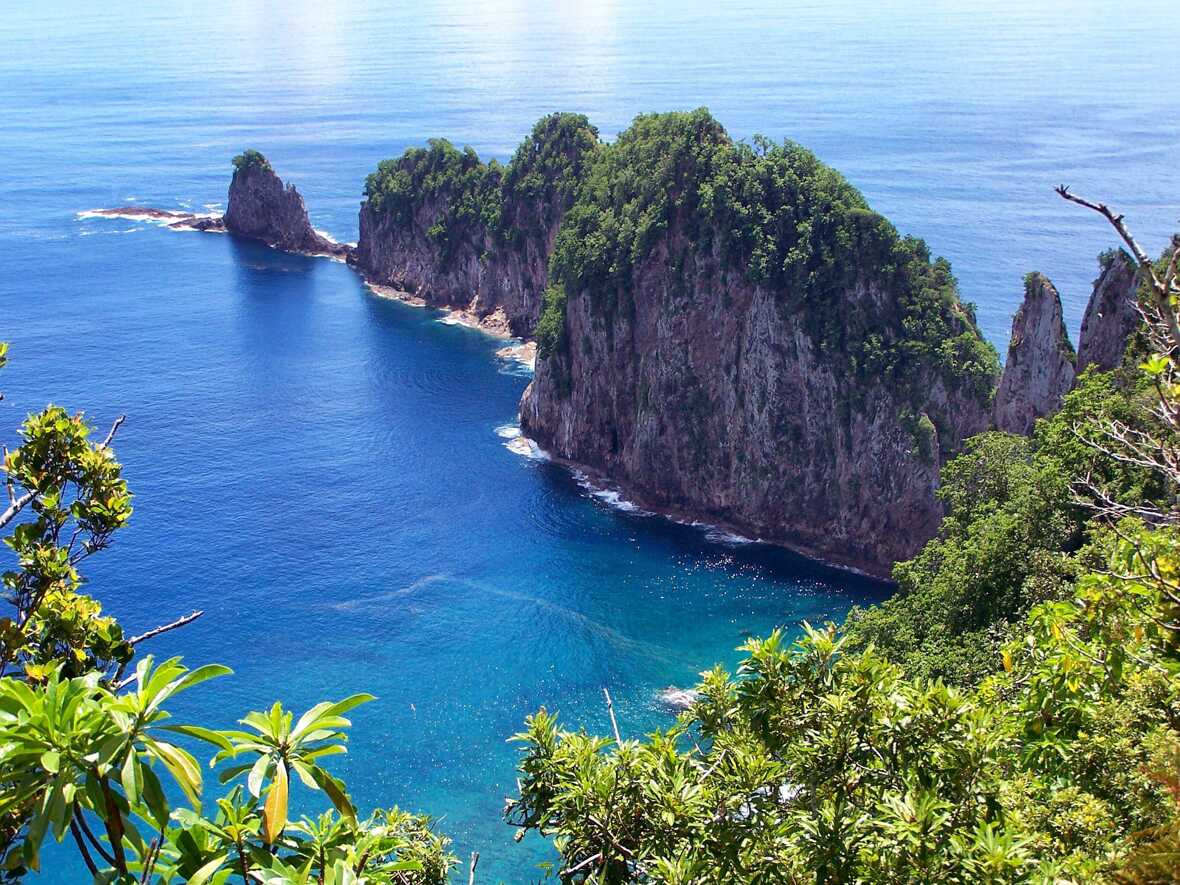
American Samoa pays you back for the flight with raw, volcanic drama. Ridge trails drop to reef flats so clear you count parrotfish from shore. Rainforest hugs knife-edge cliffs; Pola’s sea stacks spear out of Vai’ava Strait. … read more 👉
American Samoa pays you back for the flight with raw, volcanic drama. Ridge trails drop to reef flats so clear you count parrotfish from shore. Rainforest hugs knife-edge cliffs; Pola’s sea stacks spear out of Vai’ava Strait. Hop to Ofu for aquarium‑calm shallows, to Ta‘ū for Lata’s clouded summit, and Aunu‘u’s crater lake and bog. Views everywhere, earned.
Want the complete picture of American Samoa?
The offline Travel Guide brings everything together — routes, highlights & planning.

See what's included in the guide 👉

Get the Travel Guide -

⭐ HighlightsStandout locations across the country

  • Ofu Beach (Manu‘a): You earn this one. Small plane to Ofu or boat from Ta‘ū, then paradise with no stores—bring cash and your own mask. Hit the beach at sunrise when the trades sleep; the lagoon goes glass-calm and the sand squeaks under your heel while parrotfish crunch coral just offshore.
  • Mount Alava Adventure Trail: The ladder route is a sweat tax with a view dividend over Pago Pago Harbor. Start by 6 a.m., gloves help on the slick rungs, and rain turns the clay to soap. Proof you were there: the cold iron of the old tram wheels and the harbor laid out like a map.
  • Pola Island & Vatia Tide Pools: Park before the village, dress modestly, and ask before crossing the beach—respect travels fast here. Time it for a falling tide; the pools clear and the swell behaves. Frigatebirds knife the wind above as salt spray thumps the cliff face.
  • Aunu‘u Island: Cash-only skiffs run from Auasi in the morning and quit by late afternoon—don’t miss the last one. Circle the crater lake and skirt the Taufusi
read more 👉
  • Ofu Beach (Manu‘a): You earn this one. Small plane to Ofu or boat from Ta‘ū, then paradise with no stores—bring cash and your own mask. Hit the beach at sunrise when the trades sleep; the lagoon goes glass-calm and the sand squeaks under your heel while parrotfish crunch coral just offshore.
  • Mount Alava Adventure Trail: The ladder route is a sweat tax with a view dividend over Pago Pago Harbor. Start by 6 a.m., gloves help on the slick rungs, and rain turns the clay to soap. Proof you were there: the cold iron of the old tram wheels and the harbor laid out like a map.
  • Pola Island & Vatia Tide Pools: Park before the village, dress modestly, and ask before crossing the beach—respect travels fast here. Time it for a falling tide; the pools clear and the swell behaves. Frigatebirds knife the wind above as salt spray thumps the cliff face.
  • Aunu‘u Island: Cash-only skiffs run from Auasi in the morning and quit by late afternoon—don’t miss the last one. Circle the crater lake and skirt the Taufusi marsh; the “quicksand” patches are real. Volcanic cinders crunch underfoot and breadfruit smoke hangs in the air.
  • Vaitogi “Turtle and Shark” Cliffs: Go late day for side light on the black lava, but stand well back—sets hit without warning. No swimming, no drones over homes, and Sundays are for church. The basalt radiates heat through your soles while the spray salts your lips; for off-the-map, try Fogama‘a (Larsen) Bay by rough 4WD track, the Blunts Point WWII guns above Utulei, and the Amalau pullout at dusk when fruit bats rise.
Spotted a mistake or missing a highlight? Contact us.

But American Samoa offers more...

Discover and compare all of its highlights per category

🧭 RoutesLogical itineraries covering the highlights

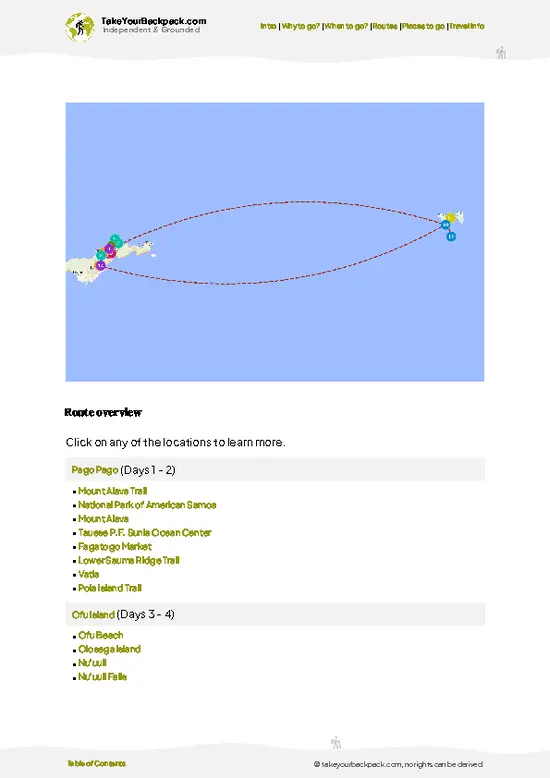
The 2-Day Harbor & Highlands Sprint

The Vibe: A quick-hit escape that anchors you in Pago Pago’s harbor life, then launches you up into the National Park ridges for big views and village time without ever feeling rushed. Perfect if you want maximum scenery and culture in a single, easy base using taxis and short local bus rides.
The Highlights:
  • Harbor walks and cultural context in Pago Pago and Fagatogo
  • Local color and food at Fagatogo Market
  • Rainforest ridge hiking on the Mount Alava Trail to Mount Alava
  • Quiet bay time in the village of Vatia inside the National Park

The 3-Day Tutuila Peaks & Bays Route

The Vibe: A balanced loop around Tutuila that mixes harbor culture, big viewpoints, and wild coastline at a moderate pace, with time for both museums and muddy boots. Ideal if you want to understand the island’s shape—from ridge to reef—without jumping to the outer islands.
The Highlights:
  • Cultural grounding at the Jean P. Haydon Museum and Tauese P.F. Sunia Ocean Center
  • Ridge-and-peak time on the
read more 👉

The 2-Day Harbor & Highlands Sprint

The Vibe: A quick-hit escape that anchors you in Pago Pago’s harbor life, then launches you up into the National Park ridges for big views and village time without ever feeling rushed. Perfect if you want maximum scenery and culture in a single, easy base using taxis and short local bus rides.
The Highlights:
  • Harbor walks and cultural context in Pago Pago and Fagatogo
  • Local color and food at Fagatogo Market
  • Rainforest ridge hiking on the Mount Alava Trail to Mount Alava
  • Quiet bay time in the village of Vatia inside the National Park

The 3-Day Tutuila Peaks & Bays Route

The Vibe: A balanced loop around Tutuila that mixes harbor culture, big viewpoints, and wild coastline at a moderate pace, with time for both museums and muddy boots. Ideal if you want to understand the island’s shape—from ridge to reef—without jumping to the outer islands.
The Highlights:
  • Cultural grounding at the Jean P. Haydon Museum and Tauese P.F. Sunia Ocean Center
  • Ridge-and-peak time on the Mount Alava Trail and in the National Park of American Samoa
  • North-coast drama around Vatia and the Pola Island Trail
  • West-side history and reef protection at Leone and Fagatele Bay National Marine Sanctuary

The 5-Day Tutuila & Manu‘a Explorer

The Vibe: A deeper dive that starts with Pago Pago’s harbor and Tutuila’s ridges, then pushes out to the quieter Manu‘a Islands for reef-fringed beaches and high volcanic peaks. Best for travelers who want both the social energy of the main island and the slow, remote feel of outer-island life.
The Highlights:
  • Harbor culture and markets in Pago Pago and Fagatogo
  • National Park hiking around Mount Alava, Vatia, and west Tutuila’s protected shoreline
  • Marine sanctuary time at Fagatele Bay National Marine Sanctuary and nearby coast
  • Outer-island escapes on Ofu Island, Ofu Beach, Olosega Island, and the high presence of Lata Mountain near Ta’u Island
🌍 Want a ready-to-use travel plan for American Samoa?
The overview above compares different route options based on your travel time and style. The complete Travel Guide breaks each itinerary down in detail, including maps, stops, highlights, and transport information.

Explore all route details 👉

Get the Travel Guide -

🌤️ When to go?A month-by-month overview

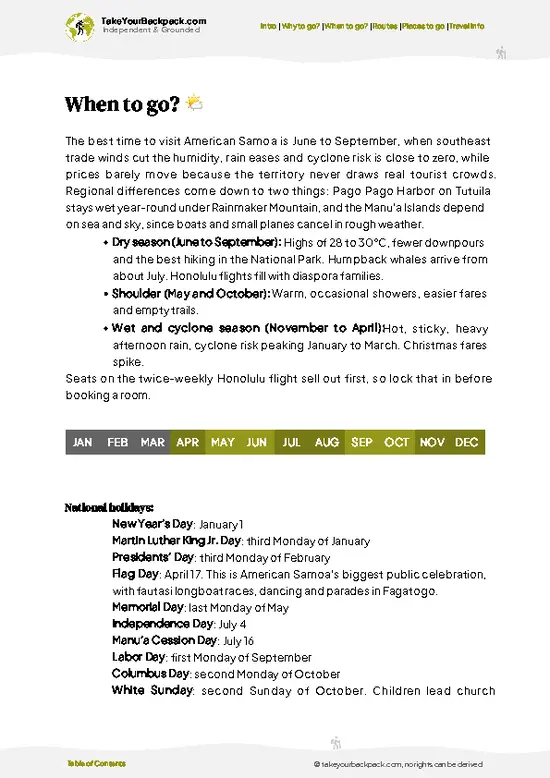
Late May-June and September-October are the sweet spot. Trades are steady, showers brief, trails finally hold grip, and cyclones are off the board. Heat still bites, but the breeze dulls it; mosquitoes ease; reef visibility improves; interisland boats cancel less. Prices sit below July-August and holiday homecoming surges, and you won’t be fighting for the last rental car. September adds whale song offshore and dry ridges that don’t eat your shoes.
  • Peak Dry (Jul-Aug, late Dec): Prices climb and seats vanish, but you get laser-clear reefs, reliable boats, and hardpack ridges to Alava and Rainmaker that pay out with huge horizons. It’s a grind; it’s also the classic payoff.
  • Shoulder (late May-June, Sep-Oct): Rains back off, mud tightens, locals shift from holiday mode to routine, ferries and shops keep regular hours, and you move faster with fewer detours.
  • Wet/Cyclone Core (Jan-Mar): Skies hang low, waterfalls roar, trails empty. Start at first light, carry a silnylon tarp and dry bags, and treat feet aggressively—maceration, not cliffs, ends trips here.

Book the Honolulu-PPG hop at least a month out and reserve a car the same day; fleets are tiny and last-minute storms or church weekends wipe inventory.

source: climatestotravel.comJANJanuary: fair for travelingFEBFebruary: fair for travelingMARMarch: fair for travelingAPRApril: good for travelingMAYMay: highly recommended for travelingJUNJune: highly recommended for travelingJULJuly: good for travelingAUGAugust: good for travelingSEPSeptember: highly recommended for travelingOCTOctober: highly recommended for travelingNOVNovember: good for travelingDECDecember: good for traveling
📅 Traveling in a specific month?
Get a full month-by-month breakdown of weather, crowds, costs, festivals, and seasonal highlights in the complete travel guide.

Get full details when to go 👉

Get the Travel Guide -
american-samoa-pixabay-113759

💰 Costs (as of 2025)Typical budget expectations

$65-95/day on Tutuila if you ride the buses and eat local; any hop to the Manu’a islands can push you to $150+.
  • dorm accommodation: True hostels are rare; think “simple guesthouse” territory. Expect $35-60 for a basic room, $20-35 per person if you score church/mission lodging; hotels jump to $120-180. System: arrive Tue-Thu, ask the National Park office or a pastor for church guesthouse leads, request the weekly rate, and pay cash—$10-15 usually falls off. Bring a sheet; AC sometimes costs extra.
  • meals: Supermarket Survival: Cost-U-Less/KS Mart runs keep you to $7-12/day (tuna, PB&J, bananas, ramen, local bread). Street food reality: plate lunches and BBQ stalls are $7-12, bakery snacks $1-3, sit-down plates $12-18. Relative value: 30-50% pricier than independent Samoa, roughly half the damage of Hawaii if you avoid restaurants.
  • local transport: The aiga buses are your key—$1-2 per ride, Mon-Sat from early morning to ~6 pm; thin on evenings, near-zero on Sundays. Flag them anywhere; pay on exit. Airport by bus is pocket change; by taxi $20-30. Hitching is normal and friendly in daylight; offer a couple dollars if someone detours. For two or more, a one-day car rental ($60-80) unlocks
read more 👉
$65-95/day on Tutuila if you ride the buses and eat local; any hop to the Manu’a islands can push you to $150+.
  • dorm accommodation: True hostels are rare; think “simple guesthouse” territory. Expect $35-60 for a basic room, $20-35 per person if you score church/mission lodging; hotels jump to $120-180. System: arrive Tue-Thu, ask the National Park office or a pastor for church guesthouse leads, request the weekly rate, and pay cash—$10-15 usually falls off. Bring a sheet; AC sometimes costs extra.
  • meals: Supermarket Survival: Cost-U-Less/KS Mart runs keep you to $7-12/day (tuna, PB&J, bananas, ramen, local bread). Street food reality: plate lunches and BBQ stalls are $7-12, bakery snacks $1-3, sit-down plates $12-18. Relative value: 30-50% pricier than independent Samoa, roughly half the damage of Hawaii if you avoid restaurants.
  • local transport: The aiga buses are your key—$1-2 per ride, Mon-Sat from early morning to ~6 pm; thin on evenings, near-zero on Sundays. Flag them anywhere; pay on exit. Airport by bus is pocket change; by taxi $20-30. Hitching is normal and friendly in daylight; offer a couple dollars if someone detours. For two or more, a one-day car rental ($60-80) unlocks trailheads and quiet coves; split it and you beat taxis.
  • activities: Hiking in the National Park is free; donations welcome. Aunu’u boat is pocket money. Snorkel gear $10-15/day. Diving runs $120-160 for two tanks. The cost grenade: inter-island flights to Manu’a (and scarce rooms once there). Fishing charters are US-priced; skip unless it’s your priority.
  • miscellaneous: Budget leaks: ATM fees ($3-5), 3% card surcharges, 5-8% tax, late-night taxis when buses stop, Sunday closures forcing restaurant spends, bottled water. Beer: bar $4-6, six-pack $11-14—higher than Samoa, far lower than Hawaii. Local SIM/data isn’t cheap; preload offline maps and stash Wi-Fi passwords.
⚠️ Prices can change and everyone travels differently, so take this as a rough guide. Hope it helps you plan your adventure!

✈️ The backpacker research shortcutAmerican Samoa Travel Guide

An offline-friendly backpacking guide with optimized travel routes, ranked highlights, transport advice, and the best areas to stay.
example page 0 from our offline Travel Guide for American Samoaexample page 1 from our offline Travel Guide for American Samoaexample page 2 from our offline Travel Guide for American Samoaexample page 3 from our offline Travel Guide for American Samoaexample page 4 from our offline Travel Guide for American Samoaexample page 5 from our offline Travel Guide for American Samoaexample page 6 from our offline Travel Guide for American Samoaexample page 7 from our offline Travel Guide for American Samoa
The digital guide (162 pages) contains:
37 highlights, ranked by travel appeal
Optimized 2, 3 & 5-day travel routes
Cities, national parks, beaches, historical sites, ...
How to get around
Offline-friendly for travel without Wi-Fi
👉 Click to see all 30+ guide features

📅 Plan smarter in minutes, not weeks
Month by month travel advice
Festivals & national holidays
Budget expectations

🗺️ Go to the right places, skip the overrated ones
Honest pros & cons of destinations
Top hikes, parks & viewpoints
Lesser-known places most travelers miss
Clear “worth it vs skip it” guidance

🛏️ Travel smoothly without rookie mistakes
Best areas to stay
Transport systems explained simply
Common scams & safety advice
SIM cards, money & practical tips

🌍 Understand the country, not just visit it
Culture & traditions
52 Essential phrases & customs
Festivals worth planning around
Traveler-friendly historical context
Insights that make places more meaningful

📱 Built for real travel conditions
Fully downloadable PDF
Works completely offline
Optimized for phone use
Useful in remote areas & buses
Everything in one place
Save weeks of stressful planning
Get instant access to the full guide directly. 30-day money-back guarantee.


Sent to your inbox immediately after payment • 100% Secure Checkout
Best Backpacking Travel Advisor 2025 tourism awardBest Backpacking
Travel Advisor
2025
What others say about Take Your Backpack Guides:
⭐⭐⭐⭐⭐
Fantastic, amazing amount of information!
⭐⭐⭐⭐⭐
My goodness this is amazing, it's what I've been looking for hats off too you!
⭐⭐⭐⭐⭐
I think this is absolutely BRILLIANT
⭐⭐⭐⭐
Very complete and informative. It's still missing places, but I gotta to commend you
⭐⭐⭐⭐⭐
This is truly amazing, thank you, can't wait to explore it with my kids!
⭐⭐⭐⭐⭐
Awesome resource, thank you!
⭐⭐⭐⭐⭐
This is amazing! Can't wait to explore the ones I haven't seen
⭐⭐⭐⭐
I love this! Well done, great idea.
⭐⭐⭐⭐⭐
Thanks for taking the time to make this gem!
⭐⭐⭐⭐⭐
This might be the best website I've ever seen.
⭐⭐⭐⭐⭐
Congratulations, and thank you so much for your work; it's incredibly valuable.
⭐⭐⭐⭐
In all seriousness I think you did a great job pointing out the important spots
⭐⭐⭐⭐⭐
10/10 very good
⭐⭐⭐⭐⭐
As someone who's only just starting to visit regularly this is awesome, thank you.
⭐⭐⭐⭐
Thank you very much! I'm going to visit my dad, it's going to be very useful!
⭐⭐⭐⭐⭐
This is really cool! We'll be travelling for the first time and this definitely come in handy.
⭐⭐⭐⭐⭐
You are now our minister of culture, congratulations 👨‍💼
⭐⭐⭐⭐⭐
Just wanted to tell you that this is a pearl! Going to follow your recommendations.
⭐⭐⭐⭐⭐
This is so cool. I'll definitely be using the resource for my travels soon.
⭐⭐⭐⭐⭐
This is very impressive! Good work.
⭐⭐⭐⭐⭐
This is an amazing and informative site. Very well done!

🛏️ Where to stay?Choosing the right base for your trip

Yes — American Samoa has hostel-style guesthouses and low-cost lodging, mainly on Tutuila island, concentrated in Pago Pago/Fagatogo and Tafuna near the airport, with a few budget options in Leone and other villages.
Pago Pago/Fagatogo: central and closest to ferries, shops and cultural sites but slightly pricier and busier with limited nightlife; Tafuna: cheapest and easiest for arrivals with more local dining but farther from beaches and trails so a car or taxi is practical; Leone: quiet and closer to western beaches and cultural sites but services and accommodation choices are very limited … read more 👉
Yes — American Samoa has hostel-style guesthouses and low-cost lodging, mainly on Tutuila island, concentrated in Pago Pago/Fagatogo and Tafuna near the airport, with a few budget options in Leone and other villages.
Pago Pago/Fagatogo: central and closest to ferries, shops and cultural sites but slightly pricier and busier with limited nightlife; Tafuna: cheapest and easiest for arrivals with more local dining but farther from beaches and trails so a car or taxi is practical; Leone: quiet and closer to western beaches and cultural sites but services and accommodation choices are very limited so book ahead.

If you enjoy meeting fellow travelers, consider choosing hostels with high ratings for atmosphere. On the other hand, if you prefer having your own space, a hotel might be a better option.

🚌 Getting aroundTransportation options and logistics

American Samoa moves on church bells and trade winds, not timetables. The spine road wakes at dawn, naps at noon, and quits near dusk. Buses thump island pop, stop where you point, and vanish on Sundays. Inter-island links obey weather and paperwork before your ambitions. Ride the morning pulse and accept that cargo outranks you: ports in Fagatogo, the airport in Tafuna, and villages stitched by one relentless lane.
  • ‘Aiga buses (Tutuila) Climb in, greet with “Talofa,” and keep small bills ready;
read more 👉
American Samoa moves on church bells and trade winds, not timetables. The spine road wakes at dawn, naps at noon, and quits near dusk. Buses thump island pop, stop where you point, and vanish on Sundays. Inter-island links obey weather and paperwork before your ambitions. Ride the morning pulse and accept that cargo outranks you: ports in Fagatogo, the airport in Tafuna, and villages stitched by one relentless lane.
  • ‘Aiga buses (Tutuila) Climb in, greet with “Talofa,” and keep small bills ready; you pay when you step off. Flag anywhere, say your stop early, and surrender your seat to elders. Fares are pocket change (think US$1-3), service runs sunrise to sunset, and nearly dies on Sunday. No food, no beachwear. The music is loud; the vibe is gentle.
  • Inter-island flights to Manu‘a Thirty minutes in the air beats a day wrestling the sea, but you’ll pay several times the ferry and your bag weight will be policed. Book the earliest flight for calmer winds and fewer cancellations. Leave a buffer day on both ends; rollovers happen.
  • Government ferry to Manu‘a When planes blink, this boat makes the geometry work: it actually reaches Ta‘ū and Ofu. Tickets are priced in tens, not hundreds. Sign up at Port Administration in Fagatogo, expect schedules to slip, cargo to load first, and 4-6 hours if seas behave. Bring shade, snacks, and seasickness pills.
  • Hitchhiking Stand on the main road, palm down, and you’ll often ride a pickup bed within minutes. Offer a couple dollars for long hops; many refuse, thank them anyway (“fa‘afetai”). Daylight only, avoid church hours, and bail early if a ride feels off.

Master tip: Move at first light—first ‘aiga bus to Fagatogo/Tafuna, target morning inter-island departures, carry small bills, and never schedule a critical hop on Sunday.
Distance
Pago Pago International Airport (PPG) in Tafuna is about 11 km (7 miles) west of the Pago Pago/Fagatogo waterfront, which is the practical “city center.”

Main ways to get there
  • Aiga bus (public minibus) — The colorful privately run buses serve the main road right outside the airport. Look for ones marked “Pago Pago,” “Fagatogo,” or “Utulei.” Flag them down and pay the driver in cash (USD) when you get off.

    Time: 25-45 minutes, depending on stops and traffic

    Cost: about $1-$2.50 per person

    Hours: roughly 6:00-18:00 Mon-Sat; very limited on Sundays and evenings
  • Hotel/guesthouse transfer (pre-booked) — Some properties will arrange a pickup if you ask in advance.

    Time: 20-30 minutes

    Cost: typically $10-$20 per person (check with your accommodation)
  • Rental car — A few local agencies operate near the airport. Good if you plan to explore the island.

    Time: 20-25 minutes to downtown once you’ve got the keys

    Cost: around $65-$90 per day, plus fuel

Taxis
Taxis are available outside the terminal, but there’s no meter. Confirm the price before you go. Expect about $20-$30 for the ride to the Pago Pago/Fagatogo area; travel time is 20-25 minutes. Cash only.

Good to know
- No Uber/Lyft in American Samoa. If you land late, buses may not be running, so arrange a taxi or hotel pickup in advance.
- Buses stop on request; just wave them down and press the button or tell the driver when you want to get off.
⚠️ Prices and routes can change, so take this as a rough guide and ask for local advice when you arrive.

🔒 Safety (risk Level: low)Safety considerations for travelers

Safety for solo travelers, including women and LGBTQ+ individuals
American Samoa is generally safe for solo travelers, including women and LGBTQ+ individuals, but always exercise common sense. The local culture is conservative, so modest dress and respectful behavior are advised. LGBTQ+ travelers should be aware that while the community is not widely visible, they are usually treated with tolerance. Familiarize yourself with local customs to ensure a smooth, respectful visit.

✈️ VisaWhat travelers should know about visas

U.S. citizens don’t need a visa to visit American Samoa, but a valid passport is required. Non-U.S. citizens might need a visa, and it’s best to check with the nearest U.S. embassy or consulate for specific requirements. For quick info, visit the U.S. State Department’s website and search for travel details related to American Samoa.

source: doi.gov
⚠️ Visa requirements can change over time, so always check the latest visa requirements with the official embassy or government website before you travel.

🎒 What to pack?What you'll need while traveling

American Samoa’s got that tropical vibe, so be ready for hot and humid weather with a healthy chance of rain. You’ll find yourself exploring beaches, jungles, and some pretty hilly terrain, so consider that when planning your adventures. Keep in mind, it’s a bit more conservative here, so pack modest clothing—think lightweight and breathable but respectful. If you’re planning to visit any churches, covering shoulders and knees is a must. Lastly, don’t forget to respect the local culture while enjoying the stunning landscapes.

Apart from this country specific advice, I have also crafted a general packing list that should help on any trip. authorOver the years, I've learned the importance of packing minimally. It's so much easier to jump on the back of a truck or squeeze yourself into the last spot of a minibus without that supersized backpack. If you're headed to a warm destination, leave your winter jacket at home; for colder regions, opt for thin thermal underlayers. Instead of packing your entire wardrobe, bring just three sets of clothes, as laundry facilities are available everywhere.
View the full list 👉
🎒 Planning the practical side of your trip?
Get detailed information on transport, daily budgets, internet access, local customs, food, language, and other essentials in the complete Travel Guide.

Get detailed practical information 👉

Get the Travel Guide -

🙋 FAQQuick answers to practical concerns

Trip Planning


Personal tip: I normally search on good rating for atmosphere (for meeting people) and location (for easy exploring). Cleanliness as a bonus.


Travel Essentials

Hepatitis A: Recommended for all travelers.
Hepatitis B: Consider if you might have close contact with locals or medical procedures.
Typhoid: Especially if you plan to eat or drink outside major hotels and restaurants.
Routine Vaccines: Ensure you’re up-to-date on MMR, DPT, varicella, polio, and your yearly flu shot.

Consult with a healthcare provider for personalized advice. Always check for updates on vaccination requirements.


vaccination requirements
When I first started traveling, I often spent part of my first day in a new country hunting for a local SIM card. While this can still be slightly cheaper, it also takes time and planning.

These days, it's much simpler to install an eSIM before leaving home. Once you arrive in American Samoa, you can activate it immediately and have mobile data from the moment you land — which is especially useful for ordering transport or navigating away from busy airports.

There are many providers nowadays, and price differences are usually small. I personally go with Airalo, as it offers excellent network coverage throughout the country and strong global coverage, so you can manage multiple countries from a single app.


Get your e-sim for American Samoa

Culture & Customs

Respect local customs: dress modestly, especially in villages. Cover shoulders and knees. Sundays are for church and rest; avoid loud activities and business.

Do ask for permission before taking photos of people or private property. Always remove shoes before entering someone’s home.

For LGBTQ+ travelers, public displays of affection might draw attention. Be discreet.

Women should be aware that gender roles are traditional; take cues from local women on behavior.

Always use your right hand for giving and receiving, as the left hand is considered impolite in many contexts.
Trying traditional food is always a great way to experience the culture. Here are some must-try dishes for American Samoa.
  • Palusami: This dish is a staple in Samoan cuisine, made from young taro leaves wrapped around coconut cream and often mixed with onions or sometimes corned beef. The parcels are then baked or steamed. It’s creamy, rich, and delivers a taste of both the land and sea, embodying the essence of local flavors.
  • Oka: Oka is a raw fish salad, somewhat similar to ceviche, made from fresh fish marinated in coconut milk with a mix of lime juice, onions, and chili. It’s a refreshing and zesty dish, perfect for the tropical climate, and showcases the island’s abundant seafood.
  • Pani Popo: These are sweet coconut buns that are soft, fluffy, and soaked in a sweet coconut sauce. A popular treat for breakfast or dessert, they highlight the Samoan love for coconut in their cuisine.
  • Fa’ausi: A sweet treat made from grated taro or breadfruit that’s mixed with coconut cream and sugar, then baked. It’s a delightful dessert that offers a taste of traditional Samoan ingredients, making it a favorite at local gatherings.
  • Laufusi: This is a unique dish made from the banana heart (blossom) cooked with coconut milk, onions, and sometimes meat. It’s a lesser-known dish but offers a truly local taste, showcasing the versatility of local ingredients.
Tap water in American Samoa is generally not recommended for tourists to drink as locals often opt for filtered or bottled water. While some locals might drink tap water, it’s safer for travelers to stick with bottled or filtered options. Bottled water is widely available and is a reliable choice for peace of mind.
The main language in American Samoa is Samoan. Backpacking is way more rewarding if you know a bit of the local language, so I'd suggest brushing up on the basics just in case your Samoan skills have become a bit rusty.

Want to understand locals better?
The complete Travel Guide for American Samoa includes 52 essential words and phrases — greetings, thank-yous, ordering food, transport, numbers, and common local expressions you'll actually hear.

Get your local basic phrases 👉

Get the Travel Guide -


In American Samoa, English is widely spoken, especially in urban areas and among younger generations. While Samoan is the primary language and is used in daily life, government, and cultural expressions, English serves as a second language and is commonly used in education, business, and tourism. Signs, menus, and official documents are often bilingual, reflecting the territory’s connection to the United States.

Visitors will find that most locals, particularly those working in the hospitality and service industries, are proficient in English. However, in more rural areas, you may encounter individuals who are less fluent in English, as Samoan is the dominant language in those communities. Overall, English communication should not pose significant challenges for travelers, making it relatively easy to navigate and engage with the local culture while exploring the beautiful landscapes and rich traditions of American Samoa.

Money & Payments

The local currency of American Samoa is USD ($).

Cash is King: In American Samoa, cash is your best friend. ATMs can be a bit scarce, especially outside of Pago Pago. When you find one, it’s usually in a bank or a big supermarket. Keep a few hundred dollars in cash on you, but don’t keep it all in one place.

Dollars Only: The currency here is the U.S. dollar, so leave your euros at home. Make sure to have small bills; locals might not have change for larger denominations.

Card Acceptance: Credit and debit cards are mostly accepted in larger hotels and some restaurants, but don’t count on it everywhere. Always have cash as a backup, especially in more remote areas.

Exchange Options: If you’re arriving with foreign currency, exchange it at a bank in Pago Pago. Avoid airport kiosks due to unfavorable rates. Remember, exchanging outside the main town can be a hassle, so plan ahead.

Tipping in American Samoa isn’t a common practice, as service charges are often included in bills at restaurants and hotels. However, if you feel you’ve received exceptional service, a small tip of 5-10% is appreciated. When taking taxis, rounding up the fare is a considerate gesture.

🧩 Nearby countriesOther countries to combine with American Samoa

We 💚 feedbackKey takeaways from the trip

American Samoa feels like small-town Pacific with church bells and pickup trucks. The best surprise: fruit bats cruising the ridge at dusk above Pago Pago; you hear their wings. Pago Pago smells of tuna on cannery days; shrug and keep moving. Sundays go quiet; buy groceries Saturday and keep a shirt on in villages. Aiga buses stop around 5pm; no service Sunday. Dogs bark—bend to pick up a rock and they back off. Strategic win: buffer flights to Ofu/Ta‘ū by 24–48 hours—weather cancels happen, but the beaches pay off.

✍️ Help improve this page!
The information on this page is based on in-depth research, insights shared by experienced travelers, and feedback from the local travel community in American Samoa. While every effort is made to keep the information accurate and current, conditions can change — so if you spot anything incorrect or outdated, please get in touch.


🙋‍♂️ Give feedback

👋 Meet the founderWho’s Behind Take Your Backpack?

Johan, backpacker and founder of TakeYourBackpackHi, I’m Johan (Netherlands 🇳🇱), the creator of TakeYourBackpack. Over the past decade, I’ve backpacked through 80+ countries across six continents, gaining extensive experience with independent travel, long-term trips, and overland routes.

This site is built on a combination of firsthand travel experience and carefully curated insights from other backpackers. Many guides are based on places I’ve personally visited, while others bring together tips, observations, and practical advice shared by trusted travelers I’ve met along the way.

The goal is to provide realistic, experience-driven guidance — not generic itineraries — so you can explore destinations with better context, clearer expectations, and more confidence.

Get full country guide •
Instant download • 37 highlights • Full Offline guide