×
Bulgaria 🇧🇬

backpacking Europe Bulgaria 🇧🇬Move between mountain villages and Black Sea coastlines easily.

Explore Bosnia and HerzegovinaExplore Croatia

Backpacking Bulgaria in 2026

A complete guide including when and where to go, costs, transport, itineraries, and practical travel advice.
Traveling in Bulgaria: what to expect

Backpacking Bulgaria
By Johan Kruseman 🇳🇱 | Updated June 11, 2026

Bulgaria isn’t the sketchy, 50-cent-beer, cash-only backwater from your buddy’s 2008 hostel blog. It’s safe by common-sense standards, buses beat the trains, Sofia has a clean, cheap metro—and prices rose, but value still smokes Western Europe.

Come for mountains built for legs: Pirin’s granite switchbacks, Rila’s ice-blue lakes, and a fresco-rich monastery at the trailhead. Slide to the Black Sea for cliff walks, quiet coves, and seafood that doesn’t pad the bill. Between them, Plovdiv’s Roman theater and Thracian tombs under rose fields anchor the story. Eat shopska that tastes of tomatoes, tear into banitsa, and clink rakia with strangers. Yes, Cyrillic signs and the odd smoky cafe test your patience, but learn a few letters, ride the bus, and the rhythm clicks.

Greece has louder beaches, Turkey bigger drama, Romania darker castles; Bulgaria is the quiet powerhouse—mountains plus coast, monasteries plus wine, depth without crowds. Go if you want high value, real texture, and a country that rewards a little effort.

👉 Get the 📖 Travel Guide of Bulgaria

Sofia & Vitosha

Basecamp with benefits. Everything funnels here: buses, trains, cheap taxis, and a gondola up Vitosha when the legs need quick altitude. You trade romance for convenience—traffic, concrete, and late-night noise—but you gain time. Student-heavy bars, budget eats, gear shops that actually stock gas canisters. Best for short trips and tight schedules.

Rila & Pirin (Southwest Mountains via E79)

High-effort, high-payoff country. Buses from Sofia roll down the Struma corridor; from there it’s trailheads, huts (cash-only, blankets scratchy), and weather that changes mid-sandwich. The narrow-gauge train to Pirin is slow on purpose, like it’s admiring the view. You pay in knees, not lev. Rewards patient hikers and sunrise chasers.

Plovdiv to the Western Rhodopes (Route 86 spine)

Plovdiv gives you history, cafes, and easy rail access; Route 86 then drags you uphill to Asen’s Fortress, Bachkovo Monastery, and on to Devin and Smolyan. Buses are steady but unhurried, villages are spread out, English signage thins fast. Cheaper rooms, slower meals, warmer conversations—if you budget time, not money. Ideal for culture grazers who don’t mind transfers.

Veliko Tarnovo & the Central Balkan

Hilltop drama, fortress walls, and quick day trips over the Shipka Pass into serious ridge walking. Trains drop you nearby, but buses rule for the passes. The towns are compact; the mountains aren’t. Summer heat is real, so start early or embrace the siesta. For history nerds who keep boots in their daypack.

Black Sea Coast (Varna–Burgas, E87)

Two anchor cities, then a bus conveyor belt along the shore. July–August means crowds, loud music, and prices that creep; May/September buys space and sanity. Sand is easy, logistics simple, but solitude takes effort—head south to Sozopol/Sinemorets or north beyond Varna. Best for swimmers, families, and anyone who measures value in daylight hours.
Geography and where places are located
Loading the map 🌍
CLICK TO FILTER
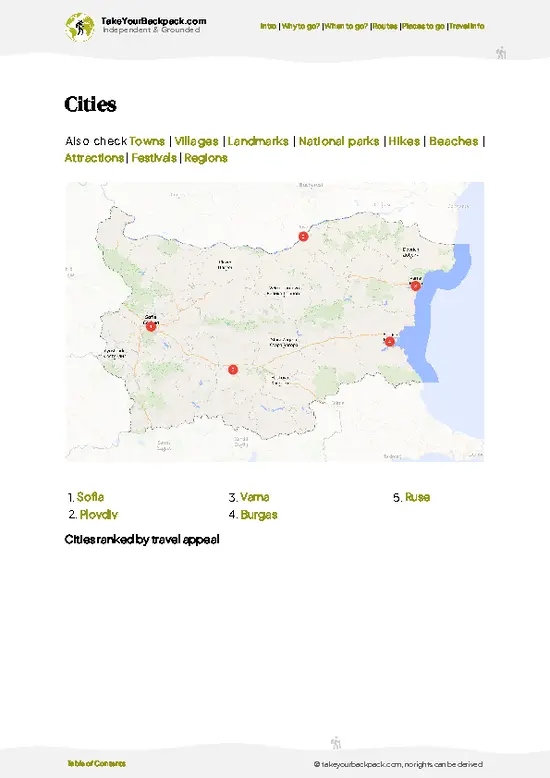
cities
towns
villages
landmarks
national parks
hikes
beaches
attractions
festivals
regions
SHOW COUNTRY’S BESTSHOW ALL

Why go?Reasons people choose to visit

Backpackers

Bulgaria rewards backpackers who like big days and small bills. Beds in mountain huts cost less than … read more 👉
Bulgaria rewards backpackers who like big days and small bills. Beds in mountain huts cost less than a burger in Berlin, and the ridgelines of Rila and Pirin knit together into week-long walks without touching your wallet much. Sofia and Plovdiv serve cheap eats and talkative hostels; the Black Sea throws in buses that undercut your bar tab. Trains amble like they’re sightseeing too, but they get there. You’ll wade through Cyrillic, drink rakia you didn’t ask for, and meet people who actually help. It’s rough-edged, generous, and worth the scuffed boots.

Low cost

Bulgaria is where a shoestring stops squeaking. Buses are cheap—slow, but they do the job; trains trundle, … read more 👉
Bulgaria is where a shoestring stops squeaking. Buses are cheap—slow, but they do the job; trains trundle, but your wallet barely notices. Hostel beds, kebapche, and a beer cost less than a taxi flag-drop in Western Europe, so you can stretch days, add a detour, or upgrade to a private room without guilt. Expect a backpacker daily average in the low-to-mid 30s, depending on how often you sit down to eat and how far you chase monasteries. Spend time, save money; the comfort hit is mostly drafty buses and firm mattresses.

Mountains

Bulgaria rewards hikers who like big scenery without Swiss prices. Rila, Pirin, and the Stara Planina … read more 👉
Bulgaria rewards hikers who like big scenery without Swiss prices. Rila, Pirin, and the Stara Planina give you granite ridges, ice-cold tarns, and weeklong traverses; you pay in sweat, not euros. Huts are cheap, hearty, and occasionally eccentric—expect bean soup, wood smoke, and a mattress that squeaks like a mouse choir. Buses reach most trailheads, though schedules feel aspirational. Afternoon storms crack hard, shepherd dogs have opinions, and trail blazes wander. The trade: time and a bit of comfort, in exchange for space, silence, and real mountain days.

Architecture

Bulgaria is a crash course in European architecture taught at walking speed and bus-stop prices. You … read more 👉
Bulgaria is a crash course in European architecture taught at walking speed and bus-stop prices. You can step from Roman amphitheaters in Plovdiv to medieval ramparts at Tsarevets, then sleep under Revival-era eaves in Koprivshtitsa, all before the kebapche cools. Sofia throws in gold-domed Orthodoxy, Communist grandeur at the Largo, and unapologetic panel blocks that look better at sunset—trust me. On the side: Black Sea churches of Nessebar, Thracian tombs, and the UFO-like hulk at Buzludzha if you’re willing to earn it. Cheap, dense, and delightfully weird to navigate.

Uniqueness

Bulgaria is a clean trade: money stretches; time snaps. Buses wander mountain roads, trains shrug at … read more 👉
Bulgaria is a clean trade: money stretches; time snaps. Buses wander mountain roads, trains shrug at schedules, and signage prefers Cyrillic, not you. Pay in patience and you get the good clips: empty Pirin ridgelines, Rhodope hamlets where banitsa and cheese still cost coins, rose fields and Thracian tombs, a socialist UFO on a windy peak, monasteries tucked in cold pines, Black Sea coves if you dodge the resorts. Comfort is mixed: family guesthouses, hot showers that arrive eventually, and rakia that erases second thoughts.
Want the complete picture of Bulgaria?
The offline Travel Guide brings everything together — routes, highlights & planning.

See what's included in the guide 👉

Get the Travel Guide -

⭐ HighlightsThe places that define a trip here

  • Rila Monastery: Under the frescoed arcades, pine resin and candle wax hang in the cool air, and the bell thuds off the cliffs. Time: 5-6 hours round-trip from Sofia by bus; a private driver saves an hour but costs a full day’s lodging. Comfort: dress modestly, stone floors numb ankles, lunch is bob chorba and bread. Off-map: Stob Pyramids, St. Ivan’s hermit cave, Kirilova Polyana.
  • Plovdiv Old Town & Roman Theater: Old Town’s cobbles force your calves to earn every National Revival house; the Roman theater perches over the city, pigeons patrolling the stage. Time: aim for golden hour; buses beat the trains by a bit. Money: taxis across town cost coffee money; parking costs sanity. Comfort: slippery stones in summer heat. Off-map: Asen’s Fortress, Bachkovo Monastery, Hisarya’s Roman walls.
  • Veliko Tarnovo’s Tsarevets Fortress: Tsarevets rises like a stone ship; from the ramparts you hear church bells and the hiss of grills along Gurko Street. Time: buses from Sofia are faster than trains; climb-heavy
read more 👉
  • Rila Monastery: Under the frescoed arcades, pine resin and candle wax hang in the cool air, and the bell thuds off the cliffs. Time: 5-6 hours round-trip from Sofia by bus; a private driver saves an hour but costs a full day’s lodging. Comfort: dress modestly, stone floors numb ankles, lunch is bob chorba and bread. Off-map: Stob Pyramids, St. Ivan’s hermit cave, Kirilova Polyana.
  • Plovdiv Old Town & Roman Theater: Old Town’s cobbles force your calves to earn every National Revival house; the Roman theater perches over the city, pigeons patrolling the stage. Time: aim for golden hour; buses beat the trains by a bit. Money: taxis across town cost coffee money; parking costs sanity. Comfort: slippery stones in summer heat. Off-map: Asen’s Fortress, Bachkovo Monastery, Hisarya’s Roman walls.
  • Veliko Tarnovo’s Tsarevets Fortress: Tsarevets rises like a stone ship; from the ramparts you hear church bells and the hiss of grills along Gurko Street. Time: buses from Sofia are faster than trains; climb-heavy sightseeing taxes knees. Money: guesthouses are kinder than capitals. Comfort: midday crowds and August heat bite. Off-map: Arbanasi’s courtyards, Hotnitsa waterfall, Dryanovo Monastery with Bacho Kiro Cave.
  • Belogradchik Rocks & Fortress: Red rock towers fence a fortress and a sky full of swifts; thyme and dust stick to your boots. Time: remote means two buses and a prayer, or a rental car and pothole diplomacy. Money: rooms and rakia are cheap; fuel isn’t. Comfort: no shade, serious sun. Off-map: Magura Cave’s prehistoric art, Rabisha Lake, Chuprene Reserve.
  • Pirin National Park — Mt. Vihren: On Vihren the marble scree crunches like broken plates and the wind tastes of cold metal; goat bells drift from below. Time: pre-dawn start, 6-8 hours on trail; chairlifts help elsewhere but not here. Money: Bansko is bargain-basement off-season. Comfort: steep, exposed, glorious if your knees behave. Off-map: Koncheto ridge, Baikushev’s fir, Melnik’s sandstone pyramids.
Spotted a mistake or missing a highlight? Contact us.

But Bulgaria offers more...

Discover and compare all of its highlights per category

🧭 RoutesHow travelers typically move through the country

The 5-Day Sofia & Rila Escape

The Vibe: A relaxed, mountain-meets-city intro to Bulgaria built around Sofia’s café culture and the drama of Rila’s peaks and monastery, with minimal packing and easy transfers. You get big history, big churches, and big landscapes without ever feeling rushed.
The Highlights:
  • Sofia’s historic center anchored by Alexander Nevsky Cathedral and the National Theatre Ivan Vazov area.
  • Quick access to alpine trails and views in Vitosha National Park.
  • A deep-dive day and night around Rila Monastery and Rila National Park.

The 10-Day Capitals, Monasteries & Mountains Loop

The Vibe: A balanced overland loop for travelers who want Bulgaria’s greatest cultural hits plus real time in the high country, moving at a steady, comfortable pace. Expect medieval fortresses, painted monasteries, and at least one big hiking day in serious mountains.
The Highlights:
  • Sofia’s museums and neighborhoods as a soft landing and cultural primer.
  • Base days in Bansko with hiking in Pirin National Park
read more 👉

The 5-Day Sofia & Rila Escape

The Vibe: A relaxed, mountain-meets-city intro to Bulgaria built around Sofia’s café culture and the drama of Rila’s peaks and monastery, with minimal packing and easy transfers. You get big history, big churches, and big landscapes without ever feeling rushed.
The Highlights:
  • Sofia’s historic center anchored by Alexander Nevsky Cathedral and the National Theatre Ivan Vazov area.
  • Quick access to alpine trails and views in Vitosha National Park.
  • A deep-dive day and night around Rila Monastery and Rila National Park.

The 10-Day Capitals, Monasteries & Mountains Loop

The Vibe: A balanced overland loop for travelers who want Bulgaria’s greatest cultural hits plus real time in the high country, moving at a steady, comfortable pace. Expect medieval fortresses, painted monasteries, and at least one big hiking day in serious mountains.
The Highlights:
  • Sofia’s museums and neighborhoods as a soft landing and cultural primer.
  • Base days in Bansko with hiking in Pirin National Park and the option of tackling Koncheto Ridge.
  • Time at Rila Monastery and in Rila National Park, plus a night in the wine village of Melnik.
  • Fortress views and old streets in Veliko Tarnovo and Tsarevets Fortress.

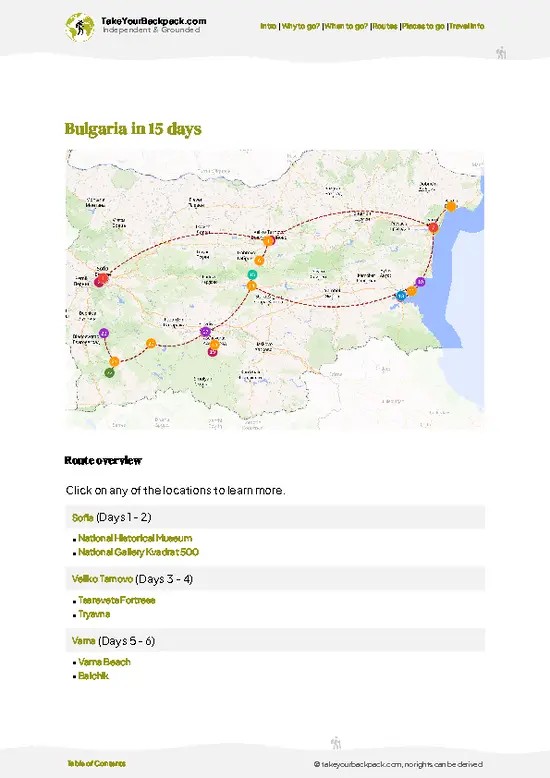
The 15-Day Bulgaria Grand Traverse

The Vibe: A full-country journey for travelers who want to connect the dots between cities, mountains, and the Black Sea, with enough time to add wetlands, small towns, and nature parks along the way. The pace is medium—regular moves, but with multi-night stays so each region actually sinks in.
The Highlights:
  • Three days in Sofia for cathedrals, museums, and hikes in Vitosha National Park.
  • Plovdiv’s Old Town and Roman Theatre paired with Rhodope villages and mountain trails.
  • Black Sea time in Varna, Golden Sands, and the Ancient City of Nessebar with nearby beaches and nature parks.
  • Wetlands around Burgas Lakes, Strandzha Nature Park’s quieter coast, and a finale in Veliko Tarnovo, Ruse, and Rusenski Lom Nature Park.
🌍 Want a ready-to-use travel plan for Bulgaria?
The overview above compares different route options based on your travel time and style. The complete Travel Guide breaks each itinerary down in detail, including maps, stops, highlights, and transport information.

Explore all route details 👉

Get the Travel Guide -

🌤️ When to go?Best time to visit Bulgaria

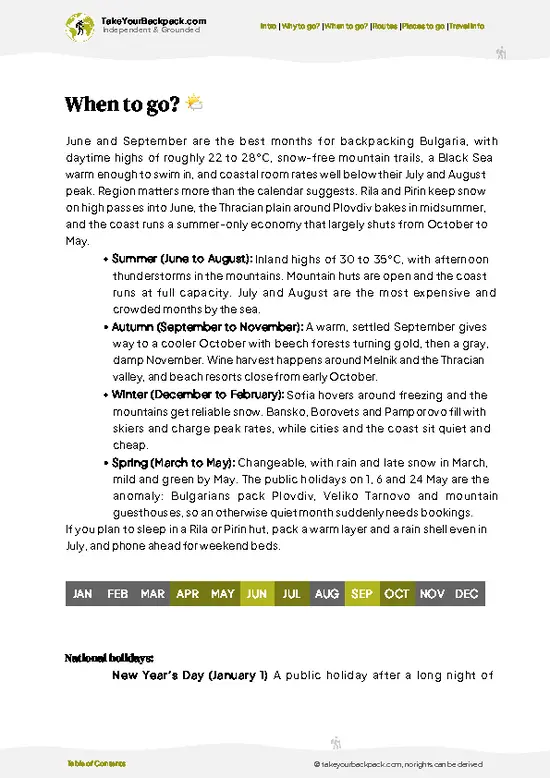
Late May to mid-June and early to mid-September are the sweet spot in Bulgaria. Spring pushes snowlines back in Rila and Pirin just as huts unlock and buses add departures; wildflowers still show in June, but the thunderheads are more bark than bite. On the Black Sea, the water warms by June without the towel-to-towel chaos, then September keeps the sea bath-warm while prices quietly drop after August’s frenzy. Days are long enough for a ridge plus a town stroll, nights cool enough to sleep, and the big tour groups have either not yet arrived or already gone home.
  • Peak Summer (Jul-Aug): The heat and crowds punch first. Sofia hostels fill, seaside prices climb, and there’s a queue to pose at the Seven Rila Lakes. The high: endless daylight, every lift running, huts stocked, and a golden hour on Pirin’s granite that makes you forget the bus station sauna you survived.
  • Shoulder Shift (Late May-June, Sept): Bulgaria stretches awake. Chairs scrape onto sidewalks, trail signs reappear from snowmelt, grapes sag on trucks, and beaches exhale as families leave in September. Anomaly: early May holiday weekends spike domestic crowds in monasteries and eco-trails—looks like July for 72 hours, then it’s quiet again.
  • Deep Off-Peak (Nov-Mar): Interiors rule. Sofia goes soft and steamy in mehanas while the Black Sea turns steel. Mountain bowls empty out, wind bites, and streets glaze. Survival hack: carry microspikes—Sofia sidewalks and trailheads turn to polished glass after a thaw-freeze.

Tactical tip: For July-August weekends, reserve mountain huts about two weeks ahead or sleep outside.

source: climatestotravel.comJANJanuary: below average for travelingFEBFebruary: below average for travelingMARMarch: fair for travelingAPRApril: good for travelingMAYMay: good for travelingJUNJune: excellent for travelingJULJuly: good for travelingAUGAugust: fair for travelingSEPSeptember: excellent for travelingOCTOctober: good for travelingNOVNovember: fair for travelingDECDecember: below average for traveling
📅 Traveling in a specific month?
Get a full month-by-month breakdown of weather, crowds, costs, festivals, and seasonal highlights in the complete travel guide.

Get full details when to go 👉

Get the Travel Guide -
pixabay-bulgaria-nature-1362673

💰 Costs (as of 2026)Prices, expenses, and money tips

Expect €30-45 per day in Bulgaria if you stick to dorms, buses, and banitsa; push it to €50-70 if you want private rooms or the coast in peak season.
  • dorm accommodation: Expect €10-18 inland/shoulder season, €12-22 in Sofia/Plovdiv, and €15-25 on the Black Sea or during ski season. Many throw in a basic breakfast and a kitchen. System tip: book day-of to chase deals, except July-August on the coast and winter weekends in Bansko; target 6-8-bed dorms (cheapest without the snore orchestra), and sleep near bus/rail to turn checkout day into a half-day adventure. Relative value: a hair cheaper than Romania, far cheaper than Greece.
  • meals: Supermarket Survival: €6-10/day buys bread, tomatoes, sirene cheese, yogurt, and coffee; cook once, eat twice; cheaper than Romania and way under Greek prices. Street food reality: banitsa or kebapche + salad lunch for €3-5, “menu of the day” €5-8, dinner grill with beer €8-12. Portion sizes are honest; tourist zones are not—Vitosha Blvd and beach promenades can add 30-50% for the same plate. Tap water is fine; craft beer is where your budget goes to die.
  • local transport: Cheapest way to unlock the country: regional buses and second-class trains. Sofia-Plovdiv
read more 👉
Expect €30-45 per day in Bulgaria if you stick to dorms, buses, and banitsa; push it to €50-70 if you want private rooms or the coast in peak season.
  • dorm accommodation: Expect €10-18 inland/shoulder season, €12-22 in Sofia/Plovdiv, and €15-25 on the Black Sea or during ski season. Many throw in a basic breakfast and a kitchen. System tip: book day-of to chase deals, except July-August on the coast and winter weekends in Bansko; target 6-8-bed dorms (cheapest without the snore orchestra), and sleep near bus/rail to turn checkout day into a half-day adventure. Relative value: a hair cheaper than Romania, far cheaper than Greece.
  • meals: Supermarket Survival: €6-10/day buys bread, tomatoes, sirene cheese, yogurt, and coffee; cook once, eat twice; cheaper than Romania and way under Greek prices. Street food reality: banitsa or kebapche + salad lunch for €3-5, “menu of the day” €5-8, dinner grill with beer €8-12. Portion sizes are honest; tourist zones are not—Vitosha Blvd and beach promenades can add 30-50% for the same plate. Tap water is fine; craft beer is where your budget goes to die.
  • local transport: Cheapest way to unlock the country: regional buses and second-class trains. Sofia-Plovdiv is ~€6-8 by bus in ~2.5 hours; the train is slower but a euro cheaper and roomier. In cities, rides run €0.80-1.20; a 10-ride card/day pass beats singles and saves fumbling. Validate tickets; inspectors are not hypothetical. From Sofia airport, use the metro, not “special” taxis. Compared to neighbors: cheaper than Romania’s intercity trains and miles cheaper than Greece; Serbia is similar. Time vs money: buses save time, trains save coins (and nerves).
  • activities: Museums/fortresses are pocket change (€2-6). Hiking is free; lifts and park shuttles aren’t—the Seven Rila Lakes cable car costs more than the trail hurts. Day trips from Sofia to Rila/Plovdiv in a van run €25-45; DIY by bus halves the price and doubles the faff. Winter is the splurge: ski passes and rentals are a bargain versus the Alps but will still dwarf your food budget. Black Sea add-ons—boat rides, clubs, sun loungers—push you toward Greek pricing fast.
  • miscellaneous: Budget leaks: ATM fees (use bank ATMs and refuse “conversion”), beach sunbed/umbrella taxes, airport rides, laundry-by-the-kilo, and coffee-and-pastry drift. SIM with big data is cheap (€6-10) and prevents “let’s just taxi it” moments. Paying in euros at bars earns a comedy exchange rate—use leva. Cards work in cities; carry cash in villages. Relative value: fewer leaks than Greece, similar to Serbia, slightly cheaper than Romania—until you start collecting craft beers and taxi stories.
⚠️ Prices can change and everyone travels differently, so take this as a rough guide. Hope it helps you plan your adventure!

✈️ The backpacker research shortcutBulgaria Travel Guide

An offline-friendly backpacking guide with optimized travel routes, ranked highlights, transport advice, and the best areas to stay.
example page 0 from our offline Travel Guide for Bulgariaexample page 1 from our offline Travel Guide for Bulgariaexample page 2 from our offline Travel Guide for Bulgariaexample page 3 from our offline Travel Guide for Bulgariaexample page 4 from our offline Travel Guide for Bulgariaexample page 5 from our offline Travel Guide for Bulgariaexample page 6 from our offline Travel Guide for Bulgariaexample page 7 from our offline Travel Guide for Bulgaria
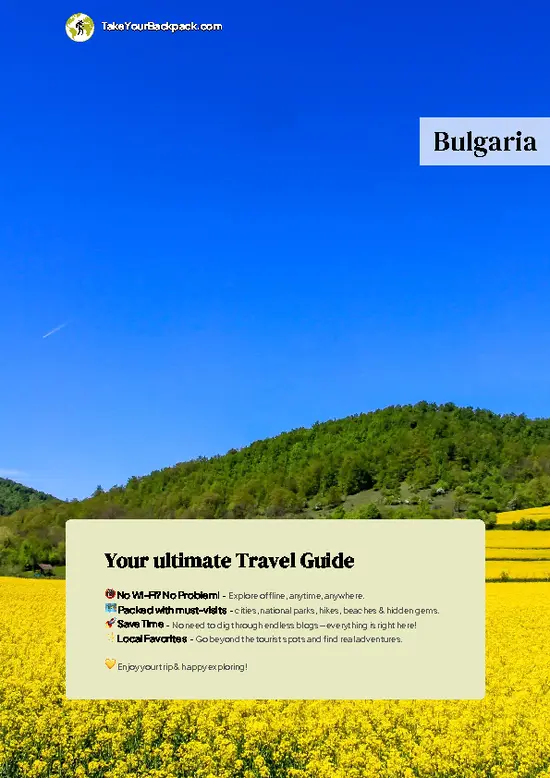
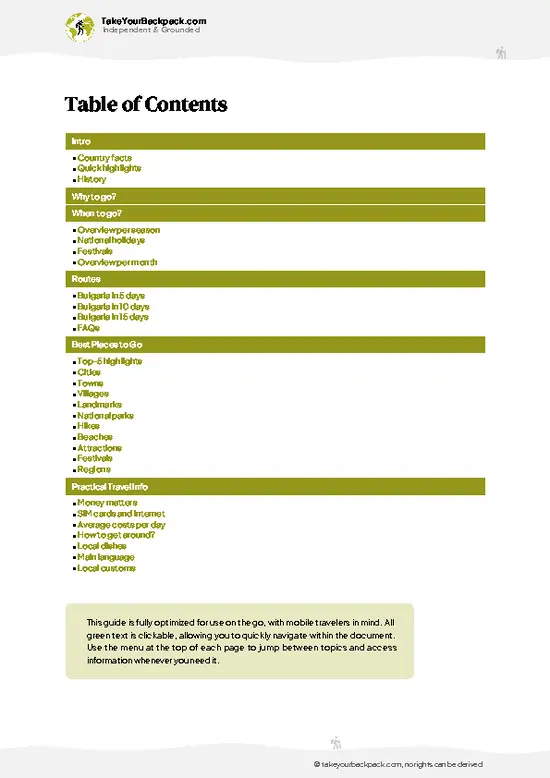
The digital guide (363 pages) contains:
93 highlights, ranked by travel appeal
Optimized 5, 10 & 15-day travel routes
Cities, national parks, beaches, historical sites, ...
How to get around
Offline-friendly for travel without Wi-Fi
👉 Click to see all 30+ guide features

📅 Plan smarter in minutes, not weeks
Month by month travel advice
Festivals & national holidays
Budget expectations

🗺️ Go to the right places, skip the overrated ones
Honest pros & cons of destinations
Top hikes, parks & viewpoints
Lesser-known places most travelers miss
Clear “worth it vs skip it” guidance

🛏️ Travel smoothly without rookie mistakes
Best areas to stay
Transport systems explained simply
Common scams & safety advice
SIM cards, money & practical tips

🌍 Understand the country, not just visit it
Culture & traditions
52 Essential phrases & customs
Festivals worth planning around
Traveler-friendly historical context
Insights that make places more meaningful

📱 Built for real travel conditions
Fully downloadable PDF
Works completely offline
Optimized for phone use
Useful in remote areas & buses
Everything in one place
Save weeks of stressful planning
Get instant access to the full guide directly. 30-day money-back guarantee.


Sent to your inbox immediately after payment • 100% Secure Checkout
Best Backpacking Travel Advisor 2025 tourism awardBest Backpacking
Travel Advisor
2025
What others say about Take Your Backpack Guides:
⭐⭐⭐⭐⭐
Fantastic, amazing amount of information!
⭐⭐⭐⭐⭐
My goodness this is amazing, it's what I've been looking for hats off too you!
⭐⭐⭐⭐⭐
I think this is absolutely BRILLIANT
⭐⭐⭐⭐
Very complete and informative. It's still missing places, but I gotta to commend you
⭐⭐⭐⭐⭐
This is truly amazing, thank you, can't wait to explore it with my kids!
⭐⭐⭐⭐⭐
Awesome resource, thank you!
⭐⭐⭐⭐⭐
This is amazing! Can't wait to explore the ones I haven't seen
⭐⭐⭐⭐
I love this! Well done, great idea.
⭐⭐⭐⭐⭐
Thanks for taking the time to make this gem!
⭐⭐⭐⭐⭐
This might be the best website I've ever seen.
⭐⭐⭐⭐⭐
Congratulations, and thank you so much for your work; it's incredibly valuable.
⭐⭐⭐⭐
In all seriousness I think you did a great job pointing out the important spots
⭐⭐⭐⭐⭐
10/10 very good
⭐⭐⭐⭐⭐
As someone who's only just starting to visit regularly this is awesome, thank you.
⭐⭐⭐⭐
Thank you very much! I'm going to visit my dad, it's going to be very useful!
⭐⭐⭐⭐⭐
This is really cool! We'll be travelling for the first time and this definitely come in handy.
⭐⭐⭐⭐⭐
You are now our minister of culture, congratulations 👨‍💼
⭐⭐⭐⭐⭐
Just wanted to tell you that this is a pearl! Going to follow your recommendations.
⭐⭐⭐⭐⭐
This is so cool. I'll definitely be using the resource for my travels soon.
⭐⭐⭐⭐⭐
This is very impressive! Good work.
⭐⭐⭐⭐⭐
This is an amazing and informative site. Very well done!

🛏️ Where to stay?Choosing the right base for your trip

Yes — hostels, budget guesthouses and small hotels are common across Bulgaria, with the largest supply in major cities, Black Sea resorts and mountain towns like Sofia, Plovdiv, Varna, Burgas, Veliko Tarnovo and Bansko.

Sofia (city centre/University/NDK) offers the widest choice and best transport links — pro: walkable to museums and nightlife; con: noisier and a bit pricier; Plovdiv (Old Town, Kapana) is compact and artsy — pro: easy access to sights and bars; con: touristy and limited late-night transport; Varna and Burgas (Sea Garden/city centre) put you by the beach — pro: seaside access … read more 👉
Yes — hostels, budget guesthouses and small hotels are common across Bulgaria, with the largest supply in major cities, Black Sea resorts and mountain towns like Sofia, Plovdiv, Varna, Burgas, Veliko Tarnovo and Bansko.

Sofia (city centre/University/NDK) offers the widest choice and best transport links — pro: walkable to museums and nightlife; con: noisier and a bit pricier; Plovdiv (Old Town, Kapana) is compact and artsy — pro: easy access to sights and bars; con: touristy and limited late-night transport; Varna and Burgas (Sea Garden/city centre) put you by the beach — pro: seaside access and summer nightlife; con: crowded and costlier in high season; Veliko Tarnovo (Old Town) is scenic and walkable — pro: historic atmosphere close to sights; con: hilly streets and fewer ultra-budget options; Bansko (town centre/gondola area) suits skiers — pro: slope access and après-ski; con: strong seasonal price surges and quieter off-season.

Pick central or Old Town areas for convenience and nightlife if noise and slightly higher rates are acceptable, choose residential districts or stay outside peak season to save money and find quieter streets, and expect coastal and ski towns to be significantly pricier and busier during summer and winter high seasons.

If you enjoy meeting fellow travelers, consider choosing hostels with high ratings for atmosphere. On the other hand, if you prefer having your own space, a hotel might be a better option.

🚌 Getting aroundHow to travel within the country

Bulgaria moves on a shrug and a stopwatch. The Sofia Metro clicks like a metronome; buses mostly leave when the clock says so; trains consider punctuality more of a suggestion. You don’t beat the flow here—you ride it: plan with intent, then accept that mountains, smoke breaks, and “just five minutes” are laws of nature.
  • Intercity Buses The speed-to-lev ratio is your friend. Between big hubs—Sofia to Plovdiv, Veliko Tarnovo, Burgas—motorways make buses decisively quicker than trains for only a few
read more 👉
Bulgaria moves on a shrug and a stopwatch. The Sofia Metro clicks like a metronome; buses mostly leave when the clock says so; trains consider punctuality more of a suggestion. You don’t beat the flow here—you ride it: plan with intent, then accept that mountains, smoke breaks, and “just five minutes” are laws of nature.
  • Intercity Buses The speed-to-lev ratio is your friend. Between big hubs—Sofia to Plovdiv, Veliko Tarnovo, Burgas—motorways make buses decisively quicker than trains for only a few BGN more. Expect 2.5-3 hours Sofia-Plovdiv and 7-8 to the coast, with tickets roughly 15-35 BGN depending on distance and company. Seats are assigned more in theory than practice; luggage may cost an extra 1-2 BGN. Air-con ranges from Arctic to aspirational. Departures are usually on time, especially from Sofia’s Central Bus Station—show up 20 minutes early because gates change with the subtlety of a wink.
  • City Trams, Trolleys & Metro This is where the country’s social code hums. Validate your ticket immediately; inspectors materialize like magicians and fines are cash-on-the-spot. Offer seats to elders without theatrics. Keep your backpack low and your voice lower. In Sofia, the metro is clean, fast, and mercifully labeled; surface vehicles are older, doors snap shut like mousetraps, and drivers appreciate exact change. In smaller towns, you often pay the driver—hand over coins, don’t block the aisle, and pretend you understand every shouted stop even when you don’t.
  • Narrow-Gauge Train (Septemvri-Dobrinishte) The geometric unlock: it threads the Rhodopes where roads meander and buses skip. It climbs to Avramovo, the Balkans’ highest station, then drifts past spruce, goat pens, and hot-spring towns like Velingrad. It’s slow—think hours, not logic—but it gets you into valleys no coach bothers with, and the views buy your patience. Timetables are thin; miss one and your new hobby is waiting. Bring snacks, layers, and shameless wonder.
  • BDŽ Regular & Night Trains The budget disruptor if you play it right. Day trains are cheaper than buses and roomier, just slower and delay-prone; you trade time for lev and legroom. The real hack is the sleeper or couchette east-west: Sofia-Varna or Sofia-Burgas overnight turns a long slog into a moving hostel, effectively paying your bed to get you there. Reserve a seat (or berth) at the counter; keep expectations modest and valuables closer.

Master tip: For long jumps, book a night train to cover distance while you sleep, then finish the last stretch at dawn by bus—speed where it counts, savings where it matters.
Sofia Airport sits about 10 km (6 miles) east of the city center. Here’s how to get in, without overthinking it:
  • Metro (from Terminal 2)

    Time: about 25-30 minutes to Serdika (the central hub). Trains run roughly every 6-10 minutes, from around 05:30 until just before midnight.

    Cost: about 1.60 BGN (~€0.80) for a single ride (as of 2025). You can pay by contactless bank card at the gates or use a ticket machine.

    Notes: If you land at Terminal 1, take the free shuttle to Terminal 2 for the metro.
  • Bus (84 or 184)

    Time: typically 35-50 minutes to the center (traffic can stretch this). Buses run every 7-15 minutes during the day.

    Cost: about 1.60 BGN (~€0.80) per ride (as of 2025). Tap a contactless bank card on the onboard validator or buy from a kiosk/driver.

    Where they go: Both serve Terminals 1 and 2 and head toward the center around Orlov Most/Sofia University, with connections to other lines and a short walk to central sights.
  • Taxi

    Time: 20-35 minutes, depending on traffic and where you’re staying downtown.

    Cost: usually 20-30 BGN (€10-15). Use the official taxi desk/stand at Arrivals or a reputable app (e.g., TaxiMe, Bolt). Avoid anyone soliciting rides inside the terminal.

If you want the easiest/cheapest combo, take the metro from Terminal 2. Late arrival after the metro closes? Grab an official taxi.
⚠️ Prices and routes can change, so take this as a rough guide and ask for local advice when you arrive.

🔒 Safety (risk Level: low)Common concerns and things to watch out for

Safety for solo travelers, including women and LGBTQ+ individuals
Bulgaria is generally safe for solo travelers, including women and LGBTQ+ individuals, though some caution is advisable. Stick to well-traveled areas and avoid isolated places at night. LGBTQ+ travelers should be aware that while Bulgaria is legally progressive, societal attitudes can be conservative, particularly in rural areas. Always trust your instincts and keep local emergency numbers handy.


Full official government travel advisory (live updates)
View details 👉

✈️ VisaVisa requirements for Bulgaria

Visa requirements for Bulgaria depend on your nationality. Citizens of the EU, US, Canada, Australia, and several other countries can enter Bulgaria visa-free for up to 90 days within a 180-day period. If you do need a visa, apply through a Bulgarian embassy or consulate in your country, ensuring you have all required documents like a valid passport and proof of accommodation.

source: mfa.bg
⚠️ Visa requirements can change over time, so always check the latest visa requirements with the official embassy or government website before you travel.

🎒 What to pack?Packing essentials for the trip

Bulgaria’s got a bit of everything—mountains, beaches, and city life, so pack versatile. Summers can be scorching in cities like Sofia and Plovdiv, but the Black Sea coast offers a breezy relief. Winters, especially in the mountains, scream for layers. If you’re venturing into the Rhodope or Balkan mountains, sturdy footwear is a must. When visiting monasteries or rural villages, dress modestly—think longer sleeves and pants or skirts.

Apart from this country specific advice, I have also crafted a general packing list that should help on any trip. authorOver the years, I've learned the importance of packing minimally. It's so much easier to jump on the back of a truck or squeeze yourself into the last spot of a minibus without that supersized backpack. If you're headed to a warm destination, leave your winter jacket at home; for colder regions, opt for thin thermal underlayers. Instead of packing your entire wardrobe, bring just three sets of clothes, as laundry facilities are available everywhere.

View the full list 👉
🎒 Planning the practical side of your trip?
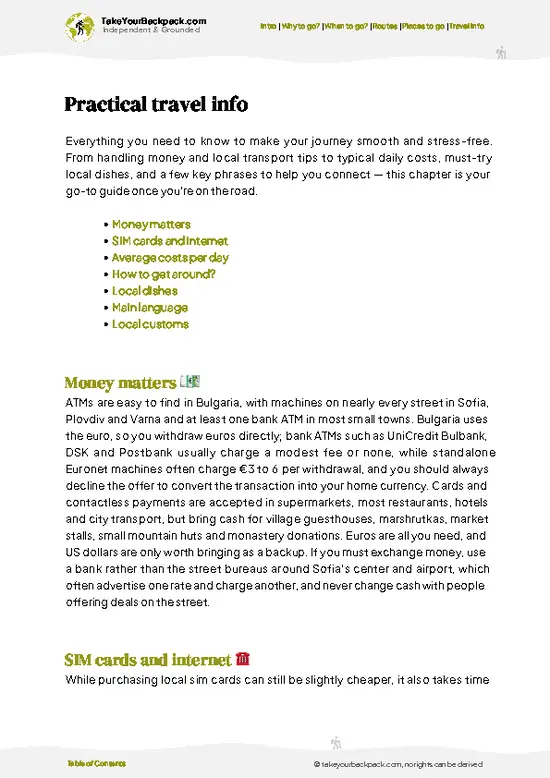
Get detailed information on transport, daily budgets, internet access, local customs, food, language, and other essentials in the complete Travel Guide.

Get detailed practical information 👉

Get the Travel Guide -

🙋 FAQThings travelers often ask

Trip Planning


Personal tip: I normally search on good rating for atmosphere (for meeting people) and location (for easy exploring). Cleanliness as a bonus.


Travel Essentials

Routine vaccinations like measles-mumps-rubella (MMR), diphtheria-tetanus-pertussis, varicella (chickenpox), polio, and your annual flu shot are advised for Bulgaria.

Consider vaccinations for hepatitis A and B, especially if you’re planning to stay longer or engage in activities where you’re at risk. Rabies might be a consideration if you’ll be in rural areas or around animals a lot.

Check with a healthcare provider for the most current advice.


vaccination requirements
When I first started traveling, I often spent part of my first day in a new country hunting for a local SIM card. While this can still be slightly cheaper, it also takes time and planning.

These days, it's much simpler to install an eSIM before leaving home. Once you arrive in Bulgaria, you can activate it immediately and have mobile data from the moment you land — which is especially useful for ordering transport or navigating away from busy airports.

There are many providers nowadays, and price differences are usually small. I personally go with Airalo, as it offers excellent network coverage throughout the country and strong global coverage, so you can manage multiple countries from a single app.


Get your e-sim for Bulgaria

Culture & Customs

When in Bulgaria, always greet with a firm handshake and maintain eye contact. Nodding means ”no,” and shaking your head means ”yes”—it’s confusing, so watch for context. Dress modestly in churches, covering shoulders and knees.

For LGBTQ+ travelers, Bulgaria is generally safe, but public displays of affection might attract attention. Exercise caution. Women travelers should feel generally safe, but it’s wise to avoid walking alone late at night in unfamiliar areas.

Do: Accept gifts or invitations for coffee, it’s a big part of Bulgarian hospitality.
Don’t: Criticize the country or compare it unfavorably with others in public.
Trying traditional food is always a great way to experience the culture. Here are some must-try dishes for Bulgaria.
  • Banitsa: A flaky pastry filled with a mixture of eggs, yogurt, and white cheese. It’s a traditional breakfast staple and a symbol of Bulgarian hospitality.
  • Shopska Salad: Made with tomatoes, cucumbers, onions, peppers, and topped with grated sirene cheese. It’s refreshing and represents the colors of the Bulgarian flag.
  • Kavarma: A slow-cooked stew typically made with pork, onions, and peppers. It’s a comforting dish often enjoyed during colder months.
  • Tarator: A cold soup made from yogurt, cucumbers, garlic, and dill. Perfect for cooling down in the hot Bulgarian summer.
  • Moussaka: Unlike the Greek version, the Bulgarian moussaka features potatoes and ground meat, layered and baked. It’s a hearty dish beloved by locals.
Tap water in Bulgaria is generally safe to drink, and locals do consume it. However, it can vary by region and some travelers might notice a strong mineral taste. If you’re sensitive or cautious, opt for bottled or filtered water, especially in rural areas.
The main language in Bulgaria is Bulgarian. Backpacking is way more rewarding if you know a bit of the local language, so I'd suggest brushing up on the basics just in case your Bulgarian skills have become a bit rusty.

Want to understand locals better?
The complete Travel Guide for Bulgaria includes 52 essential words and phrases — greetings, thank-yous, ordering food, transport, numbers, and common local expressions you'll actually hear.

Get your local basic phrases 👉

Get the Travel Guide -


In Bulgaria, English is increasingly spoken, especially in urban areas and tourist destinations. In cities like Sofia, Plovdiv, and Varna, many young people and professionals, particularly in the hospitality and service industries, are proficient in English. Signs, menus, and information in tourist areas often include English translations, making navigation easier for English-speaking travelers.

However, in rural areas and smaller towns, English proficiency may be limited. Older generations, in particular, may have minimal English skills, as it was not widely taught during the communist era. In these regions, basic phrases or gestures may be necessary for effective communication.

Overall, while English is not universally spoken, travelers can generally expect to find enough English speakers to facilitate their experience, especially in tourist hotspots. Learning a few basic Bulgarian phrases can enhance interactions and show respect for the local culture.

Money & Payments

The local currency of Bulgaria is BGN (лв).

ATMs: You’ll find ATMs in most towns and cities, but some rural areas might be a bit sparse. Stick to ATMs attached to banks for better security.

Cash or Card: Always have some cash on you, especially outside major cities. Small shops, local eateries, and markets often prefer cash. Cards are widely accepted in urban areas, though.

Dollars/Euros: Don’t bother carrying dollars or euros for spending. You can exchange them at banks or exchange bureaus, but rates can vary. You’ll want Bulgarian levs for everything.

Card Acceptance: Visa and MasterCard are widely accepted, but always have a backup plan—like cash—if you’re heading somewhere less touristy.

Exchanging Money: Best to exchange at banks or official exchange bureaus in cities for decent rates. Avoid exchanging money at airports, as they tend to have lower rates and higher fees.

In Bulgaria, tipping is customary but not obligatory. Leaving a tip of around 10% is appreciated in restaurants; however, rounding up the bill is also common. For taxis and other services, rounding up to the nearest whole number is generally sufficient.

🧩 Nearby countriesSimilar backpacking destinations

We 💚 feedbackKey takeaways from the trip

Bulgaria rewards the patient. Mountains like Rila and Pirin deliver big-alpine days for Balkan prices: hut networks, empty trails, cold beer that costs less than a bus ticket in France. The catch: getting anywhere can feel like a side quest—slow trains, bus stations that speak only Cyrillic, timetables that shrug. Best for hikers and history-curious travelers who count their euros and can improvise when plans wobble. Not ideal for itinerary maximalists, AC addicts, or anyone who needs frictionless transit and nightly craft lattes.

✍️ Help improve this page!
The information on this page is based on in-depth research, insights shared by experienced travelers, and feedback from the local travel community in Bulgaria. While every effort is made to keep the information accurate and current, conditions can change — so if you spot anything incorrect or outdated, please get in touch.


🙋‍♂️ Give feedback

👋 Meet the founderWho’s Behind Take Your Backpack?

Johan, backpacker and founder of TakeYourBackpackHi, I’m Johan (Netherlands 🇳🇱), the creator of TakeYourBackpack. Over the past decade, I’ve backpacked through 80+ countries across six continents, gaining extensive experience with independent travel, long-term trips, and overland routes.

This site is built on a combination of firsthand travel experience and carefully curated insights from other backpackers. Many guides are based on places I’ve personally visited, while others bring together tips, observations, and practical advice shared by trusted travelers I’ve met along the way.

The goal is to provide realistic, experience-driven guidance — not generic itineraries — so you can explore destinations with better context, clearer expectations, and more confidence.

Get full Bulgaria guide •
Instant download • 93 highlights • Full Offline guide