×
Chad 🇹🇩

backpacking Africa Chad 🇹🇩Cross stark open spaces where travel itself defines purpose.

Explore Central African RepublicExplore Côte d’Ivoire

Backpacking Chad in 2026

A complete guide including when and where to go, costs, transport, itineraries, and practical travel advice.
The big picture before you go

Backpacking Chad
By Johan Kruseman 🇳🇱 | Updated June 8, 2026

Chad isn’t a no-go blank on the map. It’s bigger than Spain and Germany combined and very much awake—markets thrum in N’Djamena while caravans still move by starlight. It rewards patience more than swagger.

In the Ennedi Massif, wind-sculpted arches guard shadowed gueltas where camel trains drink beside crocodiles; at Zakouma, elephants bunch at dusk while lions supply the bassline; farther north the Tibesti’s black volcanoes and Emi Koussi rise from a sea of sand, with the Ounianga Lakes flashing turquoise below. Tea circles stretch a day, Toubou guides read tracks like a book, and rock art whispers from cliff walls. Yes, roads punish, flights are thin, and the north needs permits, a serious fixer, and paperwork ready for checkpoints; spend on a solid 4x4, dry-season timing, and the occasional flight instead of burning days on corrugations—this is how you save energy and money for the moments that count. You earn every view, and that effort makes it land deeper.

Compared with Niger’s softer dunes or Cameroon’s easier comforts, Chad is wilder; versus Sudan’s archaeology or CAR’s rainforest, it’s a study in space and silence with a surprise: serious big game at Zakouma. Come if you value solitude over services, story-rich travel over polish, and a frontier that gives more the more you bring. If comfort tops your list, go elsewhere; if meaning does, this is your country.

👉 Get the 📖 Travel Guide of Chad

N’Djamena & the Chari Corridor

Use the capital as your launchpad, not your main event. It’s where you get cash sorted (ATMs hiccup; carry CFA), lock down permits, and line up a vehicle that actually has spares. Pick a hotel with a reliable generator and water; don’t cheap out here because rest matters before the bush. Expect police checkpoints; stay polite, carry copies, keep cameras down at bridges. Stock fuel, filters, and a local SIM. Evenings are for river air and regrouping, not roaming aimlessly.

Zakouma National Park

If you want certainty in Chad, this is it. A dry-season (Dec–Apr) operation with real wildlife density and firm rules that keep it that way. You either charter/fly in, or grind a long 4x4 approach via Sarh/Am Timan with sand, broken bridges, and zero forgiveness for sloppy prep. Book park lodging early; fees add up but deliver actual game viewing and ranger presence. Carry extra fuel; there’s none inside. Days get furnace-hot by March. This rewards patient wildlife people, not box-tickers.

Ennedi Plateau (Fada, Guelta d’Archei)

Sculpted sandstone and Saharan life, earned the hard way. Long, off-track drives; two vehicles are wise, or one with a driver-mechanic who’s replaced a leaf spring in the wind. Permits and checkpoints around Fada; slow is smooth. You’ll wild camp, filter bitter water, and wake with sand in your teeth. Bring goggles for harmattan grit and respect for herders’ space at gueltas. It pays off for trekkers and photographers who can handle a week with no showers and a lot of sky.

Tibesti Mountains (Bardaï, Emi Koussi)

The high Sahara is not casual. Access runs through Faya-Largeau and military posts; travel is frequently restricted, and escorts or permits can shift without notice. Legacy mines exist—never leave established tracks. Nights bite in winter; altitude will test soft acclimatizers. Fuel is scarce and cash-only; you cache or you turn back. This is for true expedition travelers with sat-coms, time slack, and a taste for volcanic ridges. Everyone else should bank the money for Zakouma + Ennedi.

Guéra Massif (Mongo–Bitkine)

Closer, cheaper, and honest. Granite domes, small markets, and friendly but no-frills towns reachable from N’Djamena in a long day. Rainy season turns laterite into soap; plan exits, not heroics. Hire local guides to approach domes and rock art; small fees avoid big misunderstandings. Expect bucket showers, power cuts, and goats at dawn. It rewards walkers and tinkerers who like fixing a clutch cable with string while kids critique their French and everyone ends up laughing.
Safety warning

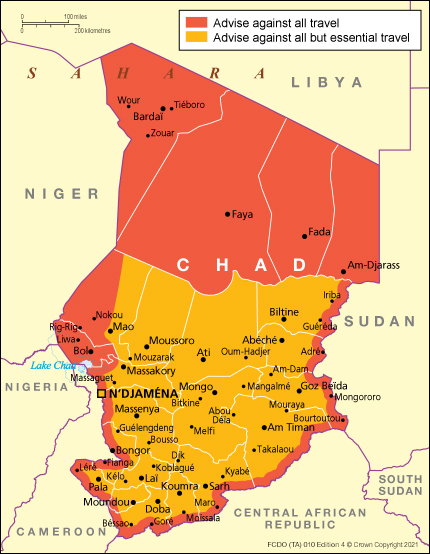
The current risk level for Chad is high. Check the advice before going.
Get your Chad guide
69 ranked highlights, routes & tips, works offline (298 pages)
Seeing the layout at a glance
Loading the map 🌍
CLICK TO FILTER
city
town
unique site
national park
hike
attraction
festival
region
SHOW COUNTRY’S BESTSHOW ALL
film
0
0
0a
Sao Cultural Sites near Lake Chad region
film
1
1
1a
Grand Mosque of N’Djamena
film
2
2
2a
N’Djamena Central Market
film
3
3
3a
Crafts Market of N’Djamena
film
4
4
4a
Traditional Camel Markets of Abéché
film
5
5
5a
Fada Arch Trail
film
6
6
6a
Ennedi Massif
film
7
7
7a
Ouadi Rimé-Ouadi Achim
film
8
8
8a
Tibesti Mountains

Why go?Reasons people choose to visit

Low cost

Chad is kind to a backpacker’s wallet if you move like a local. Eat where drivers eat, sleep in bare-bones auberges, ride bush taxis, and your daily burn stays lean—roughly mid-30s to low-40s USD on average. The savings are real because markets feed you well, rooms are no-frill cheap, and shared transport is the default.

The gotchas are predictable and avoidable. Western hotels, private 4x4s, and park or desert expeditions will torch your budget … read more 👉
Chad is kind to a backpacker’s wallet if you move like a local. Eat where drivers eat, sleep in bare-bones auberges, ride bush taxis, and your daily burn stays lean—roughly mid-30s to low-40s USD on average. The savings are real because markets feed you well, rooms are no-frill cheap, and shared transport is the default.

The gotchas are predictable and avoidable. Western hotels, private 4x4s, and park or desert expeditions will torch your budget fast; save those for what truly matters. Long distances add up—choose slow buses and shared cars instead of charters. Keep photocopies of your passport and stay calm at checkpoints to avoid “extra” fees. Buy a local SIM on day one. Carry cash outside big towns. Do this, and you’ll spend your money on experiences, not logistics.
Want the complete picture of Chad?
The offline Travel Guide brings everything together — routes, highlights & planning.

See what's included in the guide 👉

Get the Travel Guide -

⭐ HighlightsUnmissable destinations

  • Ennedi Plateau & Guelta d’Archei: Sandstone cathedrals rise from pale sand, wind hisses through slot canyons, and camel bells echo off walls painted with ancient art. Hike before the heat and scramble to the ledge above Guelta d’Archei to watch camel trains wade through inky water while shy crocodiles hold to the shadows. Go with a local operator, carry copies of your passport for checkpoints, and bring extra fuel and a real headscarf—this is big desert, and the sun punishes sloppy planning.
  • Zakouma National Park: Dry-season pans boil with life—red-billed queleas swarm like smoke, and elephants file in with purpose at first light. Make the dawn run to Rigueik Pan, then shut up and just listen; lions often announce themselves before you see them. Aim for January-April, base at Tinga Camp if you’re counting francs, and bring cash—outside N’Djamena, ATMs are theory. Stay on tracks, pack a spare air filter, and accept the dust as the price of seeing a park that fought its way back.
  • Lakes of
read more 👉
  • Ennedi Plateau & Guelta d’Archei: Sandstone cathedrals rise from pale sand, wind hisses through slot canyons, and camel bells echo off walls painted with ancient art. Hike before the heat and scramble to the ledge above Guelta d’Archei to watch camel trains wade through inky water while shy crocodiles hold to the shadows. Go with a local operator, carry copies of your passport for checkpoints, and bring extra fuel and a real headscarf—this is big desert, and the sun punishes sloppy planning.
  • Zakouma National Park: Dry-season pans boil with life—red-billed queleas swarm like smoke, and elephants file in with purpose at first light. Make the dawn run to Rigueik Pan, then shut up and just listen; lions often announce themselves before you see them. Aim for January-April, base at Tinga Camp if you’re counting francs, and bring cash—outside N’Djamena, ATMs are theory. Stay on tracks, pack a spare air filter, and accept the dust as the price of seeing a park that fought its way back.
  • Lakes of Ounianga: A chain of blue and green eyes stare out from dunes, some lakes salty enough to float you, others sweet and guarded by date palms. Climb the ridge above Lake Yoa for sunrise, then take a slow float in briny Lake Uma to feel the desert hold you. Permits are handled in Faya-Largeau, fuel is precious, and wind can sandblast cameras—stash gear in dry bags and never swim where locals draw drinking water; respect keeps doors open on this route.
  • N’Djamena & the Chari River: The capital runs on heat, dust, and grilled meat smoke, with the river as its slow heartbeat. Ride a pirogue at sunset to feel the city unclench, then work the central market for Sahel textiles and spices without flashing your camera like a lighthouse. Use hotel cars over random taxis, keep small bills handy for petty stops, and avoid the riverbank after dark; malaria bites here, so treat repellent and prophylaxis as non-negotiable gear.
  • Tibesti Mountains & Emi Koussi: Black volcanoes and white salt craters break a horizon that feels lunar, and silence lands heavy enough to hear your pulse. If you make it, the three-day push to Emi Koussi’s rim is the kind of climb that clears mental clutter fast. This is advanced Sahara: permits stacked on permits, escorts often required, real sand driving, and nights that freeze after brutal days—only go with a trusted operator and a sat phone; if paperwork stalls, pivot to Ennedi or Ounianga rather than bleeding time. For off-the-map detours, look at Gaoui’s Sao pottery village, the pirogue town of Douguia on the Chari, and Ati’s raucous camel market when it runs.
Spotted a mistake or missing a highlight? Contact us.

But Chad offers more...

Discover and compare all of its highlights per category

🧭 RoutesHow to structure a trip

The 7-Day N’Djamena & Gaoui Cultural Loop

The Vibe: A relaxed, one-region immersion that keeps you based around the capital while still giving you a real taste of Chadian history, markets, and village life. Ideal if you want depth over distance, with minimal long drives and plenty of time to wander.
The Highlights:
  • Exploring the National Museum of Chad and key mosques to frame the country’s story.
  • Getting lost (in a good way) in N’Djamena’s central and crafts markets.
  • Spending slow time in Gaoui Traditional Village and Museum for living culture.
  • Evening food and people-watching along Avenue Charles de Gaulle.

The 14-Day Capital-to-Safari Southern Circuit

The Vibe: A balanced two-week journey that links N’Djamena’s urban energy with river towns and one of Central Africa’s standout wildlife areas. Designed for travelers who want both culture and safari without racing across the entire country.
The Highlights:
  • City days in N’Djamena with museums, mosques, and markets.
  • Village and regional exploration
read more 👉

The 7-Day N’Djamena & Gaoui Cultural Loop

The Vibe: A relaxed, one-region immersion that keeps you based around the capital while still giving you a real taste of Chadian history, markets, and village life. Ideal if you want depth over distance, with minimal long drives and plenty of time to wander.
The Highlights:
  • Exploring the National Museum of Chad and key mosques to frame the country’s story.
  • Getting lost (in a good way) in N’Djamena’s central and crafts markets.
  • Spending slow time in Gaoui Traditional Village and Museum for living culture.
  • Evening food and people-watching along Avenue Charles de Gaulle.

The 14-Day Capital-to-Safari Southern Circuit

The Vibe: A balanced two-week journey that links N’Djamena’s urban energy with river towns and one of Central Africa’s standout wildlife areas. Designed for travelers who want both culture and safari without racing across the entire country.
The Highlights:
  • City days in N’Djamena with museums, mosques, and markets.
  • Village and regional exploration around Gaoui and the Chari-Baguirmi area.
  • Multi-day wildlife experiences in Zakouma National Park and the Salamat region.
  • Unwinding along the Sarh riverside promenade in the greener south.

The 21-Day Desert, Highlands & Zakouma Expedition

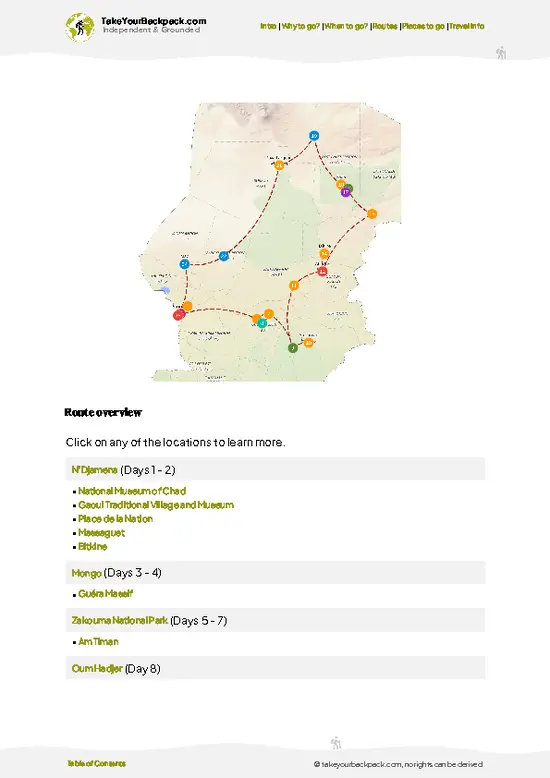
The Vibe: A full-on, three-week expedition that stitches together Sahara plateaus, rock arches, remote lakes, highland hikes, and big-game savanna. Built for experienced travelers who want Chad’s greatest hits and its quiet corners in one ambitious loop.
The Highlights:
  • Desert staging in Borkou and Faya-Largeau before heading into the Ennedi Plateau and Massif.
  • Iconic rock formations and gueltas around Guelta d’Archei and the Fada Arch Trail.
  • Otherworldly colors and silence at the Lakes of Ounianga.
  • Highland time in the Guera Massif and multi-day wildlife viewing in Zakouma National Park and the Salamat region, bookended by city life in N’Djamena and southern towns.
🌍 Want a ready-to-use travel plan for Chad?
The overview above compares different route options based on your travel time and style. The complete Travel Guide breaks each itinerary down in detail, including maps, stops, highlights, and transport information.

Explore all route details 👉

Get the Travel Guide -

🌤️ When to go?Choosing the right months to travel

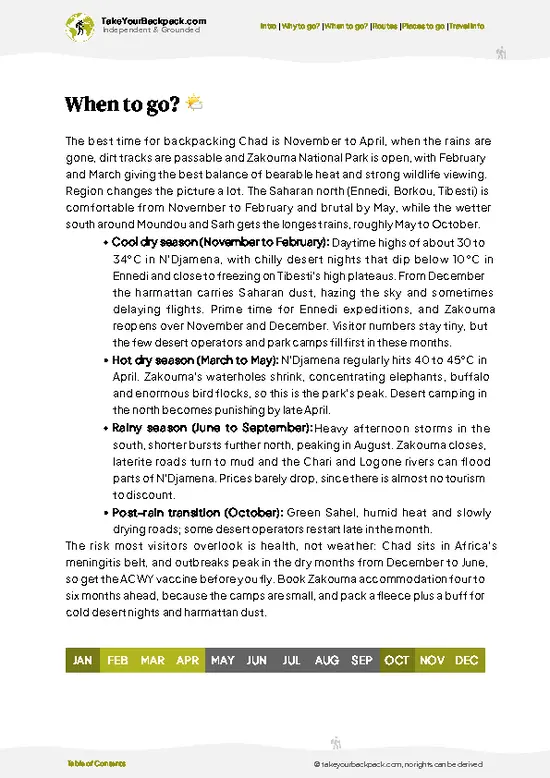
Aim for mid-November to mid-December. It’s the tight window after the southern rains release their grip and before holiday markups and the furnace of late dry season. Tracks in the Sahel harden, river crossings return, and bush taxis actually run, while Ennedi and Tibesti are cool enough to hike by midday without burning through your water stash. Zakouma reopens but hasn’t hit its late-dry-season feeding frenzy, so limited beds and 4x4s aren’t yet bid up by fly-in groups. You accept Harmattan haze muting skies and dust in your tea, but you buy back workable roads, fewer bureaucratic delays, and nights cold enough for real sleep. It’s the rare overlap where logistics, heat, and price shake hands.
  • Peak (Feb-Apr): You grind through blistering afternoons, scarce vehicles, and inflated rates, but the payoff is real: elephants and antelope packed into Zakouma’s pans, long lens days that justify every mile, and Saharan evenings warm enough to linger under a hard sky. Ignore the thermometer and you’ll pay for it; heatstroke sneaks up on convoys rattling over corrugations. Hidden cost most miss: guide/vehicle shortages spike permit and fuel “facilitation” fees.
  • Shoulder (Late Oct-mid-Dec): The country exhales—mud dries, shop shutters lift, long-parked trucks roll, and drivers actually answer their phones. You move faster on less cash. Some ferries and timber bridges are still patchwork, and Harmattan can ground short hops, so build slack and keep routes flexible.
  • Off-Peak Rains (Jun-Sep): Big sky, green hush, villages slowed to the rhythm of storms. You get the place to yourself, if you can move at all. Survival hack: travel at first light before black-cotton soils turn to glue; line your pack with heavy trash bags and carry plastic sandals for knee-deep mud. Seasonal blind spot: whole corridors simply close, and trucks sit for days at washed-out culverts—plan to wait or don’t go.

Tactical tip: If you’re targeting wildlife or remote desert, secure your 4x4 and driver before you buy the flight—on arrival, last-minute vehicles bleed cash and kill days.

source: climatestotravel.comJANJanuary: good for travelingFEBFebruary: excellent for travelingMARMarch: excellent for travelingAPRApril: excellent for travelingMAYMay: fair for travelingJUNJune: below average for travelingJULJuly: below average for travelingAUGAugust: below average for travelingSEPSeptember: fair for travelingOCTOctober: good for travelingNOVNovember: highly recommended for travelingDECDecember: highly recommended for traveling
📅 Traveling in a specific month?
Get a full month-by-month breakdown of weather, crowds, costs, festivals, and seasonal highlights in the complete travel guide.

Get full details when to go 👉

Get the Travel Guide -
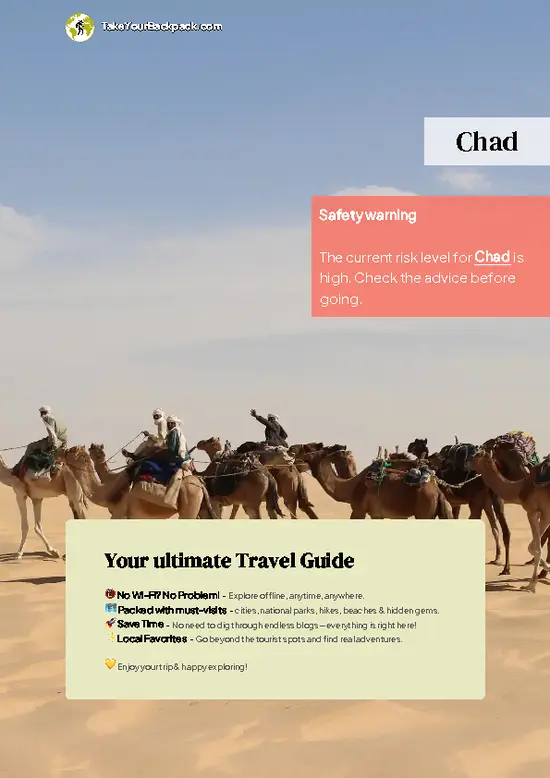
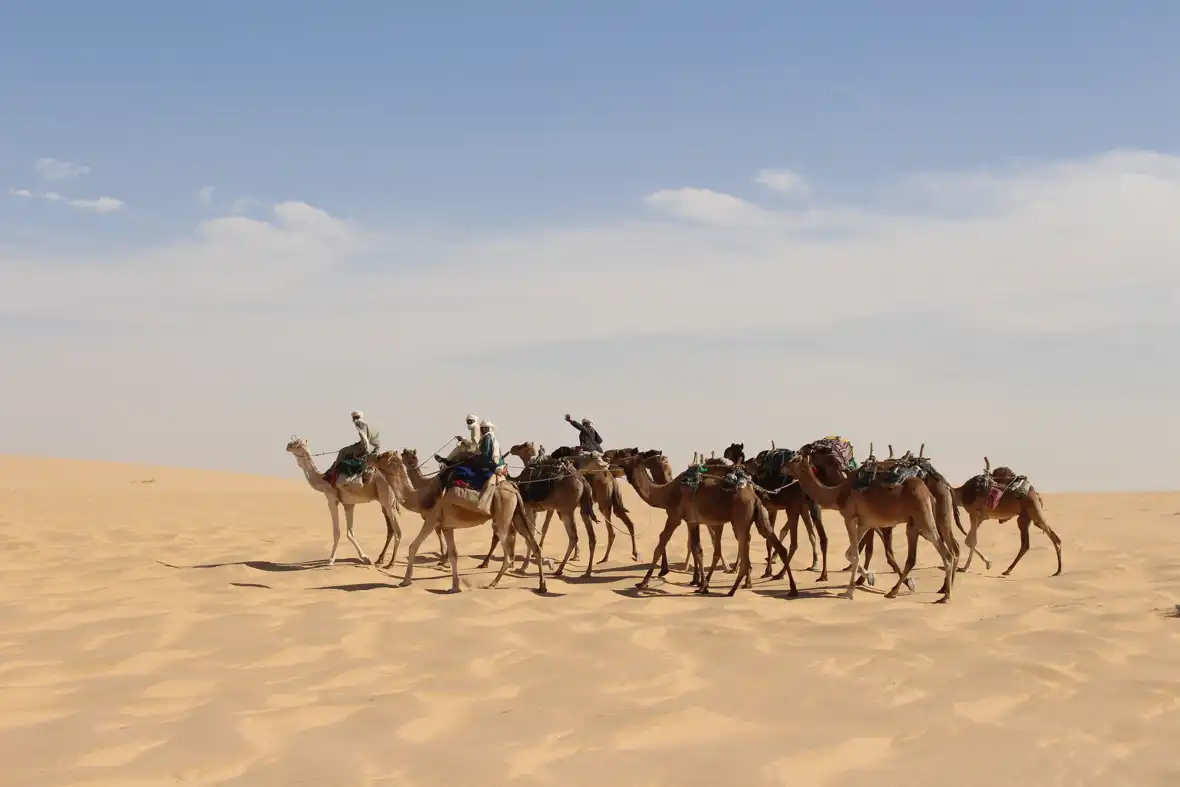
pixabay-chad-caravan-4483792

💰 Costs (as of 2025)How expensive it really is

Plan on 25,000-40,000 XAF ($40-65) per day if you move slow and skip safaris; crossing big distances or chasing wildlife will blow that number up fast.
  • dorm accommodation: True dorms are rare; think basic “chambre” in an auberge or mission guesthouse. In small towns, 6,000-12,000 XAF gets a fan room with shared washroom; N’Djamena is more like 10,000-20,000 XAF, and A/C adds 5,000-10,000. System tip: arrive before sunset, ask to see the fan room, negotiate a multi-night cash rate, and carry a sheet/liner so you can accept the cheapest clean-but-sparse option. Always ask if “taxe” is included on the receipt before you pay.
  • meals: Supermarket Survival: imports are pricey—tuna, cheese, cereal can run 1.5-3x Cameroon/Nigeria. You’ll spend more and eat worse. Street food reality: hot plates at busy stands win. Rice with sauce or boule: 500-1,000 XAF, brochettes 100-200 XAF each, omelette sandwich 300-500, foul or beans 500-800. Bottled water 300-500 for 1.5L. Eat where turnover is fast and the pot is still boiling; hotel restaurants drain budgets fast for middling food.
  • local transport: In towns, moto-taxis are the unlock: 200-500 XAF for short hops; shared cars in N’Djamena often 300-500.
read more 👉
Plan on 25,000-40,000 XAF ($40-65) per day if you move slow and skip safaris; crossing big distances or chasing wildlife will blow that number up fast.
  • dorm accommodation: True dorms are rare; think basic “chambre” in an auberge or mission guesthouse. In small towns, 6,000-12,000 XAF gets a fan room with shared washroom; N’Djamena is more like 10,000-20,000 XAF, and A/C adds 5,000-10,000. System tip: arrive before sunset, ask to see the fan room, negotiate a multi-night cash rate, and carry a sheet/liner so you can accept the cheapest clean-but-sparse option. Always ask if “taxe” is included on the receipt before you pay.
  • meals: Supermarket Survival: imports are pricey—tuna, cheese, cereal can run 1.5-3x Cameroon/Nigeria. You’ll spend more and eat worse. Street food reality: hot plates at busy stands win. Rice with sauce or boule: 500-1,000 XAF, brochettes 100-200 XAF each, omelette sandwich 300-500, foul or beans 500-800. Bottled water 300-500 for 1.5L. Eat where turnover is fast and the pot is still boiling; hotel restaurants drain budgets fast for middling food.
  • local transport: In towns, moto-taxis are the unlock: 200-500 XAF for short hops; shared cars in N’Djamena often 300-500. Intercity is bush taxis and pickups: roughly 3,000-5,000 XAF per 100-150 km; long hauls stack to 10,000-20,000 XAF. Cheapest system: travel at dawn, go on market days, and buy an extra seat to avoid four-across. Fuel shortages and checkpoints add time and cost. Compared to Cameroon, per-km costs are higher and speeds slower; similar to Niger; the CAR is worse.
  • activities: Major cost drivers are logistics, not tickets. Zakouma and Ennedi will wreck a shoestring: park entry for foreigners, mandatory guide, 4x4 hire, fuel, sometimes an escort—easily $100+ per day even when shared, with camp fees on top. City sights are affordable: small museums 1,000-3,000 XAF, mosques and markets free (tip the guard). Expect photo fees at some sites and occasional “camera permits” requests—push back politely or budget a few thousand XAF.
  • miscellaneous: Budget leaks: SIM + starter data 5,000-10,000 XAF, ATM foreign fees and poor rates (carry CFA if coming from Cameroon), photocopies for checkpoints, bottled water every day, laundry (1,000-2,000 XAF or bucket-wash), and lack of small change that rounds every fare up. Occasional “spot fines” at roadblocks cost time; patience saves money. Relative value: Chad costs more and gives you less convenience than Cameroon or Nigeria; it’s on par with Niger for grind, cheaper than South Sudan, and only “good value” when you use the money you saved by moving slow.
⚠️ Prices can change and everyone travels differently, so take this as a rough guide. Hope it helps you plan your adventure!

✈️ The backpacker research shortcutChad Travel Guide

An offline-friendly backpacking guide with optimized travel routes, ranked highlights, transport advice, and the best areas to stay.
example page 0 from our offline Travel Guide for Chadexample page 1 from our offline Travel Guide for Chadexample page 2 from our offline Travel Guide for Chadexample page 3 from our offline Travel Guide for Chadexample page 4 from our offline Travel Guide for Chadexample page 5 from our offline Travel Guide for Chadexample page 6 from our offline Travel Guide for Chadexample page 7 from our offline Travel Guide for Chad
The digital guide (298 pages) contains:
69 highlights, ranked by travel appeal
Optimized 7, 14 & 21-day travel routes
Cities, national parks, beaches, historical sites, ...
How to get around
Offline-friendly for travel without Wi-Fi
👉 Click to see all 30+ guide features

📅 Plan smarter in minutes, not weeks
Month by month travel advice
Festivals & national holidays
Budget expectations

🗺️ Go to the right places, skip the overrated ones
Honest pros & cons of destinations
Top hikes, parks & viewpoints
Lesser-known places most travelers miss
Clear “worth it vs skip it” guidance

🛏️ Travel smoothly without rookie mistakes
Best areas to stay
Transport systems explained simply
Common scams & safety advice
SIM cards, money & practical tips

🌍 Understand the country, not just visit it
Culture & traditions
52 Essential phrases & customs
Festivals worth planning around
Traveler-friendly historical context
Insights that make places more meaningful

📱 Built for real travel conditions
Fully downloadable PDF
Works completely offline
Optimized for phone use
Useful in remote areas & buses
Everything in one place
Save weeks of stressful planning
Get instant access to the full guide directly. 30-day money-back guarantee.


Sent to your inbox immediately after payment • 100% Secure Checkout
Best Backpacking Travel Advisor 2025 tourism awardBest Backpacking
Travel Advisor
2025
What others say about Take Your Backpack Guides:
⭐⭐⭐⭐⭐
Fantastic, amazing amount of information!
⭐⭐⭐⭐⭐
My goodness this is amazing, it's what I've been looking for hats off too you!
⭐⭐⭐⭐⭐
I think this is absolutely BRILLIANT
⭐⭐⭐⭐
Very complete and informative. It's still missing places, but I gotta to commend you
⭐⭐⭐⭐⭐
This is truly amazing, thank you, can't wait to explore it with my kids!
⭐⭐⭐⭐⭐
Awesome resource, thank you!
⭐⭐⭐⭐⭐
This is amazing! Can't wait to explore the ones I haven't seen
⭐⭐⭐⭐
I love this! Well done, great idea.
⭐⭐⭐⭐⭐
Thanks for taking the time to make this gem!
⭐⭐⭐⭐⭐
This might be the best website I've ever seen.
⭐⭐⭐⭐⭐
Congratulations, and thank you so much for your work; it's incredibly valuable.
⭐⭐⭐⭐
In all seriousness I think you did a great job pointing out the important spots
⭐⭐⭐⭐⭐
10/10 very good
⭐⭐⭐⭐⭐
As someone who's only just starting to visit regularly this is awesome, thank you.
⭐⭐⭐⭐
Thank you very much! I'm going to visit my dad, it's going to be very useful!
⭐⭐⭐⭐⭐
This is really cool! We'll be travelling for the first time and this definitely come in handy.
⭐⭐⭐⭐⭐
You are now our minister of culture, congratulations 👨‍💼
⭐⭐⭐⭐⭐
Just wanted to tell you that this is a pearl! Going to follow your recommendations.
⭐⭐⭐⭐⭐
This is so cool. I'll definitely be using the resource for my travels soon.
⭐⭐⭐⭐⭐
This is very impressive! Good work.
⭐⭐⭐⭐⭐
This is an amazing and informative site. Very well done!

🛏️ Where to stay?Where to stay in Chad

True backpacker hostels are rare in Chad, but basic budget hotels and guesthouses exist mainly in the capital and a few regional towns.
Most options cluster in N’Djamena’s city center/riverfront (close to markets, transport and the limited nightlife but noisier and with higher petty‑crime risk), the embassy/expat districts (quieter and safer but more expensive and isolated), and the airport/outer corridor (convenient for arrivals but with very limited services).
Outside the capital—especially towns like Moundou and Abeche—lodging is sparse and very basic, suitable for short stays near regional … read more 👉
True backpacker hostels are rare in Chad, but basic budget hotels and guesthouses exist mainly in the capital and a few regional towns.
Most options cluster in N’Djamena’s city center/riverfront (close to markets, transport and the limited nightlife but noisier and with higher petty‑crime risk), the embassy/expat districts (quieter and safer but more expensive and isolated), and the airport/outer corridor (convenient for arrivals but with very limited services).
Outside the capital—especially towns like Moundou and Abeche—lodging is sparse and very basic, suitable for short stays near regional highlights but not for travelers who need amenities or organized hostel-style social life.

If you enjoy meeting fellow travelers, consider choosing hostels with high ratings for atmosphere. On the other hand, if you prefer having your own space, a hotel might be a better option.

🚌 Getting aroundGetting around Chad

Chad moves by daylight and consensus. Vehicles leave when they’re full, not when a timetable says so, and the road itself negotiates your speed. Rain re-draws the map. Checkpoints set the rhythm. The trick is to ride the pulse without letting it drain you: pay small when it saves hours, stand your ground when it only buys five minutes, and always, always start at dawn.
  • Long-distance buses and Hiace minibuses — The fast option is the one with the engine running. Big coaches on the paved south-east
read more 👉
Chad moves by daylight and consensus. Vehicles leave when they’re full, not when a timetable says so, and the road itself negotiates your speed. Rain re-draws the map. Checkpoints set the rhythm. The trick is to ride the pulse without letting it drain you: pay small when it saves hours, stand your ground when it only buys five minutes, and always, always start at dawn.
  • Long-distance buses and Hiace minibuses — The fast option is the one with the engine running. Big coaches on the paved south-east spine feel safer and spare your spine, but they crawl through checkpoints and stop for cargo and prayers. Hiaces jump faster between towns and fill up quicker, but you trade legroom and get wedged with jerrycans. Both are cheap compared to any flight or charter. Pay the luggage fee up front, fight for a front seat, and avoid the rear bench that turns every pothole into a launch. In rainy season, speed dies on laterite; dry season dust costs you lungs, not time.
  • Moto-taxis — This is the local handshake on wheels. Greet the driver, state your landmark, agree the fare before you swing a leg. No helmet offered; bring a light scarf for dust and keep your bag in front where your arms cage it. Don’t backseat-drive the route; he knows which sand patches eat axles and which streets attract police. Prices rise after dark and in rain. If you’re carrying a daypack, pay a tiny top-up to keep it on your lap—cheaper than replacing what bounces off a rack. Step off on the right, pay exact, and leave fast so he can grab the next fare.
  • Camion bâché (cargo trucks) — The poor traveler’s warp drive to the north and east. You buy space on sacks under a tarp and accept that “departure time” equals “when the last goat is tied.” It’s a tenth the cost of chartering a 4×4 and reaches places buses won’t risk. Bring a foam pad, 10 liters of water, salt crackers, and patience for load-unload purgatory. Talk to the chef de bord, pay in stages, keep small bills for checkpoint tea, and carry photocopies of your documents. Nights bite in the desert; a light jacket beats bravado. Never ride the ladder when the truck moves.
  • Pirogues on the Chari-Logone — When the floodplains swell, water beats wheels. These dugouts and longboats link villages that roads abandon, especially near Bongor, Laï, and south of N’Djamena. They go when full or on market days. No lifejackets, slick planks, and engines that sulk. Pay extra for a dry plank near the centerline, bag your passport, and keep hands inside—hippos don’t brake. Useful detours that cut hours of muddy backtracking, but never treat them as border shuttles; stay domestic and keep your camera buried.

Master tactic: move at first light along the paved spine, take the first vehicle leaving to the next hub (not the “best” one later), and buy comfort where it buys speed—front seat, confirmed luggage spot, photocopies ready for checkpoints. This preserves daylight, your back, and your budget in one shot.
Distance: N’Djamena International Airport (NDJ) is about 4 km (2.5 mi) from the city center.

Is there an airport bus? No official airport bus as of 2025. You’ll be choosing between taxis, hotel shuttles, shared taxis/minibuses, or moto-taxis.

Options, time, and typical costs:
  • Taxi (private hire) — 10-20 minutes depending on traffic and checkpoints. Expect 5,000-10,000 XAF in daytime; 8,000-12,000 XAF late at night or during busy hours. No meters; agree the fare before you get in.
  • Hotel shuttle — 10-20 minutes. Many mid-range and upscale hotels offer pre-booked pick-up, sometimes free, often 3,000-8,000 XAF. Arrange ahead so the driver can meet you at arrivals.
  • Shared taxi/minibus (local transport) — 20-40 minutes. About 200-500 XAF per seat on fixed routes. They usually don’t enter the airport area; you may need to walk out to the main gate or the nearest main road and flag one toward the center. Light luggage only.
  • Moto-taxi (motorbike) — 10-15 minutes. Roughly 500-1,500 XAF for central areas. They typically wait near the airport gate rather than inside. Helmets are rare; only use if you’re comfortable with the risk.

Taxi quick note: Taxis wait outside the terminal but may be kept back from the inner curb by security. Cash only (XAF), no meters, and negotiation is normal. A fair daytime rate to central hotels is usually 5,000-10,000 XAF; confirm the price before you ride.

Extras:
- After dark, options thin out; a hotel pickup is the easiest and safest bet.
- Security checkpoints are common and can add a few minutes.
- Have small bills; card payments and ride-hailing apps (Uber/Bolt) aren’t available.
⚠️ Prices and routes can change, so take this as a rough guide and ask for local advice when you arrive.

🔒 Safety (risk Level: high)Is Chad safe to visit?

Safety for solo travelers, including women and LGBTQ+ individuals
Chad can be challenging for solo travelers, especially women and LGBTQ+ individuals, due to limited infrastructure and conservative social norms. While N’Djamena is generally safer, rural areas may pose risks. It’s crucial to stay updated on local security advisories, as some regions can be volatile. Consider traveling with a local guide and ensure you have reliable communication means.


Full official government travel advisory (live updates)
View details 👉
safety image

source: www.gov.uk

✈️ VisaDo you need a visa to visit?

Yes, a visa is required to visit Chad for most nationalities. You can apply for a visa at a Chadian embassy or consulate, and you’ll typically need a passport, a completed application form, and a passport-sized photo. Check with the nearest Chadian diplomatic mission for specific requirements and fees.
⚠️ Visa requirements can change over time, so always check the latest visa requirements with the official embassy or government website before you travel.

🎒 What to pack?What you'll need while traveling

Chad’s a bit of a wild ride, so pack smart! The climate swings from scorching hot in the Sahara to more humid in the south. Lightweight, breathable clothing is a must, but remember to dress modestly, especially in rural areas where locals appreciate covered shoulders and knees. If you’re heading to the Tibesti Mountains, it gets surprisingly cool, so a warm layer won’t go amiss. Don’t forget a good pair of sturdy shoes for those rocky terrains and dusty roads. Adjust your packing for the season, as the rainy season (June to September) can turn travel into a muddy affair.

Apart from this country specific advice, I have also crafted a general packing list that should help on any trip. authorOver the years, I've learned the importance of packing minimally. It's so much easier to jump on the back of a truck or squeeze yourself into the last spot of a minibus without that supersized backpack. If you're headed to a warm destination, leave your winter jacket at home; for colder regions, opt for thin thermal underlayers. Instead of packing your entire wardrobe, bring just three sets of clothes, as laundry facilities are available everywhere.
View the full list 👉
🎒 Planning the practical side of your trip?
Get detailed information on transport, daily budgets, internet access, local customs, food, language, and other essentials in the complete Travel Guide.

Get detailed practical information 👉

Get the Travel Guide -

🙋 FAQQuick answers to practical concerns

Trip Planning


Personal tip: I normally search on good rating for atmosphere (for meeting people) and location (for easy exploring). Cleanliness as a bonus.


Travel Essentials

Yellow fever vaccination is mandatory for entering Chad. It’s wise to also get vaccinated for hepatitis A and B, typhoid, meningitis, and rabies, especially if you plan on spending time in rural areas or interacting with animals. Ensure your routine vaccines, like MMR (measles, mumps, rubella) and DPT (diphtheria, pertussis, tetanus), are up-to-date. Stay safe!


vaccination requirements
When I first started traveling, I often spent part of my first day in a new country hunting for a local SIM card. While this can still be slightly cheaper, it also takes time and planning.

These days, it's much simpler to install an eSIM before leaving home. Once you arrive in Chad, you can activate it immediately and have mobile data from the moment you land — which is especially useful for ordering transport or navigating away from busy airports.

There are many providers nowadays, and price differences are usually small. I personally go with Airalo, as it offers excellent network coverage throughout the country and strong global coverage, so you can manage multiple countries from a single app.


Get your e-sim for Chad

Culture & Customs

Make sure you dress modestly, especially women; long skirts and covered shoulders are a good choice. Always ask for permission before photographing people, as not everyone is comfortable with it. When greeting, a handshake is common, but use the right hand only. Avoid discussing politics or religion, as these can be sensitive topics.

For LGBTQ+ travelers, it’s important to note that homosexuality is illegal in Chad, so discretion is advised. Women should be cautious when traveling alone, particularly in rural areas, and it’s best to avoid traveling at night. Public displays of affection are generally frowned upon, so keep it low-key.
Trying traditional food is always a great way to experience the culture. Here are some must-try dishes for Chad.
  • Boule: This is a staple dish made from millet or sorghum, forming a thick porridge that’s a bit like a dense dough. It’s a traditional accompaniment to many meals and reflects the agricultural roots of Chad.
  • Jarret de Boeuf: A slow-cooked beef dish, often prepared with okra and served with a side of boule. The slow cooking process makes the meat tender and flavorful, highlighting Chadian hospitality and communal meals.
  • Daraba: A vegetarian stew packed with okra, tomatoes, sweet potato, and sometimes peanuts. It’s hearty and nutritious, showcasing the local produce and the importance of plant-based dishes in Chadian diet.
  • La Bouillie: A sweet, creamy porridge made from millet or maize, often flavored with peanut butter or honey. It’s commonly eaten for breakfast and shows the influence of local ingredients in daily life.
  • Karkanji: A refreshing hibiscus tea, sometimes spiced with ginger or mint. It’s not just a drink but a social ritual, reflecting the blend of flavors and cultures in Chad.
Tap water in Chad is generally not safe for tourists to drink. Locals may consume it, but it’s recommended that travelers stick to bottled or properly filtered water to avoid health issues. Always ensure the seal on bottled water is intact before purchasing.
The main language in Chad is Arabic. Backpacking is way more rewarding if you know a bit of the local language, so I'd suggest brushing up on the basics just in case your Arabic skills have become a bit rusty.

Want to understand locals better?
The complete Travel Guide for Chad includes 52 essential words and phrases — greetings, thank-yous, ordering food, transport, numbers, and common local expressions you'll actually hear.

Get your local basic phrases 👉

Get the Travel Guide -


In Chad, English is not widely spoken, as the official languages are French and Arabic. While English is taught in some schools and universities, proficiency levels vary significantly across the country. In urban areas, particularly in the capital, N’Djamena, you may encounter some English speakers, especially among the younger population and those working in tourism or international organizations. However, in rural regions, English speakers are rare.

Travelers are advised to learn basic French phrases or use a translation app to facilitate communication. Having a French phrasebook can also be helpful, as it allows for smoother interactions with locals. Overall, while you might find some English speakers in Chad, especially in specific contexts, relying solely on English may pose challenges during your travels.

Money & Payments

The local currency of Chad is XAF (FCFA).

When backpacking in Chad, it’s smart to keep a mix of cash and cards. ATMs can be pretty rare, especially outside N’Djamena, and they often run out of cash or have connectivity issues. Bring enough cash in USD or EUR to cover unexpected situations or trips to rural areas.

For exchanging money, head to the main banks in N’Djamena. They usually offer better rates than the airport or hotels. Be sure to carry some smaller denominations for day-to-day expenses since larger bills can be tough to break.

Credit cards aren’t widely accepted outside of major hotels and some restaurants in the capital, so always have cash on hand for local markets and transport. Remember, too, that using cards may incur foreign transaction fees, so check with your bank before traveling.

Tipping in Chad is not a widespread custom, but it’s appreciated in tourist areas and urban centers. Leaving around 10% at restaurants or rounding up a taxi fare is generally well-received. Always tip in local currency to avoid confusion.

🧩 Nearby countriesNearby backpacking alternatives

We 💚 feedbackFinal notes for travelers

Chad rewards effort, not impulse. Budget for the real costs: fuel is scarce and pricey beyond N’Djamena, the Ennedi needs a 4x4, a fixer, and days of water—pay for reliability or you’ll bleed time at roadblocks. Carry 10+ passport copies; hand those over, not your original. Keep cameras down near bridges, bases, and checkpoints. No drones. Dry season only; rains turn “roads” into memory.

Best surprise: tea circles at dusk on the Chari, desert stars that hum, and Zakouma’s elephant comeback that feels like hope with tusks.

Fear check: it isn’t chaos end-to-end. With a December–March window, a solid driver, cash in CFA/euros, and an Airtel SIM, it’s workably tough—and worth it. Start at first light. Dress long, stay polite, drink more water than you think.

✍️ Help improve this page!
The information on this page is based on in-depth research, insights shared by experienced travelers, and feedback from the local travel community in Chad. While every effort is made to keep the information accurate and current, conditions can change — so if you spot anything incorrect or outdated, please get in touch.


🙋‍♂️ Give feedback

👋 Meet the founderWho’s Behind Take Your Backpack?

Johan, backpacker and founder of TakeYourBackpackHi, I’m Johan (Netherlands 🇳🇱), the creator of TakeYourBackpack. Over the past decade, I’ve backpacked through 80+ countries across six continents, gaining extensive experience with independent travel, long-term trips, and overland routes.

This site is built on a combination of firsthand travel experience and carefully curated insights from other backpackers. Many guides are based on places I’ve personally visited, while others bring together tips, observations, and practical advice shared by trusted travelers I’ve met along the way.

The goal is to provide realistic, experience-driven guidance — not generic itineraries — so you can explore destinations with better context, clearer expectations, and more confidence.

Get full Chad guide •
Instant download • 69 highlights • Full Offline guide