×
Tajikistan 🇹🇯

backpacking Asia Tajikistan 🇹🇯Pamir Highway passes, turquoise lakes and Persian-speaking homestays.

Explore TaiwanExplore Thailand

Backpacking Tajikistan in 2027

A complete guide including when and where to go, costs, transport, itineraries, and practical travel advice.
What a trip here is really like

Backpacking Tajikistan
By Johan Kruseman 🇳🇱 | Updated October 19, 2026

Tajikistan is the odd one out in Central Asia: it speaks Persian. Tajik is a close cousin of Iranian Farsi and Afghan Dari, so the poetry quoted at dinner, the greetings in the bazaar and the dishes on the table point south toward Iran, away from the Turkic languages of Uzbekistan and Kyrgyzstan next door.

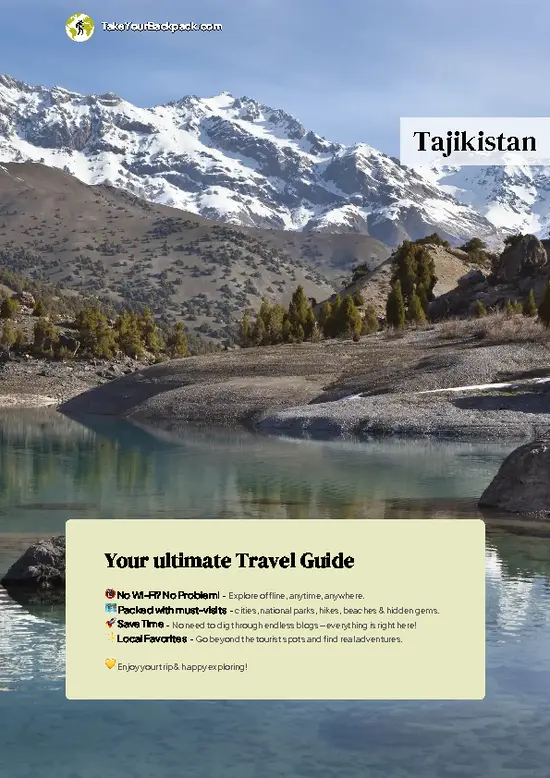
The country hits you with altitude almost everywhere. You ride the Pamir Highway past yurts and yak herds at 4,000 meters, hike from one turquoise lake to the next in the Fann Mountains, and roll down the Wakhan Valley with Afghan villages close enough to wave at across the river. Evenings end cross-legged on a homestay floor with warm flatbread and a pot of green tea. The hard parts are plain: roads are rough, distances crawl, a private 4x4 gets pricey if you can’t share it, and the Pamirs require a separate permit on top of your visa.

Kyrgyzstan next door has smoother logistics and more trekking infrastructure, and Uzbekistan has the grand Silk Road cities. Tajikistan runs wilder than both. It suits travelers who enjoy dust, thin air and improvising with a phrasebook. If you need fast Wi-Fi and fixed schedules, it will be hard going.

👉 Get the 📖 Travel Guide of Tajikistan

Dushanbe and the Hisor Valley (Dushanbe, Hisor Fortress, Varzob Gorge)

Most trips through Tajikistan kick off in Dushanbe, a capital of wide boulevards and fresh marble ministries where the real energy sits in the Mehrgon and Shohmansur bazaars, piled with dried apricots and hot non bread. Shared taxis whisk you to the restored gate of Hisor Fortress in 30 to 40 minutes, and the Varzob Gorge climbs north straight out of town. Ideal for first-timers finding their feet, with a riverside plov lunch as the prize.

Fann Mountains and Zarafshan Valley (Penjikent, Iskanderkul, Seven Lakes)

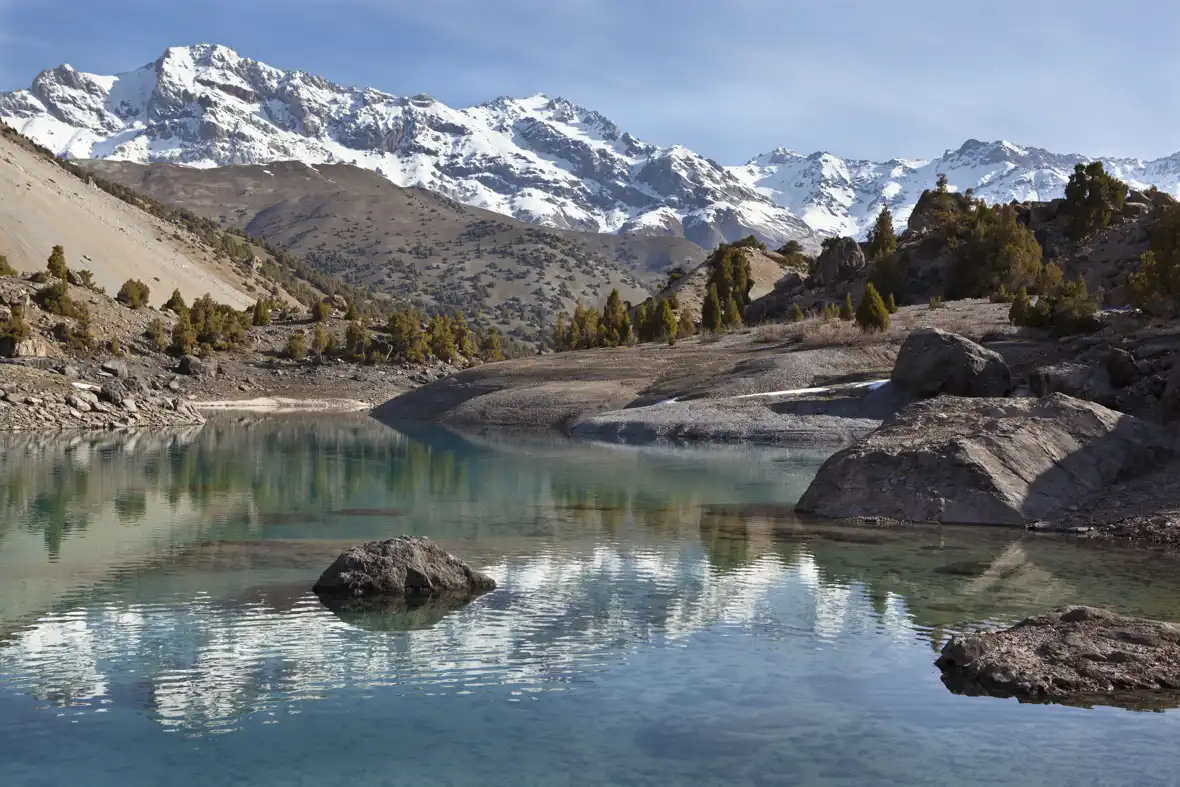
Shared taxis punch through the Anzob tunnel and reach Penjikent in 4 to 5 hours, with Iskanderkul’s turnoff about 3 hours out. From Artuch you haul yourself up steep switchbacks to the Kulikalon lakes; from Penjikent a rough road threads the Seven Lakes past village homestays. Sogdian ruins sit right above Penjikent’s bazaar. Trekkers with a week love it, and the reward is a turquoise lake to yourself at dawn.

Khujand and the North (Khujand, Istaravshan)

Cross the Shahriston pass and in 5 to 6 hours by shared taxi the mountains flatten into Ferghana Valley farmland. Khujand runs on Russian and Uzbek as much as Tajik, and its domed Panjshanbe bazaar hums with spice sellers and tea drinkers. An hour southwest, Istaravshan’s old quarter still turns out hand-forged knives. City wanderers and food lovers fit right in, leaving with a blade and a bag of sweet melons.

Pamir Highway (Khorog, Murghab, Karakul)

Shared Land Cruisers grind 12 to 16 hours from Dushanbe to Khorog, hugging the Panj River with Afghan villages close enough to wave at. Beyond Khorog, the road climbs onto a treeless plateau around 3,600 meters, where Murghab’s container bazaar and the salt-rimmed shore of Karakul feel lunar. Patient travelers comfortable with altitude thrive here, rewarded with Pamiri homestay dinners and skies thick with stars.

Wakhan Valley (Ishkashim, Langar, Yamchun Fortress)

South of Khorog, Ishkashim is 2 to 3 hours away and Langar a long, bumpy day, on transport so sparse that cyclists and hired jeeps rule the gravel. You scramble up to the crumbling walls of Yamchun Fortress, then soak in the Bibi Fatima hot springs below. Slow travelers and cyclists get the best of it: the snowbound Hindu Kush filling the far bank all day long.
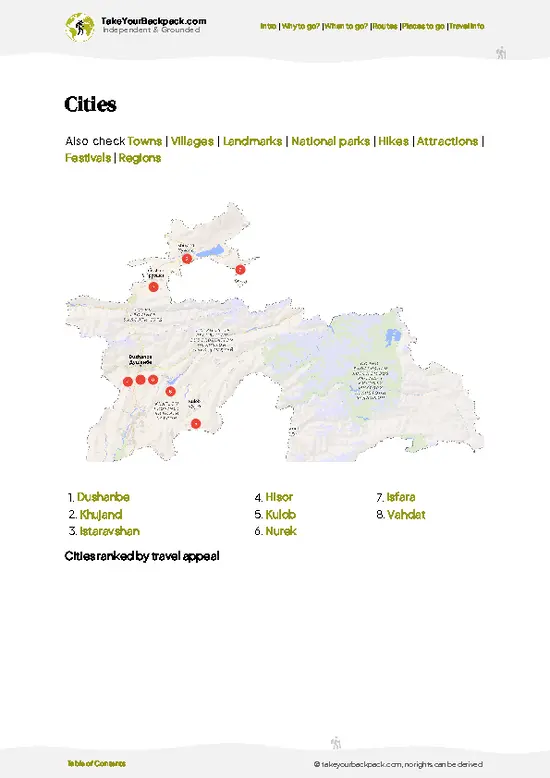
Geography and where places are located
Loading the map 🌍
CLICK TO FILTER
cities
towns
villages
landmarks
national parks
hikes
attractions
festivals
regions
SHOW COUNTRY’S BESTSHOW ALL

Why go?Reasons people choose to visit

Mountains

Around 93 percent of Tajikistan is mountainous, and you feel it the moment you leave Dushanbe. The Pamirs … read more 👉
Around 93 percent of Tajikistan is mountainous, and you feel it the moment you leave Dushanbe. The Pamirs climb to 7,495 meters at Ismoil Somoni Peak, the Fedchenko Glacier stretches for about 77 kilometers, and the Fann Mountains pack high passes and glacial lakes into a compact range you can cross in a week. Start in the Fanns if you’re new to high-altitude trekking: trails are clearer, resupply villages appear every day or two, and July to September brings the most stable weather. Save the remote Pamir valleys for once your lungs have adjusted.

People

Walk through any village in Tajikistan and expect an invitation within the hour. Hosts spread a dastarkhan, … read more 👉
Walk through any village in Tajikistan and expect an invitation within the hour. Hosts spread a dastarkhan, a cloth loaded with bread, nuts, sweets and tea, before asking your name. Older men will test your Russian, kids will practice their English, and grandmothers will insist you eat more. Humor runs warm and teasing, especially about your marital status. Learn “salom” for hello and “rahmat” for thank you, and use them freely. Accept at least one cup of tea when invited, and bring small gifts from home, like postcards or chocolate, for host families.

Uniqueness

Few places let you hike for days and meet only shepherds, yet Tajikistan does it routinely. In the Yagnob … read more 👉
Few places let you hike for days and meet only shepherds, yet Tajikistan does it routinely. In the Yagnob Valley, a few hundred villagers speak Yaghnobi, a living descendant of ancient Sogdian, the language of Silk Road merchants. In the Pamirs, people speak languages like Shughni and Wakhi that are rarely heard outside these valleys. Mobile signal disappears for long stretches, and the nearest town may be a day’s drive away. Carry cash, offline maps and a paper notebook of key phrases; the remoteness works best when you’re ready to go fully unplugged.

Low cost

Backpacking Tajikistan typically costs around 200 to 350 somoni (US$20 to 35) a day, covering a homestay … read more 👉
Backpacking Tajikistan typically costs around 200 to 350 somoni (US$20 to 35) a day, covering a homestay bed, two home-cooked meals and a shared-taxi seat. Homestays usually include dinner and breakfast, so your main extra spending is snacks, tea and bazaar fruit. Street food stays cheap: a plate of plov or a bowl of qurutob rarely strains a budget. The big expense is private 4x4 hire in the Pamirs, so team up with other travelers at guesthouses in Khorog or Dushanbe and split the cost. Carry small notes, since change runs short in villages.

⭐ HighlightsStandout locations across the country

  • Wakhan Valley: The Panj River churns gray-green below you, and on the far bank Afghan farmers walk their donkeys past mud-walled hamlets. Climb to the ruined Yamchun fortress for the full sweep of the Hindu Kush, then soak in the Bibi Fatima hot spring, where the mineral water smells faintly of sulfur and local women come to bathe and chat.
  • Haft Kul (Seven Lakes): A dirt road from Penjikent strings seven lakes up a narrow valley, each a different shade from milky jade to deep sapphire. Kids sell apricots by the roadside, and in the upper villages you hear the clank of cowbells echoing off the cliffs while bread bakes in clay tandoors.
  • Iskanderkul: Legend ties this lake to Alexander the Great. The water turns electric blue in afternoon light, wind rattles the poplars along the shore, and a short walk brings you to a waterfall that throws cold spray across the viewpoint railing.
  • Karakul Lake: At roughly 3,900 meters, the air feels thin and sharp in your lungs. This huge salt lake glows under
… read more 👉
  • Wakhan Valley: The Panj River churns gray-green below you, and on the far bank Afghan farmers walk their donkeys past mud-walled hamlets. Climb to the ruined Yamchun fortress for the full sweep of the Hindu Kush, then soak in the Bibi Fatima hot spring, where the mineral water smells faintly of sulfur and local women come to bathe and chat.
  • Haft Kul (Seven Lakes): A dirt road from Penjikent strings seven lakes up a narrow valley, each a different shade from milky jade to deep sapphire. Kids sell apricots by the roadside, and in the upper villages you hear the clank of cowbells echoing off the cliffs while bread bakes in clay tandoors.
  • Iskanderkul: Legend ties this lake to Alexander the Great. The water turns electric blue in afternoon light, wind rattles the poplars along the shore, and a short walk brings you to a waterfall that throws cold spray across the viewpoint railing.
  • Karakul Lake: At roughly 3,900 meters, the air feels thin and sharp in your lungs. This huge salt lake glows under snowcapped ridges near the Chinese border, and the tiny village of the same name serves salty milk tea in homestays heated by dung-fired stoves.
  • Panjshanbe Bazaar, Khujand: Under a pastel Soviet-era dome, traders pile pyramids of pomegranates, walnuts and rock-hard balls of dried yogurt called qurut. Vendors press samples into your palm, and the air smells of cumin, fresh bread and grilled meat from the stalls outside.
Further out, the Bartang Valley, the cliff-ringed village of Jizev and the lonely shores of Zorkul reward travelers willing to walk or wait for a rare ride.
Spotted a mistake or missing a highlight? Contact us.

But Tajikistan offers more...

Discover and compare all of its highlights per category

🧭 RoutesPlanning a route that makes sense

The 5-Day Fann Lakes Route


Five days of turquoise lakes, rough mountain roads and village homestays in the Fann Mountains, without a multi-day trek. It ends near the Uzbek border, so it fits neatly before or after Samarkand.
  • Iskanderkul and its waterfall
  • The Seven Lakes road and a homestay night
  • The Sogdian ruins of Panjakent

👉 explore this 5-day route

The 10-Day Trek and Silk Road Route


A proper trek over a high pass between alpine lakes, followed by the caravan towns of the north. It balances tough trail days with slow afternoons in bazaars and old fortresses.
  • The Kulikalon and Alaudin lakes of the Fann Mountains
  • The reclining Buddha of Dushanbe
  • The blue domes and knife-makers of Istaravshan
  • Khujand, the city Alexander founded

👉 explore this 10-day route

The 15-Day Sogdiana to Pamirs Route


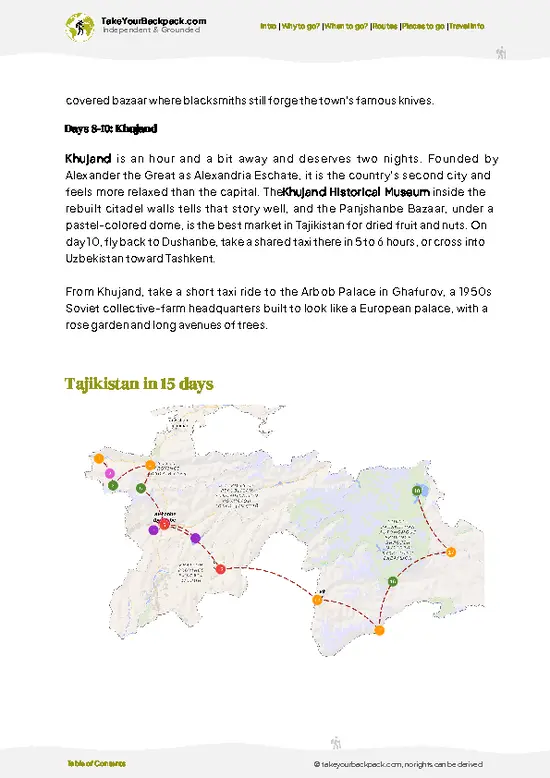
A full crossing of the country from the Samarkand border to the high Pamir plateau and on to Kyrgyzstan. Expect long road days, Afghan villages across the river and nights above 3,500 meters.
  • The Seven Lakes
… read more 👉

The 5-Day Fann Lakes Route


Five days of turquoise lakes, rough mountain roads and village homestays in the Fann Mountains, without a multi-day trek. It ends near the Uzbek border, so it fits neatly before or after Samarkand.
  • Iskanderkul and its waterfall
  • The Seven Lakes road and a homestay night
  • The Sogdian ruins of Panjakent

👉 explore this 5-day route

The 10-Day Trek and Silk Road Route


A proper trek over a high pass between alpine lakes, followed by the caravan towns of the north. It balances tough trail days with slow afternoons in bazaars and old fortresses.
  • The Kulikalon and Alaudin lakes of the Fann Mountains
  • The reclining Buddha of Dushanbe
  • The blue domes and knife-makers of Istaravshan
  • Khujand, the city Alexander founded

👉 explore this 10-day route

The 15-Day Sogdiana to Pamirs Route


A full crossing of the country from the Samarkand border to the high Pamir plateau and on to Kyrgyzstan. Expect long road days, Afghan villages across the river and nights above 3,500 meters.
  • The Seven Lakes and Iskanderkul
  • The Wakhan Valley and the petroglyphs above Langar
  • Murghab and the Ak-Baital Pass
  • Karakul Lake on the Pamir Highway

👉 explore this 15-day route

🌤️ When to go?Weather, seasons, and timing

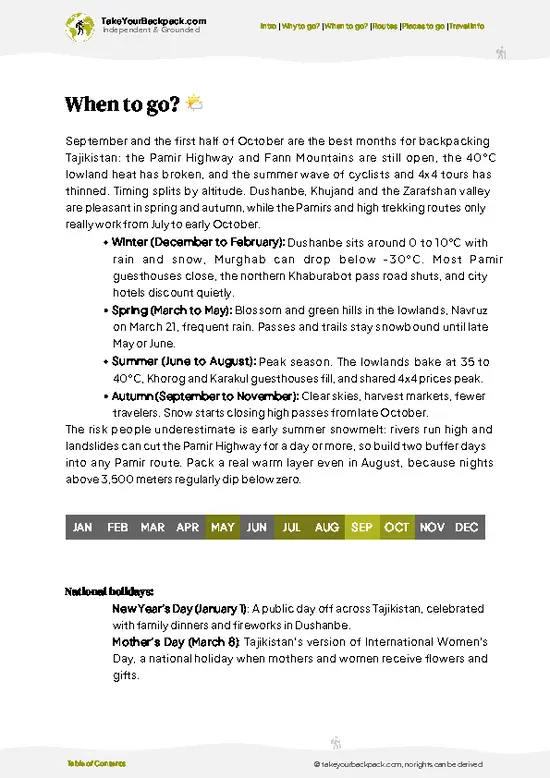
September and the first half of October are the best months for backpacking Tajikistan: the Pamir Highway and Fann Mountains are still open, the 40°C lowland heat has broken, and the summer wave of cyclists and 4x4 tours has thinned. Timing splits by altitude. Dushanbe, Khujand and the Zarafshan valley are pleasant in spring and autumn, while the Pamirs and high trekking routes only really work from July to early October.
  • Winter (December to February): Dushanbe sits around 0 to 10°C with rain and snow, Murghab can drop below -30°C. Most Pamir guesthouses close, the northern Khaburabot pass road shuts, and city hotels discount quietly.
  • Spring (March to May): Blossom and green hills in the lowlands, Navruz on March 21, frequent rain. Passes and trails stay snowbound until late May or June.
  • Summer (June to August): Peak season. The lowlands bake at 35 to 40°C, Khorog and Karakul guesthouses fill, and shared 4x4 prices peak.
  • Autumn (September to November): Clear skies, harvest markets, fewer travelers. Snow starts closing high passes from late October.
The risk people underestimate is early summer snowmelt: rivers run high and landslides can cut the Pamir Highway for a day or more, so build two buffer days into any Pamir route. Pack a real warm layer even in August, because nights above 3,500 meters regularly dip below zero.

source: climatestotravel.comJANJanuary: below average for travelingFEBFebruary: below average for travelingMARMarch: fair for travelingAPRApril: fair for travelingMAYMay: good for travelingJUNJune: fair for travelingJULJuly: good for travelingAUGAugust: good for travelingSEPSeptember: excellent for travelingOCTOctober: highly recommended for travelingNOVNovember: fair for travelingDECDecember: below average for traveling
Tajikistan iStock-180840361

💰 Costs (as of 2026)Prices, expenses, and money tips

Backpacking Tajikistan costs about US$25 to 40 a day if you sleep in dorms and homestays, eat in chaikhanas and travel by shared taxi. The Pamir Highway is the exception, because hiring a 4x4 can double that figure.
CategoryBudget RangeLocal Reality
Dorm accommodationUS$8 to 25 per nightA dorm bed at a Dushanbe hostel costs US$8 to 15. Khorog guesthouses charge US$10 to 15. Homestays in the Pamirs and the Fann Mountains cost US$15 to 25, and that usually includes dinner and breakfast, so they often work out cheaper than a hostel plus meals. Paying in cash and staying several nights can knock a dollar or two off.
MealsUS$5 to 12 per daySamsa costs US$0.30 to 0.60, a round of non bread US$0.30, and a plate of plov or lagman in a chaikhana US$2 to 3. Supermarkets in Dushanbe and Khujand stock bread, dried fruit, nuts and dairy for US$3 to 5 a day. Outside the cities, shops carry very little, so stock up before you head into the Pamirs.
Local transportUS$0.20 to 55 per tripCity buses and marshrutkas in Dushanbe cost US$0.20 to 0.30. A shared taxi from Dushanbe to Khujand costs US$20 to 25, and a seat from Dushanbe to Khorog costs US$40 to 55 for a ride of 12 to 16 hours. Shared seats are the
… read more 👉
Backpacking Tajikistan costs about US$25 to 40 a day if you sleep in dorms and homestays, eat in chaikhanas and travel by shared taxi. The Pamir Highway is the exception, because hiring a 4x4 can double that figure.
CategoryBudget RangeLocal Reality
Dorm accommodationUS$8 to 25 per nightA dorm bed at a Dushanbe hostel costs US$8 to 15. Khorog guesthouses charge US$10 to 15. Homestays in the Pamirs and the Fann Mountains cost US$15 to 25, and that usually includes dinner and breakfast, so they often work out cheaper than a hostel plus meals. Paying in cash and staying several nights can knock a dollar or two off.
MealsUS$5 to 12 per daySamsa costs US$0.30 to 0.60, a round of non bread US$0.30, and a plate of plov or lagman in a chaikhana US$2 to 3. Supermarkets in Dushanbe and Khujand stock bread, dried fruit, nuts and dairy for US$3 to 5 a day. Outside the cities, shops carry very little, so stock up before you head into the Pamirs.
Local transportUS$0.20 to 55 per tripCity buses and marshrutkas in Dushanbe cost US$0.20 to 0.30. A shared taxi from Dushanbe to Khujand costs US$20 to 25, and a seat from Dushanbe to Khorog costs US$40 to 55 for a ride of 12 to 16 hours. Shared seats are the cheapest way to cover long distances. Prices are close to Kyrgyzstan’s, but you get more road time per dollar on Uzbekistan’s trains.
ActivitiesUS$0 to 100+ per dayTrekking around Iskanderkul and the Seven Lakes is free apart from transport and homestays. Museums in Dushanbe cost US$1 to 3. The big expenses are a private 4x4 with driver on the Pamir Highway, roughly US$150 to 250 a day split between up to four people, and the GBAO permit, about US$20 on top of the e-visa.
MiscellaneousUS$2 to 5 per dayA Tcell or MegaFon SIM card with data costs US$3 to 6. Bottled water is US$0.30 to 0.50 a liter. A banya in a homestay costs US$2 to 5. Outside Dushanbe, Khujand and Khorog, ATMs are rare and often run out of cash, so carry clean US dollar notes to change.
Total Daily BudgetUS$25 to 40US$25 covers a homestay with meals, food from the bazaar and the occasional marshrutka. US$40 also covers long shared-taxi days. If you add a shared 4x4 in the Pamirs, budget US$60 to 90.
Compared with its neighbors, the country costs about the same as Kyrgyzstan for beds and food. It is a little cheaper than Uzbekistan for accommodation, but transport costs more, because most travel is by road over long distances and there are almost no trains. Your biggest single expense will almost always be transport, so find people to share a jeep with in Dushanbe or Khorog before you set off.
⚠️ Prices can change and everyone travels differently, so take this as a rough guide. Hope it helps you plan your adventure!

✈️ The backpacker research shortcutTajikistan Travel Guide

An offline-friendly backpacking guide with optimized travel routes, ranked highlights, transport advice, and the best areas to stay.
example page 0 from our offline Travel Guide for Tajikistan
example page 1 from our offline Travel Guide for Tajikistan
example page 2 from our offline Travel Guide for Tajikistan
example page 3 from our offline Travel Guide for Tajikistan
example page 4 from our offline Travel Guide for Tajikistan
example page 5 from our offline Travel Guide for Tajikistan
example page 6 from our offline Travel Guide for Tajikistan
example page 7 from our offline Travel Guide for Tajikistan
The digital guide (268 pages) contains:
✅ 64 highlights, ranked by travel appeal
✅ Optimized 5, 10 & 15-day travel routes
✅ Cities, national parks, landmarks, beaches
✅ How to get around
✅ Offline-friendly for travel without Wi-Fi
👉 Click to see all 30+ guide features

📅 Plan smarter in minutes, not weeks
✅ Month by month travel advice
✅ Festivals & national holidays
✅ Budget expectations

🗺️ Go to the right places, skip the overrated ones
✅ Honest pros & cons of destinations
✅ Top hikes, parks & viewpoints
✅ Lesser-known places most travelers miss
✅ Clear “worth it vs skip it” guidance

🛏️ Travel smoothly without rookie mistakes
✅ Best areas to stay
✅ Transport systems explained simply
✅ Common scams & safety advice
✅ SIM cards, money & practical tips

🌍 Understand the country, not just visit it
✅ Culture & traditions
✅ 52 Essential phrases & customs
✅ Festivals worth planning around
✅ Traveler-friendly historical context
✅ Insights that make places more meaningful

📱 Built for real travel conditions
✅ Fully downloadable PDF
✅ Works completely offline
✅ Optimized for phone use
✅ Useful in remote areas & buses
✅ Everything in one place
Stop searching, start planning
Get instant access to your full guide. 30‑day money-back guarantee.
+ Add another guide for just

By proceeding you agree to our terms.
Sent to your inbox immediately after payment • 100% Secure Checkout
Best Backpacking Travel Advisor 2025 tourism awardBest Backpacking
Travel Advisor
2025
What others say about Take Your Backpack Guides:
⭐⭐⭐⭐⭐
Fantastic, amazing amount of information!
⭐⭐⭐⭐⭐
My goodness this is amazing, it's what I've been looking for hats off too you!
⭐⭐⭐⭐⭐
I think this is absolutely BRILLIANT
⭐⭐⭐⭐
Very complete and informative. It's still missing places, but I gotta to commend you
⭐⭐⭐⭐⭐
This is truly amazing, thank you, can't wait to explore it with my kids!
⭐⭐⭐⭐⭐
Awesome resource, thank you!
⭐⭐⭐⭐⭐
This is amazing! Can't wait to explore the ones I haven't seen
⭐⭐⭐⭐
I love this! Well done, great idea.
⭐⭐⭐⭐⭐
Thanks for taking the time to make this gem!
⭐⭐⭐⭐⭐
This might be the best website I've ever seen.
⭐⭐⭐⭐⭐
Congratulations, and thank you so much for your work; it's incredibly valuable.
⭐⭐⭐⭐
In all seriousness I think you did a great job pointing out the important spots
⭐⭐⭐⭐⭐
10/10 very good
⭐⭐⭐⭐⭐
As someone who's only just starting to visit regularly this is awesome, thank you.
⭐⭐⭐⭐
Thank you very much! I'm going to visit my dad, it's going to be very useful!
⭐⭐⭐⭐⭐
This is really cool! We'll be travelling for the first time and this definitely come in handy.
⭐⭐⭐⭐⭐
You are now our minister of culture, congratulations 👨‍💼
⭐⭐⭐⭐⭐
Just wanted to tell you that this is a pearl! Going to follow your recommendations.
⭐⭐⭐⭐⭐
This is so cool. I'll definitely be using the resource for my travels soon.
⭐⭐⭐⭐⭐
This is very impressive! Good work.
⭐⭐⭐⭐⭐
This is an amazing and informative site. Very well done!

🛏️ Where to stay?Accommodation types and options

Tajikistan has a small but growing hostel scene, with dorm beds from roughly US$7 to 12 and guesthouse rooms from about US$15 to 30, most of them in Dushanbe, Khorog and Khujand. In Dushanbe, the streets around Rudaki Avenue put you within walking distance of the parks, museums and the few bars and cafes that stay open late, while the quieter residential lanes south toward the Shohmansur bazaar area are cheaper and closer to shared taxi stands but a longer walk from evening life. In Khorog, places near the center and the Panj River make it easy to arrange Pamir Highway transport, and nights are … read more 👉
Tajikistan has a small but growing hostel scene, with dorm beds from roughly US$7 to 12 and guesthouse rooms from about US$15 to 30, most of them in Dushanbe, Khorog and Khujand. In Dushanbe, the streets around Rudaki Avenue put you within walking distance of the parks, museums and the few bars and cafes that stay open late, while the quieter residential lanes south toward the Shohmansur bazaar area are cheaper and closer to shared taxi stands but a longer walk from evening life. In Khorog, places near the center and the Panj River make it easy to arrange Pamir Highway transport, and nights are calm and safe with almost no nightlife, while homestays in the Pamir and Fann Mountain villages trade hostel social life for home-cooked meals and very early nights.

If you enjoy meeting fellow travelers, consider choosing hostels with high ratings for atmosphere. On the other hand, if you prefer having your own space, a hotel might be a better option.

🚌 Getting aroundGetting around Tajikistan

Shared taxis move most backpackers around Tajikistan, because passenger rail barely exists and long-distance buses are rare outside a few northern routes. You walk up to the right stand, a driver yells your destination, and the car rolls the moment every seat is sold.
  • Shared taxis: Sedans and minivans link every town. Dushanbe to Khujand runs 5 to 6 hours through the Anzob or Shahriston tunnels for roughly 150 to 250 somoni (US$14 to 23) a seat. Dushanbe to Penjikent takes 4 to 5 hours for 100 to
… read more 👉
Shared taxis move most backpackers around Tajikistan, because passenger rail barely exists and long-distance buses are rare outside a few northern routes. You walk up to the right stand, a driver yells your destination, and the car rolls the moment every seat is sold.
  • Shared taxis: Sedans and minivans link every town. Dushanbe to Khujand runs 5 to 6 hours through the Anzob or Shahriston tunnels for roughly 150 to 250 somoni (US$14 to 23) a seat. Dushanbe to Penjikent takes 4 to 5 hours for 100 to 150 somoni. Pay the driver in cash, and expect the front seat to cost a bit extra. The Anzob tunnel is dark, flooded in places and full of exhaust, so keep the window shut. On the far side the Fann Mountains rise straight off the road.
  • Shared 4x4s on the Pamir Highway: Land Cruisers and Pajeros leave Dushanbe for Khorog around dawn and need 12 to 16 hours on a road that hugs the Panj River, for 400 to 600 somoni (US$37 to 55). Khorog to Murghab takes 7 to 9 hours for 200 to 350 somoni. I’d buy two seats if you’re tall. For hours you ride within shouting distance of Afghan villages on the opposite bank.
  • Private 4x4 with driver: Expect US$150 to 250 a day for the vehicle, split between up to four people, plus the driver’s meals. Guesthouses in Khorog and Murghab set these up. You get to stop on demand for the Wakhan Valley hot springs and the fortress ruins above the river.
  • Dushanbe minibuses and Yandex Go: Minibuses and buses cost 2 to 3 somoni a ride, paid on board. Yandex Go runs reliably in the capital, at 10 to 25 somoni across town with the price fixed upfront. That puts the teahouses and bazaars of the whole city within a cheap 15-minute hop.
  • Hitchhiking: Common in the Pamirs, where Chinese trucks and local cars pick people up. Drivers often expect a contribution, so agree on it first. Traffic between Murghab and Karakul can dry up for hours. When it works, you share bread and tea in a truck cab at 4,000 meters.
Run the Pamir Highway one way only: start in Dushanbe, finish by crossing the Kyzyl-Art pass into Kyrgyzstan toward Osh, and you skip two full days of backtracking.
Dushanbe International Airport (DYU) in Tajikistan sits about 5 km (3 miles) southeast of the city center, and the cheapest reliable way in is a city bus or minibus for around 2 to 3 somoni (about US$0.20 to 0.30).
  • City bus or minibus (20 to 35 minutes, 2 to 3 somoni / about US$0.20 to 0.30): catch it on the main road a short walk from the terminal exit, pay the driver or conductor in small somoni notes, and expect services to thin out after about 9 pm.
  • Airport taxi (10 to 20 minutes, 30 to 60 somoni / about US$3 to 6): drivers wait right outside arrivals, so agree on the price in somoni before you get in and carry small notes, since change is often short.
  • Yandex Go ride-hailing (10 to 20 minutes, 15 to 30 somoni / about US$1.50 to 3): book in the app with a local SIM or airport Wi-Fi, pay the driver in cash, and walk a little away from the terminal door if the pickup pin causes confusion with waiting taxi drivers.
Many flights land between 2 and 5 am, so if yours does, set up Yandex Go or ask your hostel to arrange a pickup before you fly, because buses are not running and taxi drivers quote their highest prices at that hour.
⚠️ Prices and routes can change, so take this as a rough guide and ask for local advice when you arrive.
🚀 Don’t waste time on the road.
We’ll generate a route that minimizes unnecessary travel and fits your available days.

Generate my itinerary

🔒 Safety (risk Level: medium)Is Tajikistan safe to visit?

Safety for solo travelers, including women and LGBTQ+ individuals
Tajikistan is generally safe for solo travelers, with low rates of violent crime and a strong culture of hospitality toward guests, though petty theft can happen in busy bazaars and the Afghan border areas and parts of Gorno-Badakhshan can see sudden security restrictions. Solo women travel here without major problems, but should expect curious stares, frequent questions about marriage and occasional unwanted attention, so modest clothing and choosing family-run guesthouses help. Same-sex relations are legal in Tajikistan, yet LGBTQ+ people face strong social stigma and police harassment of locals has been reported, so discretion and avoiding public displays of affection are strongly advised. Register with your embassy if you head to the Pamirs and keep copies of your passport and GBAO permit with you.


Full official government travel advisory (live updates)
View details 👉

✈️ VisaWhat travelers should know about visas

Many nationalities can enter Tajikistan visa-free for a short stay, and most others, including those who need a visa, can apply online for a Tajik e-Visa (typically single entry for up to 60 days) through the official evisa.tj portal, with approval usually within a few working days. If you plan to travel the Pamir Highway or anywhere in the Gorno-Badakhshan region, you also need a GBAO permit, which you can add to your e-Visa application for an extra fee or obtain separately. Check your nationality’s current rules on the official portal before you book.

source: evisa.tj
⚠️ Visa requirements can change over time, so always check the latest visa requirements with the official embassy or government website before you travel.

🎒 What to pack?What to wear and bring

Packing for Tajikistan means planning for two climates at once: Dushanbe and the lowlands can top 40°C in July, while nights on the Pamir Plateau drop near freezing even in summer. Bring layers you can add on the road, a warm jacket and a sleeping bag liner for chilly homestays, plus strong sunscreen and sunglasses for the intense high-altitude sun. Dusty gravel roads and long 4x4 days make a sturdy bag, a buff for dust and good walking shoes far more useful than anything fancy. Tajikistan is a conservative Muslim-majority country, so pack loose clothing that covers shoulders and knees, and a scarf if you’re a woman, especially for villages and mosques. Cash, a basic first aid kit and a water filter matter more here than gadgets, since pharmacies and ATMs disappear once you leave the main towns.

Apart from this country specific advice, I have also crafted a general packing list that should help on any trip. authorOver the years, I've learned the importance of packing minimally. It's so much easier to jump on the back of a truck or squeeze yourself into the last spot of a minibus without that supersized backpack. If you're headed to a warm destination, leave your winter jacket at home; for colder regions, opt for thin thermal underlayers. Instead of packing your entire wardrobe, bring just three sets of clothes, as laundry facilities are available everywhere.

View the full list 👉

🙋 FAQQuick answers to practical concerns

Trip Planning

Planning a backpacking route through Tajikistan can be tricky — you need to balance must-see places, travel times, budget, and how long to stay in each destination. Our free personalized Tajikistan itinerary planner creates a route based on your travel style, trip duration, and interests, so you can spend less time researching and more time exploring.


Personal tip: I normally search on good rating for atmosphere (for meeting people) and location (for easy exploring). Cleanliness as a bonus.


Travel Essentials

No vaccinations are required to enter Tajikistan unless you arrive from a yellow fever risk country, in which case proof of yellow fever vaccination may be requested. Make sure routine vaccines (MMR, diphtheria-tetanus-pertussis, polio) are up to date, and get hepatitis A and typhoid, since food and water hygiene in Tajikistan can be patchy. Hepatitis B is advised for longer stays, and rabies vaccination is worth considering for remote Pamir trips, where dogs are common and clinics are days away. Tajikistan was certified malaria-free by the WHO, so antimalarials are not needed.


vaccination requirements
When I first started traveling, I often spent part of my first day in a new country hunting for a local SIM card. While this can still be slightly cheaper, it also takes time and planning.

These days, it's much simpler to install an eSIM before leaving home. Once you arrive in Tajikistan, you can activate it immediately and have mobile data from the moment you land — which is especially useful for ordering transport or navigating away from busy airports.

There are many providers nowadays, and price differences are usually small. I personally go with Holafly, as it offers excellent network coverage throughout the country and strong global coverage, so you can manage multiple countries from a single app.


HolaFly eSim

Culture & Customs

Hospitality is close to sacred in Tajikistan, so accept at least a cup of tea and a piece of bread when invited, and expect your host to keep refilling your bowl (a nearly empty bowl means you want more). Take your shoes off before entering a home or stepping onto the dastarkhan (the cloth or mat where food is laid out), never step over it, and never place bread upside down or on the ground. Eat and pass things with your right hand, and let elders sit and eat first. Dress modestly, covering shoulders and knees, and women should bring a scarf for mosques and shrines. Ask before photographing people, especially women, and never photograph military sites, border posts, police or government buildings. During Ramadan, avoid eating, drinking or smoking in public during daylight in conservative areas. Women may find that men address their male companions instead of them, and couples of any kind should keep physical affection private, which matters even more for LGBTQ+ travelers.
Trying traditional food is always a great way to experience the culture. Here are some must-try dishes for Tajikistan.
  1. Qurutob: Tajikistan’s national dish, made of flaky flatbread torn into pieces and soaked in qurut (dried salty yogurt balls dissolved in water), topped with fried onions, tomatoes and herbs. It’s served on a shared wooden tray and eaten with the right hand, which makes it a communal meal as much as a dish.
  2. Osh (plov): Rice cooked in a huge kazan with lamb or beef, yellow carrots, onions and chickpeas, often finished with quail eggs or raisins. It anchors weddings, funerals and Thursday or Friday gatherings, and men traditionally cook it.
  3. Non: Round, stamped bread baked on the walls of a clay tandoor oven. Bread is treated as sacred, never placed upside down or thrown away, and every meal starts with it being broken and shared.
  4. Sambusa: Triangular pastries stuffed with minced lamb, onion and fat, baked in a tandoor. They’re the go-to street snack at bazaars and roadside stops, best eaten straight from the oven.
  5. Shashlik: Skewers of lamb, beef or liver grilled over charcoal, served with raw onion and non. Chaikhanas across the country build their reputation on them.
  6. Laghman: Thick hand-pulled noodles in a meat and vegetable broth or stir-fried, a Central Asian staple that warms you up on cold mountain evenings.
  7. Shirchoy: Salty milk tea with butter, with bread broken into it, a Pamiri breakfast that keeps homestay guests fueled at high altitude.
Tap water in Tajikistan is not safe for travelers to drink, and even many locals in Dushanbe and other cities boil it or buy bottled water. Stick to bottled water, which is cheap and sold everywhere, or carry a filter or purifier for the Pamirs and Fann Mountains, where streams can be contaminated by livestock. Boiled tea served in homes and teahouses is safe.
The main language in Tajikistan is Tajik. Backpacking is way more rewarding if you know a bit of the local language, so I'd suggest brushing up on the basics just in case your Tajik skills have become a bit rusty.

Want to understand locals better?
The complete Travel Guide for Tajikistan includes 52 essential words and phrases — greetings, thank-yous, ordering food, transport, numbers, and common local expressions you'll actually hear.

Get your local basic phrases 👉

Get the Travel Guide -


English is thin on the ground in Tajikistan: you’ll find it at hotels, hostels, travel agencies and some cafés in Dushanbe, and among a growing number of students and young professionals. Pamiri guesthouse families, especially in Khorog, often have a younger member who speaks decent English. In villages, bazaars and shared taxis, expect almost none. Russian is by far the most useful second language everywhere, so download an offline Russian pack in Google Translate and learn to read Cyrillic, which also unlocks Tajik signs and menus.

Money & Payments

The local currency of Tajikistan is TJS (Somoni).
In Tajikistan, ATMs are easy to find in Dushanbe and Khujand and exist in Khorog, but they are rare to nonexistent in Murghab and the rest of the Pamirs, so withdraw enough somoni before heading east. Visa cards work at most machines, Mastercard less reliably, and local banks typically charge a fee of roughly 1 to 3 percent on top of whatever your home bank adds, with some ATMs also dispensing US dollars. Cards are accepted at upscale hotels, larger supermarkets and some restaurants in Dushanbe, while bazaars, shared taxis, homestays and nearly everything outside the capital run on cash. Bring US dollars as a backup in clean, undamaged, recent notes, since worn or older bills are often refused, and euros and Russian rubles are also exchanged in the cities. Change money at banks or licensed exchange booths, which post their rates openly, and avoid street changers.
Tipping is not a deep tradition in Tajikistan, and many restaurants in Dushanbe already add a 10 to 15 percent service charge to the bill, so check before leaving more. Where no charge is included, rounding up or leaving around 5 to 10 percent for good service is appreciated, while shared taxi drivers do not expect tips. Guides and private drivers on multi-day Pamir trips usually receive a tip of about 5 to 10 percent of the trip cost, and homestay hosts often value a small gift from your home country as much as cash.

🧩 Nearby countriesOther countries to combine with Tajikistan

We 💚 feedbackIs Tajikistan worth visiting?

Go to Tajikistan for the Pamirs, where you can drive for hours and see more yaks than cars, then sleep in a family home at the end of the road. The drawback is time: rough roads, breakdowns and waiting for shared rides eat whole days, so build slack into your plans. As for safety fears tied to the Afghan border, the road along the Panj sees steady traveler traffic, and petty crime against visitors is rare. Your biggest real hazard here is altitude, so ascend slowly.

✍️ Help improve this page!
The information on this page is based on in-depth research, insights shared by experienced travelers, and feedback from the local travel community in Tajikistan. While every effort is made to keep the information accurate and current, conditions can change — so if you spot anything incorrect or outdated, please get in touch.


🙋‍♂️ Give feedback

👋 Meet the founderWho’s Behind Take Your Backpack?

Johan, backpacker and founder of TakeYourBackpackHi, I’m Johan (Netherlands 🇳🇱), the creator of TakeYourBackpack. Over the past 3 decades, I’ve backpacked through 90+ countries across six continents, gaining extensive experience with independent travel, long-term trips, and overland routes.

This site is built on a combination of firsthand travel experience and carefully curated insights from other backpackers. Many guides are based on places I’ve personally visited, while others bring together tips, observations, and practical advice shared by trusted travelers I’ve met along the way.

The goal is to provide realistic, experience-driven guidance — not generic itineraries — so you can explore destinations with better context, clearer expectations, and more confidence.