×
Jamaica 🇯🇲

backpacking North America Jamaica 🇯🇲Move at rhythm-first island pace shaped by music.

Explore HondurasExplore Martinique

Backpacking Jamaica in 2026

A complete guide including when and where to go, costs, transport, itineraries, and practical travel advice.
An overview of visiting Jamaica

Backpacking Jamaica
By Johan Kruseman 🇳🇱 | Updated June 5, 2026

Cash rules beyond resorts, route taxis run the show, and the hustle comes with the hello. Jamaica runs on small businesses, not meters and apps; prices are spoken, not printed. Settle into that rhythm and you’re treated like family, not a wallet.

Here, the island’s soul is basslines and birdcall: reggae from a zinc fence at dusk, the doctor bird flashing in the Blue Mountains as you sip farm‑side coffee. You hike to falls that feel earned—Reach, YS, maybe a nameless cascade a farmer points out—raft the Rio Grande on bamboo, then argue which sound system owned the night over pepper sauce and jerk smoke. Yes, heat, vendor pressure, and long rides can test you, and some headline sights charge like theme parks; but learn the route‑taxi hand signal, carry small bills, eat at cookshops, and the island opens up.

Compared with the Dominican Republic’s easy resort grid, Cuba’s state‑run slow dance, or Cayman’s polish, Jamaica hits harder: bigger personality, steeper hills, real street music. It’s for travelers who want rhythm with their river swims and don’t mind a little friction to earn it.

👉 Get the 📖 Travel Guide of Jamaica

Kingston + Blue Mountains

Culture first, beach later. Kingston rewards travelers who want music, food, and real daily life, then cool air in the hills. Stay New Kingston/Liguanea for safer nights and quick exits. Use red-plate taxis or a vetted driver; traffic eats hours. Hike coffee country by day only, start early, and skip night driving in the hills. Budget goes to shows and food, not transfers.

North Coast Spine: Montego Bay–Falmouth–Ocho Rios (A1)

This is the easy button. Airport close, highway direct, options everywhere. Good for short trips, families, or anyone who wants maximum activity per hour: river rafting, waterfalls, quick boat trips. Prices skew higher and cruise days spike crowds. Beat it by using Knutsford Express and red-plate route taxis, and by timing big sights early.

Negril (Seven Mile + West End)

Slow days, long swims, cliff jumps at sunset. The beach is social and vendor-heavy; the cliffs are quieter and better for couples. It’s a 1.5–2.5 hour run from Montego Bay, mostly along A1. Cash rules at many bars, ATMs are limited, and petty theft is a beach reality—don’t leave phones in bags while you swim. Ideal for low-planning, high-sun downtime.

Port Antonio + The East

Green, rainy, slower. Surf Boston Bay, raft the Rio Grande, swim coves with entry fees that feel worth it if you linger. Logistics are the tax: long transfers from either Kingston or the North Coast, fewer night options, frequent cash-only spots. Suits patient travelers who cook some meals and don’t need nightlife.

South Coast: Treasure Beach, Black River, YS

Rural and spread out. Fewer hustlers, more neighbor hellos. Best with a car or a steady driver; public transit is thin. Sea can be rough, stores sparse, and ATMs not guaranteed. The reward: long empty walks, boat to Pelican Bar, rum country day trips. For readers, writers, and early risers.
A visual overview of the country
Loading the map 🌍
CLICK TO FILTER
city
town
village
unique site
national park
hike
beach
attraction
festival
region
SHOW COUNTRY’S BESTSHOW ALL
film
0
0
0a
Dunn’s River Falls & Park Central Area Facilities
film
1
1
1a
Bob Marley Museum
film
2
2
2a
Rick’s Cafe
film
3
3
3a
Rose Hall Great House
film
4
4
4a
Appleton Estate Rum Experience
film
5
5
5a
Mystic Mountain Adventure Park
film
6
6
6a
Green Grotto Caves Visitor Complex
film
7
7
7a
Jamaica National Heritage Trust–Port Royal Historic Zone
film
8
8
8a
Seven Mile Beach
Giacomo
film
9
9
9a
Negril Beach
Negril Beach Club Condos
film
10
10
10a
Doctor’s Cave Beach
film
11
11
11a
Frenchman’s Cove
film
12
12
12a
Winnifred Beach
film
13
13
13a
Boston Bay Beach
film
14
14
14a
James Bond Beach
Evelyn Villalba
film
15
15
15a
Treasure Beach
Freyser Gomez
film
16
16
16a
San San Beach
film
17
17
17a
Bloody Bay Beach
film
18
18
18a
Lime Cay
film
19
19
19a
Reggae Beach
film
20
20
20a
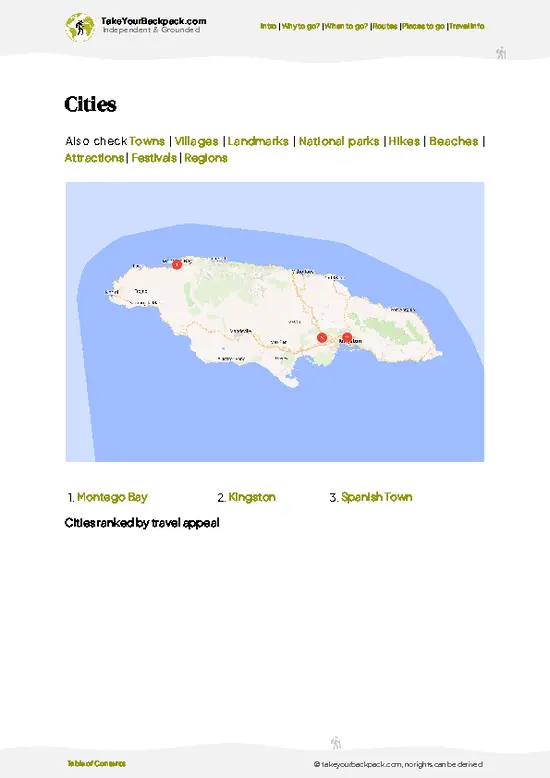
Montego Bay
film
21
21
21a
Blue Mountain Peak
Alecia Cain
film
22
22
22a
Cockpit Country
Omar Downie
film
23
23
23a
Reach Falls
Anne Robinet
film
24
24
24a
Blue Mountains
Dan Long
film
25
25
25a
Negril Marine Park
Ronnygld88
film
26
26
26a
Black River Lower Morass
film
27
27
27a
Royal Palm Reserve
film
28
28
28a
Cranbrook Flower Forest
film
29
29
29a
Rio Grande Valley
film
30
30
30a
Luminous Lagoon
film
31
31
31a
Negril
film
32
32
32a
Ocho Rios
film
33
33
33a
Falmouth
Michael
film
34
34
34a
Runaway Bay
film
35
35
35a
Black River
film
36
36
36a
Bluefields
film
37
37
37a
YS Falls
film
38
38
38a
Mayfield Falls
Mayfield Falls & Mineral Springs - Original
film
39
39
39a
Lover’s Leap

Why go?Reasons people choose to visit

Beach life

Jamaica delivers beach time that actually delivers: sugar-sand sprawl in Negril for lazy days, reef-ledges … read more 👉
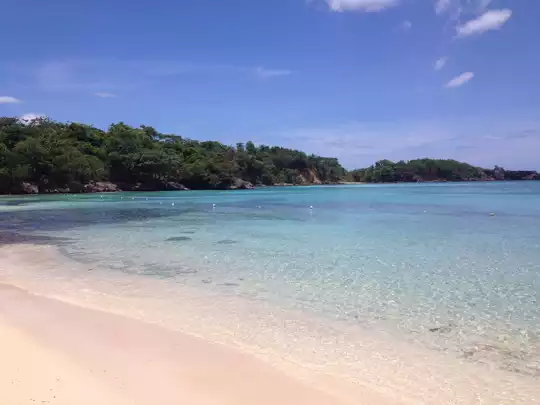
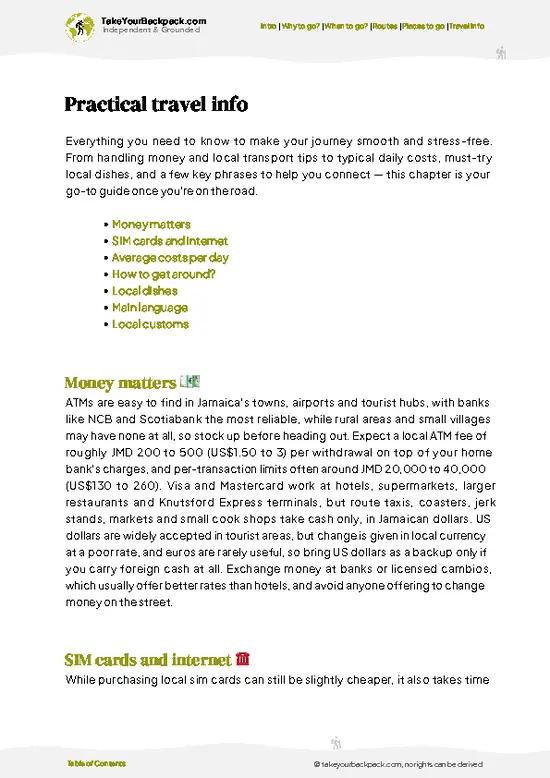
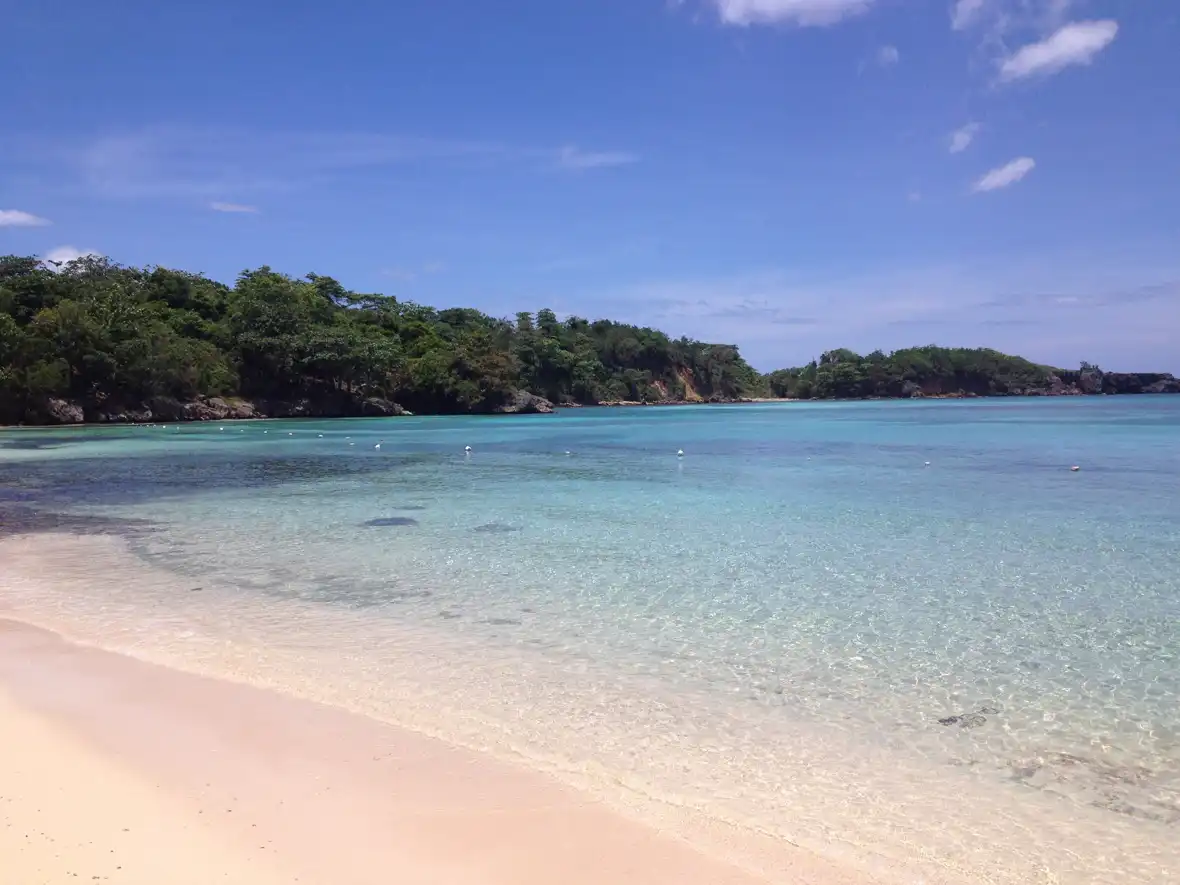
Jamaica delivers beach time that actually delivers: sugar-sand sprawl in Negril for lazy days, reef-ledges off Runaway Bay for fish-watching, and after-dark drum-and-dance on the sand when the grills fire up. Skip the resort cattle boats—hire a licensed local captain at dawn; you’ll beat the crowds and pay half. Bring reef-safe sunscreen and cash for small access fees—I learned the hard way that many of the best strips (Doctor’s Cave, Frenchman’s Cove) charge a gate. Pro tip: on cruise days, route taxi to Winnifred Beach or Treasure Beach—fewer hawkers, more room to breathe.

Scenery

Jamaica pays off if you chase the land, not the resorts. Limestone cliffs in Negril, river-cut gorges, … read more 👉
Jamaica pays off if you chase the land, not the resorts. Limestone cliffs in Negril, river-cut gorges, and the Blue Mountains throwing shade over two coasts. Sunrise above Newcastle made my legs burn and my brain go quiet. Skip tour-bus waterfalls at noon; reach Dunn’s River or YS Falls at opening, or go for Reach Falls or the Blue Hole in the first hour instead. Pro tip: water shoes and small bills save you from rental fees and “mandatory” lockers. Caves at Green Grotto and the karst of Cockpit Country remind you this island has bones, not just beaches.

People

Jamaicans meet you with warmth and quick wit, but respect is the price of entry. Greet first: “Morning” … read more 👉
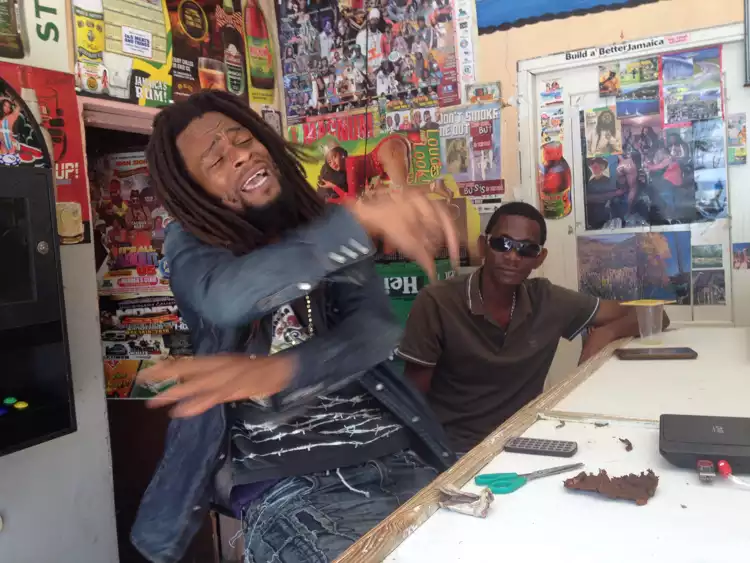
Jamaicans meet you with warmth and quick wit, but respect is the price of entry. Greet first: “Morning” goes farther than money. Don’t bark orders. They joke, they test — laugh with them, don’t posture. Expect offers: rides, crafts, herb, “guide” help; say “No thanks, respect,” and keep moving. Always ask the price before accepting help; carry small bills. Pro tip: pull up at a domino table in a corner bar; buy the next round and they’ll teach you the game. Slow your tempo; small talk before business is not optional — it’s the bridge to real kindness.

Backpackers

Jamaica rewards backpackers who like grit with payoff: reggae nights in Kingston yards, cliff swims … read more 👉
Jamaica rewards backpackers who like grit with payoff: reggae nights in Kingston yards, cliff swims in Negril’s West End, and cheap plates of jerk that keep you moving. The scene is social without the package-tour nonsense; you’ll meet people in route taxis and at yard stays, not lobbies. Pro tip: ride red‑plate route taxis and pay the local fixed fare in Jamaican dollars—carry small bills. I cut my costs in half doing Port Antonio–Boston Bay runs. Skip resort day passes; pay the small public‑beach fee and spend the savings on patties and a Blue Mountain sunrise hike.

Uniqueness

Jamaica rewards effort. Leave the resorts and you get Blue Mountain dawns that smell like coffee smoke, … read more 👉
Jamaica rewards effort. Leave the resorts and you get Blue Mountain dawns that smell like coffee smoke, bamboo-raft runs on the Rio Grande, jerk pulled from a rusty drum in Boston Bay. It’s off the main backpacker loop because transport is slow and hustles add up if you don’t know the system. Use red-plate route taxis, not chartered cars; pay the local fare. Pro tip: carry small JMD, not dollars—cashiers round against you. I hike Blue Mountain Peak overnight for sunrise; start at 2 a.m., pack a shell, and bug oil—Portland sandflies are tiny thieves of joy.
Want the complete picture of Jamaica?
The offline Travel Guide brings everything together — routes, highlights & planning.

See what's included in the guide 👉

Get the Travel Guide -

⭐ HighlightsKey places and experiences

  • Blue Mountain Peak Sunrise: The climb starts in the dark from Whitfield Hall, damp air in your lungs and a headlamp cutting through mist. It’s cold at the top; pack a real jacket and dry socks or you’ll shiver through the payoff. Roads up are rough—share a taxi to keep costs sane. The proof: steam from a thermos of local coffee mixing with cloud as the island wakes below you.
  • Dunn’s River Falls, Ocho Rios: Skip the hand-holding conga line and go after cruise hours; you’ll move faster and spend less energy dodging elbows. Bring your own water shoes, not the overpriced rentals, and stash phones in a cheap dry bag—lockers eat small bills. The proof: limestone gripping your feet while cold water hammers your calves and drowns your voice.
  • Floyd’s Pelican Bar, St. Elizabeth: A shack on stilts in the sea sounds gimmicky until you feel the trade wind slap and the floor flex under your step. Go early before the chop, agree on the boat price up front, and carry cash—card machines die out here. The
read more 👉
  • Blue Mountain Peak Sunrise: The climb starts in the dark from Whitfield Hall, damp air in your lungs and a headlamp cutting through mist. It’s cold at the top; pack a real jacket and dry socks or you’ll shiver through the payoff. Roads up are rough—share a taxi to keep costs sane. The proof: steam from a thermos of local coffee mixing with cloud as the island wakes below you.
  • Dunn’s River Falls, Ocho Rios: Skip the hand-holding conga line and go after cruise hours; you’ll move faster and spend less energy dodging elbows. Bring your own water shoes, not the overpriced rentals, and stash phones in a cheap dry bag—lockers eat small bills. The proof: limestone gripping your feet while cold water hammers your calves and drowns your voice.
  • Floyd’s Pelican Bar, St. Elizabeth: A shack on stilts in the sea sounds gimmicky until you feel the trade wind slap and the floor flex under your step. Go early before the chop, agree on the boat price up front, and carry cash—card machines die out here. The proof: salt crust on your lips, rum fumes in your nose, and tar-slick boards under bare feet.
  • Luminous Lagoon, Falmouth: Pick a dark, moonless night and don’t expect fireworks—this is subtle magic. Smaller boats mean fewer elbows, and the glow pops best if the wind is low and rain hasn’t muddied things. Photos are an upsell; enjoy the water instead. The proof: blue sparks racing off your fingertips and a faint sulfur breath from the mangroves.
  • Negril West End Cliffs: Rick’s is a spectacle with tourist prices; the smarter play is a smaller bar with a ladder and locals who know the depth. Watch jumps first, then go—save the drinks for after. Route taxis beat charter rates if you’re patient. The proof: warm rock under your toes, jerk smoke from a drum pan, and a bassline thumping through your ribs as the sun drops; off the map, try Winnifred Beach’s community-run sands, Cane River Falls near Kingston on a quiet weekday, or Rocklands Bird Sanctuary where a doctor bird perches on your finger—Winnifred is my personal favorite for a plate of fried fish right on the sand.
Spotted a mistake or missing a highlight? Contact us.

But Jamaica offers more...

Discover and compare all of its highlights per category

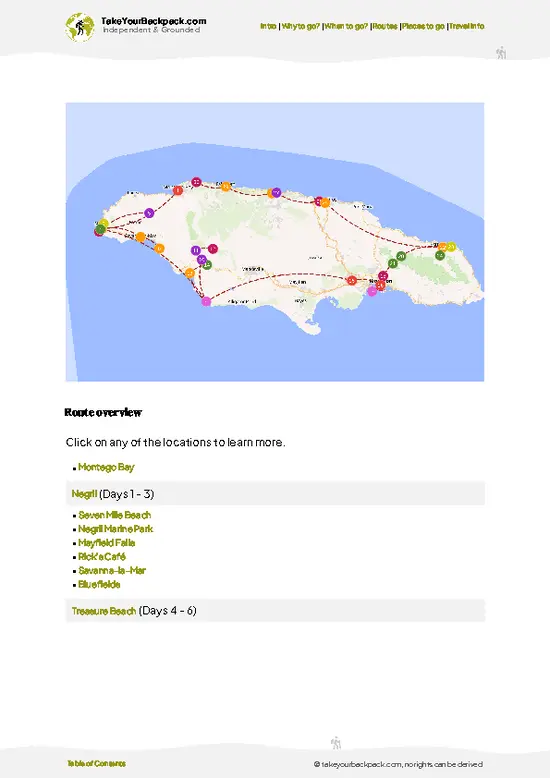
🧭 RoutesSuggested travel routes through Jamaica

The 5-Day North Coast Splash Route

The vibe: A relaxed, beach-and-waterfall-focused escape based around Ocho Rios, perfect if you want maximum time in the sea and minimal time in transit. You’ll lean into easy day trips, soft adventure, and classic north-coast scenery.
The highlights:
  • Base days in Ocho Rios with quick access to beaches and food.
  • Climbing Dunn’s River Falls and cooling off at the Blue Hole.
  • Rainforest thrills at Mystic Mountain Adventure Park.
  • Coastal downtime at James Bond Beach and Bamboo Beach.

The 10-Day Coast & Clouds Route

The vibe: A balanced loop that links Montego Bay, Negril, and the Blue Mountains, mixing classic beaches with reef time and cool highland hikes. Ideal if you want both resort comfort and a taste of Jamaica’s wilder, greener side.
The highlights:
  • Beach and reef time around Doctor’s Cave Beach and Montego Bay Marine Park.
  • Sunset sessions and long walks along Negril’s Seven Mile Beach.
  • Cliff-jumping and live music at Rick’s Cafe.
  • Cool-air hiking in Holywell National
read more 👉

The 5-Day North Coast Splash Route

The vibe: A relaxed, beach-and-waterfall-focused escape based around Ocho Rios, perfect if you want maximum time in the sea and minimal time in transit. You’ll lean into easy day trips, soft adventure, and classic north-coast scenery.
The highlights:
  • Base days in Ocho Rios with quick access to beaches and food.
  • Climbing Dunn’s River Falls and cooling off at the Blue Hole.
  • Rainforest thrills at Mystic Mountain Adventure Park.
  • Coastal downtime at James Bond Beach and Bamboo Beach.

The 10-Day Coast & Clouds Route

The vibe: A balanced loop that links Montego Bay, Negril, and the Blue Mountains, mixing classic beaches with reef time and cool highland hikes. Ideal if you want both resort comfort and a taste of Jamaica’s wilder, greener side.
The highlights:
  • Beach and reef time around Doctor’s Cave Beach and Montego Bay Marine Park.
  • Sunset sessions and long walks along Negril’s Seven Mile Beach.
  • Cliff-jumping and live music at Rick’s Cafe.
  • Cool-air hiking in Holywell National Park and up toward Blue Mountain Peak.

The 15-Day Full Island Loop Route

The vibe: A deep-dive journey that circles from Montego Bay to Negril, down the south coast, and up through Kingston into the Blue Mountains, blending big-name sights with quieter countryside stops. Best for travelers who want to feel the contrast between resort strips, rural river valleys, and the island’s cultural capital.
The highlights:
  • Sea, history, and haunted plantation stories around Montego Bay and Rose Hall Great House.
  • Negril’s beaches and cliffs, plus a refreshing detour to Mayfield Falls.
  • South-coast days at YS Falls, Appleton Estate, Treasure Beach, and Bamboo Avenue.
  • Kingston’s Bob Marley Museum, National Gallery, Port Royal’s historic zone, and a cool finish in the Blue Mountains and Holywell.
🌍 Want a ready-to-use travel plan for Jamaica?
The overview above compares different route options based on your travel time and style. The complete Travel Guide breaks each itinerary down in detail, including maps, stops, highlights, and transport information.

Explore all route details 👉

Get the Travel Guide -

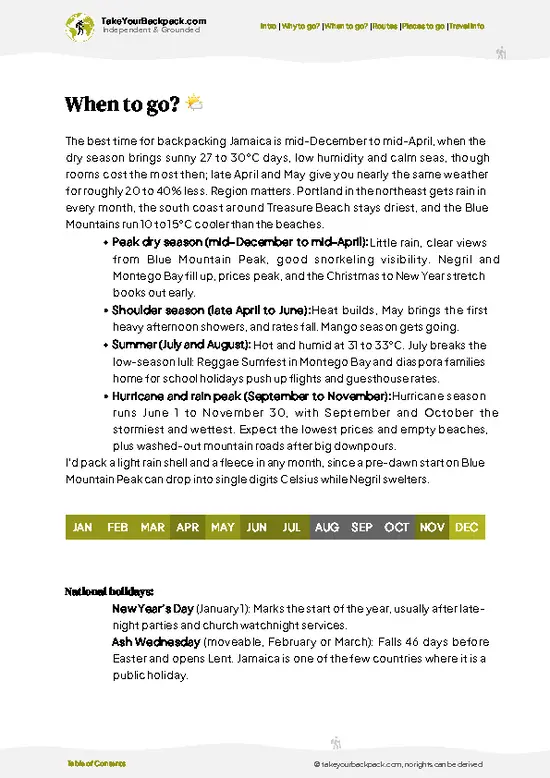
🌤️ When to go?Weather, seasons, and timing

Late November to early December is the sweet spot. Hurricane risk backs off, trade winds scrub the air, and the sea clears without the Christmas stampede. Rooms haven’t spiked yet; you can still bargain without being laughed out of the yard. Heat is real but manageable, and buses aren’t crammed with winter escapees or summer school breaks. If you miss that, late April into May works too: peak ends, prices slide, showers are short and predictable, and you get space on the sand without surrendering sunshine.
  • Peak Dry (mid-Dec to March): The grind is cost and crowds—sold-out guesthouses, inflated taxis, and cruise-day choke points. The high is razor-clear water, firm hiking trails, and Blue Mountain dawn that hits like a clean drumbeat. If you can stomach the price, conditions are dialed.
  • Shoulder Shift (late Nov-early Dec; late Apr-June): The island exhales. Rates drift down, shop shutters lift earlier, beach sellers actually make eye contact, and routes open up. You move faster with fewer detours and better conversations.
  • Hurricane Core (Aug-Oct): Quiet beaches, brooding hills, long talks under zinc roofs. Start early, finish by early afternoon, and carry a dry bag; squalls are sharp and roads pond fast. Flex your plans and stick to uphill lodgings for drainage.
  • Summer Steam (June-July): Heavy heat, ripe fruit, late nights. Most places are calm, but July pops near Montego Bay and Ocho Rios—Reggae Sumfest and school breaks spike beds unexpectedly.

I book my first and last nights two weeks out in the sweet spot, then walk in midday elsewhere—cash ready, bag light—because that’s when owners actually deal.

source: climatestotravel.comJANJanuary: highly recommended for travelingFEBFebruary: highly recommended for travelingMARMarch: highly recommended for travelingAPRApril: good for travelingMAYMay: highly recommended for travelingJUNJune: good for travelingJULJuly: good for travelingAUGAugust: fair for travelingSEPSeptember: fair for travelingOCTOctober: fair for travelingNOVNovember: good for travelingDECDecember: excellent for traveling
📅 Traveling in a specific month?
Get a full month-by-month breakdown of weather, crowds, costs, festivals, and seasonal highlights in the complete travel guide.

Get full details when to go 👉

Get the Travel Guide -
!2016-05-05 11.50.41

💰 Costs (as of 2026)Travel costs in Jamaica

Expect $60-85 per day if you sleep in dorms, ride shared route taxis, and eat street food—break that system and you’ll blast past $100 without trying.
  • dorm accommodation: Coast dorms in Negril/MoBay/Ochi run about $22-35; inland towns (Mandeville, Spanish Town, Port Antonio outskirts) can dip to $15-25. AC usually adds $5-10; fan beds are fine if you pick an upper bunk and catch the breeze. Watch for 10-15% tax not included in the sticker price. System tip: book 2-3 nights midweek, pay cash, and ask for the “fan-dorm” rate—same bed, less power cost. Compared to the DR, Jamaica beds are ~20-40% higher; still miles cheaper than Cayman or the Bahamas.
  • meals: Supermarket Survival: bread, peanut butter, bananas, eggs, tin mackerel, ramen—$8-12/day if you self-cater; imported dairy, cereal, and “health” snacks are punishing (often pricier than Mexico). Street food reality: patties $2-3, a jerk quarter-chicken with festival $6-10, ital stew $4-7, breakfast boxes $4-6; tourist sit-downs jump to $12-20 before drinks. Mix markets and cookups with two street meals and you’ll land near $10-18/day. I carry a small spice mix; it rescues bland hostel pasta when rain traps you.
  • local transport: Red-plate
read more 👉
Expect $60-85 per day if you sleep in dorms, ride shared route taxis, and eat street food—break that system and you’ll blast past $100 without trying.
  • dorm accommodation: Coast dorms in Negril/MoBay/Ochi run about $22-35; inland towns (Mandeville, Spanish Town, Port Antonio outskirts) can dip to $15-25. AC usually adds $5-10; fan beds are fine if you pick an upper bunk and catch the breeze. Watch for 10-15% tax not included in the sticker price. System tip: book 2-3 nights midweek, pay cash, and ask for the “fan-dorm” rate—same bed, less power cost. Compared to the DR, Jamaica beds are ~20-40% higher; still miles cheaper than Cayman or the Bahamas.
  • meals: Supermarket Survival: bread, peanut butter, bananas, eggs, tin mackerel, ramen—$8-12/day if you self-cater; imported dairy, cereal, and “health” snacks are punishing (often pricier than Mexico). Street food reality: patties $2-3, a jerk quarter-chicken with festival $6-10, ital stew $4-7, breakfast boxes $4-6; tourist sit-downs jump to $12-20 before drinks. Mix markets and cookups with two street meals and you’ll land near $10-18/day. I carry a small spice mix; it rescues bland hostel pasta when rain traps you.
  • local transport: Red-plate route taxis and minibuses are the key to unlocking the island cheap. Town hops cost $1-2; multi-leg runs like Ochi to Port Antonio about $6-10 if you change where locals change. Say “route, not charter,” have small bills, and pay the posted fare, not what a bored driver quotes. Knutsford Express is comfy but 2-3x the price. Start early; after dark you’ll get chartered. I watched a couple pay $60 for a ride I shared for $6 by waiting five minutes for a full car.
  • activities: Paywalls add up. Big waterfalls and “blue holes” hit $10-25 entry; river rafting is $60-100 per raft (better split two ways); snorkel or glass-bottom boats $25-40; live music $5-15 at the door, more in tourist bars. Beach access is often free, but chairs and “security fee” can be $2-10. Compared to Cuba or the DR, Jamaica charges more per natural site, so pick one paid headliner per day and fill the rest with free swims and market wandering.
  • miscellaneous: Budget leaks: ATM fees stack ($4-7 plus your bank), bars sling $4-6 beers and $8-12 cocktails, and “helpful guides” at sights expect $2-5. Sunscreen and DEET are double inland prices at resort strips; buy in a local pharmacy. SIMs are fair ($5-10 for a light data pack) and save on navigation. Some hostels charge for towels and lockers; bring a travel lock and quick-dry towel. Jamaica is pricier than mainland Central America, but with discipline you’ll still beat any Caribbean island with cruise ships.
⚠️ Prices can change and everyone travels differently, so take this as a rough guide. Hope it helps you plan your adventure!

✈️ The backpacker research shortcutJamaica Travel Guide

An offline-friendly backpacking guide with optimized travel routes, ranked highlights, transport advice, and the best areas to stay.
example page 0 from our offline Travel Guide for Jamaicaexample page 1 from our offline Travel Guide for Jamaicaexample page 2 from our offline Travel Guide for Jamaicaexample page 3 from our offline Travel Guide for Jamaicaexample page 4 from our offline Travel Guide for Jamaicaexample page 5 from our offline Travel Guide for Jamaicaexample page 6 from our offline Travel Guide for Jamaicaexample page 7 from our offline Travel Guide for Jamaica
The digital guide (325 pages) contains:
87 highlights, ranked by travel appeal
Optimized 5, 10 & 15-day travel routes
Cities, national parks, beaches, historical sites, ...
How to get around
Offline-friendly for travel without Wi-Fi
👉 Click to see all 30+ guide features

📅 Plan smarter in minutes, not weeks
Month by month travel advice
Festivals & national holidays
Budget expectations

🗺️ Go to the right places, skip the overrated ones
Honest pros & cons of destinations
Top hikes, parks & viewpoints
Lesser-known places most travelers miss
Clear “worth it vs skip it” guidance

🛏️ Travel smoothly without rookie mistakes
Best areas to stay
Transport systems explained simply
Common scams & safety advice
SIM cards, money & practical tips

🌍 Understand the country, not just visit it
Culture & traditions
Local customs
Festivals worth planning around
Traveler-friendly historical context
Insights that make places more meaningful

📱 Built for real travel conditions
Fully downloadable PDF
Works completely offline
Optimized for phone use
Useful in remote areas & buses
Everything in one place
Save weeks of stressful planning
Get instant access to the full guide directly. 30-day money-back guarantee.


Sent to your inbox immediately after payment • 100% Secure Checkout
Best Backpacking Travel Advisor 2025 tourism awardBest Backpacking
Travel Advisor
2025
What others say about Take Your Backpack Guides:
⭐⭐⭐⭐⭐
Fantastic, amazing amount of information!
⭐⭐⭐⭐⭐
My goodness this is amazing, it's what I've been looking for hats off too you!
⭐⭐⭐⭐⭐
I think this is absolutely BRILLIANT
⭐⭐⭐⭐
Very complete and informative. It's still missing places, but I gotta to commend you
⭐⭐⭐⭐⭐
This is truly amazing, thank you, can't wait to explore it with my kids!
⭐⭐⭐⭐⭐
Awesome resource, thank you!
⭐⭐⭐⭐⭐
This is amazing! Can't wait to explore the ones I haven't seen
⭐⭐⭐⭐
I love this! Well done, great idea.
⭐⭐⭐⭐⭐
Thanks for taking the time to make this gem!
⭐⭐⭐⭐⭐
This might be the best website I've ever seen.
⭐⭐⭐⭐⭐
Congratulations, and thank you so much for your work; it's incredibly valuable.
⭐⭐⭐⭐
In all seriousness I think you did a great job pointing out the important spots
⭐⭐⭐⭐⭐
10/10 very good
⭐⭐⭐⭐⭐
As someone who's only just starting to visit regularly this is awesome, thank you.
⭐⭐⭐⭐
Thank you very much! I'm going to visit my dad, it's going to be very useful!
⭐⭐⭐⭐⭐
This is really cool! We'll be travelling for the first time and this definitely come in handy.
⭐⭐⭐⭐⭐
You are now our minister of culture, congratulations 👨‍💼
⭐⭐⭐⭐⭐
Just wanted to tell you that this is a pearl! Going to follow your recommendations.
⭐⭐⭐⭐⭐
This is so cool. I'll definitely be using the resource for my travels soon.
⭐⭐⭐⭐⭐
This is very impressive! Good work.
⭐⭐⭐⭐⭐
This is an amazing and informative site. Very well done!

🛏️ Where to stay?Accommodation types and options

Yes, hostels and budget accommodation in Jamaica are widely available in main tourist towns and small beach villages, with the heaviest concentration around Negril (Seven Mile Beach/West End), Montego Bay (Hip Strip/airport corridor), Ocho Rios (town center), Kingston (New Kingston/waterfront), Port Antonio, and Treasure Beach.
Negril gives top beaches and lively nightlife but can be touristy and pricier near Seven Mile while West End is cheaper and quieter; Montego Bay is the easiest transport hub with lots of nightlife but feels busy and less authentic; Ocho Rios puts you close to waterfalls … read more 👉
Yes, hostels and budget accommodation in Jamaica are widely available in main tourist towns and small beach villages, with the heaviest concentration around Negril (Seven Mile Beach/West End), Montego Bay (Hip Strip/airport corridor), Ocho Rios (town center), Kingston (New Kingston/waterfront), Port Antonio, and Treasure Beach.
Negril gives top beaches and lively nightlife but can be touristy and pricier near Seven Mile while West End is cheaper and quieter; Montego Bay is the easiest transport hub with lots of nightlife but feels busy and less authentic; Ocho Rios puts you close to waterfalls and tours but is the most tour‑focused.
Kingston is best for culture and night spots—stay in main tourist districts for safety—Port Antonio is remote, nature‑rich with fewer budget beds, and Treasure Beach is low‑key, affordable and quiet but has limited public transport and services.

If you enjoy meeting fellow travelers, consider choosing hostels with high ratings for atmosphere. On the other hand, if you prefer having your own space, a hotel might be a better option.

🚌 Getting aroundTransportation options and logistics

Jamaica moves by pulse, not by timetable. Outside the big private coaches, vehicles leave when full, not when the clock says. You’ll read the road by sound: a shout from a conductor, a honk that means “two seats left,” dancehall leaking from a minibus that’s already decided your plans. Fight that, and you’ll waste energy. Work with it, and the island opens on your schedule—early.
  • Knutsford Express coaches The Efficiency Trade-off: This is the calm eye in the storm. Seats are assigned, AC runs cold,
read more 👉
Jamaica moves by pulse, not by timetable. Outside the big private coaches, vehicles leave when full, not when the clock says. You’ll read the road by sound: a shout from a conductor, a honk that means “two seats left,” dancehall leaking from a minibus that’s already decided your plans. Fight that, and you’ll waste energy. Work with it, and the island opens on your schedule—early.
  • Knutsford Express coaches The Efficiency Trade-off: This is the calm eye in the storm. Seats are assigned, AC runs cold, and they usually depart on time. It costs roughly double a minibus on the same corridor, but the stress tax you don’t pay is the point. The catch: terminals sit outside the action, so you’ll need a taxi on both ends, and that can erase savings if you’re not careful. They won’t wait for you; miss one and the next could be hours. Pack a layer, tag your bag, and budget for oversized luggage fees that appear when your backpack looks like furniture.
  • Route taxis (red-plate shared cars) The Social Fabric: This is Jamaica’s bloodstream. Hail with a flat palm, slide in, and make yourself small—four in the back, two in front happens. Pay the standard fare in small bills; no drama, no speeches. Call “drop” shortly before your stop and don’t slam the door. Music can be loud, banter even louder, but courtesy gets you everywhere. Only ride red PPV plates; white-plate “robot” cars are a false economy. After dark or on Sundays, cars thin out and prices creep; move early and skip the fatigue of waiting in empty lay-bys.
  • Coaster minibuses The Geometric Unlock: These thread the island’s ribs—mountain switchbacks and parish backroads the big coach ignores. They stop anywhere, which is the blessing and the curse. You’ll reach trailheads, junction towns, and markets that don’t exist on tourist transfer maps, at speeds that can make prayer feel useful. Keep your bag on your lap or you might be sold a second seat for it. Expect standing room, erratic air, and surprise police checkpoints where a seatbelt suddenly matters.
  • JUTC city buses (Kingston) The Budget Disruptor: When you need to cross Kingston’s sprawl, these yellow workhorses crush costs. Main corridors—Downtown, Half-Way-Tree, Papine—flow better when you ride the spine instead of paying three taxis to zigzag. Stops are marked, fares are low, and you’re not negotiating with anyone. Crowded at rush hour, thin late at night. Keep your phone buried and your eyes on the door when you exit.

Master tip: For cross-island days, take the first morning Knutsford between major hubs, then immediately jump to red-plate route taxis for the last mile—book the seat the day before, sit front to cut motion fatigue, carry exact change, and you’ll beat traffic, heat, and the nickel-and-dime drift that kills momentum.
Short answer: Norman Manley International Airport (KIN) is about 18-20 km (11-12 miles) from central Kingston (Downtown/New Kingston). You’ve got city buses, shared “route taxis,” and regular taxis/ride-hailing. Here’s what that looks like in 2025.

Main public transport options
  • JUTC city bus (yellow buses) — The public bus stops outside the terminal area and runs toward Downtown (Parade) via Harbour View, with onward connections to Half-Way-Tree/New Kingston.

    Time: about 45-70 minutes, depending on traffic and where you hop off.

    Cost: roughly JMD $200 per adult ride.

    Hours/frequency: Daytime service is fairly regular (about every 20-30 minutes), thinner in the evening; late-night service is limited. Pay the driver/conductor; small bills help.
  • Shared route taxis (red-plate cars) — Budget option locals use. From the airport, take a red-plate taxi toward Harbour View, then transfer to another red-plate for Downtown (Parade) or Half-Way-Tree/New Kingston.

    Time: 35-60 minutes total.

    Cost: usually JMD $300-$600 total across the two legs, depending on time of day and exact drop-off.

    Tip: Only use licensed red-plate cars and confirm it’s a shared “route” fare before getting in.

Taxis and ride-hailing
  • Official airport taxis (JUTA/JCAL dispatch desks inside Arrivals) — Fixed, posted rates; pay in JMD or USD, and you can request a receipt.

    Time: 25-40 minutes to Downtown or New Kingston, longer at rush hour.

    Typical fares: to Downtown Kingston about US$20-$30; to New Kingston/Half-Way-Tree about US$25-$35.
  • Ride-hailing (Uber, inDrive) — App coverage is good in Kingston. For pickup, drivers often prefer the departures level or the car park.

    Time: 25-40 minutes.

    Typical fares: roughly JMD $2,500-$4,500 (about US$16-$30), but can surge at peak times.

Good to know
  • Traffic in and out of the city can snarl around weekday rush hours (roughly 7:00-9:00 and 16:00-19:00). Build in buffer time.
  • For buses and route taxis, carry small JMD notes and coins; exact change makes life easier.
⚠️ Prices and routes can change, so take this as a rough guide and ask for local advice when you arrive.

🔒 Safety (risk Level: medium)Safety considerations for travelers

Safety for solo travelers, including women and LGBTQ+ individuals
Jamaica can be safe for solo travelers, including women and LGBTQ+ individuals, but it’s important to stay vigilant. Stick to well-known tourist areas like Montego Bay and Negril, and avoid isolated places, especially at night. For LGBTQ+ travelers, discretion is advised due to local attitudes, but resorts tend to be more welcoming. Always trust your instincts and use reputable transportation options to enhance safety.


Full official government travel advisory (live updates)
View details 👉

✈️ VisaVisa requirements for Jamaica

Most visitors to Jamaica, including those from the US, Canada, and the UK, do not need a visa for stays up to 90 days. If you do require a visa, apply through a Jamaican consulate or embassy, providing a completed application form, passport-sized photos, and your valid passport. Always double-check the latest entry requirements before traveling, as they can change.

source: mfaft.gov.jm
⚠️ Visa requirements can change over time, so always check the latest visa requirements with the official embassy or government website before you travel.

🎒 What to pack?A practical packing list

Expect the sun to be your constant companion in Jamaica, so lightweight and breathable clothing is your best friend, but don’t forget a good hat and sunglasses. The island vibe is laid-back, but remember to pack a few modest outfits for visiting local communities or churches. If you’re planning to hike in the Blue Mountains, layers are key since it’s cooler up there. Also, be ready for sudden tropical showers, especially from May to November—quick-dry clothes and a compact rain jacket will save you. Flip-flops are cool for the beach, but sturdy sandals or shoes are a must for exploring the varied terrain.

Apart from this country specific advice, I have also crafted a general packing list that should help on any trip. authorOver the years, I've learned the importance of packing minimally. It's so much easier to jump on the back of a truck or squeeze yourself into the last spot of a minibus without that supersized backpack. If you're headed to a warm destination, leave your winter jacket at home; for colder regions, opt for thin thermal underlayers. Instead of packing your entire wardrobe, bring just three sets of clothes, as laundry facilities are available everywhere.

View the full list 👉
🎒 Planning the practical side of your trip?
Get detailed information on transport, daily budgets, internet access, local customs, food, language, and other essentials in the complete Travel Guide.

Get detailed practical information 👉

Get the Travel Guide -

🙋 FAQCommon questions before visiting

Trip Planning


Personal tip: I normally search on good rating for atmosphere (for meeting people) and location (for easy exploring). Cleanliness as a bonus.


Travel Essentials

Hepatitis A and B vaccines are recommended for Jamaica. Consider a typhoid vaccine if you plan to stay in rural areas or eat street food. Routine vaccines like MMR (measles, mumps, rubella) and DPT (diphtheria, pertussis, tetanus) should be up-to-date. Malaria isn’t a risk, but dengue fever is present, so pack mosquito repellent. For specific health concerns, consult a healthcare professional before traveling.


vaccination requirements
When I first started traveling, I often spent part of my first day in a new country hunting for a local SIM card. While this can still be slightly cheaper, it also takes time and planning.

These days, it's much simpler to install an eSIM before leaving home. Once you arrive in Jamaica, you can activate it immediately and have mobile data from the moment you land — which is especially useful for ordering transport or navigating away from busy airports.

There are many providers nowadays, and price differences are usually small. I personally go with Airalo, as it offers excellent network coverage throughout the country and strong global coverage, so you can manage multiple countries from a single app.


Get your e-sim for Jamaica

Culture & Customs

Do: Greet people with a friendly ”good morning” or ”good afternoon” instead of just ”hello.” Respect personal space; Jamaicans appreciate politeness and direct eye contact. Tipping is customary, around 10-15% in restaurants and for services.

Don’t: Avoid wearing camouflage clothing, as it’s reserved for military use. Don’t rush conversations; Jamaicans value taking time to chat and connect.

Women Travelers: Be ready for occasional catcalling, but a polite refusal or ignoring usually works.

LGBTQ+ Travelers: Public displays of affection may attract unwanted attention; exercise discretion, as attitudes can be conservative.
Trying traditional food is always a great way to experience the culture. Here are some must-try dishes for Jamaica.
  • Jerk Chicken: A spicy grilled chicken marinated with a blend of Scotch bonnet peppers, thyme, and allspice. It’s a staple at roadside stands and beach shacks, embodying the smoky, fiery flavors that are central to Jamaican cuisine.
  • Ackee and Saltfish: Jamaica’s national dish, made with ackee (a local fruit) and salted cod. It’s often served for breakfast, and it’s loved for its unique combination of buttery ackee and savory fish.
  • Curry Goat: A rich and aromatic dish made with slow-cooked goat meat seasoned with curry spices. Popular at celebrations and family gatherings, it reflects the island’s Indian influence.
  • Escovitch Fish: Fried fish topped with a spicy vinegar-based dressing of onions, carrots, and peppers. This dish is a flavorful example of Jamaica’s love for bold, tangy tastes and is often enjoyed at Easter.
  • Callaloo: A leafy green vegetable dish, similar to spinach, often cooked with onions, tomatoes, and peppers. It’s a versatile side that’s a regular feature in Jamaican homes, showcasing the island’s agricultural bounty.
Tap water is generally safe to drink in Jamaica and many locals do drink it. However, travelers might prefer to stick with bottled or filtered water to avoid any potential stomach upsets. Bottled water is widely available if you want to play it safe.
English is the official language of Jamaica and is widely spoken throughout the island. Most Jamaicans are fluent in English, especially in urban areas and among younger generations. In tourist destinations, such as Montego Bay, Negril, and Ocho Rios, English is the primary language used in hotels, restaurants, and shops, making it easy for travelers to communicate.

However, many Jamaicans also speak Patois (Patwa), a Creole language that blends English with African, Spanish, and other influences. While Patois can be challenging for non-native speakers to understand, it is an integral part of Jamaican culture and identity. In casual settings, you may encounter locals using Patois, but they will typically switch to English when conversing with tourists.

Overall, travelers should feel comfortable navigating Jamaica with English, as it is the predominant language in both formal and informal contexts.

Money & Payments

The local currency of Jamaica is JMD ($).

In Jamaica, cash is king, especially in rural areas. Stick with Jamaican dollars for the best value, but U.S. dollars are widely accepted in tourist spots if you run out. Euros? Not so much. Carry a mix of cash and cards, but don’t rely solely on plastic.

ATMs are common in towns and cities. Scotiabank and NCB are your go-tos for reliable machines. Be cautious though—ATM fees can add up, so withdraw larger amounts if you can safely store it. Speaking of safety, avoid using ATMs at night or in sketchy areas.

Credit cards are generally accepted in hotels and larger restaurants, but always check first. For exchanging money, skip the airport kiosks—they’ll gobble your cash with poor rates. Instead, hit up a bank or a cambio for better deals. Keep an eye on your bills; some places might try sneaky tricks if they see you’re not local.

In Jamaica, tipping is appreciated but not mandatory, with 10-15% being a typical range for good service in restaurants. Some places may add a service charge to the bill, so check your receipt. For taxis and hotel staff, a few Jamaican dollars as a tip is generally well-received.

🧩 Nearby countriesNearby backpacking alternatives

📸 PhotosMoments captured along the way

Take your backpack - Jamaica - 0
Take your backpack - Jamaica - 1
Take your backpack - Jamaica - 2
Take your backpack - Jamaica - 3
Take your backpack - Jamaica - 4
Take your backpack - Jamaica - 5
Take your backpack - Jamaica - 6
Take your backpack - Jamaica - 7
Take your backpack - Jamaica - 8
Take your backpack - Jamaica - 9
Take your backpack - Jamaica - 10
Take your backpack - Jamaica - 11
Photographed by: Johan Kruseman

We 💚 feedbackFinal notes for travelers

Jamaica runs on basslines and side‑eyes: warm when you slow down, prickly when you rush. Best surprise: Blue Mountain dawn hikes and $5 roadside jerk that ruins resort buffets forever. Biggest gotcha: taxis—red‑plate route taxis cost pocket change; chartered cars will vacuum your budget. Bring cash, ask for Jamaican‑dollar prices, and skip the wristband bubble. Best for travelers who like music, food, and real conversation, plus beaches earned the hard way. Not ideal for checklist cruisers or anyone allergic to haggling and patience.

✈️ When did I visit Jamaica?
As part of my 1.5 year travel around the world trip, I visited Jamaica in May 2016. While my visit dates back, this guide is continuously refined using feedback from locals and current backpackers (last update: 10 June 2026)

✍️ Help improve this page!
The information on this page is based on my own backpacking experience in Jamaica, supplemented with up-to-date research and feedback from other travelers. Travel details can change, so if you notice anything outdated or incomplete, feel free to let me know.


🙋‍♂️ Give feedback

👋 Meet the founderWho’s Behind Take Your Backpack?

Johan, backpacker and founder of TakeYourBackpackHi, I’m Johan (Netherlands 🇳🇱), the creator of TakeYourBackpack. Over the past decade, I’ve backpacked through 80+ countries across six continents, gaining extensive experience with independent travel, long-term trips, and overland routes.

This site is built on a combination of firsthand travel experience and carefully curated insights from other backpackers. Many guides are based on places I’ve personally visited, while others bring together tips, observations, and practical advice shared by trusted travelers I’ve met along the way.

The goal is to provide realistic, experience-driven guidance — not generic itineraries — so you can explore destinations with better context, clearer expectations, and more confidence.

Get full Jamaica guide •
Instant download • 87 highlights • Full Offline guide