×
Montenegro 🇲🇪

backpacking Europe Montenegro 🇲🇪
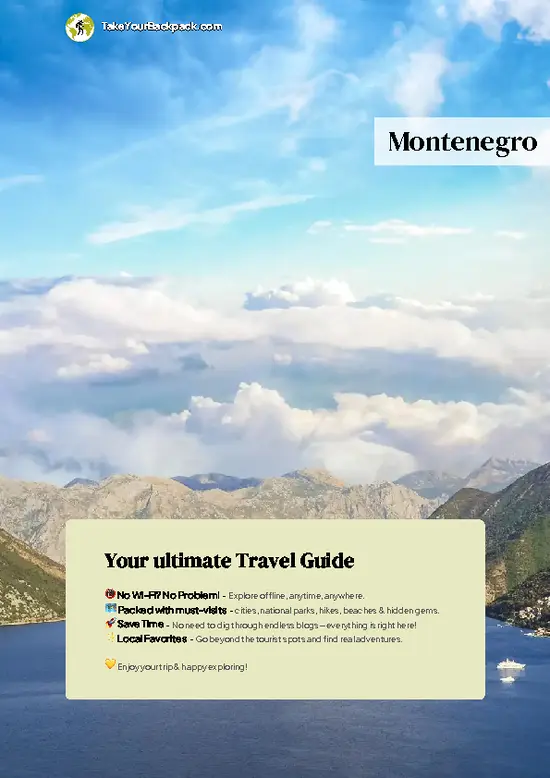
Climb from fjord-like bays into rugged peaks.

Explore MonacoExplore The Netherlands

Backpacking Montenegro in 2026

A complete guide including when and where to go, costs, transport, itineraries, and practical travel advice.
Traveling in Montenegro: what to expect

Backpacking Montenegro
By Johan Kruseman 🇳🇱 | Updated June 2, 2026

Unprepared travelers bleed time, money, and energy in Montenegro by misreading its scale—coastal bottlenecks, slow buses, and old-town menus priced for cruise-day splurges. Roads swing from sea-level switchbacks to high limestone plateaus; an inch on the map can take an hour. With a plan, that friction turns into access—peaks and coves within a morning’s reach.

I come for contrasts: the Bay of Kotor at blue hour, bells threading salt air; Durmitor’s black pines and clean, cold wind; the Tara thundering below; Skadar’s reed beds where pelicans skim. Pay a few euros for the short bay ferry instead of an hour of hairpins, wake early for Kotor’s Ladder, rent a car when buses thin, carry cash for Ostrog’s cliffside hush. Heat, summer crowds, and stone glare are real, but they shrink beside that light, that water, that mountain silence.

Compared with Croatia it’s rougher and often cheaper beyond the hotspots; versus Albania, more compact; against Bosnia or Serbia, you get coast plus peaks. It suits hikers, road-trippers, and payoff-per-mile travelers.

👉 Get the 📖 Travel Guide of Montenegro

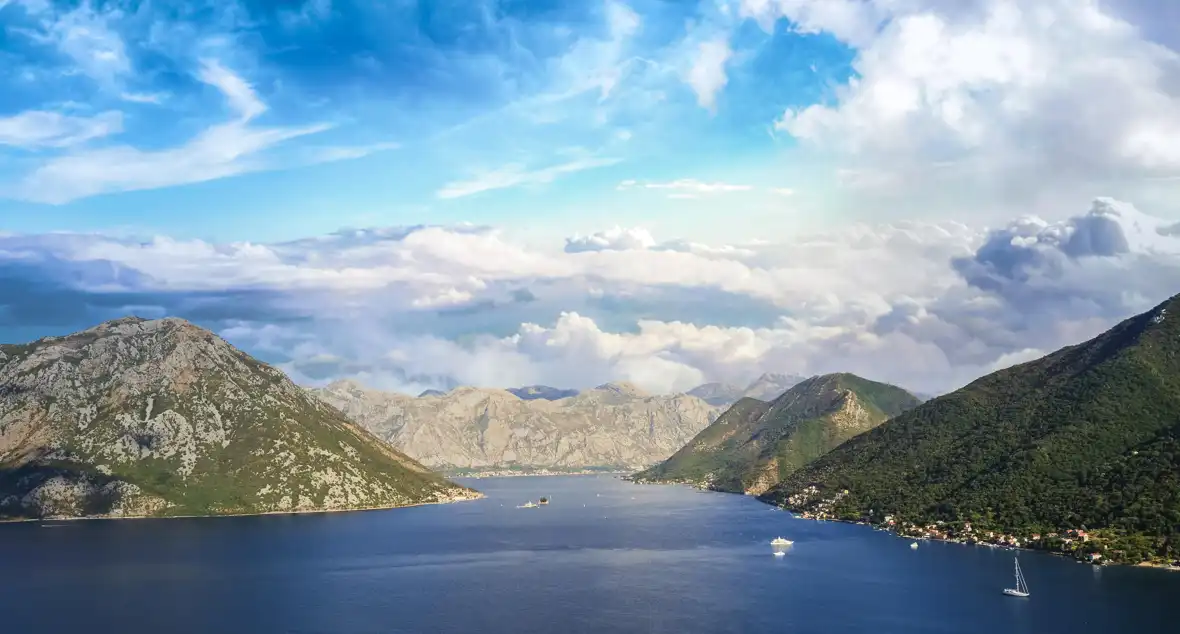
Bay of Kotor (Kotor, Perast, Herceg Novi)

Stone lanes damp at dawn, bells echoing off limestone, diesel from the first bus. The bay is compact but slow; buses creep, parking is a knife fight. Pay for speedboats to slash time, or spend it waiting and walking. Prices run higher than inland. Climb the fortress at sunrise for space and cool air; by noon you’re trading comfort for views. Base in Dobrota or Muo for sanity and a flat waterside walk into Kotor.

Budva Riviera to Ulcinj (one coastal spine)

This is Montenegro’s loud strip: sun lotion, bass from beach clubs, plastic chairs on hot tiles. Buses are frequent along the M‑1, but summer traffic stalls and A/C struggles. Budva rewards night owls and easy swimmers; you spend money to buy shade and avoid crowds. Push south to Ulcinj for cheaper rooms, long sand, and steady wind at Ada Bojana—less polish, more elbow room, better if you can live with grit and salt on everything.

Durmitor & Žabljak

Pine resin in the air, cold mornings, black rock and sudden storms. Distances are long and bus schedules sparse; a car unlocks the ring road and trailheads. You trade comfort (basic cabins, wood stoves, early starts) for big, quiet alpine days. Costs drop compared to the coast. Hike Bobotov Kuk or circle Black Lake; raft the Tara if water levels allow. Two nights minimum to make the drive worth it.

Lake Skadar & Crmnica

Reeds whisper, herons lift, grill smoke from carp and eel curls over the quay. Virpazar is easy by train; that saves money and nerves. Boat trips are best at first light—pay more to have fewer boats around you. Summer brings mosquitoes and heavy heat. Wineries are close, pours are generous; this rewards slow afternoons and a tolerance for uneven roads and laid-back timing.

Prokletije (Grebaje, Plav, Gusinje)

Razor ridges, cowbells, sour-milk and fresh bread on the table. Getting here eats a day: long transfers, few buses, often a taxi from Plav. Trails are steep and sometimes faint; weather turns fast. Costs are low, hospitality high, comfort basic. Come if silence and hard miles matter more than convenience—wake to pink light on limestone and no one else on the path.
A visual overview of the country
Loading the map 🌍
CLICK TO FILTER
city
town
village
unique site
national park
hike
beach
attraction
festival
region
SHOW COUNTRY’S BESTSHOW ALL
film
0
0
0a
Cetinje Monastery
film
1
1
1a
King Nikola Museum
film
2
2
2a
Maritime Museum of Montenegro
film
3
3
3a
Sveti Stefan
film
4
4
4a
Jaz Beach
Poseidon
film
5
5
5a
Mogren Beach
Avala Resort & Villas
film
6
6
6a
Plavi Horizonti
film
7
7
7a
Ada Bojana
film
8
8
8a
Lučice beach
film
9
9
9a
Perazića Do beach
film
10
10
10a
Mirišta
film
11
11
11a
Sutomore
film
12
12
12a
Kotor Bay Beaches
Dragan Murgaški
film
13
13
13a
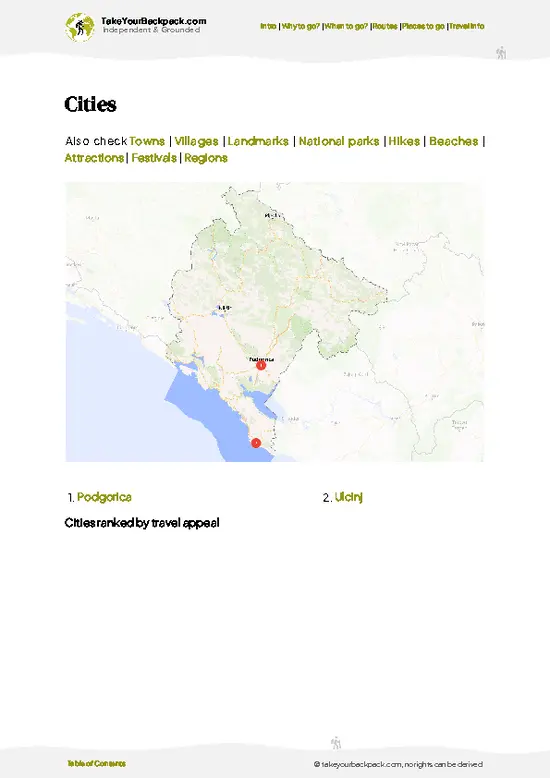
Podgorica
film
14
14
14a
Ulcinj
Ruzica Filipovic
film
15
15
15a
Kotor Fortress Trail
film
16
16
16a
Tara River Canyon
Wojciech Więch
film
17
17
17a
Kotor serpentine viewpoint
film
18
18
18a
Peaks of the Balkan trail
Dominique Labelle
film
19
19
19a
Balkan Trail
Unsplash
film
20
20
20a
Durmitor
Lukic Stevan
film
21
21
21a
Biogradska Gora
Randolfo Santos
film
22
22
22a
Prokletije
film
23
23
23a
Skadar Lake
Piotr Makara
film
24
24
24a
Lovćen
Corner Toe
film
25
25
25a
Orjen Nature Park
film
26
26
26a
Boka Bay
Gianni E Tommasina
film
27
27
27a
Kotor
Fitor Haziri
film
28
28
28a
Budva
Mike Halikias
film
29
29
29a
Herceg Novi
Joe 97
film
30
30
30a
Tivat
film
31
31
31a
Cetinje
film
32
32
32a
Gusinje
film
33
33
33a
Plav
film
34
34
34a
Risan
Sandra Vidic
film
35
35
35a
Niksic
film
36
36
36a
Rožaje
film
37
37
37a
Kotor’s Fortress
film
38
38
38a
Ostrog Monastery
Nenad Radunovic
film
39
39
39a
Nevidio Canyon
film
40
40
40a
Old town of Bar
film
41
41
41a
Olive tree in Mirovica
film
42
42
42a
Batlavsko Jezero
film
43
43
43a
Njeguši
Snezana Scepanovic

Why go?What sets this destination apart

Low cost

Montenegro is kind to a backpacker’s wallet. Trade time for savings: diesel buses stitch coast to mountains; … read more 👉
Montenegro is kind to a backpacker’s wallet. Trade time for savings: diesel buses stitch coast to mountains; a rental buys comfort and early starts, not thrift. Sleep in dorms or simple guesthouses and you’ll keep a low–mid double‑digit daily average. Eat where fishermen eat—two streets back from the quay—and the view tax vanishes. Pro tip: hit a pekara at sunrise for warm burek; refill from mountain taps. I camped in Durmitor on coin change and woke to thin frost, pine on the air, and a quiet trail all to myself.

Scenery

Montenegro rewards effort. Limestone ridges drink the heat, cold rivers hiss through spruce, and the … read more 👉
Montenegro rewards effort. Limestone ridges drink the heat, cold rivers hiss through spruce, and the Bay of Kotor turns to liquid pewter at dawn. Your choices decide the payoff. Spend sweat on the old Ladder of Kotor before sunrise—quieter, cheaper, feet aching—then watch the walls glow gold. Or spend euros on a taxi to Lovćen for the first light at Njegoš’s steps and keep your legs for later. Pro tip: take a 6 a.m. Skadar Lake boat. The reeds smell sweet, pelicans drift close, and you’ll shiver under a damp blanket—but the light is worth it.

Mountains

Montenegro pays you back in height and silence. Durmitor and Prokletije rise in pale limestone, lakes … read more 👉
Montenegro pays you back in height and silence. Durmitor and Prokletije rise in pale limestone, lakes like coins dropped in the rock. Mornings smell of wet stone and spruce resin; by noon, thunderheads muscle over the ridges. Pro tip: start before dawn and carry at least 2 liters—the karst runs dry. Spend a few euros on a jeep to remote trailheads and you trade money for hours. Sleep in katuns for cheap warmth and smoky cheese. I earned sunrise on Bobotov Kuk through ball-bearing scree; the Tara canyon lit up like a fuse.

Backpackers

Montenegro rewards backpackers who like their days salty and their nights social. It’s cheaper than … read more 👉
Montenegro rewards backpackers who like their days salty and their nights social. It’s cheaper than Croatia, the buses are slow and sweaty, and the payoffs are right in your face: Kotor’s stone alleys humming with hostel patios, rakija breath and clattering glasses; the cool pines above Durmitor after a hot, sticky transfer through Nikšić. You trade speed for scenery and meet half your trip on the bus. Pro tip: climb Kotor’s fortress at sunrise—quiet steps, pink light over the bay, then coffee in the Old Town before the cruise ships spill in.
Want the complete picture of Montenegro?
The offline Travel Guide brings everything together — routes, highlights & planning.

See what's included in the guide 👉

Get the Travel Guide -

⭐ HighlightsWhat not to miss along the way

  • Kotor City Walls to St. John Fortress: Climb in the blue hour and the bay glows like pewter; the air tastes of salt and rosemary, and damp limestone slicks your palms on the last switchbacks. It’s a calf-burn and a sweat-soaker with no shade after sunrise. Time is your currency here—45-90 minutes up, the same down—and money if you hit the ticketed gate; go pre-dawn to trade comfort for savings and a near-empty wall.
  • Durmitor National Park (Bobotov Kuk or Black Lake): Pines bleed resin in the cold, and wind up high smells metallic, like snow even in June. Bobotov Kuk costs a day, sore knees on scree, and layers you’ll actually wear; the reward is silence wide enough to hear your heartbeat. Short on time or cash? Pay the small park fee and orbit Black Lake in an hour, watching light move across a perfect bowl of water.
  • Ostrog Monastery: A white facade glued to raw cliff, bells thudding your chest, and the tight chapel is thick with beeswax and incense. The road up is a string of hairpins and
read more 👉
  • Kotor City Walls to St. John Fortress: Climb in the blue hour and the bay glows like pewter; the air tastes of salt and rosemary, and damp limestone slicks your palms on the last switchbacks. It’s a calf-burn and a sweat-soaker with no shade after sunrise. Time is your currency here—45-90 minutes up, the same down—and money if you hit the ticketed gate; go pre-dawn to trade comfort for savings and a near-empty wall.
  • Durmitor National Park (Bobotov Kuk or Black Lake): Pines bleed resin in the cold, and wind up high smells metallic, like snow even in June. Bobotov Kuk costs a day, sore knees on scree, and layers you’ll actually wear; the reward is silence wide enough to hear your heartbeat. Short on time or cash? Pay the small park fee and orbit Black Lake in an hour, watching light move across a perfect bowl of water.
  • Ostrog Monastery: A white facade glued to raw cliff, bells thudding your chest, and the tight chapel is thick with beeswax and incense. The road up is a string of hairpins and bus exhaust; parking low means a steep hot walk, parking high means a queue. It’s free, but you’ll pay in patience and modest dress, swapping comfort for the peculiar charge of a lived-in pilgrimage site.
  • Lake Skadar (Virpazar boats and lily fields): The boat putters through green carpets; lily pads slap the hull, herons lift like paper, and dragonflies tick your forearms. Private boats cost more but buy you silence and detours; shared tours are cheaper and slower. Two hours is the minimum meaningful slice, and the real price is the midday sun and a few mosquito bites at dusk.
  • Tara River Canyon Rafting and Đurđevića Tara Bridge: Neoprene smells like a tire shop, the river is glacial to the wrist, and pine pitch carries from the banks while the bridge throws a cool shadow. Outfitters near the bridge charge for convenience; cheaper camps mean longer shuttles and earlier starts. You’ll trade warm comfort for cold splashes and a bruised shin or two, paid back by green water cutting sheer limestone; if you want off the map, hike Vrmac ridge bunkers above Kotor, roam the Komovi massif’s shepherd trails, or swim off Luštica’s Arza headland—my repeat escape is Vrmac for the thyme on the wind and empty stone tracks.
Spotted a mistake or missing a highlight? Contact us.

But Montenegro offers more...

Discover and compare all of its highlights per category

🧭 RoutesHow travelers typically move through the country

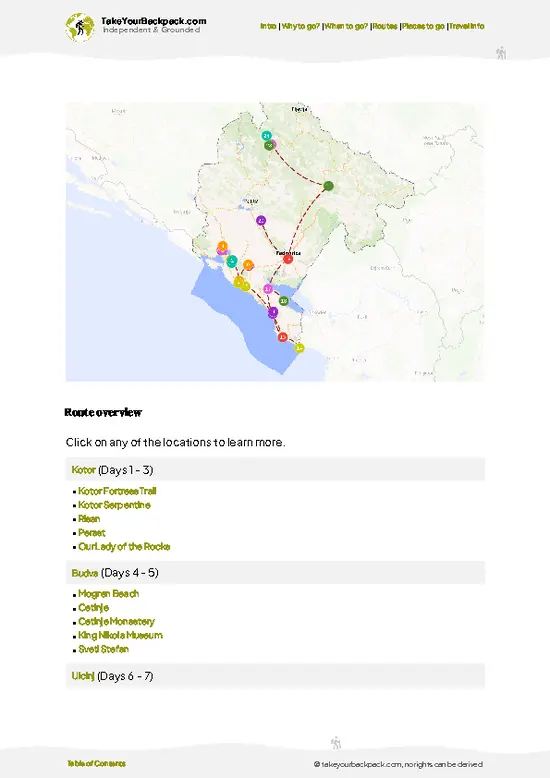
The 5-Day Bay & Old Town Sprint

The vibe: A coastal-first sampler that keeps you mostly in and around Boka Bay, trading long transfers for slow walks, fortress climbs, and swims, perfect if you want maximum scenery with minimal logistics. You’ll move at a relaxed pace between stone towns and beaches, using short bus rides and boats instead of big travel days.
The highlights:
  • Wandering the medieval alleys and waterfront of Kotor
  • Climbing to Kotor’s Fortress for sweeping bay views
  • Boat-hopping from Perast to Our Lady of the Rocks
  • Beach time around Budva, including Mogren and views of Sveti Stefan

The 10-Day Coast-to-Mountains Classic

The vibe: A balanced loop that links Boka Bay, the old royal capital, and Durmitor’s high country, ideal if you want both sea and serious mountains without rushing. Expect a mix of bus rides, a couple of longer transfers, and plenty of time on foot in old towns, national parks, and around lakes and canyons.
The highlights:
  • Exploring Herceg Novi and Kotor as twin gateways
read more 👉

The 5-Day Bay & Old Town Sprint

The vibe: A coastal-first sampler that keeps you mostly in and around Boka Bay, trading long transfers for slow walks, fortress climbs, and swims, perfect if you want maximum scenery with minimal logistics. You’ll move at a relaxed pace between stone towns and beaches, using short bus rides and boats instead of big travel days.
The highlights:
  • Wandering the medieval alleys and waterfront of Kotor
  • Climbing to Kotor’s Fortress for sweeping bay views
  • Boat-hopping from Perast to Our Lady of the Rocks
  • Beach time around Budva, including Mogren and views of Sveti Stefan

The 10-Day Coast-to-Mountains Classic

The vibe: A balanced loop that links Boka Bay, the old royal capital, and Durmitor’s high country, ideal if you want both sea and serious mountains without rushing. Expect a mix of bus rides, a couple of longer transfers, and plenty of time on foot in old towns, national parks, and around lakes and canyons.
The highlights:
  • Exploring Herceg Novi and Kotor as twin gateways to Boka Bay
  • Road-tripping from the Kotor serpentine viewpoint into Lovćen
  • Tracing Montenegro’s royal history in Cetinje’s monastery and museum
  • Hiking and lake time around Durmitor and the Tara River Canyon

The 15-Day Montenegro Grand Circuit

The vibe: A full-country adventure that loops from the Adriatic through high plateaus, deep canyons, and remote borderlands before dropping back to the southern coast, built for travelers who want depth over speed. You’ll combine buses, local transfers, and guided outings to reach quieter parks and villages most visitors never see.
The highlights:
  • Multi-day immersion in Boka Bay, from Herceg Novi and Orjen to Kotor
  • Mountain panoramas in Lovćen and cultural stops in Cetinje and Njeguši
  • Big-sky days around Durmitor, the Durmitur Ring, and the Tara River Canyon
  • Remote trekking in Prokletije and a laid-back finale in Ulcinj and Ada Bojana
🌍 Want a ready-to-use travel plan for Montenegro?
The overview above compares different route options based on your travel time and style. The complete Travel Guide breaks each itinerary down in detail, including maps, stops, highlights, and transport information.

Explore all route details 👉

Get the Travel Guide -

🌤️ When to go?A month-by-month overview

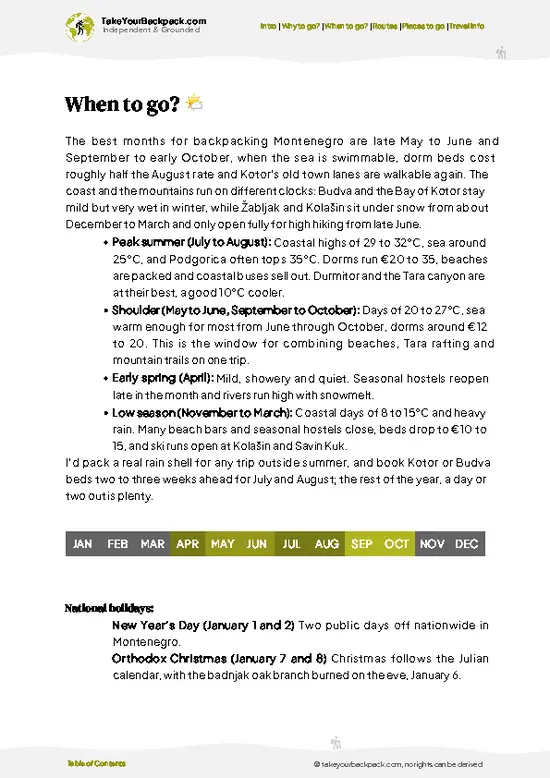
Mid-September to early October is the clean hit in Montenegro. The sea keeps its summer warmth while the sun steps down a notch; you swim without that cooked-asphalt haze chasing you back to shade. In the mountains, the last thunderheads have usually burned off, high passes stay open, and evenings cool enough to sleep without a fan. School’s back, cruise-ship days thin, and room rates slip from their August peak while buses still run useful schedules. Trails clear of selfie queues, grape must perfumes village lanes, and the Adriatic light goes honey-low by late afternoon—easy on skin, kind on photos. A backup window is late May to mid-June: wildflowers on Durmitor meadows, calmer coast, lower prices—just mind lingering snow on north-facing ridges and a few still-sleepy services inland.
  • Peak Summer (Jul-Aug): The grind: noon heat baking Kotor’s stones, scooters whining, boat touts circling, beds priced like mini-holidays. The high: 10 p.m. swims off Budva rocks, fully open alpine routes, Tara Canyon light turning copper at long dusk—if you move at dawn and nap at noon, it sings.
  • Autumn Shoulder (mid-Sep-mid-Oct): Montenegro exhales. Beach bars turn the volume down, shop shutters lift without rush, buses still hum, prices relax. You climb the Ladder of Kotor into clean air and walk Durmitor circuits in quiet, with figs soft in the pocket.
  • Winter/Off-Peak (Nov-Mar): Interior mood. Kotor’s alleys slick with rain and woodsmoke, Žabljak under a hard blue sky and deep snow. Survival hack: waterproof boots plus microspikes—ice hides on shaded stone and trail steps long after noon.

Personal tip: For the September window, reserve weekend beds in Kotor and Žabljak about a week out; leave everything else flexible so you can chase clear skies.

source: climatestotravel.comJANJanuary: fair for travelingFEBFebruary: fair for travelingMARMarch: fair for travelingAPRApril: good for travelingMAYMay: highly recommended for travelingJUNJune: highly recommended for travelingJULJuly: good for travelingAUGAugust: good for travelingSEPSeptember: excellent for travelingOCTOctober: excellent for travelingNOVNovember: fair for travelingDECDecember: fair for traveling
📅 Traveling in a specific month?
Get a full month-by-month breakdown of weather, crowds, costs, festivals, and seasonal highlights in the complete travel guide.

Get full details when to go 👉

Get the Travel Guide -
montenegro- bay-5675837

💰 Costs (as of 2025)Typical budget expectations

Plan on €40-55 per day if you sleep in dorms, eat simply, and ride buses; July-August on the coast shoves you toward the top of that range.
  • dorm accommodation: €10-18 inland and shoulder season; €18-25 on the coast most of the year; €22-30+ in Kotor/Budva in peak summer. Expect creaky bunks, pine-scented balconies, and cash-only check-ins. Tourist tax of €1-2 per person per night is often added on arrival. System tip: sleep inland, play on the coast—base in Cetinje, Nikšić, or Žabljak for cheaper beds and day-trip to the water; in coastal towns, anything 10 minutes uphill from the old stones drops 20-30%.
  • meals: Supermarket Survival: €6-10/day buys bread, tomatoes, ajvar/kajmak, yogurt, fruit, and a cold shop beer (€0.80-1.20). You’ll eat on a quay wall with salt in the air and save your euros. Street food reality: burek €1.50-2.50, ćevapi €3-6, slice pizza €1.50-2.50, a paper cone of fried seafood €5-8; sit-down fish mains on the coast run €12-20. Compared to Croatia you’ll spend roughly a third less; compared to Bosnia/Serbia/Albania, coastal menus are pricier. I trim costs by ducking two blocks off any promenade—the smoke turns from perfume to grill fat and prices drop.
  • local transport:
read more 👉
Plan on €40-55 per day if you sleep in dorms, eat simply, and ride buses; July-August on the coast shoves you toward the top of that range.
  • dorm accommodation: €10-18 inland and shoulder season; €18-25 on the coast most of the year; €22-30+ in Kotor/Budva in peak summer. Expect creaky bunks, pine-scented balconies, and cash-only check-ins. Tourist tax of €1-2 per person per night is often added on arrival. System tip: sleep inland, play on the coast—base in Cetinje, Nikšić, or Žabljak for cheaper beds and day-trip to the water; in coastal towns, anything 10 minutes uphill from the old stones drops 20-30%.
  • meals: Supermarket Survival: €6-10/day buys bread, tomatoes, ajvar/kajmak, yogurt, fruit, and a cold shop beer (€0.80-1.20). You’ll eat on a quay wall with salt in the air and save your euros. Street food reality: burek €1.50-2.50, ćevapi €3-6, slice pizza €1.50-2.50, a paper cone of fried seafood €5-8; sit-down fish mains on the coast run €12-20. Compared to Croatia you’ll spend roughly a third less; compared to Bosnia/Serbia/Albania, coastal menus are pricier. I trim costs by ducking two blocks off any promenade—the smoke turns from perfume to grill fat and prices drop.
  • local transport: Regional buses are the backbone: €3-10 per leg, plus €1 per bag in the hold. Afternoon coastal traffic can add 30-60 minutes; ride mornings when the asphalt is cool and empty. Cheapest unlock: combine the Bar-Podgorica-Nikšić train (€2-5, canyon views, windows humming) with buses to jump cheaply between regions. Local Bay buses are €1-2; short city taxi hops are €3-6 if you’re cooked and carrying. Versus Croatia, it’s cheaper but less frequent; versus Albania, similar price with slightly better roads.
  • activities: Major costs come from boats and adrenaline. Bay tours (Blue Cave/Perast) run €15-25. Kotor city walls are €8-10; the longer Kotor Ladder trail is free and sweatier, with goat bells and shale underfoot. National parks (Durmitor, Lovćen) charge €3-5 at gates. Tara rafting is €45-70 with lunch; canyoning €60-90; ziplines near Đurđevića Tara Bridge €10-20. Ostrog Monastery is free; the ride up costs a few euros and a stomach.
  • miscellaneous: Budget leaks: ATM markups of 4-6%—decline “conversion” screens and use bank ATMs. Platform fees at some bus stations (€0.50-1) and luggage storage (€2-4). Beach loungers €5-15 for a set. Laundry €5-7 per load. Coffee is mercifully cheap (€1-1.50; double that on the promenade); draft beer €2-3. Tap water is widely fine inland; refill at roadside springs to avoid €1 bottles. Compared with Croatia these leaks sting less; they’re still pricier than inland Balkans. My best save in Kotor: a €2 burek and €1 espresso from a steamy bakery behind the market instead of a €9 “old town breakfast.”
⚠️ Prices can change and everyone travels differently, so take this as a rough guide. Hope it helps you plan your adventure!

✈️ The backpacker research shortcutMontenegro Travel Guide

An offline-friendly backpacking guide with optimized travel routes, ranked highlights, transport advice, and the best areas to stay.
example page 0 from our offline Travel Guide for Montenegroexample page 1 from our offline Travel Guide for Montenegroexample page 2 from our offline Travel Guide for Montenegroexample page 3 from our offline Travel Guide for Montenegroexample page 4 from our offline Travel Guide for Montenegroexample page 5 from our offline Travel Guide for Montenegroexample page 6 from our offline Travel Guide for Montenegroexample page 7 from our offline Travel Guide for Montenegro
The digital guide (252 pages) contains:
64 highlights, ranked by travel appeal
Optimized 5, 10 & 15-day travel routes
Cities, national parks, beaches, historical sites, ...
How to get around
Offline-friendly for travel without Wi-Fi
👉 Click to see all 30+ guide features

📅 Plan smarter in minutes, not weeks
Month by month travel advice
Festivals & national holidays
Budget expectations

🗺️ Go to the right places, skip the overrated ones
Honest pros & cons of destinations
Top hikes, parks & viewpoints
Lesser-known places most travelers miss
Clear “worth it vs skip it” guidance

🛏️ Travel smoothly without rookie mistakes
Best areas to stay
Transport systems explained simply
Common scams & safety advice
SIM cards, money & practical tips

🌍 Understand the country, not just visit it
Culture & traditions
52 Essential phrases & customs
Festivals worth planning around
Traveler-friendly historical context
Insights that make places more meaningful

📱 Built for real travel conditions
Fully downloadable PDF
Works completely offline
Optimized for phone use
Useful in remote areas & buses
Everything in one place
Save weeks of stressful planning
Get instant access to the full guide directly. 30-day money-back guarantee.


Sent to your inbox immediately after payment • 100% Secure Checkout
Best Backpacking Travel Advisor 2025 tourism awardBest Backpacking
Travel Advisor
2025
What others say about Take Your Backpack Guides:
⭐⭐⭐⭐⭐
Fantastic, amazing amount of information!
⭐⭐⭐⭐⭐
My goodness this is amazing, it's what I've been looking for hats off too you!
⭐⭐⭐⭐⭐
I think this is absolutely BRILLIANT
⭐⭐⭐⭐
Very complete and informative. It's still missing places, but I gotta to commend you
⭐⭐⭐⭐⭐
This is truly amazing, thank you, can't wait to explore it with my kids!
⭐⭐⭐⭐⭐
Awesome resource, thank you!
⭐⭐⭐⭐⭐
This is amazing! Can't wait to explore the ones I haven't seen
⭐⭐⭐⭐
I love this! Well done, great idea.
⭐⭐⭐⭐⭐
Thanks for taking the time to make this gem!
⭐⭐⭐⭐⭐
This might be the best website I've ever seen.
⭐⭐⭐⭐⭐
Congratulations, and thank you so much for your work; it's incredibly valuable.
⭐⭐⭐⭐
In all seriousness I think you did a great job pointing out the important spots
⭐⭐⭐⭐⭐
10/10 very good
⭐⭐⭐⭐⭐
As someone who's only just starting to visit regularly this is awesome, thank you.
⭐⭐⭐⭐
Thank you very much! I'm going to visit my dad, it's going to be very useful!
⭐⭐⭐⭐⭐
This is really cool! We'll be travelling for the first time and this definitely come in handy.
⭐⭐⭐⭐⭐
You are now our minister of culture, congratulations 👨‍💼
⭐⭐⭐⭐⭐
Just wanted to tell you that this is a pearl! Going to follow your recommendations.
⭐⭐⭐⭐⭐
This is so cool. I'll definitely be using the resource for my travels soon.
⭐⭐⭐⭐⭐
This is very impressive! Good work.
⭐⭐⭐⭐⭐
This is an amazing and informative site. Very well done!

🛏️ Where to stay?Best areas to base yourself

Yes — Montenegro has many hostels and budget accommodation, concentrated around Kotor Old Town, Budva (Old Town and the Riviera), Tivat (airport/marina area), Podgorica city centre, Ulcinj (Old Town/Long Beach) and Herceg Novi.
Kotor gives the most character and direct access to bay hikes and boat trips but books out and gets pricier in summer; Budva offers the widest choice for beaches and nightlife yet is the busiest and noisiest at peak season; Tivat is the easiest arrival hub with better transport links but fewer truly cheap options.
Podgorica is the cheapest transport hub with basic hostels … read more 👉
Yes — Montenegro has many hostels and budget accommodation, concentrated around Kotor Old Town, Budva (Old Town and the Riviera), Tivat (airport/marina area), Podgorica city centre, Ulcinj (Old Town/Long Beach) and Herceg Novi.
Kotor gives the most character and direct access to bay hikes and boat trips but books out and gets pricier in summer; Budva offers the widest choice for beaches and nightlife yet is the busiest and noisiest at peak season; Tivat is the easiest arrival hub with better transport links but fewer truly cheap options.
Podgorica is the cheapest transport hub with basic hostels but few sights and hot summers; Ulcinj is best for budget beach stays and cheaper food while sitting farther from northern attractions; Herceg Novi is quieter and cheaper off-season but has limited hostel supply — pick based on whether you prioritise beaches and nightlife, historic hiking, or transport convenience.

If you enjoy meeting fellow travelers, consider choosing hostels with high ratings for atmosphere. On the other hand, if you prefer having your own space, a hotel might be a better option.

🚌 Getting aroundWhat moving around is really like

Montenegro moves on mountain logic: printed schedules pinned under plastic, then drivers add their own edits with an espresso and a cigarette. Things depart roughly on time, until rain slicks the switchbacks or a herd of tourists meets a single-lane tunnel. You surf by intuition: show up early, keep small bills ready, and accept that the Adriatic breeze and diesel smell are part of the meter. When the country wants to flow, it flows; when it doesn’t, you earn your view with patience.
  • Intercity Buses
read more 👉
Montenegro moves on mountain logic: printed schedules pinned under plastic, then drivers add their own edits with an espresso and a cigarette. Things depart roughly on time, until rain slicks the switchbacks or a herd of tourists meets a single-lane tunnel. You surf by intuition: show up early, keep small bills ready, and accept that the Adriatic breeze and diesel smell are part of the meter. When the country wants to flow, it flows; when it doesn’t, you earn your view with patience.
  • Intercity Buses This is the spine. Cheapest door-to-door between coastal towns and Podgorica, but speed dies on hairpins and in summer traffic—add 20-40 minutes to whatever the board promises. Buy at the station and budget for the platform fee; the driver may also charge a small coin for luggage. Air-con can be a rumor; sit near a window and avoid the rear if you get carsick. It’s still the best cost-to-coverage ratio.
  • Local Coast Buses This is the social classroom. You flag with a low, palm-down wave; you pay the driver in coins; you don’t flash big notes at 7 a.m. Give up your seat for elders before anyone asks. Backpacks on your lap, not in the aisle. Doors snap shut fast—step decisively. Expect radio pop-folk, sunscreen in the air, and open windows doing the work of a broken vent. Ring early; stops can be more suggestion than science.
  • Bar-Podgorica-North Trains The budget disruptor if you’re linking coast to mountains. Skip the bus over the tiring inland passes: bus to Bar, then train through the canyons to Podgorica, Kolašin, or beyond for less money and steadier stomachs. Seats are basic but spacious; views switch sides between tunnels and high bridges. Trains wander late rather than vanish, so delays cost time, not cash. Bring snacks and a layer; inspectors actually check tickets.
  • Bay Ferries & Water Taxis The geometric unlock. Crossing Kamenari-Lepetane chops a long loop around Boka into five salty minutes. Foot passengers pay pocket change; departures are near-constant. Small water taxis stitch Perast, islets, and quiet coves the buses ignore—use them point-to-point, not as “tours,” and say you just want across. Mornings are glassy; afternoons kick up chop and spray. Cash rules; lifejackets exist, even if they’re sun-faded.

Master tip: To cross the country fast and cheap, move at dawn, chain a short coastal bus to Bar with the northbound train, use the bay ferry to cut road detours, and always buy the first departure that gets you moving instead of hunting for the “perfect” connection.
Distance: Podgorica Airport (TGD) is about 11 km (7 miles) south of the city center.

Main ways to get into town
  • Train (cheapest): Walk about 1 km (10-15 minutes) from the terminal to “Aerodrom” halt and take any northbound train to “Podgorica” main station.

    Time: 7-10 minutes on the train (+ the short walk).

    Cost: €1.20-€1.50, buy from the conductor (cash).

    Frequency: About 1-2 per hour in the daytime; fewer at night. Good option if your flight timing matches.
  • Local bus: There’s no city bus directly into the terminal. You can walk to the stops on the main road (E65/E80) just outside the airport area and catch a bus toward Podgorica.

    Time: Around 25-35 minutes to the center once onboard (+ a 5-10 minute walk to the stop).

    Cost: Typically €1.00-€2.00, pay the driver (cash).

    Frequency: Roughly every 20-40 minutes in the day; sparse evenings/Sundays. Simple if you’re traveling light.
  • Taxi / ride-hailing: Taxis wait outside arrivals; Bolt and local taxi apps also operate in Podgorica.

    Time: 15-20 minutes to the center, traffic permitting.

    Cost: Usually €10-€15 to central Podgorica. Agree a fixed fare at the stand or make sure the meter is on. Cards are hit-or-miss; carry cash.

Good to know
  • No official airport shuttle as of 2025.
  • The main train station (“Podgorica”) is a 10-15 minute walk from the central area once you arrive by rail.
  • Late arrivals: trains thin out after late evening, and buses can be infrequent—taxi is the most reliable then.
⚠️ Prices and routes can change, so take this as a rough guide and ask for local advice when you arrive.

🔒 Safety (risk Level: low)What first-time visitors should know

Safety for solo travelers, including women and LGBTQ+ individuals
Montenegro is generally safe for solo travelers, including women and LGBTQ+ individuals, but like anywhere, staying aware of your surroundings is wise. Women usually experience no issues, but modest dress and avoiding isolated areas at night are recommended. LGBTQ+ travelers should be cautious in rural areas where conservative attitudes prevail, while urban centers like Podgorica and Kotor are more welcoming. Always check the latest travel advisories and consider connecting with local LGBTQ+ groups for current insights.


Full official government travel advisory (live updates)
View details 👉

✈️ VisaVisa requirements for Montenegro

Most visitors to Montenegro don’t need a visa for stays up to 90 days, including citizens from the EU, US, UK, Canada, and Australia. If you’re from a country that requires a visa, apply through the nearest Montenegrin embassy or consulate by submitting your application, passport, and any required documents. Always double-check current requirements as they can change.

source: gov.me
⚠️ Visa requirements can change over time, so always check the latest visa requirements with the official embassy or government website before you travel.

🎒 What to pack?What to wear and bring

Montenegro packs a punch with its diverse landscapes, so prepare for some variety. Summers are hot, especially along the Adriatic coast, so lightweight, breathable clothing is a must. However, if you’re heading to the mountains or exploring the Durmitor National Park, layers are your friend since it can get chilly at night. Rain showers can sneak up on you, particularly in the fall, so a compact rain jacket is handy. While Montenegro is pretty laid-back, in smaller towns and religious sites, covering shoulders and knees is a sign of respect.

Apart from this country specific advice, I have also crafted a general packing list that should help on any trip. authorOver the years, I've learned the importance of packing minimally. It's so much easier to jump on the back of a truck or squeeze yourself into the last spot of a minibus without that supersized backpack. If you're headed to a warm destination, leave your winter jacket at home; for colder regions, opt for thin thermal underlayers. Instead of packing your entire wardrobe, bring just three sets of clothes, as laundry facilities are available everywhere.
View the full list 👉
🎒 Planning the practical side of your trip?
Get detailed information on transport, daily budgets, internet access, local customs, food, language, and other essentials in the complete Travel Guide.

Get detailed practical information 👉

Get the Travel Guide -

🙋 FAQFrequently asked questions

Trip Planning


Personal tip: I normally search on good rating for atmosphere (for meeting people) and location (for easy exploring). Cleanliness as a bonus.


Travel Essentials

For visiting Montenegro, you don’t need any mandatory vaccinations if you’re up-to-date on routine vaccines like measles, mumps, rubella (MMR), and tetanus. However, consider these recommended vaccinations:

Hepatitis A: Recommended for most travelers.
Hepatitis B: Consider if you might have intimate contact with locals, get a tattoo, or require medical procedures.
Rabies: If you plan to explore caves or have extended outdoor activities.
Tick-borne encephalitis: If you’ll be spending time in rural or forested areas.

Always check the latest health advisories before traveling.


vaccination requirements
When I first started traveling, I often spent part of my first day in a new country hunting for a local SIM card. While this can still be slightly cheaper, it also takes time and planning.

These days, it's much simpler to install an eSIM before leaving home. Once you arrive in Montenegro, you can activate it immediately and have mobile data from the moment you land — which is especially useful for ordering transport or navigating away from busy airports.

There are many providers nowadays, and price differences are usually small. I personally go with Airalo, as it offers excellent network coverage throughout the country and strong global coverage, so you can manage multiple countries from a single app.


Get your e-sim for Montenegro

Culture & Customs

Respect local traditions—dress modestly in rural areas and when visiting religious sites. Montenegrins are hospitable; accept coffee or rakija if offered. Tipping around 10% is appreciated in restaurants.

Do: Greet with a handshake and maintain eye contact. Learn a few basic Montenegrin phrases; locals appreciate the effort.

Don’t: Discuss political topics, especially regarding neighboring countries. Avoid making the ”OK” hand gesture, as it can be offensive.

For women: Dress modestly in traditional areas. Solo travel is generally safe, but exercise usual caution.

For LGBTQ+ travelers: Montenegro is becoming more open, especially in urban areas, but discretion is advised in rural settings.
Trying traditional food is always a great way to experience the culture. Here are some must-try dishes for Montenegro.
  • Njeguški Pršut: This is a smoked ham from the village of Njeguši. It’s a staple in Montenegrin cuisine and is often compared to Italian prosciutto. The unique flavor comes from the mountain air and traditional smoking techniques, making it a must-try for any meat lover.
  • Kačamak: A hearty dish made from potatoes, cornmeal, and cheese. It’s a mountain comfort food and reflects the simplicity and richness of Montenegrin rural life. Perfect for warming up after a day of hiking.
  • Cicvara: This is a creamy dish made from corn flour and cheese, often infused with butter. It’s a traditional breakfast choice, offering a taste of Montenegro’s dairy-rich cuisine.
  • Riblja Čorba: A fish soup that showcases Montenegro’s coastal flavors. Usually made with fresh fish from the Adriatic Sea, it’s a staple for those exploring the seaside towns.
  • Sarma: These are cabbage rolls stuffed with minced meat and rice. Though common in the Balkans, Montenegro puts its twist on it with local spices, making it a comforting and familiar taste for many visitors.
Yes, tap water is generally safe to drink in Montenegro, and locals do consume it. However, if you’re traveling through rural areas or have a sensitive stomach, it’s wise to stick to bottled or filtered water. Always check for local advisories or ask locals if you’re unsure about a specific area.
The main language in Montenegro is Montenegrin. Backpacking is way more rewarding if you know a bit of the local language, so I'd suggest brushing up on the basics just in case your Montenegrin skills have become a bit rusty.

Want to understand locals better?
The complete Travel Guide for Montenegro includes 52 essential words and phrases — greetings, thank-yous, ordering food, transport, numbers, and common local expressions you'll actually hear.

Get your local basic phrases 👉

Get the Travel Guide -


In Montenegro, English is increasingly spoken, especially in tourist areas such as Kotor, Budva, and Podgorica. Many younger Montenegrins, particularly those in the hospitality and service industries, have a good command of English due to education and exposure to tourism. In urban centers, you’ll find that most hotel staff, restaurant employees, and tour guides can communicate effectively in English.

However, in more rural areas or among older generations, English proficiency may be limited. While some locals may understand basic phrases, it’s advisable to learn a few key phrases in Montenegrin to enhance communication and show respect for the local culture.

Overall, travelers should find navigating Montenegro relatively easy in terms of language, but being prepared with a translation app or phrasebook can be helpful in less touristy regions.

Money & Payments

The local currency of Montenegro is EUR (€).

If you’re backpacking through Montenegro, here are some money tips to keep in mind:

ATM Access: ATMs are pretty common in cities and larger towns. Make sure your card is set for international withdrawals, and check for any bank fees that might sneak up on you.

Cash or Card: Carry some cash on you, especially if you’re heading to rural areas or smaller towns. Euros are the way to go here — Montenegro uses them as their de facto currency. Most places in cities accept cards, but cash is king in smaller spots.

Dollars vs. Euros: Stick with euros. While some places might accept dollars, it’s not reliable, and you might end up with a bad exchange rate.

Card Acceptance: Major cards like Visa and Mastercard are widely accepted in urban areas, but don’t expect the same in remote villages or for small purchases.

Exchanging Money: Exchange offices are available in tourist areas and offer decent rates. Banks are also a safe bet, but avoid airport exchanges if you can — they tend to have less favorable rates.

Tipping in Montenegro isn’t mandatory but appreciated. In restaurants, leaving around 10% is common if the service was good. For taxis and other services, rounding up or adding a small amount is typically sufficient.

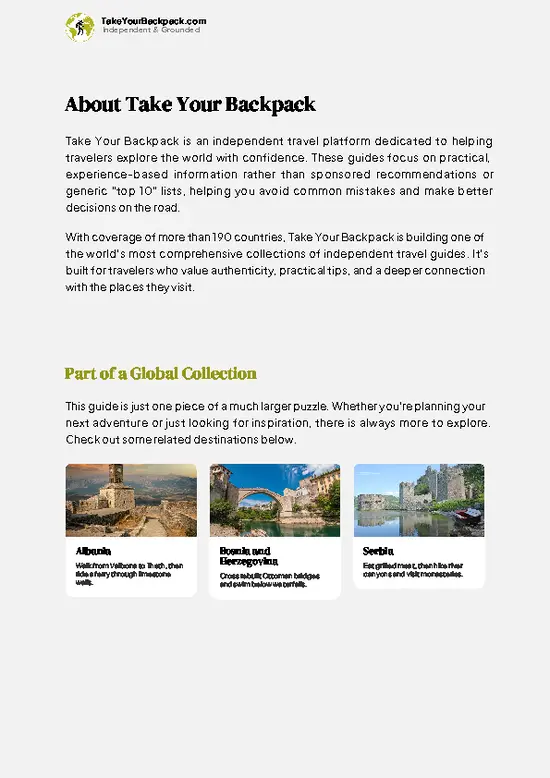
🧩 Nearby countriesSimilar backpacking destinations

We 💚 feedbackKey takeaways from the trip

Go for the compression: in a single day you can taste salt spray in Kotor at dawn, then crunch frost on Durmitor trails by late afternoon. The catch is friction. Buses creep, summer heat bakes the coast, and cruise crowds turn old stones into a queue. Strategic fix: pool hostel mates and rent a car for 48 hours—split four ways it beats three long bus days, lets you chase first light, and puts the quiet valleys back within reach.

✈️ When did I visit Montenegro?
In October 2025 I have walked the Peaks of the Balcan, crossing Albania, Kosovo and Montenegro. Since then, this guide is regularly updated based on feedback from locals and recent backpackers (last update: 28 December 2025)

✍️ Help improve this page!
The information on this page is based on my own backpacking experience in Montenegro, supplemented with up-to-date research and feedback from other travelers. Travel details can change, so if you notice anything outdated or incomplete, feel free to let me know.


🙋‍♂️ Give feedback

👋 Meet the founderWho’s Behind Take Your Backpack?

Johan, backpacker and founder of TakeYourBackpackHi, I’m Johan (Netherlands 🇳🇱), the creator of TakeYourBackpack. Over the past decade, I’ve backpacked through 80+ countries across six continents, gaining extensive experience with independent travel, long-term trips, and overland routes.

This site is built on a combination of firsthand travel experience and carefully curated insights from other backpackers. Many guides are based on places I’ve personally visited, while others bring together tips, observations, and practical advice shared by trusted travelers I’ve met along the way.

The goal is to provide realistic, experience-driven guidance — not generic itineraries — so you can explore destinations with better context, clearer expectations, and more confidence.

Get full Montenegro guide •
Instant download • 64 highlights • Full Offline guide