Trip Planning
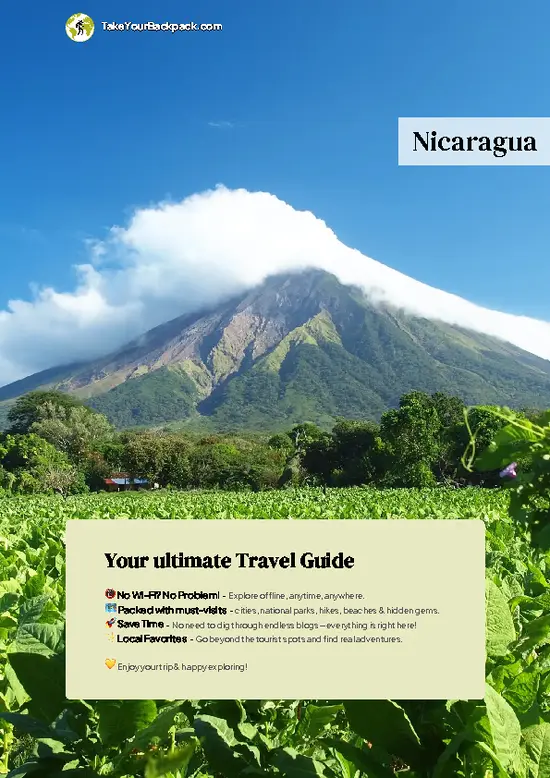
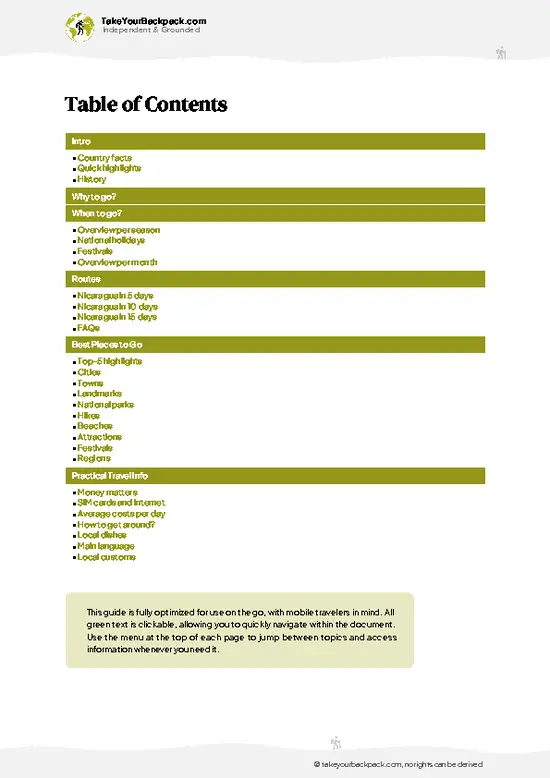
The TakeYourBackpack guidebooks are your all-in-one travel companion, featuring the best cities, national parks, hikes, beaches, and unique sites, along with essential tips on when to go, how to get around, exchanging money, and even local phrases to get you started — everything you need for a smooth, unforgettable backpacking adventure.
Stop researching. Start exploring.Discover all 71 highlights,ranked
and organized into practical routes.
Get instant access
Planning a backpacking route through Nicaragua can be tricky — you need to balance must-see places, travel times, budget, and how long to stay in each destination. Our free personalized Nicaragua itinerary planner creates a route based on your travel style, trip duration, and interests, so you can spend less time researching and more time exploring.
Personal tip: I normally search on good rating for atmosphere (for meeting people) and location (for easy exploring). Cleanliness as a bonus.
Travel Essentials
No vaccinations are required for most travelers to Nicaragua, except a yellow fever certificate if you arrive from a country with yellow fever risk. Make sure routine vaccines (MMR, tetanus-diphtheria, polio, flu, COVID-19) are up to date, and hepatitis A and typhoid are recommended because of food and water risks. Hepatitis B and rabies are worth considering for long stays, rural travel or contact with animals. Malaria risk is low and mostly limited to the Caribbean region, while dengue, chikungunya and Zika occur nationwide, so bring strong insect repellent.
vaccination requirementsWhen I first started traveling, I often spent part of my first day in a new country hunting for a local SIM card. While this can still be slightly cheaper, it also takes time and planning.
These days, it's much simpler to install an eSIM before leaving home. Once you arrive in Nicaragua, you can activate it immediately and have mobile data from the moment you land — which is especially useful for ordering transport or navigating away from busy airports.
There are many providers nowadays, and price differences are usually small. I personally go with
Holafly, as it offers excellent network coverage throughout the country and strong global coverage, so you can manage multiple countries from a single app.
HolaFly eSimCulture & Customs
Nicaraguans value politeness and personal presentation, so do dress neatly in cities and cover shoulders and knees when visiting churches. Do ask before photographing people, especially in markets and rural communities, and do accept offered food or coffee graciously when visiting someone’s home. Don’t start conversations about politics, the government or the 2018 protests with strangers, and never photograph police, soldiers or official buildings. Don’t flash expensive phones, cameras or jewelry, and avoid bargaining aggressively over tiny amounts with market vendors. Women may encounter machismo in the form of catcalls, which are best ignored rather than confronted. LGBTQ+ travelers will find the most relaxed atmosphere in Granada, León and San Juan del Sur, while in rural areas public displays of affection between same-sex couples can draw unwanted attention.
Trying traditional food is always a great way to experience the culture. Here are some must-try dishes for Nicaragua.
- Gallo pinto: Red beans and rice fried together with onion and sweet pepper, served at breakfast with eggs, fresh cheese, sweet plantains and tortillas. It is the everyday national staple, and locals will happily claim it beats the Costa Rican version.
- Vigorón: Boiled yuca topped with crunchy chicharrón (fried pork rind) and a tangy cabbage and tomato slaw, served on a banana leaf. It was born in Granada, where it is still sold around the central park.
- Nacatamal: A large tamal of corn dough stuffed with pork, rice, potato, tomato and mint, wrapped in a banana leaf and steamed for hours. It is traditional weekend food, often eaten with coffee on Saturday and Sunday mornings.
- Indio viejo: A thick stew of shredded beef, corn masa, onion and sour orange, tinted with achiote. Its roots go back to pre-Columbian cooking, and it shows up at family gatherings and festivals.
- Quesillo: A warm corn tortilla wrapped around soft, stretchy cheese, topped with pickled onion and sour cream and served in a plastic bag. The roadside stalls of Nagarote and La Paz Centro on the León highway are famous for it.
- Vaho (baho): Beef brisket, green and ripe plantain and yuca steamed together for hours in banana leaves. It is a Sunday favorite, cooked in big pots for sharing.
- Rondón: A Caribbean coconut-milk stew with fish or seafood, plantain, yuca and breadfruit. It is the signature dish of the Creole communities around Bluefields and the Corn Islands.
Tap water in Managua and some larger cities in Nicaragua is treated and many locals drink it, but quality varies and pipes can be unreliable, especially in rural areas and during the rainy season. Travelers are advised not to drink tap water and to stick to bottled or filtered water, including for brushing teeth if you have a sensitive stomach. Many hostels offer refill stations with large purified-water jugs, and carrying a filter bottle saves money and plastic.
The main language in Nicaragua is
Spanish. Backpacking is way more rewarding if you know a bit of the local language, so I'd suggest brushing up on the basics just in case your Spanish skills have become a bit rusty.
Want to understand locals better?The complete Travel Guide for Nicaragua includes 52 essential words and phrases — greetings, thank-yous, ordering food, transport, numbers, and common local expressions you'll actually hear.
Get your local basic phrases 👉
Get the Travel Guide - is limited in Nicaragua: you’ll find it in hostels, surf camps, tour agencies and upscale restaurants in Granada, San Juan del Sur and León, and among some younger, university-educated people in Managua. Outside those hubs, on chicken buses, at markets and in rural villages, Spanish is the only language you can count on. The Caribbean coast is the exception, where Creole English is widely spoken on the Corn Islands and in Bluefields. Learn basic Spanish numbers and phrases for directions and prices, and download Google Translate’s offline Spanish pack before you travel.
Money & Payments
The local currency of Nicaragua is NIO (C$).
ATMs are easy to find in Nicaragua’s cities and tourist towns like Managua, Granada, León and San Juan del Sur, and most banks (BAC, Banpro, LAFISE) dispense both córdobas and US dollars, with local fees usually around US$3 to 5 per withdrawal on top of your own bank’s charges. Smaller places have few or no ATMs: Ometepe has machines mainly in Moyogalpa and Altagracia, and the Corn Islands have very limited options, so carry enough cash before heading there. Cards work in mid-range and upscale hotels, supermarkets, larger restaurants and some tour agencies, often with a 3 to 5% surcharge, but buses, markets, street food, small hostels and mototaxis are cash only. Bring US dollars in clean, untorn bills, since they are widely accepted (change usually comes in córdobas at around C$36 to 37 per US$1), while euros are hard to exchange outside Managua. Change money at banks or official exchange offices, and if you use the licensed street changers (coyotes) at land borders, check the rate first and count your notes carefully before handing over cash.
Tipping in Nicaragua is modest: sit-down restaurants usually add a 10% propina to the bill, which is officially voluntary, so extra tipping is only needed for outstanding service. Tour and hiking guides typically get US$5 to 10 per person per day, and hotel porters or housekeeping around C$20 to 50 (US$0.50 to 1.50). Taxi drivers and street food vendors do not expect tips, though rounding up is appreciated.
v2.webp)
 Best Backpacking
.jpg) Over the years, I've learned the importance of packing minimally. It's so much easier to jump on the back of a truck or squeeze yourself into the last spot of a minibus without that supersized backpack. If you're headed to a warm destination, leave your winter jacket at home; for colder regions, opt for thin thermal underlayers. Instead of packing your entire wardrobe, bring just three sets of clothes, as laundry facilities are available everywhere.
Over the years, I've learned the importance of packing minimally. It's so much easier to jump on the back of a truck or squeeze yourself into the last spot of a minibus without that supersized backpack. If you're headed to a warm destination, leave your winter jacket at home; for colder regions, opt for thin thermal underlayers. Instead of packing your entire wardrobe, bring just three sets of clothes, as laundry facilities are available everywhere.


.jpg) Hi, I’m Johan (Netherlands 🇳🇱), the creator of TakeYourBackpack. Over the past 3 decades, I’ve backpacked through 90+ countries across six continents, gaining extensive experience with independent travel, long-term trips, and overland routes.
Hi, I’m Johan (Netherlands 🇳🇱), the creator of TakeYourBackpack. Over the past 3 decades, I’ve backpacked through 90+ countries across six continents, gaining extensive experience with independent travel, long-term trips, and overland routes.