×
Bahamas 🇧🇸

backpacking North America Bahamas 🇧🇸Hop islands by boat, letting tides dictate your daily plans.

Explore ArubaExplore Barbados

Backpacking The Bahamas in 2026

A complete guide including when and where to go, costs, transport, itineraries, and practical travel advice.
Traveling in The Bahamas: what to expect

Backpacking The Bahamas
By Johan Kruseman 🇳🇱 | Updated June 5, 2026

In The Bahamas, water, weather, and cost run the show. Ferries skip, flights reshuffle, and prices swell on cruise days. Ride that tide and the place opens up—slow porch talk and seafood pulled from the shallows hours ago.

Come for the blues: Exuma banks that look unreal, Andros flats where bonefish ghost past your ankles, and Harbour Island’s pink edge at sunrise. Sail between cays, free-dive a blue hole, hear rake-and-scrape and Junkanoo, and chase a lime with conch salad. Yes, Nassau crowds, sticker shock, no-see-ums, and choppy inter-island hops are real. Time it right—first mailboat, non‑cruise days, shoulder season with an eye on storms—and you trade hassle for empty beaches, dock talk, and star-punched nights.

Against Turks and Caicos’ polish, Cuba’s urban pull, and Jamaica’s mountain drama, The Bahamas is the water specialist—English-speaking and close; go if you’re a swimmer, sailor, or patient explorer who values tide over nightlife.

👉 Get the 📖 Travel Guide of The Bahamas

Exumas — Essential

You earn this one by doing it right: fly to George Town or Staniel, not a cattle-boat day trip from Nassau. Rent a small boat, hit sandbars on a low slack tide, and work Stocking Island before noon. Chat ’N’ Chill conch shack opens late; plan snacks.

Eleuthera & Harbour Island — Essential

Long, skinny, and rewarding if you self-drive. Fly to North Eleuthera, grab a car, then water taxi to Harbour Island for a dawn walk on Pink Sands before golf carts swarm. Time Glass Window Bridge for early calm; Queen’s Bath only at mid–low tide. Friday fish fry at Governor’s Harbour is the social anchor.

Andros — Essential

Rugged and remote, built for divers, bonefishers, and people who like silence. Short hop from Nassau, sparse schedules. Rent a truck, carry cash, eat when you find an open door. Blue holes at first light, mangrove paddles on slack tide. Sandflies will test your prep.

Abaco Cays — Essential

Best done on the ferry spine from Marsh Harbour: Hope Town, Man‑O‑War, Great Guana. Base in Hope Town, use Albury’s like a bus. Tahiti Beach at dead calm, Guana midweek (skip Nipper’s Sunday circus). Golf cart over car.

Nassau & Paradise Island — Overrated

It’s the gateway to The Bahamas, not the prize. One night max. Beat cruise crowds by hitting Clifton Heritage right at opening for the sculpture reef, then Potter’s Cay for conch at lunch. Skip Atlantis day passes and any day with 4+ ships.
Map of The Bahamas
Loading the map 🌍
CLICK TO FILTER
city
town
village
unique site
national park
hike
beach
attraction
festival
region
SHOW COUNTRY’S BESTSHOW ALL
film
0
0
0a
Ardastra Gardens & Wildlife Conservation Centre
film
1
1
1a
National Art Gallery of The Bahamas
film
2
2
2a
Pirates of Nassau Museum
film
3
3
3a
John Watling’s Distillery
film
4
4
4a
Graycliff Heritage Village and Chocolate Factory
film
5
5
5a
Junkanoo World Museum & Arts Centre
film
6
6
6a
Pink Sands Beach
Rolando Arturo Marquez Ramos
film
7
7
7a
Pig Beach
Warren Deyes
film
8
8
8a
Cable Beach
Jpe Tejado
film
9
9
9a
Cabbage Beach
Divine
film
10
10
10a
Tropic of Cancer Beach
film
11
11
11a
Gold Rock Beach
Bobbie Patterson
film
12
12
12a
Half Moon Cay
Se Travel
film
13
13
13a
Taino Beach
film
14
14
14a
Jaws Beach
film
15
15
15a
Long Bay Beach
Jordan H
film
16
16
16a
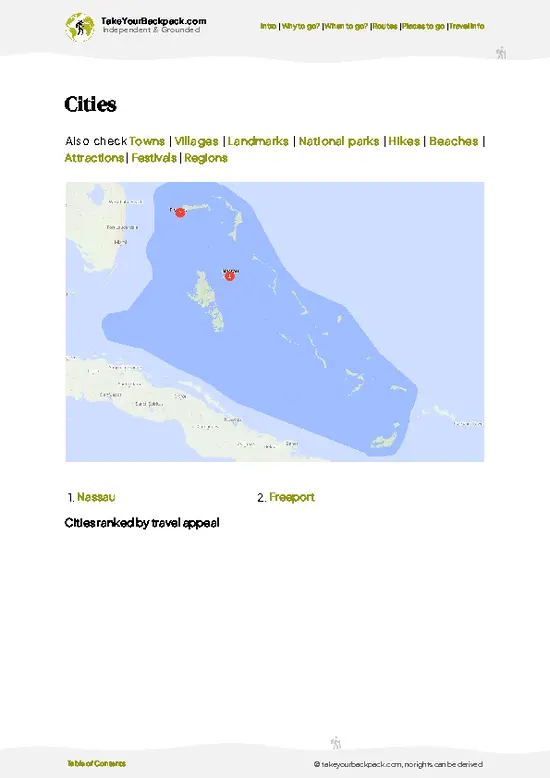
Nassau
Eric Alard
film
17
17
17a
Freeport
Patryk Pańka
film
18
18
18a
Queen’s Staircase
Fasc Decrescenzo
film
19
19
19a
Exuma Cays Land and Sea Park
film
20
20
20a
Lucayan
film
21
21
21a
Conception Island
Vibungsan Global
film
22
22
22a
Primeval Forest
Max Donovan
film
23
23
23a
North and South Marine Parks
film
24
24
24a
Crab Replenishment Reserve
film
25
25
25a
Abacos
film
26
26
26a
Eleuthera Island
Gxm
film
27
27
27a
Andros Island
film
28
28
28a
Berry Islands
film
29
29
29a
Cat Island
Agata S-ka
film
30
30
30a
Rum Cay
film
31
31
31a
Andros Barrier Reef
Michael King
film
32
32
32a
Swimming Pigs
John Porambo
film
33
33
33a
Glass Window Bridge
Ric Lewis Photography
film
34
34
34a
Blue Hole
Hyly Moss
film
35
35
35a
Rock Sound Ocean Hole
film
36
36
36a
Bimini Road
film
37
37
37a
Harbour Island
Tania Rolle
film
38
38
38a
Staniel Cay
Nikki January

Why go?What makes this country worth the trip

Beach life

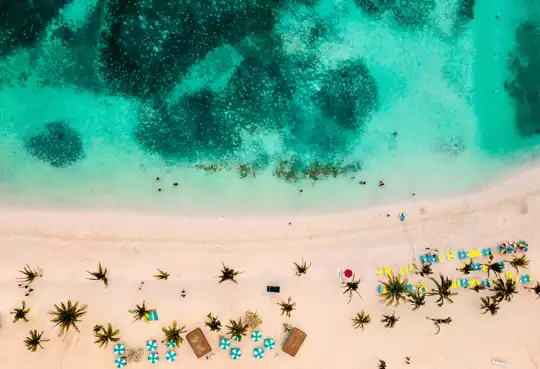
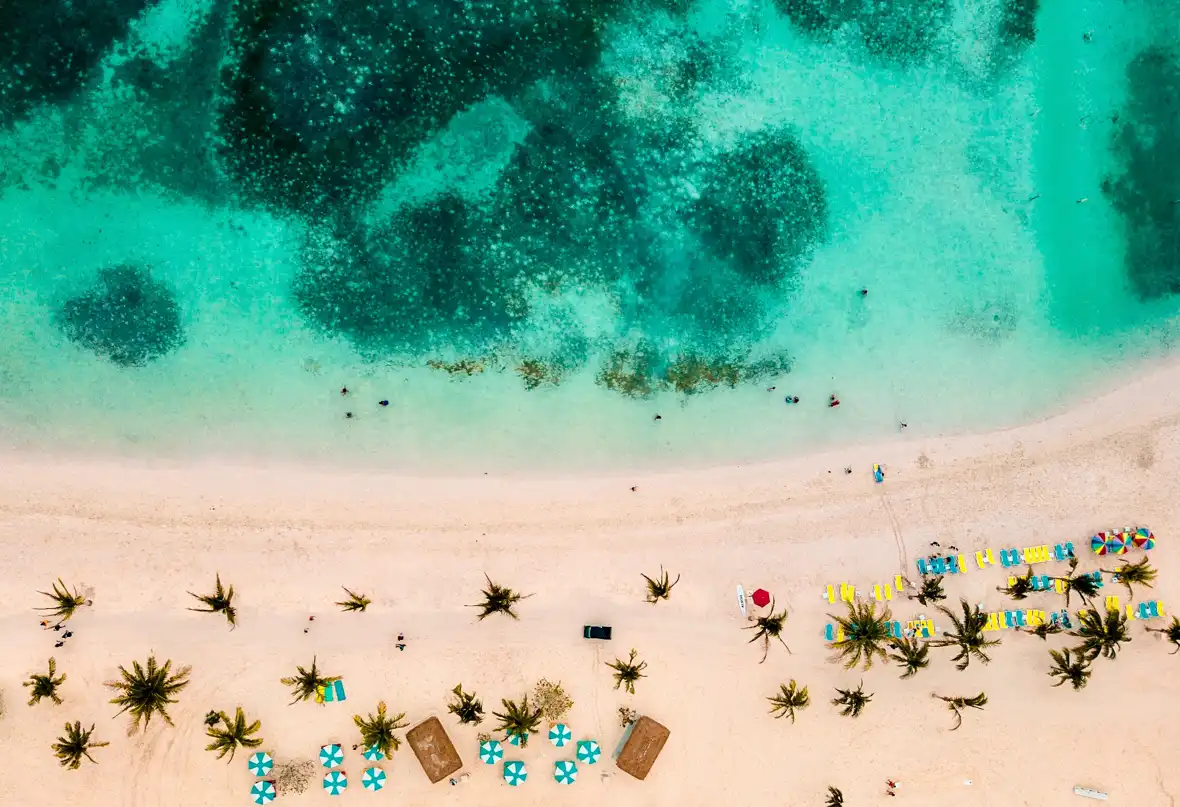
The Bahamas spoils beach people. Water so clear you count starfish from the boat, sandbars that rise at low tide like private runways. Hit the Exumas on a calm morning, snorkel the Andros blue holes when the tide slackens, then chase conch salad and rake‑and‑scrape at Arawak Cay. Avoid cruise hours; move at island sunrise.
Want the complete picture of The Bahamas?
The offline Travel Guide brings everything together — routes, highlights & planning.

See what's included in the guide 👉

Get the Travel Guide -

⭐ HighlightsHighlights of The Bahamas

  • Exuma Cays Land & Sea Park — Essential: Grab a mooring at Warderick Wells and ride slack tide through Shroud Cay; the current ferries you over starfish. Mangroves breathe, sand squeaks, salt dries to a fine crust on your forearms. Hit mid-neap tides for the clearest water.
  • Dean’s Blue Hole (Long Island) — Essential: Show up before the wind so the surface sits glassy and you hear your heartbeat after the drop. The water snaps cold as you cross the lip, ears press, colors go ink blue. Low tide, gentle swell, safer jumps.
  • Atlantis, Paradise Island — Overrated: Yes, the slides are big; so are lines, prices, and whistles. Chlorine drowns out the sea. If you must, go midweek late afternoon when cruise crowds thin. For real water, Cabbage Beach outside the gates is free.
  • Andros Blue Holes & West Side Flats — Essential: Book a dawn skiff; wind is lowest and bonefish tails wink like tiny flags. The line sings through guides, mosquitoes whine in mangroves, and some blue holes carry a sulphur note.
read more 👉
  • Exuma Cays Land & Sea Park — Essential: Grab a mooring at Warderick Wells and ride slack tide through Shroud Cay; the current ferries you over starfish. Mangroves breathe, sand squeaks, salt dries to a fine crust on your forearms. Hit mid-neap tides for the clearest water.
  • Dean’s Blue Hole (Long Island) — Essential: Show up before the wind so the surface sits glassy and you hear your heartbeat after the drop. The water snaps cold as you cross the lip, ears press, colors go ink blue. Low tide, gentle swell, safer jumps.
  • Atlantis, Paradise Island — Overrated: Yes, the slides are big; so are lines, prices, and whistles. Chlorine drowns out the sea. If you must, go midweek late afternoon when cruise crowds thin. For real water, Cabbage Beach outside the gates is free.
  • Andros Blue Holes & West Side Flats — Essential: Book a dawn skiff; wind is lowest and bonefish tails wink like tiny flags. The line sings through guides, mosquitoes whine in mangroves, and some blue holes carry a sulphur note. Two tide windows beat one—plan with a local tide table.
  • Pig Beach (Big Major Cay) — Overrated: Instagram sells it; the hooves on your dinghy sell you back. Bristles scratch, snouts bump dry bags, and the feeding is staged. If you insist, sunrise from Staniel Cay, five minutes tops; better yet, drift Pipe Creek sandbars. Off-the-map: Conception Island turtle creek, Acklins Bight, Great Inagua flamingo flats.
Spotted a mistake or missing a highlight? Contact us.

But The Bahamas offers more...

Discover and compare all of its highlights per category

🧭 RoutesHow travelers typically move through the country

The 2-Day Nassau City & Shore Sampler

The vibe: A quick-hit escape that keeps you based in Nassau, mixing easy culture with classic beach time at a relaxed pace. You’ll walk, taxi, and swim your way through the capital without ever rushing for a domestic flight.
  • Exploring the galleries and historic streets around the National Art Gallery of The Bahamas.
  • Diving into pirate lore at the Pirates of Nassau Museum.
  • Meeting wildlife at Ardastra Gardens & Wildlife Conservation Centre.
  • Unwinding on the sand and in the water at Cable Beach.

The 3-Day Nassau Culture & Coast Escape

The vibe: A long weekend that layers Nassau’s art, history, and festival culture with a full day of coastal trails and quieter beaches. You’ll stay in one base but feel like you’ve seen both the city’s energy and the island’s wilder edges.
  • Immersive Bahamian art at the National Art Gallery of The Bahamas.
  • Story-rich pirate and rum history at Pirates of Nassau Museum and John Watling’s Distillery.
  • Coastal hiking and heritage sites
read more 👉

The 2-Day Nassau City & Shore Sampler

The vibe: A quick-hit escape that keeps you based in Nassau, mixing easy culture with classic beach time at a relaxed pace. You’ll walk, taxi, and swim your way through the capital without ever rushing for a domestic flight.
  • Exploring the galleries and historic streets around the National Art Gallery of The Bahamas.
  • Diving into pirate lore at the Pirates of Nassau Museum.
  • Meeting wildlife at Ardastra Gardens & Wildlife Conservation Centre.
  • Unwinding on the sand and in the water at Cable Beach.

The 3-Day Nassau Culture & Coast Escape

The vibe: A long weekend that layers Nassau’s art, history, and festival culture with a full day of coastal trails and quieter beaches. You’ll stay in one base but feel like you’ve seen both the city’s energy and the island’s wilder edges.
  • Immersive Bahamian art at the National Art Gallery of The Bahamas.
  • Story-rich pirate and rum history at Pirates of Nassau Museum and John Watling’s Distillery.
  • Coastal hiking and heritage sites along the Clifton Heritage National Park Trail.
  • Hands-on color and rhythm at Junkanoo World Museum & Arts Centre.

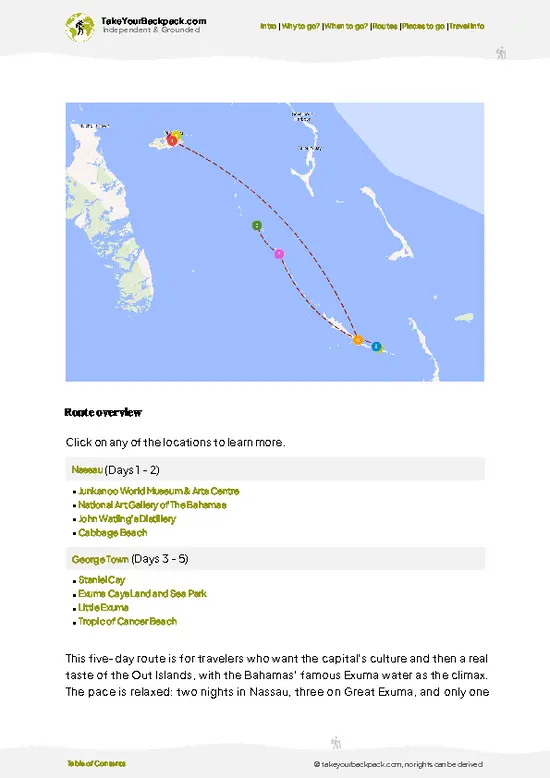
The 5-Day Nassau, Exuma & Grand Bahama Explorer

The vibe: A fuller journey that links the capital’s culture with Exuma’s cays and Grand Bahama’s coastal parks, at a steady, experience-first pace. You’ll fly once, boat between cays, and balance big-name sights with quieter beaches and trails.
  • Historic streets, art, and rum tastings in Nassau.
  • Snorkeling and island-hopping in Exuma Cays Land and Sea Park.
  • Meeting the Swimming Pigs at Pig Beach and relaxing in George Town.
  • Boardwalks, caves, and wide sands in and around Lucayan National Park and Gold Rock Beach near Freeport.
🌍 Want a ready-to-use travel plan for The Bahamas?
The overview above compares different route options based on your travel time and style. The complete Travel Guide breaks each itinerary down in detail, including maps, stops, highlights, and transport information.

Explore all route details 👉

Get the Travel Guide -

🌤️ When to go?A month-by-month overview

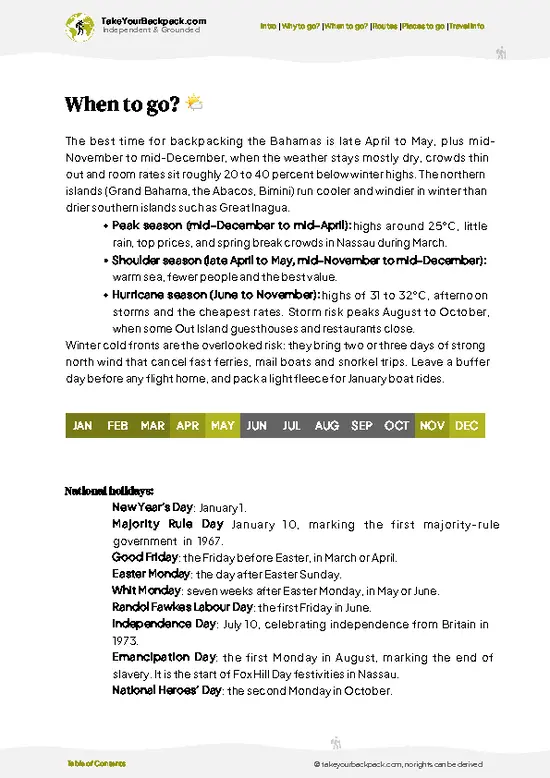
The Bahamas pays out best in late April-May and late November-early December. After spring breakers leave and before winter rates spike, trades ease and the sea stays warm. Ferries steady up versus mid-winter fronts, visibility improves, and room prices soften. Long beach days, fewer cruise waves.
  • Peak: Big rates, tight bookings, and shoulder-to-shoulder Nassau afternoons. Upside: glassy visibility, steady breeze for sails, bugs at bay, nightlife alive. But passing northers flip the banks to whitecaps and cancel ferries—an underplayed spoiler for snorkel and hop plans.
  • Shoulder: The islands shift gear. Skiffs get paint, guesthouses crack shutters, rates slip, cruise spillovers fade. You move faster, boats have seats, and locals actually linger.
  • Off-Peak: Heat presses, thunderheads brood, beaches go quiet. Swim at dawn, nap at noon, hug leeward coves, carry a dry bag, and keep routes soft to dodge squalls.

For the sweet spot, lock ferries first and keep rooms cancellable a couple weeks out; pack a light windproof.

source: climatestotravel.comJANJanuary: good for travelingFEBFebruary: good for travelingMARMarch: good for travelingAPRApril: highly recommended for travelingMAYMay: excellent for travelingJUNJune: fair for travelingJULJuly: fair for travelingAUGAugust: fair for travelingSEPSeptember: below average for travelingOCTOctober: fair for travelingNOVNovember: highly recommended for travelingDECDecember: excellent for traveling
📅 Traveling in a specific month?
Get a full month-by-month breakdown of weather, crowds, costs, festivals, and seasonal highlights in the complete travel guide.

Get full details when to go 👉

Get the Travel Guide -
bahamas- adam-gonzales-ndnZLh3LK6c-unsplash

💰 Costs (as of 2025)Prices, expenses, and money tips

Expect $90-140 USD per day if you’re disciplined and avoid hopping islands every other sunrise.
  • dorm accommodation: Nassau/Freeport dorms run $35-60 (pushes $70 in peak months); on the Out Islands, dorms basically don’t exist, so you’re in simple guesthouses at $70-120. System tip: base in a Nassau hostel Sun-Thu, cook there, and negotiate a weekly rate; when two of you appear, a basic double often beats two dorm beds, per person.
  • meals: Supermarket Survival: still pricey, but cheaper than restaurants—think $10-12 for a rotisserie chicken, $3-4 bread, rice/beans cheap, produce marked up. Street food reality: Nassau’s Fish Fry plates $12-18, conch fritters $4-6; outside Nassau options thin and resort pricing creeps in. Compared to Jamaica/DR, expect 30-60% higher food costs; still below Bermuda/Cayman restaurant shock.
  • local transport: Jitneys in Nassau are the unlock—$1.25-$2.50 cash, exact change, daytime only. Taxis start at $15-30 for short hops; meter fairy tales abound. Inter-island: mailboats are the budget move ($10-60, overnight benches, weekly schedules) vs fast ferries or flights ($60-200+ one way). Real talk: pick one island and go deep; island-hopping torches your budget.
  • activities:
read more 👉
Expect $90-140 USD per day if you’re disciplined and avoid hopping islands every other sunrise.
  • dorm accommodation: Nassau/Freeport dorms run $35-60 (pushes $70 in peak months); on the Out Islands, dorms basically don’t exist, so you’re in simple guesthouses at $70-120. System tip: base in a Nassau hostel Sun-Thu, cook there, and negotiate a weekly rate; when two of you appear, a basic double often beats two dorm beds, per person.
  • meals: Supermarket Survival: still pricey, but cheaper than restaurants—think $10-12 for a rotisserie chicken, $3-4 bread, rice/beans cheap, produce marked up. Street food reality: Nassau’s Fish Fry plates $12-18, conch fritters $4-6; outside Nassau options thin and resort pricing creeps in. Compared to Jamaica/DR, expect 30-60% higher food costs; still below Bermuda/Cayman restaurant shock.
  • local transport: Jitneys in Nassau are the unlock—$1.25-$2.50 cash, exact change, daytime only. Taxis start at $15-30 for short hops; meter fairy tales abound. Inter-island: mailboats are the budget move ($10-60, overnight benches, weekly schedules) vs fast ferries or flights ($60-200+ one way). Real talk: pick one island and go deep; island-hopping torches your budget.
  • activities: Cost drivers are on the water. Day boats to pig beaches or Exuma sandbars: $150-250 (Overrated unless that photo is your north star). Two-tank diving: $150-200. DIY wins: free beaches, shore snorkel if you bring a mask, national parks $5-10 (Essential). Kayaks/SUPs $20-40 per hour—better value as half-day bundles.
  • miscellaneous: Budget leaks: 10% VAT plus automatic 15% service in many eateries, 3-5% card surcharges, $4-6 ATM fees, bottled water markups, and “resort fees” that aren’t optional. USD and Bahamian dollars are 1:1; carry small bills. Relative value: pricier than Puerto Rico/Jamaica/DR, roughly Turks & Caicos territory, still softer than Bermuda/Cayman for rooms—tours, not so much.
⚠️ Prices can change and everyone travels differently, so take this as a rough guide. Hope it helps you plan your adventure!

✈️ The backpacker research shortcutThe Bahamas Travel Guide

An offline-friendly backpacking guide with optimized travel routes, ranked highlights, transport advice, and the best areas to stay.
example page 0 from our offline Travel Guide for Bahamasexample page 1 from our offline Travel Guide for Bahamasexample page 2 from our offline Travel Guide for Bahamasexample page 3 from our offline Travel Guide for Bahamasexample page 4 from our offline Travel Guide for Bahamasexample page 5 from our offline Travel Guide for Bahamasexample page 6 from our offline Travel Guide for Bahamasexample page 7 from our offline Travel Guide for Bahamas
The digital guide (240 pages) contains:
64 highlights, ranked by travel appeal
Optimized 2, 3 & 5-day travel routes
Cities, national parks, beaches, historical sites, ...
How to get around
Offline-friendly for travel without Wi-Fi
👉 Click to see all 30+ guide features

📅 Plan smarter in minutes, not weeks
Month by month travel advice
Festivals & national holidays
Budget expectations

🗺️ Go to the right places, skip the overrated ones
Honest pros & cons of destinations
Top hikes, parks & viewpoints
Lesser-known places most travelers miss
Clear “worth it vs skip it” guidance

🛏️ Travel smoothly without rookie mistakes
Best areas to stay
Transport systems explained simply
Common scams & safety advice
SIM cards, money & practical tips

🌍 Understand the country, not just visit it
Culture & traditions
Local customs
Festivals worth planning around
Traveler-friendly historical context
Insights that make places more meaningful

📱 Built for real travel conditions
Fully downloadable PDF
Works completely offline
Optimized for phone use
Useful in remote areas & buses
Everything in one place
Save weeks of stressful planning
Get instant access to the full guide directly. 30-day money-back guarantee.


Sent to your inbox immediately after payment • 100% Secure Checkout
Best Backpacking Travel Advisor 2025 tourism awardBest Backpacking
Travel Advisor
2025
What others say about Take Your Backpack Guides:
⭐⭐⭐⭐⭐
Fantastic, amazing amount of information!
⭐⭐⭐⭐⭐
My goodness this is amazing, it's what I've been looking for hats off too you!
⭐⭐⭐⭐⭐
I think this is absolutely BRILLIANT
⭐⭐⭐⭐
Very complete and informative. It's still missing places, but I gotta to commend you
⭐⭐⭐⭐⭐
This is truly amazing, thank you, can't wait to explore it with my kids!
⭐⭐⭐⭐⭐
Awesome resource, thank you!
⭐⭐⭐⭐⭐
This is amazing! Can't wait to explore the ones I haven't seen
⭐⭐⭐⭐
I love this! Well done, great idea.
⭐⭐⭐⭐⭐
Thanks for taking the time to make this gem!
⭐⭐⭐⭐⭐
This might be the best website I've ever seen.
⭐⭐⭐⭐⭐
Congratulations, and thank you so much for your work; it's incredibly valuable.
⭐⭐⭐⭐
In all seriousness I think you did a great job pointing out the important spots
⭐⭐⭐⭐⭐
10/10 very good
⭐⭐⭐⭐⭐
As someone who's only just starting to visit regularly this is awesome, thank you.
⭐⭐⭐⭐
Thank you very much! I'm going to visit my dad, it's going to be very useful!
⭐⭐⭐⭐⭐
This is really cool! We'll be travelling for the first time and this definitely come in handy.
⭐⭐⭐⭐⭐
You are now our minister of culture, congratulations 👨‍💼
⭐⭐⭐⭐⭐
Just wanted to tell you that this is a pearl! Going to follow your recommendations.
⭐⭐⭐⭐⭐
This is so cool. I'll definitely be using the resource for my travels soon.
⭐⭐⭐⭐⭐
This is very impressive! Good work.
⭐⭐⭐⭐⭐
This is an amazing and informative site. Very well done!

🛏️ Where to stay?Accommodation types and options

Yes — there are hostels, budget guesthouses and dorm-style stays in The Bahamas, but they cluster on the main islands rather than the remote cays.
Most choices are in Nassau (Downtown and Cable Beach) — pro: nearest airport, ferries, nightlife and attractions; con: tourist traffic and higher prices; Freeport (Lucaya) — pro: cheaper local food and quieter beaches; con: fewer true hostels and limited night transport; and George Town (Exuma) and Harbour Island — pro: direct island access and great beaches; con: scarce budget beds and strong seasonality.
Plan and book ahead for high season, expect … read more 👉
Yes — there are hostels, budget guesthouses and dorm-style stays in The Bahamas, but they cluster on the main islands rather than the remote cays.
Most choices are in Nassau (Downtown and Cable Beach) — pro: nearest airport, ferries, nightlife and attractions; con: tourist traffic and higher prices; Freeport (Lucaya) — pro: cheaper local food and quieter beaches; con: fewer true hostels and limited night transport; and George Town (Exuma) and Harbour Island — pro: direct island access and great beaches; con: scarce budget beds and strong seasonality.
Plan and book ahead for high season, expect many budget options to be guesthouse-style rather than full hostels, and factor inter-island ferries or flights into your budget and schedule.

If you enjoy meeting fellow travelers, consider choosing hostels with high ratings for atmosphere. On the other hand, if you prefer having your own space, a hotel might be a better option.

🚌 Getting aroundWhat moving around is really like

The Bahamas moves on tide and gossip, not timetables. Buses vanish at dusk, boats leave when the last crate is lashed, and planes pile into the morning before the wind gets feisty. Chase clockwork and you’ll stew; lean into the rhythm and you’ll cross water for less, with better stories.
  • Domestic island hops (Bahamasair + small carriers) Speed wins between far-flung islands, but you pay for it. Fares jump late, bags get weighed like produce, and weather can stall you. Show up early, take the first
read more 👉
The Bahamas moves on tide and gossip, not timetables. Buses vanish at dusk, boats leave when the last crate is lashed, and planes pile into the morning before the wind gets feisty. Chase clockwork and you’ll stew; lean into the rhythm and you’ll cross water for less, with better stories.
  • Domestic island hops (Bahamasair + small carriers) Speed wins between far-flung islands, but you pay for it. Fares jump late, bags get weighed like produce, and weather can stall you. Show up early, take the first flight of the day, carry-on only. Essential when islands are more than one sea away; anything else is theater.
  • Nassau/Freeport jitneys This is the social spine: exact cash, a quick nod to the driver, a soft “bus stop” before your corner. Seats fill with uniforms, groceries, beach buckets. No big luggage, mind the music, and don’t expect service after early evening or much on Sunday. Essential by day; overrated when the sun goes down because they simply don’t run.
  • Mailboats out of Potter’s Cay The geometric unlock. These freighters reach the islands flights skip when budgets tighten. Cash on board, schedules drift with the cargo, and you sleep under the stars if the cabin’s full. Bring a sweater, snacks, and patience; give forklifts the right of way. Cheapest long-haul, landing you at dawn where roads end in water.
  • Hitchhiking on the Out Islands The budget disruptor locals understand. Daylight only, palm-down wave, hop in the back of a pickup, offer a couple bucks for fuel or a thank-you. Works on Eleuthera, Long Island, Cat Island; skip it in Nassau. Cuts taxi spend, which is overrated for short hops outside airports.

Master tactical tip: Fly out early to your farthest island, move locally by jitney or thumb, then take a mailboat overnight back to Nassau—you trade dead time for miles and halve your costs across The Bahamas.
Distance: Lynden Pindling International Airport (NAS) sits about 16 km (10 miles) west of Downtown Nassau (Bay Street/Rawson Square).

Main public transport options
  • Jitney (local bus): Jitneys don’t enter the airport. Walk about 10-15 minutes from the terminal to the roundabout on John F. Kennedy Drive to flag Route 12B toward Downtown.

    Time: 35-50 minutes, traffic-dependent.

    Cost: B$1.50-$2.00 per person, cash only (Bahamian or US dollars accepted at par).

    Hours: Roughly 6:30 am-7:00 pm Mon-Sat; very limited or no service on Sundays/late evenings.

    Good to know: Space is tight; drivers may refuse large luggage.
  • Shared shuttle (pre-booked): Companies like Majestic Tours and hotel-arranged shuttles run shared transfers to downtown hotels.

    Time: 30-45 minutes depending on stops.

    Cost: About US$18-$25 per person one-way.

    Notes: Best to pre-book; desks are usually in Arrivals when flights are landing.

Taxi
  • Readily available at the official rank outside Arrivals.

    Time: 20-30 minutes to Downtown.

    Cost: Typically US$35-$45 (same in Bahamian dollars), plus about US$1 per large bag; 10-15% tip is customary.

Extras
  • No Uber/Lyft in The Bahamas as of 2025.
  • Traffic can be heavy at rush hour; add buffer time if catching a ferry or tour.
⚠️ Prices and routes can change, so take this as a rough guide and ask for local advice when you arrive.

🔒 Safety (risk Level: medium)Staying safe while traveling

Safety for solo travelers, including women and LGBTQ+ individuals
The Bahamas is generally safe for solo travelers, but like anywhere, it’s important to stay aware of your surroundings. For women, sticking to well-lit areas and avoiding isolated places at night is wise. LGBTQ+ travelers should be mindful that while the Bahamas is generally tolerant, public displays of affection might attract some unwanted attention. Always keep your belongings secure and check for any local advisories before heading out.


Full official government travel advisory (live updates)
View details 👉

✈️ VisaEntry requirements and paperwork

Most travelers from the US, Canada, UK, and EU do not need a visa to visit the Bahamas for stays up to 90 days. Always double-check with the Bahamas’ official government site or your local embassy, as rules can change. If a visa is required, apply through the Bahamas Ministry of Foreign Affairs website.
⚠️ Visa requirements can change over time, so always check the latest visa requirements with the official embassy or government website before you travel.

🎒 What to pack?What to pack for The Bahamas

Heading to the Bahamas? Expect sunny skies and balmy breezes. Keep it light and breathable, since you’re looking at constant heat and humidity. Beaches are the main stage here, but don’t forget to pack something modest for any local gatherings or dining in town—locals appreciate a bit of respect for their cultural norms. While the vibe is laid-back, a sudden rain shower can catch you off guard, so a quick-dry layer or two won’t hurt. Stay comfy, and enjoy the island life!

Apart from this country specific advice, I have also crafted a general packing list that should help on any trip. authorOver the years, I've learned the importance of packing minimally. It's so much easier to jump on the back of a truck or squeeze yourself into the last spot of a minibus without that supersized backpack. If you're headed to a warm destination, leave your winter jacket at home; for colder regions, opt for thin thermal underlayers. Instead of packing your entire wardrobe, bring just three sets of clothes, as laundry facilities are available everywhere.

View the full list 👉
🎒 Planning the practical side of your trip?
Get detailed information on transport, daily budgets, internet access, local customs, food, language, and other essentials in the complete Travel Guide.

Get detailed practical information 👉

Get the Travel Guide -

🙋 FAQTravel questions about The Bahamas

Trip Planning


Personal tip: I normally search on good rating for atmosphere (for meeting people) and location (for easy exploring). Cleanliness as a bonus.


Travel Essentials

Routine Vaccinations: Ensure you’re up-to-date on standard vaccines like measles-mumps-rubella (MMR), diphtheria-tetanus-pertussis, varicella (chickenpox), polio, and your yearly flu shot.

Recommended Vaccines: Hepatitis A and typhoid are recommended, as you might come into contact with contaminated food or water.

Consider: Hepatitis B if you might have new sexual partners, get a tattoo, or require medical treatment.

Rabies: Generally not necessary unless you’re planning on extensive outdoor activities or working with animals.


vaccination requirements
When I first started traveling, I often spent part of my first day in a new country hunting for a local SIM card. While this can still be slightly cheaper, it also takes time and planning.

These days, it's much simpler to install an eSIM before leaving home. Once you arrive in The Bahamas, you can activate it immediately and have mobile data from the moment you land — which is especially useful for ordering transport or navigating away from busy airports.

There are many providers nowadays, and price differences are usually small. I personally go with Airalo, as it offers excellent network coverage throughout the country and strong global coverage, so you can manage multiple countries from a single app.


Get your e-sim for The Bahamas

Culture & Customs

Respect local customs by greeting people with a friendly ”good morning” or ”good afternoon.” Dress modestly, especially when away from beaches—cover up when entering shops or restaurants. Tipping is customary; 15% is standard.

Don’t rush—Bahamian culture values a relaxed pace. LGBTQ+ travelers should be discreet; while the Bahamas is generally tolerant, public displays of affection might attract unwanted attention. Women should be aware of occasional catcalling but can expect a relatively safe environment.

Using your right hand for greetings and transactions is polite. Avoid discussing politics or religion unless invited to do so.
Trying traditional food is always a great way to experience the culture. Here are some must-try dishes for The Bahamas.
  • Conch Fritters: Deep-fried balls of conch meat mixed with batter, onions, and peppers. A staple at any Bahamian gathering, these are beloved for their crispy texture and spicy kick.
  • Cracked Conch: Tenderized and battered conch meat, deep-fried until golden. Often served with a side of peas and rice or fries. It’s a favorite for its crispy exterior and tender inside.
  • Rock Lobster: Also known as Bahamian lobster, it’s usually grilled or steamed. It’s popular for its sweet, tender meat and is often enjoyed with a squeeze of lime.
  • Souse: A spicy soup made with meat (usually chicken, sheep’s tongue, or pig’s feet), lime juice, and allspice. Known for its tangy flavor, it’s often eaten as a hangover cure or breakfast.
  • Peas and Rice: A side dish of pigeon peas and rice cooked with tomatoes, onions, and spices. It’s a must-try due to its status as a Bahamian staple and its savory, comforting taste.
Tap water in the Bahamas is generally safe for locals to drink, but tourists might find it has a slight taste due to mineral content. It’s often recommended for tourists to opt for bottled or filtered water to avoid any potential stomach upsets. Stick to bottled water if you’re unsure, especially in more remote areas.
In the Bahamas, English is the official language and is widely spoken throughout the islands. The majority of the population is fluent in English, making communication easy for travelers. You’ll find that locals, including those in tourism, hospitality, and retail sectors, are typically very proficient in English, often using a friendly and welcoming tone.

In addition to standard English, many Bahamians speak a local dialect known as Bahamian English, which incorporates unique phrases and expressions. While this dialect might sound different at times, it’s generally understandable to English speakers.

In tourist areas, such as Nassau and Paradise Island, English is the primary language of interaction, and signs, menus, and information are predominantly in English. This linguistic familiarity enhances the travel experience, allowing visitors to engage comfortably with locals and navigate the islands without language barriers.

Overall, travelers can expect to communicate easily in English throughout the Bahamas, making it an accessible and enjoyable destination.

Money & Payments

The local currency of The Bahamas is BSD ($).

ATMs: You’ll find ATMs in most urban areas and tourist spots like Nassau and Freeport. They usually dispense Bahamian dollars, which are on par with USD. Don’t rely on them in remote areas, though. Also, check for fees—some ATMs charge a pretty penny.

Cash: Always good to have some cash on you for small purchases or markets. Bahamian dollars are accepted everywhere, and USD is widely accepted too. Forget euros; they’ll just complicate things.

Card Use: Credit and debit cards are widely accepted at hotels, restaurants, and larger stores, but carry some cash for smaller vendors or local spots. Note that smaller places might add a surcharge for card payments.

Currency Exchange: If you need to exchange cash, banks are your best bet. Airport exchange booths are convenient but often have less favorable rates. Avoid exchanging cash at hotels unless you’re desperate—they usually offer the worst rates.

In the Bahamas, it’s standard to tip around 15% to 20% at restaurants if a gratuity isn’t already included in the bill. Taxis and hotel staff generally appreciate a couple of dollars for good service. Always check your bill, as some places automatically add a service charge.

🧩 Nearby countriesSimilar backpacking destinations

We 💚 feedbackIs The Bahamas worth visiting?

Here’s the cut: Essential — Exuma Cays by small skiff at first light (Pipe Creek sandbars at dead‑low tide); Andros blue holes with a local; Cat Island’s Hermitage sunrise; Abaco by sail. Overrated — Atlantis day passes, Pig Beach at noon (if you must, at sunrise), Compass Cay shark cuddles, straw‑market laps. Vibe is sea‑salty and unhurried. Surprise: all beaches are public. Small warning: no‑see‑ums hammer you when wind dies. Misconception: The Bahamas isn’t only resorts; mailboats, jitneys, and conch shacks keep costs sane and human.

✍️ Help improve this page!
The information on this page is based on in-depth research, insights shared by experienced travelers, and feedback from the local travel community in The Bahamas. While every effort is made to keep the information accurate and current, conditions can change — so if you spot anything incorrect or outdated, please get in touch.


🙋‍♂️ Give feedback

👋 Meet the founderWho’s Behind Take Your Backpack?

Johan, backpacker and founder of TakeYourBackpackHi, I’m Johan (Netherlands 🇳🇱), the creator of TakeYourBackpack. Over the past decade, I’ve backpacked through 80+ countries across six continents, gaining extensive experience with independent travel, long-term trips, and overland routes.

This site is built on a combination of firsthand travel experience and carefully curated insights from other backpackers. Many guides are based on places I’ve personally visited, while others bring together tips, observations, and practical advice shared by trusted travelers I’ve met along the way.

The goal is to provide realistic, experience-driven guidance — not generic itineraries — so you can explore destinations with better context, clearer expectations, and more confidence.

Get full country guide •
Instant download • 64 highlights • Full Offline guide