×

Algeria🇩🇿 | national parksDjurdjura National ParkLalla Khedidja summit, Tikjda plateau, Kabylie limestone, winter skiing | things to do and best time to go

Explore Taza National ParkExplore Tlemcen National Park

Backpacking in Djurdjura
🏆 Top picknational park ranked #3
By Johan Kruseman 🇳🇱 | Updated October 22, 2026

Your lungs burn on the cedar-lined path while the limestone wall ahead flashes gray and white, and somewhere above a Barbary macaque barks from the branches. That is Djurdjura National Park, in the north of Algeria, a ridge of limestone rising south of Tizi Ouzou and Bouira, its highest point Lalla Khedidja at about 2,300 meters. Trails are rough and often unmarked, because the park runs on local knowledge rather than signage, so you hire a village guide or download offline maps. Snow lingers into late spring, so you pack crampons or wait for summer. Public transport stops at the villages, so you plan on shared taxis and long walks. Crowds are thin, the cedar forests smell of resin, and village hospitality is warm. Hikers who like raw, self-reliant mountains will love it. Anyone wanting polished facilities and clear signs will not.

Discover everything you want to know in the 📖 Algeria Travel Guide.


example page 0 from our offline Travel Guide for Algeria
example page 1 from our offline Travel Guide for Algeria
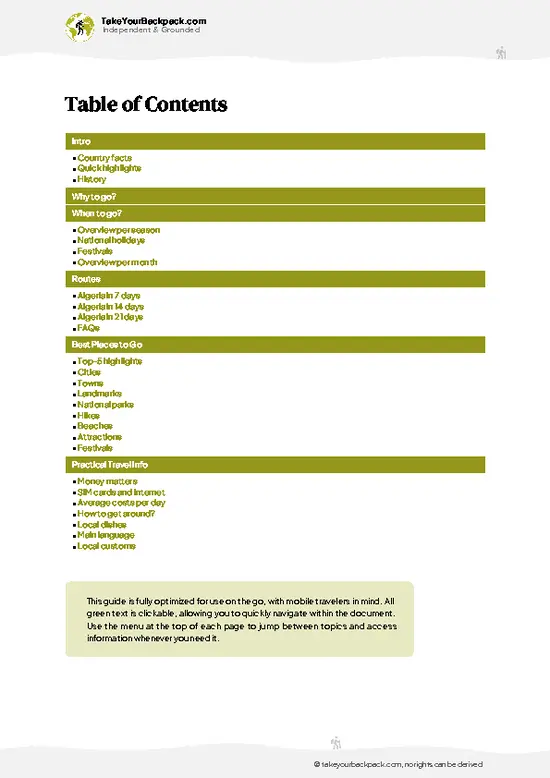
example page 2 from our offline Travel Guide for Algeria
example page 3 from our offline Travel Guide for Algeria
example page 4 from our offline Travel Guide for Algeria
example page 5 from our offline Travel Guide for Algeria
example page 6 from our offline Travel Guide for Algeria
example page 7 from our offline Travel Guide for Algeria
Loading the map 🌍
CLICK TO FILTER
cities
towns
landmarks
national parks
hikes
beaches
attractions
festivals
SHOW COUNTRY’S BESTSHOW ALL

✨ Why go?
Ranked #3 national park in Algeria
Why Djurdjura should be on your travel list

Djurdjura National Park suits you if you like walking without a queue. The range is compact, and you can climb from Kabyle villages like Tikjda straight into cedar forests above 1,400 meters, then onto bare limestone ridges. There are no ticketed shuttles and no mandatory tours, so you set your own pace, camp or arrange a village bed, and change plans when the clouds drop. Self-guided travelers manage fine in good weather with offline maps, though a local guide takes the stress out of route-finding on the higher ridges. The other draw is the wildlife. Barbary macaques live in the cedar and oak woods, and you may spot eagles over the cliffs. In winter, Tikjda’s small ski area adds a rare North African snow option, and the Kabyle food and conversation in the villages round out each trip with warmth that no organized tour reproduces.

💡 HighlightsPlaces and moments you shouldn't skip

  1. Lalla Khedidja Peak: The highest summit of the range, about 2,300 meters, with long views across Kabylie. The climb is steep and exposed, best in dry summer conditions.
  2. Tikjda Plateau: The park’s main base for hikers, set among cedars at roughly 1,400 meters, with the trailheads and a sports center close by.
  3. Cedar forests of Tikjda: Atlas cedars with dark, layered branches and a resinous smell, shady in summer and quiet in snow.
  4. Barbary macaques: Algeria’s wild monkeys, often seen near forest edges and road bends. Keep your distance and do not feed them.
  5. Tala Guilef Gorge area: Cool, shaded terrain with cliff walls and streams, a gentler outing on hot days.
  6. Haizer and Akouker ridges: Open limestone crests with sweeping views, for experienced hikers who want a full day above the tree line.
  7. Winter
… read more 👉
  1. Lalla Khedidja Peak: The highest summit of the range, about 2,300 meters, with long views across Kabylie. The climb is steep and exposed, best in dry summer conditions.
  2. Tikjda Plateau: The park’s main base for hikers, set among cedars at roughly 1,400 meters, with the trailheads and a sports center close by.
  3. Cedar forests of Tikjda: Atlas cedars with dark, layered branches and a resinous smell, shady in summer and quiet in snow.
  4. Barbary macaques: Algeria’s wild monkeys, often seen near forest edges and road bends. Keep your distance and do not feed them.
  5. Tala Guilef Gorge area: Cool, shaded terrain with cliff walls and streams, a gentler outing on hot days.
  6. Haizer and Akouker ridges: Open limestone crests with sweeping views, for experienced hikers who want a full day above the tree line.
  7. Winter skiing at Tikjda: A modest ski area with snow from about December to March, popular with Algerians on weekends.
Djurdjura National Park can be seen in two to three days if you combine the plateau, the forest and one summit attempt.
Spotted a mistake or missing something? Contact us.

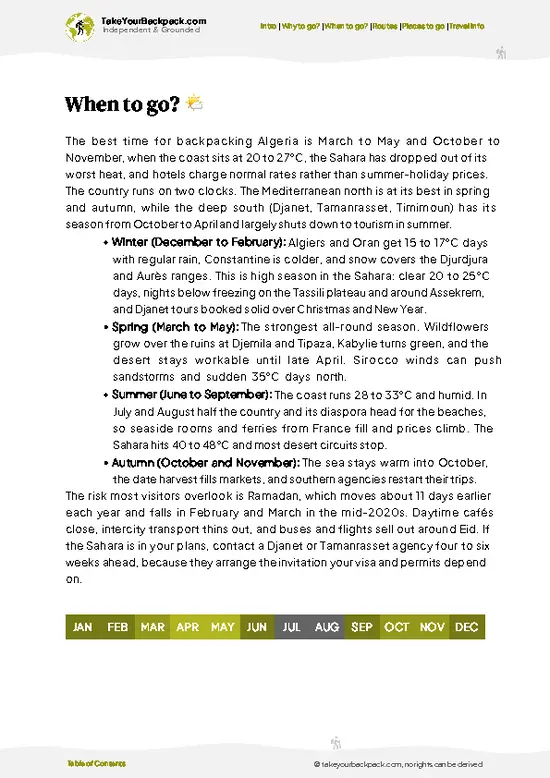
🌤️ When to go?Weather, crowds, and seasonal trade-offs

  • Late Spring (May to June): Snowmelt feeds the streams, wildflowers open on the lower slopes, and daytime highs run 15 to 24°C (59 to 75°F). Higher ridges can still hold snow patches into May, and daylight lasts about 14 hours.
  • Summer (July to September): Dry and sunny, with 22 to 32°C (72 to 90°F) in the valleys and cooler air above 1,800 meters. Algerian families fill the roads and Tikjda in August, and guesthouse prices rise.
  • Autumn (October to November): Clear light, 10 to 20°C (50 to 68°F), thin crowds and the first rain. Days shorten to about 10 hours by November.
  • Winter (December to March): Heavy snow closes high routes and cuts roads, with lows of -10 to 0°C (14 to 32°F). Tikjda has modest skiing and ski-touring, and rates stay steady.
Aim for the shoulder weeks of late May or late September, … read more 👉
  • Late Spring (May to June): Snowmelt feeds the streams, wildflowers open on the lower slopes, and daytime highs run 15 to 24°C (59 to 75°F). Higher ridges can still hold snow patches into May, and daylight lasts about 14 hours.
  • Summer (July to September): Dry and sunny, with 22 to 32°C (72 to 90°F) in the valleys and cooler air above 1,800 meters. Algerian families fill the roads and Tikjda in August, and guesthouse prices rise.
  • Autumn (October to November): Clear light, 10 to 20°C (50 to 68°F), thin crowds and the first rain. Days shorten to about 10 hours by November.
  • Winter (December to March): Heavy snow closes high routes and cuts roads, with lows of -10 to 0°C (14 to 32°F). Tikjda has modest skiing and ski-touring, and rates stay steady.
Aim for the shoulder weeks of late May or late September, when trails are open and beds are easy to find.


source: climatestotravel.comJANJanuary: fair for travelingFEBFebruary: fair for travelingMARMarch: good for travelingAPRApril: excellent for travelingMAYMay: excellent for travelingJUNJune: highly recommended for travelingJULJuly: below average for travelingAUGAugust: below average for travelingSEPSeptember: excellent for travelingOCTOctober: excellent for travelingNOVNovember: good for travelingDECDecember: fair for traveling
algeria-national-park-djurdjura-national-park v1
© Google |

✈️ The backpacker research shortcutAlgeria Travel Guide

An offline-friendly backpacking guide with optimized travel routes, ranked highlights, transport advice, and the best areas to stay.
example page 0 from our offline Travel Guide for Algeria
example page 1 from our offline Travel Guide for Algeria
example page 2 from our offline Travel Guide for Algeria
example page 3 from our offline Travel Guide for Algeria
example page 4 from our offline Travel Guide for Algeria
example page 5 from our offline Travel Guide for Algeria
example page 6 from our offline Travel Guide for Algeria
example page 7 from our offline Travel Guide for Algeria
The digital guide (314 pages) contains:
✅ 79 highlights, ranked by travel appeal
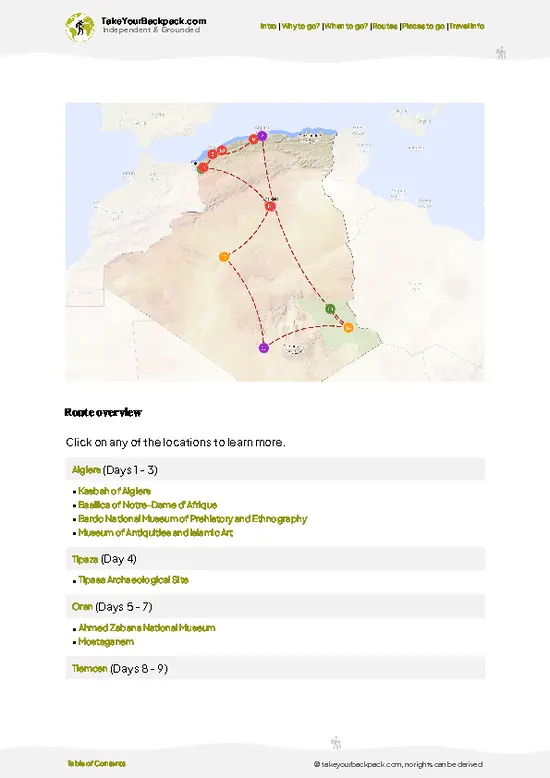
✅ Optimized 7, 14 & 21-day travel routes
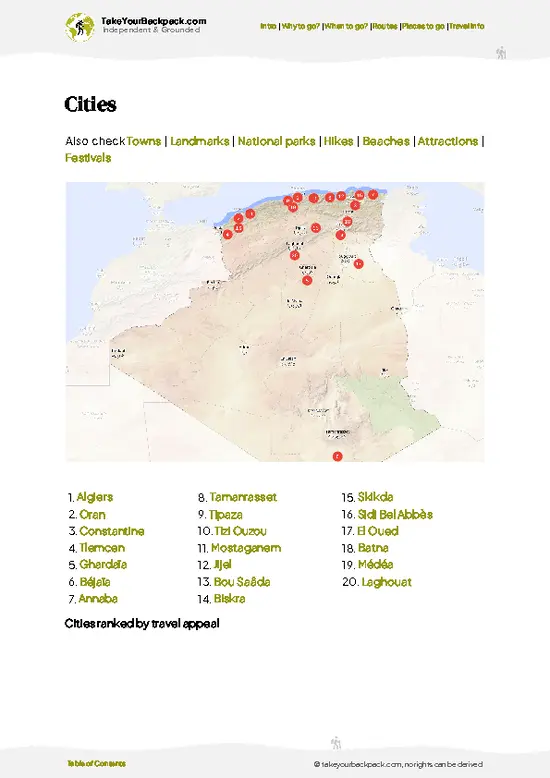
✅ Cities, national parks, landmarks, beaches
✅ How to get around
✅ Offline-friendly for travel without Wi-Fi
👉 Click to see all 30+ guide features

📅 Plan smarter in minutes, not weeks
✅ Month by month travel advice
✅ Festivals & national holidays
✅ Budget expectations

🗺️ Go to the right places, skip the overrated ones
✅ Honest pros & cons of destinations
✅ Top hikes, parks & viewpoints
✅ Lesser-known places most travelers miss
✅ Clear “worth it vs skip it” guidance

🛏️ Travel smoothly without rookie mistakes
✅ Best areas to stay
✅ Transport systems explained simply
✅ Common scams & safety advice
✅ SIM cards, money & practical tips

🌍 Understand the country, not just visit it
✅ Culture & traditions
✅ 52 Essential phrases & customs
✅ Festivals worth planning around
✅ Traveler-friendly historical context
✅ Insights that make places more meaningful

📱 Built for real travel conditions
✅ Fully downloadable PDF
✅ Works completely offline
✅ Optimized for phone use
✅ Useful in remote areas & buses
✅ Everything in one place
Stop searching, start planning
Get instant access to your full guide. 30‑day money-back guarantee.
+ Add another guide for just

By proceeding you agree to our terms.
Sent to your inbox immediately after payment • 100% Secure Checkout
Best Backpacking Travel Advisor 2025 tourism awardBest Backpacking
Travel Advisor
2025
What others say about Take Your Backpack Guides:
⭐⭐⭐⭐⭐
Fantastic, amazing amount of information!
⭐⭐⭐⭐⭐
My goodness this is amazing, it's what I've been looking for hats off too you!
⭐⭐⭐⭐⭐
I think this is absolutely BRILLIANT
⭐⭐⭐⭐
Very complete and informative. It's still missing places, but I gotta to commend you
⭐⭐⭐⭐⭐
This is truly amazing, thank you, can't wait to explore it with my kids!
⭐⭐⭐⭐⭐
Awesome resource, thank you!
⭐⭐⭐⭐⭐
This is amazing! Can't wait to explore the ones I haven't seen
⭐⭐⭐⭐
I love this! Well done, great idea.
⭐⭐⭐⭐⭐
Thanks for taking the time to make this gem!
⭐⭐⭐⭐⭐
This might be the best website I've ever seen.
⭐⭐⭐⭐⭐
Congratulations, and thank you so much for your work; it's incredibly valuable.
⭐⭐⭐⭐
In all seriousness I think you did a great job pointing out the important spots
⭐⭐⭐⭐⭐
10/10 very good
⭐⭐⭐⭐⭐
As someone who's only just starting to visit regularly this is awesome, thank you.
⭐⭐⭐⭐
Thank you very much! I'm going to visit my dad, it's going to be very useful!
⭐⭐⭐⭐⭐
This is really cool! We'll be travelling for the first time and this definitely come in handy.
⭐⭐⭐⭐⭐
You are now our minister of culture, congratulations 👨‍💼
⭐⭐⭐⭐⭐
Just wanted to tell you that this is a pearl! Going to follow your recommendations.
⭐⭐⭐⭐⭐
This is so cool. I'll definitely be using the resource for my travels soon.
⭐⭐⭐⭐⭐
This is very impressive! Good work.
⭐⭐⭐⭐⭐
This is an amazing and informative site. Very well done!

🛏️ Where to stay?Best areas to stay in Algeria

Tikjda, the mountain resort on the park’s southern flank in Bouira province, is the only real base inside Djurdjura National Park. It has the Centre National des Sports de Montagne, which takes walk-in guests in simple dorm-style rooms and chalets for roughly US$15 to 35 a night, plus a couple of hotels and meals served on site. It sits at about 1,400 meters and puts you at the foot of Lalla Khedidja’s approaches, with the trailheads a short walk away.
On the northern side, Tizi Ouzou province has village guesthouses and small hotels near Aïn El Hammam, Yakouren and Tala Guilef. Expect US$20 to … read more 👉
Tikjda, the mountain resort on the park’s southern flank in Bouira province, is the only real base inside Djurdjura National Park. It has the Centre National des Sports de Montagne, which takes walk-in guests in simple dorm-style rooms and chalets for roughly US$15 to 35 a night, plus a couple of hotels and meals served on site. It sits at about 1,400 meters and puts you at the foot of Lalla Khedidja’s approaches, with the trailheads a short walk away.
On the northern side, Tizi Ouzou province has village guesthouses and small hotels near Aïn El Hammam, Yakouren and Tala Guilef. Expect US$20 to 45 a night for a private room, often with home cooking. Michelet (Aïn El Hammam) is the best-known entry for the Tizi N’Kouilal approaches. Many places there are family-run and booking by phone is common.
For cheaper beds and shops, Bouira city and Tizi Ouzou city are the main hubs, with budget hotels at US$20 to 40. Wild camping is possible in the high meadows in summer, but carry water and a full kit since there are no facilities.

👛 Costs (as of 22 October 2026)Travel costs and budget guide for Djurdjura

Djurdjura National Park costs a backpacker about US$40 to 60 per day, with most of that going to a bed and meals. Prices are in US dollars, though you pay in Algerian dinars and cash is the norm in the villages.
CategoryBudget RangeLocal Reality
Entrance feesUS$0 to 2Access is mostly free or a token amount at specific sites. Guide fees are separate.
Accommodation (high season)US$15 to 35Dorms or chalets at Tikjda, and guesthouses in Tizi Ouzou villages at the upper end. Low season is about 10 to 20 percent cheaper.
Local transportUS$3 to 10Shared taxis and minibuses from Bouira or Tizi Ouzou to the foothill villages. Last stretches to trailheads may need a private ride.
Food and suppliesUS$8 to 15Bakery bread, grilled meat, couscous and tagines in village cafes. Stock up on trail food in the towns.
… read more 👉
Djurdjura National Park costs a backpacker about US$40 to 60 per day, with most of that going to a bed and meals. Prices are in US dollars, though you pay in Algerian dinars and cash is the norm in the villages.
CategoryBudget RangeLocal Reality
Entrance feesUS$0 to 2Access is mostly free or a token amount at specific sites. Guide fees are separate.
Accommodation (high season)US$15 to 35Dorms or chalets at Tikjda, and guesthouses in Tizi Ouzou villages at the upper end. Low season is about 10 to 20 percent cheaper.
Local transportUS$3 to 10Shared taxis and minibuses from Bouira or Tizi Ouzou to the foothill villages. Last stretches to trailheads may need a private ride.
Food and suppliesUS$8 to 15Bakery bread, grilled meat, couscous and tagines in village cafes. Stock up on trail food in the towns.
Guide (optional)US$0 to 15Day rates for a mountain guide split among a group. Many solo hikers skip this on marked routes.
Total Daily BudgetUS$40 to 60Lower end if you cook, share rides and camp. Higher in August.


source: algeria.com
⚠️ Prices can change and everyone travels differently, so take this as a rough guide. Hope it helps you plan your adventure!

🥾 TrailsDiscover Djurdjura's top trails and natural wonders

Djurdjura National Park offers rugged day walks and longer ridge routes, mostly on limestone that is sharp underfoot and slick when wet. Trail marking is patchy, so guides from nearby villages are valuable. Distances and times below are approximate.
  • Lalla Khedidja Summit Route: About 8 to 10 hours round trip from the Tikjda area, hard, with steep scree, exposed rock and a big elevation gain. Best from late spring to early autumn.
  • Tikjda Cedar Loops: Two to four hours, easy to moderate, on forest paths and tracks through Atlas cedar, with a good chance of seeing macaques.
  • Tala Guilef Gorge Walk: Two
… read more 👉
Djurdjura National Park offers rugged day walks and longer ridge routes, mostly on limestone that is sharp underfoot and slick when wet. Trail marking is patchy, so guides from nearby villages are valuable. Distances and times below are approximate.
  • Lalla Khedidja Summit Route: About 8 to 10 hours round trip from the Tikjda area, hard, with steep scree, exposed rock and a big elevation gain. Best from late spring to early autumn.
  • Tikjda Cedar Loops: Two to four hours, easy to moderate, on forest paths and tracks through Atlas cedar, with a good chance of seeing macaques.
  • Tala Guilef Gorge Walk: Two to three hours, moderate, along cliffs and streambeds with cooler air and some rocky steps.
  • Ridge Traverses: Full-day routes for fit hikers along the high crests, with route-finding skills essential and weather that changes fast.
The terrain shifts from oak and cedar woods to bare rock and scree, and snow can sit on the higher slopes into early summer. Wildlife includes Barbary macaques, birds of prey and smaller forest mammals. Reaching the park without a car is possible but slow, since you usually travel to Bouira or Tizi Ouzou and then take shared taxis or local transport to the mountain villages. Crowds are light on weekdays and heavier on winter weekends around Tikjda. Entry is usually inexpensive or informal, with any charges paid in local currency.
⚠️ Hiking info can sometimes be outdated or inaccurate. Before you hit the trail, check the latest conditions with locals. If you do spot anything that's off, I'd love to hear from you, so I can update it for fellow travelers.

🛡️ SafetyScams, Hazards, and Annoyances

Djurdjura is a serious limestone range, so treat it like alpine terrain rather than a park stroll. Weather turns fast. Summer storms and cloud can roll in by afternoon, and snow lingers on the ridges from roughly November into May, making navigation and footing tricky. Start early, carry a warm layer and waterproof even in July, and pack more water than you expect to need, since springs are scarce on the high routes.
Trails are often rough and rocky, with scree, steep gullies and limited signage, so download offline maps and consider a local guide from Tikjda for routes like Lalla Khedidja. Barbary macaques live in the cedar forests and are used to being fed. Don’t feed them, and keep food zipped up. Tell your guesthouse your route and return time, because phone signal drops in the gorges. … read more 👉
Djurdjura is a serious limestone range, so treat it like alpine terrain rather than a park stroll. Weather turns fast. Summer storms and cloud can roll in by afternoon, and snow lingers on the ridges from roughly November into May, making navigation and footing tricky. Start early, carry a warm layer and waterproof even in July, and pack more water than you expect to need, since springs are scarce on the high routes.
Trails are often rough and rocky, with scree, steep gullies and limited signage, so download offline maps and consider a local guide from Tikjda for routes like Lalla Khedidja. Barbary macaques live in the cedar forests and are used to being fed. Don’t feed them, and keep food zipped up. Tell your guesthouse your route and return time, because phone signal drops in the gorges. Check road and security conditions locally before setting out.

FAQCommon questions from travelers

Two to three days is enough for Djurdjura National Park if you base yourself at Tikjda or Aïn El Hammam. One day covers the Lalla Khedidja area or a cedar forest walk, while a second lets you reach higher ridges like Tizi N’Kouilal. Add a third day for ski-touring in winter or a longer traverse.
Yes, Djurdjura National Park can be reached without a car, though the last stretches take effort. Shared taxis and minibuses run from Bouira and Tizi Ouzou, roughly 1.5 to 3 hours, to villages like Aïn El Hammam and the road up to Tikjda. From there, trailheads are walkable or a short taxi ride away. Services are thinner outside summer, so arrange return rides early.
Djurdjura National Park has no strict permit system for ordinary hikers, and entry is free or a token fee of up to about US$2 at certain sites. Guides, camping spots and Tikjda facilities are charged separately, with guesthouses at US$15 to 45 a night. Carry your passport, since checkpoints on mountain roads are routine. Check local conditions for any restricted zones before heading out.
⚠️ Things can change over time, so always validate details locally before you go.

Other Algerian national parks near Djurdjura

Explore more nearby:


💡 Not sure where to go next?
Create a personalized itinerary for Algeria including Djurdjura and the places that fit your trip.

Generate my itinerary

👉 Discover all national parks

Or checkout all Algeria has to offer (think cities, towns, villages, national parks, hikes, beaches, festivals)
Country photo of Algeria

We 💚 feedbackWhat to keep in mind

Djurdjura National Park is at its best in early summer, when the snow has gone from the lower trails and the cedar shade is cool, or at first light, when the limestone glows and the macaques are active. I would start early, carry more water than seems sensible and bring a warm layer, because the weather turns quickly on the ridges.

✍️ Help improve this page!
The information on this page is based on in-depth research, insights shared by experienced travelers, and feedback from the local travel community in Algeria. While every effort is made to keep the information accurate and current, conditions can change — so if you spot anything incorrect or outdated, please get in touch.


🙋‍♂️ Give feedback

👋 Meet the founderWho’s Behind Take Your Backpack?

Johan, backpacker and founder of TakeYourBackpackHi, I’m Johan (Netherlands 🇳🇱), the creator of TakeYourBackpack. Over the past 3 decades, I’ve backpacked through 90+ countries across six continents, gaining extensive experience with independent travel, long-term trips, and overland routes.

This site is built on a combination of firsthand travel experience and carefully curated insights from other backpackers. Many guides are based on places I’ve personally visited, while others bring together tips, observations, and practical advice shared by trusted travelers I’ve met along the way.

The goal is to provide realistic, experience-driven guidance — not generic itineraries — so you can explore destinations with better context, clearer expectations, and more confidence.