×

Algeria🇩🇿 | best national parksWhere to Find the 11 Best national parks in Algeria

Algeria’s national parks split into two different worlds. The northern parks run along the Mediterranean coast and the Tell and Aures Atlas, where cedar and cork oak forests smell of resin and damp earth, and winter snow dusts the ridges. Shared taxis and local buses from towns such as Tizi Ouzou, Béjaïa and Batna get independent travelers close, entry is cheap or free, and you will mostly hear goat bells and wind. The Saharan parks in the far south are another matter: sandstone towers glow orange at dusk, the silence is total, and the ground crunches underfoot. Here a licensed agency, a local guide and a flight to Djanet or Tamanrasset are standard, so costs climb sharply. Backpackers on a tight budget will find the north easier, while the south pays back anyone with the money and time.

By Johan Kruseman 🇳🇱 | Updated October 23, 2026
Explore the best hikes in Algeria

Why go?What Makes Them Special

Algeria is the largest country in Africa, and that size explains its national parks. Within one border you get a Mediterranean coast, high Atlas ranges that hold snow into spring, steppe plateaus and a vast stretch of the Sahara. Parks were set up to protect each of these zones, so the range of terrain is far wider than in a typical European or North American park system. Cedar forests, coastal lagoons, granite volcanic massifs and sandstone plateaus carved with prehistoric rock art all sit under national park status.

The trade-off is infrastructure. Most parks have little tourist development: few marked trails, sparse signage in English, and few or no visitor centers or mountain huts. Maps are scarce, so download offline ones before you go. Cell coverage drops fast away from towns. That keeps … read more 👉
Algeria is the largest country in Africa, and that size explains its national parks. Within one border you get a Mediterranean coast, high Atlas ranges that hold snow into spring, steppe plateaus and a vast stretch of the Sahara. Parks were set up to protect each of these zones, so the range of terrain is far wider than in a typical European or North American park system. Cedar forests, coastal lagoons, granite volcanic massifs and sandstone plateaus carved with prehistoric rock art all sit under national park status.

The trade-off is infrastructure. Most parks have little tourist development: few marked trails, sparse signage in English, and few or no visitor centers or mountain huts. Maps are scarce, so download offline ones before you go. Cell coverage drops fast away from towns. That keeps crowds close to zero outside local weekends (Friday and Saturday), when families picnic at forest edges in the north, but it puts the planning on you.

Before choosing Algeria, know three things. First, most nationalities need a visa arranged in advance, and the process is slower and more paperwork-heavy than in neighboring Morocco or Tunisia. Second, the Sahara parks are regulated: entry generally goes through a licensed local agency, with a guide and permits included in the price. Third, French is the working second language in the north, Arabic and Tamasheq in the south, and English is rare. Security conditions vary by region, so check current government advice and keep clear of the border zones with Libya, Mali and Niger. Summer wildfires in the northern forests and extreme heat in the south shape what is realistic, and prices are quoted in Algerian dinars (DZD).
Evaluating the Top Choices
The list of best national parks in Algeria is created based on landscapes, wildlife, adventure opportunities, facilities, and overall experience. If you feel a national park is missing in this list, please let us know.

When to go?When to Plan Your Trip

Best months by region: The best months for national parks in Algeria are April to June and September to October for the northern parks, and October to March for the Sahara, because those are the windows when daytime temperatures are walkable in each zone.

In the Mediterranean north, spring brings 15 to 24°C days, green hillsides and wildflowers, with rain tapering off after April. Autumn is similar, with warm seas and quieter trails. July and August push the coast and lowland forests to 30 to 38°C, and wildfire risk is high, which can close forest areas without notice. Humidity along the coast makes midday walking miserable.

Winter and the high ranges: From December to March the higher Atlas parks get snow and freezing nights, and roads can close for days. Annual rainfall in the northern mountains … read more 👉
Best months by region: The best months for national parks in Algeria are April to June and September to October for the northern parks, and October to March for the Sahara, because those are the windows when daytime temperatures are walkable in each zone.

In the Mediterranean north, spring brings 15 to 24°C days, green hillsides and wildflowers, with rain tapering off after April. Autumn is similar, with warm seas and quieter trails. July and August push the coast and lowland forests to 30 to 38°C, and wildfire risk is high, which can close forest areas without notice. Humidity along the coast makes midday walking miserable.

Winter and the high ranges: From December to March the higher Atlas parks get snow and freezing nights, and roads can close for days. Annual rainfall in the northern mountains runs roughly 600 to 1,200 mm, mostly November to March. That makes winter a season for hardy walkers with proper layers, though the air is crisp and the cedar forests are at their most atmospheric under snow.

The Sahara window: In the south, November to February is the comfortable heart of the season: days of 20 to 28°C, clear skies and star-heavy nights that drop to 0 to 8°C, and colder still at altitude in the Ahaggar highlands, where winter nights can fall below freezing. March and October are warm shoulder months. From May to September, daytime highs of 40 to 45°C and almost no rain make trekking impractical, and most agencies pause departures.

Crowds and prices: Peak pressure falls in the Saharan winter, especially around Christmas and New Year, when the small number of agencies in Djanet and Tamanrasset fill and flights sell out weeks ahead. Book early then. In the north, local summer holidays in July and August bring crowds to the coastal parks, while shoulder months stay quiet and cheaper for rooms.

national park hoppingPlanning Your Route Efficiently

How many days to allow: A trip combining several national parks in Algeria needs 10 to 16 days, because distances are huge and the Sahara and the north are separated by long flights rather than roads.

The sensible approach is to treat the country as two separate trips. The northern parks cluster along the Algiers, Kabylie and Béjaïa corridor, plus the eastern stretch toward Annaba, with Batna as a separate hub inland. The Sahara parks cluster around Djanet and Tamanrasset, which are connected to Algiers by Air Algérie flights of about 2 to 3 hours. Start in the north, because it is cheaper, acclimatizes you to local transport and paperwork, and lets you sort out Saharan bookings from Algiers. Then fly south for the longer, guided leg and fly back to Algiers for your departure.

Allow 2 to 3 days … read more 👉
How many days to allow: A trip combining several national parks in Algeria needs 10 to 16 days, because distances are huge and the Sahara and the north are separated by long flights rather than roads.

The sensible approach is to treat the country as two separate trips. The northern parks cluster along the Algiers, Kabylie and Béjaïa corridor, plus the eastern stretch toward Annaba, with Batna as a separate hub inland. The Sahara parks cluster around Djanet and Tamanrasset, which are connected to Algiers by Air Algérie flights of about 2 to 3 hours. Start in the north, because it is cheaper, acclimatizes you to local transport and paperwork, and lets you sort out Saharan bookings from Algiers. Then fly south for the longer, guided leg and fly back to Algiers for your departure.

Allow 2 to 3 days per northern stop, including a half day to reach the trailhead by shared taxi or minibus. Allow 5 to 8 days per Saharan stop, since treks run on camel or foot at a slow pace and agencies price in multi-day blocks. Travel between northern regions takes roughly 2 to 6 hours by road: Algiers to Tizi Ouzou is about 1.5 to 2 hours, and Algiers to Batna is closer to 5 hours. Winter mountain roads and police checkpoints add time.

The most common planning mistakes are packing the north into a single frantic week, trying to reach the south overland (the distances run to well over 1,500 km), and leaving no buffer for flight changes, which are frequent. Instead, book the Saharan flights and agency first, leave one spare day on either side of them, and keep the northern leg flexible. Avoid tight same-day connections between buses and flights.

The ListMust-Visit national parks in Algeria

1 Tassili n’Ajjer National Park

Saharan rock art, Djanet plateau, sandstone towers, guided treks

Ascend a loose-stone path above Djanet into wind-carved sandstone, where painted shelters hold herders and cattle, then camp under a dark desert sky.

2 Djurdjura National Park

Lalla Khedidja summit, Tikjda plateau, Kabylie limestone, winter skiing

Hike from the Tikjda plateau into cedar forest and onto exposed limestone ridges, climbing toward a 2,300-meter summit with long views across Kabylie.

algeria-national-park-djurdjura-national-park
© Google |

3 El Kala National Park

Lac Tonga reeds, cork oaks, Lac Bleu, El Tarf coves

Walk reedy lakeshores and cork oak tracks in the far northeast, then finish at pine-backed coves and a working fishing harbor.

4 Gouraya National Park

Bejaia gulf summit, Fort Gouraya, Pic des Singes, sea cliffs

Head up from Bejaia's streets through pine and scrub to a hilltop fort, a 672-meter summit and sheer cliffs above hidden coves.

algeria-national-park-gouraya-national-park
© Google |

5 Tlemcen National Park

El Ourit waterfalls, Lalla Setti plateau, Beni Add caves, holm oak

Day-hike from Tlemcen to red-rock cascades and a pine plateau above the rooftops, then explore damp limestone caverns at Beni Add.

algeria-national-park-tlemcen-national-park
© Google |

6 Chréa National Park

Blidean Atlas cedars, roadside macaques, Chiffa gorges, Chréa ski lift

Drive up from Blida through a narrow limestone canyon to cedar woods wrapped in fog, with macaques by the road and viewpoints over the Mitidja plain.

algeria-national-park-chrea-national-park
© Google |

7 Theniet El Had National Park

Cedar of the Kings, Rond-Point des Cèdres, Mount Meddad, snowy forest

Wander quiet cedar and oak forest to a giant ancient tree, then continue toward a 1,787-meter high point with views over the Ouarsenis ridges.

8 Belezma National Park

Aurès cedar slopes, limestone scree, Djebel Tuggurt crest, Batna basin views

Climb through resinous cedar forest above Batna to a high ridge, where macaques, eagles and limestone cliffs fill a full day on foot.

9 Taza National Park

Babors oak woods, Cap Bouak cliffs, Grotte Merveilleuse, Jijel coves

Follow rough tracks through cork and Algerian oak woods to cliff-edge viewpoints and pebbly coves, with a stalactite cave just beyond the boundary.

algeria-national-park-taza-national-park
© Google |

10 Ouarsenis National Park

Ouarsenis cedars, Sidi Amar ridge, mountain villages, remote crags

Climb steep cedar slopes toward Sidi Amar and its long highland view, then rest in mountain villages over bread and mint tea.

11 Mergueb Nature Reserve

Alfa steppe, houbara bustards, dorcas gazelles, shepherd camps

Scan open alfa grass and dry salt flats at dawn for bustards and gazelles, passing flocks and black tents of steppe herders.

algeria-national-park-mergueb-nature-reserve
© Google |
Loading the map 🌍

Expert viewWhat You Should Know

How many parks to visit: Two or three parks is the right number for a first trip to Algeria, because getting between them takes real time and each place needs a slow, unhurried day or more. Trying to tick off five or six turns the trip into hours in shared taxis and a blur of checkpoints. With three, you can pick one northern forest or mountain park, one coastal or wetland park, and, if the budget allows, one Saharan park, and still have time to sit with a glass of mint tea and watch the light change.

Choosing a kind of park: The northern parks suit independent backpackers on a tight budget and anyone who wants to walk among cedar trunks, hear running water and smell wet pine. You can reach them by public transport and decide on the day. They reward you with ridge views over the Mediterranean … read more 👉
How many parks to visit: Two or three parks is the right number for a first trip to Algeria, because getting between them takes real time and each place needs a slow, unhurried day or more. Trying to tick off five or six turns the trip into hours in shared taxis and a blur of checkpoints. With three, you can pick one northern forest or mountain park, one coastal or wetland park, and, if the budget allows, one Saharan park, and still have time to sit with a glass of mint tea and watch the light change.

Choosing a kind of park: The northern parks suit independent backpackers on a tight budget and anyone who wants to walk among cedar trunks, hear running water and smell wet pine. You can reach them by public transport and decide on the day. They reward you with ridge views over the Mediterranean or the Kabylie valleys, and with conversations in village cafés.

The Saharan parks suit travelers who prefer structured, guided adventure and have a bigger budget. You get silence broken only by footsteps, rock formations that glow red at sunset, and cold, star-packed nights around a fire. A guide is compulsory, so independence is not on offer. If you have limited cash but a lot of curiosity, pick the north and save the Sahara for a later trip.

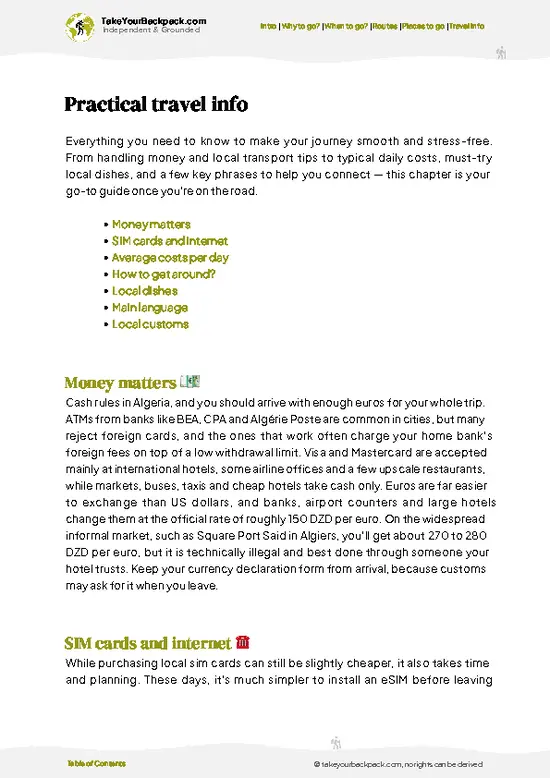
What it costs: In the north, a backpacker budget of roughly US$25 to 45 a day (about 3,500 to 6,000 DZD at typical exchange rates) covers a guesthouse or basic hotel, local meals such as couscous, grilled meat and fresh bread, and shared taxis. Park entry is usually small or free, and a local guide for a day hike costs about US$15 to 35 where you want one. Carry cash in dinars, as cards are rarely accepted outside big hotels.

The Sahara is a different scale. Agency-organized treks usually come to around US$80 to 150 a day per person including guide, permits, food, camping gear and transport on the ground, with group size pushing the price down. Add the domestic flight from Algiers, typically US$100 to 250 return depending on season and how early you book. A realistic total for a week in the Sahara is US$700 to 1,300 before international flights.

Safety and cultural points: Check your government’s current travel advice before booking, and stay out of the border regions with Libya, Mali and Niger. Inside the parks, follow your guide’s instructions and carry your passport at all times, since police and gendarmerie checkpoints are common and polite cooperation speeds things up. Photographing police, military sites or people without permission causes problems, so ask first.

Dress modestly, particularly in villages around the parks: long trousers and covered shoulders go down well. Friday is the main day of rest, so shops and some transport slow down. During Ramadan, eating and drinking in public is discouraged, and hiking in daytime is harder, so plan around it. Alcohol is hard to find outside licensed venues.

For the land itself, carry at least 3 liters of water a person in the north and much more in the south, as natural sources are unreliable. Forest fires in summer can close areas fast, and winter snow in the mountains catches people out with cotton clothes. Carry a printed copy of your accommodation and permits, and download maps before leaving town.

✈️ The backpacker research shortcutAlgeria Travel Guide

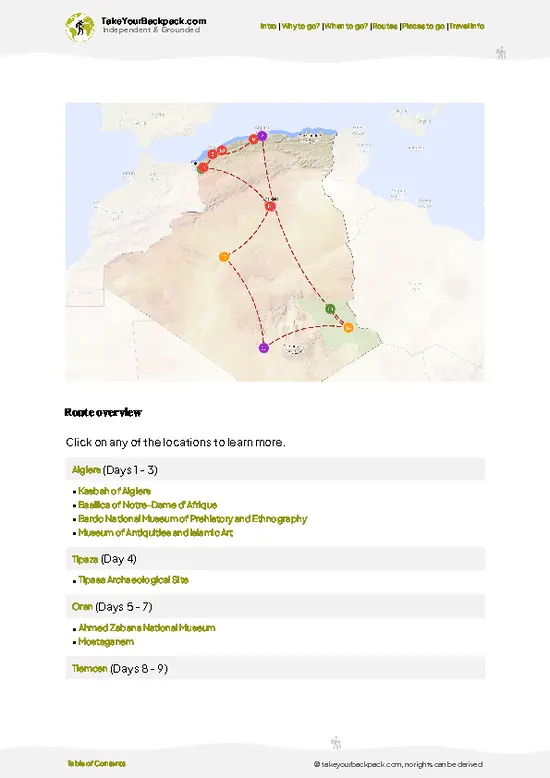
An offline-friendly backpacking guide with optimized travel routes, ranked highlights, transport advice, and the best areas to stay.
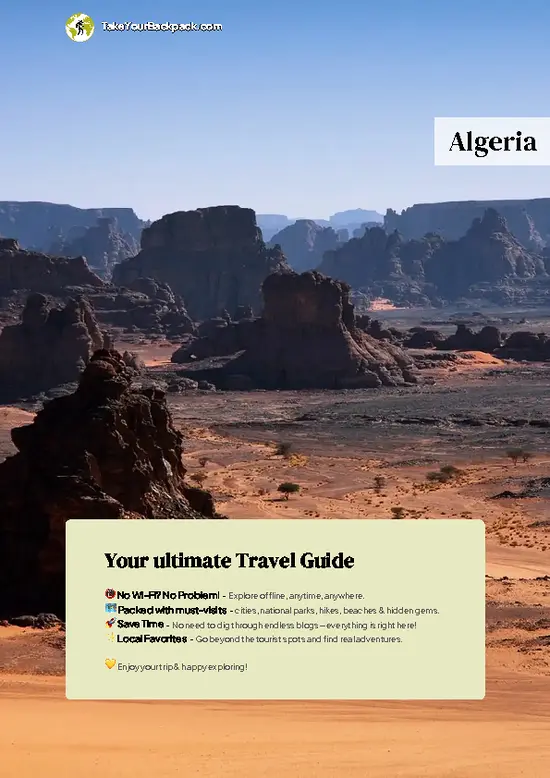
example page 0 from our offline Travel Guide for Algeria
example page 1 from our offline Travel Guide for Algeria
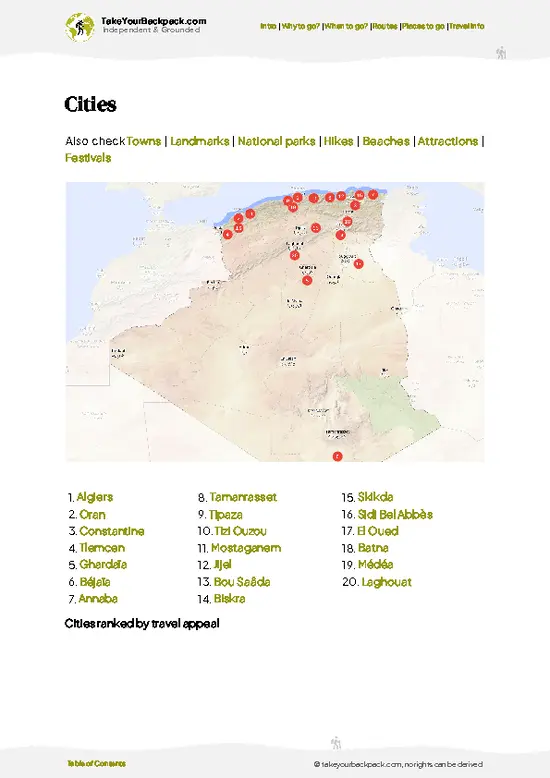
example page 2 from our offline Travel Guide for Algeria
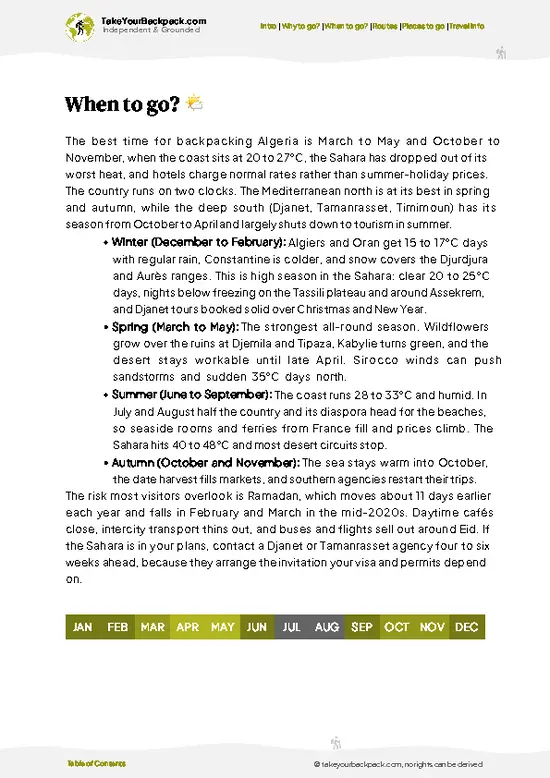
example page 3 from our offline Travel Guide for Algeria
example page 4 from our offline Travel Guide for Algeria
example page 5 from our offline Travel Guide for Algeria
example page 6 from our offline Travel Guide for Algeria
example page 7 from our offline Travel Guide for Algeria
The digital guide (314 pages) contains:
✅ 79 highlights, ranked by travel appeal
✅ Optimized 7, 14 & 21-day travel routes
✅ Cities, national parks, landmarks, beaches
✅ How to get around
✅ Offline-friendly for travel without Wi-Fi
👉 Click to see all 30+ guide features

📅 Plan smarter in minutes, not weeks
✅ Month by month travel advice
✅ Festivals & national holidays
✅ Budget expectations

🗺️ Go to the right places, skip the overrated ones
✅ Honest pros & cons of destinations
✅ Top hikes, parks & viewpoints
✅ Lesser-known places most travelers miss
✅ Clear “worth it vs skip it” guidance

🛏️ Travel smoothly without rookie mistakes
✅ Best areas to stay
✅ Transport systems explained simply
✅ Common scams & safety advice
✅ SIM cards, money & practical tips

🌍 Understand the country, not just visit it
✅ Culture & traditions
✅ 52 Essential phrases & customs
✅ Festivals worth planning around
✅ Traveler-friendly historical context
✅ Insights that make places more meaningful

📱 Built for real travel conditions
✅ Fully downloadable PDF
✅ Works completely offline
✅ Optimized for phone use
✅ Useful in remote areas & buses
✅ Everything in one place
Stop searching, start planning
Get instant access to your full guide. 30‑day money-back guarantee.
+ Add another guide for just

By proceeding you agree to our terms.
Sent to your inbox immediately after payment • 100% Secure Checkout
Best Backpacking Travel Advisor 2025 tourism awardBest Backpacking
Travel Advisor
2025
What others say about Take Your Backpack Guides:
⭐⭐⭐⭐⭐
Fantastic, amazing amount of information!
⭐⭐⭐⭐⭐
My goodness this is amazing, it's what I've been looking for hats off too you!
⭐⭐⭐⭐⭐
I think this is absolutely BRILLIANT
⭐⭐⭐⭐
Very complete and informative. It's still missing places, but I gotta to commend you
⭐⭐⭐⭐⭐
This is truly amazing, thank you, can't wait to explore it with my kids!
⭐⭐⭐⭐⭐
Awesome resource, thank you!
⭐⭐⭐⭐⭐
This is amazing! Can't wait to explore the ones I haven't seen
⭐⭐⭐⭐
I love this! Well done, great idea.
⭐⭐⭐⭐⭐
Thanks for taking the time to make this gem!
⭐⭐⭐⭐⭐
This might be the best website I've ever seen.
⭐⭐⭐⭐⭐
Congratulations, and thank you so much for your work; it's incredibly valuable.
⭐⭐⭐⭐
In all seriousness I think you did a great job pointing out the important spots
⭐⭐⭐⭐⭐
10/10 very good
⭐⭐⭐⭐⭐
As someone who's only just starting to visit regularly this is awesome, thank you.
⭐⭐⭐⭐
Thank you very much! I'm going to visit my dad, it's going to be very useful!
⭐⭐⭐⭐⭐
This is really cool! We'll be travelling for the first time and this definitely come in handy.
⭐⭐⭐⭐⭐
You are now our minister of culture, congratulations 👨‍💼
⭐⭐⭐⭐⭐
Just wanted to tell you that this is a pearl! Going to follow your recommendations.
⭐⭐⭐⭐⭐
This is so cool. I'll definitely be using the resource for my travels soon.
⭐⭐⭐⭐⭐
This is very impressive! Good work.
⭐⭐⭐⭐⭐
This is an amazing and informative site. Very well done!

🛏️ Where to stay?Best Stay Options in Algeria

Backpacker-style hostels are rare in Algeria, so budget travelers mostly stay in state-run youth hostels (auberges de jeunesse), simple family hotels and private rooms or apartments, with doubles typically running about 3,000 to 6,000 DZD (US$22 to 45). In Algiers, the streets around Grande Poste and Didouche Mourad put you within walking distance of the Casbah and the best cafés, though they are noisy and quiet down early at night, while Hydra is calm and safe but pricier and a taxi ride from the sights. In Oran, the city center near Place du 1er Novembre and the Front de Mer gives you the liveliest evenings in the country, and in Constantine the old center near the bridges is the most practical … read more 👉
Backpacker-style hostels are rare in Algeria, so budget travelers mostly stay in state-run youth hostels (auberges de jeunesse), simple family hotels and private rooms or apartments, with doubles typically running about 3,000 to 6,000 DZD (US$22 to 45). In Algiers, the streets around Grande Poste and Didouche Mourad put you within walking distance of the Casbah and the best cafés, though they are noisy and quiet down early at night, while Hydra is calm and safe but pricier and a taxi ride from the sights. In Oran, the city center near Place du 1er Novembre and the Front de Mer gives you the liveliest evenings in the country, and in Constantine the old center near the bridges is the most practical base, just very hilly and short on budget choices.

If you enjoy meeting fellow travelers, consider choosing hostels with high ratings for atmosphere. On the other hand, if you prefer having your own space, a hotel might be a better option.

AlgeriaWhere to Go Next

👋 Meet the founderWho’s Behind Take Your Backpack?

Johan, backpacker and founder of TakeYourBackpackHi, I’m Johan (Netherlands 🇳🇱), the creator of TakeYourBackpack. Over the past 3 decades, I’ve backpacked through 90+ countries across six continents, gaining extensive experience with independent travel, long-term trips, and overland routes.

This site is built on a combination of firsthand travel experience and carefully curated insights from other backpackers. Many guides are based on places I’ve personally visited, while others bring together tips, observations, and practical advice shared by trusted travelers I’ve met along the way.

The goal is to provide realistic, experience-driven guidance — not generic itineraries — so you can explore destinations with better context, clearer expectations, and more confidence.