×

Honduras🇭🇳 | regionsEl Cacao
cacao farms, rural villages, foothill trails | things to do and best time to go

Explore La Muralla National ParkExplore Guanaja

Backpacking in El Cacao
👌 Worth visitingregion ranked #3
By Johan Kruseman 🇳🇱 | last update: 24 April, 2026

Everyone thinks El Cacao is just “that random village you pass on the way to the coast.” It isn’t. El Cacao sits in northern Honduras, inland from the Caribbean side, in the broader Atlántida region that funnels you between the mountains and the sea. For backpackers, it’s a trade: you give up easy, polished tourism and get raw, rural Honduras back. The hills and rivers around El Cacao are quietly gorgeous, with swimming holes, cacao and cattle fincas, and birdlife you’ll never see from a shuttle window, but buses are slow, schedules loose, and you’ll be sweating in the back of a pickup more than once. It’s cheaper and more authentic than La Ceiba or Tela, but also sleepier, with fewer obvious “things to do” and almost no nightlife. I treat it as a base to slow down, meet families, and reset between the chaos of the Bay Islands and the highway grind.

Discover everything you want to know in the 📖 Honduras Travel Guide.
Loading the map 🌍
CLICK TO FILTER
city
town
unique site
national park
hike
beach
attraction
festival
region
SHOW COUNTRY‘S BESTSHOW ALL

✨ Why go?
Ranked #3 region in Honduras
Reasons people choose to visit here

In the heart of Honduras, El Cacao is a backpacker’s playground. Why do so many linger here? It’s all about variety. You’ve got lush jungles, serene lakes, and vibrant villages all within reach. You can dive into nature one day and soak up local culture the next, without the hassle of constant relocation.

Transport is a breeze. Local buses and shuttles are cheap and frequent, giving you the freedom to explore at your own pace. Want to hike in the Cerro Azul Meámbar National Park one morning and sip coffee in a quaint town the next? Go for it!

This region encourages slow travel. You can truly immerse yourself in the rhythms of life here, savoring the flavors and sounds that make it unique. Each moment spent in El Cacao is a chance to connect with the land and its people, making it a high-value … read more 👉
In the heart of Honduras, El Cacao is a backpacker’s playground. Why do so many linger here? It’s all about variety. You’ve got lush jungles, serene lakes, and vibrant villages all within reach. You can dive into nature one day and soak up local culture the next, without the hassle of constant relocation.

Transport is a breeze. Local buses and shuttles are cheap and frequent, giving you the freedom to explore at your own pace. Want to hike in the Cerro Azul Meámbar National Park one morning and sip coffee in a quaint town the next? Go for it!

This region encourages slow travel. You can truly immerse yourself in the rhythms of life here, savoring the flavors and sounds that make it unique. Each moment spent in El Cacao is a chance to connect with the land and its people, making it a high-value experience that’s hard to replicate elsewhere. So, pack light, stay a while, and let El Cacao work its magic.
Get the complete Travel Guide for Honduras
Everything organized for offline planning — routes, highlights, costs & tips

See what’s inside 👉

Get the Travel Guide -
  1. Finca La Ceiba — family-run cacao farm tour
    Hands-on walkthrough of cacao from pod to dry bean: harvesting, fermentation pits, and drying patios you can walk through. The slow, patient processing here gives the chocolate its local character and you can taste fresh, single-farm nibs and traditional hot chocolate the way locals make it.
  2. Cooperativa de Cacao El Cacao — cooperative chocolate workshop
    Local farmers run daily demonstrations showing roasting, grinding on metates or small mills, and molding bars. You leave with a bar you helped make and a real sense of the community economics around cacao — that combination of agriculture, craft, and local pride doesn’t feel like a staged tourist thing. (Personal favorite)
  3. Mercado Municipal de El Cacao — town market
    Early-morning market where farmers
  4. read more 👉
  1. Finca La Ceiba — family-run cacao farm tour
    Hands-on walkthrough of cacao from pod to dry bean: harvesting, fermentation pits, and drying patios you can walk through. The slow, patient processing here gives the chocolate its local character and you can taste fresh, single-farm nibs and traditional hot chocolate the way locals make it.
  2. Cooperativa de Cacao El Cacao — cooperative chocolate workshop
    Local farmers run daily demonstrations showing roasting, grinding on metates or small mills, and molding bars. You leave with a bar you helped make and a real sense of the community economics around cacao — that combination of agriculture, craft, and local pride doesn’t feel like a staged tourist thing. (Personal favorite)
  3. Mercado Municipal de El Cacao — town market
    Early-morning market where farmers sell cacao beans, fresh produce, homemade chocolates, and street breakfasts. It’s the best place to sample regional flavors, hear local gossip, and buy small-batch cacao products at neighbor prices.
  4. Iglesia Parroquial de El Cacao — central parish church and plaza
    Simple, well-kept parish church anchoring the town square. The plaza life—vendors, kids playing, and evening processions during festivals—shows how local culture centers around faith and family in a way unique to small cacao towns.
  5. Sendero Río Cacao & Cascada — river trail and pool (hidden gem)
    Short hike along a shaded riverside trail to a modest waterfall and clear plunge pools people actually swim in. It’s a local weekend spot with natural pools and rock ledges you won’t find on guidebooks, perfect for a quiet afternoon rinse after farm visits.
  6. Cerro Mirador de Los Naranjos — cacao-and-coffee ridge viewpoint (hidden gem)
    A short climb to a low ridge where intercropped cacao and coffee plots roll away down the valley. Sunrise or late afternoon light makes the patchwork fields glow; local farmers sometimes invite visitors to walk the contour lines and explain shade-grown techniques unique to this microclimate.
  7. Taller de Artesanía El Cacao — small woodworking and chocolate-gear shop (hidden gem)
    A tiny workshop where craftsmen carve wooden cacao spoons, molds, and utility items used in local chocolate-making. You can buy a handcrafted chocolate mold or watch a demonstration of traditional tools that aren’t sold in tourist markets elsewhere.
Spotted a mistake or missing something? Contact me.

⌛️ 5 daysWhat you can realistically do in a week

Day 1: La Ceiba
The journey kicks off in La Ceiba, the gateway to El Cacao. You’ll want to get here early; the bus system is your lifeline. Buses run frequently, but they can fill up fast. Grab a seat on the 8 AM bus to Tela. It’s a scenic ride along the coast, and you’ll want to soak in those views. Arriving in Tela by noon gives you the afternoon to explore the beach or hit up a local seafood joint. The vibe here is laid-back, perfect for easing into your adventure.

Day 2: Tela
Spend the day in Tela, but don’t just lounge. Rent a bike and cruise to Punta Sal National Park. The ride is about 30 minutes, and it’s worth it for the wildlife and stunning coastal views. The park is less crowded, so you can really connect with nature. This day is about balancing relaxation with exploration, … read more 👉
Day 1: La Ceiba
The journey kicks off in La Ceiba, the gateway to El Cacao. You’ll want to get here early; the bus system is your lifeline. Buses run frequently, but they can fill up fast. Grab a seat on the 8 AM bus to Tela. It’s a scenic ride along the coast, and you’ll want to soak in those views. Arriving in Tela by noon gives you the afternoon to explore the beach or hit up a local seafood joint. The vibe here is laid-back, perfect for easing into your adventure.

Day 2: Tela
Spend the day in Tela, but don’t just lounge. Rent a bike and cruise to Punta Sal National Park. The ride is about 30 minutes, and it’s worth it for the wildlife and stunning coastal views. The park is less crowded, so you can really connect with nature. This day is about balancing relaxation with exploration, and the bike ride gives you that freedom.

Day 3: Tela to La Ceiba
Head back to La Ceiba in the morning. This time, take a detour to the Garifuna village of Triunfo de la Cruz. It’s a short bus ride, and you’ll experience authentic culture, music, and food. This off-path reward is a slice of local life that most tourists miss. Afterward, return to La Ceiba and prepare for the next leg of your journey.

Day 4: La Ceiba to El Cacao
Catch an early bus to El Cacao. The transport here is less frequent, so timing is crucial. Once you arrive, dive into the local scene. Visit the cacao farms and learn about the chocolate-making process. This is where you’ll really feel the heart of the region.

Day 5: El Cacao
Spend your final day soaking in the tranquility. Hike the nearby trails or simply relax at a local café. This day is about savoring the experience and reflecting on your journey.

The must-do day? Day 4 in El Cacao. It’s where you’ll connect with the land and its people, making it the highlight of your trip.
Build the Right Itinerary
Use the Honduras Travel Guide’s 5, 10 & 15-day routes as a starting point to plan a trip that actually works on the ground.

Get the Travel Guide -

🌤️ When to go?When to go for the best experience


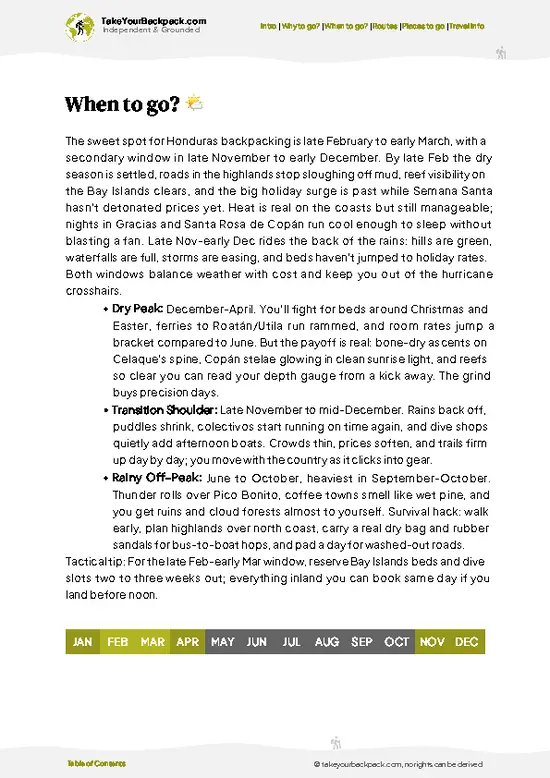
  • Weather: The dry season from November to April is your best bet—less mud, fewer leeches, and trails that don’t turn into slip-and-slide adventures. The rainy season (May to October) can be brutal with daily downpours, but it’s also when the jungle is at its greenest and wildest.

  • Temperature: Expect highs around 28-32°C (82-90°F) during the day, cooling to 18-22°C (64-72°F) at night. The dry season tends to be warmer and more comfortable for trekking, while the rainy season can feel muggy and sticky.

  • Daylight Hours: Roughly 11-12 hours year-round, but the dry season offers clearer skies, so you get more usable daylight for hitting the trails without rushing.

  • Crowds: Peak backpacker influx aligns with the dry season, especially December to February. If you want elbow room on the trails,
  • read more 👉

  • Weather: The dry season from November to April is your best bet—less mud, fewer leeches, and trails that don’t turn into slip-and-slide adventures. The rainy season (May to October) can be brutal with daily downpours, but it’s also when the jungle is at its greenest and wildest.

  • Temperature: Expect highs around 28-32°C (82-90°F) during the day, cooling to 18-22°C (64-72°F) at night. The dry season tends to be warmer and more comfortable for trekking, while the rainy season can feel muggy and sticky.

  • Daylight Hours: Roughly 11-12 hours year-round, but the dry season offers clearer skies, so you get more usable daylight for hitting the trails without rushing.

  • Crowds: Peak backpacker influx aligns with the dry season, especially December to February. If you want elbow room on the trails, aim for shoulder months like November or April.

  • Seasonal Activities: Dry months bring local festivals and coffee harvest celebrations—perfect for blending in and scoring authentic experiences. The rainy season is quieter but great for spotting wildlife in lush surroundings.

  • Price Fluctuations: Expect higher prices on lodging and tours during the dry season’s peak. The rainy season offers bargains but comes with the trade-off of unpredictable weather and limited access to some trails.


Pro-tip: Arrive late November—just after the first rains clear but before the crowds hit—and you’ll snag the best mix of green landscapes, manageable weather, and wallet-friendly rates.


source: climatestotravel.comJANJanuary: excellent for travelingFEBFebruary: excellent for travelingMARMarch: excellent for travelingAPRApril: highly recommended for travelingMAYMay: fair for travelingJUNJune: fair for travelingJULJuly: fair for travelingAUGAugust: fair for travelingSEPSeptember: fair for travelingOCTOctober: fair for travelingNOVNovember: highly recommended for travelingDECDecember: excellent for traveling
when-to-go

✈️ The ultimate backpacker shortcutHonduras Travel Guide

Skip weeks of research and hit the road with confidence. Get 282 pages of proven routes, transport advice, and real safety insights—built for your phone and 100% offline-ready.
example page 0 from our offline Travel Guide for Hondurasexample page 1 from our offline Travel Guide for Hondurasexample page 2 from our offline Travel Guide for Hondurasexample page 3 from our offline Travel Guide for Hondurasexample page 4 from our offline Travel Guide for Honduras
🎒 Your 282-page offline travel companion
5, 10 & 15-day routes paced for real travel
84 ranked highlights with honest skip-it advice
Logistics solved: Best areas to stay & transport
Safety blueprints: Common local scams to avoid
No Wi-Fi? No problem: Phone-optimized offline PDF
👉 See all 30+ guide features

📅 Plan smarter in minutes, not weeks
Realistic travel times & pacing
Best months per region
Festivals & national holidays
Budget expectations

🗺️ Go to the right places, skip the overrated ones
84 ranked highlights across the country
Hidden gems beyond the tourist trail
Honest pros & cons of destinations
Top hikes, parks & viewpoints
Lesser-known places most travelers miss
Clear “worth it vs skip it” guidance

🛏️ Travel smoothly without rookie mistakes
Best areas to stay
Transport systems explained simply
Local transport tradeoffs
Common scams & safety advice
SIM cards, money & practical tips
What to expect before arrival

🌍 Understand the country, not just visit it
Culture & traditions
52 Essential phrases & customs
Festivals worth planning around
Traveler-friendly historical context
Insights that make places more meaningful

📱 Built for real travel conditions
Fully downloadable PDF
Works completely offline
Optimized for phone use
Useful in remote areas & buses
Everything in one place
Save weeks of stressful planning
Get instant access to the full guide directly. 30-day money-back guarantee.


Sent to your inbox immediately after payment • 100% Secure Checkout
Best Backpacking Travel Advisor 2025 tourism awardBest Backpacking
Travel Advisor
2025
What others say about Take Your Backpack Guides:
⭐⭐⭐⭐⭐
Fantastic, amazing amount of information!
⭐⭐⭐⭐⭐
My goodness this is amazing, it's what I've been looking for hats off too you!
⭐⭐⭐⭐⭐
I think this is absolutely BRILLIANT
⭐⭐⭐⭐
Very complete and informative. It's still missing places, but I gotta to commend you
⭐⭐⭐⭐⭐
This is truly amazing, thank you, can't wait to explore it with my kids!
⭐⭐⭐⭐⭐
Awesome resource, thank you!
⭐⭐⭐⭐⭐
This is amazing! Can't wait to explore the ones I haven't seen
⭐⭐⭐⭐
I love this! Well done, great idea.
⭐⭐⭐⭐⭐
Thanks for taking the time to make this gem!
⭐⭐⭐⭐⭐
This might be the best website I've ever seen.
⭐⭐⭐⭐⭐
Congratulations, and thank you so much for your work; it's incredibly valuable.
⭐⭐⭐⭐
In all seriousness I think you did a great job pointing out the important spots
⭐⭐⭐⭐⭐
10/10 very good
⭐⭐⭐⭐⭐
As someone who's only just starting to visit regularly this is awesome, thank you.
⭐⭐⭐⭐
Thank you very much! I'm going to visit my dad, it's going to be very useful!
⭐⭐⭐⭐⭐
This is really cool! We'll be travelling for the first time and this definitely come in handy.
⭐⭐⭐⭐⭐
You are now our minister of culture, congratulations 👨‍💼
⭐⭐⭐⭐⭐
Just wanted to tell you that this is a pearl! Going to follow your recommendations.
⭐⭐⭐⭐⭐
This is so cool. I'll definitely be using the resource for my travels soon.
⭐⭐⭐⭐⭐
This is very impressive! Good work.
⭐⭐⭐⭐⭐
This is an amazing and informative site. Very well done!

🛏️ Where to stay?Where staying makes the most sense

In the heart of El Cacao, you’ll find a few standout spots that cater to backpackers looking for safety, social vibes, and budget-friendly options.

First up, La Ceiba. This bustling city is your gateway to the Bay Islands and has a lively backpacker scene. The waterfront is perfect for sunset chats with fellow travelers. Plus, the local markets are a treasure trove of street food that won’t break the bank.

Then there’s Tegucigalpa, the capital. It might not be the first choice, but it’s surprisingly welcoming. The historic district is rich with culture and offers plenty of cafes where you … read more 👉
In the heart of El Cacao, you’ll find a few standout spots that cater to backpackers looking for safety, social vibes, and budget-friendly options.

First up, La Ceiba. This bustling city is your gateway to the Bay Islands and has a lively backpacker scene. The waterfront is perfect for sunset chats with fellow travelers. Plus, the local markets are a treasure trove of street food that won’t break the bank.

Then there’s Tegucigalpa, the capital. It might not be the first choice, but it’s surprisingly welcoming. The historic district is rich with culture and offers plenty of cafes where you can mingle with locals and other travelers. Just keep your wits about you in certain neighborhoods, and you’ll be fine.

Don’t overlook Copán Ruinas. This charming town is famous for its Mayan ruins, but the real magic is in its laid-back atmosphere. You’ll find plenty of hostels and communal spaces where stories flow as freely as the coffee.

Each of these places offers a unique slice of Honduran life, making them ideal for those who want to dive deeper than the surface. Choose wisely, and you’ll walk away with experiences that stick.

🚌 Getting aroundGetting around like a local

El Cacao is a vibrant swirl of life, where the rhythm of travel dances between the structured and the spontaneous. Picture this: a bustling market where the scent of fresh tortillas mingles with the laughter of children, and the sound of honking horns punctuates the air. Here, schedules are more like suggestions, and the flow of transport is a mix of organized chaos and local intuition. You’ll find that getting around isn’t just about reaching your destination; it’s about embracing the journey, feeling the pulse of the region, and connecting with its people.

Here’s the lowdown on your transport options in El Cacao, tailored for the budget traveler looking to navigate this lively landscape:


  • Chicken Buses: These colorful, repurposed school buses are the lifeblood of local transport. They
  • read more 👉
El Cacao is a vibrant swirl of life, where the rhythm of travel dances between the structured and the spontaneous. Picture this: a bustling market where the scent of fresh tortillas mingles with the laughter of children, and the sound of honking horns punctuates the air. Here, schedules are more like suggestions, and the flow of transport is a mix of organized chaos and local intuition. You’ll find that getting around isn’t just about reaching your destination; it’s about embracing the journey, feeling the pulse of the region, and connecting with its people.

Here’s the lowdown on your transport options in El Cacao, tailored for the budget traveler looking to navigate this lively landscape:


  • Chicken Buses: These colorful, repurposed school buses are the lifeblood of local transport. They run from dawn until dusk, with fares around 20-30 Lempira (about $1). Expect a bumpy ride, but you’ll soak in the local culture as you share the space with friendly faces and lively chatter.


  • Tuk-Tuks: For shorter distances, these three-wheeled wonders are a fun and efficient choice. Prices vary but generally hover around 50-100 Lempira ($2-4) depending on the distance. They’re quick, and you can often negotiate the fare, making them a flexible option for hopping around town.


  • Shared Taxis: If you’re looking for a bit more comfort, shared taxis are a solid option. They usually charge about 30-50 Lempira ($1-2) per person and can take you to various destinations. They run on a loose schedule, so be prepared to wait until the car fills up.


  • Private Taxis: For those moments when you want to skip the wait, private taxis are available. Rates start around 150 Lempira ($6) for short trips. While pricier, they offer comfort and convenience, especially if you’re traveling with gear.


  • Walking: Don’t underestimate the power of your own two feet. El Cacao is small enough to explore on foot, and walking allows you to discover hidden spots and local eateries that you might miss while zooming by.


To navigate El Cacao efficiently, embrace the local vibe: hop on a chicken bus during peak hours for a lively experience, or take a tuk-tuk late in the afternoon when the sun casts a golden glow over the streets. Timing is everything; the best adventures often happen when you let go of rigid plans and go with the flow.

🍲 FoodEating & Drinking in El Cacao

In the heart of El Cacao, the air is thick with the scent of fried plantains and the rich aroma of freshly brewed coffee. You can’t miss the baleadas, a staple here—thick flour tortillas stuffed with beans, cheese, and a drizzle of hot sauce. Grab one from a street vendor, and you’ll taste the essence of local life.

For something sweet, try cacao drinks made from the region’s namesake. They’re often served warm, spiced with cinnamon, and are a perfect pick-me-up after a day of exploring. Don’t overlook the local beers; they’re crisp and refreshing, ideal for sipping while watching the sunset.

Markets are the heartbeat of El Cacao. Wander through bustling stalls filled with vibrant fruits and vegetables. Here, you’ll find locals chatting over cups of atol de elote, a sweet corn drink that’s … read more 👉
In the heart of El Cacao, the air is thick with the scent of fried plantains and the rich aroma of freshly brewed coffee. You can’t miss the baleadas, a staple here—thick flour tortillas stuffed with beans, cheese, and a drizzle of hot sauce. Grab one from a street vendor, and you’ll taste the essence of local life.

For something sweet, try cacao drinks made from the region’s namesake. They’re often served warm, spiced with cinnamon, and are a perfect pick-me-up after a day of exploring. Don’t overlook the local beers; they’re crisp and refreshing, ideal for sipping while watching the sunset.

Markets are the heartbeat of El Cacao. Wander through bustling stalls filled with vibrant fruits and vegetables. Here, you’ll find locals chatting over cups of atol de elote, a sweet corn drink that’s both comforting and delicious.

Dining is casual; don’t be surprised if you share a table with strangers. It’s all part of the experience. Just remember, when you’re offered food, it’s polite to accept. Embrace the communal vibe, and you’ll feel like a local in no time.

Other Honduran regions near El Cacao

Explore more nearby:

  • Guanaja—coral reefs, mangrove channels, island settlements| 185 km away
  • Monteverde—cloud forest, canopy walks, mountain weather| 308 km away
  • La Mosquitia—rainforest rivers, indigenous territories, remote wetlands| 332 km away

👉 Discover all regions

Or checkout all Honduras has to offer (think cities, towns, villages, national parks, hikes, beaches, festivals)
Country photo of Honduras

I 💚 feedbackIs it worth it?

El Cacao is a slice of paradise where the coffee is as rich as the culture. You’ll sip brews made from beans grown right there, and trust me, it’s a game-changer. But here’s the kicker: the roads can be a bit rough, and getting around might test your patience. Embrace the bumps; they’re part of the adventure. Just know that the experience is worth every jolt.

✈️ When did I visit Honduras?
Honduras I visited during my half year trip through South and Central America back in 2003

✍️ Help improve this page!
The information on this page is based on my own backpacking experience in Honduras, supplemented with up-to-date research and feedback from other travelers. Travel details can change, so if you notice anything outdated or incomplete, feel free to let me know.


🙋‍♂️ Give feedback

👋 Meet the authorWho’s Behind Take Your Backpack?

Johan, backpacker and founder of TakeYourBackpackHi, I’m Johan (Netherlands 🇳🇱), the creator of TakeYourBackpack. Over the past decade, I’ve backpacked through 80+ countries across six continents, gaining extensive experience with independent travel, long-term trips, and overland routes.

This site is built on a combination of firsthand travel experience and carefully curated insights from other backpackers. Many guides are based on places I’ve personally visited, while others bring together tips, observations, and practical advice shared by trusted travelers I’ve met along the way.

The goal is to provide realistic, experience-driven guidance — not generic itineraries — so you can explore destinations with better context, clearer expectations, and more confidence.

Get Full Country Guide |
Instant download • 84 highlights • Full Offline guide