×

Honduras🇭🇳 | regionsGuanajaCar-free Bonacca, wreck dives, Pico Dixon, mangrove inlets | things to do and best time to go

Explore El CacaoExplore La Mosquitia

Backpacking in Guanaja
🌟 Highlightregion ranked #1
By Johan Kruseman 🇳🇱 | Updated October 22, 2026

The water taxi’s engine cuts out beside a plank dock in Bonacca, and the diesel smell gives way to fried fish and wet timber. No cars, only footbridges over green canals. My mistake was assuming I could walk to a lodge on the main island, and I ended up paying a private boat to run me there in the dark. Guanaja lies off the north coast of Honduras, the easternmost of the Bay Islands. Don’t come for nightlife, because there is almost none. Do come for reefs, pine ridges and quiet coves with few other visitors. Hurricane Mitch flattened much of the forest in 1998, and the slopes are still recovering. Staying in Bonacca saves money and puts shops nearby, but every beach and dive site is a boat ride away. A lodge on the island costs more yet saves hours of shuttling, so it wins for anyone with three days or more. Before you go, arrange your boat pickup with the lodge in advance.

Discover everything you want to know in the 📖 Honduras Travel Guide.


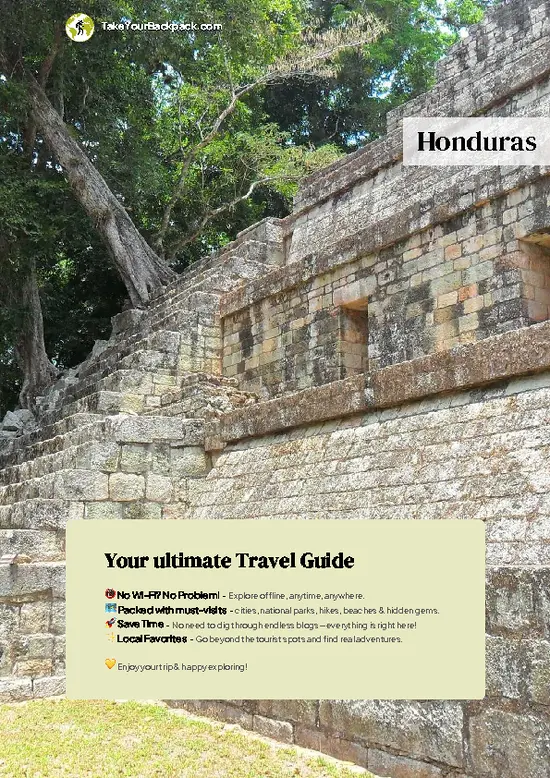
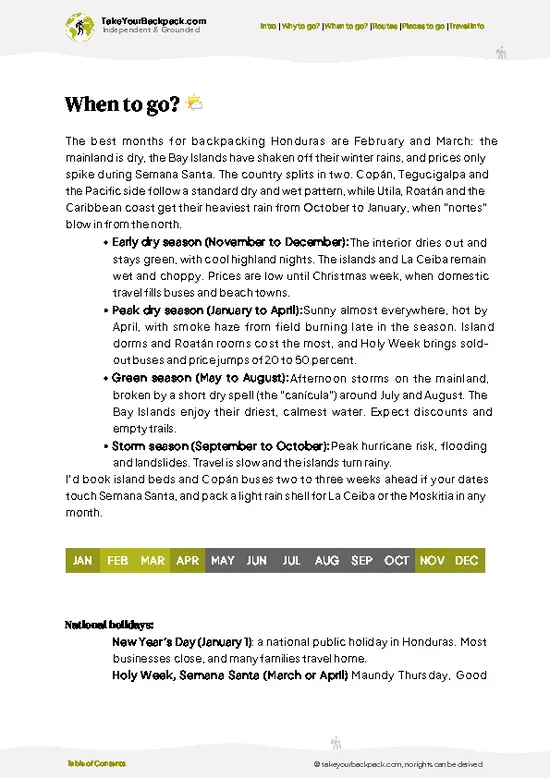
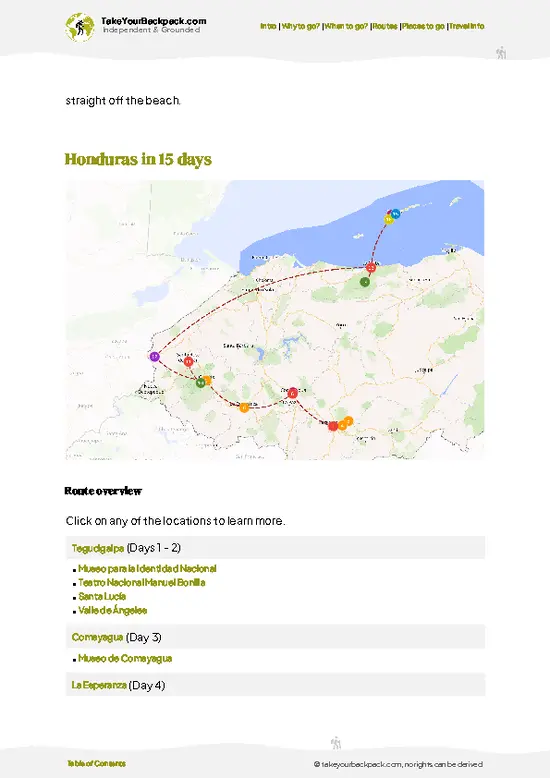
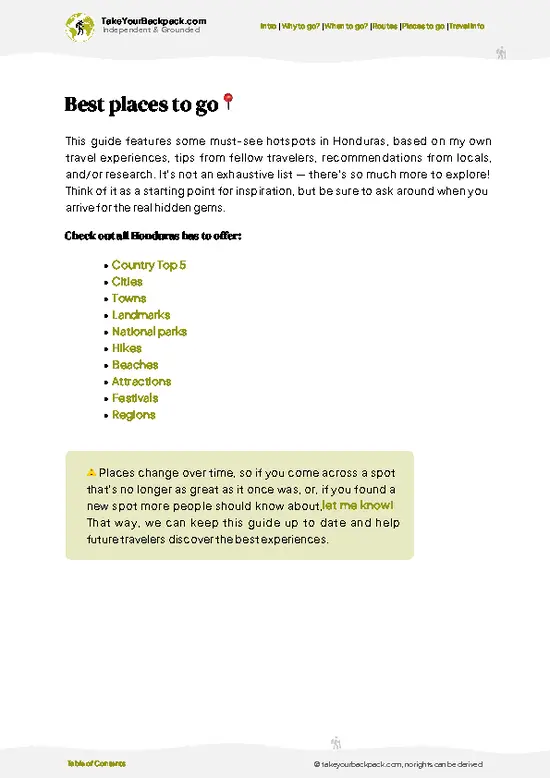
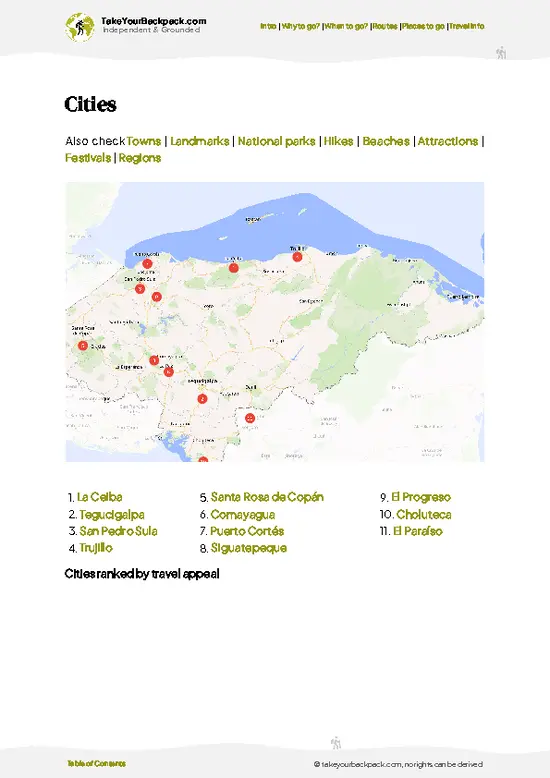
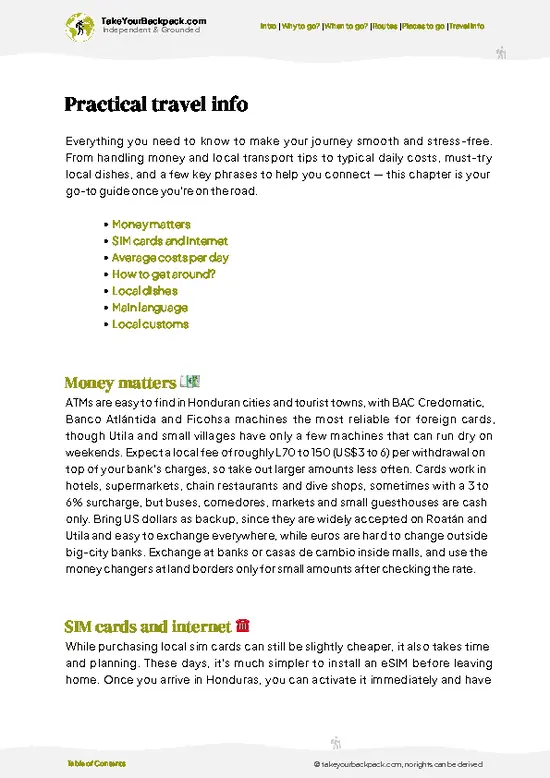
example page 0 from our offline Travel Guide for Honduras
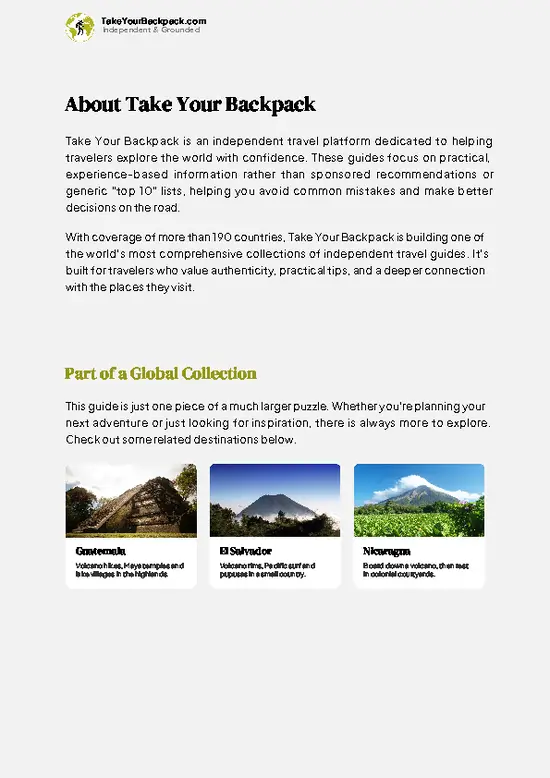
example page 1 from our offline Travel Guide for Honduras
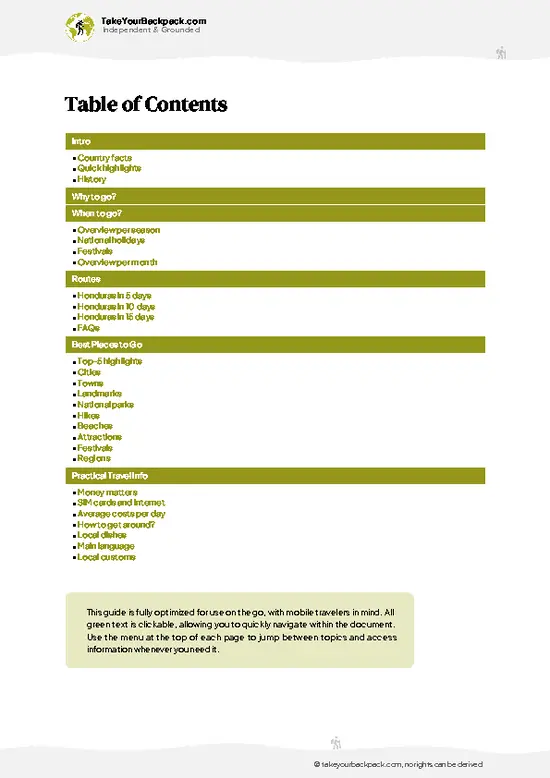
example page 2 from our offline Travel Guide for Honduras
example page 3 from our offline Travel Guide for Honduras
example page 4 from our offline Travel Guide for Honduras
example page 5 from our offline Travel Guide for Honduras
example page 6 from our offline Travel Guide for Honduras
example page 7 from our offline Travel Guide for Honduras
Loading the map 🌍
CLICK TO FILTER
cities
towns
landmarks
national parks
hikes
beaches
attractions
festivals
regions
SHOW COUNTRY’S BESTSHOW ALL

✨ Why go?
Ranked #1 region in Honduras
What makes this region worth visiting

Guanaja gives you reef diving, a forest hike and a stilt-built town without any serious relocating, because boats are the only roads and every lodge runs them. That makes the island efficient in an unusual way: you pick one base and the rest comes to you by water.
The diving is the main draw. The Jado Trader wreck and the walls and pinnacles around the island see far fewer divers than the reefs on neighboring Roatán, so sites feel uncrowded and operators can be flexible about where they take you.
On land, Pico Dixon gives you a proper ridge walk through pine and broadleaf forest, with views over the reef line, and it works well on a day when the sea is rough.
Then there is Bonacca, a crowded little cay of wooden houses on stilts where English-based Creole is spoken as often as Spanish. An evening … read more 👉
Guanaja gives you reef diving, a forest hike and a stilt-built town without any serious relocating, because boats are the only roads and every lodge runs them. That makes the island efficient in an unusual way: you pick one base and the rest comes to you by water.
The diving is the main draw. The Jado Trader wreck and the walls and pinnacles around the island see far fewer divers than the reefs on neighboring Roatán, so sites feel uncrowded and operators can be flexible about where they take you.
On land, Pico Dixon gives you a proper ridge walk through pine and broadleaf forest, with views over the reef line, and it works well on a day when the sea is rough.
Then there is Bonacca, a crowded little cay of wooden houses on stilts where English-based Creole is spoken as often as Spanish. An evening on its walkways tells you more about island life than any lodge brochure. Slow travel suits Guanaja: ferries and water taxis are infrequent, so staying put for several days is the practical choice, and it costs you nothing in experience.

💡 HighlightsWhat this place is best known for

  1. Bonacca Town: a small cay packed with stilted wooden houses, canals and footbridges, with no cars at all. Walk the waterfront at dusk and eat grilled fish where the fishing boats tie up.
  2. Pico Dixon: the island’s highest point, reached by a forest trail through pine and broadleaf trees. The top gives a long view over the island and the reef beyond. Go with a local guide, as paths fork.
  3. Jado Trader wreck: a freighter deliberately sunk as a dive site, now covered in coral and visited by large schools of fish. It suits intermediate divers and gives a lot of drama for a single dive.
  4. Michael’s Rock reef: a well-known dive and snorkel area on the north side, with coral formations close to the surface. Operators here know the currents and choose spots by sea conditions.
  5. Sandy Bay: a quiet stretch of coast
… read more 👉
  1. Bonacca Town: a small cay packed with stilted wooden houses, canals and footbridges, with no cars at all. Walk the waterfront at dusk and eat grilled fish where the fishing boats tie up.
  2. Pico Dixon: the island’s highest point, reached by a forest trail through pine and broadleaf trees. The top gives a long view over the island and the reef beyond. Go with a local guide, as paths fork.
  3. Jado Trader wreck: a freighter deliberately sunk as a dive site, now covered in coral and visited by large schools of fish. It suits intermediate divers and gives a lot of drama for a single dive.
  4. Michael’s Rock reef: a well-known dive and snorkel area on the north side, with coral formations close to the surface. Operators here know the currents and choose spots by sea conditions.
  5. Sandy Bay: a quiet stretch of coast with small lodges and calm, clear shallows. It works as a swimming and kayaking base and sits comfortably outside the day-tripper circuit.
  6. Savannah Bight: a small settlement on the island’s east coast with Bay Islander homes and slow evenings. Few tourists stop here, and locals will happily talk about life after the hurricane.
  7. Mangrove Bight: a sheltered inlet lined with mangroves and rebuilt houses on the water’s edge. Paddle it in the early morning when birds are active and the surface is still.
  8. North East Bight: a remote cove on the far side of the island that few visitors reach. The reward is empty beach and a feel of the island before lodges arrived; you need a boat to get there.
Guanaja’s cheapest highlight is Bonacca Town itself, since walking its canals and footbridges costs nothing.
Spotted a mistake or missing something? Contact us.

Things to do near Guanaja

Ratings based on Tripadvisor reviews. When you book through this link, you support our work at no extra cost to you.

⌛️ 5 daysWhat you can realistically do in a week

Day 1: Bonacca: A slow wandering day on foot, because Bonacca is small enough to cover in an afternoon and everything else on the island begins here. Arrive on the water taxi, drop your bag, and walk the footbridges and waterfront, then eat fish where the boats unload. Boats set the pace across Guanaja. Departures are limited and sea conditions decide what runs, so use today to confirm your pickup for tomorrow.
Day 2: Sandy Bay: Move by boat to the quieter north-side coast and spend two days here. Day 2 is for swimming, snorkeling and settling in, because the lodges run their own boats and you save more by staying in one place than by hopping between bays. Day 3 goes to diving the Jado Trader wreck or snorkeling Michael’s Rock reef, whichever the dive operator recommends for that day’s sea. … read more 👉
Day 1: Bonacca: A slow wandering day on foot, because Bonacca is small enough to cover in an afternoon and everything else on the island begins here. Arrive on the water taxi, drop your bag, and walk the footbridges and waterfront, then eat fish where the boats unload. Boats set the pace across Guanaja. Departures are limited and sea conditions decide what runs, so use today to confirm your pickup for tomorrow.
Day 2: Sandy Bay: Move by boat to the quieter north-side coast and spend two days here. Day 2 is for swimming, snorkeling and settling in, because the lodges run their own boats and you save more by staying in one place than by hopping between bays. Day 3 goes to diving the Jado Trader wreck or snorkeling Michael’s Rock reef, whichever the dive operator recommends for that day’s sea. Detour: ask the boat captain to swing by Mangrove Bight on the way back, a short paddle-friendly inlet that adds mangroves and local houses without changing your base.
Day 4: Pico Dixon: This is a hiking day. The trail climbs through pine and broadleaf forest to the island’s highest point, and a guide keeps you on the right path where trails fork. Start early, carry plenty of water, and plan to be back at the coast before the afternoon sea chop picks up.
Day 5: Savannah Bight: Finish with a settlement day on the east coast, where you can talk with islanders and eat a home-cooked meal before heading back to Bonacca for the return boat. If one day justifies the trip, I would pick Day 4: standing on Pico Dixon with the whole reef line below you shows exactly why Guanaja is worth the extra boat ride.

🌤️ When to go?Weather, crowds, and seasonal trade-offs

  • Dry Season (March to May): Guanaja’s calmest and clearest stretch, with seas flat enough for the best diving and snorkeling visibility. Highs run 28 to 31°C (82 to 88°F), and the Easter week around Semana Santa brings Honduran holidaymakers and higher room rates.
  • Early Wet Season (June to September): Short, heavy downpours alternate with hot sunshine, at 27 to 32°C (81 to 90°F). Rooms are easier to find, prices soften, and the island is quiet. Hurricane season technically runs through November, so watch forecasts.
  • Peak Rains (October to January): This is the wettest period, with northers that bring rain for days, rougher crossings and 24 to 28°C (75 to 82°F). Some boat services and small lodges slow down or close.
  • Cool Dry Spell (February): Lower humidity, 25 to 29°C (77 to 84°F), and few crowds.
… read more 👉
  • Dry Season (March to May): Guanaja’s calmest and clearest stretch, with seas flat enough for the best diving and snorkeling visibility. Highs run 28 to 31°C (82 to 88°F), and the Easter week around Semana Santa brings Honduran holidaymakers and higher room rates.
  • Early Wet Season (June to September): Short, heavy downpours alternate with hot sunshine, at 27 to 32°C (81 to 90°F). Rooms are easier to find, prices soften, and the island is quiet. Hurricane season technically runs through November, so watch forecasts.
  • Peak Rains (October to January): This is the wettest period, with northers that bring rain for days, rougher crossings and 24 to 28°C (75 to 82°F). Some boat services and small lodges slow down or close.
  • Cool Dry Spell (February): Lower humidity, 25 to 29°C (77 to 84°F), and few crowds. Daylight stays at roughly 11 to 13 hours across the year, so plan outings for the morning.
Book diving trips and any Christmas or Easter stays a month or two ahead, and keep a spare day in case seas cancel a boat.


source: climatestotravel.comJANJanuary: good for travelingFEBFebruary: excellent for travelingMARMarch: excellent for travelingAPRApril: highly recommended for travelingMAYMay: good for travelingJUNJune: fair for travelingJULJuly: fair for travelingAUGAugust: fair for travelingSEPSeptember: below average for travelingOCTOctober: fair for travelingNOVNovember: fair for travelingDECDecember: good for traveling
when-to-go

✈️ The backpacker research shortcutHonduras Travel Guide

An offline-friendly backpacking guide with optimized travel routes, ranked highlights, transport advice, and the best areas to stay.
example page 0 from our offline Travel Guide for Honduras
example page 1 from our offline Travel Guide for Honduras
example page 2 from our offline Travel Guide for Honduras
example page 3 from our offline Travel Guide for Honduras
example page 4 from our offline Travel Guide for Honduras
example page 5 from our offline Travel Guide for Honduras
example page 6 from our offline Travel Guide for Honduras
example page 7 from our offline Travel Guide for Honduras
The digital guide (255 pages) contains:
✅ 70 highlights, ranked by travel appeal
✅ Optimized 5, 10 & 15-day travel routes
✅ Cities, national parks, landmarks, beaches
✅ How to get around
✅ Offline-friendly for travel without Wi-Fi
👉 Click to see all 30+ guide features

📅 Plan smarter in minutes, not weeks
✅ Month by month travel advice
✅ Festivals & national holidays
✅ Budget expectations

🗺️ Go to the right places, skip the overrated ones
✅ Honest pros & cons of destinations
✅ Top hikes, parks & viewpoints
✅ Lesser-known places most travelers miss
✅ Clear “worth it vs skip it” guidance

🛏️ Travel smoothly without rookie mistakes
✅ Best areas to stay
✅ Transport systems explained simply
✅ Common scams & safety advice
✅ SIM cards, money & practical tips

🌍 Understand the country, not just visit it
✅ Culture & traditions
✅ 52 Essential phrases & customs
✅ Festivals worth planning around
✅ Traveler-friendly historical context
✅ Insights that make places more meaningful

📱 Built for real travel conditions
✅ Fully downloadable PDF
✅ Works completely offline
✅ Optimized for phone use
✅ Useful in remote areas & buses
✅ Everything in one place
Stop searching, start planning
Get instant access to your full guide. 30‑day money-back guarantee.
+ Add another guide for just

By proceeding you agree to our terms.
Sent to your inbox immediately after payment • 100% Secure Checkout
Best Backpacking Travel Advisor 2025 tourism awardBest Backpacking
Travel Advisor
2025
What others say about Take Your Backpack Guides:
⭐⭐⭐⭐⭐
Fantastic, amazing amount of information!
⭐⭐⭐⭐⭐
My goodness this is amazing, it's what I've been looking for hats off too you!
⭐⭐⭐⭐⭐
I think this is absolutely BRILLIANT
⭐⭐⭐⭐
Very complete and informative. It's still missing places, but I gotta to commend you
⭐⭐⭐⭐⭐
This is truly amazing, thank you, can't wait to explore it with my kids!
⭐⭐⭐⭐⭐
Awesome resource, thank you!
⭐⭐⭐⭐⭐
This is amazing! Can't wait to explore the ones I haven't seen
⭐⭐⭐⭐
I love this! Well done, great idea.
⭐⭐⭐⭐⭐
Thanks for taking the time to make this gem!
⭐⭐⭐⭐⭐
This might be the best website I've ever seen.
⭐⭐⭐⭐⭐
Congratulations, and thank you so much for your work; it's incredibly valuable.
⭐⭐⭐⭐
In all seriousness I think you did a great job pointing out the important spots
⭐⭐⭐⭐⭐
10/10 very good
⭐⭐⭐⭐⭐
As someone who's only just starting to visit regularly this is awesome, thank you.
⭐⭐⭐⭐
Thank you very much! I'm going to visit my dad, it's going to be very useful!
⭐⭐⭐⭐⭐
This is really cool! We'll be travelling for the first time and this definitely come in handy.
⭐⭐⭐⭐⭐
You are now our minister of culture, congratulations 👨‍💼
⭐⭐⭐⭐⭐
Just wanted to tell you that this is a pearl! Going to follow your recommendations.
⭐⭐⭐⭐⭐
This is so cool. I'll definitely be using the resource for my travels soon.
⭐⭐⭐⭐⭐
This is very impressive! Good work.
⭐⭐⭐⭐⭐
This is an amazing and informative site. Very well done!

🛏️ Where to stay?Choosing the right base

Guanaja Town on Bonacca Cay is the best base for most backpackers, since it holds the shops, the dock, the handful of bars and the easiest access to boats. A tight grid of wooden houses on stilts, with canals instead of streets, it is small enough to walk end to end in minutes and safe enough for solo travelers to move around at night with normal care. You will meet divers, volunteers and the occasional sailor at the waterfront, and prices for basic rooms usually run US$20 to 45 a night.

If you want quiet and sand, look at the north and east shores of the main island, around Savannah Bight and … read more 👉
Guanaja Town on Bonacca Cay is the best base for most backpackers, since it holds the shops, the dock, the handful of bars and the easiest access to boats. A tight grid of wooden houses on stilts, with canals instead of streets, it is small enough to walk end to end in minutes and safe enough for solo travelers to move around at night with normal care. You will meet divers, volunteers and the occasional sailor at the waterfront, and prices for basic rooms usually run US$20 to 45 a night.

If you want quiet and sand, look at the north and east shores of the main island, around Savannah Bight and Mangrove Bight. These are fishing communities where you will sleep in simple guesthouses or small lodges, eat what the family cooks and spend evenings with neighbors rather than other tourists. Expect to pay more for transfers and food here, around US$30 to 60 a night. It suits slow days of snorkeling off the shore.

Diving-focused travelers often choose a lodge or dive resort on a cay or the main coast, where packages bundle meals, boats and gear. They cost more than the town but save you daily boat fares. Stay in Guanaja Town first, then move out to a bight for a few nights once you know the water.

🚌 Getting aroundMoving around without the hassle

Water taxis are the easiest way to get around Guanaja, because the main island has almost no road network and nearly every settlement, dive site and cay sits on the water. Guanaja Town, the Bonacca cay, is the hub, with small boats pulling up all day to ferry people to the main island and beyond. Reliability is decent in the dry months and patchy when northers blow in.
  • Water taxis (lanchas): Expect roughly US$2 to 4 for a short hop around the bay and US$10 to 30 or more for longer runs to places like Savannah Bight, Mangrove Bight or the north coast, depending on distance and fuel. They are fast, they leave when you ask, and they are the best value in time and comfort for a solo traveler or pair. Split fares when you can.
  • Flights: Small planes connect Guanaja to La Ceiba and Roatán, about 30
… read more 👉
Water taxis are the easiest way to get around Guanaja, because the main island has almost no road network and nearly every settlement, dive site and cay sits on the water. Guanaja Town, the Bonacca cay, is the hub, with small boats pulling up all day to ferry people to the main island and beyond. Reliability is decent in the dry months and patchy when northers blow in.
  • Water taxis (lanchas): Expect roughly US$2 to 4 for a short hop around the bay and US$10 to 30 or more for longer runs to places like Savannah Bight, Mangrove Bight or the north coast, depending on distance and fuel. They are fast, they leave when you ask, and they are the best value in time and comfort for a solo traveler or pair. Split fares when you can.
  • Flights: Small planes connect Guanaja to La Ceiba and Roatán, about 30 to 45 minutes, usually US$100 to 180 one way. They cost far more than the sea route, yet they are the one option worth paying for if you are short on days or the sea is rough.
  • Ferry from La Ceiba: Boat service on the mainland route has been irregular, with crossings of several hours, so do not build a fixed schedule around it. Confirm it is running before you commit, and treat it as a backup to flying.
  • Walking and the short footpaths: Guanaja Town is a few minutes’ walk end to end, and the settlements have short paths between houses. Walking is free and fine for these stretches, but it will not get you across the island, as the interior is steep jungle with few trails.
  • Dive and tour boats: Operators run their own boats to reefs, waterfalls and the Michael Rock area, typically US$40 to 70 per dive trip. Booking a day with an operator beats arranging a private water taxi for the same sites, since fuel is the main cost and it is already shared.
Agree on the fare before you step into any boat, carry small US dollar notes or lempiras for change, and ask for a pickup time for the return so you are not stranded after dark.

🍲 FoodWhat to Eat & Drink

Guanaja eats from the sea first. Fried fish with tajadas (crisp plantain slices) and a squeeze of lime is the everyday plate, and conch soup is the dish to chase, creamy with coconut milk, yuca and plantain, and bright with pepper. Rondón, a slow stew of fish, root vegetables and coconut, is the island’s Afro-Caribbean signature and smells of thyme and smoke long before it reaches the table. Look for coconut bread and sweet johnnycakes still warm in the morning.

Backpackers eat at small comedores and family kitchens in Guanaja Town and along the bights, where a plate of fish and rice and beans costs about US$5 to 10, more for lobster. Little bakeries and a few waterfront bars handle breakfast and cold drinks. Bring snacks if you plan a day at a remote cay, since shops are limited there.

… read more 👉
Guanaja eats from the sea first. Fried fish with tajadas (crisp plantain slices) and a squeeze of lime is the everyday plate, and conch soup is the dish to chase, creamy with coconut milk, yuca and plantain, and bright with pepper. Rondón, a slow stew of fish, root vegetables and coconut, is the island’s Afro-Caribbean signature and smells of thyme and smoke long before it reaches the table. Look for coconut bread and sweet johnnycakes still warm in the morning.

Backpackers eat at small comedores and family kitchens in Guanaja Town and along the bights, where a plate of fish and rice and beans costs about US$5 to 10, more for lobster. Little bakeries and a few waterfront bars handle breakfast and cold drinks. Bring snacks if you plan a day at a remote cay, since shops are limited there.

For drinks, try fresh coconut water, tropical juices, and local beer such as Salva Vida or Port Royal on a dock at dusk. Rum drinks are common at beach bars.

Meals are often cooked to order, so expect a wait and settle in. Order early if you want the day’s catch, and greet people when you walk in, because it is polite. Cash is the norm.

FAQTraveler FAQ

Plan on 3 to 5 days for Guanaja, and a week if you want to dive more than a few times. The island is about 17 km (11 miles) long, so Savannah Bight, Mangrove Bight and the Bonacca Cay town of Guanaja can be seen in a day or two, while the rest of your time goes to reef diving, snorkeling and waterfall hikes. Dive packages usually run 3 to 7 nights, and weather can delay the ferry or flights, so a spare day at the end helps.
Water taxis and small boats are the only practical way to move around Guanaja, because the island’s only road runs between Mangrove Bight and Savannah Bight. A hop between Bonacca Cay and nearby bights typically costs US$3 to 10 by shared or private panga, and longer runs to the north or east side can reach US$20 to 40 per boat. Walking trails connect a few villages and the waterfall at Bayman Bay, and a short stretch of sandy road runs along Savannah Bight. Most travelers also arrange pickups through their guesthouse or dive shop.
Guanaja is known for its diving and snorkeling on the Mesoamerican Barrier Reef, with walls, wrecks and clear water that often exceeds 25 m (80 feet) of visibility. It is the greenest and least developed of the Bay Islands, with Caribbean pine forests, waterfalls and a central ridge that rises to about 400 m (1,300 feet). Bonacca Cay, a crowded island town built on a small cay just off the main island, is a landmark with houses on stilts and canals instead of streets. Hurricane Mitch in 1998 flattened much of the island, and its rebuilt, quiet feel is a big part of the appeal.
⚠️ Things can change over time, so always validate details locally before you go.

Other Honduran regions near Guanaja

Explore more nearby:

  • Roatán—West End diving, reef from the dock, Punta Gorda, quiet northern coves| 71 km away
  • Cayos Cochinos—Garifuna sandbar stays, fringing reef snorkeling, pink boa trails, oil-lamp nights| 85 km away
  • El Cacao—cacao farms, rural villages, foothill trails| 200 km away

💡 Not sure where to go next?
Create a personalized itinerary for Honduras including Guanaja and the places that fit your trip.

Generate my itinerary

👉 Discover all regions

Or checkout all Honduras has to offer (think cities, towns, villages, national parks, hikes, beaches, festivals)
Country photo of Honduras

We 💚 feedbackFinal thoughts on visiting Guanaja

Guanaja punishes the overnight visit. Travelers often arrive with one night and spend half of it arranging boats. I would book at least three nights at one lodge, confirm transfers before you land, and bring enough cash for boats and meals, because the island is more remote than it looks on a map.

✈️ When did I visit Honduras?
Honduras I visited during my half year trip through South and Central America back in 2003

✍️ Help improve this page!
The information on this page is based on my own backpacking experience in Honduras, supplemented with up-to-date research and feedback from other travelers. Travel details can change, so if you notice anything outdated or incomplete, feel free to let me know.


🙋‍♂️ Give feedback

👋 Meet the founderWho’s Behind Take Your Backpack?

Johan, backpacker and founder of TakeYourBackpackHi, I’m Johan (Netherlands 🇳🇱), the creator of TakeYourBackpack. Over the past 3 decades, I’ve backpacked through 90+ countries across six continents, gaining extensive experience with independent travel, long-term trips, and overland routes.

This site is built on a combination of firsthand travel experience and carefully curated insights from other backpackers. Many guides are based on places I’ve personally visited, while others bring together tips, observations, and practical advice shared by trusted travelers I’ve met along the way.

The goal is to provide realistic, experience-driven guidance — not generic itineraries — so you can explore destinations with better context, clearer expectations, and more confidence.