v2.webp)
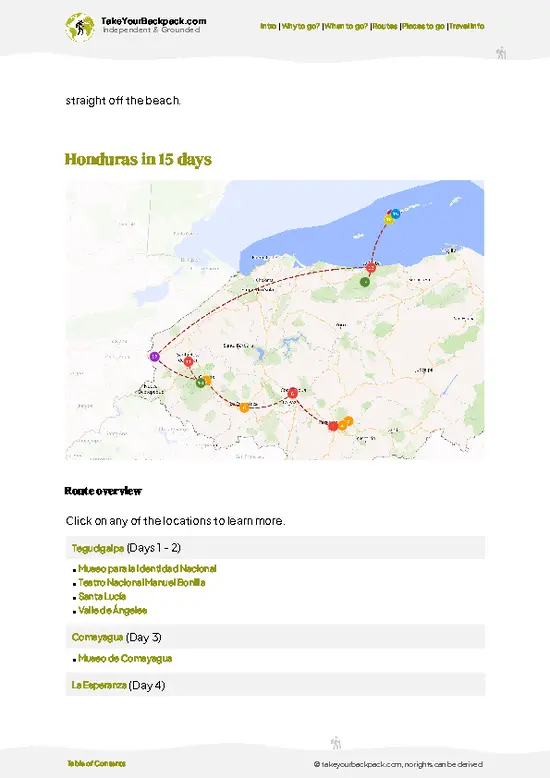
- Pico Bonito National Park: Cloud forest, rivers and waterfalls beneath a peak of about 2,435 meters. The Zacate waterfall trail and river swims are the easiest outings, and birds are most active in the early morning. Entry runs roughly US$10 to 20 depending on the trail or lodge, and you need 3 to 5 hours.
- Cangrejal River rafting: Whitewater runs through a granite-boulder canyon, with rapids that range from moderate to challenging depending on water level. Rain months have the strongest flow. Guided trips cost about US$60 to 100 and take 3 to 4 hours.
- Parque Morazán: The central plaza, shaded by large trees, with locals meeting, shoe shiners and food carts. Go late afternoon when it fills up. It is free, and 30 to 45 minutes is enough.
- Catedral San Isidro: The city’s main church, dedicated to
- Pico Bonito National Park: Cloud forest, rivers and waterfalls beneath a peak of about 2,435 meters. The Zacate waterfall trail and river swims are the easiest outings, and birds are most active in the early morning. Entry runs roughly US$10 to 20 depending on the trail or lodge, and you need 3 to 5 hours.
- Cangrejal River rafting: Whitewater runs through a granite-boulder canyon, with rapids that range from moderate to challenging depending on water level. Rain months have the strongest flow. Guided trips cost about US$60 to 100 and take 3 to 4 hours.
- Parque Morazán: The central plaza, shaded by large trees, with locals meeting, shoe shiners and food carts. Go late afternoon when it fills up. It is free, and 30 to 45 minutes is enough.
- Catedral San Isidro: The city’s main church, dedicated to its patron saint, whose festival drives the May celebrations. Visit in the morning for a quiet look inside. It is free and takes about 20 minutes.
- Playa Ceiba beachfront: The city’s Caribbean shoreline, best for a sunset walk and a cold drink at a beach bar rather than for swimming. It is free, and an hour is plenty.
- Carnaval Grande: The big street parade in May, the largest on the Honduran coast, with floats, dancers and music, and hotels that book out early. Entry to the street is free, and the parade lasts most of a day.
Spotted a mistake or missing something? Contact us.

Incredible Rafting in Rio Cangrejal

The best of La Ceiba walking tour

Romantic tour in La Ceiba

La Ceiba Private City Transfers / Charter

Private Transfer from Goloson Airport (LCE) to Banana Coast Port

Private Transfer from La Ceiba hotels to Banana Coast Cruise Port

Private Shore Tour in La Ceiba from Banana Coast Cruise Port


 Best Backpacking
.jpg) Hi, I’m Johan (Netherlands 🇳🇱), the creator of TakeYourBackpack. Over the past 3 decades, I’ve backpacked through 90+ countries across six continents, gaining extensive experience with independent travel, long-term trips, and overland routes.
Hi, I’m Johan (Netherlands 🇳🇱), the creator of TakeYourBackpack. Over the past 3 decades, I’ve backpacked through 90+ countries across six continents, gaining extensive experience with independent travel, long-term trips, and overland routes.