×

Honduras🇭🇳 | best citiesDiscover the 11 Best cities Across Honduras

Cities in Honduras are working towns first and sights second, and that shapes everything. The country has no single showpiece capital; the best urban stops are spread across a Caribbean coast, a western highland region and a Bay Islands fringe. Highland colonial towns are cool, walkable and cheap. The north coast is hot, humid and rougher. Island stops cost the most and draw the most visitors. For backpacking or independent travel, the highlands give the easiest first week. The two big commercial centers, Tegucigalpa and San Pedro Sula, are mostly transit points and not worth extra nights.

By Johan Kruseman 🇳🇱 | Updated October 23, 2026
Explore the best towns in Honduras

Why go?Key Factors That Shape the Experience

Honduras suits small, character-heavy towns far better than big-city sightseeing. Mountains cover most of the interior, so settlements grew in isolated valleys and ridge-top pockets, which is why the colonial silver-mining towns and the Maya-era sites in the west sit apart from each other and from the coast. The Caribbean side developed differently, with Garifuna and Afro-Caribbean communities, English-influenced Creole on the islands and a food culture built on coconut, seafood and cassava. That split gives the country real variety, but it is variety you travel for, not stack up in one afternoon.

Before choosing Honduras for its cities, know the limits. The two largest cities have high crime rates, weak public transport and little worth seeing, so treat them as places to change buses. There … read more 👉
Honduras suits small, character-heavy towns far better than big-city sightseeing. Mountains cover most of the interior, so settlements grew in isolated valleys and ridge-top pockets, which is why the colonial silver-mining towns and the Maya-era sites in the west sit apart from each other and from the coast. The Caribbean side developed differently, with Garifuna and Afro-Caribbean communities, English-influenced Creole on the islands and a food culture built on coconut, seafood and cassava. That split gives the country real variety, but it is variety you travel for, not stack up in one afternoon.

Before choosing Honduras for its cities, know the limits. The two largest cities have high crime rates, weak public transport and little worth seeing, so treat them as places to change buses. There is no metro or rail network; movement is by long-distance coach, minibus and the occasional domestic flight. Distances look short on a map but roads are slow and winding, and landslides in the wet season can close routes. Museums and historic centers are modest in scale and often have limited hours. Go for atmosphere, markets, food and access to nature right outside the town, not for monuments on a European scale. Tourism infrastructure is thinner than in Guatemala or Costa Rica, which keeps prices low and crowds small.
How the List Was Created
The list of best cities in Honduras is created based on culture, vibe, attractions, transport ease, and local charm. If you feel a city is missing in this list, please let us know.

When to go?Optimal Periods for Travel

Best months and why: The best months for Honduran cities are February to April, when the highlands and most of the interior are dry, sunny and mostly free of road-closing rain. Western highland towns sit at roughly 600 to 1,100 meters, so days run 24 to 30°C with cool nights of 12 to 18°C. Pack a fleece. Lowland and coastal cities are hotter, often 30 to 35°C, with high humidity year-round.
Shoulder and wet seasons: The interior rainy season runs roughly May to October, with a short drier break in July and August. Showers tend to arrive in the afternoon, so mornings stay usable. Landslides can slow buses on mountain roads, so allow slack. November and December are shoulder months: green, cooler and quieter, with prices at their lowest.
North coast and islands: The Caribbean side runs on a different … read more 👉
Best months and why: The best months for Honduran cities are February to April, when the highlands and most of the interior are dry, sunny and mostly free of road-closing rain. Western highland towns sit at roughly 600 to 1,100 meters, so days run 24 to 30°C with cool nights of 12 to 18°C. Pack a fleece. Lowland and coastal cities are hotter, often 30 to 35°C, with high humidity year-round.
Shoulder and wet seasons: The interior rainy season runs roughly May to October, with a short drier break in July and August. Showers tend to arrive in the afternoon, so mornings stay usable. Landslides can slow buses on mountain roads, so allow slack. November and December are shoulder months: green, cooler and quieter, with prices at their lowest.
North coast and islands: The Caribbean side runs on a different calendar. Its heaviest rain falls October to January, with northern cold fronts bringing wind and gray days, so these are the poorest months for the coast. The best coastal window is roughly March to June, and the islands are driest in that stretch.
Peak periods: Holy Week (Semana Santa) and the Christmas to New Year period are the real peaks. Hotels in popular towns fill, domestic travelers crowd the buses and rates on the islands can rise 20 to 40 percent. Book ahead or travel a few days either side.

city hoppingSuggested Travel Strategies

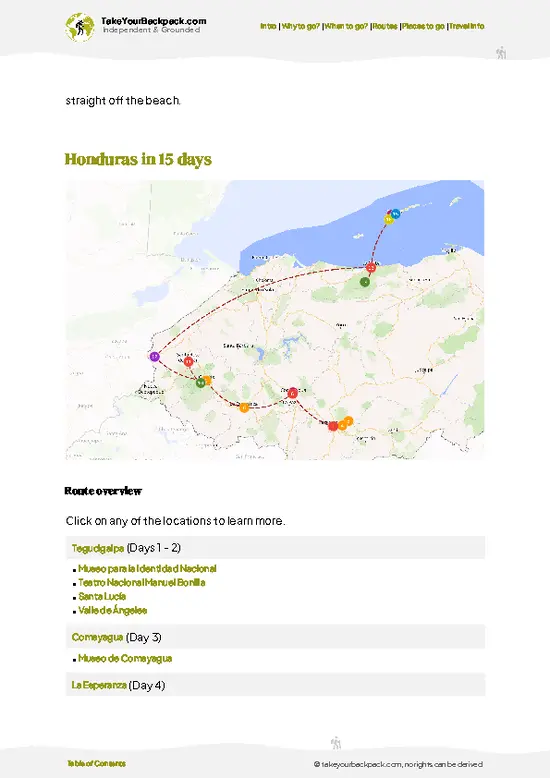
How long to allow: A trip linking several Honduran cities needs 10 to 14 days; under a week, pick one region and stay in it. Honduras clusters into three zones: the western highlands near the Guatemalan border, the north coast around the Caribbean, and the Bay Islands offshore. The two big commercial hubs, San Pedro Sula and Tegucigalpa, serve as connecting points, with San Pedro Sula the better one for the west and coast.
Direction and timing: Enter from Guatemala through the border at Copán Ruinas and work west to east: highlands first, then north to the coast, then the islands last as a rest stop before flying out of the north coast. Give each highland stop 2 to 3 nights, a coastal stop 2 nights and the islands 3 to 5. Typical transfers run 3 to 4 hours from the west to San Pedro Sula and … read more 👉
How long to allow: A trip linking several Honduran cities needs 10 to 14 days; under a week, pick one region and stay in it. Honduras clusters into three zones: the western highlands near the Guatemalan border, the north coast around the Caribbean, and the Bay Islands offshore. The two big commercial hubs, San Pedro Sula and Tegucigalpa, serve as connecting points, with San Pedro Sula the better one for the west and coast.
Direction and timing: Enter from Guatemala through the border at Copán Ruinas and work west to east: highlands first, then north to the coast, then the islands last as a rest stop before flying out of the north coast. Give each highland stop 2 to 3 nights, a coastal stop 2 nights and the islands 3 to 5. Typical transfers run 3 to 4 hours from the west to San Pedro Sula and 3 to 4 hours onward to the coast. A ferry from the mainland to the islands takes about 1 to 1.5 hours. Tegucigalpa lies 4 to 6 hours from the northern hub.
Planning mistakes: The most common error is cramming the whole country into a week. Honduran buses are slow, and a 200 km leg can eat half a day, so cap yourself at one major transfer per day. Another is passing through the capital for no reason; skip it unless a flight or border requires it. Many travelers also arrive at hubs after dark. Schedule long legs to land by mid-afternoon, and choose first-class coaches between main cities over local minibuses.

The ListMust-Visit cities in Honduras

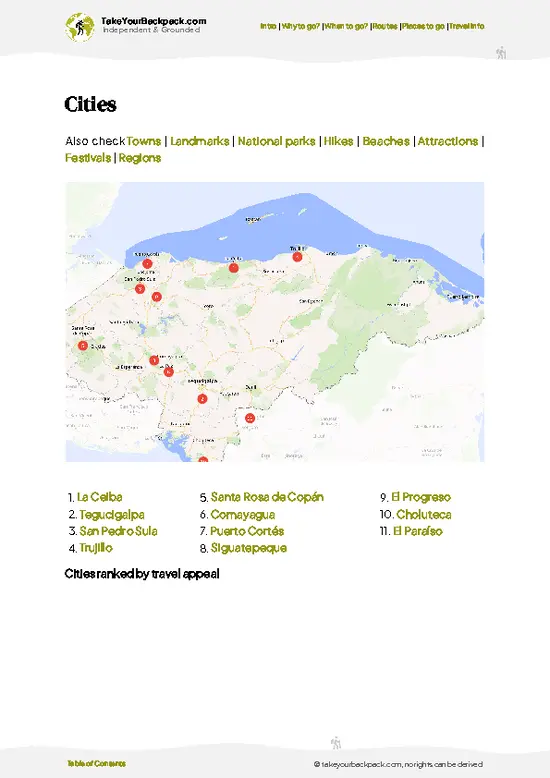
1 La Ceiba

Pico Bonito, Cangrejal rapids, May carnival, island ferries

Raft the granite-boulder canyon of the Cangrejal, hike waterfall trails below the cloud forest, then walk the beachfront at sunset.

honduras-city-la-ceiba
© Google |

2 Tegucigalpa

Highland capital, colonial core, pilgrimage basilica, hilltop Christ, market baleadas

Walk the cobbled lanes around Parque Central, then climb to a forested hilltop statue for views across the red roofs of the valley.

honduras-city-tegucigalpa
© Google | Ulices Posso

3 San Pedro Sula

Craft market, anthropology museum, Real España matches, baleada counters

Browse leather and hammocks at Mercado Guamilito, trace the banana era at the museum and cheer from the stands at a football match.

4 Trujillo

Spanish fort, Garifuna tapado, mangrove lagoon, Columbus landing

Walk the old fort's cannon line above the bay, take a dawn boat through the mangrove lagoon and eat tapado soup in Santa Fe.

honduras-city-trujillo
© Google |

5 Santa Rosa de Copán

Hand-rolled cigars, Calvario Hill, highland coffee, weekend market streets

Watch workers roll cigars by hand, climb to the hilltop chapel for views over red roofs and finish with regional coffee.

6 Comayagua

Baroque cathedral, ancient tower clock, Lenca artifacts, sawdust carpets

Climb the cathedral tower to see a medieval clock, then browse colonial churches and an archaeology museum in the former presidential palace.

honduras-city-comayagua
© Google |

7 Puerto Cortés

Container port, Garífuna beach, fried fish, malecón

Watch ships queue offshore from the waterfront promenade, then head to Travesía for coconut rice, whole fried fish and drumming.

8 Siguatepeque

Dawn bakeries, strawberry farms, pine-hill calm, central highlands base

Taste warm pan de yema in the early morning, pick up fresh strawberries from hill farms and spend an afternoon on the pine hills above town.

9 El Progreso

Banana country, Ulúa riverbanks, market lunches, weekend football

Visit the plantation edges outside town, then cross to the river at golden hour and finish with baleadas from the evening stalls.

10 Choluteca

Stranded 1998 bridge, shifted river, plaza evenings, cattle-country stopover

Stand beneath the 1998 bridge left high and dry by a rerouted river, then spend the evening under the plaza trees.

11 El Paraíso

Plaza shoeshiners, border-region stopover, comedor suppers

Pause for a quiet hour in the plaza, browse the morning market and eat grilled meat plates from the stalls at dusk.

Loading the map 🌍

Expert viewPro Tips for Exploring the Best

How many cities to visit: I advise three to four stops, five at most in two weeks. Transfers are slow, the roads wind, and each town gives its best in two or three nights, once you have walked its market, eaten locally and taken one outing. More stops mean more days spent on buses.
Choosing by travel style: For first-timers and anyone short on time, prioritize highland colonial towns: they are cool, compact and the easiest to manage. History and culture travelers should add a Maya-era town in the west. Beach-minded travelers should accept that the coastal and island stops cost more and are hotter. Skip the two largest commercial cities as destinations; they are connection points and offer little to justify extra nights or the added risk.
What it costs: A realistic backpacker budget is US$30 … read more 👉
How many cities to visit: I advise three to four stops, five at most in two weeks. Transfers are slow, the roads wind, and each town gives its best in two or three nights, once you have walked its market, eaten locally and taken one outing. More stops mean more days spent on buses.
Choosing by travel style: For first-timers and anyone short on time, prioritize highland colonial towns: they are cool, compact and the easiest to manage. History and culture travelers should add a Maya-era town in the west. Beach-minded travelers should accept that the coastal and island stops cost more and are hotter. Skip the two largest commercial cities as destinations; they are connection points and offer little to justify extra nights or the added risk.
What it costs: A realistic backpacker budget is US$30 to 50 a day on the mainland: dorm bed or basic room US$10 to 20, meals US$6 to 12 (a baleada is under US$2), local transport US$5 to 12. Islands push this to US$50 to 80. Entry to major archaeological sites is about US$15 to 20 for foreigners, and a guide there runs US$25 to 40 per group. Coach tickets between main cities generally cost US$10 to 25 on direct services. Carry lempiras for markets and small towns, since cards are not accepted everywhere and ATM fees add up, so withdraw larger amounts less often.
Costs and delays that catch people out: Taxis without agreed fares inflate prices, so settle the price first or use a hotel-called driver. Border crossings can add US$3 to 10 in informal fees; ask for a receipt. Buses leave when full, not on schedule, so build a buffer. Rain closures can add hours in the wet season; check road status with your hotel the night before a long leg.
Safety and cultural points: Honduras has among the highest homicide rates in the region, concentrated in big cities and some neighborhoods. Tourist areas of smaller towns are generally calm, but travel by day, use hotel-booked taxis after dark, and avoid walking with a phone out. Do not carry more than you need and keep a spare card hidden. Dress modestly in inland towns, ask before photographing people, and greet shopkeepers before asking for anything; courtesy goes a long way. A little Spanish helps far more than in tourist-heavy countries.

✈️ The backpacker research shortcutHonduras Travel Guide

An offline-friendly backpacking guide with optimized travel routes, ranked highlights, transport advice, and the best areas to stay.
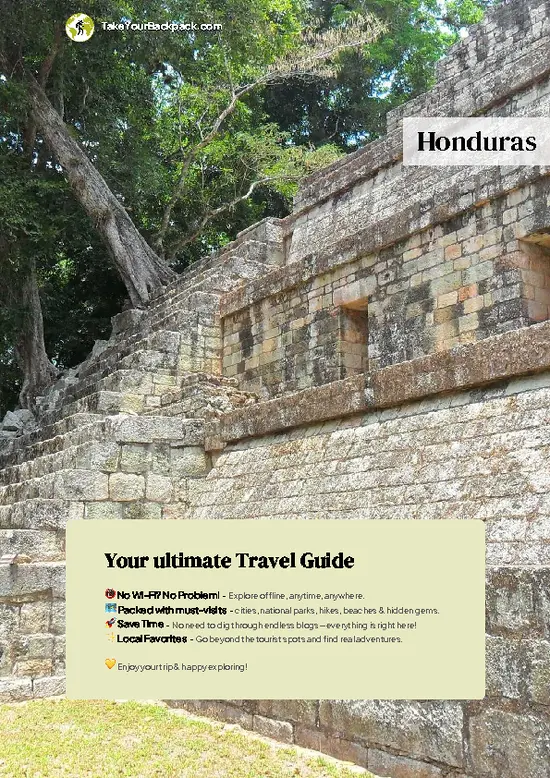
example page 0 from our offline Travel Guide for Honduras
example page 1 from our offline Travel Guide for Honduras
example page 2 from our offline Travel Guide for Honduras
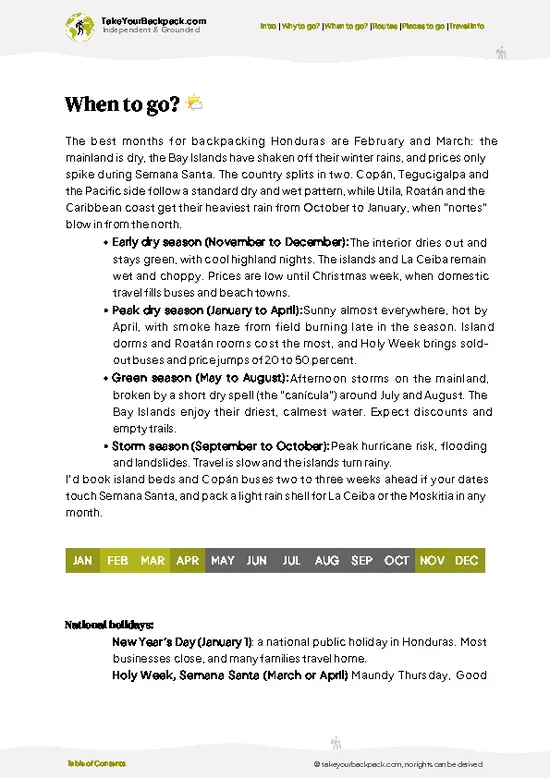
example page 3 from our offline Travel Guide for Honduras
example page 4 from our offline Travel Guide for Honduras
example page 5 from our offline Travel Guide for Honduras
example page 6 from our offline Travel Guide for Honduras
example page 7 from our offline Travel Guide for Honduras
The digital guide (255 pages) contains:
✅ 70 highlights, ranked by travel appeal
✅ Optimized 5, 10 & 15-day travel routes
✅ Cities, national parks, landmarks, beaches
✅ How to get around
✅ Offline-friendly for travel without Wi-Fi
👉 Click to see all 30+ guide features

📅 Plan smarter in minutes, not weeks
✅ Month by month travel advice
✅ Festivals & national holidays
✅ Budget expectations

🗺️ Go to the right places, skip the overrated ones
✅ Honest pros & cons of destinations
✅ Top hikes, parks & viewpoints
✅ Lesser-known places most travelers miss
✅ Clear “worth it vs skip it” guidance

🛏️ Travel smoothly without rookie mistakes
✅ Best areas to stay
✅ Transport systems explained simply
✅ Common scams & safety advice
✅ SIM cards, money & practical tips

🌍 Understand the country, not just visit it
✅ Culture & traditions
✅ 52 Essential phrases & customs
✅ Festivals worth planning around
✅ Traveler-friendly historical context
✅ Insights that make places more meaningful

📱 Built for real travel conditions
✅ Fully downloadable PDF
✅ Works completely offline
✅ Optimized for phone use
✅ Useful in remote areas & buses
✅ Everything in one place
Stop searching, start planning
Get instant access to your full guide. 30‑day money-back guarantee.
+ Add another guide for just

By proceeding you agree to our terms.
Sent to your inbox immediately after payment • 100% Secure Checkout
Best Backpacking Travel Advisor 2025 tourism awardBest Backpacking
Travel Advisor
2025
What others say about Take Your Backpack Guides:
⭐⭐⭐⭐⭐
Fantastic, amazing amount of information!
⭐⭐⭐⭐⭐
My goodness this is amazing, it's what I've been looking for hats off too you!
⭐⭐⭐⭐⭐
I think this is absolutely BRILLIANT
⭐⭐⭐⭐
Very complete and informative. It's still missing places, but I gotta to commend you
⭐⭐⭐⭐⭐
This is truly amazing, thank you, can't wait to explore it with my kids!
⭐⭐⭐⭐⭐
Awesome resource, thank you!
⭐⭐⭐⭐⭐
This is amazing! Can't wait to explore the ones I haven't seen
⭐⭐⭐⭐
I love this! Well done, great idea.
⭐⭐⭐⭐⭐
Thanks for taking the time to make this gem!
⭐⭐⭐⭐⭐
This might be the best website I've ever seen.
⭐⭐⭐⭐⭐
Congratulations, and thank you so much for your work; it's incredibly valuable.
⭐⭐⭐⭐
In all seriousness I think you did a great job pointing out the important spots
⭐⭐⭐⭐⭐
10/10 very good
⭐⭐⭐⭐⭐
As someone who's only just starting to visit regularly this is awesome, thank you.
⭐⭐⭐⭐
Thank you very much! I'm going to visit my dad, it's going to be very useful!
⭐⭐⭐⭐⭐
This is really cool! We'll be travelling for the first time and this definitely come in handy.
⭐⭐⭐⭐⭐
You are now our minister of culture, congratulations 👨‍💼
⭐⭐⭐⭐⭐
Just wanted to tell you that this is a pearl! Going to follow your recommendations.
⭐⭐⭐⭐⭐
This is so cool. I'll definitely be using the resource for my travels soon.
⭐⭐⭐⭐⭐
This is very impressive! Good work.
⭐⭐⭐⭐⭐
This is an amazing and informative site. Very well done!

🛏️ Where to stay?Top Areas to Stay

Honduras has a solid hostel scene, with dorm beds typically around L250 to 500 (US$10 to 20) and private rooms in guesthouses from about L600 (US$25), concentrated where backpackers actually go rather than in the big cities. On the Bay Islands, Utila has the most and cheapest beds plus a loud dive-bar night scene, while West End on Roatán costs more but puts you on a walkable beach strip; inland, the cobbled grid of Copán Ruinas is quiet, safe and a short walk from the ruins, and the Lake Yojoa area around Los Naranjos and Peña Blanca is all hammocks and early nights. In Tegucigalpa, stick to Colonia Palmira and the streets near Boulevard Morazán, where options are fewer and pricier but the … read more 👉
Honduras has a solid hostel scene, with dorm beds typically around L250 to 500 (US$10 to 20) and private rooms in guesthouses from about L600 (US$25), concentrated where backpackers actually go rather than in the big cities. On the Bay Islands, Utila has the most and cheapest beds plus a loud dive-bar night scene, while West End on Roatán costs more but puts you on a walkable beach strip; inland, the cobbled grid of Copán Ruinas is quiet, safe and a short walk from the ruins, and the Lake Yojoa area around Los Naranjos and Peña Blanca is all hammocks and early nights. In Tegucigalpa, stick to Colonia Palmira and the streets near Boulevard Morazán, where options are fewer and pricier but the area is calmer and close to restaurants, and treat San Pedro Sula as a one-night transit stop near the bus terminal.

If you enjoy meeting fellow travelers, consider choosing hostels with high ratings for atmosphere. On the other hand, if you prefer having your own space, a hotel might be a better option.

HondurasDiscover the Country

👋 Meet the founderWho’s Behind Take Your Backpack?

Johan, backpacker and founder of TakeYourBackpackHi, I’m Johan (Netherlands 🇳🇱), the creator of TakeYourBackpack. Over the past 3 decades, I’ve backpacked through 90+ countries across six continents, gaining extensive experience with independent travel, long-term trips, and overland routes.

This site is built on a combination of firsthand travel experience and carefully curated insights from other backpackers. Many guides are based on places I’ve personally visited, while others bring together tips, observations, and practical advice shared by trusted travelers I’ve met along the way.

The goal is to provide realistic, experience-driven guidance — not generic itineraries — so you can explore destinations with better context, clearer expectations, and more confidence.