×

American Samoa🇦🇸 | festivalsSamoan Cultural FestivalFa’ataupati slap dance, ‘ava ceremony, pandanus weaving, umu plates | things to do and best time to go

Explore Independence DayExplore Tisa’s Tattoo Festival

Backpacking in Samoan Cultural
By Johan Kruseman 🇳🇱 | Updated October 15, 2026

The slap of palms on thighs ripples down a row of dancers, and the smoke from an umu earth oven drifts past your shoulder with a hint of coconut cream. That’s the Samoan Cultural Festival, held around the Pago Pago Harbor area of Tutuila in American Samoa. Expect siva dancing, fa’ataupati slap dances, the ‘ava ceremony, weaving demonstrations and plates of food from the oven, in front of crowds of local families and church groups with a handful of travelers. The mood is warm and unhurried. Get there early, claim a shaded seat near where the dancers enter, and carry small bills for the food stalls so you can eat what everyone else is eating. It feels like a community gathering, not a ticketed show, so you stand close enough to see the faces and the technique. It suits curious travelers who like to watch, ask and taste. If you want light-show stages, camping and late-night parties, skip it.

Discover everything you want to know in the 📖 American Samoa Travel Guide.


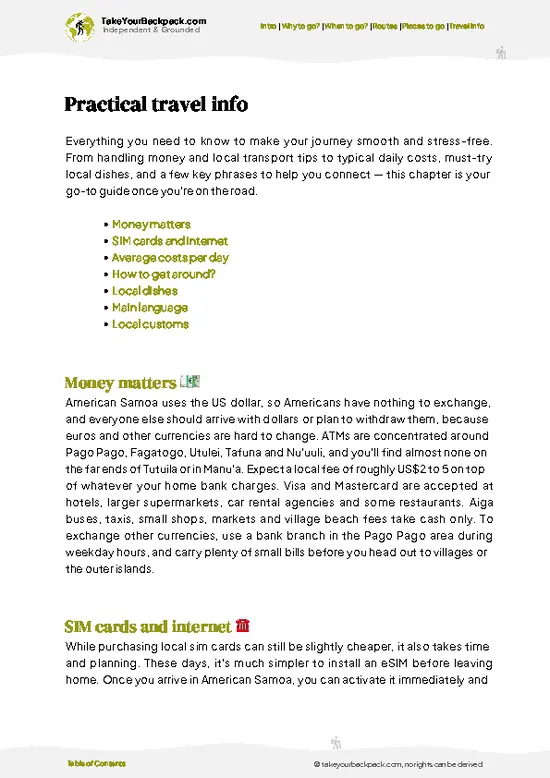
example page 0 from our offline Travel Guide for American Samoa
example page 1 from our offline Travel Guide for American Samoa
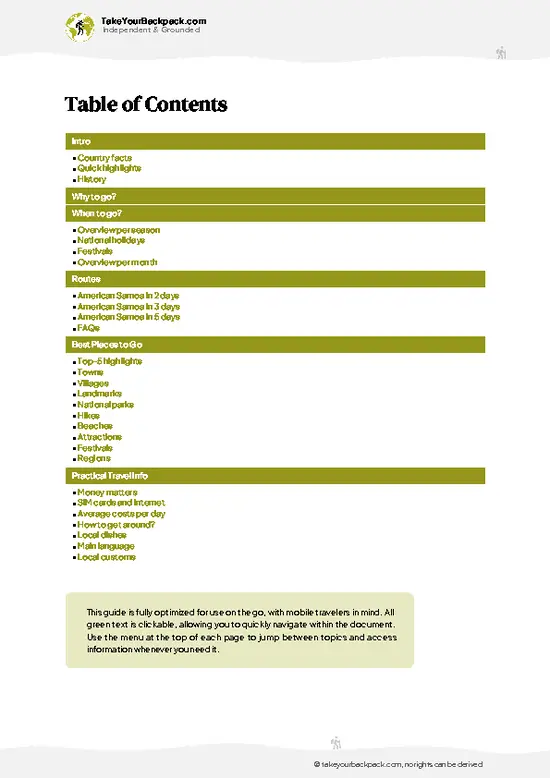
example page 2 from our offline Travel Guide for American Samoa
example page 3 from our offline Travel Guide for American Samoa
example page 4 from our offline Travel Guide for American Samoa
example page 5 from our offline Travel Guide for American Samoa
example page 6 from our offline Travel Guide for American Samoa
example page 7 from our offline Travel Guide for American Samoa
Loading the map 🌍
CLICK TO FILTER
towns
villages
landmarks
national parks
hikes
beaches
attractions
festivals
regions
SHOW COUNTRY’S BESTSHOW ALL

✨ Why go?
Ranked #99 festival in American Samoa
The unique appeal for travelers

Backpackers plan around this because it puts you inside fa’a Samoa, the Samoan way of doing things, rather than beside it. American Samoa has few organized attractions, so a gathering where elders explain the ‘ava cup order, chiefs speak in formal oratory and weavers work in plain view gives you a context that no hike or beach can. People talk to you here. Ask a weaver about a pattern and you will often leave with a half-hour lesson and an invitation to taste something.

The second pull is cost and pace. This is a local event, so you are not paying festival-ticket prices for a wristband and a tent field. You eat from community stalls, watch from the grass and go back to your lodging at night.

It also anchors a longer route well. Pair it with the National Park of American Samoa trails and … read more 👉
Backpackers plan around this because it puts you inside fa’a Samoa, the Samoan way of doing things, rather than beside it. American Samoa has few organized attractions, so a gathering where elders explain the ‘ava cup order, chiefs speak in formal oratory and weavers work in plain view gives you a context that no hike or beach can. People talk to you here. Ask a weaver about a pattern and you will often leave with a half-hour lesson and an invitation to taste something.

The second pull is cost and pace. This is a local event, so you are not paying festival-ticket prices for a wristband and a tent field. You eat from community stalls, watch from the grass and go back to your lodging at night.

It also anchors a longer route well. Pair it with the National Park of American Samoa trails and the quieter villages around the island, and you end up with a trip that has a beginning, a middle and a proper cultural peak.

💡 HighlightsPlaces and moments you shouldn't skip

  1. Siva and fa’ataupati dance performances. This is the heart of the day. Groups in lavalava and flower crowns move through slow, graceful siva, then switch to fa’ataupati, where men slap their bodies in rapid rhythm, a dance descended from the sound of slapping at mosquitoes. Stand near the front to catch the synchronized timing.
  2. The ‘ava ceremony. A chief or talking chief pours the ceremonial kava drink in a strict order of rank, with each cup announced aloud. You will not be handed one by accident, but watching the formal speech and gestures shows how Samoan society is organized.
  3. Umu food and village stalls. Taro, breadfruit, palusami (taro leaves baked in coconut cream), fish and pork come out of earth ovens heated by hot stones. Buy a plate and eat with your hands as locals do. The coconut-cream
… read more 👉
  1. Siva and fa’ataupati dance performances. This is the heart of the day. Groups in lavalava and flower crowns move through slow, graceful siva, then switch to fa’ataupati, where men slap their bodies in rapid rhythm, a dance descended from the sound of slapping at mosquitoes. Stand near the front to catch the synchronized timing.
  2. The ‘ava ceremony. A chief or talking chief pours the ceremonial kava drink in a strict order of rank, with each cup announced aloud. You will not be handed one by accident, but watching the formal speech and gestures shows how Samoan society is organized.
  3. Umu food and village stalls. Taro, breadfruit, palusami (taro leaves baked in coconut cream), fish and pork come out of earth ovens heated by hot stones. Buy a plate and eat with your hands as locals do. The coconut-cream richness is the taste to remember.
  4. Weaving and fine mat demonstrations. Women plait pandanus leaves into mats and baskets, and the ie toga fine mats carry deep ceremonial value. You see the stripping, softening and weaving up close, and you can usually buy a small piece directly from the maker.
  5. Fire knife dance (siva afi). When it is on the program, a performer spins a blazing knife at speed around the body and throws it overhead. It is loud, fast and the one moment where the whole crowd leans in.
An afternoon and the early evening cover all five comfortably.
Spotted a mistake or missing something? Contact us.

🌤️ When to go?When is the celebration of Samoan Cultural Festival?

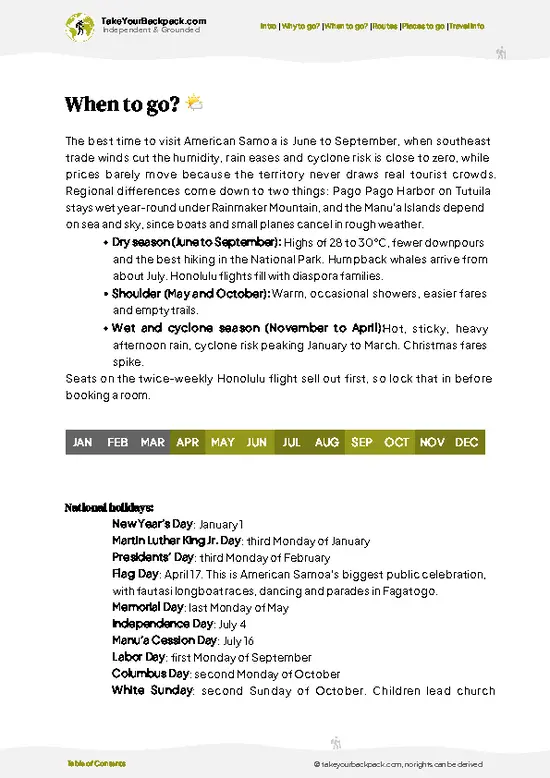
The festival is held in April around Flag Day (April 17), runs several days, and centers on the Pago Pago harbor area, with events in Utulei and Fagatogo.
  • Best day: Go on the main performance day for the biggest groups, full ‘siva’ dancing and ceremonial dress. Weekday sessions are quieter and easier for talking to performers.
  • Weather: Expect 24 to 31°C (75 to 88°F), high humidity and short, heavy showers, since Pago Pago is one of the wettest harbors in the Pacific. Daylight lasts about 12 hours. Bring a light rain jacket, reef-safe sunscreen, a hat and sandals you can dry quickly.
  • Booking: Reserve a room 6 to 8 weeks ahead, as the island has few beds. Rates around the festival can run 15 to 30 percent higher.
  • Crowds and roads: Traffic on the main road between Tafuna and Pago Pago slows at midday.
… read more 👉
The festival is held in April around Flag Day (April 17), runs several days, and centers on the Pago Pago harbor area, with events in Utulei and Fagatogo.
  • Best day: Go on the main performance day for the biggest groups, full ‘siva’ dancing and ceremonial dress. Weekday sessions are quieter and easier for talking to performers.
  • Weather: Expect 24 to 31°C (75 to 88°F), high humidity and short, heavy showers, since Pago Pago is one of the wettest harbors in the Pacific. Daylight lasts about 12 hours. Bring a light rain jacket, reef-safe sunscreen, a hat and sandals you can dry quickly.
  • Booking: Reserve a room 6 to 8 weeks ahead, as the island has few beds. Rates around the festival can run 15 to 30 percent higher.
  • Crowds and roads: Traffic on the main road between Tafuna and Pago Pago slows at midday. Arrive an hour before programs begin and leave after the last dance, once the road clears.
Book flights into Tafuna early, because seats from Honolulu and Apia fill quickly.


source: climatestotravel.comJANJanuary: not recommended for travelingFEBFebruary: not recommended for travelingMARMarch: not recommended for travelingAPRApril: not recommended for travelingMAYMay: excellent for travelingJUNJune: not recommended for travelingJULJuly: not recommended for travelingAUGAugust: not recommended for travelingSEPSeptember: not recommended for travelingOCTOctober: not recommended for travelingNOVNovember: not recommended for travelingDECDecember: not recommended for traveling

✈️ The backpacker research shortcutAmerican Samoa Travel Guide

An offline-friendly backpacking guide with optimized travel routes, ranked highlights, transport advice, and the best areas to stay.
example page 0 from our offline Travel Guide for American Samoa
example page 1 from our offline Travel Guide for American Samoa
example page 2 from our offline Travel Guide for American Samoa
example page 3 from our offline Travel Guide for American Samoa
example page 4 from our offline Travel Guide for American Samoa
example page 5 from our offline Travel Guide for American Samoa
example page 6 from our offline Travel Guide for American Samoa
example page 7 from our offline Travel Guide for American Samoa
The digital guide (141 pages) contains:
✅ 36 highlights, ranked by travel appeal
✅ Optimized 2, 3 & 5-day travel routes
✅ Cities, national parks, landmarks, beaches
✅ How to get around
✅ Offline-friendly for travel without Wi-Fi
👉 Click to see all 30+ guide features

📅 Plan smarter in minutes, not weeks
✅ Month by month travel advice
✅ Festivals & national holidays
✅ Budget expectations

🗺️ Go to the right places, skip the overrated ones
✅ Honest pros & cons of destinations
✅ Top hikes, parks & viewpoints
✅ Lesser-known places most travelers miss
✅ Clear “worth it vs skip it” guidance

🛏️ Travel smoothly without rookie mistakes
✅ Best areas to stay
✅ Transport systems explained simply
✅ Common scams & safety advice
✅ SIM cards, money & practical tips

🌍 Understand the country, not just visit it
✅ Culture & traditions
✅ 52 Essential phrases & customs
✅ Festivals worth planning around
✅ Traveler-friendly historical context
✅ Insights that make places more meaningful

📱 Built for real travel conditions
✅ Fully downloadable PDF
✅ Works completely offline
✅ Optimized for phone use
✅ Useful in remote areas & buses
✅ Everything in one place
Stop searching, start planning
Get instant access to your full guide. 30‑day money-back guarantee.
+ Add another guide for just

By proceeding you agree to our terms.
Sent to your inbox immediately after payment • 100% Secure Checkout
Best Backpacking Travel Advisor 2025 tourism awardBest Backpacking
Travel Advisor
2025
What others say about Take Your Backpack Guides:
⭐⭐⭐⭐⭐
Fantastic, amazing amount of information!
⭐⭐⭐⭐⭐
My goodness this is amazing, it's what I've been looking for hats off too you!
⭐⭐⭐⭐⭐
I think this is absolutely BRILLIANT
⭐⭐⭐⭐
Very complete and informative. It's still missing places, but I gotta to commend you
⭐⭐⭐⭐⭐
This is truly amazing, thank you, can't wait to explore it with my kids!
⭐⭐⭐⭐⭐
Awesome resource, thank you!
⭐⭐⭐⭐⭐
This is amazing! Can't wait to explore the ones I haven't seen
⭐⭐⭐⭐
I love this! Well done, great idea.
⭐⭐⭐⭐⭐
Thanks for taking the time to make this gem!
⭐⭐⭐⭐⭐
This might be the best website I've ever seen.
⭐⭐⭐⭐⭐
Congratulations, and thank you so much for your work; it's incredibly valuable.
⭐⭐⭐⭐
In all seriousness I think you did a great job pointing out the important spots
⭐⭐⭐⭐⭐
10/10 very good
⭐⭐⭐⭐⭐
As someone who's only just starting to visit regularly this is awesome, thank you.
⭐⭐⭐⭐
Thank you very much! I'm going to visit my dad, it's going to be very useful!
⭐⭐⭐⭐⭐
This is really cool! We'll be travelling for the first time and this definitely come in handy.
⭐⭐⭐⭐⭐
You are now our minister of culture, congratulations 👨‍💼
⭐⭐⭐⭐⭐
Just wanted to tell you that this is a pearl! Going to follow your recommendations.
⭐⭐⭐⭐⭐
This is so cool. I'll definitely be using the resource for my travels soon.
⭐⭐⭐⭐⭐
This is very impressive! Good work.
⭐⭐⭐⭐⭐
This is an amazing and informative site. Very well done!

🛏️ Where to stay?Best areas to stay in American Samoa

Stay along the Pago Pago harbor, between Utulei and Fagatogo, to walk to most festival events and catch buses on the island’s main road.
Fagatogo is the practical choice. It has the market, the waterfront green where gatherings happen, and the most evening activity on the island. Backpackers meet at the market stalls and at cheap lunch counters, so solo travelers rarely eat alone. Streets are lit and busy at night, though a short taxi is smart after dark.
Utulei, on the southwest edge of the harbor, is quieter and has a beach, a short walk from festival grounds. It suits those who want sleep and … read more 👉
Stay along the Pago Pago harbor, between Utulei and Fagatogo, to walk to most festival events and catch buses on the island’s main road.
Fagatogo is the practical choice. It has the market, the waterfront green where gatherings happen, and the most evening activity on the island. Backpackers meet at the market stalls and at cheap lunch counters, so solo travelers rarely eat alone. Streets are lit and busy at night, though a short taxi is smart after dark.
Utulei, on the southwest edge of the harbor, is quieter and has a beach, a short walk from festival grounds. It suits those who want sleep and sea views over social buzz.
Nu’uuli and the Tafuna side are 20 to 30 minutes by road from the harbor. Rooms there are easier to find and sometimes cheaper, and the airport is close. The downside is that you depend on buses or a rental car, and buses thin out in the evening.
Homestays and family-run guesthouses in villages near Pago Pago give the most authentic stay. Hosts often invite guests to church or village events. Accommodation is limited, so lock in your stay early, and choose the harbor area if you plan to meet other travelers.

👛 Costs (as of 15 October 2026)How expensive it really is

A realistic daily budget for attending the festival is US$131 to 235, driven almost entirely by lodging.
CategoryBudget RangeLocal Reality
Festival ticketsUS$0Cultural performances and gatherings in the harbor area are usually open to the public. Small donations or craft purchases are welcome.
AccommodationUS$90 to 150 (high season)Few beds on the island, so basic guesthouses and small hotels near Pago Pago fill and cost more around the festival. Off-season rooms run about US$70 to 110.
Local transportUS$6 to 15Colorful aiga buses cost about US$1 to 2 per ride, and short taxi trips cost US$5 to 15. Services thin out in the evening.
Food & drinksUS$25 to 45Plate lunches run US$8 to 14, festival stalls US$5 to 12 a plate, and a beer US$3 to 5. Groceries are pricey because most goods are imported.
… read more 👉
A realistic daily budget for attending the festival is US$131 to 235, driven almost entirely by lodging.
CategoryBudget RangeLocal Reality
Festival ticketsUS$0Cultural performances and gatherings in the harbor area are usually open to the public. Small donations or craft purchases are welcome.
AccommodationUS$90 to 150 (high season)Few beds on the island, so basic guesthouses and small hotels near Pago Pago fill and cost more around the festival. Off-season rooms run about US$70 to 110.
Local transportUS$6 to 15Colorful aiga buses cost about US$1 to 2 per ride, and short taxi trips cost US$5 to 15. Services thin out in the evening.
Food & drinksUS$25 to 45Plate lunches run US$8 to 14, festival stalls US$5 to 12 a plate, and a beer US$3 to 5. Groceries are pricey because most goods are imported.
Miscellaneous expensesUS$10 to 25Handmade crafts, sunscreen, a rain poncho and small tips or donations. Bring cash, as ATMs are few.
Total Daily BudgetUS$131 to 235Sharing a room trims the lower end considerably.
⚠️ Prices can change and everyone travels differently, so take this as a rough guide. Hope it helps you plan your adventure!

🍲 FoodWhat to Eat & Drink

Festival food in American Samoa is a village feast spread out on trestle tables and a few stalls, built around taro, breadfruit and palusami, which is taro leaves baked with coconut cream until soft and rich.
Look for oka, raw fish cured in lime and coconut milk, fa’ausi, taro in caramelized coconut cream, and koko Samoa, cocoa drunk hot and bitter. Barbecued chicken and pork from the umu (earth oven) are the real flavor of the day, smoky and falling off the bone. Sip fresh coconut water straight from the husk, and cool down with a cold Samoan-brewed or imported beer where sold.
Try pani popo, sweet coconut buns, and panikeke, fried banana pancakes, from a food table. Portions are large and plates are often sold with generous sides, so go in a pair and split one.
Bring cash in small US bills, … read more 👉
Festival food in American Samoa is a village feast spread out on trestle tables and a few stalls, built around taro, breadfruit and palusami, which is taro leaves baked with coconut cream until soft and rich.
Look for oka, raw fish cured in lime and coconut milk, fa’ausi, taro in caramelized coconut cream, and koko Samoa, cocoa drunk hot and bitter. Barbecued chicken and pork from the umu (earth oven) are the real flavor of the day, smoky and falling off the bone. Sip fresh coconut water straight from the husk, and cool down with a cold Samoan-brewed or imported beer where sold.
Try pani popo, sweet coconut buns, and panikeke, fried banana pancakes, from a food table. Portions are large and plates are often sold with generous sides, so go in a pair and split one.
Bring cash in small US bills, since many stalls do not take cards. Lines move slowly and nobody hurries. If you are invited to share a family table, accept graciously, wait for the elders to start, and do not refuse food outright. Eat and drink while walking only at stalls, and not during formal ceremonies.

FAQCommon questions from travelers

The festival takes place in April, around Flag Day on April 17, and runs for several days. Events center on the Pago Pago harbor area, mainly Utulei and Fagatogo, a few minutes apart by bus. Performances usually start in the morning and finish by late afternoon, so plan to arrive early.
Attending costs very little, since most cultural performances are free to watch. Your real expense is the stay, with rooms at around US$90 to 150 a night in April, plus US$25 to 45 a day for food and US$1 to 2 per bus ride. A realistic total is about US$131 to 235 per day.
Tickets are generally not required for the main public performances around the harbor, so you can simply turn up. What you must book early are flights into Tafuna airport and your room, ideally 6 to 8 weeks ahead, because the island has few beds. Check with the American Samoa Visitors Bureau for any ticketed evening events.
⚠️ Things can change over time, so always validate details locally before you go.

Other American Samoan festivals near Samoan Cultural

Explore more nearby:

  • Independence Day—fireworks, family picnics, Pago Pago Harbor, patriotic displays| 0 km away
  • Flag Day—Fautasi longboat races, Deed of Cession ceremony, Fagatogo malae parade, week-long program| 2 km away
  • Tisa’s Tattoo Festival—Alega Beach, barefoot bar, siva afi after dark, beach fale| 7 km away

💡 Not sure where to go next?
Create a personalized itinerary for American Samoa including Samoan Cultural and the places that fit your trip.

Generate my itinerary

👉 Discover all festivals

Or checkout all American Samoa has to offer (think cities, towns, villages, national parks, hikes, beaches, festivals)
Country photo of American Samoa

We 💚 feedbackFinal thoughts on celebrating the Samoan Cultural

This festival is for travelers who would rather listen than scroll: people who like watching craft, music and ceremony at close range and talking with those who practice them. Wear modest clothes that cover your knees, bring cash for food, and sit through the speeches before the dancing. They are part of the show, and you will understand the rest better for it.

✍️ Help improve this page!
The information on this page is based on in-depth research, insights shared by experienced travelers, and feedback from the local travel community in American Samoa. While every effort is made to keep the information accurate and current, conditions can change — so if you spot anything incorrect or outdated, please get in touch.


🙋‍♂️ Give feedback

👋 Meet the founderWho’s Behind Take Your Backpack?

Johan, backpacker and founder of TakeYourBackpackHi, I’m Johan (Netherlands 🇳🇱), the creator of TakeYourBackpack. Over the past 3 decades, I’ve backpacked through 90+ countries across six continents, gaining extensive experience with independent travel, long-term trips, and overland routes.

This site is built on a combination of firsthand travel experience and carefully curated insights from other backpackers. Many guides are based on places I’ve personally visited, while others bring together tips, observations, and practical advice shared by trusted travelers I’ve met along the way.

The goal is to provide realistic, experience-driven guidance — not generic itineraries — so you can explore destinations with better context, clearer expectations, and more confidence.