×
Réunion 🇷🇪

backpacking Africa Réunion 🇷🇪Climb volcanic trails above tropical coastlines.

Explore CongoExplore Rwanda

Backpacking Réunion in 2026

A complete guide including when and where to go, costs, transport, itineraries, and practical travel advice.
What a trip here is really like

Backpacking Réunion
By Johan Kruseman 🇳🇱 | Updated June 5, 2026

You won’t save island money here—you’ll pay Euro prices and you’ll need a car. Buses are scarce and the island is vertical; fuel and insurance add up. But those hairpins lead to a French‑Creole island where a live volcano and highland cirques sit an hour from coral reef.

Réunion rewards sweat: Maïdo sunrise with clouds spilling into Mafate; switchbacks to Cilaos pastries; warm lava underfoot at Piton de la Fournaise; reef snorkel; smoky cari, rum arrangé, and maloya under a tin roof. Trails go straight up, rain hits without warning, roads pinch your shoulders. The grind makes the payoff hit harder—the cold Dodo, the serrated skyline, a hot samoussa pressed into your hand.

Against Mauritius’s resort ease and Madagascar’s wild sprawl, Réunion delivers big nature with French reliability; the Seychelles do beaches, not volcano‑to‑reef in a day—go if you want mountain mornings, reef afternoons, and lived‑in culture.

👉 Get the 📖 Travel Guide of Réunion

Cirque de Mafate

Footpaths, not roads. Mafate makes you earn lunch. Drop in from Col des Bœufs or grind up Rivière des Galets: sweat, ladders, tin roofs. Carry cash and a headlamp. Payoff: cold river ankles and a night sky that crackles.

Cilaos

Reached by a 400‑bend road, Cilaos suits hikers who want a base with hearty plates and a bed. Mornings clear, afternoons gray. Bag Piton des Neiges or canyon Bras Rouge, then crush lentils with a cold Dodo.

Piton de la Fournaise & Plaine des Sables

Piton de la Fournaise pays those who start early. RN3 to Pas de Bellecombe, then wind and cinder underfoot, no shade. Move steady. By mid‑morning the view’s gone; you’re sipping thermos coffee on the rim.

West Coast Lagoon (Saint‑Gilles–L’Ermitage–Saint‑Leu)

Saint‑Gilles to Saint‑Leu rides the N1 spine: easy buses, rush‑hour jams. Reef equals calm lagoon; bring a mask. Outside passes, sharks are real. After hikes, hit roulottes, cheap samosas, sunset beer, and a sandy sit.

Sud Sauvage (Sainte‑Rose–Saint‑Philippe)

Further along RN2, the Sud Sauvage is for patient road‑trippers. Fresh lava, salt‑blasted cliffs, quick squalls. Stop at Cap Méchant and Sainte‑Rose flows. Short roadside walks, big surf, and picnic fruit while the sea hammers.
A visual overview of the country
Loading the map 🌍
CLICK TO FILTER
city
town
village
unique site
national park
hike
beach
attraction
festival
SHOW COUNTRY’S BESTSHOW ALL

Why go?What sets this destination apart

Scenery

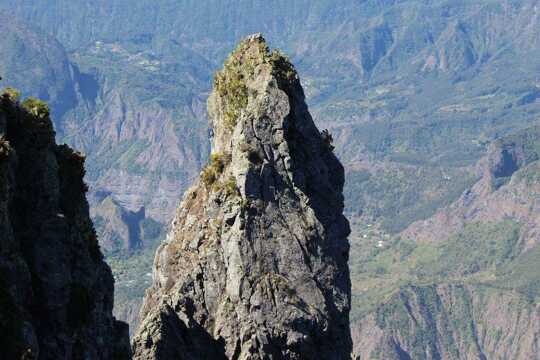
Réunion pays you back in views that feel won, not handed out. Lava crunches under your boots at Piton de la Fournaise; in Bélouve the air smells like wet fern and peat, mist lifts off Grand Étang; above Mafate the wind rakes your sweat dry at Maïdo. Then you drop to the coast, salt on your lips and an ice-cold Dodo in your hand.
Want the complete picture of Réunion?
The offline Travel Guide brings everything together — routes, highlights & planning.

See what's included in the guide 👉

Get the Travel Guide -

⭐ HighlightsKey places and experiences

  • Piton de la Fournaise: On the Plaine des Sables the world turns rust and graphite, boots crunching cinder while the wind tastes faintly of sulphur. White paint marks march over fresh flows to the Dolomieu rim, heat shimmering. The payoff is that raw crater view and, back in Bourg-Murat, an ice-cold Dodo that scrubs ash from your throat.
  • Cirque de Mafate: You earn it one switchback at a time from Col des Bœufs—sweat stinging, cicadas drilling the air, mule bells somewhere below. In La Nouvelle the tin roofs ping under sun, and dinner is rice, lentils, cari, plus a small glass of rum arrangé. Sleep hits hard in a gîte while the river ticks over stones.
  • Piton des Neiges, sunrise: Leave Cilaos in the cold, headlamp halo catching basalt grit. Fingers numb, breath smoky; the summit breaks above a white ocean of cloud and the three cirques read like a relief map. Coffee from a thermos tastes ridiculous at 3,070 meters.
  • Bélouve Forest to Trou de Fer: A damp, high forest where tree ferns drip and
read more 👉
  • Piton de la Fournaise: On the Plaine des Sables the world turns rust and graphite, boots crunching cinder while the wind tastes faintly of sulphur. White paint marks march over fresh flows to the Dolomieu rim, heat shimmering. The payoff is that raw crater view and, back in Bourg-Murat, an ice-cold Dodo that scrubs ash from your throat.
  • Cirque de Mafate: You earn it one switchback at a time from Col des Bœufs—sweat stinging, cicadas drilling the air, mule bells somewhere below. In La Nouvelle the tin roofs ping under sun, and dinner is rice, lentils, cari, plus a small glass of rum arrangé. Sleep hits hard in a gîte while the river ticks over stones.
  • Piton des Neiges, sunrise: Leave Cilaos in the cold, headlamp halo catching basalt grit. Fingers numb, breath smoky; the summit breaks above a white ocean of cloud and the three cirques read like a relief map. Coffee from a thermos tastes ridiculous at 3,070 meters.
  • Bélouve Forest to Trou de Fer: A damp, high forest where tree ferns drip and the boardwalk flexes under muddy soles. The air smells of wet leaf and peat; somewhere ahead, a steady thunder—the falls. At the belvedere, the canyon gapes and hot samoussas disappear while mist beads on your eyelashes.
  • Cascade Langevin (Grand Galet): Cane trucks growl past as the road drops to a wall of water chiseling a turquoise pool. The rocks are slick and shock-cold on your skin; surface to the smell of wet basalt and grilled bouchons from a roadside stand. Off-the-map: the lava tunnels of Sainte-Rose, Piton d’Anchaing’s ridge in Salazie, and the yellow cliff of Cap Jaune at Vincendo.
Spotted a mistake or missing a highlight? Contact us.

But Réunion offers more...

Discover and compare all of its highlights per category

🧭 RoutesSuggested travel routes through Réunion

The 2-Day West Coast Taster

The vibe: A laid-back coastal escape that mixes easy lagoon time with one big mountain viewpoint, perfect if you want Réunion’s greatest hits without leaving the west side of the island. You’ll base yourself in one beach town and use short drives to hop between sand, reef, and highland panoramas.
  • Lagoon swims and snorkeling at L’Hermitage and nearby Trou d’Eau.
  • Sunset and surfy atmosphere at Boucan Canot.
  • Big cirque views from Le Maïdo over the Cirque de Mafate.
  • Café and promenade time in Saint-Gilles-les-Bains.

The 3-Day Coast & Cilaos Loop

The vibe: A balanced mini-road trip that links the west coast lagoons with a night in the high mountains, ideal if you want both beach and cirque scenery without rushing. You’ll split your time between sea-level swims, cliff-ringed valleys, and one or two short hikes.
  • Beach-hopping between L’Hermitage and Plage de la Saline.
  • Mountain roads and viewpoints in the Cirque de Cilaos.
  • Creole food and cool evenings in the town of Cilaos.
read more 👉

The 2-Day West Coast Taster

The vibe: A laid-back coastal escape that mixes easy lagoon time with one big mountain viewpoint, perfect if you want Réunion’s greatest hits without leaving the west side of the island. You’ll base yourself in one beach town and use short drives to hop between sand, reef, and highland panoramas.
  • Lagoon swims and snorkeling at L’Hermitage and nearby Trou d’Eau.
  • Sunset and surfy atmosphere at Boucan Canot.
  • Big cirque views from Le Maïdo over the Cirque de Mafate.
  • Café and promenade time in Saint-Gilles-les-Bains.

The 3-Day Coast & Cilaos Loop

The vibe: A balanced mini-road trip that links the west coast lagoons with a night in the high mountains, ideal if you want both beach and cirque scenery without rushing. You’ll split your time between sea-level swims, cliff-ringed valleys, and one or two short hikes.
  • Beach-hopping between L’Hermitage and Plage de la Saline.
  • Mountain roads and viewpoints in the Cirque de Cilaos.
  • Creole food and cool evenings in the town of Cilaos.
  • A waterfall stop at Bassin des Aigrettes and a mellow finale in Saint-Leu.

The 5-Day Island Contrasts Circuit

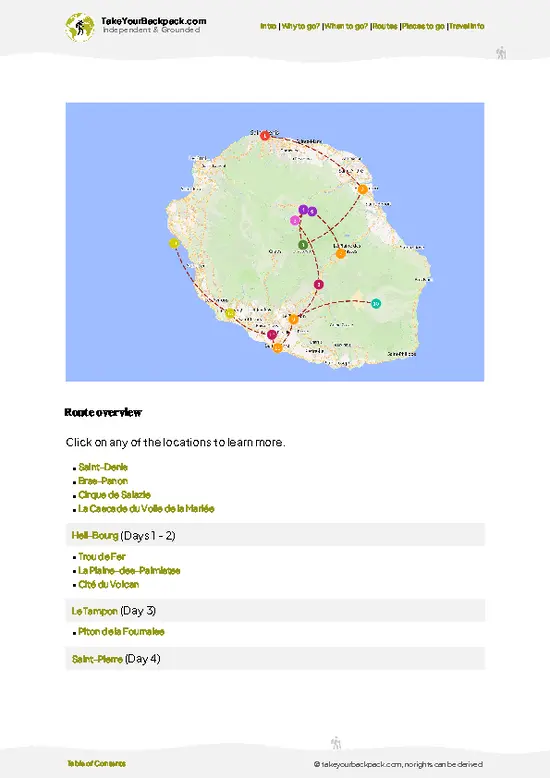
The vibe: A full but unhurried loop that threads together cirques, volcano, waterfalls, and both south and west coasts, for travelers who want to feel how different each corner of Réunion really is. You’ll stay in villages, small towns, and one bigger hub, with time for a couple of solid hikes and plenty of scenic driving breaks.
  • Creole architecture and mountain air in Hell-Bourg and the Cirque de Salazie.
  • Deep ravines and waterfalls at Trou de Fer and Cascades de Takamaka.
  • Lava landscapes and hiking around Piton de la Fournaise.
  • Southern beaches like Grande Anse plus lagoon time at L’Hermitage and cultural stops in Saint-Pierre and Saint-Leu.
🌍 Want a ready-to-use travel plan for Réunion?
The overview above compares different route options based on your travel time and style. The complete Travel Guide breaks each itinerary down in detail, including maps, stops, highlights, and transport information.

Explore all route details 👉

Get the Travel Guide -

🌤️ When to go?When to go for the best experience

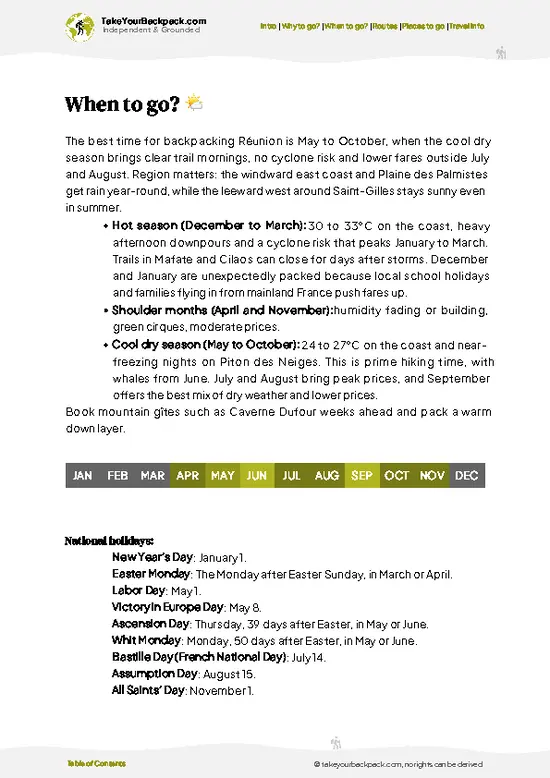
Late May to mid-June and September are the sweet spot on Réunion. Rains have scrubbed the air, the tracks set firm, waterfalls still run, and the alizé keeps sweat from pooling under your pack. Nights in the cirques are cool without biting, mornings clear enough to earn a Piton des Neiges sunrise, and prices slip between French holiday spikes. Whale blows drift off Saint-Gilles, lychee scent rides the breeze, buses feel breathable, gîtes actually answer.
  • The Crowd/Heat Peak: July-August and late December. The grind is queues in Cilaos, booked gîtes, and cars priced like Paris. The high is razor-edge light on Mafate ridgelines, or, in December, that first ice-cold Dodo after a furnace-hot coastal slog, salt crust on your forearms.
  • The Transition/Shoulder: May-June, September-early October. Trails dry, clouds lift, shop shutters roll up earlier, and you move—ridge to ridge—without jostling. Anomaly: October looks quiet but spikes hard during Grand Raid week; beds vanish in Cilaos and Saint-Pierre.
  • The Off-Peak/Extreme: January-March. Cyclone rain drums on tin roofs, valleys go inward-quiet, and you get Mafate to yourself. Survival hack: start at dawn, stay leeward (Maïdo, Hauts de l’Ouest), pack dry bags and respect swollen ravines.

Book mountain gîtes first—two weeks out in the shoulder, a month or more for July-August and Grand Raid week—and let everything else bend around that.

source: climatestotravel.comJANJanuary: fair for travelingFEBFebruary: fair for travelingMARMarch: fair for travelingAPRApril: good for travelingMAYMay: highly recommended for travelingJUNJune: excellent for travelingJULJuly: good for travelingAUGAugust: good for travelingSEPSeptember: excellent for travelingOCTOctober: good for travelingNOVNovember: good for travelingDECDecember: fair for traveling
📅 Traveling in a specific month?
Get a full month-by-month breakdown of weather, crowds, costs, festivals, and seasonal highlights in the complete travel guide.

Get full details when to go 👉

Get the Travel Guide -
reunion-island-pixabay-2908875

💰 Costs (as of 2026)How expensive it really is

€55-70 per day if you sleep in dorms/gîtes, ride buses, and self-cater; rent a car or book canyoning and it jumps to €110+.
  • dorm accommodation: Coast hostels run €22-35; mountain gîtes dorms sit €18-25 (blanket rental extra). Beds go fast on weekends in the cirques. System tip: book demi-pension by phone a day ahead—locking dinner and breakfast usually saves €5-10 and spares you overpriced, scarce mountain meals.
  • meals: Supermarket Survival: baguette €1, cheese/charcuterie/fruit to build €4-6 lunches, plus a €2 Dodo beer—€10-14/day if disciplined. Street food reality: “snacks” sell cari plates for €6-9 and bouchon sandwiches for €4-5; in the cirques, add 20-30%. Cheaper than France, pricier than Mauritius or Madagascar.
  • local transport: Car Jaune + local buses are the cheapest unlock: €2-4 per leg, so €6-12 for a day of hops if you start early. Expect slow connections to trailheads; hitchhiking fills the last kilometers and is common. Compared to Mauritius buses, you’ll pay more but get safer roads and better schedules. Car rental (€35-50/day + fuel) only pays if you split it.
  • activities: Hiking the cirques and volcano is free; the views are the reward you earn with sweat. Cost drivers
read more 👉
€55-70 per day if you sleep in dorms/gîtes, ride buses, and self-cater; rent a car or book canyoning and it jumps to €110+.
  • dorm accommodation: Coast hostels run €22-35; mountain gîtes dorms sit €18-25 (blanket rental extra). Beds go fast on weekends in the cirques. System tip: book demi-pension by phone a day ahead—locking dinner and breakfast usually saves €5-10 and spares you overpriced, scarce mountain meals.
  • meals: Supermarket Survival: baguette €1, cheese/charcuterie/fruit to build €4-6 lunches, plus a €2 Dodo beer—€10-14/day if disciplined. Street food reality: “snacks” sell cari plates for €6-9 and bouchon sandwiches for €4-5; in the cirques, add 20-30%. Cheaper than France, pricier than Mauritius or Madagascar.
  • local transport: Car Jaune + local buses are the cheapest unlock: €2-4 per leg, so €6-12 for a day of hops if you start early. Expect slow connections to trailheads; hitchhiking fills the last kilometers and is common. Compared to Mauritius buses, you’ll pay more but get safer roads and better schedules. Car rental (€35-50/day + fuel) only pays if you split it.
  • activities: Hiking the cirques and volcano is free; the views are the reward you earn with sweat. Cost drivers are guided canyoning (€65-90 half-day), helicopter laps over the caldera (€200-300), dives (€40-60), and whale outings in season (€50-70). Mountain half-board at gîtes (€45-55) is the “experience tax.”
  • miscellaneous: Budget leaks: sunscreen and repellent (€12-18), laundry tokens (€5-8), bar beers (€4-6), Sunday shopping markups, and buying bottled water when trailhead taps are potable. Card fees bite; pull cash in one go. Relative value: pricier than Mauritius/Madagascar, but you’re paying European reliability to reach wild terrain.
⚠️ Prices can change and everyone travels differently, so take this as a rough guide. Hope it helps you plan your adventure!

✈️ The backpacker research shortcutRéunion Travel Guide

An offline-friendly backpacking guide with optimized travel routes, ranked highlights, transport advice, and the best areas to stay.
example page 0 from our offline Travel Guide for Réunionexample page 1 from our offline Travel Guide for Réunionexample page 2 from our offline Travel Guide for Réunionexample page 3 from our offline Travel Guide for Réunionexample page 4 from our offline Travel Guide for Réunionexample page 5 from our offline Travel Guide for Réunionexample page 6 from our offline Travel Guide for Réunionexample page 7 from our offline Travel Guide for Réunion
The digital guide (245 pages) contains:
67 highlights, ranked by travel appeal
Optimized 2, 3 & 5-day travel routes
Cities, national parks, beaches, historical sites, ...
How to get around
Offline-friendly for travel without Wi-Fi
👉 Click to see all 30+ guide features

📅 Plan smarter in minutes, not weeks
Month by month travel advice
Festivals & national holidays
Budget expectations

🗺️ Go to the right places, skip the overrated ones
Honest pros & cons of destinations
Top hikes, parks & viewpoints
Lesser-known places most travelers miss
Clear “worth it vs skip it” guidance

🛏️ Travel smoothly without rookie mistakes
Best areas to stay
Transport systems explained simply
Common scams & safety advice
SIM cards, money & practical tips

🌍 Understand the country, not just visit it
Culture & traditions
52 Essential phrases & customs
Festivals worth planning around
Traveler-friendly historical context
Insights that make places more meaningful

📱 Built for real travel conditions
Fully downloadable PDF
Works completely offline
Optimized for phone use
Useful in remote areas & buses
Everything in one place
Save weeks of stressful planning
Get instant access to the full guide directly. 30-day money-back guarantee.


Sent to your inbox immediately after payment • 100% Secure Checkout
Best Backpacking Travel Advisor 2025 tourism awardBest Backpacking
Travel Advisor
2025
What others say about Take Your Backpack Guides:
⭐⭐⭐⭐⭐
Fantastic, amazing amount of information!
⭐⭐⭐⭐⭐
My goodness this is amazing, it's what I've been looking for hats off too you!
⭐⭐⭐⭐⭐
I think this is absolutely BRILLIANT
⭐⭐⭐⭐
Very complete and informative. It's still missing places, but I gotta to commend you
⭐⭐⭐⭐⭐
This is truly amazing, thank you, can't wait to explore it with my kids!
⭐⭐⭐⭐⭐
Awesome resource, thank you!
⭐⭐⭐⭐⭐
This is amazing! Can't wait to explore the ones I haven't seen
⭐⭐⭐⭐
I love this! Well done, great idea.
⭐⭐⭐⭐⭐
Thanks for taking the time to make this gem!
⭐⭐⭐⭐⭐
This might be the best website I've ever seen.
⭐⭐⭐⭐⭐
Congratulations, and thank you so much for your work; it's incredibly valuable.
⭐⭐⭐⭐
In all seriousness I think you did a great job pointing out the important spots
⭐⭐⭐⭐⭐
10/10 very good
⭐⭐⭐⭐⭐
As someone who's only just starting to visit regularly this is awesome, thank you.
⭐⭐⭐⭐
Thank you very much! I'm going to visit my dad, it's going to be very useful!
⭐⭐⭐⭐⭐
This is really cool! We'll be travelling for the first time and this definitely come in handy.
⭐⭐⭐⭐⭐
You are now our minister of culture, congratulations 👨‍💼
⭐⭐⭐⭐⭐
Just wanted to tell you that this is a pearl! Going to follow your recommendations.
⭐⭐⭐⭐⭐
This is so cool. I'll definitely be using the resource for my travels soon.
⭐⭐⭐⭐⭐
This is very impressive! Good work.
⭐⭐⭐⭐⭐
This is an amazing and informative site. Very well done!

🛏️ Where to stay?Where to stay in Réunion

Yes—Réunion Island has hostels, cheap guesthouses and simple gîtes for backpackers, but availability is concentrated in main towns while mountain cirques and long-distance trails have far fewer options.
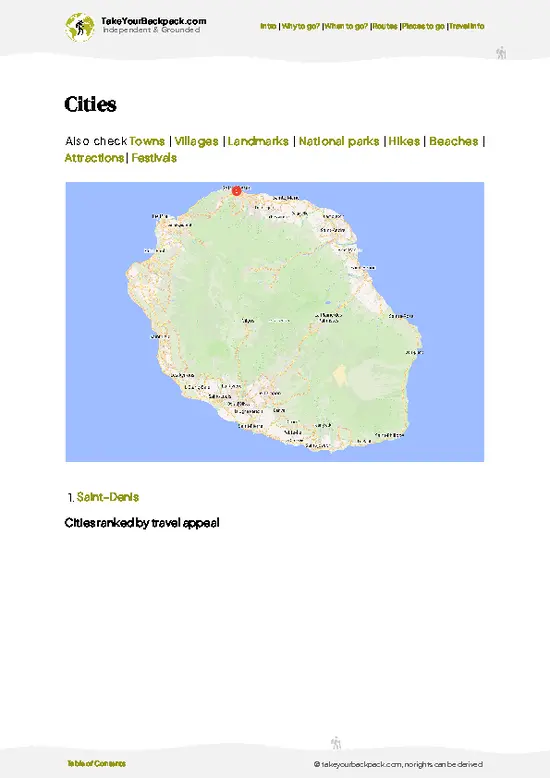
The main hubs are Saint-Denis (best for transport links, lowest prices and urban services but not near beaches), Saint-Gilles-les-Bains (best beach access, most nightlife and tourist facilities but busier and often pricier), and Saint-Pierre (balanced choice with good bus connections, active nightlife and access to southern trails though less resort-style).
For hiking and quiet stays choose … read more 👉
Yes—Réunion Island has hostels, cheap guesthouses and simple gîtes for backpackers, but availability is concentrated in main towns while mountain cirques and long-distance trails have far fewer options.
The main hubs are Saint-Denis (best for transport links, lowest prices and urban services but not near beaches), Saint-Gilles-les-Bains (best beach access, most nightlife and tourist facilities but busier and often pricier), and Saint-Pierre (balanced choice with good bus connections, active nightlife and access to southern trails though less resort-style).
For hiking and quiet stays choose the cirques like Cilaos or Salazie, where small gîtes sit close to trails and views but hostel options, public transport and last-minute availability are limited so book ahead.

If you enjoy meeting fellow travelers, consider choosing hostels with high ratings for atmosphere. On the other hand, if you prefer having your own space, a hotel might be a better option.

🚌 Getting aroundWhat moving around is really like

Morning on Réunion smells like diesel, wet basalt, and bakery sugar. Timetables are posted and mostly honored, but the island moves in pulses: early starts glide, midday stalls, and late-day traffic buckles along the sea-cliff road when swell or rain toys with rockfall barriers. You learn to move with the weather and beat the rush, or you pay with hours.
  • Car Jaune (island buses) The Efficiency Trade-off: cheapest way around the ring, and it’ll get you almost everywhere on the coast for a few euros.
read more 👉
Morning on Réunion smells like diesel, wet basalt, and bakery sugar. Timetables are posted and mostly honored, but the island moves in pulses: early starts glide, midday stalls, and late-day traffic buckles along the sea-cliff road when swell or rain toys with rockfall barriers. You learn to move with the weather and beat the rush, or you pay with hours.
  • Car Jaune (island buses) The Efficiency Trade-off: cheapest way around the ring, and it’ll get you almost everywhere on the coast for a few euros. It’s slow by design—many stops, school rushes, and choke points near Saint-Denis and Saint-Paul. Catch the first departures; never aim for the last.
  • Urban buses (Citalis, Kar’Ouest, Alternéo, Estival) The Social Fabric: say “Bonjour” to the driver, keep your pack on your lap, and ring early. Kids in uniforms, market bags, reggae leaking from earbuds. People queue loosely but yield seats; cash works best if it’s small. Doors close fast—be decisive.
  • 4x4 navettes, Rivière des Galets → Deux Bras The Geometric Unlock: bouncy benches in the back, dust in your teeth, and suddenly you’ve skipped two brutal hours of riverbed to the Mafate gate. Leaves when full, stops after heavy rain, cash only. Miss the last run and you’re walking out by headlamp.
  • Shared rental car day The Budget Disruptor: split a compact with hostel mates and the N3 opens the highlands on your terms. Dawn run to Pas de Bellecombe before fog, quick hits on trailheads, back by sunset. Fuel shared beats tours; switchbacks and squalls demand calm hands.

Master tip: Move clockwise at dawn by bus, make your mountain moves before noon, and plan for the second-to-last connection—never the last.
Réunion Roland Garros Airport (RUN) sits about 7 km (4.3 mi) east of Saint-Denis city center. You can get downtown by city bus, regional coach, or taxi right from outside the terminal.
  • City bus (Citalis) — Look for Citalis buses signed for Saint-Denis (centre/gare). The stop is outside Arrivals and staff usually point you the right way. Daytime frequencies are roughly every 10-20 minutes on weekdays (less often evenings, Sundays, and holidays). Travel time: about 20-30 minutes depending on traffic. Typical cost: about €1.50-€1.70 for a single ticket (buy from the driver; small change helps).
  • Regional coach (Car Jaune) — Yellow regional coaches also stop at “Aéroport Roland Garros” and run to Saint-Denis Gare Routière. They’re useful if one shows up first. Travel time: about 15-25 minutes. Typical cost: around €2 for a single ride (buy on board).
  • Taxi — The official taxi rank is just outside Arrivals. Travel time: 10-20 minutes in normal traffic. Typical cost: about €20-€35 in the daytime; €25-€45 at night/Sundays/holidays (metered, with standard surcharges for airport pick-ups and luggage). Many drivers take cards, but carry cash just in case.

Notes: Services run mainly from early morning to evening; there’s little or no late-night public transport. Fares and timetables can change, so if you’re arriving late or on a holiday, check the Citalis and Car Jaune websites or plan on a taxi. Information current for 2025.
⚠️ Prices and routes can change, so take this as a rough guide and ask for local advice when you arrive.

🔒 Safety (risk Level: low)Safety considerations for travelers

Safety for solo travelers, including women and LGBTQ+ individuals
Réunion is generally safe for solo travelers, including women and LGBTQ+ individuals. Violent crime is rare, but petty theft can occur, so keep an eye on your belongings. The island is LGBTQ+ friendly, with diverse communities and events, particularly in Saint-Denis. As with any destination, exercise common sense and stay aware of your surroundings.

✈️ VisaEntry requirements and paperwork

Réunion is an overseas department of France, so if you’re a citizen of an EU country or the Schengen Area, you can visit without a visa for up to 90 days. If you’re from a non-EU country, check if you need a Schengen visa; you can apply through the French consulate in your country. Always verify the latest entry requirements as they can change.

source: diplomatie.gouv.fr
⚠️ Visa requirements can change over time, so always check the latest visa requirements with the official embassy or government website before you travel.

🎒 What to pack?What to pack for Réunion

If you’re heading to Réunion, be ready for some serious diversity in climate and terrain. You’ll be bouncing between humid coasts and cooler mountain areas like Cirque de Mafate, so think layers. Rain is a regular guest, especially from November to April, so pack accordingly. The island’s got a laid-back vibe, but keep it respectful—especially in rural areas or during temple visits. Beaches are chill, but if you’re hiking, you’ll need sturdy shoes for those rugged trails.

Apart from this country specific advice, I have also crafted a general packing list that should help on any trip. authorOver the years, I've learned the importance of packing minimally. It's so much easier to jump on the back of a truck or squeeze yourself into the last spot of a minibus without that supersized backpack. If you're headed to a warm destination, leave your winter jacket at home; for colder regions, opt for thin thermal underlayers. Instead of packing your entire wardrobe, bring just three sets of clothes, as laundry facilities are available everywhere.

View the full list 👉
🎒 Planning the practical side of your trip?
Get detailed information on transport, daily budgets, internet access, local customs, food, language, and other essentials in the complete Travel Guide.

Get detailed practical information 👉

Get the Travel Guide -

🙋 FAQThings travelers often ask

Trip Planning


Personal tip: I normally search on good rating for atmosphere (for meeting people) and location (for easy exploring). Cleanliness as a bonus.


Travel Essentials

Hepatitis A and B, typhoid, and rabies are recommended vaccinations for Réunion. Ensure your routine vaccines (measles, mumps, rubella, diphtheria, tetanus, pertussis, varicella) are up to date. Consider the flu shot if traveling during flu season. Always consult with a healthcare professional for personalized advice.


vaccination requirements
When I first started traveling, I often spent part of my first day in a new country hunting for a local SIM card. While this can still be slightly cheaper, it also takes time and planning.

These days, it's much simpler to install an eSIM before leaving home. Once you arrive in Réunion, you can activate it immediately and have mobile data from the moment you land — which is especially useful for ordering transport or navigating away from busy airports.

There are many providers nowadays, and price differences are usually small. I personally go with Airalo, as it offers excellent network coverage throughout the country and strong global coverage, so you can manage multiple countries from a single app.


Get your e-sim for Réunion

Culture & Customs

Respect local customs by dressing modestly, especially in rural areas and religious sites. Avoid discussions on sensitive topics like politics and religion unless you know the locals well. Do greet people with a friendly ”Bonjour” when entering shops or restaurants; it’s considered polite.

Women travelers generally find Réunion safe but stay cautious at night. LGBTQ+ travelers usually face no issues, as the island is relatively open-minded. If invited to someone’s home, bringing a small gift is appreciated. Public displays of affection are common but keep it moderate in more conservative areas.
Trying traditional food is always a great way to experience the culture. Here are some must-try dishes for Réunion.
  • Rougail Saucisse: This is a spicy sausage dish often served with rice, and it’s a staple on the island. The sausages are typically simmered in a rich, tomato-based sauce with onions, garlic, and ginger. It’s popular for its hearty flavors and is a classic example of Reunionese Creole cuisine.
  • Cari Poulet: A chicken curry that is one of the most beloved dishes in Reunion. Made with a blend of spices, tomatoes, and onions, it’s usually served with rice and grains. This dish captures the island’s Indian and Malagasy culinary influences.
  • Lentilles de Cilaos: These are lentils grown in the highlands of Cilaos, a region famous for its unique climate and fertile soil. They’re often cooked with spices and served as a side dish. Celebrated for their creamy texture and flavor, these lentils are a crucial part of local meals.
  • Bichiques: Tiny fish, often referred to as ”caviar of Reunion,” served fried or in a curry. Due to their seasonal availability, they are considered a delicacy. Their unique taste and the effort required to catch them make bichiques a culturally significant dish.
  • Samoussas: Reunion’s take on samosas, filled with a variety of ingredients like meat, fish, or vegetables. These are popular street food snacks that reflect the island’s Indian influence, offering a quick and tasty bite for on-the-go travelers.
Tap water in Réunion is generally safe to drink, and locals do consume it. However, some tourists might prefer bottled or filtered water due to its mineral content or taste differences. If you’re sensitive or cautious, stick to bottled water, which is widely available.
The main language in Réunion is French. Backpacking is way more rewarding if you know a bit of the local language, so I'd suggest brushing up on the basics just in case your French skills have become a bit rusty.

Want to understand locals better?
The complete Travel Guide for Réunion includes 52 essential words and phrases — greetings, thank-yous, ordering food, transport, numbers, and common local expressions you'll actually hear.

Get your local basic phrases 👉

Get the Travel Guide -


In Réunion, the primary language is French, as it is an overseas department of France. While English is not widely spoken, you will find that many people in tourist areas, such as hotels, restaurants, and attractions, have a basic understanding of English. Younger generations and those working in the tourism industry are more likely to speak English, but fluency can vary significantly.

In rural areas and among the older population, English proficiency tends to be lower. Visitors may encounter challenges in communication, particularly outside of major tourist hubs. However, the local population is generally friendly and willing to help, often using gestures or basic French to bridge the language gap.

If you’re planning to visit Réunion, knowing some basic French phrases can enhance your experience and ease communication. Overall, while English is not the dominant language, you can still navigate the island with some effort and a positive attitude.

Money & Payments

The local currency of Réunion is EUR (€).

When backpacking in Réunion, keep in mind that the Euro (EUR) is the local currency, so there’s no need for US dollars. ATMs are fairly widespread in urban areas like Saint-Denis and Saint-Pierre, but once you hit the trails or smaller towns, access can be limited. Always have some cash handy for rural spots or local markets where cards might not be accepted.

Credit and debit cards are widely accepted in cities, but smaller eateries and shops may prefer cash, so it’s smart to carry a mix. If you need to exchange currency, banks and exchange offices in major towns are your best bet, as airport rates can be steep.

Avoid relying solely on cards; a combination of cash and card is your safest play. Keep an eye on ATM fees, especially with international cards, as they can add up.

Tipping in Réunion is not obligatory, but it’s appreciated for good service. You can leave a small tip of about 5-10% in restaurants if you’re satisfied with the service. For taxi drivers, rounding up the fare is a common practice.

🧩 Nearby countriesNearby backpacking alternatives

We 💚 feedbackKey takeaways from the trip

Réunion’s vibe is half boulangerie, half lava field: croissant crumbs on a dashboard that smells of sunscreen and eucalyptus. Mornings bite—basalt dust on your calves, breath fogging—then the island fog rolls in by noon. The payoff is simple: a gîte bench in Mafate, boots off, Dodo beer cold, steam rising from your shirt, a spoon of cari that fixes everything. Best for hikers who like switchbacks, sketchy weather, and driving hairpins. Not ideal for beach loungers, nightlife hunters, or anyone relying on buses—or swimming outside lagoons.

✍️ Help improve this page!
The information on this page is based on in-depth research, insights shared by experienced travelers, and feedback from the local travel community in Réunion. While every effort is made to keep the information accurate and current, conditions can change — so if you spot anything incorrect or outdated, please get in touch.


🙋‍♂️ Give feedback

👋 Meet the founderWho’s Behind Take Your Backpack?

Johan, backpacker and founder of TakeYourBackpackHi, I’m Johan (Netherlands 🇳🇱), the creator of TakeYourBackpack. Over the past decade, I’ve backpacked through 80+ countries across six continents, gaining extensive experience with independent travel, long-term trips, and overland routes.

This site is built on a combination of firsthand travel experience and carefully curated insights from other backpackers. Many guides are based on places I’ve personally visited, while others bring together tips, observations, and practical advice shared by trusted travelers I’ve met along the way.

The goal is to provide realistic, experience-driven guidance — not generic itineraries — so you can explore destinations with better context, clearer expectations, and more confidence.

Get full Réunion guide •
Instant download • 67 highlights • Full Offline guide