×
Curaçao 🇨🇼

backpacking North America Curaçao 🇨🇼
Wander colorful streets before cooling off in clear waters.

Explore CubaExplore Dominica

Backpacking Curaçao in 2026

A complete guide including when and where to go, costs, transport, itineraries, and practical travel advice.
Traveling in Curaçao: what to expect

Backpacking Curaçao
By Johan Kruseman 🇳🇱 | Updated June 5, 2026

Most people hemorrhage time and cash by skipping a rental car and showing up to beaches without cash. Curaçao runs on your wheels and small, cash-only fees; the west-side coves are spread out and kiosks close when they feel like it. It’s Dutch-Caribbean at heart—organized enough to work, relaxed enough to breathe.

Come for Willemstad’s candy-colored waterfront and the Queen Emma Bridge that swings like a friendly hinge, then stay for easy, from-shore snorkeling and diving at Tugboat, turtles at Playa Piskado, and the electric-blue glow of the Blue Room. Dawn hikes up Christoffel trade sweat for island-wide views; trade winds comb cactus hills while waves hammer Shete Boka. Refuel with pastechi, goat stew, and truki pan sandwiches, wash it down with a tour at the Curaçao liqueur distillery, and catch Papiamentu banter and tambú rhythms in the street. Yes, the sun is fierce, the north coast can slap, and petty theft is real—pack water shoes, leave nothing in the car, start early—and the island gives more back.

Compared with Aruba’s resort polish and Bonaire’s diver monasticism, Curaçao is the balanced middle: culture plus DIY beaches, real food, and wallet-sane fun. It’s for curious drivers, shore divers, snorkelers, and anyone who wants color and character without a bubble.

👉 Get the 📖 Travel Guide of Curaçao

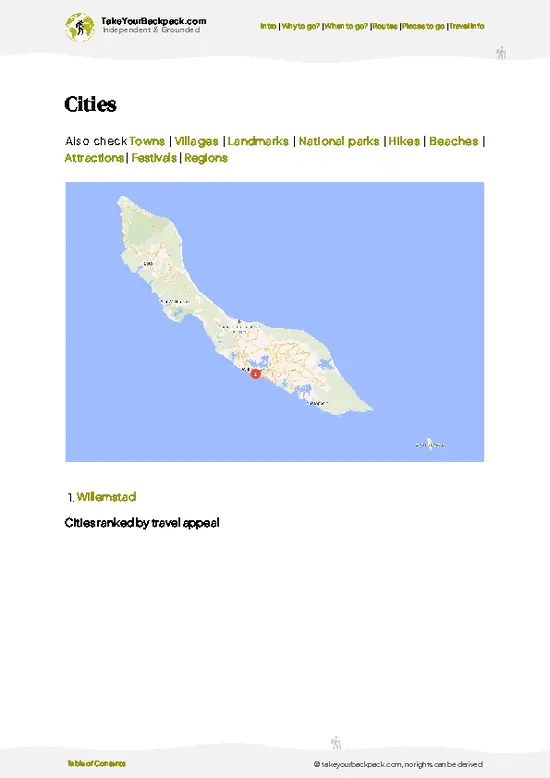
Willemstad (Punda & Otrobanda)

Walkable, culture-heavy, easy wins. Park early at Waaigat (cheap, open) or the Renaissance garage, then cross the Queen Emma Bridge before 10:30 to dodge cruise swells; if it swings open, grab the free ferry. Plasa Bieu lunch 11–2 (go first, sells out). Best for walkers, photographers, and history nerds who like street energy without a car day.

Pietermaai

Connected and nightlife-forward. Ten-minute walk to Punda, but the action is here after dark. Street parking is tight; use paid lots and bring earplugs if you’re sleeping nearby. Rocky entries; ladders at Scuba Lodge make quick snorkel dips doable. Rewards food-focused travelers and couples.

Banda Abou Beaches (Daaibooi, Porto Mari, Cas Abao, Lagun)

The shore-dive circuit. Drive 35–50 minutes; arrive before 10 for calm water and parking. Small cash fees, chair rentals, shacks close by 5. Leave the car empty. Porto Mari’s double reef is beginner-friendly; Daaibooi cooks on weekends. Low-friction for snorkelers, divers, and DIY picnickers.

Westpunt & Shete Boka Coast

Rugged and remote. Fuel at Barber; services thin. Shete Boka hits hardest 8–10 a.m.—sun brutal by noon, wear real shoes. Turtles at Playa Piskado 8–9 a.m. before tours. Drive back before dark. For hikers, photographers, and patient drivers.

Jan Thiel & Mambo (Sea Aquarium strip)

Plug-and-play beach clubs. Pay entry, extra for chairs; lockers and showers make it easy. Minibuses run often from town. Tugboat/Caracasbaai is 10 minutes away—go early, bring booties. Loud on weekends. Best for groups, kids, and low-effort sea time.
Seeing the layout at a glance
Loading the map 🌍
CLICK TO FILTER
city
town
village
unique site
national park
hike
beach
attraction
festival
region
SHOW COUNTRY’S BESTSHOW ALL
film
0
0
0a
Kura Hulanda Museum
film
1
1
1a
Mikvé Israel-Emanuel Synagogue & Jewish Cultural Historical Muse
film
2
2
2a
Ostrich Farm
film
3
3
3a
Grote Knip
Rodrigo Vieira
film
4
4
4a
Cas Abao Beach
Ivanka Krumov
film
5
5
5a
Playa Porto Mari
film
6
6
6a
Mambo Beach
film
7
7
7a
Playa Lagun
film
8
8
8a
Tugboat Beach
Papagayo Beach Hotel Curacao
film
9
9
9a
Willemstad
Taxi Max
film
10
10
10a
Mount Christoffel Trail
Dirk Marciniak
film
11
11
11a
Boka Pistol Trail
Rouslan Valonen (libertytoursllc)
film
12
12
12a
Tafelberg
film
13
13
13a
St. Joris Bay Trail
Licet Maria Hernandez Cueto
film
14
14
14a
Christoffel
Running Borders
film
15
15
15a
Shete Boka
Rouslan Valonen (libertytoursllc)
film
16
16
16a
Hofi Pastor Nature Reserve
film
17
17
17a
Den Dunki
film
18
18
18a
Malpais
Rouslan Valonen (libertytoursllc)
film
19
19
19a
Punda
film
20
20
20a
Lagun
Christakis Taouni
film
21
21
21a
Hato Caves
film
22
22
22a
Willemstad’s Floating Market
film
23
23
23a
Boka Tabla
Rouslan Valonen (libertytoursllc)
film
24
24
24a
Mikve Israel-Emanuel Synagogue
Juan E
film
25
25
25a
Landhuis Chobolobo
film
26
26
26a
Watamula Hole
film
27
27
27a
Westpunt
Marloes Van Der Sluiszen
film
28
28
28a
Sint Michiel

Why go?What sets this destination apart

Beach life

Curaçao is built for beach days that keep paying off. Calm, clear leeward water, reefs right off shore, and drive-up coves mean you’re swimming minutes after parking. Shore-dive from yellow-stone entries, snorkel over the double … read more 👉
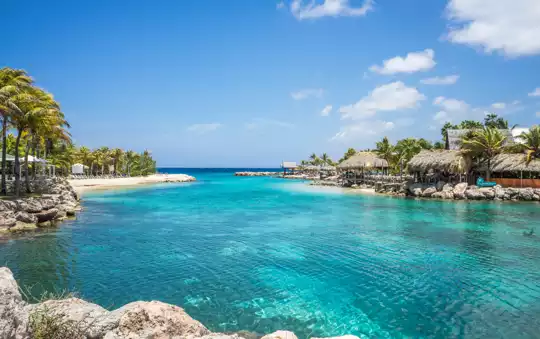
Curaçao is built for beach days that keep paying off. Calm, clear leeward water, reefs right off shore, and drive-up coves mean you’re swimming minutes after parking. Shore-dive from yellow-stone entries, snorkel over the double reef at Porto Mari, chase west-end sunsets, then hit Mambo/Pietermaai after dark. Minimal sargassum, steady trade winds, warm water year‑round.

People

Open with “Bon dia.” Two words unlock smiles. Folks slide between Papiamentu, Dutch, Spanish, and English; try a phrase and watch faces soften. Expect playful teasing—affection, not mockery. Keep your voice low, your patience … read more 👉
Open with “Bon dia.” Two words unlock smiles. Folks slide between Papiamentu, Dutch, Spanish, and English; try a phrase and watch faces soften. Expect playful teasing—affection, not mockery. Keep your voice low, your patience high. Sundays are for family. Use “mersi” and “ayo.” Save “dushi” for food, not strangers. Ask directions; you’ll get a walk, not a point.
Want the complete picture of Curaçao?
The offline Travel Guide brings everything together — routes, highlights & planning.

See what's included in the guide 👉

Get the Travel Guide -

⭐ HighlightsStandout locations across the country

  • Willemstad’s Queen Emma Bridge & Handelskade: Hit dusk. The pontoon groans, the horn blasts, and you ride the swing as a freighter slides past; tar-and-salt air, timber planks buzzing under your soles while the candy facades ignite across the water. Side quest: Kaya Kaya murals in Otrobanda, Waterfort arches, Scharloo’s art streets.
  • Christoffel Peak (Christoffelpark): Be at the gate at 6:00 a.m.; last start is mid-morning for a reason. It’s a hands-and-feet scramble through thorn and cactus, goats skittering, volcanic grit in your palms; at the top the trade wind licks sweat dry. Side quest: Hofi Pastor’s giant ceiba, Savonet Museum, Boka Grandi’s rough surf.
  • Playa Kenepa Grandi (Grote Knip): Park free, walk down, swim before 9 to beat the tour vans. The left cliff gives a clean jump; sand squeaks, coral bits crunch, and the breeze smells like fried fish from a cash-only shack. Side quest: Playa Jeremi’s quiet cove, Playa Lagun for turtles, Playa Piskadó’s pier.
  • Tugboat Beach & Fort Beekenburg:
read more 👉
  • Willemstad’s Queen Emma Bridge & Handelskade: Hit dusk. The pontoon groans, the horn blasts, and you ride the swing as a freighter slides past; tar-and-salt air, timber planks buzzing under your soles while the candy facades ignite across the water. Side quest: Kaya Kaya murals in Otrobanda, Waterfort arches, Scharloo’s art streets.
  • Christoffel Peak (Christoffelpark): Be at the gate at 6:00 a.m.; last start is mid-morning for a reason. It’s a hands-and-feet scramble through thorn and cactus, goats skittering, volcanic grit in your palms; at the top the trade wind licks sweat dry. Side quest: Hofi Pastor’s giant ceiba, Savonet Museum, Boka Grandi’s rough surf.
  • Playa Kenepa Grandi (Grote Knip): Park free, walk down, swim before 9 to beat the tour vans. The left cliff gives a clean jump; sand squeaks, coral bits crunch, and the breeze smells like fried fish from a cash-only shack. Side quest: Playa Jeremi’s quiet cove, Playa Lagun for turtles, Playa Piskadó’s pier.
  • Tugboat Beach & Fort Beekenburg: Drive the dusty track, stash valuables out of sight, and fin two minutes to the sunken tug; parrotfish pop coral like bubble wrap and rust flakes stain your fingers. Go early before dive boats churn it. Side quest: Director’s Bay wall, the Quarantine House ruins, Jan Thiel salt flats.
  • Klein Curaçao Day Trip: Boats leave 7-8; pick a catamaran if you’re wave-soft. Walk to the pink lighthouse and wreck, then snorkel the lee where turtles move like slow knives; sunscreen and diesel mingle on the wind. Side quest: Restricted Oostpunt coast, Blue Room sea cave, Jan Kok flamingos.
Spotted a mistake or missing a highlight? Contact us.

But Curaçao offers more...

Discover and compare all of its highlights per category

🧭 RoutesSuggested travel routes through Curaçao

The 2-Day Willemstad & West Coast Snapshot

The Vibe: A quick-hit escape that pairs Curaçao’s historic capital with one iconic west-side beach, perfect if you want depth over distance and don’t feel like spending your whole weekend in a car. You’ll walk, swim, and eat well, with just enough movement to feel like a real trip without any rush.
The Highlights:
  • Colorful streets and harbor views in Willemstad and Punda
  • Street art and old mansions in Scharloo
  • Powerful history at the Kura Hulanda Museum
  • Classic turquoise bay time at Grote Knip near Westpunt

The 3-Day Culture, Caves & Coves Circuit

The Vibe: A balanced long weekend that threads together city heritage, wild north-coast drama, and laid-back west-side beaches. You’ll move a bit more, but still have time to linger over viewpoints, sea caves, and sunset swims.
The Highlights:
  • Historic streets and harbor life in Willemstad, Punda, and Scharloo
  • Jewish heritage at the Mikvé Israel-Emanuel Synagogue & Jewish Cultural Historical Muse
  • Crashing waves
read more 👉

The 2-Day Willemstad & West Coast Snapshot

The Vibe: A quick-hit escape that pairs Curaçao’s historic capital with one iconic west-side beach, perfect if you want depth over distance and don’t feel like spending your whole weekend in a car. You’ll walk, swim, and eat well, with just enough movement to feel like a real trip without any rush.
The Highlights:
  • Colorful streets and harbor views in Willemstad and Punda
  • Street art and old mansions in Scharloo
  • Powerful history at the Kura Hulanda Museum
  • Classic turquoise bay time at Grote Knip near Westpunt

The 3-Day Culture, Caves & Coves Circuit

The Vibe: A balanced long weekend that threads together city heritage, wild north-coast drama, and laid-back west-side beaches. You’ll move a bit more, but still have time to linger over viewpoints, sea caves, and sunset swims.
The Highlights:
  • Historic streets and harbor life in Willemstad, Punda, and Scharloo
  • Jewish heritage at the Mikvé Israel-Emanuel Synagogue & Jewish Cultural Historical Muse
  • Crashing waves and sea caves in Shete Boka National Park and Boka Tabla
  • Beach-hopping between Grote Knip, Playa Porto Mari, and the Westpunt area

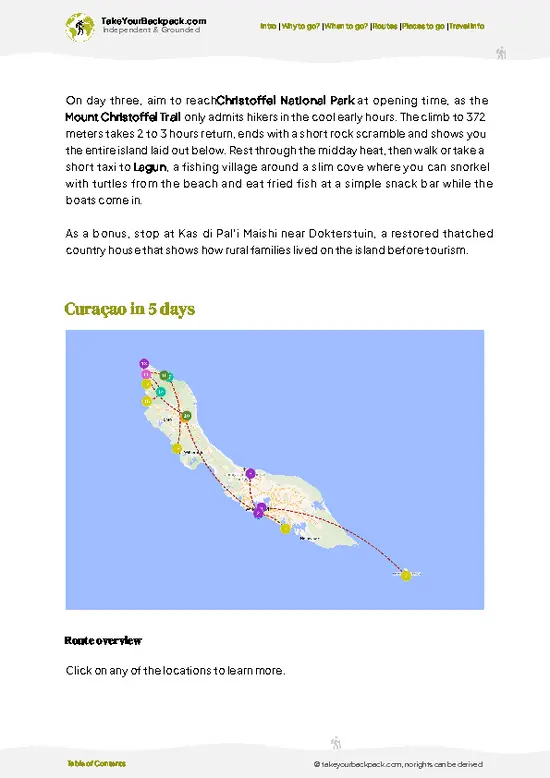
The 5-Day Island-Deep Dive: Peaks, Parks & Hidden Coves

The Vibe: A full-on Curaçao immersion that loops from the capital through national parks, rugged cliffs, and quiet fishing villages, ideal if you want to understand the island rather than just skim its beaches. Expect active days with hikes and coastal walks, balanced by long, lazy afternoons in the water.
The Highlights:
  • Two days of museums, markets, and harborfront evenings in Willemstad
  • Heavy history at the Kura Hulanda Museum and local flavor at Willemstad’s Floating Market
  • Hiking the Mount Christoffel Trail and exploring Shete Boka National Park with Boka Pistol Trail and Boka Tabla
  • Slow days in Westpunt, Lagun, and along beaches like Grote Knip, Playa Porto Mari, and Cas Abao Beach
🌍 Want a ready-to-use travel plan for Curaçao?
The overview above compares different route options based on your travel time and style. The complete Travel Guide breaks each itinerary down in detail, including maps, stops, highlights, and transport information.

Explore all route details 👉

Get the Travel Guide -

🌤️ When to go?A month-by-month overview

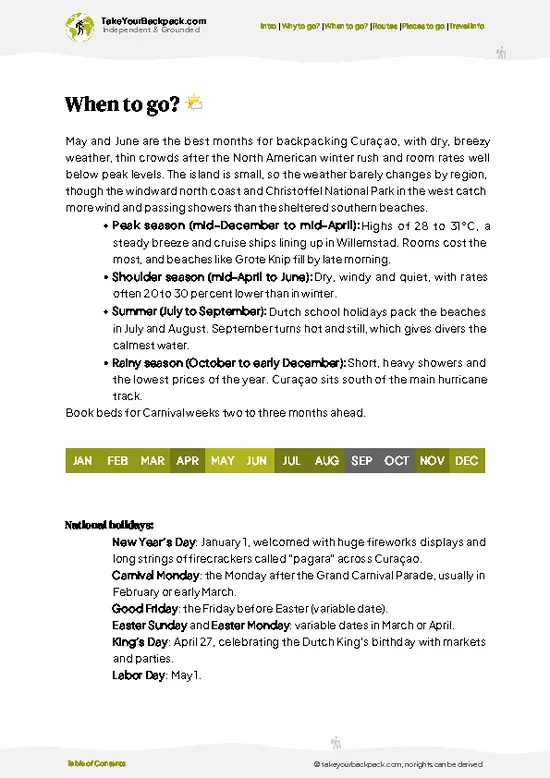
Late April-June is the sweet spot. Post-Easter crowds thin and room rates ease, yet trade winds still run like natural AC. Rain is scarce, seas warm; you dodge hurricane chatter and July-August Euro-holiday pricing. Dive boats have spare tanks, buses aren’t packed with day-trippers, and you can top Christoffel at dawn without leapfrogging the trail.
  • The Crowd Peak: Dec-mid Apr: island hums, prices peak, rental cars vanish. Payoff: wind-cooled nights, carnival, clear leeward dives, and kinder hiking temps.
  • The Transition Shoulder: Late Apr-Jun: cruise calls fade, bars slide to local pace, operators deal, and you move fast without prebooking every hour. Winds steady; showers rare.
  • The Off-Peak Heat: Sep-early Oct: dead-calm bays, real solitude, brutal sun. Hack: start pre-dawn, freeze water, wear a long-sleeve rashguard, then siesta hard till mid-afternoon.

Tactical tip: For the shoulder sweet spot, book flights 6-8 weeks out and the car the same day; leave lodging last—walk-in deals appear.

source: climatestotravel.comJANJanuary: highly recommended for travelingFEBFebruary: highly recommended for travelingMARMarch: highly recommended for travelingAPRApril: good for travelingMAYMay: excellent for travelingJUNJune: excellent for travelingJULJuly: good for travelingAUGAugust: good for travelingSEPSeptember: fair for travelingOCTOctober: fair for travelingNOVNovember: good for travelingDECDecember: highly recommended for traveling
📅 Traveling in a specific month?
Get a full month-by-month breakdown of weather, crowds, costs, festivals, and seasonal highlights in the complete travel guide.

Get full details when to go 👉

Get the Travel Guide -
curacao - pixabay - lagoon-911963

💰 Costs (as of 2025)Prices, expenses, and money tips

Expect $55-70 USD per day if you cook and ride minibuses; add $25-40 on dive or car days.
  • dorm accommodation: $18-35 most of the year, $35-50 around Christmas/Carnival. System tip: message hostels directly for weekly/cash rates (Dutch-run spots often play ball), prioritize kitchens and free drinking water, and pick fan rooms over A/C if you can sleep light—power surcharges happen.
  • meals: Supermarket Survival: shop Centrum or Cost-U-Less, cook two meals, snack on fruit—$10-15/day if you’re disciplined. Street food reality: trùki pan plates $8-12, pastechi $1-2, local snacks at snèks cheap; beach clubs jump to $15-25 a plate. Curaçao is ~15-25% cheaper than Aruba, similar to or slightly cheaper than Bonaire; far pricier than Colombia/DR.
  • local transport: Minibuses (konvoi) are the unlock: $1.50-2.50 in town, $3-4 cross-island; they taper off by evening and thin out Sundays, so start early. For beach hopping, a day car is the real hack: $35-45 base + $10-15 insurance + fuel; split three ways ≈ $20-25 per person. Scooters $25-35/day but sun and wind make it tiring. Taxis are meterless and bite hard—avoid for routine moves.
  • activities: Shore diving is Curaçao’s value play: tank $12-15; add
read more 👉
Expect $55-70 USD per day if you cook and ride minibuses; add $25-40 on dive or car days.
  • dorm accommodation: $18-35 most of the year, $35-50 around Christmas/Carnival. System tip: message hostels directly for weekly/cash rates (Dutch-run spots often play ball), prioritize kitchens and free drinking water, and pick fan rooms over A/C if you can sleep light—power surcharges happen.
  • meals: Supermarket Survival: shop Centrum or Cost-U-Less, cook two meals, snack on fruit—$10-15/day if you’re disciplined. Street food reality: trùki pan plates $8-12, pastechi $1-2, local snacks at snèks cheap; beach clubs jump to $15-25 a plate. Curaçao is ~15-25% cheaper than Aruba, similar to or slightly cheaper than Bonaire; far pricier than Colombia/DR.
  • local transport: Minibuses (konvoi) are the unlock: $1.50-2.50 in town, $3-4 cross-island; they taper off by evening and thin out Sundays, so start early. For beach hopping, a day car is the real hack: $35-45 base + $10-15 insurance + fuel; split three ways ≈ $20-25 per person. Scooters $25-35/day but sun and wind make it tiring. Taxis are meterless and bite hard—avoid for routine moves.
  • activities: Shore diving is Curaçao’s value play: tank $12-15; add $20-30 for full gear. Boat dives run $60-90. National parks: Christoffel ~$15, Shete Boka ~$10. Many beaches are free; some charge $3-8 access or $5-10 chairs. Klein Curaçao boat trips $100-130 (big ticket). Compared to Aruba, water trips cost a touch less; compared to Bonaire, shore diving is similar value, boats pricier.
  • miscellaneous: Budget leaks: ATM fees ($3-6 per pull), beach chair/umbrella rentals ($5-15), bottled water (tap is safe—carry a bottle), sunscreen/gear markups, late-night taxis when buses stop, 10% service charges that already include the tip. Local SIM $12-20 for a few GB saves you from “lost bus” tax.
⚠️ Prices can change and everyone travels differently, so take this as a rough guide. Hope it helps you plan your adventure!

✈️ The backpacker research shortcutCuraçao Travel Guide

An offline-friendly backpacking guide with optimized travel routes, ranked highlights, transport advice, and the best areas to stay.
example page 0 from our offline Travel Guide for Curaçaoexample page 1 from our offline Travel Guide for Curaçaoexample page 2 from our offline Travel Guide for Curaçaoexample page 3 from our offline Travel Guide for Curaçaoexample page 4 from our offline Travel Guide for Curaçaoexample page 5 from our offline Travel Guide for Curaçaoexample page 6 from our offline Travel Guide for Curaçaoexample page 7 from our offline Travel Guide for Curaçao
The digital guide (166 pages) contains:
43 highlights, ranked by travel appeal
Optimized 2, 3 & 5-day travel routes
Cities, national parks, beaches, historical sites, ...
How to get around
Offline-friendly for travel without Wi-Fi
👉 Click to see all 30+ guide features

📅 Plan smarter in minutes, not weeks
Month by month travel advice
Festivals & national holidays
Budget expectations

🗺️ Go to the right places, skip the overrated ones
Honest pros & cons of destinations
Top hikes, parks & viewpoints
Lesser-known places most travelers miss
Clear “worth it vs skip it” guidance

🛏️ Travel smoothly without rookie mistakes
Best areas to stay
Transport systems explained simply
Common scams & safety advice
SIM cards, money & practical tips

🌍 Understand the country, not just visit it
Culture & traditions
52 Essential phrases & customs
Festivals worth planning around
Traveler-friendly historical context
Insights that make places more meaningful

📱 Built for real travel conditions
Fully downloadable PDF
Works completely offline
Optimized for phone use
Useful in remote areas & buses
Everything in one place
Save weeks of stressful planning
Get instant access to the full guide directly. 30-day money-back guarantee.


Sent to your inbox immediately after payment • 100% Secure Checkout
Best Backpacking Travel Advisor 2025 tourism awardBest Backpacking
Travel Advisor
2025
What others say about Take Your Backpack Guides:
⭐⭐⭐⭐⭐
Fantastic, amazing amount of information!
⭐⭐⭐⭐⭐
My goodness this is amazing, it's what I've been looking for hats off too you!
⭐⭐⭐⭐⭐
I think this is absolutely BRILLIANT
⭐⭐⭐⭐
Very complete and informative. It's still missing places, but I gotta to commend you
⭐⭐⭐⭐⭐
This is truly amazing, thank you, can't wait to explore it with my kids!
⭐⭐⭐⭐⭐
Awesome resource, thank you!
⭐⭐⭐⭐⭐
This is amazing! Can't wait to explore the ones I haven't seen
⭐⭐⭐⭐
I love this! Well done, great idea.
⭐⭐⭐⭐⭐
Thanks for taking the time to make this gem!
⭐⭐⭐⭐⭐
This might be the best website I've ever seen.
⭐⭐⭐⭐⭐
Congratulations, and thank you so much for your work; it's incredibly valuable.
⭐⭐⭐⭐
In all seriousness I think you did a great job pointing out the important spots
⭐⭐⭐⭐⭐
10/10 very good
⭐⭐⭐⭐⭐
As someone who's only just starting to visit regularly this is awesome, thank you.
⭐⭐⭐⭐
Thank you very much! I'm going to visit my dad, it's going to be very useful!
⭐⭐⭐⭐⭐
This is really cool! We'll be travelling for the first time and this definitely come in handy.
⭐⭐⭐⭐⭐
You are now our minister of culture, congratulations 👨‍💼
⭐⭐⭐⭐⭐
Just wanted to tell you that this is a pearl! Going to follow your recommendations.
⭐⭐⭐⭐⭐
This is so cool. I'll definitely be using the resource for my travels soon.
⭐⭐⭐⭐⭐
This is very impressive! Good work.
⭐⭐⭐⭐⭐
This is an amazing and informative site. Very well done!

🛏️ Where to stay?Accommodation types and options

Yes — Curaçao has hostels and budget guesthouses, concentrated in Willemstad (Punda/Otrobanda), Pietermaai and along the Mambo Beach/Jan Thiel corridor; Westpunt and resort areas have far fewer cheap options so plan for self-catering rentals there if you go remote.
Willemstad gives best access to sights, buses and nightlife but can be noisy and petty theft occurs so secure valuables; Pietermaai offers affordable, walkable guesthouses with a quieter-yet-lively vibe; Mambo Beach/Sunset is beach-close and tourist-focused with higher prices and party noise; Jan Thiel is calmer with excellent snorkeling … read more 👉
Yes — Curaçao has hostels and budget guesthouses, concentrated in Willemstad (Punda/Otrobanda), Pietermaai and along the Mambo Beach/Jan Thiel corridor; Westpunt and resort areas have far fewer cheap options so plan for self-catering rentals there if you go remote.
Willemstad gives best access to sights, buses and nightlife but can be noisy and petty theft occurs so secure valuables; Pietermaai offers affordable, walkable guesthouses with a quieter-yet-lively vibe; Mambo Beach/Sunset is beach-close and tourist-focused with higher prices and party noise; Jan Thiel is calmer with excellent snorkeling but limited hostels and taxi dependence; Westpunt/Blue Bay suit divers and solitude but have sparse, often pricier budget stays and minimal public transport.

If you enjoy meeting fellow travelers, consider choosing hostels with high ratings for atmosphere. On the other hand, if you prefer having your own space, a hotel might be a better option.

🚌 Getting aroundGetting around Curaçao

Curaçao runs on clocks that squint at the sun. Timetables exist, but drivers leave when the seats make sense and ships boss the bridge. You move by hubs and timing, not by minutes. Accept the drift, and you’ll string smooth transfers like a local.
  • ABC public buses (konvoi) The cheap backbone to Banda Abou and Westpunt. Fares are pocket change; the tax is time. Buses bunch, then vanish. First runs are gold, mid-day is molasses, Sunday skeletal. Use Punda terminal, confirm windshield placard, carry
read more 👉
Curaçao runs on clocks that squint at the sun. Timetables exist, but drivers leave when the seats make sense and ships boss the bridge. You move by hubs and timing, not by minutes. Accept the drift, and you’ll string smooth transfers like a local.
  • ABC public buses (konvoi) The cheap backbone to Banda Abou and Westpunt. Fares are pocket change; the tax is time. Buses bunch, then vanish. First runs are gold, mid-day is molasses, Sunday skeletal. Use Punda terminal, confirm windshield placard, carry small ANG (USD small bills = ANG change), expect on-demand stops and warm seats.
  • Minibuses (“busjes”) Where the island’s social code lives. Wave with intent, greet with bon dia, backpack on lap. Say “aki, por fabor” to stop, pay as you exit, no drama. Music on, AC improvisational, routes bend for elders and groceries. After dark, frequencies thin—leave margins.
  • St. Anna Bay pedestrian ferry The geometric cheat when the Queen Emma Bridge swings open. It’s free, constant, and bikes fit. Skip waiting for the pontoon to settle or detouring via Schottegat. Stand starboard for wind; jump fast—crew doesn’t coddle dawdlers.
  • Scooter or small car (shared) The budget disruptor that beats taxis and tours. Split three ways, a day’s rental undercuts two zone fares and unlocks beach-to-park chains. Drive defensive: unlit shoulders, sudden speed bumps, goats, oil-slick rain. Park nose-out; don’t plan Westpunt nights without your own wheels.

Master tip: Treat Willemstad’s Punda terminal as your slingshot—catch the first outbound to Banda Abou, stitch minibuses for last-mile beaches, and start returning by 4 pm to beat the island’s nightly transit fade.
Curaçao International Airport (CUR, Hato) sits about 12 km (7.5 miles) northwest of Willemstad’s center (Punda/Otrobanda). It’s a straightforward run down the main road.
  • Public bus (ABC - Autobusbedrijf Curaçao): Walk out of the terminal to the main road by the roundabout; the airport bus stop is there. Buses run roughly every 30-60 minutes on weekdays (less frequent evenings and Sundays). Ride time to Punda/Otrobanda is about 30-40 minutes once you’re on board. Fare is typically ANG 2.50-3.00 (about US$1.50-1.75). Cash only; exact change helps.
  • Minibus/van (“bus”): Privately operated vans use the same roadside area near the roundabout. They’re a bit more frequent in daytime and will say they’re going to “Punda,” “Otrabanda,” or “Centro.” Expect 25-35 minutes travel time, depending on stops. Typical fare is ANG 3-4 (about US$1.75-2.25), cash only.
  • Taxi: There’s an official taxi rank just outside arrivals with government-set rates. To Willemstad (Punda/Otrobanda) you’ll usually pay around US$30-40 (ANG ~55-75) in the daytime; expect a 10-25% surcharge late at night, on Sundays, or holidays. The ride takes about 15-20 minutes. Most drivers take ANG or USD in cash; cards are hit-or-miss, so don’t rely on them.

A couple of practical notes: local buses don’t run late into the night, so if you land late, plan on a taxi. Bring small bills/coins for fares. There’s no Uber/Lyft on Curaçao as of 2025.

Prices and schedules can change, but the ranges above are current as of 2025.
⚠️ Prices and routes can change, so take this as a rough guide and ask for local advice when you arrive.

🔒 Safety (risk Level: low)Staying safe while traveling

Safety for solo travelers, including women and LGBTQ+ individuals
Curaçao is generally safe for solo travelers, including women and LGBTQ+ individuals. The island is known for its welcoming and diverse culture, but it’s always wise to stay aware of your surroundings, especially at night or in less populated areas. Public displays of affection might draw attention, so exercise discretion if you’re part of the LGBTQ+ community. Keep an eye on local news and follow any travel advisories for the most up-to-date information.

✈️ VisaUnderstanding entry rules

U.S. and EU citizens don’t need a visa for stays up to 90 days in Curaçao. If you’re from a country that requires a visa, apply through the Dutch embassy or consulate. Check the official government website for the latest entry requirements and application process.

source: government.nl
⚠️ Visa requirements can change over time, so always check the latest visa requirements with the official embassy or government website before you travel.

🎒 What to pack?A practical packing list

Curaçao’s got that sunny vibe, with a steady breeze, and it rarely dips below ”tropical.” Think hot and dry with a chance of some rain showers, especially between October and February. If you’re planning to explore the island’s rugged coastlines and hidden beaches, sturdy footwear is a must. When in town or visiting more traditional areas, opt for modest attire—locals appreciate it if you cover up a bit, especially in places like Willemstad. And trust me, you’ll want to pack extra sunscreen; the sun doesn’t mess around here!

Apart from this country specific advice, I have also crafted a general packing list that should help on any trip. authorOver the years, I've learned the importance of packing minimally. It's so much easier to jump on the back of a truck or squeeze yourself into the last spot of a minibus without that supersized backpack. If you're headed to a warm destination, leave your winter jacket at home; for colder regions, opt for thin thermal underlayers. Instead of packing your entire wardrobe, bring just three sets of clothes, as laundry facilities are available everywhere.
View the full list 👉
🎒 Planning the practical side of your trip?
Get detailed information on transport, daily budgets, internet access, local customs, food, language, and other essentials in the complete Travel Guide.

Get detailed practical information 👉

Get the Travel Guide -

🙋 FAQFrequently asked questions

Trip Planning


Personal tip: I normally search on good rating for atmosphere (for meeting people) and location (for easy exploring). Cleanliness as a bonus.


Travel Essentials

For visiting Curaçao, ensure you’re up-to-date on routine vaccines like MMR (measles, mumps, rubella), DTP (diphtheria, tetanus, pertussis), and varicella (chickenpox). It’s also recommended to have the Hepatitis A vaccine, as you might be exposed through contaminated food or water. Hepatitis B is advisable if you plan on any risky activities. No specific vaccines are mandated, but it’s wise to stay informed. Always consult with a healthcare professional before traveling.


vaccination requirements
When I first started traveling, I often spent part of my first day in a new country hunting for a local SIM card. While this can still be slightly cheaper, it also takes time and planning.

These days, it's much simpler to install an eSIM before leaving home. Once you arrive in Curaçao, you can activate it immediately and have mobile data from the moment you land — which is especially useful for ordering transport or navigating away from busy airports.

There are many providers nowadays, and price differences are usually small. I personally go with Airalo, as it offers excellent network coverage throughout the country and strong global coverage, so you can manage multiple countries from a single app.


Get your e-sim for Curaçao

Culture & Customs

Respect the Dutch influence and local Papiamentu language by greeting locals with a smile and a simple ”Bon dia” (Good morning). Dress modestly when visiting religious sites. Tipping is appreciated but not mandatory; 10-15% is standard if service charge isn’t included. Public displays of affection are generally accepted, but it’s wise to be discreet in more rural areas. LGBTQ+ travelers usually find Curaçao welcoming, especially in Willemstad. Women should feel comfortable, but as always, stay aware of your surroundings. Avoid discussing politics or criticizing the local way of life openly.
Trying traditional food is always a great way to experience the culture. Here are some must-try dishes for Curaçao.
  • Keshi Yena: This dish is a cheesy delight where a large round of cheese (usually Edam or Gouda) is stuffed with spiced meat, often chicken, mixed with onions, olives, and other goodies. It’s a staple on the island because it reflects the resourceful nature of Curaçao’s culture, using leftovers to create something delicious.
  • Stoba: A hearty stew typically made with beef, goat, or chicken, slow-cooked with vegetables and spices. It’s popular because it’s comfort food that showcases the island’s blend of African, Dutch, and Spanish influences.
  • Funchi: Essentially polenta, this side dish made from cornmeal is a local favorite, often served with stews or fish. It’s a cultural staple that ties back to the island’s African heritage, providing a simple yet filling accompaniment to many meals.
  • Pastechi: A savory pastry filled with cheese, meat, or fish, and deep-fried to perfection. It’s a popular snack and breakfast choice because it’s quick, tasty, and portable, reflecting the island’s love for hearty, on-the-go bites.
  • Ayaka: A traditional Christmas dish that features cornmeal dough wrapped around a filling of meat, raisins, and capers, all wrapped in banana leaves. It’s culturally important as it’s part of the festive celebrations, bringing families together with its labor-intensive preparation.
Yes, the tap water in Curaçao is safe to drink and locals do consume it regularly. It’s desalinated and meets high-quality standards, so tourists can drink it without worries. No need for bottled or filtered water unless you prefer the taste.
The main language in Curaçao is Papiamento. Backpacking is way more rewarding if you know a bit of the local language, so I'd suggest brushing up on the basics just in case your Papiamento skills have become a bit rusty.

Want to understand locals better?
The complete Travel Guide for Curaçao includes 52 essential words and phrases — greetings, thank-yous, ordering food, transport, numbers, and common local expressions you'll actually hear.

Get your local basic phrases 👉

Get the Travel Guide -


In Curaçao, English is widely spoken and understood, making it a convenient destination for English-speaking travelers. The island has a multicultural population, and English is one of the official languages alongside Dutch and Papiamentu, the local Creole language. Many residents, especially in urban areas and tourist spots, are fluent in English, and you’ll find it commonly used in hotels, restaurants, and shops.

Curaçao’s tourism industry has contributed to the prevalence of English, with many workers trained to cater to international visitors. Additionally, English is often used in educational settings, further enhancing its familiarity among locals. While Papiamentu is the primary language for everyday communication, you’ll have no trouble navigating the island or interacting with its people in English.

Overall, whether you’re exploring Willemstad’s colorful streets, enjoying the beaches, or dining at local eateries, you can expect to communicate effectively in English throughout Curaçao.

Money & Payments

The local currency of Curaçao is ANG (ƒ).

When backpacking in Curaçao, it’s wise to carry a mix of cash and cards. ATMs are widely available in urban areas like Willemstad, but they might be scarce if you’re exploring more remote parts of the island. If you withdraw cash, you’ll get it in Antillean Guilders (ANG), but US dollars are also accepted almost everywhere.

Credit and debit cards are generally accepted at most restaurants and shops, but it’s always good to have some cash on hand for local markets or smaller eateries. Avoid carrying Euros, as they’re not as widely accepted, and exchanging them can be a hassle.

For currency exchange, your best bet is to hit up local banks or authorized exchange offices in Willemstad. Steer clear of airport exchange counters if possible, as they tend to offer less favorable rates.

In Curaçao, tipping isn’t mandatory, but it’s appreciated. In restaurants, leaving around 10% to 15% for good service is common. For taxi drivers, rounding up the fare or adding a small tip is a nice gesture.

🧩 Nearby countriesSimilar backpacking destinations

We 💚 feedbackIs Curaçao worth visiting?

Curaçao rewards the self-directed. Shore snorkeling is world‑class for the price of a bus fare; carry your own mask and rock shoes. Base in Otrobanda for cheap eats, but expect buses to the west to ghost you after 4 pm. Wind is constant—great for heat, bad for drones and hats. Strategic play: rent a car Tue–Thu, dawn-to-dusk. Hit Playa Piskado at 7:30, Grote Knip by 9, Lagun for shade, then Shete Boka late. Preload Maps.me; cell dead zones are real.

✍️ Help improve this page!
The information on this page is based on in-depth research, insights shared by experienced travelers, and feedback from the local travel community in Curaçao. While every effort is made to keep the information accurate and current, conditions can change — so if you spot anything incorrect or outdated, please get in touch.


🙋‍♂️ Give feedback

👋 Meet the founderWho’s Behind Take Your Backpack?

Johan, backpacker and founder of TakeYourBackpackHi, I’m Johan (Netherlands 🇳🇱), the creator of TakeYourBackpack. Over the past decade, I’ve backpacked through 80+ countries across six continents, gaining extensive experience with independent travel, long-term trips, and overland routes.

This site is built on a combination of firsthand travel experience and carefully curated insights from other backpackers. Many guides are based on places I’ve personally visited, while others bring together tips, observations, and practical advice shared by trusted travelers I’ve met along the way.

The goal is to provide realistic, experience-driven guidance — not generic itineraries — so you can explore destinations with better context, clearer expectations, and more confidence.

Get full Curaçao guide •
Instant download • 43 highlights • Full Offline guide