×
Saint Barthélemy 🇧🇱

backpacking North America Saint Barthélemy 🇧🇱Small, polished French island with free beaches and costly beds.

Explore Puerto RicoExplore St. Kitts & Nevis

Backpacking Saint Barthélemy in 2027

A complete guide including when and where to go, costs, transport, itineraries, and practical travel advice.
The big picture before you go

Backpacking Saint Barthélemy
By Johan Kruseman 🇳🇱 | Updated October 24, 2026

On Saint Barthélemy, the trade-off is money against access. The island has no hostels and no campsites (camping is banned), and rooms under €200 a night are rare in high season, so the beaches cost nothing while a bed near them costs a great deal.
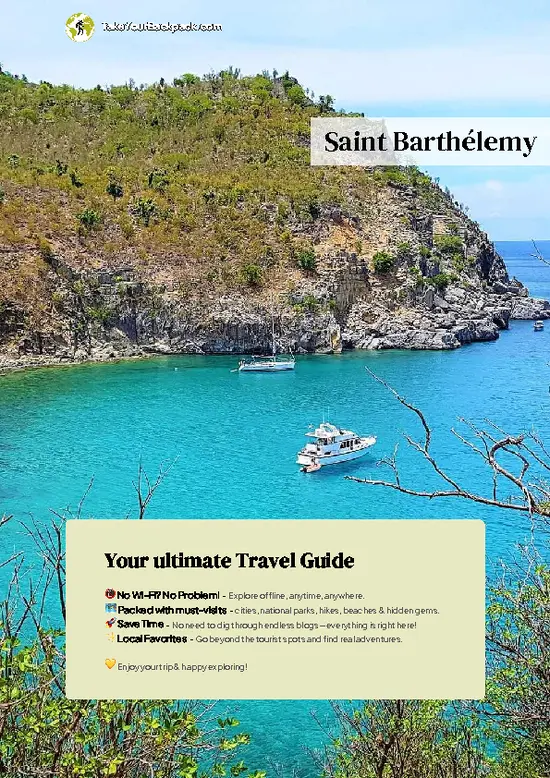
What you pay for is small and well kept: about 25 square kilometers of steep hills, clear water around a protected marine reserve, the Swedish-era stone buildings of Gustavia, and French cooking. Every beach is public. The main problems are cost and arrival. Small planes from Saint Martin face weather delays and tight baggage limits, so pack light and keep the ferry as a fallback. Rental cars run out from December to April, so book one with your room.
Saint Martin next door is cheaper, busier and rougher around the edges. Anguilla is just as expensive but flatter. Saint Barthélemy suits snorkelers, walkers and anyone with a fixed budget for a short stay. It does not suit long, slow, cheap travel.

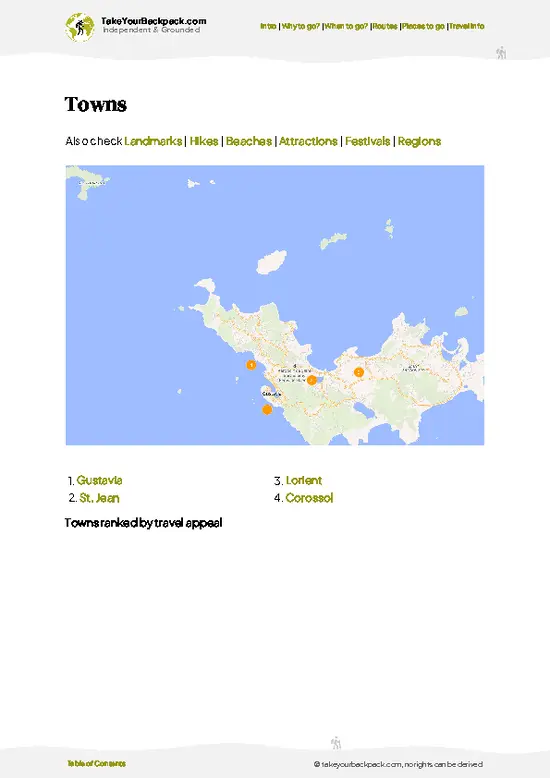
Gustavia (Gustavia Harbor, Fort Karl, Shell Beach)

Gustavia, the capital of Saint Barthélemy, is a working harbor lined with red-roofed Swedish-era buildings, ferry docks and luxury boutiques. Shell Beach and the Fort Karl lookout are a ten-minute walk from the quay, so you can skip the car here. Parking is the real constraint: arrive before 9 a.m. or leave the car on the edge of town. Over Christmas and New Year, superyachts fill the port and dinner tables book out weeks ahead. It suits walkers and first-timers.

Saint-Jean (Saint-Jean Beach, Eden Rock, Airport)

Five minutes by car from Gustavia, Saint-Jean holds the airport, the main supermarkets and the most social beach, split by the Eden Rock promontory. Planes skim the hilltop roundabout and drop onto the short runway right behind the sand. Beach-club lunches run long and cost many times more than a picnic from the shops across the road, so pack your own for a full day. It suits travelers who want everything within walking distance.

Flamands and the Northwest (Flamands, Corossol, Anse de Colombier)

The northwest is residential and quiet, about 15 minutes by car from Gustavia. Corossol keeps a small fishing beach and a tradition of latania palm weaving. From the road’s end above Petite Anse, a rocky 20 to 30 minute trail drops to Anse de Colombier, with turtles in the bay but no road, no shop and little shade. The path is loose stone, so wear proper shoes and carry water. It suits hikers and snorkelers.

East and South Coast (Grand Cul-de-Sac, Lorient, Saline, Gouverneur)

The windward side feels rural: goats on the slopes, steep switchbacks and the shallow, reef-sheltered lagoon at Grand Cul-de-Sac, popular with kitesurfers. Saline and Gouverneur have no facilities, no lifeguards and almost no shade, so bring an umbrella and supplies. Allow 15 to 20 minutes from Gustavia. One of the island’s two gas stations sits in Lorient, and both keep short hours, so fill up early. It suits drivers seeking empty sand.
Seeing the layout at a glance
Loading the map 🌍
CLICK TO FILTER
towns
landmarks
hikes
beaches
attractions
festivals
regions
SHOW COUNTRY’S BESTSHOW ALL

Why go?What draws travelers here

Beach life

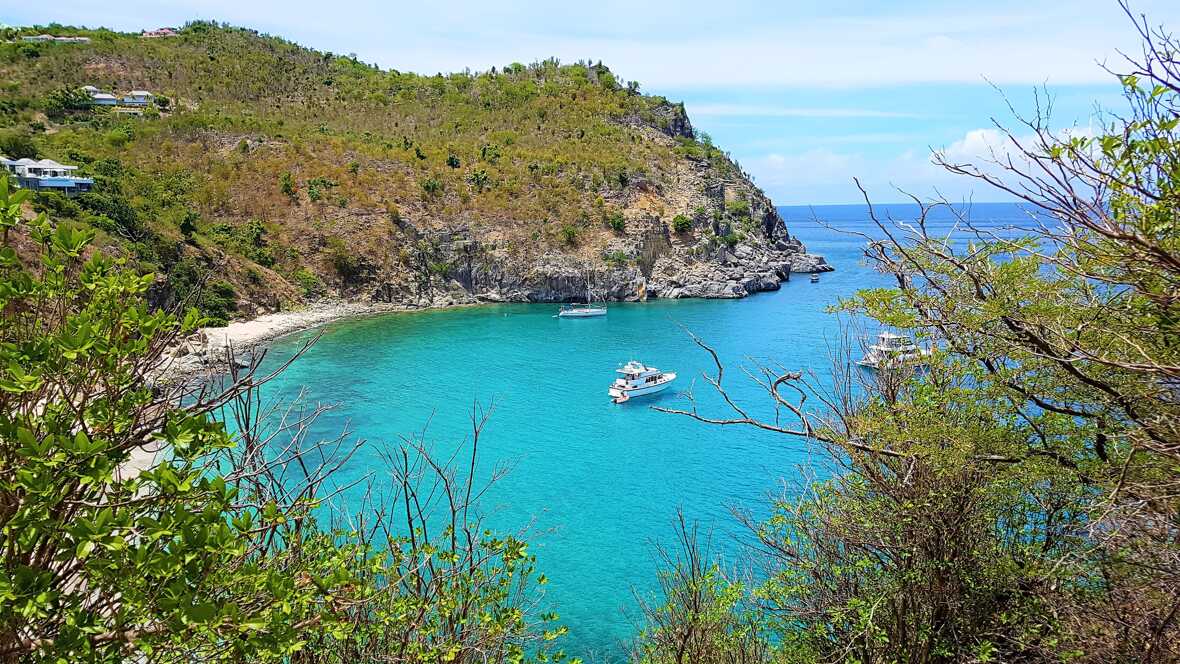
Saint Barthélemy has about a dozen beaches, all public by law, and most remain quiet even in high season. The water is clear thanks to the marine reserve around the coast. For snorkeling, Colombier and the rocks at Anse des Cayes are the best spots. Arrive at Saline before 9 a.m. for calm water. In the evening, Gustavia’s harbor bars stay busiest.

⭐ HighlightsWhat not to miss along the way

  • Anse de Colombier: The trail from Flamands takes about 30 minutes over scrubby headland, and cactus brushes your shins on the way. Below is a sheltered cove where sea turtles graze on the seagrass, sometimes close enough to hear them breathe at the surface.
  • Shell Beach: This is Gustavia’s town beach, made of crushed shells instead of sand. It crunches underfoot and is hot by noon. Locals swim off the rocks at the southern end at sunset.
  • Anse de Saline: You cross a dune and pass a salt pond to reach a long, open beach backed by low hills. Bring your own shade, because the rest is wind and the sound of surf.
  • Fort Karl and the Gustavia waterfront: A short, steep climb ends at the ruined fort, with a view over yachts packed into the harbor. Back down, the Wall House museum explains the Swedish period in cool stone rooms.
  • Grand Cul-de-Sac: A reef-protected lagoon only waist deep, with kites cracking overhead in the afternoon breeze. It is the easiest water on the island for a first lesson.
Away … read more 👉
  • Anse de Colombier: The trail from Flamands takes about 30 minutes over scrubby headland, and cactus brushes your shins on the way. Below is a sheltered cove where sea turtles graze on the seagrass, sometimes close enough to hear them breathe at the surface.
  • Shell Beach: This is Gustavia’s town beach, made of crushed shells instead of sand. It crunches underfoot and is hot by noon. Locals swim off the rocks at the southern end at sunset.
  • Anse de Saline: You cross a dune and pass a salt pond to reach a long, open beach backed by low hills. Bring your own shade, because the rest is wind and the sound of surf.
  • Fort Karl and the Gustavia waterfront: A short, steep climb ends at the ruined fort, with a view over yachts packed into the harbor. Back down, the Wall House museum explains the Swedish period in cool stone rooms.
  • Grand Cul-de-Sac: A reef-protected lagoon only waist deep, with kites cracking overhead in the afternoon breeze. It is the easiest water on the island for a first lesson.
Away from the usual stops, look for the rock pools at Grand Fond, the women’s palm-straw weaving in Corossol, and the empty cove at Petit Cul-de-Sac.
Spotted a mistake or missing a highlight? Contact us.

But Saint Barthélemy offers more...

Discover and compare all of its highlights per category

🧭 RoutesHow to structure a trip

The 2-Day Gustavia and Colombier Escape


A car-free weekend that keeps you within walking distance of the harbor and the protected northwest tip. Expect a lesson in Swedish colonial history, a shell-covered swimming cove and a trail to a beach with no road.
  • Wall House Museum on La Pointe
  • Sunset views from Fort Karl
  • Shell Beach
  • Colombier Beach and Nature Reserve

👉 explore this 2-day route

The 3-Day Peaks and Beaches Route


A mix of trail work and beach time, with a summit hike, wild southern coves and a final evening in the capital. You will drive between contrasting sides of the island, all within a short distance of a central base.
  • The coastal walk from Grande Saline to Petit Saline
  • Morne du Vitet summit
  • Flamands Beach
  • The Swedish Clock Tower in Gustavia

👉 explore this 3-day route

The 5-Day Full Island Route


A slower circuit from the polished harbor to the windswept east, with time for fishing villages, surf breaks and rock pools. It covers nearly every corner of the island, with three nights in the … read more 👉

The 2-Day Gustavia and Colombier Escape


A car-free weekend that keeps you within walking distance of the harbor and the protected northwest tip. Expect a lesson in Swedish colonial history, a shell-covered swimming cove and a trail to a beach with no road.
  • Wall House Museum on La Pointe
  • Sunset views from Fort Karl
  • Shell Beach
  • Colombier Beach and Nature Reserve

👉 explore this 2-day route

The 3-Day Peaks and Beaches Route


A mix of trail work and beach time, with a summit hike, wild southern coves and a final evening in the capital. You will drive between contrasting sides of the island, all within a short distance of a central base.
  • The coastal walk from Grande Saline to Petit Saline
  • Morne du Vitet summit
  • Flamands Beach
  • The Swedish Clock Tower in Gustavia

👉 explore this 3-day route

The 5-Day Full Island Route


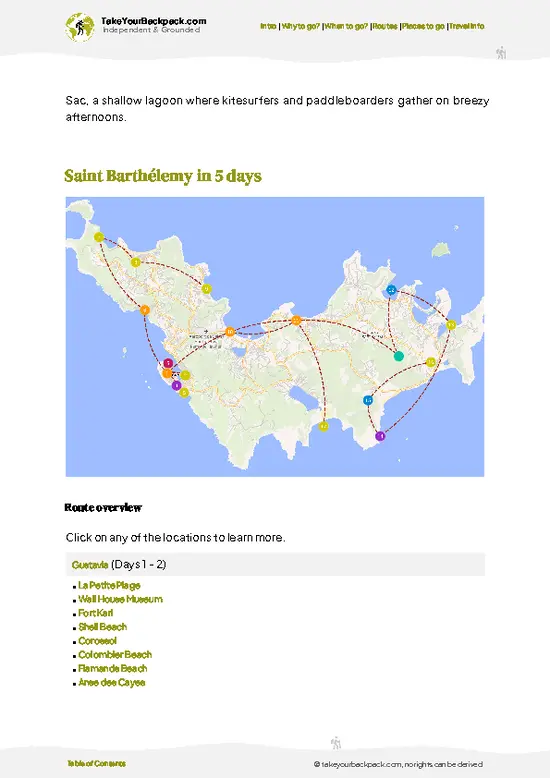
A slower circuit from the polished harbor to the windswept east, with time for fishing villages, surf breaks and rock pools. It covers nearly every corner of the island, with three nights in the most local village on the coast.
  • Gustavia, Fort Karl and Shell Beach
  • Corossol and the hike to Colombier
  • Morne du Vitet and the Natural Aquarium
  • The wild coast of Grand Fond and Toiny

👉 explore this 5-day route

🌤️ When to go?Best time to visit Saint Barthélemy

April to June is the best time for backpacking Saint Barthélemy: the dry season mostly holds, the sea is calm and warm, and room rates fall roughly 30 to 50 percent once the Easter crowd leaves. The island covers only about 25 square kilometers, so timing barely shifts by region, though the east coast around Grand Cul-de-Sac and Toiny stays windier than leeward Gustavia and Shell Beach all year.
  • Peak season (mid-December to mid-April): Dry and breezy, highs around 28°C. Even modest rooms run €300 to 600 a night and sell out months ahead. Oddly, the first two weeks of December are quiet and cheaper, right before the year’s most expensive fortnight.
  • Shoulder season (mid-April to July): Hotter, mostly dry, sea near 28°C, lower prices, nearly everything open.
  • Hurricane peak (August to November): Humid, heavy showers, storm risk highest in September; many hotels and restaurants close from late August through October.
Book your connecting flight from St Maarten early, since the small planes seat under 20 people.

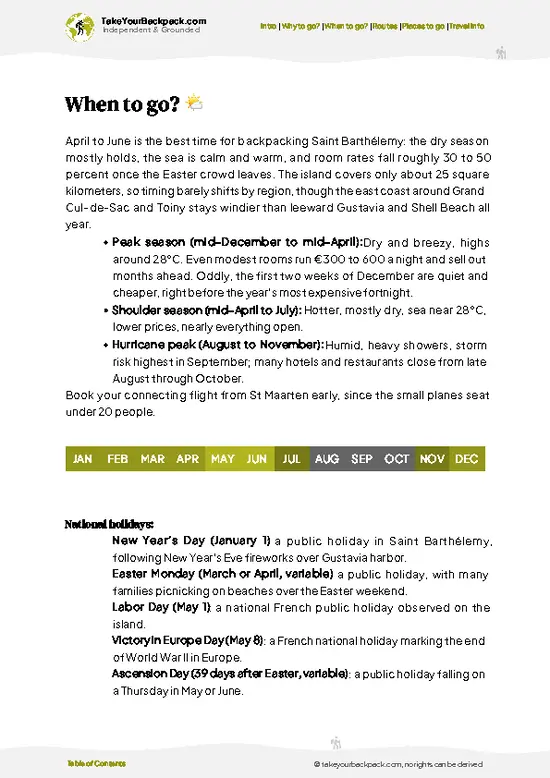
source: climatestotravel.comJANJanuary: highly recommended for travelingFEBFebruary: highly recommended for travelingMARMarch: highly recommended for travelingAPRApril: highly recommended for travelingMAYMay: excellent for travelingJUNJune: excellent for travelingJULJuly: good for travelingAUGAugust: fair for travelingSEPSeptember: fair for travelingOCTOctober: fair for travelingNOVNovember: good for travelingDECDecember: highly recommended for traveling
st-bartelemy-pixabay

💰 Costs (as of 2026)Travel costs in Saint Barthélemy

Backpacking Saint Barthélemy on a tight budget still costs about €200 to 380 per person per day, because the island has no hostels, no campsites and no public buses.

Your bed takes most of the money in Saint Barthélemy. Plan everything else around that fact. The island uses the euro, and US dollars are widely accepted, but you’ll usually get a better rate paying by card in euros. Visitors often arrive from Sint Maarten/Saint-Martin, where rooms in Grand Case cost roughly half as much. Puerto Rico has hostel dorms for US$30 to 45. Nothing on St. Barth comes close.

CategoryBudget RangeLocal Reality
Dorm accommodation€130 to 220 per night (private room, no dorms exist)There are no dorm beds anywhere on the island. Small hotels such as Hotel La Normandie in Lorient or the Sunset Hotel in Gustavia run about €150 to 250 in low season and far more from December to April. Rental studios go for €130 to 200. Splitting a room between two people halves the cost.
Meals€30 to 60 per dayThere’s no real street food here. Supermarkets like Marché U in Saint-Jean and AMC in Gustavia charge roughly 20 to 30 percent more than shops in mainland France. Expect €1.20 to 1.50 for a baguette and €8 to 12 for a
… read more 👉
Backpacking Saint Barthélemy on a tight budget still costs about €200 to 380 per person per day, because the island has no hostels, no campsites and no public buses.

Your bed takes most of the money in Saint Barthélemy. Plan everything else around that fact. The island uses the euro, and US dollars are widely accepted, but you’ll usually get a better rate paying by card in euros. Visitors often arrive from Sint Maarten/Saint-Martin, where rooms in Grand Case cost roughly half as much. Puerto Rico has hostel dorms for US$30 to 45. Nothing on St. Barth comes close.

CategoryBudget RangeLocal Reality
Dorm accommodation€130 to 220 per night (private room, no dorms exist)There are no dorm beds anywhere on the island. Small hotels such as Hotel La Normandie in Lorient or the Sunset Hotel in Gustavia run about €150 to 250 in low season and far more from December to April. Rental studios go for €130 to 200. Splitting a room between two people halves the cost.
Meals€30 to 60 per dayThere’s no real street food here. Supermarkets like Marché U in Saint-Jean and AMC in Gustavia charge roughly 20 to 30 percent more than shops in mainland France. Expect €1.20 to 1.50 for a baguette and €8 to 12 for a bakery sandwich. A burger at Le Select in Gustavia costs about €12 to 16. A sit-down dinner starts at €40.
Local transport€35 to 55 per dayRenting a scooter is the cheapest way to get around, at €35 to 50 a day. A small car costs €50 to 90. Taxis charge about €20 to 30 for short hops like airport to Gustavia, and fuel runs around €1.80 to 2 a liter. Walking is free, but the hills are steep and some roads have no shoulder.
Activities€0 to 30 per dayEvery beach is public and free, including Shell Beach, Saline and Gouverneur. The trail to Colombier costs nothing too. Boat trips are where the money goes: half-day snorkeling charters run €100 to 150 per person, and paddleboard rentals cost about €25 to 40 an hour.
Miscellaneous€5 to 20 per dayA coffee costs €3 to 4. Bottled water is €1.50 to 3, and a beer at a bar is €6 to 8. Sunscreen bought on the island costs about €20, so bring it from home.
Total Daily Budget€200 to 380At the low end, you share a room in low season, cook from Marché U, ride a scooter and spend your days on free beaches. One boat trip or two restaurant dinners will push you to the top of the range.

I’d plan a short visit of two to four nights and do the rest of a Caribbean trip somewhere cheaper. A round-trip ferry from Saint-Martin costs about €90 to 130. Day-tripping from there saves you the room entirely, which is the biggest single saving on the island.
⚠️ Prices can change and everyone travels differently, so take this as a rough guide. Hope it helps you plan your adventure!

✈️ The backpacker research shortcutSaint Barthélemy Travel Guide

An offline-friendly backpacking guide with optimized travel routes, ranked highlights, transport advice, and the best areas to stay.
example page 0 from our offline Travel Guide for Saint Barthélemy
example page 1 from our offline Travel Guide for Saint Barthélemy
example page 2 from our offline Travel Guide for Saint Barthélemy
example page 3 from our offline Travel Guide for Saint Barthélemy
example page 4 from our offline Travel Guide for Saint Barthélemy
example page 5 from our offline Travel Guide for Saint Barthélemy
example page 6 from our offline Travel Guide for Saint Barthélemy
example page 7 from our offline Travel Guide for Saint Barthélemy
The digital guide (107 pages) contains:
✅ 22 highlights, ranked by travel appeal
✅ Optimized 2, 3 & 5-day travel routes
✅ Cities, national parks, landmarks, beaches
✅ How to get around
✅ Offline-friendly for travel without Wi-Fi
👉 Click to see all 30+ guide features

📅 Plan smarter in minutes, not weeks
✅ Month by month travel advice
✅ Festivals & national holidays
✅ Budget expectations

🗺️ Go to the right places, skip the overrated ones
✅ Honest pros & cons of destinations
✅ Top hikes, parks & viewpoints
✅ Lesser-known places most travelers miss
✅ Clear “worth it vs skip it” guidance

🛏️ Travel smoothly without rookie mistakes
✅ Best areas to stay
✅ Transport systems explained simply
✅ Common scams & safety advice
✅ SIM cards, money & practical tips

🌍 Understand the country, not just visit it
✅ Culture & traditions
✅ 52 Essential phrases & customs
✅ Festivals worth planning around
✅ Traveler-friendly historical context
✅ Insights that make places more meaningful

📱 Built for real travel conditions
✅ Fully downloadable PDF
✅ Works completely offline
✅ Optimized for phone use
✅ Useful in remote areas & buses
✅ Everything in one place
Stop searching, start planning
Get instant access to your full guide. 30‑day money-back guarantee.
+ Add another guide for just

By proceeding you agree to our terms.
Sent to your inbox immediately after payment • 100% Secure Checkout
Best Backpacking Travel Advisor 2025 tourism awardBest Backpacking
Travel Advisor
2025
What others say about Take Your Backpack Guides:
⭐⭐⭐⭐⭐
Fantastic, amazing amount of information!
⭐⭐⭐⭐⭐
My goodness this is amazing, it's what I've been looking for hats off too you!
⭐⭐⭐⭐⭐
I think this is absolutely BRILLIANT
⭐⭐⭐⭐
Very complete and informative. It's still missing places, but I gotta to commend you
⭐⭐⭐⭐⭐
This is truly amazing, thank you, can't wait to explore it with my kids!
⭐⭐⭐⭐⭐
Awesome resource, thank you!
⭐⭐⭐⭐⭐
This is amazing! Can't wait to explore the ones I haven't seen
⭐⭐⭐⭐
I love this! Well done, great idea.
⭐⭐⭐⭐⭐
Thanks for taking the time to make this gem!
⭐⭐⭐⭐⭐
This might be the best website I've ever seen.
⭐⭐⭐⭐⭐
Congratulations, and thank you so much for your work; it's incredibly valuable.
⭐⭐⭐⭐
In all seriousness I think you did a great job pointing out the important spots
⭐⭐⭐⭐⭐
10/10 very good
⭐⭐⭐⭐⭐
As someone who's only just starting to visit regularly this is awesome, thank you.
⭐⭐⭐⭐
Thank you very much! I'm going to visit my dad, it's going to be very useful!
⭐⭐⭐⭐⭐
This is really cool! We'll be travelling for the first time and this definitely come in handy.
⭐⭐⭐⭐⭐
You are now our minister of culture, congratulations 👨‍💼
⭐⭐⭐⭐⭐
Just wanted to tell you that this is a pearl! Going to follow your recommendations.
⭐⭐⭐⭐⭐
This is so cool. I'll definitely be using the resource for my travels soon.
⭐⭐⭐⭐⭐
This is very impressive! Good work.
⭐⭐⭐⭐⭐
This is an amazing and informative site. Very well done!

🛏️ Where to stay?Choosing the right base for your trip

Saint Barthélemy has no hostels or dorm beds, so the cheapest realistic option is a simple guesthouse room, studio or small villa, usually starting around €150 to 250 a night in low season and climbing well past that from December to April. Gustavia puts you within walking distance of the harbor, restaurants and the island’s busiest nightlife but has the steepest rates, while Saint-Jean sits on the beach next to the airport with beach bars and some daytime plane noise. Lorient is quieter and more residential, with a surf beach and some of the more affordable rooms, though you will want a car or … read more 👉
Saint Barthélemy has no hostels or dorm beds, so the cheapest realistic option is a simple guesthouse room, studio or small villa, usually starting around €150 to 250 a night in low season and climbing well past that from December to April. Gustavia puts you within walking distance of the harbor, restaurants and the island’s busiest nightlife but has the steepest rates, while Saint-Jean sits on the beach next to the airport with beach bars and some daytime plane noise. Lorient is quieter and more residential, with a surf beach and some of the more affordable rooms, though you will want a car or scooter to reach Gustavia in the evening.

If you enjoy meeting fellow travelers, consider choosing hostels with high ratings for atmosphere. On the other hand, if you prefer having your own space, a hotel might be a better option.

🚌 Getting aroundGetting around Saint Barthélemy

Getting around Saint Barthélemy comes down to one choice: rent your own wheels for €50 to 120 a day, or rely on taxis at €20 to 40 a ride plus your feet. The island covers about 25 km² and no point is more than 20 minutes’ drive from Gustavia, so the real cost is money, not time. There is no public bus.
  • Rental car: about €50 to 80 a day in low season and €90 to 150 from December to April. Most drives take 5 to 15 minutes. Small automatics handle the steep, narrow roads best. Book online weeks ahead
… read more 👉
Getting around Saint Barthélemy comes down to one choice: rent your own wheels for €50 to 120 a day, or rely on taxis at €20 to 40 a ride plus your feet. The island covers about 25 km² and no point is more than 20 minutes’ drive from Gustavia, so the real cost is money, not time. There is no public bus.
  • Rental car: about €50 to 80 a day in low season and €90 to 150 from December to April. Most drives take 5 to 15 minutes. Small automatics handle the steep, narrow roads best. Book online weeks ahead for the holidays, because the fleet sells out. Gustavia parking fills by mid-morning, so arrive early or park at the edge of town.
  • Scooter: roughly €30 to 50 a day, with the same short travel times. It is easy to park but punishing on 20% gradients in rain. You need the correct license class, and gravel on hairpins causes most of the island’s accidents.
  • Taxi: about €20 to 40 between most points, with higher rates at night and on Sundays. There is no ride-hailing app, so phone ahead or use the stands at the airport and in Gustavia. Evening cars are scarce, so book your ride home before dinner.
  • Walking and hitching: free. Gustavia to Shell Beach takes 10 minutes, and Saint-Jean to Gustavia takes 35 to 45 minutes over a hill with no sidewalk. Hitching is common and generally safe in daylight.
To keep costs down, rent only for the days you plan to explore the east coast and walk the rest. Also fill the tank on weekdays, since the island’s few fuel stations keep short Sunday hours.
Gustavia Airport, officially Rémy de Haenen Airport (SBH), sits in Saint-Jean about 2 km (1.2 miles) from Gustavia, and since Saint Barthélemy has no public buses or ride-hailing, the cheapest reliable option is walking, with a taxi as the easiest paid choice.
  • Walking (25 to 35 minutes, free): Head up the road over the Col de la Tourmente hill toward Gustavia, which is steep, hot and partly without sidewalks, so it only makes sense with light luggage and in daylight.
  • Taxi (5 to 10 minutes, roughly €25 to 35): Taxis wait outside the small terminal when flights land, pay in euros cash or ask the driver about cards before you get in, and expect a surcharge in the evening and on Sundays.
  • Rental car or scooter (5 to 10 minutes, about €50 to 90 a day for a small car, €35 to 50 for a scooter): Rental desks are right in the arrivals area, and booking ahead is essential in high season when the small fleets sell out.
  • Hotel or villa transfer (5 to 15 minutes, free to around €40): Many guesthouses and villa agencies meet you at arrivals if you arrange it when booking, which saves haggling over a taxi.
The airport has no night landings, so if you are reaching the island late, it will be by ferry from Sint Maarten into Gustavia harbor, and you should pre-book a taxi or your host’s pickup because drivers thin out quickly after dark.
⚠️ Prices and routes can change, so take this as a rough guide and ask for local advice when you arrive.
🚀 Don’t waste time on the road.
We’ll generate a route that minimizes unnecessary travel and fits your available days.

Generate my itinerary

🔒 Safety (risk Level: low)Is Saint Barthélemy safe to visit?

Safety for solo travelers, including women and LGBTQ+ individuals
Saint Barthélemy is one of the safest destinations in the Caribbean for solo travelers, with very low violent crime and a small, close-knit population. Women traveling alone generally report few problems, though common sense applies: lock rental cars, keep valuables out of sight on beaches and arrange a taxi home late at night. As French territory, the island has full legal protection for LGBTQ+ people, including same-sex marriage, and the tourism scene is relaxed and welcoming. The most real danger is on the road, where steep hairpins and scooter accidents cause far more injuries than crime.

✈️ VisaDo you need a visa to visit?

Saint Barthélemy is a French overseas collectivity outside the Schengen Area, and citizens of the EU, the US, Canada, the UK, Australia and many other countries can visit visa-free for short stays of up to 90 days. Travelers who need a visa must apply in advance through the official France-Visas portal, choosing Saint Barthélemy as the destination, since a standard Schengen visa is not valid here. Check your passport validity and carry proof of onward travel, as airlines flying via Sint Maarten or Guadeloupe may ask for it.
⚠️ Visa requirements can change over time, so always check the latest visa requirements with the official embassy or government website before you travel.

🎒 What to pack?A practical packing list

Saint Barthélemy is hot and sunny all year, with temperatures around 25 to 31°C and short tropical showers, so pack light, breathable clothes and a rain shell that dries fast rather than anything warm. The island is steep and rocky, and the trails to beaches like Colombier and Saline cross loose stone, so sturdy sandals or light trail shoes beat flip-flops. Bring strong reef-safe sunscreen and a hat, since shade is scarce and much of the coastline is a protected marine reserve. Gustavia dresses smart-casual in the evening, so one nicer outfit will keep you from feeling underdressed at dinner. Groceries, sunscreen and pharmacy items cost noticeably more on the island, so arriving well stocked saves real money.

Apart from this country specific advice, I have also crafted a general packing list that should help on any trip. authorOver the years, I've learned the importance of packing minimally. It's so much easier to jump on the back of a truck or squeeze yourself into the last spot of a minibus without that supersized backpack. If you're headed to a warm destination, leave your winter jacket at home; for colder regions, opt for thin thermal underlayers. Instead of packing your entire wardrobe, bring just three sets of clothes, as laundry facilities are available everywhere.

View the full list 👉

🙋 FAQTravel questions about Saint Barthélemy

Trip Planning

Planning a backpacking route through Saint Barthélemy can be tricky — you need to balance must-see places, travel times, budget, and how long to stay in each destination. Our free personalized Saint Barthélemy itinerary planner creates a route based on your travel style, trip duration, and interests, so you can spend less time researching and more time exploring.


Personal tip: I normally search on good rating for atmosphere (for meeting people) and location (for easy exploring). Cleanliness as a bonus.


Travel Essentials

No vaccinations are required to enter Saint Barthélemy for most travelers. Make sure routine vaccines (MMR, tetanus-diphtheria, polio) are up to date, and consider hepatitis A and B as standard Caribbean travel precautions. Dengue is present in the French Antilles and there is no widely used vaccine for travelers, so mosquito repellent and covering up at dawn and dusk matter more than shots. Arrivals from countries with yellow fever risk should check whether proof of vaccination is needed.


vaccination requirements
When I first started traveling, I often spent part of my first day in a new country hunting for a local SIM card. While this can still be slightly cheaper, it also takes time and planning.

These days, it's much simpler to install an eSIM before leaving home. Once you arrive in Saint Barthélemy, you can activate it immediately and have mobile data from the moment you land — which is especially useful for ordering transport or navigating away from busy airports.

There are many providers nowadays, and price differences are usually small. I personally go with Holafly, as it offers excellent network coverage throughout the country and strong global coverage, so you can manage multiple countries from a single app.


HolaFly eSim

Culture & Customs

Saint Barthélemy blends French manners with small-island reserve, so politeness and discretion go a long way. Do wear a cover-up or shirt when leaving the beach, since swimwear in Gustavia’s streets, shops and restaurants is frowned upon. Topless sunbathing is widely accepted on beaches, but full nudity is officially prohibited, so follow what others are doing. Don’t trespass onto private villa land to reach a beach, as all beaches are public but access paths are not always open. Drive patiently, give a short honk before blind hairpin bends as locals do, and never block narrow roads to take photos. Ask before photographing residents, particularly older women in Corossol. The island is socially liberal, and LGBTQ+ couples and women traveling alone rarely face issues beyond what you would expect in mainland France.
Trying traditional food is always a great way to experience the culture. Here are some must-try dishes for Saint Barthélemy.
  1. Accras de morue: crisp fritters of salt cod, herbs and hot pepper. They are the standard aperitif snack across the French Caribbean and show up at nearly every beach bar and family gathering on the island.
  2. Boudin créole: a spicy blood sausage seasoned with chili, thyme and lime. It is a holiday and Sunday favorite that links Saint Barth to its Guadeloupe and Martinique neighbors.
  3. Colombo: a turmeric-heavy curry of chicken, goat or fish, built on a spice blend brought to the Antilles by Indian laborers in the 19th century. It is cheap, filling, and the most common plate at casual lunch spots.
  4. Langouste grillée: Caribbean spiny lobster grilled with garlic butter or a sauce chien of lime, herbs and chili. It is the island’s signature splurge, best eaten in season when it is caught locally.
  5. Court-bouillon de poisson: fresh reef fish such as red snapper, poached in a tomato, lime and pepper broth. It is a home-style Creole dish that shows off the island’s fishing heritage around Corossol.
  6. Ti’ punch: white agricole rum, cane syrup and a squeeze of lime, mixed by the drinker. It is the social ritual of the French Antilles, served before any proper meal.
Tap water in Saint Barthélemy comes mostly from a desalination plant and meets French standards, so it is generally safe to drink. Many villas and guesthouses, however, run on rainwater cisterns, and locals often drink bottled water at home for taste and peace of mind. Ask whether your accommodation’s water comes from the public network; if it comes from a cistern, stick to bottled or filtered water.
The main language in Saint Barthélemy is French. Backpacking is way more rewarding if you know a bit of the local language, so I'd suggest brushing up on the basics just in case your French skills have become a bit rusty.

Want to understand locals better?
The complete Travel Guide for Saint Barthélemy includes 52 essential words and phrases — greetings, thank-yous, ordering food, transport, numbers, and common local expressions you'll actually hear.

Get your local basic phrases 👉

Get the Travel Guide -


English is widely spoken in Saint Barthélemy wherever visitors spend money, so in Gustavia and Saint-Jean hotel staff, car rental desks, shop assistants and most restaurant servers switch to it easily, a result of the island’s heavy flow of North American visitors. Younger islanders and seasonal workers usually speak it well, and since the island has no hostels, guesthouse owners and villa managers are the people you will deal with most, and nearly all of them handle English bookings without trouble. In quieter corners such as Corossol or the eastern villages, older residents speak French first, and some still use a local Norman-derived patois, so English there can be patchy. French is the language that helps most. Open with “bonjour” before any request, add “merci” and “s’il vous plaît,” and download the offline French pack in Google Translate for menus, supermarket labels and road signs.

Money & Payments

The local currency of Saint Barthélemy is EUR (€).
Saint Barthélemy uses the euro, though US dollars are accepted in many shops and restaurants, usually at a rate that favors the merchant. ATMs are limited to a handful of bank branches and machines in Gustavia and Saint-Jean, so withdraw when you pass one rather than counting on finding one in Lorient or Flamands. Local machines usually do not add a fee, but your home bank may charge a foreign transaction fee, so a fee-free travel card saves money. Visa and Mastercard are accepted almost everywhere, including supermarkets, gas stations and most restaurants, while small snack bars, beach shacks and some taxis prefer cash. Bringing euros is the better choice, and if you need to exchange money, use a bank in Gustavia or Saint-Jean rather than accepting a shop’s improvised rate.
In Saint Barthélemy, restaurant bills follow French rules and include service (service compris), so tipping is not obligatory. Many visitors still leave around 5 to 10% for good service, and higher-end places used to American guests may expect 10 to 15%. Rounding up taxi fares and leaving a few euros for housekeeping or bar staff is appreciated.

🧩 Nearby countriesOther countries to combine with Saint Barthélemy

We 💚 feedbackThe bottom line on traveling here

The best reason to come to Saint Barthélemy is the water. The beaches are public, quiet and unusually clean, and you can walk to some of them from the road in minutes. The drawback is cost: almost nothing here is cheap, and there is no budget lodging to fall back on. The island works well for a short, planned stay of three to five days. Travelers who want months of cheap wandering will be happier on Saint Martin or in the Grenadines.

✍️ Help improve this page!
The information on this page is based on in-depth research, insights shared by experienced travelers, and feedback from the local travel community in Saint Barthélemy. While every effort is made to keep the information accurate and current, conditions can change — so if you spot anything incorrect or outdated, please get in touch.


🙋‍♂️ Give feedback

👋 Meet the founderWho’s Behind Take Your Backpack?

Johan, backpacker and founder of TakeYourBackpackHi, I’m Johan (Netherlands 🇳🇱), the creator of TakeYourBackpack. Over the past 3 decades, I’ve backpacked through 90+ countries across six continents, gaining extensive experience with independent travel, long-term trips, and overland routes.

This site is built on a combination of firsthand travel experience and carefully curated insights from other backpackers. Many guides are based on places I’ve personally visited, while others bring together tips, observations, and practical advice shared by trusted travelers I’ve met along the way.

The goal is to provide realistic, experience-driven guidance — not generic itineraries — so you can explore destinations with better context, clearer expectations, and more confidence.