v2.webp)
.jpg)
Johan Kruseman
First off, let me explain why there are no tall Bolivians. The water here is heated electrically, and the showers are kinda low. Anyone over 1.75 meters (that’s me) risks getting electrocuted while showering. I’ve had about three shocks so far, but hey, I’m still kicking.
Spent 10 days in Tupiza, basically the Costa del Sol without the Costa but with a whole lot of sun! After two weeks of hardcore budget travel, I decided to treat myself. Splurged on a room with its own shower and toilet, hot water(!), a shower high enough to avoid electrocution(!!), and, most importantly, my own roll of toilet paper on the toilet!!! The hotel even throws in a pool and a ping-pong table for its guests. Costs me about 20 BOBs a day. Divide a BOB by 10, multiply by 1.5, and you’ve got euros.
Also did a 5-hour horseback riding tour. “I’ve never been on a horse, is that a problem?” “No, no problemo!” Naively thinking that riding for 5 hours without experience was no problemo. Well, there were a few issues. Firstly, no one explained how to steer a horse. After a bit of trial and error in Tupiza’s center, I figured out the basics.
Horses apparently have three gears. First, walking (not sure if there’s a fancy horse term for it), which is fine. You feel in control, look around a bit (look at me, I’m a badass cowboy), but it’s not very fast. Since we had to cover a 7-hour tour in 5 hours, walking wasn’t always an option. Second gear (called trot) is a disaster. You’re still not really going fast, but you’ve lost all control. The horse keeps bouncing you out of the saddle, and it’s a bumpy ride. So, I quickly decided to try the third gear: gallop. Terrifying, way too fast, but super cool, and you can stay in the saddle. Prioritizing avoiding a sore butt over a bit of fear, I gave the horse two choices: walk or gallop. It seemed generous, but I didn’t have much choice; the horse knew the way better than I did. Suddenly, the horse veered right. I desperately asserted my rider status, eventually convincing the horse to go straight, only for the guide to shout that we should’ve turned right. Grudgingly, I directed the horse to its initial choice, and from then on, I accepted that the horse was both horse and rider. I just had to remind it occasionally that trotting wasn’t an option today.
The third problem was that my horse seized every opportunity to gallop. If the guide told his horse to speed up or if I accidentally tapped my horse’s belly twice in a row, off we went galloping. But hey, anything was better than trotting. The scenery was amazing, and we even had to cross a river where the water reached the horse’s belly. No regrets, super experience.
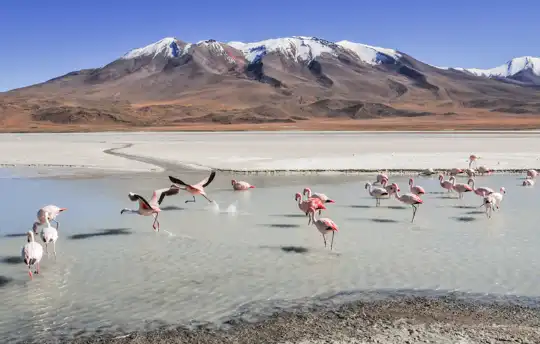
Between Tupiza and Cochabamba, where I am now, I embraced being a 100% tourist. Sunglasses on, camera on the belly, cruising with six other gringos to the coolest sights (take a picture and move on). A salt flat the size of a quarter of the Netherlands, an island in that salt flat with nothing but cacti, a hotel entirely made of salt (even the interior), a white, a green, and a red lake, all with lots and lots of flamingos, a bit of food poisoning (no photos), geysers, and finally, a hot spring lake at 5000 meters above sea level. It was freezing at 7 am, and we took a dip in the super warm water. Getting out was the real challenge, so we had our breakfast in the water until the sun made it warm enough to get dressed again.
A small side note for whoever wants to travel to Bolivia: the concept of time has a whole different meaning in Bolivia. According to the dictionary, ‘ahora’ means now, ‘ahorita’ is the diminutive of ‘ahora’ and should mean even sooner than now. In Bolivia, ‘ahorita’ actually means ‘I don’t know when or if something will happen.’ ‘35 minutos’ means 2 1/2 hours, and ‘a mañana’ (literally until tomorrow) means something like maybe I’ll be there tomorrow, maybe not (even if you made plans with someone). You need to add at least two hours to any given time, as if all Bolivians live in a different time zone than I do.
Traveled route: La Paz, Potosí, Sucre, Tupiza, Uyuni, Salar de Uyuni, Cochabamba, Villa Tunari, Coroico, Rurrenabaque,Most Dangerous Road of the World, Isla del Sol