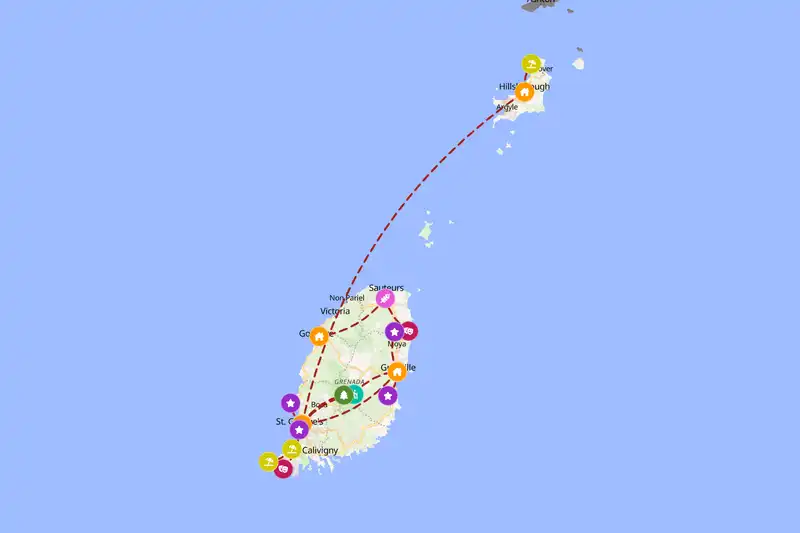
Yes, Grenada is easy to backpack independently: English is the official language, the main island is only about 34 kilometers long, and cheap public minibuses reach every corner from the capital.
Fares from
St. George’s run EC$2.50 to 10 (US$1 to 4), whether you’re heading 15 minutes to
Grand Anse or 1 to 1.5 hours to
Sauteurs. There’s almost no hostel scene, so expect guesthouses and small apartments at EC$110 to 220 (US$40 to 80) a night, and a daily budget of roughly US$65 to 120. The Osprey ferry to
Carriacou takes about two hours. Plan around thin bus service after dark and on Sundays.
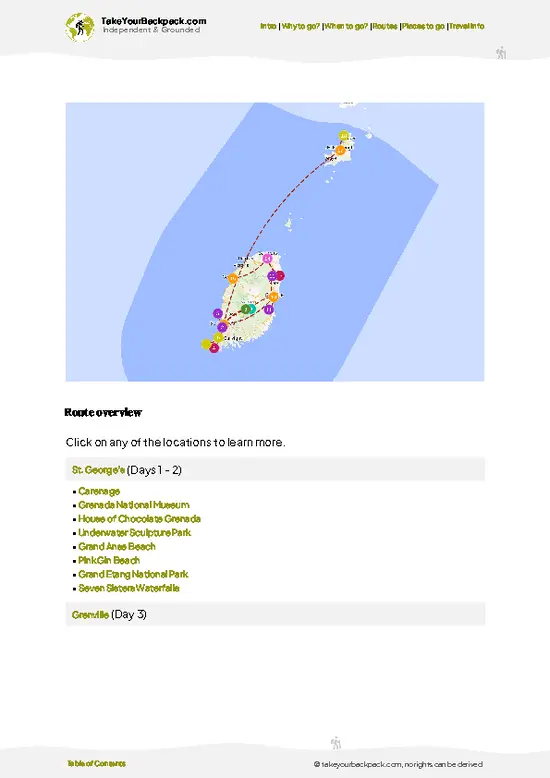
Five days is the right amount of time for Grenada, enough for the capital, the rainforest, the northern estates and a night on Carriacou.
With 2 days, stay on
Grand Anse and cover the
Underwater Sculpture Park,
St. George’s and the
Seven Sisters waterfall hike, all within 40 minutes of each other. Three days lets you add the north, with
Sauteurs,
Levera National Park and
River Antoine as a day trip of 1 to 1.5 hours each way. Five days adds the east coast around
Grenville plus the two-hour ferry to
Carriacou. Divers should allow a full week.
Yes, you can get around Grenada without a car, because numbered public minibuses connect St. George’s with every town on the main island from early morning until early evening.
Minibuses leave from the Melville Street terminal in
St. George’s:
Grand Anse is 10 to 15 minutes for EC$2.50 (about US$1),
Grenville roughly an hour, and
Sauteurs 1 to 1.5 hours for EC$8 to 10 (US$3 to 4). You’ll want a taxi for spots off the main roads, such as
Levera National Park,
River Antoine and
Belmont Estate. Buses thin out after about 7 pm and on Sundays. The Osprey ferry reaches
Carriacou in about two hours.
The must-visits in Grenada are St. George’s, Grand Anse Beach, the Underwater Sculpture Park, Grand Etang with the Seven Sisters falls, River Antoine Rum Distillery and, with time, Carriacou.
St. George’s and
Grand Anse sit 15 minutes apart by minibus, and a snorkel boat to the
Underwater Sculpture Park costs EC$110 to 160 (US$40 to 60).
Grand Etang National Park is 30 to 40 minutes inland, and the
Seven Sisters hike takes 45 to 60 minutes each way. In the north,
River Antoine and
Sauteurs make a full day trip.
Carriacou is a two-hour ferry ride and deserves at least one night.
If you’re short on time in Grenada, skip Annandale Falls, Carriacou and the smaller chocolate and park stops, and focus on the southwest coast plus Grand Etang.
Annandale Falls is small and fills with cruise groups, while the
Seven Sisters hike, 45 to 60 minutes each way, gives you a far better waterfall.
Carriacou needs at least one night because of the two-hour ferry each way, so leave it for trips of four days or more.
House of Chocolate in St. George’s overlaps with
Belmont Estate, and
Mount Hartman National Park mainly appeals to birders looking for the Grenada dove.
Grenville is a transit town you can pass straight through.
Yes, our itinerary-planner does exactly that. Set your trip length in days, give your interests and travel style, optionally give start- and end location and/or some mandatory stops you would like to include and the itinerary planner creates your personalized routes for Grenada in seconds. Try it out!
Try the itinerary plannerv2.webp)
 Best Backpacking