×

Liechtenstein🇱🇮 | regionsMalbunSki bowl, Sareis chairlift, ridge summits, road's end | things to do and best time to go

Explore Gänglesee TrailExplore Gaflei

Backpacking in Malbun
🏆 Top pickregion ranked #1
By Johan Kruseman 🇳🇱 | Updated November 6, 2026

The real decision at Malbun is whether to come in snow season or hiking season, and the answer is whichever matches your legs: winter gives you short, easy slopes and sledding, summer gives you ridge walks above 2,000 meters. Malbun sits in the south-east of Liechtenstein, at the road’s dead end in a high bowl above Triesenberg. There is one main street, a handful of hotels, a chairlift beside the car park and a couple of mountain restaurants where you can order rösti with the Alps in front of you. It is small, quiet and not at all overrun. Mornings are best, when the ridgelines are sharp and the lift queues are empty, and a mid-afternoon coffee on a terrace is the right way to end a hike. Nightlife barely exists. Hikers, families and ski-and-snowshoe types will love it. Anyone chasing hostels, bars or a big town scene will be bored by dinner.

Part of Backpacking in Liechtenstein: all 25 places on one map, with routes and the best time to go.
Discover everything you want to know in the 📖 Liechtenstein Travel Guide.
Loading the map 🌍
CLICK TO FILTER
towns
villages
landmarks
hikes
attractions
festivals
regions
SHOW COUNTRY’S BESTSHOW ALL

✨ Why go?
Ranked #1 region in Liechtenstein
Reasons people choose to visit here

Malbun gives you a full alpine range in one compact valley, so you can base yourself in one place and still change your day completely. A chairlift to Sareis puts you on ridge paths without a long, steep climb, while the harder walkers can head for Augstenberg or the Austrian and Swiss border peaks. Because everything radiates from the top of one road, there is no juggling of connections. You wake up already at altitude, which means early starts are easy and the trails feel empty before the lifts open. Winter changes the picture without changing the logistics: the same slopes turn into ski runs, toboggan tracks and snowshoe routes, all within walking distance of a bed. The country’s small size helps too. A hut night at the Pfälzerhütte gives you a proper mountain overnight with a trailhead … read more 👉
Malbun gives you a full alpine range in one compact valley, so you can base yourself in one place and still change your day completely. A chairlift to Sareis puts you on ridge paths without a long, steep climb, while the harder walkers can head for Augstenberg or the Austrian and Swiss border peaks. Because everything radiates from the top of one road, there is no juggling of connections. You wake up already at altitude, which means early starts are easy and the trails feel empty before the lifts open. Winter changes the picture without changing the logistics: the same slopes turn into ski runs, toboggan tracks and snowshoe routes, all within walking distance of a bed. The country’s small size helps too. A hut night at the Pfälzerhütte gives you a proper mountain overnight with a trailhead only a short bus ride from the capital, which makes Malbun a gentle first step for anyone nervous about alpine travel and a handy shortcut for those who aren’t.

💡 HighlightsWhat this place is best known for

  1. Sareis chairlift: The lift out of the village carries you up to the Sareis ridge, the easiest way to reach high walking paths and the main winter ski lift. The restaurant at the top has a sunny terrace.
  2. Augstenberg: At 2,359 meters this is the classic summit on the marked Fürstin-Gina-Weg from Malbun. It is a steady, demanding day with views into Austria and Switzerland.
  3. Bettlerjoch: A saddle on the ridge route where the landscape opens up in both directions. It makes a good lunch stop on a loop.
  4. Pfälzerhütte: A mountain hut on the Bettlerjoch at the Austrian border, run for hikers who want to sleep high. Sunset from here is far quieter than at any lift station.
  5. Naafkopf: A summit where Liechtenstein, Switzerland and Austria meet. It is a serious full-day hike for confident walkers.
  6. Rappenstein:
… read more 👉
  1. Sareis chairlift: The lift out of the village carries you up to the Sareis ridge, the easiest way to reach high walking paths and the main winter ski lift. The restaurant at the top has a sunny terrace.
  2. Augstenberg: At 2,359 meters this is the classic summit on the marked Fürstin-Gina-Weg from Malbun. It is a steady, demanding day with views into Austria and Switzerland.
  3. Bettlerjoch: A saddle on the ridge route where the landscape opens up in both directions. It makes a good lunch stop on a loop.
  4. Pfälzerhütte: A mountain hut on the Bettlerjoch at the Austrian border, run for hikers who want to sleep high. Sunset from here is far quieter than at any lift station.
  5. Naafkopf: A summit where Liechtenstein, Switzerland and Austria meet. It is a serious full-day hike for confident walkers.
  6. Rappenstein: A rocky 2,222-meter peak that most day visitors never attempt. It gives you a rugged ridge walk with lots of space to yourself.
  7. Hocheck: A short, rewarding summit above the village, good for a sunset stroll when your legs are tired. The panorama over the valley is wide for so little effort.
  8. Valüna valley: A green side valley with old alpine huts and meadows, reached on a gentle path. It is where locals walk when they want solitude.
  9. Sücka pass: The old crossing between the village and the lower valley, with a restaurant and a viewpoint over Vaduz and the Rhine. The drop-off below the terrace is dramatic.
Malbun’s chairlift needs a ticket in both seasons, and the Pfälzerhütte should be booked ahead if you want a bed for the night.
Spotted a mistake or missing something? Contact us.

Things to do around Malbun

Ratings based on Tripadvisor reviews. When you book through this link, you support our work at no extra cost to you.

⌛️ 5 daysWhat you can realistically do in a week

Day 1: Sareis: Start with the chairlift to Sareis, the one stop that sets up the whole stay. From the top, a ridge path gives you orientation, and you can see which peaks you will tackle later. The village has a single bus line that ends here, so everything runs in a loop: arrive, walk, return, repeat. That keeps the pace slow, and you should build your days around the first and last bus rather than around cities.
Day 2: Hocheck: Spend a lighter day on the Hocheck summit. Your legs adjust to the altitude, and the short loops show you the valley’s geography before you commit to a long day. Finish with an early dinner in the village, since the quiet streets empty fast.
Day 3: Augstenberg: This is the day that justifies the whole trip. Start early on the path toward Augstenberg, climb through meadows … read more 👉
Day 1: Sareis: Start with the chairlift to Sareis, the one stop that sets up the whole stay. From the top, a ridge path gives you orientation, and you can see which peaks you will tackle later. The village has a single bus line that ends here, so everything runs in a loop: arrive, walk, return, repeat. That keeps the pace slow, and you should build your days around the first and last bus rather than around cities.
Day 2: Hocheck: Spend a lighter day on the Hocheck summit. Your legs adjust to the altitude, and the short loops show you the valley’s geography before you commit to a long day. Finish with an early dinner in the village, since the quiet streets empty fast.
Day 3: Augstenberg: This is the day that justifies the whole trip. Start early on the path toward Augstenberg, climb through meadows and rock, and take the ridge to the summit. The view over Liechtenstein, the Rhine valley and the Austrian ranges is the payoff for a long day, and the return along Bettlerjoch is a gentle descent when your knees need it.
Day 4: Valüna valley: Take a rest day on the gentle path through the Valüna valley. The huts, the meadows and the quiet stream give you a slower day, ideal for photos and a long lunch.
Day 5: Pfälzerhütte and Naafkopf detour: Hike up to the Pfälzerhütte, then take the detour to Naafkopf, where three countries meet. It adds a serious summit without any extra transport, since you return to the same trailhead.

🌤️ When to go?When to go for the best experience

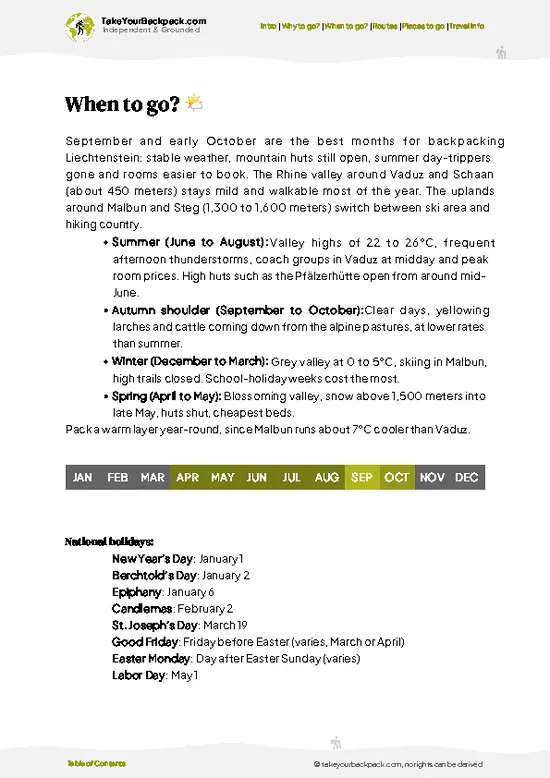
  • Ski Season (December to March): Malbun’s lifts run from roughly mid-December into late March or early April, with daytime highs around -3 to 3°C (27 to 37°F) at 1,600 meters. Days are short, about 8 to 9 hours of light in midwinter. Weekends and school holidays fill the slopes, and lift passes cost around €45 to 60 a day.
  • Spring Thaw (April to May): Lifts close, snow lingers on the upper trails, and many cafés and guesthouses shut for a few weeks. Temperatures sit around 3 to 12°C (37 to 54°F). Prices drop, but so does choice.
  • Summer Hiking (June to September): Daytime highs of 15 to 22°C (59 to 72°F) and up to 15 hours of light open the ridge trails toward Augstenberg and the Sareis chairlift. Afternoon thunderstorms are common in July and August. Weekends are busy with Liechtenstein families.
… read more 👉
  • Ski Season (December to March): Malbun’s lifts run from roughly mid-December into late March or early April, with daytime highs around -3 to 3°C (27 to 37°F) at 1,600 meters. Days are short, about 8 to 9 hours of light in midwinter. Weekends and school holidays fill the slopes, and lift passes cost around €45 to 60 a day.
  • Spring Thaw (April to May): Lifts close, snow lingers on the upper trails, and many cafés and guesthouses shut for a few weeks. Temperatures sit around 3 to 12°C (37 to 54°F). Prices drop, but so does choice.
  • Summer Hiking (June to September): Daytime highs of 15 to 22°C (59 to 72°F) and up to 15 hours of light open the ridge trails toward Augstenberg and the Sareis chairlift. Afternoon thunderstorms are common in July and August. Weekends are busy with Liechtenstein families.
  • Autumn (October to November): Crisp days of 2 to 12°C (36 to 54°F), larch needles turning gold, and quiet paths. Many businesses close in November before the ski season starts.
Go in late June through September for hiking or January through March for snow.


source: climatestotravel.comJANJanuary: fair for travelingFEBFebruary: fair for travelingMARMarch: fair for travelingAPRApril: good for travelingMAYMay: good for travelingJUNJune: highly recommended for travelingJULJuly: excellent for travelingAUGAugust: excellent for travelingSEPSeptember: highly recommended for travelingOCTOctober: good for travelingNOVNovember: good for travelingDECDecember: fair for traveling
liechtenstein-region-malbun
© Google | Randolfo Santos

✈️ The backpacker research shortcutLiechtenstein Travel Guide

What the free pages can't give you: ready-made routes, every place ranked, and it works offline. All in 1 guide.
example page 0 from our offline Travel Guide for Liechtenstein
example page 1 from our offline Travel Guide for Liechtenstein
example page 2 from our offline Travel Guide for Liechtenstein
example page 3 from our offline Travel Guide for Liechtenstein
example page 4 from our offline Travel Guide for Liechtenstein
example page 5 from our offline Travel Guide for Liechtenstein
example page 6 from our offline Travel Guide for Liechtenstein
example page 7 from our offline Travel Guide for Liechtenstein
The digital guide (106 pages) contains:-page digital guide:
✅ Ready-made 2, 3 & 5-day routes
✅ All 25 places ranked, so you skip the overrated ones
✅ Works offline, all in 1 guide
✅ Cities, national parks, landmarks, beaches
✅ How to get around
👉 Click to see all 30+ guide features

📅 Plan smarter in minutes, not weeks
✅ Month by month travel advice
✅ Festivals & national holidays
✅ Budget expectations

🗺️ Go to the right places, skip the overrated ones
✅ Honest pros & cons of destinations
✅ Top hikes, parks & viewpoints
✅ Lesser-known places most travelers miss
✅ Clear “worth it vs skip it” guidance

🛏️ Travel smoothly without rookie mistakes
✅ Best areas to stay
✅ Transport systems explained simply
✅ Common scams & safety advice
✅ SIM cards, money & practical tips

🌍 Understand the country, not just visit it
✅ Culture & traditions
✅ 52 Essential phrases & customs
✅ Festivals worth planning around
✅ Traveler-friendly historical context
✅ Insights that make places more meaningful

📱 Built for real travel conditions
✅ Fully downloadable PDF
✅ Works completely offline
✅ Optimized for phone use
✅ Useful in remote areas & buses
✅ All in 1 guide
Stop searching, start planning
Get instant access to your full guide. 30‑day money-back guarantee.


By proceeding you agree to our terms.
Sent to your inbox immediately after payment • 100% Secure Checkout
Best Backpacking Travel Advisor 2025 tourism awardBest Backpacking
Travel Advisor
2025
What others say about Take Your Backpack Guides:
⭐⭐⭐⭐⭐
Fantastic, amazing amount of information!
⭐⭐⭐⭐⭐
My goodness this is amazing, it's what I've been looking for hats off too you!
⭐⭐⭐⭐⭐
I think this is absolutely BRILLIANT
⭐⭐⭐⭐
Very complete and informative. It's still missing places, but I gotta to commend you
⭐⭐⭐⭐⭐
This is truly amazing, thank you, can't wait to explore it with my kids!
⭐⭐⭐⭐⭐
Awesome resource, thank you!
⭐⭐⭐⭐⭐
This is amazing! Can't wait to explore the ones I haven't seen
⭐⭐⭐⭐
I love this! Well done, great idea.
⭐⭐⭐⭐⭐
Thanks for taking the time to make this gem!
⭐⭐⭐⭐⭐
This might be the best website I've ever seen.
⭐⭐⭐⭐⭐
Congratulations, and thank you so much for your work; it's incredibly valuable.
⭐⭐⭐⭐
In all seriousness I think you did a great job pointing out the important spots
⭐⭐⭐⭐⭐
10/10 very good
⭐⭐⭐⭐⭐
As someone who's only just starting to visit regularly this is awesome, thank you.
⭐⭐⭐⭐
Thank you very much! I'm going to visit my dad, it's going to be very useful!
⭐⭐⭐⭐⭐
This is really cool! We'll be travelling for the first time and this definitely come in handy.
⭐⭐⭐⭐⭐
You are now our minister of culture, congratulations 👨‍💼
⭐⭐⭐⭐⭐
Just wanted to tell you that this is a pearl! Going to follow your recommendations.
⭐⭐⭐⭐⭐
This is so cool. I'll definitely be using the resource for my travels soon.
⭐⭐⭐⭐⭐
This is very impressive! Good work.
⭐⭐⭐⭐⭐
This is an amazing and informative site. Very well done!

🛏️ Where to stay?Choosing the right base

Malbun itself is the best base in the area, and for most backpackers it beats staying in the valley. The resort sits at about 1,600 meters at the end of the road, so you step from your door onto the slopes in winter or onto the trailheads in summer. It is compact, safe, and quiet at night, with the social side coming from the apres-ski terraces, mountain huts and shared tables rather than a party scene. Book ahead for winter weekends and school holidays.

Steg, a small village a few kilometers down the road at roughly 1,300 meters, suits those who want something calmer and a bit cheaper. It has … read more 👉
Malbun itself is the best base in the area, and for most backpackers it beats staying in the valley. The resort sits at about 1,600 meters at the end of the road, so you step from your door onto the slopes in winter or onto the trailheads in summer. It is compact, safe, and quiet at night, with the social side coming from the apres-ski terraces, mountain huts and shared tables rather than a party scene. Book ahead for winter weekends and school holidays.

Steg, a small village a few kilometers down the road at roughly 1,300 meters, suits those who want something calmer and a bit cheaper. It has a handful of guesthouses, a road tunnel back toward Triesenberg, and direct trails up toward Malbun and the Valuna valley. Evenings are very quiet, so it works best if you have your own food and early starts.

Vaduz, the capital, is the fallback if Malbun is closed or booked out. It is about 30 minutes by bus from the resort, has a hostel-style budget scene, supermarkets for cheap groceries, and trains and buses to Switzerland. It is safe and walkable, though lively only in summer.

🚌 Getting aroundGetting around like a local

Malbun's village center is a single strip you can walk end to end in about ten minutes, and the whole resort sits in a high bowl at roughly 1,600 meters, so nothing in the village needs a ride. Walking stops making sense the moment you want to leave the bowl: the road down to the valley is long and steep, and the trails that climb toward the ridges are where your legs earn their keep. Most backpackers arrive by public bus from the valley, then spend the days on foot or on the lifts, and the system runs dependably, though service thins out in the evening and in the quiet shoulder seasons.

Here is how I would move around.

  • LIEmobil bus from Vaduz: The route up the mountain climbs through Triesenberg in around 30 to 40 minutes, with hairpins that put the Rhine valley right outside your window.
… read more 👉
Malbun's village center is a single strip you can walk end to end in about ten minutes, and the whole resort sits in a high bowl at roughly 1,600 meters, so nothing in the village needs a ride. Walking stops making sense the moment you want to leave the bowl: the road down to the valley is long and steep, and the trails that climb toward the ridges are where your legs earn their keep. Most backpackers arrive by public bus from the valley, then spend the days on foot or on the lifts, and the system runs dependably, though service thins out in the evening and in the quiet shoulder seasons.

Here is how I would move around.

  • LIEmobil bus from Vaduz: The route up the mountain climbs through Triesenberg in around 30 to 40 minutes, with hairpins that put the Rhine valley right outside your window. A single bus ticket and a day ticket are both available, and the day ticket is the smarter buy if you plan to stop at Triesenberg on the way back down for coffee and the view.
  • On foot around the village: Everything sits within the bowl, so you stroll from a bakery to the lift station in minutes, with the air smelling of pine and woodsmoke in cooler months. In summer the flat walk along the valley floor toward the little chapel is the easiest warm-up, and you get quiet meadows with cowbells instead of traffic.
  • Chairlifts and cable cars: The lifts carry you from the village up toward the Sareis area and the high ridge in a few minutes, which saves a sweaty climb of one to two hours. Tickets run roughly €10 to 25 depending on the lift and whether you ride one way or return, and the top gets you big views over the Rhine valley and the Austrian and Swiss peaks. Walkers often ride up and hike down.
  • Hiking trails: Marked paths leave right from the village, and the ridge walks to the Austrian border area run around 2 to 4 hours. They are free, they are well signed, and they end at mountain huts where a hot meal and a cold drink taste better than anything you will get at sea level.
  • Taxi or hitching a ride down: A taxi to Vaduz costs around €35 to 50 and is worth splitting among three or four people after the last bus, though you should book ahead because cabs rarely cruise this far up. You get a door-to-door ride and no stress about missing the connection.

If you stay in Malbun overnight, buy a day ticket for the buses and ride the first lift up in the morning, when the trails are empty and the light is soft over the valley.

🍲 FoodEating & Drinking in Malbun

Malbun’s table is Alpine Liechtenstein: heavy, warm and built for cold hands. The signature is Käsknöpfle, small flour dumplings tossed with melted mountain cheese and topped with sweet fried onions, usually served with applesauce on the side. Order Ribel, a crumbly cornmeal dish served with milky coffee or stewed fruit, when you want something earthy and unusual. Pair either with a glass of local Vaduz Pinot Noir or a cold beer from the Liechtensteiner Brauhaus, and expect to pay around €15 to 25 for a main.

Eating happens in mountain restaurants and sunny terraces beside the lifts. Lunch on the slopes or trails is the cheaper move, with soup, Rösti topped with fried egg, or a sausage with bread running about €8 to 16. A small supermarket in the village sells bread, cheese and cured meat … read more 👉
Malbun’s table is Alpine Liechtenstein: heavy, warm and built for cold hands. The signature is Käsknöpfle, small flour dumplings tossed with melted mountain cheese and topped with sweet fried onions, usually served with applesauce on the side. Order Ribel, a crumbly cornmeal dish served with milky coffee or stewed fruit, when you want something earthy and unusual. Pair either with a glass of local Vaduz Pinot Noir or a cold beer from the Liechtensteiner Brauhaus, and expect to pay around €15 to 25 for a main.

Eating happens in mountain restaurants and sunny terraces beside the lifts. Lunch on the slopes or trails is the cheaper move, with soup, Rösti topped with fried egg, or a sausage with bread running about €8 to 16. A small supermarket in the village sells bread, cheese and cured meat for picnics, which saves money on hiking days.

Prices are in Swiss francs, and service is included, though rounding up a few euros is normal. Kitchens often close between lunch and early evening, so eat by 2 pm or wait for dinner service. Say Grüezi when you walk in and share a long table without fuss.

FAQFrequently asked questions about Malbun

Two days is enough for Malbun if you want a full mountain fix: one day for a ridge hike or a ski day, and one for easier walks around the bowl. Add a third day if you want to link a trail toward the Austrian border or stop at Triesenberg on the way down. Day trippers from Vaduz can manage a half day, since the bus ride takes 30 to 40 minutes each way.
Public buses make Malbun easy without a car, with LIEmobil running up from Vaduz via Triesenberg in around 30 to 40 minutes. A bus ticket and a day ticket are both on offer, and the day ticket suits anyone hopping off at Triesenberg. Once in Malbun, the village is walkable end to end in about ten minutes, and chairlifts take you uphill. A taxi back to Vaduz costs roughly €35 to 50 if the buses have stopped.
Malbun is known as Liechtenstein's only real ski resort, a small, family-friendly village at around 1,600 meters in a high bowl. In winter it offers modest slopes and lifts with views over the Rhine valley, and in summer it turns into a base for hiking toward the Austrian border and the ridges above. Lift tickets run roughly €10 to 25 for summer rides, and the resort is a short bus ride from Vaduz, so it is easy to fit into a day.
⚠️ Things can change over time, so always validate details locally before you go.

Ideas for continuing your journey

Malbun isn’t the only highlight in Liechtenstein. Explore all what Liechtenstein has to offer.
Country photo of Liechtenstein

We 💚 feedbackKey takeaways before you go

Malbun works best as the high-altitude end of a Liechtenstein trip, paired with a night in Vaduz or a day around Triesenberg and the Sücka pass. Combine it with a Swiss or Austrian mountain town on the same trip, and it becomes a calm interlude between busier stops. Bring layers, because mornings are cold even in summer, and book a hut bed early if you want the Pfälzerhütte.

✍️ Help improve this page!
The information on this page is based on in-depth research, insights shared by experienced travelers, and feedback from the local travel community in Liechtenstein. While every effort is made to keep the information accurate and current, conditions can change — so if you spot anything incorrect or outdated, please get in touch.


🙋‍♂️ Give feedback

👋 Meet the founderWho’s Behind Take Your Backpack?

Johan, backpacker and founder of TakeYourBackpackHi, I’m Johan (Netherlands 🇳🇱), the creator of TakeYourBackpack. Over the past 30 years, I’ve backpacked through 88 countries across six continents, gaining extensive experience with independent travel, long-term trips, and overland routes.

This site is built on a combination of firsthand travel experience and carefully curated insights from other backpackers. Many guides are based on places I’ve personally visited, while others bring together tips, observations, and practical advice shared by trusted travelers I’ve met along the way.

The goal is to provide realistic, experience-driven guidance — not generic itineraries — so you can explore destinations with better context, clearer expectations, and more confidence.