×

Mauritius🇲🇺 | national parksÎle aux Aigrettes Nature ReserveLagoon islet, Aldabra tortoises, coral shore, restored ebony | things to do and best time to go

Explore Bras d’Eau National ParkExplore La Vallée de Ferney

Backpacking in Île aux Aigrettes Nature Reserve
🏆 Top picknational park ranked #2
By Johan Kruseman 🇳🇱 | Updated October 22, 2026

Guided walks run on a fixed schedule, so you get a conservationist at your elbow who knows each tree by name and each gecko by its hiding spot. Île aux Aigrettes Nature Reserve is a 26-hectare coral islet in the lagoon off Mauritius’s southeast coast, a few minutes by boat from Pointe Jérôme near Mahébourg. The good side is plain: rare pink pigeons, giant Aldabra tortoises and a patch of restored coastal ebony forest that once covered the whole island. The limits are plain too. You can’t wander freely, the path is short and flat, and groups stay small, so booking ahead matters. Don’t expect hiking mileage or white-knuckle views. The vibe is quiet, scientific and surprisingly personal. Take a morning slot when the birds are active and the heat is gentle. Your first day could go like this: cross at the start of the tour, shuffle along the sandy path behind your guide, then finish with lagoon views and a cold drink back on the mainland.

Discover everything you want to know in the 📖 Mauritius Travel Guide.


example page 0 from our offline Travel Guide for Mauritius
example page 1 from our offline Travel Guide for Mauritius
example page 2 from our offline Travel Guide for Mauritius
example page 3 from our offline Travel Guide for Mauritius
example page 4 from our offline Travel Guide for Mauritius
example page 5 from our offline Travel Guide for Mauritius
example page 6 from our offline Travel Guide for Mauritius
example page 7 from our offline Travel Guide for Mauritius
Loading the map 🌍
CLICK TO FILTER
cities
towns
villages
landmarks
national parks
hikes
beaches
attractions
festivals
regions
SHOW COUNTRY’S BESTSHOW ALL

✨ Why go?
Ranked #2 national park in Mauritius
What makes it a must-see national park

Île aux Aigrettes Nature Reserve suits backpackers who want wildlife that is hard to see anywhere else, without paying for a pricey safari-style trip. It is one of the places where Mauritius’s native ecosystem is being rebuilt by hand, and the guides explain the work with the enthusiasm of people who do it daily. You walk through what is left of the dry coastal ebony forest, where the dark-trunked trees and replanted natives stand in coral rubble rather than soil. Here you meet Aldabra giant tortoises, brought in to take over the grazing role of extinct Mauritian species, and you can watch them lumber across the path. The reserve is also a refuge for the pink pigeon, the Mauritius kestrel and the Telfair’s skink, along with several rare geckos. Independent travelers like it because it fits … read more 👉
Île aux Aigrettes Nature Reserve suits backpackers who want wildlife that is hard to see anywhere else, without paying for a pricey safari-style trip. It is one of the places where Mauritius’s native ecosystem is being rebuilt by hand, and the guides explain the work with the enthusiasm of people who do it daily. You walk through what is left of the dry coastal ebony forest, where the dark-trunked trees and replanted natives stand in coral rubble rather than soil. Here you meet Aldabra giant tortoises, brought in to take over the grazing role of extinct Mauritian species, and you can watch them lumber across the path. The reserve is also a refuge for the pink pigeon, the Mauritius kestrel and the Telfair’s skink, along with several rare geckos. Independent travelers like it because it fits easily into a loose itinerary around the southeast coast, and the entry price supports the conservation work directly. Tours are the only way in, which sounds restrictive but means every visitor learns something specific about the island’s fragile past.

💡 HighlightsWhat this place is best known for

  1. Guided Nature Walk: The core experience is the roughly 1.5-hour guided loop through the reserve, with a naturalist explaining the restoration of the island’s original forest.
  2. Pink Pigeon Sightings: Once down to around ten birds worldwide, this rosy-feathered species now thrives here, and you may spot them near the feeding areas.
  3. Aldabra Giant Tortoises: These slow giants, some weighing more than 100 kilograms, graze along the path and are happy to let you stand close.
  4. Ebony Forest Remnant: Dense, dark-wooded trees such as ebony and rare native palms show how the Mauritian coast looked before settlement.
  5. Telfair’s Skink and Native Geckos: Small reptiles dart over coral stones and tree trunks, and the guides know exactly where to find the best ones.
  6. Mauritius Kestrel and Olive White-Eye: Keep your
… read more 👉
  1. Guided Nature Walk: The core experience is the roughly 1.5-hour guided loop through the reserve, with a naturalist explaining the restoration of the island’s original forest.
  2. Pink Pigeon Sightings: Once down to around ten birds worldwide, this rosy-feathered species now thrives here, and you may spot them near the feeding areas.
  3. Aldabra Giant Tortoises: These slow giants, some weighing more than 100 kilograms, graze along the path and are happy to let you stand close.
  4. Ebony Forest Remnant: Dense, dark-wooded trees such as ebony and rare native palms show how the Mauritian coast looked before settlement.
  5. Telfair’s Skink and Native Geckos: Small reptiles dart over coral stones and tree trunks, and the guides know exactly where to find the best ones.
  6. Mauritius Kestrel and Olive White-Eye: Keep your eyes on the canopy for these endemic birds, which have been brought back from the brink in conservation programs.
  7. Coral Limestone Shoreline: The rough, pale rock edge of the islet looks out over the southeast lagoon and the mainland mountains beyond.
  8. Old Quarantine and Research Buildings: Remains of past human use and the working conservation base show how the island is managed today.
For a first visit, the guided nature walk is the one to prioritize, since it brings together the tortoises, pigeons and forest in a single outing, and Île aux Aigrettes Nature Reserve can only be seen this way.
Spotted a mistake or missing something? Contact us.

Things to do near Île aux Aigrettes Nature Reserve

Ratings based on Tripadvisor reviews. When you book through this link, you support our work at no extra cost to you.

🌤️ When to go?When to go for the best experience

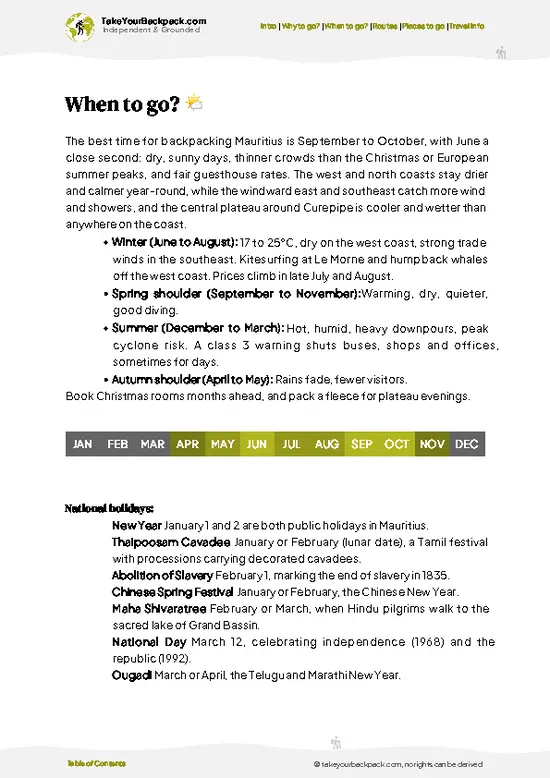
  • Cool Dry Season (May to November): Days run 20 to 26°C (68 to 79°F), with lower humidity and little rain, which suits the 1.5 to 2 hour guided walks across the islet’s open ground. Daylight lasts about 11 to 12 hours. Pink pigeons and Telfair’s skinks are active in the mild mornings.
  • Hot Wet Season (December to April): Expect 27 to 32°C (81 to 90°F), heavy humidity and sudden downpours. Cyclone risk peaks from January to March, and boat transfers can be canceled in rough weather. Daylight stretches to about 13 hours. Midday walks feel punishing, so book the earliest slot.
  • Crowds and Prices: Tours have small group caps, so slots fill in July to August and over Christmas and New Year, when Mauritius accommodation prices climb. September to October and May to June are quieter and cheaper.
Book your … read more 👉
  • Cool Dry Season (May to November): Days run 20 to 26°C (68 to 79°F), with lower humidity and little rain, which suits the 1.5 to 2 hour guided walks across the islet’s open ground. Daylight lasts about 11 to 12 hours. Pink pigeons and Telfair’s skinks are active in the mild mornings.
  • Hot Wet Season (December to April): Expect 27 to 32°C (81 to 90°F), heavy humidity and sudden downpours. Cyclone risk peaks from January to March, and boat transfers can be canceled in rough weather. Daylight stretches to about 13 hours. Midday walks feel punishing, so book the earliest slot.
  • Crowds and Prices: Tours have small group caps, so slots fill in July to August and over Christmas and New Year, when Mauritius accommodation prices climb. September to October and May to June are quieter and cheaper.
Book your tour a few days ahead in any season, and choose the first departure of the day.


source: climatestotravel.comJANJanuary: fair for travelingFEBFebruary: fair for travelingMARMarch: fair for travelingAPRApril: fair for travelingMAYMay: highly recommended for travelingJUNJune: excellent for travelingJULJuly: highly recommended for travelingAUGAugust: highly recommended for travelingSEPSeptember: highly recommended for travelingOCTOctober: excellent for travelingNOVNovember: below average for travelingDECDecember: below average for traveling
mauritius-national-park-ile-aux-aigrettes-nature-reserve v1
© Google |

✈️ The backpacker research shortcutMauritius Travel Guide

An offline-friendly backpacking guide with optimized travel routes, ranked highlights, transport advice, and the best areas to stay.
example page 0 from our offline Travel Guide for Mauritius
example page 1 from our offline Travel Guide for Mauritius
example page 2 from our offline Travel Guide for Mauritius
example page 3 from our offline Travel Guide for Mauritius
example page 4 from our offline Travel Guide for Mauritius
example page 5 from our offline Travel Guide for Mauritius
example page 6 from our offline Travel Guide for Mauritius
example page 7 from our offline Travel Guide for Mauritius
The digital guide (208 pages) contains:
✅ 65 highlights, ranked by travel appeal
✅ Optimized 2, 3 & 5-day travel routes
✅ Cities, national parks, landmarks, beaches
✅ How to get around
✅ Offline-friendly for travel without Wi-Fi
👉 Click to see all 30+ guide features

📅 Plan smarter in minutes, not weeks
✅ Month by month travel advice
✅ Festivals & national holidays
✅ Budget expectations

🗺️ Go to the right places, skip the overrated ones
✅ Honest pros & cons of destinations
✅ Top hikes, parks & viewpoints
✅ Lesser-known places most travelers miss
✅ Clear “worth it vs skip it” guidance

🛏️ Travel smoothly without rookie mistakes
✅ Best areas to stay
✅ Transport systems explained simply
✅ Common scams & safety advice
✅ SIM cards, money & practical tips

🌍 Understand the country, not just visit it
✅ Culture & traditions
✅ 52 Essential phrases & customs
✅ Festivals worth planning around
✅ Traveler-friendly historical context
✅ Insights that make places more meaningful

📱 Built for real travel conditions
✅ Fully downloadable PDF
✅ Works completely offline
✅ Optimized for phone use
✅ Useful in remote areas & buses
✅ Everything in one place
Stop searching, start planning
Get instant access to your full guide. 30‑day money-back guarantee.
+ Add another guide for just

By proceeding you agree to our terms.
Sent to your inbox immediately after payment • 100% Secure Checkout
Best Backpacking Travel Advisor 2025 tourism awardBest Backpacking
Travel Advisor
2025
What others say about Take Your Backpack Guides:
⭐⭐⭐⭐⭐
Fantastic, amazing amount of information!
⭐⭐⭐⭐⭐
My goodness this is amazing, it's what I've been looking for hats off too you!
⭐⭐⭐⭐⭐
I think this is absolutely BRILLIANT
⭐⭐⭐⭐
Very complete and informative. It's still missing places, but I gotta to commend you
⭐⭐⭐⭐⭐
This is truly amazing, thank you, can't wait to explore it with my kids!
⭐⭐⭐⭐⭐
Awesome resource, thank you!
⭐⭐⭐⭐⭐
This is amazing! Can't wait to explore the ones I haven't seen
⭐⭐⭐⭐
I love this! Well done, great idea.
⭐⭐⭐⭐⭐
Thanks for taking the time to make this gem!
⭐⭐⭐⭐⭐
This might be the best website I've ever seen.
⭐⭐⭐⭐⭐
Congratulations, and thank you so much for your work; it's incredibly valuable.
⭐⭐⭐⭐
In all seriousness I think you did a great job pointing out the important spots
⭐⭐⭐⭐⭐
10/10 very good
⭐⭐⭐⭐⭐
As someone who's only just starting to visit regularly this is awesome, thank you.
⭐⭐⭐⭐
Thank you very much! I'm going to visit my dad, it's going to be very useful!
⭐⭐⭐⭐⭐
This is really cool! We'll be travelling for the first time and this definitely come in handy.
⭐⭐⭐⭐⭐
You are now our minister of culture, congratulations 👨‍💼
⭐⭐⭐⭐⭐
Just wanted to tell you that this is a pearl! Going to follow your recommendations.
⭐⭐⭐⭐⭐
This is so cool. I'll definitely be using the resource for my travels soon.
⭐⭐⭐⭐⭐
This is very impressive! Good work.
⭐⭐⭐⭐⭐
This is an amazing and informative site. Very well done!

🛏️ Where to stay?How to pick the right area

There is no accommodation on Île aux Aigrettes Nature Reserve, so you sleep on the mainland, and Mahébourg is the practical choice for backpackers. This old fishing town sits a few minutes from the departure jetty at the Ile aux Aigrettes visitor center, which is where boats leave for the islet. Guesthouses and small family-run lodgings here cost roughly US$25 to 55 a night for a private room, and the daily market and cheap snack stalls keep food costs down. Buses connect Mahébourg with Curepipe, Port Louis and the southeast coast.
Blue Bay, about 10 to 15 minutes by road to the south, offers beach-side … read more 👉
There is no accommodation on Île aux Aigrettes Nature Reserve, so you sleep on the mainland, and Mahébourg is the practical choice for backpackers. This old fishing town sits a few minutes from the departure jetty at the Ile aux Aigrettes visitor center, which is where boats leave for the islet. Guesthouses and small family-run lodgings here cost roughly US$25 to 55 a night for a private room, and the daily market and cheap snack stalls keep food costs down. Buses connect Mahébourg with Curepipe, Port Louis and the southeast coast.
Blue Bay, about 10 to 15 minutes by road to the south, offers beach-side guesthouses and self-catering apartments from about US$40 to 80, plus a marine park for snorkeling. It is calmer and better if you want swimming time. Pointe d’Esny, between the two, has quiet B&Bs and villas, mostly in the US$50 to 100 range, and is a short ride from the jetty.
Southern coastal stays near Bel Ombre or Souillac are possible but add a long drive. Dorm beds are scarce in this corner of Mauritius, so private rooms shared between two people give the best value. Book ahead for July, August and December.

👛 Costs (as of 22 October 2026)How expensive it really is

A visit to Île aux Aigrettes Nature Reserve costs about US$70 to 129 per person per day once you add a mainland bed, food and transfers. The reserve is only reachable on a guided tour, which is the main expense, and the rest depends on how simply you live in the southeast.
CategoryBudget RangeLocal Reality
Guided tour and entryUS$25 to 35Entry is only through the guided walk, usually around 1.5 hours, and the boat transfer is included. Book ahead for the small groups.
Accommodation (high season)US$30 to 60Private rooms in Mahébourg guesthouses; dorm beds are rare. Prices drop US$5 to 15 in low season.
Local transportUS$2 to 8Buses to Mahébourg cost under US$2 per ride. A taxi to the jetty from town runs about US$5 to 10.
Food and suppliesUS$10 to 20Street snacks such as dholl puri cost US$0.50
… read more 👉
A visit to Île aux Aigrettes Nature Reserve costs about US$70 to 129 per person per day once you add a mainland bed, food and transfers. The reserve is only reachable on a guided tour, which is the main expense, and the rest depends on how simply you live in the southeast.
CategoryBudget RangeLocal Reality
Guided tour and entryUS$25 to 35Entry is only through the guided walk, usually around 1.5 hours, and the boat transfer is included. Book ahead for the small groups.
Accommodation (high season)US$30 to 60Private rooms in Mahébourg guesthouses; dorm beds are rare. Prices drop US$5 to 15 in low season.
Local transportUS$2 to 8Buses to Mahébourg cost under US$2 per ride. A taxi to the jetty from town runs about US$5 to 10.
Food and suppliesUS$10 to 20Street snacks such as dholl puri cost US$0.50 to 1.50, and a sit-down curry is around US$5 to 10. Pay in rupees.
Water, sunscreen and extrasUS$3 to 6Bottled water and sun protection are cheaper in Mahébourg supermarkets than at the jetty.
Total Daily BudgetUS$70 to 129Covers one tour day with a mid-range guesthouse bed, meals and local transfers.
⚠️ Prices can change and everyone travels differently, so take this as a rough guide. Hope it helps you plan your adventure!

🥾 TrailsWhere to hike in Île aux Aigrettes Nature Reserve: trails for every level

Île aux Aigrettes Nature Reserve has no long-distance hiking, but the guided island walk is a well-run, easy outing with plenty to see. The terrain is flat, sandy and rocky, with coral stones underfoot, so closed shoes help.
  • Guided Island Walk: Around 1.5 hours at a slow pace, easy difficulty, on a narrow path of packed sand and coral rock. You pass the ebony forest, tortoise areas and bird feeding spots.
  • Wildlife: Pink pigeons, Mauritius kestrels, Aldabra tortoises, Telfair’s skinks and nocturnal geckos. Guides point out well-camouflaged species you would otherwise miss.
  • Terrain: Mostly level, with
… read more 👉
Île aux Aigrettes Nature Reserve has no long-distance hiking, but the guided island walk is a well-run, easy outing with plenty to see. The terrain is flat, sandy and rocky, with coral stones underfoot, so closed shoes help.
  • Guided Island Walk: Around 1.5 hours at a slow pace, easy difficulty, on a narrow path of packed sand and coral rock. You pass the ebony forest, tortoise areas and bird feeding spots.
  • Wildlife: Pink pigeons, Mauritius kestrels, Aldabra tortoises, Telfair’s skinks and nocturnal geckos. Guides point out well-camouflaged species you would otherwise miss.
  • Terrain: Mostly level, with some uneven rock and little shade in open stretches, so a hat and water bottle are useful.
  • Difficulty: Suitable for most fitness levels, including children, though the pace is slow and standing time is long.
Getting there is by a short boat transfer from the mainland jetty near Mahébourg, which is reachable by bus from many parts of the island and then a short taxi ride. Visits are by tour only and entry is paid, with tickets supporting the reserve’s conservation work. Numbers are limited, so it rarely feels crowded, although the popular morning slots fill up in busy periods. Early booking is wise, and rough lagoon conditions can occasionally affect crossings.
⚠️ Hiking info can sometimes be outdated or inaccurate. Before you hit the trail, check the latest conditions with locals. If you do spot anything that's off, I'd love to hear from you, so I can update it for fellow travelers.

🛡️ SafetyScams, Hazards, and Annoyances

Île aux Aigrettes Nature Reserve is a flat, small islet with a guided, marked path, so the hazards are mild and mostly about sun and heat. There is little shade on the drier sections, and the coral limestone ground reflects glare. Bring a hat, a liter or more of water, sunscreen and closed shoes with grip, because the path can be uneven and rocky in places. Insect repellent helps in the wetter months.
The wildlife is harmless. You will meet giant Aldabra tortoises, geckos, skinks and the rare pink pigeon, which may come close. Keep to the path, never feed or touch animals, and follow your guide’s directions, since this is a restoration site for fragile species. The crossing is a short boat ride in a small boat; waves can be choppy in windy weather, so keep your bag in a dry sack. Cyclone-season … read more 👉
Île aux Aigrettes Nature Reserve is a flat, small islet with a guided, marked path, so the hazards are mild and mostly about sun and heat. There is little shade on the drier sections, and the coral limestone ground reflects glare. Bring a hat, a liter or more of water, sunscreen and closed shoes with grip, because the path can be uneven and rocky in places. Insect repellent helps in the wetter months.
The wildlife is harmless. You will meet giant Aldabra tortoises, geckos, skinks and the rare pink pigeon, which may come close. Keep to the path, never feed or touch animals, and follow your guide’s directions, since this is a restoration site for fragile species. The crossing is a short boat ride in a small boat; waves can be choppy in windy weather, so keep your bag in a dry sack. Cyclone-season swells sometimes cancel departures, so keep your schedule loose.

FAQCommon questions from travelers

Half a day is enough for Île aux Aigrettes Nature Reserve, since the guided walk takes about 1.5 to 2 hours and boats leave in the morning and early afternoon. Most travelers pair it with a second day in Mahébourg or Blue Bay for the market, the National History Museum and snorkeling. A full day in the area works best for slower schedules.
Yes, Île aux Aigrettes Nature Reserve is easy without a car. Buses run from Curepipe and Port Louis to Mahébourg (about 1 to 2 hours), and from there a taxi to the jetty takes roughly 10 minutes and costs about US$5 to 10. Boat transfers to the islet are included in the tour price.
Yes, Île aux Aigrettes Nature Reserve can only be entered on a guided tour, so the tour ticket works as your entry and permit. Expect to pay roughly US$25 to 35 per adult, with lower prices for children, and book ahead in July, August and December. The tour includes the boat crossing from the mainland jetty near Mahébourg.
⚠️ Things can change over time, so always validate details locally before you go.

Other Mauritian national parks near Île aux Aigrettes Nature Reserve

Explore more nearby:


💡 Not sure where to go next?
Create a personalized itinerary for Mauritius including Île aux Aigrettes Nature Reserve and the places that fit your trip.

Generate my itinerary

👉 Discover all national parks

Or checkout all Mauritius has to offer (think cities, towns, villages, national parks, hikes, beaches, festivals)
Country photo of Mauritius

We 💚 feedbackParting advice and final tips

Île aux Aigrettes Nature Reserve pairs neatly with a day around Mahébourg, where you can add the old naval museum, the market and the lagoon beaches nearby. I would book the earliest slot, then spend the afternoon at Blue Bay, since the two give you wildlife and snorkeling in one easy loop. Bring a hat and a refillable bottle.

✍️ Help improve this page!
The information on this page is based on in-depth research, insights shared by experienced travelers, and feedback from the local travel community in Mauritius. While every effort is made to keep the information accurate and current, conditions can change — so if you spot anything incorrect or outdated, please get in touch.


🙋‍♂️ Give feedback

👋 Meet the founderWho’s Behind Take Your Backpack?

Johan, backpacker and founder of TakeYourBackpackHi, I’m Johan (Netherlands 🇳🇱), the creator of TakeYourBackpack. Over the past 3 decades, I’ve backpacked through 90+ countries across six continents, gaining extensive experience with independent travel, long-term trips, and overland routes.

This site is built on a combination of firsthand travel experience and carefully curated insights from other backpackers. Many guides are based on places I’ve personally visited, while others bring together tips, observations, and practical advice shared by trusted travelers I’ve met along the way.

The goal is to provide realistic, experience-driven guidance — not generic itineraries — so you can explore destinations with better context, clearer expectations, and more confidence.