×

Mauritius🇲🇺 | landmarksTrou aux CerfsDormant crater, forested bowl, rim road, plateau panorama | things to do and best time to go

Explore Rochester FallsExplore Chamarel

Backpacking in Trou aux Cerfs
🏆 Top pickunique site ranked #2
By Johan Kruseman 🇳🇱 | Updated October 22, 2026

Trou aux Cerfs is a dormant volcanic crater, with no lava, no active vents and no deer wandering the rim, though the French name means “deer hole” and hints at old hunting days. It sits in Curepipe, on the cool central plateau of Mauritius, south of Port Louis. Be honest with yourself about what you’re getting. There’s a crater, a ring road and a view, so a visit takes under an hour, and tour buses do stop here for photos. Entry costs nothing, which keeps the cost side painless. What makes it worth the detour is the scale of that forested bowl, with a small lake at the bottom, and the panorama over the plateau toward the Moka range, Pieter Both and, on clear days, the sea. Locals jog and walk the rim at dawn. Go early, because cloud often rolls in by midday.

Discover everything you want to know in the 📖 Mauritius Travel Guide.


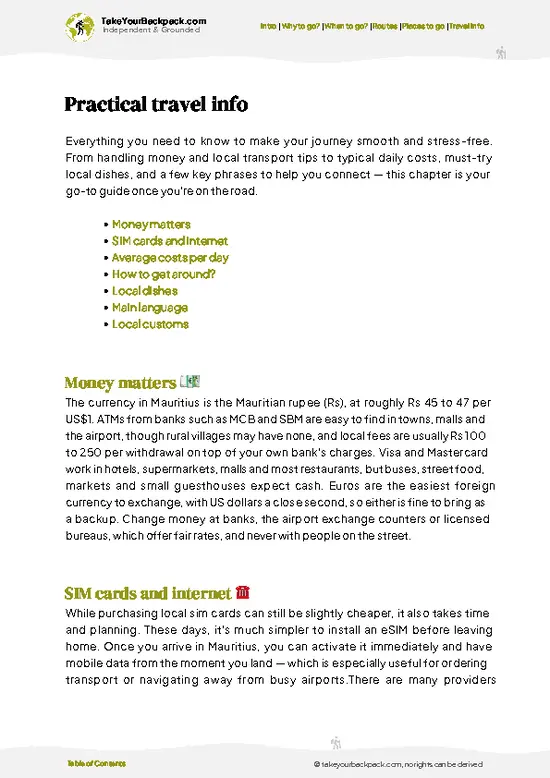
example page 0 from our offline Travel Guide for Mauritius
example page 1 from our offline Travel Guide for Mauritius
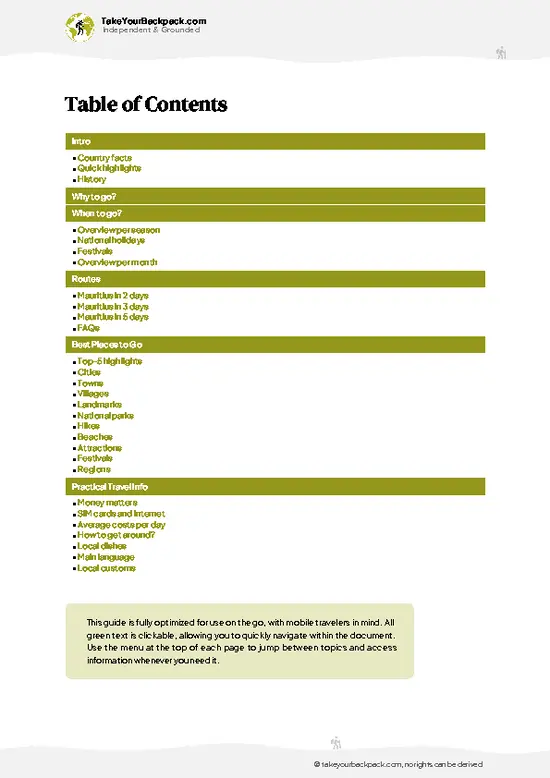
example page 2 from our offline Travel Guide for Mauritius
example page 3 from our offline Travel Guide for Mauritius
example page 4 from our offline Travel Guide for Mauritius
example page 5 from our offline Travel Guide for Mauritius
example page 6 from our offline Travel Guide for Mauritius
example page 7 from our offline Travel Guide for Mauritius
Loading the map 🌍
CLICK TO FILTER
cities
towns
villages
landmarks
national parks
hikes
beaches
attractions
festivals
regions
SHOW COUNTRY’S BESTSHOW ALL

✨ Why go?
Ranked #2 unique site in Mauritius
Why visitors keep coming back

Trou aux Cerfs gives you the island’s highland side in one quick stop, which most beach-focused itineraries never show. The crater is roughly 300 meters across and about 85 meters deep, so the drop below the rim is genuinely dramatic, with trees growing thick over the slopes and a still lake at the bottom. Because you can walk the full rim, you get changing angles on the same hole instead of one fixed viewpoint.

The second reason is fit. Curepipe is the commercial heart of the plateau, so Trou aux Cerfs combines easily with a wander through its colonial-era streets, the Curepipe Botanical Garden and the craft shops that sell model ships. Curepipe is also the wettest, coolest town on Mauritius, so the crater offers a break from coastal heat and an easy way to see how the weather changes with … read more 👉
Trou aux Cerfs gives you the island’s highland side in one quick stop, which most beach-focused itineraries never show. The crater is roughly 300 meters across and about 85 meters deep, so the drop below the rim is genuinely dramatic, with trees growing thick over the slopes and a still lake at the bottom. Because you can walk the full rim, you get changing angles on the same hole instead of one fixed viewpoint.

The second reason is fit. Curepipe is the commercial heart of the plateau, so Trou aux Cerfs combines easily with a wander through its colonial-era streets, the Curepipe Botanical Garden and the craft shops that sell model ships. Curepipe is also the wettest, coolest town on Mauritius, so the crater offers a break from coastal heat and an easy way to see how the weather changes with altitude.

It costs nothing to enter and works as a half-day add-on between the west coast and the south. For backpackers on a budget, that’s a free viewpoint with real geology under your feet, plus the Moka range panorama that locals bring visitors to see.

💡 HighlightsMust-see experiences and standout moments

  1. The crater rim walk: A paved road circles the top, and walking it gives you the best sense of the bowl’s size, around 300 meters wide. Trees and thick brush fill the slopes, and the shape reads clearly as an old volcanic cone.
  2. The crater lake: At the bottom sits a small, still pond, often dark green and ringed by vegetation. It’s something to look down on rather than visit, and it explains the “hole” in the name.
  3. The panoramic viewpoint: From the rim, you look out over the central plateau toward the Moka range and Pieter Both, with the Trois Mamelles peaks showing on clear days. On the sharpest mornings the coastline is visible far off.
  4. The orientation table: A viewing platform and marker on the rim helps you name the mountains on the horizon. It’s a useful reference if you plan hikes elsewhere
… read more 👉
  1. The crater rim walk: A paved road circles the top, and walking it gives you the best sense of the bowl’s size, around 300 meters wide. Trees and thick brush fill the slopes, and the shape reads clearly as an old volcanic cone.
  2. The crater lake: At the bottom sits a small, still pond, often dark green and ringed by vegetation. It’s something to look down on rather than visit, and it explains the “hole” in the name.
  3. The panoramic viewpoint: From the rim, you look out over the central plateau toward the Moka range and Pieter Both, with the Trois Mamelles peaks showing on clear days. On the sharpest mornings the coastline is visible far off.
  4. The orientation table: A viewing platform and marker on the rim helps you name the mountains on the horizon. It’s a useful reference if you plan hikes elsewhere on the island and want to spot the peaks first.
  5. Curepipe’s cool-weather atmosphere: At roughly 600 meters, the air is noticeably cooler and often misty. Mist drifting across the crater changes the mood completely, and you’ll want a light layer even when the coast is baking.
  6. Curepipe Botanical Garden: A short ride from the crater, this small garden holds palms, old trees and shaded paths. It pairs easily with the crater for a relaxed highland morning.
  7. Curepipe town center: Nearby streets hold colonial buildings, the town hall, shops selling model ships and plenty of casual local food stalls. It shows everyday plateau life far from the resorts.
At Trou aux Cerfs, walk the rim first, early in the morning, because the view across the plateau is clearest before clouds close in and the lake and far peaks can vanish by midday.
Spotted a mistake or missing something? Contact us.

Things to do near Trou aux Cerfs

Ratings based on Tripadvisor reviews. When you book through this link, you support our work at no extra cost to you.

🌤️ When to go?Choosing the right time of year

  • Cool Dry Season (May to October): Mornings are clear more often, with highs of 20 to 24°C (68 to 75°F) and nights down to 12 to 15°C (54 to 59°F) at Curepipe’s altitude. Daylight is about 11 hours. Pack a fleece.
  • Hot Wet Season (November to April): Highs reach 25 to 28°C (77 to 82°F) and afternoon downpours are frequent. January to March is the peak for cyclones and thick cloud over the crater rim. Daylight stretches to about 13 hours.
  • Crowds: Curepipe stays quiet outside school holidays. Local and European holiday crowds arrive around Christmas and New Year and in July and August, though the rim rarely holds more than a few dozen people.
  • Prices: Beds rise by 20 to 40 percent from mid-December to early January. Shoulder months of September to November are the cheapest for their weather.
Go early … read more 👉
  • Cool Dry Season (May to October): Mornings are clear more often, with highs of 20 to 24°C (68 to 75°F) and nights down to 12 to 15°C (54 to 59°F) at Curepipe’s altitude. Daylight is about 11 hours. Pack a fleece.
  • Hot Wet Season (November to April): Highs reach 25 to 28°C (77 to 82°F) and afternoon downpours are frequent. January to March is the peak for cyclones and thick cloud over the crater rim. Daylight stretches to about 13 hours.
  • Crowds: Curepipe stays quiet outside school holidays. Local and European holiday crowds arrive around Christmas and New Year and in July and August, though the rim rarely holds more than a few dozen people.
  • Prices: Beds rise by 20 to 40 percent from mid-December to early January. Shoulder months of September to November are the cheapest for their weather.
Go early in the morning, before cloud builds over the Curepipe plateau, to see the Trois Mamelles and the Moka range.


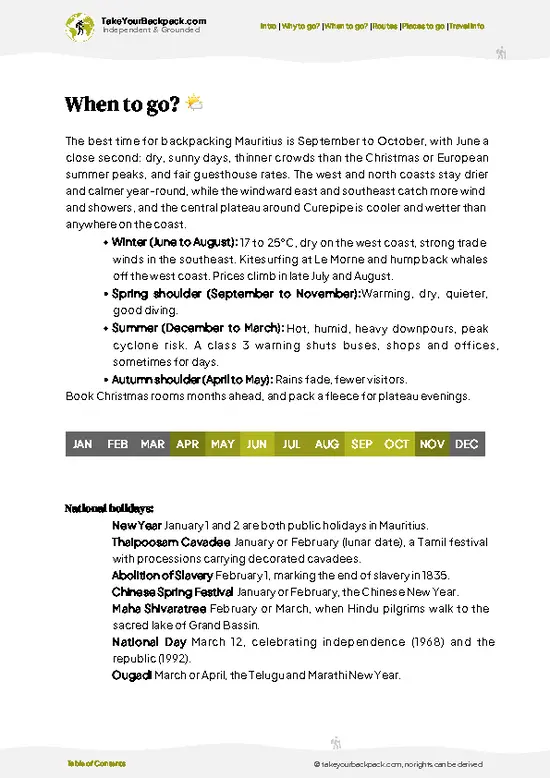
source: climatestotravel.comJANJanuary: fair for travelingFEBFebruary: fair for travelingMARMarch: fair for travelingAPRApril: good for travelingMAYMay: highly recommended for travelingJUNJune: highly recommended for travelingJULJuly: excellent for travelingAUGAugust: excellent for travelingSEPSeptember: highly recommended for travelingOCTOctober: highly recommended for travelingNOVNovember: highly recommended for travelingDECDecember: fair for traveling
mauritius-unique-site-trou-aux-cerfs v1
© Google |

✈️ The backpacker research shortcutMauritius Travel Guide

An offline-friendly backpacking guide with optimized travel routes, ranked highlights, transport advice, and the best areas to stay.
example page 0 from our offline Travel Guide for Mauritius
example page 1 from our offline Travel Guide for Mauritius
example page 2 from our offline Travel Guide for Mauritius
example page 3 from our offline Travel Guide for Mauritius
example page 4 from our offline Travel Guide for Mauritius
example page 5 from our offline Travel Guide for Mauritius
example page 6 from our offline Travel Guide for Mauritius
example page 7 from our offline Travel Guide for Mauritius
The digital guide (246 pages) contains:
✅ 65 highlights, ranked by travel appeal
✅ Optimized 2, 3 & 5-day travel routes
✅ Cities, national parks, landmarks, beaches
✅ How to get around
✅ Offline-friendly for travel without Wi-Fi
👉 Click to see all 30+ guide features

📅 Plan smarter in minutes, not weeks
✅ Month by month travel advice
✅ Festivals & national holidays
✅ Budget expectations

🗺️ Go to the right places, skip the overrated ones
✅ Honest pros & cons of destinations
✅ Top hikes, parks & viewpoints
✅ Lesser-known places most travelers miss
✅ Clear “worth it vs skip it” guidance

🛏️ Travel smoothly without rookie mistakes
✅ Best areas to stay
✅ Transport systems explained simply
✅ Common scams & safety advice
✅ SIM cards, money & practical tips

🌍 Understand the country, not just visit it
✅ Culture & traditions
✅ 52 Essential phrases & customs
✅ Festivals worth planning around
✅ Traveler-friendly historical context
✅ Insights that make places more meaningful

📱 Built for real travel conditions
✅ Fully downloadable PDF
✅ Works completely offline
✅ Optimized for phone use
✅ Useful in remote areas & buses
✅ Everything in one place
Stop searching, start planning
Get instant access to your full guide. 30‑day money-back guarantee.
+ Add another guide for just

By proceeding you agree to our terms.
Sent to your inbox immediately after payment • 100% Secure Checkout
Best Backpacking Travel Advisor 2025 tourism awardBest Backpacking
Travel Advisor
2025
What others say about Take Your Backpack Guides:
⭐⭐⭐⭐⭐
Fantastic, amazing amount of information!
⭐⭐⭐⭐⭐
My goodness this is amazing, it's what I've been looking for hats off too you!
⭐⭐⭐⭐⭐
I think this is absolutely BRILLIANT
⭐⭐⭐⭐
Very complete and informative. It's still missing places, but I gotta to commend you
⭐⭐⭐⭐⭐
This is truly amazing, thank you, can't wait to explore it with my kids!
⭐⭐⭐⭐⭐
Awesome resource, thank you!
⭐⭐⭐⭐⭐
This is amazing! Can't wait to explore the ones I haven't seen
⭐⭐⭐⭐
I love this! Well done, great idea.
⭐⭐⭐⭐⭐
Thanks for taking the time to make this gem!
⭐⭐⭐⭐⭐
This might be the best website I've ever seen.
⭐⭐⭐⭐⭐
Congratulations, and thank you so much for your work; it's incredibly valuable.
⭐⭐⭐⭐
In all seriousness I think you did a great job pointing out the important spots
⭐⭐⭐⭐⭐
10/10 very good
⭐⭐⭐⭐⭐
As someone who's only just starting to visit regularly this is awesome, thank you.
⭐⭐⭐⭐
Thank you very much! I'm going to visit my dad, it's going to be very useful!
⭐⭐⭐⭐⭐
This is really cool! We'll be travelling for the first time and this definitely come in handy.
⭐⭐⭐⭐⭐
You are now our minister of culture, congratulations 👨‍💼
⭐⭐⭐⭐⭐
Just wanted to tell you that this is a pearl! Going to follow your recommendations.
⭐⭐⭐⭐⭐
This is so cool. I'll definitely be using the resource for my travels soon.
⭐⭐⭐⭐⭐
This is very impressive! Good work.
⭐⭐⭐⭐⭐
This is an amazing and informative site. Very well done!

🛏️ Where to stay?Choosing the right base

Curepipe is the quietest base for Trou aux Cerfs, but the best social scene is elsewhere. Staying in Curepipe puts you a 20 to 30 minute walk from the crater, with guesthouses and family-run rooms at US$30 to 55 a night and a handful of local lunch counters. Evenings are very calm, and the town is cool and often drizzly.
Quatre Bornes, about 20 minutes away by bus, is the better choice for backpackers who want company. It has the island’s main central bus hub, a big market, plenty of cheap eateries and several budget guesthouses, so you can reach Curepipe, Port Louis and the west coast without … read more 👉
Curepipe is the quietest base for Trou aux Cerfs, but the best social scene is elsewhere. Staying in Curepipe puts you a 20 to 30 minute walk from the crater, with guesthouses and family-run rooms at US$30 to 55 a night and a handful of local lunch counters. Evenings are very calm, and the town is cool and often drizzly.
Quatre Bornes, about 20 minutes away by bus, is the better choice for backpackers who want company. It has the island’s main central bus hub, a big market, plenty of cheap eateries and several budget guesthouses, so you can reach Curepipe, Port Louis and the west coast without a taxi. The area is generally safe, though you should take care on poorly lit side streets late at night.
Flic en Flac on the west coast is the main social option for solo travelers. It has the island’s densest cluster of hostels, a long beach and cheap street food, and buses to Curepipe take about 1 to 1.5 hours with a change. Grand Baie in the north is livelier at night and pricier, and it adds a long journey. Mahebourg in the southeast is a calm alternative with simple guesthouses, about 40 minutes from Curepipe by bus.

👛 Costs (as of 22 October 2026)Typical daily expenses

Trou aux Cerfs costs about US$25 to 43 a day for a backpacker, because the crater itself is free and most of your money goes to a bed and food. The figures below assume a dorm or budget room in or near Curepipe.
CategoryBudget RangeLocal Reality
EntryUS$0The crater rim and the walking path are open to everyone, with no ticket booth. A parking area sits close to the rim.
Local BusUS$1 to 3Buses from Port Louis, Quatre Bornes and Mahebourg to Curepipe cost roughly US$0.60 to 1.50 each way. You pay the conductor in cash in Mauritian rupees.
TaxiUS$3 to 6A short ride from the Curepipe bus station to the crater road, agreed before you get in, as meters are rare.
FoodUS$8 to 14Street snacks such as dholl puri and gato piment cost US$0.50 to 1.50. A plate of rice with curry at a local restaurant costs
… read more 👉
Trou aux Cerfs costs about US$25 to 43 a day for a backpacker, because the crater itself is free and most of your money goes to a bed and food. The figures below assume a dorm or budget room in or near Curepipe.
CategoryBudget RangeLocal Reality
EntryUS$0The crater rim and the walking path are open to everyone, with no ticket booth. A parking area sits close to the rim.
Local BusUS$1 to 3Buses from Port Louis, Quatre Bornes and Mahebourg to Curepipe cost roughly US$0.60 to 1.50 each way. You pay the conductor in cash in Mauritian rupees.
TaxiUS$3 to 6A short ride from the Curepipe bus station to the crater road, agreed before you get in, as meters are rare.
FoodUS$8 to 14Street snacks such as dholl puri and gato piment cost US$0.50 to 1.50. A plate of rice with curry at a local restaurant costs US$3 to 6.
Accommodation (High Season)US$15 to 25Dorm beds on the west coast or a basic Curepipe room. Mid-December to early January and July to August are the busiest times.
Accommodation (Low Season)US$12 to 20May to June and September to November often have discounts, especially for stays of several nights.
Total Daily BudgetUS$25 to 43One day with free entry, a bus or taxi, local food and a high-season budget bed.


source: mauritiusnow.com
⚠️ Prices can change and everyone travels differently, so take this as a rough guide. Hope it helps you plan your adventure!

FAQFrequently asked questions about Trou aux Cerfs

Trou aux Cerfs is a dormant volcanic crater in Curepipe, in the central plateau of Mauritius. It is about 85 meters deep and roughly 300 meters across, with a small lake of rainwater on the floor and a wide, tree-lined rim. From the rim you can see Curepipe, the Trois Mamelles peaks and the Moka range, and entry is free.
Trou aux Cerfs needs about 45 minutes to 1 hour for a walk around the rim and a stop at the viewpoint. The rim circuit is about 1 km on a flat path. Most travelers combine it with a half day in Curepipe, including the Trevessant market area and the nearby Floreal craft shops.
Trou aux Cerfs is a 20 to 30 minute walk from Curepipe’s center and bus station. Buses run to Curepipe from Port Louis in about 1 hour, from Quatre Bornes in about 20 to 30 minutes and from Mahebourg in about 40 minutes, with fares of roughly US$0.60 to 1.50. A taxi from the bus station to the crater costs about US$3 to 6, and the drive from the airport is about 40 minutes.
⚠️ Things can change over time, so always validate details locally before you go.

Other Mauritian landmarks near Trou aux Cerfs

Explore more nearby:

  • Grand Bassin—sacred lake, Hindu temples, pilgrimage site| 12 km away
  • Rochester Falls—columnar basalt, freshwater cascade, forested riverbank| 21 km away
  • La Roche qui Pleure—wave-battered cliffs, dramatic ocean spray, southern coastline| 23 km away

💡 Not sure where to go next?
Create a personalized itinerary for Mauritius including Trou aux Cerfs and the places that fit your trip.

Generate my itinerary

👉 Discover all landmarks

Or checkout all Mauritius has to offer (think cities, towns, villages, national parks, hikes, beaches, festivals)
Country photo of Mauritius

We 💚 feedbackKey takeaways before you go

Trou aux Cerfs is easy to treat as a ten-minute photo stop, but the road circling the rim is the part first-timers skip. Walk it clockwise and the view over Curepipe’s rooftops, the lake below and the distant peaks keeps changing. I would arrive early, before cloud settles on the plateau, and bring a light rain jacket either way.

✍️ Help improve this page!
The information on this page is based on in-depth research, insights shared by experienced travelers, and feedback from the local travel community in Mauritius. While every effort is made to keep the information accurate and current, conditions can change — so if you spot anything incorrect or outdated, please get in touch.


🙋‍♂️ Give feedback

👋 Meet the founderWho’s Behind Take Your Backpack?

Johan, backpacker and founder of TakeYourBackpackHi, I’m Johan (Netherlands 🇳🇱), the creator of TakeYourBackpack. Over the past 3 decades, I’ve backpacked through 90+ countries across six continents, gaining extensive experience with independent travel, long-term trips, and overland routes.

This site is built on a combination of firsthand travel experience and carefully curated insights from other backpackers. Many guides are based on places I’ve personally visited, while others bring together tips, observations, and practical advice shared by trusted travelers I’ve met along the way.

The goal is to provide realistic, experience-driven guidance — not generic itineraries — so you can explore destinations with better context, clearer expectations, and more confidence.