Johan Kruseman
A country that definitely wasn’t at the top of my travel list — yet during a layover on my way to Sri Lanka, I couldn’t resist stepping outside to see just how bizarre this place really is. The whole concept of the United Arab Emirates, kick-started by oil but grown fat on finance, trade, and its strategic location as an airport hub between Asia, Africa and Europe, is basically this: ultra-tall skyscrapers where you work, ultra-luxurious shopping malls where you spend the money, and in between them a grid of 6-lane-each-way highways to shuttle you from one to the other. Elegant.
The skyscrapers feel like they’re from another planet: every building has its own dramatic design, and the Burj Khalifa, at 828 meters, is of course the undisputed monarch of them all. Fun fact: it takes a team of 40 people three months to clean all the windows. Three months. And that’s if nobody calls in sick.
Then there are the malls. All the fancy global brands lined up, connected by marble walkways wide enough to land a small aircraft. Every so often you stumble across an aquarium full of sharks, penguins, rays and thousands of fish; or a waterfall; or an ice rink; or a choreographed fountain show that any theme park would immediately claim as its main attraction.
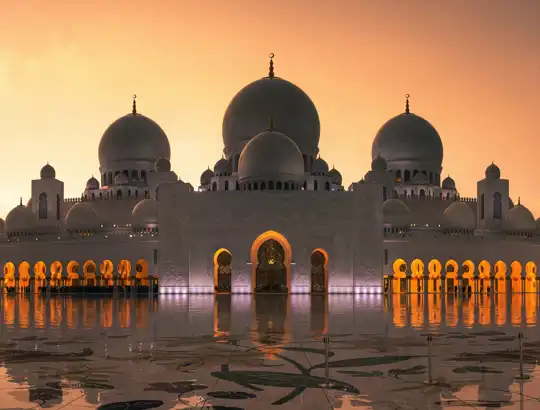
The mosques in the UAE don’t hold back either. The Sheikh Zayed Grand Mosque in Abu Dhabi ranks among the world’s top and features the planet’s largest hand-woven carpet — crafted by 1,200 people over two years. Nothing says “go big or go home” quite like that.
And since impressing people on land no longer seemed challenging enough, Dubai simply expanded its coastline with man-made islands. The world-famous Palm Jumeirah — an artificial palm-tree-shaped island so large you can see it from space with the naked eye — was built up from the sea in only a handful of years. They even launched a custom satellite just to make sure every frond of the palm was positioned perfectly. Because of course they did.
The uncomfortable truth behind this desert-and-sea-born world of luxury is that the very people who built it all can’t actually take part in it. Many live in dormitory-style labour camps far outside the city — close enough to construct the dream, but not quite close enough to live it.