×

Armenia🇦🇲 | attractionsErebuni Fortress and Erebuni Historical & Archaeological Museum-Urartian ruins, citadel foundations, cuneiform tablets | things to do and best time to go

Explore Yerevan Opera TheatreExplore Gold Beach

Backpacking in Erebuni Fortress and Erebuni Historical & Archaeological Museum-
👀 For curious travelersattraction ranked #11
By Johan Kruseman 🇳🇱 | Updated April 16, 2026

Here’s what most travelers realize too late: Erebuni Fortress and its museum are where you can actually touch the stones—no velvet ropes, no glass, just your hands on 2,800 years of history. Perched on a hill in the southeastern sprawl of Yerevan, Armenia’s capital, Erebuni isn’t the Instagram darling that Garni or Tatev are, but that’s exactly the point. You won’t be elbowing through tour groups or paying for overpriced snacks. The fortress is raw, windswept, and honest—more archaeological dig than theme park. The museum is old-school, but the artifacts are the real deal. If you want a place that feels like history still has dirt under its fingernails, this is it.

Discover everything you want to know in the 📖 Armenia Travel Guide.


Get your Armenia guide
69 ranked highlights, routes & tips, works offline (271 pages)
Loading the map 🌍
CLICK TO FILTER
cities
towns
villages
landmarks
national parks
hikes
beaches
attractions
festivals
regions
SHOW COUNTRY’S BESTSHOW ALL

✨ Why go?
Ranked #11 attraction in Armenia
Why visitors keep coming back

Erebuni Fortress isn’t just another dusty ruin plastered across Instagram—it’s the birthplace of Yerevan, Armenia’s capital, and a raw, unfiltered slice of 2,800-year-old history. Forget crowds of selfie-stick wielders; this site offers a genuine connection to the Urartian civilization that shaped the region’s identity. The adjacent Erebuni Historical & Archaeological Museum digs deeper, showcasing artifacts that bring the fortress’s story to life beyond crumbling walls. For backpackers, it’s a milestone—an anchor point on any Armenia itinerary that demands respect for its cultural weight and historical depth. The climb up to the fortress rewards you with panoramic city views, a quiet moment away from tourist traps, and a visceral sense of standing where ancient kings once ruled. It’s not … read more 👉
Erebuni Fortress isn’t just another dusty ruin plastered across Instagram—it’s the birthplace of Yerevan, Armenia’s capital, and a raw, unfiltered slice of 2,800-year-old history. Forget crowds of selfie-stick wielders; this site offers a genuine connection to the Urartian civilization that shaped the region’s identity. The adjacent Erebuni Historical & Archaeological Museum digs deeper, showcasing artifacts that bring the fortress’s story to life beyond crumbling walls. For backpackers, it’s a milestone—an anchor point on any Armenia itinerary that demands respect for its cultural weight and historical depth. The climb up to the fortress rewards you with panoramic city views, a quiet moment away from tourist traps, and a visceral sense of standing where ancient kings once ruled. It’s not flashy, but the effort-to-reward ratio is high: you get history, culture, and a grounding experience that no guidebook hype can replicate.
Want to include Erebuni Fortress and Erebuni Historical & Archaeological Museum- in your Armenia route?
Create a personalized Armenia itinerary that includes Erebuni Fortress and Erebuni Historical & Archaeological Museum- and the places that fit your trip — based on your travel style, budget, and available time. Get your route in seconds.

Generate my trip

💡 HighlightsThe experiences that define the visit

The Citadel Ruins: Walk the Bones of an Empire
Forget the Instagram drone shots—Erebuni’s citadel is not a pristine mountaintop fantasy. It’s a wind-battered, sun-bleached skeleton of Urartian ambition, built in 782 BC. You’ll scramble over basalt walls that once guarded the heart of a kingdom older than Rome. The real thrill is tactile: run your hand over cuneiform inscriptions, then look up and realize you’re standing where kings plotted the fate of the valley below. The view? Soviet apartment blocks colliding with the Ararat plain. It’s not pretty, but it’s real—and it’s Armenia’s origin story in stone.


The Erebuni Historical & Archaeological Museum: The Loot Room
This isn’t your average glass-case snooze-fest. The museum is a compact, no-nonsense trove of Urartian artifacts: bronze helmets, … read more 👉
The Citadel Ruins: Walk the Bones of an Empire
Forget the Instagram drone shots—Erebuni’s citadel is not a pristine mountaintop fantasy. It’s a wind-battered, sun-bleached skeleton of Urartian ambition, built in 782 BC. You’ll scramble over basalt walls that once guarded the heart of a kingdom older than Rome. The real thrill is tactile: run your hand over cuneiform inscriptions, then look up and realize you’re standing where kings plotted the fate of the valley below. The view? Soviet apartment blocks colliding with the Ararat plain. It’s not pretty, but it’s real—and it’s Armenia’s origin story in stone.


The Erebuni Historical & Archaeological Museum: The Loot Room
This isn’t your average glass-case snooze-fest. The museum is a compact, no-nonsense trove of Urartian artifacts: bronze helmets, ceremonial daggers, and clay tablets that look like they were baked yesterday. The highlight is the reconstructed wall paintings—faded, yes, but still pulsing with color and swagger. You’re face-to-face with the daily bling and battle gear of a vanished civilization. No velvet ropes, no crowds elbowing for selfies. Just you and the ghosts of empire.


Original Cuneiform Inscriptions: The World’s Oldest Receipts
Don’t skip the stone slabs carved with cuneiform script. These are the receipts, proclamations, and royal flexes of King Argishti I. They’re not just museum pieces—they’re the literal birth certificate of Yerevan. If you want to say you’ve seen the document that founded a city, this is it.


The Panorama: Yerevan’s Most Honest View
Climb to the fortress summit and you’ll get a panorama that’s all grit, no filter. Mount Ararat looms on the horizon, but the real story is the sprawl of Yerevan—Soviet blocks, smokestacks, and the pulse of a city that’s been lived in for 2,800 years. It’s not curated for tourists, and that’s exactly the point.


Hands-On Archaeology: Touch the Past
If you time it right, you might catch archaeologists at work—actual digs, not staged demos. Erebuni is still giving up secrets, and you can watch history being unearthed in real time. It’s messy, unpredictable, and a reminder that this place isn’t frozen in a museum—it’s alive, layer by layer.
Spotted a mistake or missing something? Contact us.

Things to do near Erebuni Fortress and Erebuni Historical & Archaeological Museum-

Ratings based on Tripadvisor reviews. When you book through this link, you support our work at no extra cost to you.

🌤️ When to go?Best time to visit Erebuni Fortress and Erebuni Historical & Archaeological Museum-


  • Weather & Temperature: From May to September, expect warm days ranging 20-30°C (68-86°F), perfect for exploring without freezing or sweating buckets. Winters (December to February) dip below freezing, making the ruins less inviting.

  • Daylight Hours: Long summer days stretch up to 15 hours in June, giving you plenty of daylight to soak in the fortress and museum without rushing. Short winter days mean less time to explore comfortably.

  • Crowds: July and August bring the biggest crowds, mostly local tourists and school groups. If you want a quieter experience, aim for late April or early October when visitor numbers thin out.

  • Seasonal Activities: Spring and early autumn offer mild weather and occasional cultural events at the museum, adding depth beyond just the ruins. Winter sees fewer
read more 👉

  • Weather & Temperature: From May to September, expect warm days ranging 20-30°C (68-86°F), perfect for exploring without freezing or sweating buckets. Winters (December to February) dip below freezing, making the ruins less inviting.

  • Daylight Hours: Long summer days stretch up to 15 hours in June, giving you plenty of daylight to soak in the fortress and museum without rushing. Short winter days mean less time to explore comfortably.

  • Crowds: July and August bring the biggest crowds, mostly local tourists and school groups. If you want a quieter experience, aim for late April or early October when visitor numbers thin out.

  • Seasonal Activities: Spring and early autumn offer mild weather and occasional cultural events at the museum, adding depth beyond just the ruins. Winter sees fewer activities and limited outdoor access.

  • Price Fluctuations: Entry fees stay stable year-round, but accommodation and transport costs spike in summer. Traveling shoulder seasons like May or September can save you money and hassle.


Pro-tip: Visit in late spring or early autumn for the sweet spot of good weather, manageable crowds, and authentic local vibes without the tourist circus.


source: climatestotravel.comJANJanuary: below average for travelingFEBFebruary: below average for travelingMARMarch: fair for travelingAPRApril: highly recommended for travelingMAYMay: excellent for travelingJUNJune: excellent for travelingJULJuly: good for travelingAUGAugust: good for travelingSEPSeptember: excellent for travelingOCTOctober: highly recommended for travelingNOVNovember: fair for travelingDECDecember: below average for traveling
when-to-go

✈️ The backpacker research shortcutArmenia Travel Guide

An offline-friendly backpacking guide with optimized travel routes, ranked highlights, transport advice, and the best areas to stay.
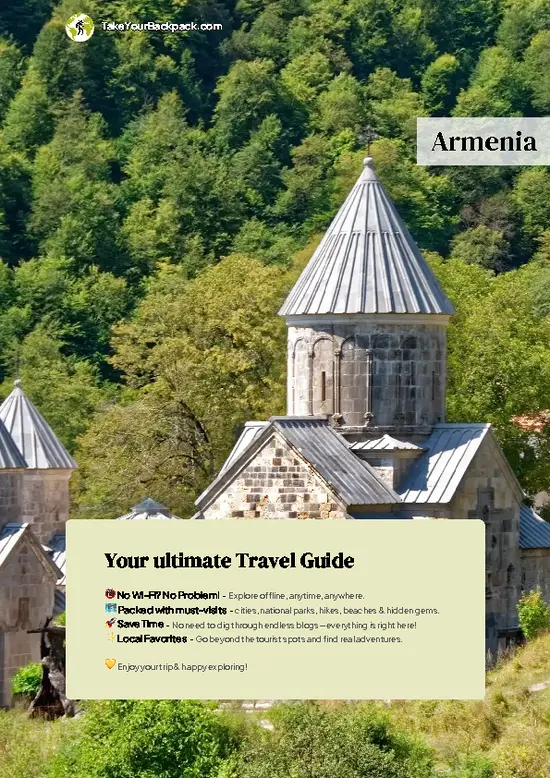
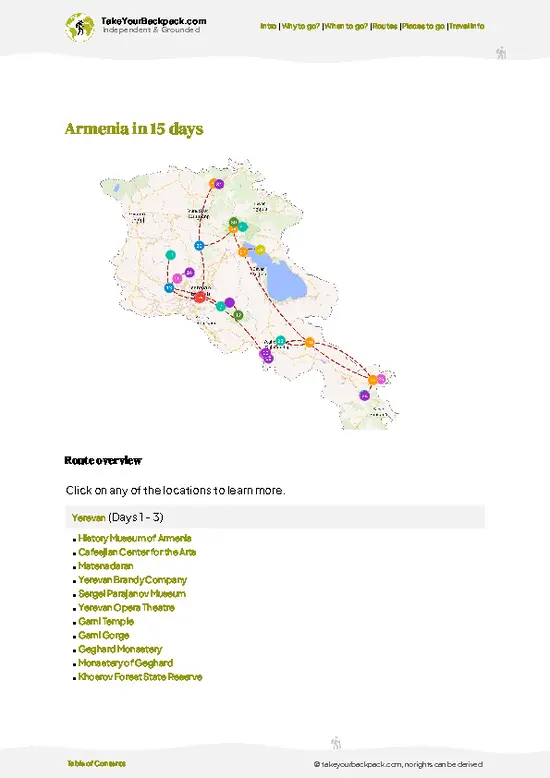
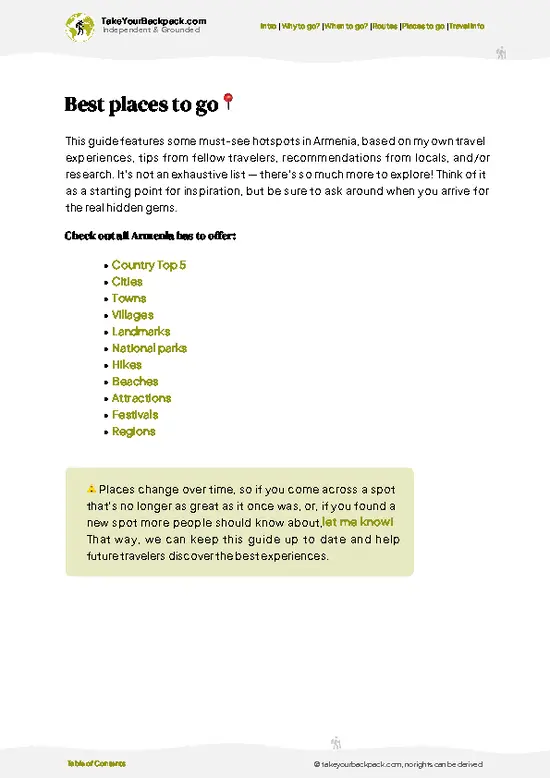
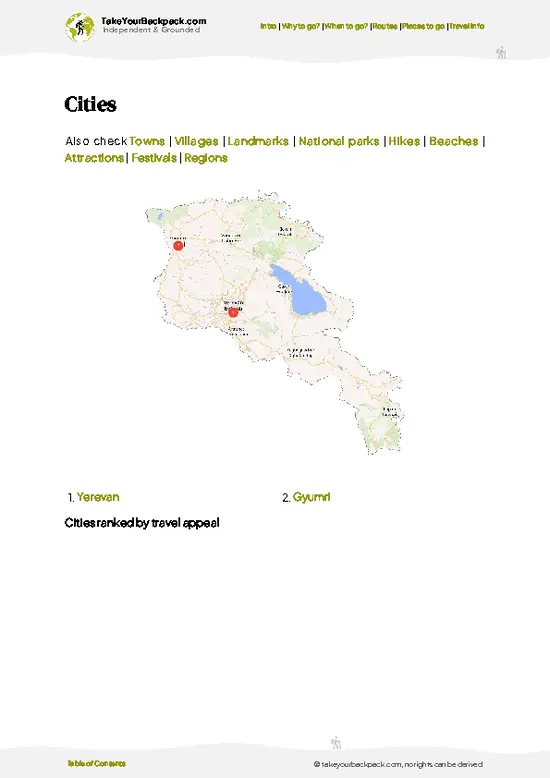
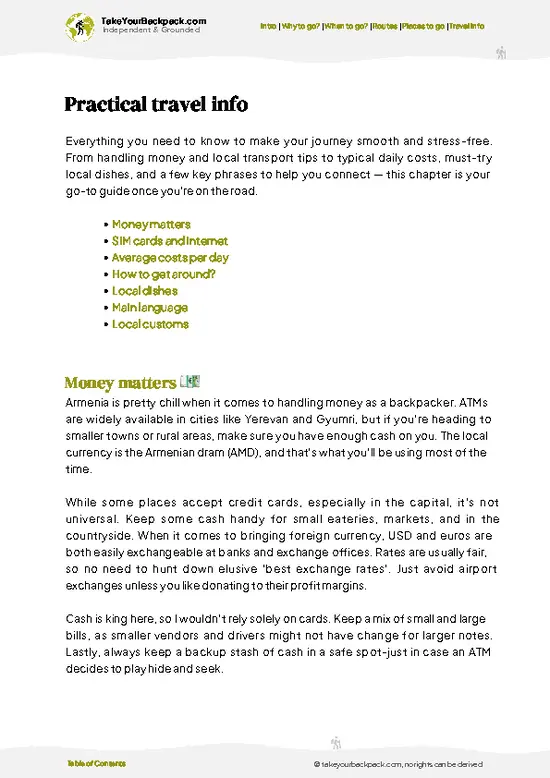
example page 0 from our offline Travel Guide for Armenia
example page 1 from our offline Travel Guide for Armenia
example page 2 from our offline Travel Guide for Armenia
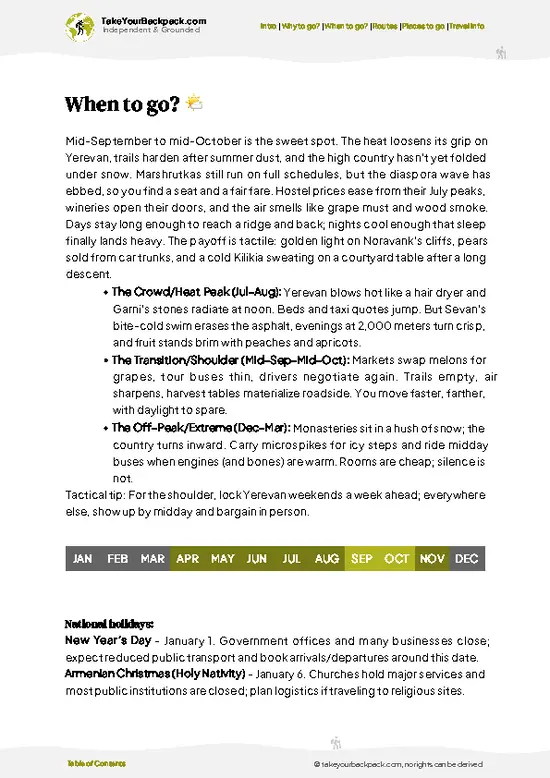
example page 3 from our offline Travel Guide for Armenia
example page 4 from our offline Travel Guide for Armenia
example page 5 from our offline Travel Guide for Armenia
example page 6 from our offline Travel Guide for Armenia
example page 7 from our offline Travel Guide for Armenia
The digital guide (271 pages) contains:
69 highlights, ranked by travel appeal
Optimized 5, 10 & 15-day travel routes
Cities, national parks, landmarks, beaches
How to get around
Offline-friendly for travel without Wi-Fi
👉 Click to see all 30+ guide features

📅 Plan smarter in minutes, not weeks
Month by month travel advice
Festivals & national holidays
Budget expectations

🗺️ Go to the right places, skip the overrated ones
Honest pros & cons of destinations
Top hikes, parks & viewpoints
Lesser-known places most travelers miss
Clear “worth it vs skip it” guidance

🛏️ Travel smoothly without rookie mistakes
Best areas to stay
Transport systems explained simply
Common scams & safety advice
SIM cards, money & practical tips

🌍 Understand the country, not just visit it
Culture & traditions
52 Essential phrases & customs
Festivals worth planning around
Traveler-friendly historical context
Insights that make places more meaningful

📱 Built for real travel conditions
Fully downloadable PDF
Works completely offline
Optimized for phone use
Useful in remote areas & buses
Everything in one place
Save weeks of stressful planning
Get instant access to your full guide. 30‑day money-back guarantee.


By proceeding you agree to our terms.
Sent to your inbox immediately after payment • 100% Secure Checkout
Best Backpacking Travel Advisor 2025 tourism awardBest Backpacking
Travel Advisor
2025
What others say about Take Your Backpack Guides:
⭐⭐⭐⭐⭐
Fantastic, amazing amount of information!
⭐⭐⭐⭐⭐
My goodness this is amazing, it's what I've been looking for hats off too you!
⭐⭐⭐⭐⭐
I think this is absolutely BRILLIANT
⭐⭐⭐⭐
Very complete and informative. It's still missing places, but I gotta to commend you
⭐⭐⭐⭐⭐
This is truly amazing, thank you, can't wait to explore it with my kids!
⭐⭐⭐⭐⭐
Awesome resource, thank you!
⭐⭐⭐⭐⭐
This is amazing! Can't wait to explore the ones I haven't seen
⭐⭐⭐⭐
I love this! Well done, great idea.
⭐⭐⭐⭐⭐
Thanks for taking the time to make this gem!
⭐⭐⭐⭐⭐
This might be the best website I've ever seen.
⭐⭐⭐⭐⭐
Congratulations, and thank you so much for your work; it's incredibly valuable.
⭐⭐⭐⭐
In all seriousness I think you did a great job pointing out the important spots
⭐⭐⭐⭐⭐
10/10 very good
⭐⭐⭐⭐⭐
As someone who's only just starting to visit regularly this is awesome, thank you.
⭐⭐⭐⭐
Thank you very much! I'm going to visit my dad, it's going to be very useful!
⭐⭐⭐⭐⭐
This is really cool! We'll be travelling for the first time and this definitely come in handy.
⭐⭐⭐⭐⭐
You are now our minister of culture, congratulations 👨‍💼
⭐⭐⭐⭐⭐
Just wanted to tell you that this is a pearl! Going to follow your recommendations.
⭐⭐⭐⭐⭐
This is so cool. I'll definitely be using the resource for my travels soon.
⭐⭐⭐⭐⭐
This is very impressive! Good work.
⭐⭐⭐⭐⭐
This is an amazing and informative site. Very well done!

🛏️ Where to stay?Choosing the right base

Erebuni Fortress is a solid draw for history buffs, but let’s cut through the tourist brochure gloss: the area around it isn’t exactly a backpacker’s party zone. The fortress sits on the outskirts of Yerevan’s city center, so if you want to crash nearby, you’re looking at neighborhoods that are quieter, more residential, and less flashy. That’s not a bad thing—it means you’ll dodge the tourist traps and overpriced cafes.

For backpackers craving safety and a social vibe, the best bet is to stay closer to Yerevan’s downtown, around the Republic Square or the Northern Avenue area. It’s a 15-20 minute … read more 👉
Erebuni Fortress is a solid draw for history buffs, but let’s cut through the tourist brochure gloss: the area around it isn’t exactly a backpacker’s party zone. The fortress sits on the outskirts of Yerevan’s city center, so if you want to crash nearby, you’re looking at neighborhoods that are quieter, more residential, and less flashy. That’s not a bad thing—it means you’ll dodge the tourist traps and overpriced cafes.

For backpackers craving safety and a social vibe, the best bet is to stay closer to Yerevan’s downtown, around the Republic Square or the Northern Avenue area. It’s a 15-20 minute taxi ride to Erebuni, but here you’ll find hostels buzzing with fellow travelers, cheap eats, and a real chance to mingle. Plus, the city center’s energy is a stark contrast to the fortress’s calm, giving you a balanced experience: ancient history by day, lively local culture by night. It’s the smart move if you want to soak in Armenia without feeling stranded or stuck in a ghost town.

👛 Costs (as of 3 July 2025)Typical daily expenses

As of the most recent estimates, the Erebuni Fortress and Erebuni Historical & Archaeological Museum in Yerevan, Armenia, charges an entrance fee of 1,500 AMD (approximately €3) for adults, 1,000 AMD (approximately €2) for students, and 500 AMD (approximately €1) for children. Guided tours are available in Armenian for 2,000 AMD (approximately €4) and in foreign languages (English, Russian, French, German) for 4,500 AMD (approximately €9). The museum operates from Tuesday to Sunday, 10:30 AM to 4:30 PM, and is closed on Mondays.

source: erebuni-museum.mus.am
⚠️ Prices can change and everyone travels differently, so take this as a rough guide. Hope it helps you plan your adventure!

Other Armenian attractions near Erebuni Fortress and Erebuni Historical & Archaeological Museum-

Explore more nearby:


💡 Not sure where to go next?
Create a personalized itinerary for Armenia including Erebuni Fortress and Erebuni Historical & Archaeological Museum- and the places that fit your trip.

Generate my itinerary

👉 Discover all attractions

Or checkout all Armenia has to offer (think cities, towns, villages, national parks, hikes, beaches, festivals)
Country photo of Armenia

We 💚 feedbackWhat to keep in mind

Erebuni Fortress isn’t some polished postcard spot—expect a handful of tourists but not a crush. The real magic hits when you step inside the museum and see how ancient life here shaped modern Armenia. It’s raw, a bit rugged, and that’s exactly why it sticks with you. Skip the hype; this place earns respect quietly.

✍️ Help improve this page!
The information on this page is based on in-depth research, insights shared by experienced travelers, and feedback from the local travel community in Armenia. While every effort is made to keep the information accurate and current, conditions can change — so if you spot anything incorrect or outdated, please get in touch.


🙋‍♂️ Give feedback

👋 Meet the founderWho’s Behind Take Your Backpack?

Johan, backpacker and founder of TakeYourBackpackHi, I’m Johan (Netherlands 🇳🇱), the creator of TakeYourBackpack. Over the past decade, I’ve backpacked through 80+ countries across six continents, gaining extensive experience with independent travel, long-term trips, and overland routes.

This site is built on a combination of firsthand travel experience and carefully curated insights from other backpackers. Many guides are based on places I’ve personally visited, while others bring together tips, observations, and practical advice shared by trusted travelers I’ve met along the way.

The goal is to provide realistic, experience-driven guidance — not generic itineraries — so you can explore destinations with better context, clearer expectations, and more confidence.

Get full Armenia guide •
Instant download • 69 highlights • Full Offline guide