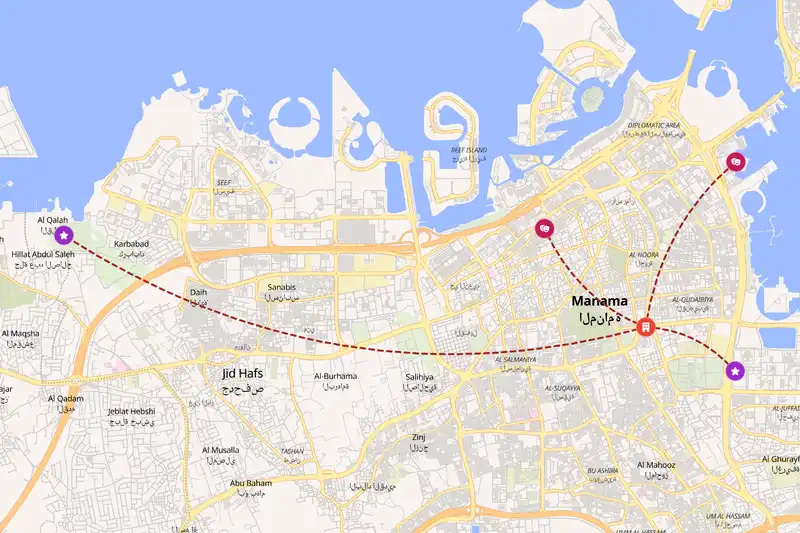
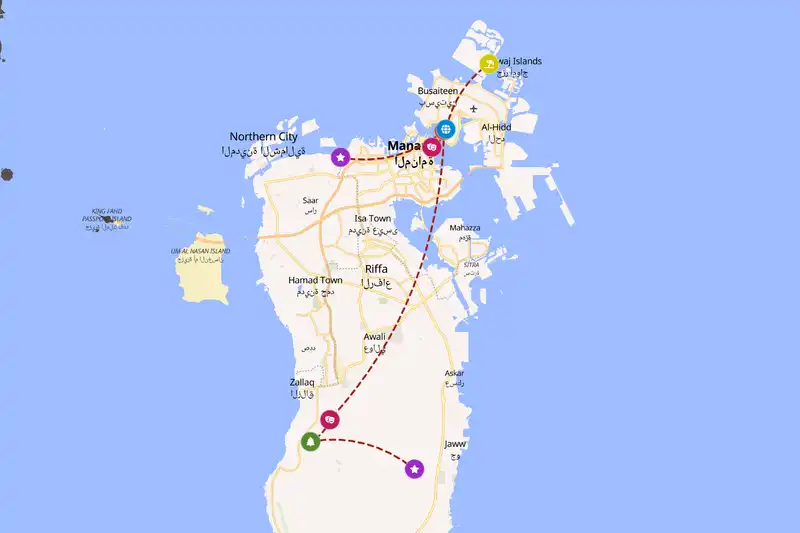
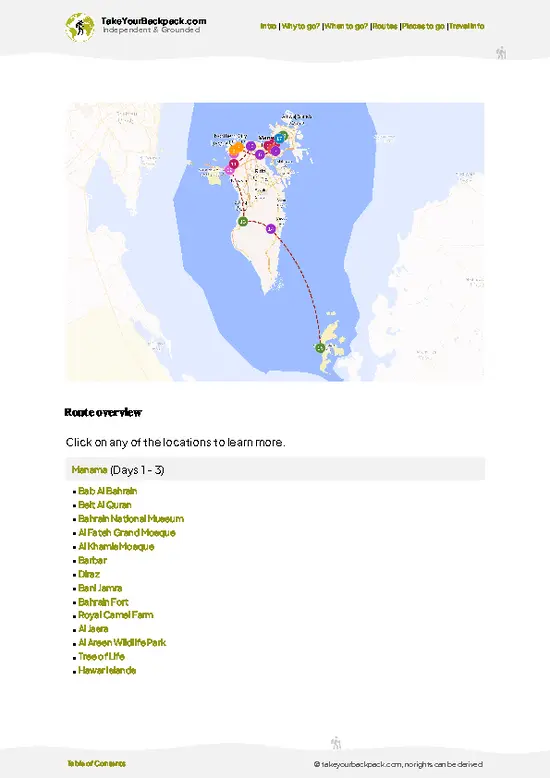
This five-day route suits travelers who want to see Bahrain beyond the capital: archaeology fans, wildlife watchers and anyone happy to trade mall time for village lanes and a day at sea. The pace is relaxed, with one long day for the Hawar Islands and short hops everywhere else, since almost nothing on the main island is more than 40 to 50 minutes apart by road. You will rely mostly on taxis and ride-hailing apps such as Careem and Uber, use the public bus between Manama and Muharraq where it fits, and take a boat to Hawar. Renting a car for days 2 and 3 makes the villages and the desert far easier.
Days 1-2: Manama and the Northern Villages
Start where the city started trading. Walk through
Bab Al Bahrain and Manama Souq in the morning, when the gold, spice and fabric lanes are calm, then head to
Beit Al Quran in Hoora for its collection of Quran manuscripts and calligraphy, a quiet hour that explains a lot about the country’s Islamic heritage. Spend the late afternoon at
Bahrain National …
read more 👉This five-day route suits travelers who want to see Bahrain beyond the capital: archaeology fans, wildlife watchers and anyone happy to trade mall time for village lanes and a day at sea. The pace is relaxed, with one long day for the Hawar Islands and short hops everywhere else, since almost nothing on the main island is more than 40 to 50 minutes apart by road. You will rely mostly on taxis and ride-hailing apps such as Careem and Uber, use the public bus between Manama and Muharraq where it fits, and take a boat to Hawar. Renting a car for days 2 and 3 makes the villages and the desert far easier.
Days 1-2: Manama and the Northern Villages
Start where the city started trading. Walk through Bab Al Bahrain and Manama Souq in the morning, when the gold, spice and fabric lanes are calm, then head to Beit Al Quran in Hoora for its collection of Quran manuscripts and calligraphy, a quiet hour that explains a lot about the country’s Islamic heritage. Spend the late afternoon at Bahrain National Museum, whose halls on Dilmun burial customs give you the background for tomorrow. Finish at Al-Fateh Mosque, where free guided tours let non-Muslim visitors see one of the largest mosques in the region, with abayas provided for women.
Day 2 is for the old farming and weaving villages along the north and west of the island, all sleeping back in Manama. Begin at Al Khamis Mosque, with its twin minarets and foundations among the oldest in the Gulf. Drive on to Barbar, where three temples were built on top of each other around a sacred freshwater spring, then to Diraz and its temple ruins. Bani Jamra is next door; this is where weavers still work cloth on traditional looms. End the day at Qal’at al-Bahrain Site Museum and walk up to Bahrain Fort for sunset, when the coral stone walls turn orange and the sea lies flat behind them.Day 3: Camels, Al Jasra and the Southern Desert
Head west to the Royal Camel Farm near Janabiyah, which is free to visit and full of camels at close range, then continue to Al Jasra for the restored coral and mud Al Jasra House, birthplace of the late Emir Sheikh Isa bin Salman, and the handicrafts center nearby. After lunch, swing south to Al Areen Wildlife Park, where the guided bus tour gets you near Arabian oryx and gazelles. Save the last light for the Tree of Life, a roughly 400-year-old mesquite standing alone in the Sakhir desert, then return to Manama for your third night.Day 4: Hawar Islands
This is the long day, which is why it follows a lighter one. Book a boat trip in advance with an operator on the southeast coast; the crossing to the Hawar Islands takes roughly 45 to 60 minutes. Expect shallow turquoise water, empty beaches and seabirds, including flamingos in season and the Socotra cormorant colonies the islands are protected for. Bring water, sun protection and snacks. Back on the main island, move your bags to Muharraq for the final night, which puts you minutes from the airport.Day 5: Muharraq Island
Wake up on Muharraq Island and walk the UNESCO-listed Pearling Path through restored merchant houses and narrow alleys. Step into the Shaikh Ebrahim Center for Culture and Research, a cluster of restored houses that hosts talks and exhibitions and shows how a traditional courtyard home stays cool. Finish with an easy stroll on the waterfront track at Arad Bay Nature Reserve and Park, watching wading birds on the mudflats beside Arad Fort, before heading to the airport.
If you have a spare hour on day 2, stop at the Saar archaeological site, where the outlines of Dilmun-era houses and a temple sit among quiet palm groves with hardly another visitor around.


 Best Backpacking