
×

Bermuda🇧🇲 | national parksCooper’s Island Nature ReserveCalm Clearwater swim area, mangrove edges, NASA station ruins, Castle Harbour lookouts | things to do and best time to go

Explore Spittal Pond Nature ReserveExplore Crystal Caves

Backpacking in Cooper’s Island Nature Reserve
👍 Recommendednational park ranked #2
By Johan Kruseman 🇳🇱 | Updated October 20, 2026

The big decision at Cooper’s Island Nature Reserve is whether to bother with the long ride out or stay on the south shore beaches, and the reserve wins if you want quiet water and a real walk. It sits at the eastern tip of Bermuda, in St. George’s Parish, past the airport and across a causeway. Mistake one: arriving with no food or water, because nothing is sold out here, so stock up in St. George’s beforehand. Mistake two: showing up at midday in summer with no shade plan, since the open stretches bake. Go in the morning or late afternoon. Buses do not reach the end of the road, so check the last return ride before you wander too far. The upside is real: sandy coves, mangrove and woodland trails, old Navy-era ruins, and far fewer people than at Horseshoe Bay. Facilities are basic and swimming spots have no lifeguards. The detail I love most is the Cooper’s Island hill with its old radar and the view over Castle Harbour.

Discover everything you want to know in the 📖 Bermuda Travel Guide.


example page 0 from our offline Travel Guide for Bermuda
example page 1 from our offline Travel Guide for Bermuda
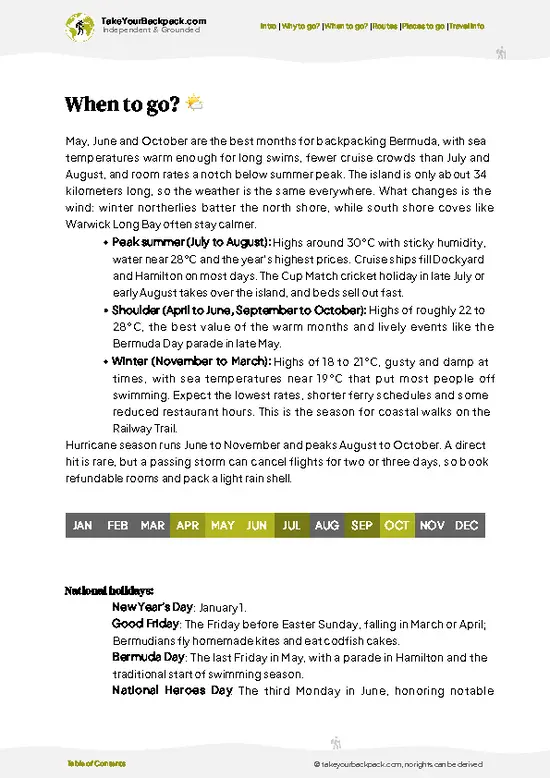
example page 2 from our offline Travel Guide for Bermuda
example page 3 from our offline Travel Guide for Bermuda
example page 4 from our offline Travel Guide for Bermuda
example page 5 from our offline Travel Guide for Bermuda
example page 6 from our offline Travel Guide for Bermuda
Loading the map 🌍
CLICK TO FILTER
cities
national parks
hikes
beaches
attractions
festivals
SHOW COUNTRY’S BESTSHOW ALL

✨ Why go?
Ranked #2 national park in Bermuda
Why Cooper’s Island Nature Reserve should be on your travel list

Cooper’s Island Nature Reserve suits backpackers who like to wander without a guide and without a ticket line. The reserve is a compact peninsula, so you can string together beach, woodland and old military sites at your own pace, which is hard to do on most of Bermuda’s busier shores. A couple of things make it distinct. The Nonsuch Bay and Clearwater beaches have calm, shallow water and a lot of room, and the shoreline is easy to explore by foot with a snorkel mask in your bag. The old NASA tracking station remains add a odd, quiet history layer that you will not find on the south shore. Most people who come here are locals, birders and families, so the mood stays unhurried. It works best as a half-day self-guided outing: you read the signs, pick a path, and decide on the spot whether to … read more 👉
Cooper’s Island Nature Reserve suits backpackers who like to wander without a guide and without a ticket line. The reserve is a compact peninsula, so you can string together beach, woodland and old military sites at your own pace, which is hard to do on most of Bermuda’s busier shores. A couple of things make it distinct. The Nonsuch Bay and Clearwater beaches have calm, shallow water and a lot of room, and the shoreline is easy to explore by foot with a snorkel mask in your bag. The old NASA tracking station remains add a odd, quiet history layer that you will not find on the south shore. Most people who come here are locals, birders and families, so the mood stays unhurried. It works best as a half-day self-guided outing: you read the signs, pick a path, and decide on the spot whether to swim or keep walking. Tours rarely cover it well, and you do not need one.

💡 HighlightsMust-see experiences and standout moments

  1. Clearwater Beach: The reserve’s best-known stretch, with pale sand, shallow water and a roped-off swim area that is calm enough for beginners and children.
  2. Annie’s Bay: A smaller, more secluded cove with a sheltered feel, good for a quiet swim away from the main beach.
  3. Nonsuch Bay and the shoreline walks: Rocky and sandy sections where you can poke around tide pools and look for small fish and crabs.
  4. Former NASA tracking station ruins: Concrete foundations and buildings left from the space-tracking era, a curious contrast to the natural setting.
  5. Cooper’s Island woodland trails: Shaded paths through native and replanted vegetation, with birds such as cardinals and the occasional migrant passing through.
  6. Mangrove and pond edges: Brackish wetland areas that shelter herons and other waterbirds, best
… read more 👉
  1. Clearwater Beach: The reserve’s best-known stretch, with pale sand, shallow water and a roped-off swim area that is calm enough for beginners and children.
  2. Annie’s Bay: A smaller, more secluded cove with a sheltered feel, good for a quiet swim away from the main beach.
  3. Nonsuch Bay and the shoreline walks: Rocky and sandy sections where you can poke around tide pools and look for small fish and crabs.
  4. Former NASA tracking station ruins: Concrete foundations and buildings left from the space-tracking era, a curious contrast to the natural setting.
  5. Cooper’s Island woodland trails: Shaded paths through native and replanted vegetation, with birds such as cardinals and the occasional migrant passing through.
  6. Mangrove and pond edges: Brackish wetland areas that shelter herons and other waterbirds, best seen quietly in early morning.
  7. Views toward Castle Harbour and the Atlantic: Open lookout spots where you can see the contrast between sheltered harbor water and the rougher ocean side.
For a first visit, start with Clearwater Beach, because it combines easy access, calm water and the simplest introduction to the reserve.
Spotted a mistake or missing something? Contact us.

🌤️ When to go?Best time to explore Cooper’s Island Nature Reserve

The best months for Cooper’s Island Nature Reserve are April to June and September to October, when days are warm and the beaches are quiet.
  • Spring (March to May): 18 to 25°C (64 to 77°F). Breezy, with water still too cool for most swimmers. Days lengthen and trails are empty on weekdays.
  • Summer (June to August): 27 to 31°C (81 to 88°F) and humid. Best for swimming and snorkeling at Clearwater Beach next door. Weekends fill with locals and cruise ship visitors, and flight and bed prices peak.
  • Autumn (September to November): 24 to 29°C (75 to 84°F) early on, cooling later. Warm water, lower prices from October. Hurricane season runs to November, so storms can close buses and ferries for a day or two.
  • Winter (December to February): 15 to 20°C (59 to 68°F), windy and often damp. Daylight is short,
… read more 👉
The best months for Cooper’s Island Nature Reserve are April to June and September to October, when days are warm and the beaches are quiet.
  • Spring (March to May): 18 to 25°C (64 to 77°F). Breezy, with water still too cool for most swimmers. Days lengthen and trails are empty on weekdays.
  • Summer (June to August): 27 to 31°C (81 to 88°F) and humid. Best for swimming and snorkeling at Clearwater Beach next door. Weekends fill with locals and cruise ship visitors, and flight and bed prices peak.
  • Autumn (September to November): 24 to 29°C (75 to 84°F) early on, cooling later. Warm water, lower prices from October. Hurricane season runs to November, so storms can close buses and ferries for a day or two.
  • Winter (December to February): 15 to 20°C (59 to 68°F), windy and often damp. Daylight is short, but the walks are peaceful and rates are lowest.
Arrive on a weekday morning to have the old naval base ruins and shoreline paths to yourself.


source: climatestotravel.comJANJanuary: fair for travelingFEBFebruary: fair for travelingMARMarch: highly recommended for travelingAPRApril: excellent for travelingMAYMay: excellent for travelingJUNJune: excellent for travelingJULJuly: highly recommended for travelingAUGAugust: highly recommended for travelingSEPSeptember: excellent for travelingOCTOctober: excellent for travelingNOVNovember: good for travelingDECDecember: fair for traveling
when-to-go

✈️ The backpacker research shortcutBermuda Travel Guide

An offline-friendly backpacking guide with optimized travel routes, ranked highlights, transport advice, and the best areas to stay.
example page 0 from our offline Travel Guide for Bermuda
example page 1 from our offline Travel Guide for Bermuda
example page 2 from our offline Travel Guide for Bermuda
example page 3 from our offline Travel Guide for Bermuda
example page 4 from our offline Travel Guide for Bermuda
example page 5 from our offline Travel Guide for Bermuda
example page 6 from our offline Travel Guide for Bermuda
The digital guide (81 pages) contains:
✅ 18 highlights, ranked by travel appeal
✅ Optimized 5, 10 & 15-day travel routes
✅ Cities, national parks, landmarks, beaches
✅ How to get around
✅ Offline-friendly for travel without Wi-Fi
👉 Click to see all 30+ guide features

📅 Plan smarter in minutes, not weeks
✅ Month by month travel advice
✅ Festivals & national holidays
✅ Budget expectations

🗺️ Go to the right places, skip the overrated ones
✅ Honest pros & cons of destinations
✅ Top hikes, parks & viewpoints
✅ Lesser-known places most travelers miss
✅ Clear “worth it vs skip it” guidance

🛏️ Travel smoothly without rookie mistakes
✅ Best areas to stay
✅ Transport systems explained simply
✅ Common scams & safety advice
✅ SIM cards, money & practical tips

🌍 Understand the country, not just visit it
✅ Culture & traditions
✅ Local customs
✅ Festivals worth planning around
✅ Traveler-friendly historical context
✅ Insights that make places more meaningful

📱 Built for real travel conditions
✅ Fully downloadable PDF
✅ Works completely offline
✅ Optimized for phone use
✅ Useful in remote areas & buses
✅ Everything in one place
Stop searching, start planning
Get instant access to your full guide. 30‑day money-back guarantee.
+ Add another guide for just

By proceeding you agree to our terms.
Sent to your inbox immediately after payment • 100% Secure Checkout
Best Backpacking Travel Advisor 2025 tourism awardBest Backpacking
Travel Advisor
2025
What others say about Take Your Backpack Guides:
⭐⭐⭐⭐⭐
Fantastic, amazing amount of information!
⭐⭐⭐⭐⭐
My goodness this is amazing, it's what I've been looking for hats off too you!
⭐⭐⭐⭐⭐
I think this is absolutely BRILLIANT
⭐⭐⭐⭐
Very complete and informative. It's still missing places, but I gotta to commend you
⭐⭐⭐⭐⭐
This is truly amazing, thank you, can't wait to explore it with my kids!
⭐⭐⭐⭐⭐
Awesome resource, thank you!
⭐⭐⭐⭐⭐
This is amazing! Can't wait to explore the ones I haven't seen
⭐⭐⭐⭐
I love this! Well done, great idea.
⭐⭐⭐⭐⭐
Thanks for taking the time to make this gem!
⭐⭐⭐⭐⭐
This might be the best website I've ever seen.
⭐⭐⭐⭐⭐
Congratulations, and thank you so much for your work; it's incredibly valuable.
⭐⭐⭐⭐
In all seriousness I think you did a great job pointing out the important spots
⭐⭐⭐⭐⭐
10/10 very good
⭐⭐⭐⭐⭐
As someone who's only just starting to visit regularly this is awesome, thank you.
⭐⭐⭐⭐
Thank you very much! I'm going to visit my dad, it's going to be very useful!
⭐⭐⭐⭐⭐
This is really cool! We'll be travelling for the first time and this definitely come in handy.
⭐⭐⭐⭐⭐
You are now our minister of culture, congratulations 👨‍💼
⭐⭐⭐⭐⭐
Just wanted to tell you that this is a pearl! Going to follow your recommendations.
⭐⭐⭐⭐⭐
This is so cool. I'll definitely be using the resource for my travels soon.
⭐⭐⭐⭐⭐
This is very impressive! Good work.
⭐⭐⭐⭐⭐
This is an amazing and informative site. Very well done!

🛏️ Where to stay?Where staying makes the most sense

There is no accommodation inside Cooper’s Island Nature Reserve, so sleep in St. George’s, about 15 to 20 minutes away by car or taxi, or along the south shore.
St. George’s is the practical choice. It is a compact UNESCO-listed town with guesthouses and small inns, a handful of pubs and groceries, and the main bus hub for the East End. Expect roughly US$120 to 220 a night for a basic room in high season. Bermuda has no hostels to speak of, so solo backpackers usually pick a guesthouse room or a self-catering studio, which lets you cook and cut food costs.
Near the reserve, the Clearwater Beach … read more 👉
There is no accommodation inside Cooper’s Island Nature Reserve, so sleep in St. George’s, about 15 to 20 minutes away by car or taxi, or along the south shore.
St. George’s is the practical choice. It is a compact UNESCO-listed town with guesthouses and small inns, a handful of pubs and groceries, and the main bus hub for the East End. Expect roughly US$120 to 220 a night for a basic room in high season. Bermuda has no hostels to speak of, so solo backpackers usually pick a guesthouse room or a self-catering studio, which lets you cook and cut food costs.
Near the reserve, the Clearwater Beach area and nearby Tobacco Bay have limited rentals but are close to the trails. Book early for June to August.
Hamilton, the capital, has more choice and nightlife, but it is about 45 to 60 minutes away by bus or ferry plus connection, which makes it a poorer base for this corner of the island.
Camping is not permitted in the reserve. Bring your own food and water for the day, as there are few shops once you pass St. George’s. Public buses on the East End run less often on Sundays, so plan your return in advance.

👛 Costs (as of 20 October 2026)What things cost and how to budget

A realistic daily budget for Cooper’s Island Nature Reserve is about US$225 per person in high season, with entry free and most of the money going to a bed and food.
CategoryBudget RangeLocal Reality
Entrance feeUS$0No charge to enter the reserve or walk its trails.
Accommodation (high season)US$120 to 180Guesthouse or small studio in St. George’s. Winter rates drop to roughly US$90 to 140. No camping allowed.
Local transportUS$4 to 15Single bus rides cost about US$4.50 (exact change in cash or a transit card). A taxi from St. George’s costs roughly US$20 to 30 each way.
Food and suppliesUS$35 to 60Groceries are pricey, and a pub meal runs US$18 to 30. Self-catering and packing lunch keeps costs down.
Activities and gear rentalUS$0 to 25Walking and swimming are free. Snorkel gear rental nearby costs
… read more 👉
A realistic daily budget for Cooper’s Island Nature Reserve is about US$225 per person in high season, with entry free and most of the money going to a bed and food.
CategoryBudget RangeLocal Reality
Entrance feeUS$0No charge to enter the reserve or walk its trails.
Accommodation (high season)US$120 to 180Guesthouse or small studio in St. George’s. Winter rates drop to roughly US$90 to 140. No camping allowed.
Local transportUS$4 to 15Single bus rides cost about US$4.50 (exact change in cash or a transit card). A taxi from St. George’s costs roughly US$20 to 30 each way.
Food and suppliesUS$35 to 60Groceries are pricey, and a pub meal runs US$18 to 30. Self-catering and packing lunch keeps costs down.
Activities and gear rentalUS$0 to 25Walking and swimming are free. Snorkel gear rental nearby costs roughly US$15 to 25.
Total Daily BudgetUS$225Per person, per day, in high season.
⚠️ Prices can change and everyone travels differently, so take this as a rough guide. Hope it helps you plan your adventure!

🥾 TrailsDiscover Cooper’s Island Nature Reserve's top trails and natural wonders

Cooper’s Island Nature Reserve is best explored on foot along its quiet service road and the short paths that branch off it, with terrain that is mostly flat or gently rolling. Most walks are easy, suitable for beginners and families, though sand and loose gravel slow you down and there is little shade in places.
  • Main road walk: A paved and gravel route from the entrance toward the beaches and the old station ruins, roughly 1 to 2 hours return at a relaxed pace. Easy, with views of the ocean on one side and scrub on the other.
  • Beach and shoreline loop: Link Clearwater Beach, Annie’s Bay and the
… read more 👉
Cooper’s Island Nature Reserve is best explored on foot along its quiet service road and the short paths that branch off it, with terrain that is mostly flat or gently rolling. Most walks are easy, suitable for beginners and families, though sand and loose gravel slow you down and there is little shade in places.
  • Main road walk: A paved and gravel route from the entrance toward the beaches and the old station ruins, roughly 1 to 2 hours return at a relaxed pace. Easy, with views of the ocean on one side and scrub on the other.
  • Beach and shoreline loop: Link Clearwater Beach, Annie’s Bay and the rocky sections between them, about 1 to 2 hours with swim stops. Easy to moderate on soft sand and uneven rock.
  • Woodland and wetland paths: Short side trails of about 30 to 60 minutes through shaded vegetation and past mangrove edges. Easy, with the best bird sightings early in the day.
  • Wildlife: Look for herons, cardinals, migrating songbirds, small fish in the shallows, and sometimes sea turtles offshore.
Getting there by public transport is possible but slow. Buses reach St. George’s and the area near the airport, and from there you walk or take a taxi for the final stretch toward the reserve, so plan your return carefully. Cycling or a scooter is the easiest way to come out. Crowds stay light for most of the year, with weekends and summer afternoons the busiest, mainly at Clearwater Beach. There is no entrance fee. Bring water, sun protection and snacks, as there is little on site, and wear sturdy sandals or shoes for the rocks.
⚠️ Hiking info can sometimes be outdated or inaccurate. Before you hit the trail, check the latest conditions with locals. If you do spot anything that's off, I'd love to hear from you, so I can update it for fellow travelers.

🛡️ SafetySafety Tips and Common Scams in Cooper’s Island Nature Reserve

Cooper’s Island Nature Reserve is easy and low risk, with short, flat, well-marked paths along the shore and through coastal woodland.
The main issues are sun and wind. There is little shade on the open stretches, so carry water, a hat and sunscreen even in winter. Rocky shoreline is sharp and slippery when wet, so wear closed shoes rather than flip-flops, and keep back from the edge in rough seas, especially when storm swells arrive in autumn and winter. Swim only at the calm sandy beaches, since currents can pick up on the exposed side.
Wildlife is mild. You may see land crabs, lizards, migratory birds and, in season, turtles in the water. Keep your distance, do not feed anything, and stay on the paths to protect nesting and fragile vegetation. Mosquitoes can be annoying after rain, so bring … read more 👉
Cooper’s Island Nature Reserve is easy and low risk, with short, flat, well-marked paths along the shore and through coastal woodland.
The main issues are sun and wind. There is little shade on the open stretches, so carry water, a hat and sunscreen even in winter. Rocky shoreline is sharp and slippery when wet, so wear closed shoes rather than flip-flops, and keep back from the edge in rough seas, especially when storm swells arrive in autumn and winter. Swim only at the calm sandy beaches, since currents can pick up on the exposed side.
Wildlife is mild. You may see land crabs, lizards, migratory birds and, in season, turtles in the water. Keep your distance, do not feed anything, and stay on the paths to protect nesting and fragile vegetation. Mosquitoes can be annoying after rain, so bring repellent.
First-timers often forget food and water, since there are no shops inside the reserve. Buses are infrequent, so check your last return before heading out. Carry a charged phone.

FAQCommon questions from travelers

Half a day is enough for Cooper’s Island Nature Reserve, and a full day lets you add swimming at nearby Clearwater Beach. The main trails take around 2 to 3 hours to walk at an easy pace. Combine it with a second day in St. George’s for Fort St. Catherine and the town’s historic streets.
Yes, Cooper’s Island Nature Reserve can be reached without a car, though it takes planning. Buses run from Hamilton to St. George’s in about 45 to 60 minutes, and from there a taxi costs roughly US$20 to 30 or you can walk or cycle the road. Scooters can be rented in St. George’s, and tourists can only rent scooters or bicycles, not cars.
No entrance fee or permit is needed for Cooper’s Island Nature Reserve, and it is free to walk the trails and use the shoreline. Camping is not permitted, so you need accommodation in St. George’s or elsewhere on the island. Budget about US$4.50 per bus ride if you come by public transport.
⚠️ Things can change over time, so always validate details locally before you go.

Ideas for continuing your journey

Cooper’s Island Nature Reserve isn’t the only highlight in Bermuda. Explore all what Bermuda has to offer.
Country photo of Bermuda

We 💚 feedbackIs it worth it?

Cooper’s Island Nature Reserve catches people out when they treat it like a quick beach stop and arrive without water, food or a plan for getting back. Do it properly instead. Bring a full bottle and a picnic, come in the morning, and walk the shoreline before the heat builds. I would pack a mask for the shallows and leave the tight schedule at home.

✍️ Help improve this page!
The information on this page is based on in-depth research, insights shared by experienced travelers, and feedback from the local travel community in Bermuda. While every effort is made to keep the information accurate and current, conditions can change — so if you spot anything incorrect or outdated, please get in touch.


🙋‍♂️ Give feedback

👋 Meet the founderWho’s Behind Take Your Backpack?

Johan, backpacker and founder of TakeYourBackpackHi, I’m Johan (Netherlands 🇳🇱), the creator of TakeYourBackpack. Over the past 3 decades, I’ve backpacked through 90+ countries across six continents, gaining extensive experience with independent travel, long-term trips, and overland routes.

This site is built on a combination of firsthand travel experience and carefully curated insights from other backpackers. Many guides are based on places I’ve personally visited, while others bring together tips, observations, and practical advice shared by trusted travelers I’ve met along the way.

The goal is to provide realistic, experience-driven guidance — not generic itineraries — so you can explore destinations with better context, clearer expectations, and more confidence.