×

Burkina Faso🇧🇫 | landmarksRoyal Court of TiébéléHand-painted mud walls, Kassena court, tiny doors, guided visit | things to do and best time to go

Explore Lac de TengrelaExplore Ruins of Loropéni

Backpacking in Royal Court of Tiébélé
UNESCO World Heritage site
🌟 Highlightunique site ranked #2
By Johan Kruseman 🇳🇱 | Updated October 22, 2026

The painted walls of Royal Court of Tiébélé are redone by hand every year by the women of the Kassena community, using mud, laterite, and a glossy varnish made from boiled néré pods, so what you photograph is never quite the same twice. The court sits in Burkina Faso’s deep south, close to the Ghana border, a long way south of Ouagadougou. The geometric patterns are the real draw: black, white, and rust-red designs on low, round mud houses that look unlike anything else in West Africa. Skip any hope of a quick, anonymous wander, because a local guide is compulsory and the entry fee covers only a small compound. Go for the decorated courtyards and the guide’s explanations, not for a sprawling site. The road is long and the compound is small, so the visit pays off only if you linger. Unlike Sindou Peaks or the Loropéni ruins, which are about landscape and stone, Tiébélé is a living home with people inside.

Discover everything you want to know in the 📖 Burkina Faso Travel Guide.
Safety warning

The current risk level for Burkina Faso is high. Check the advice before going.


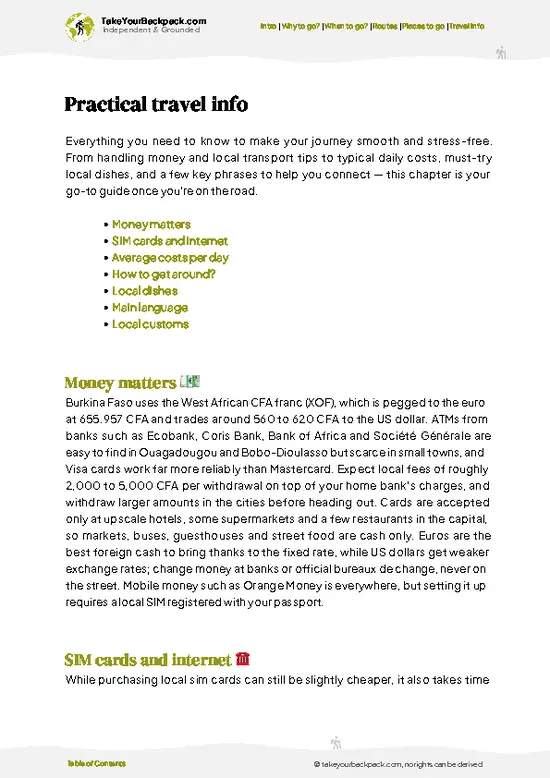
example page 0 from our offline Travel Guide for Burkina Faso
example page 1 from our offline Travel Guide for Burkina Faso
example page 2 from our offline Travel Guide for Burkina Faso
example page 3 from our offline Travel Guide for Burkina Faso
example page 4 from our offline Travel Guide for Burkina Faso
example page 5 from our offline Travel Guide for Burkina Faso
example page 6 from our offline Travel Guide for Burkina Faso
example page 7 from our offline Travel Guide for Burkina Faso
Loading the map 🌍
CLICK TO FILTER
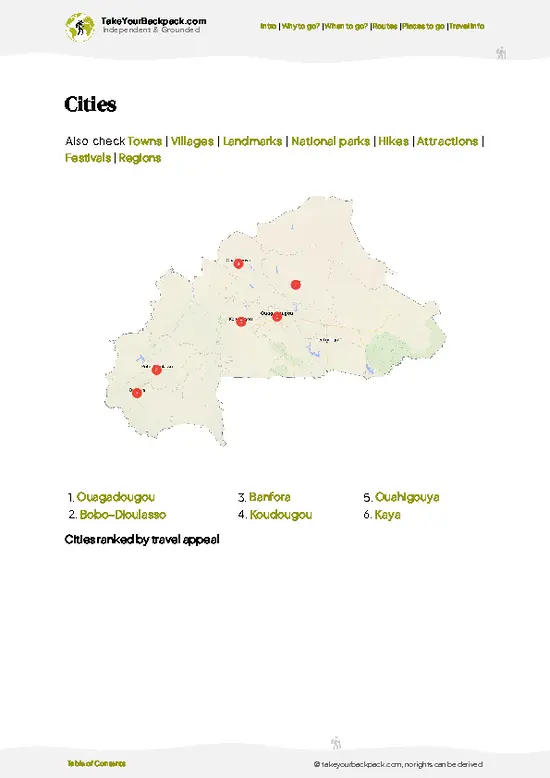
cities
towns
villages
landmarks
national parks
hikes
attractions
festivals
regions
SHOW COUNTRY’S BESTSHOW ALL

✨ Why go?
Ranked #2 unique site in Burkina Faso
The unique appeal for travelers

Royal Court of Tiébélé is worth the long haul south because nothing else in the region looks like it. The compound is a working royal residence, home to the chief and his extended family, and you walk through it with a guide who explains what each symbol means. Some motifs represent scarification patterns, others tools or the tortoise shell, and the doorways are kept deliberately tiny, a defensive design from the days of raids. That level of explanation is rare, and it turns a photo stop into something you understand.

The second reason is fit. The town lies near the Ghana border, so it slots into a loop connecting Po and Nahouri, the crocodile pond at Sabou-style stops to the north, and a crossing toward northern Ghana. Combined with the Pô area’s Kassena villages and the Nazinga game ranch, … read more 👉
Royal Court of Tiébélé is worth the long haul south because nothing else in the region looks like it. The compound is a working royal residence, home to the chief and his extended family, and you walk through it with a guide who explains what each symbol means. Some motifs represent scarification patterns, others tools or the tortoise shell, and the doorways are kept deliberately tiny, a defensive design from the days of raids. That level of explanation is rare, and it turns a photo stop into something you understand.

The second reason is fit. The town lies near the Ghana border, so it slots into a loop connecting Po and Nahouri, the crocodile pond at Sabou-style stops to the north, and a crossing toward northern Ghana. Combined with the Pô area’s Kassena villages and the Nazinga game ranch, you get culture and wildlife in one southern circuit.

Third, your fee goes straight to a community that depends on this tradition. The annual wall repainting is what keeps the craft alive, and visitors help fund it.

💡 HighlightsEssential experiences to have while visiting Royal Court of Tiébélé

  1. The painted royal compound: The headline sight, a cluster of round and rectangular mud buildings covered in black, white, and red geometric designs. Every motif has a meaning, and walking through the low doors gives you a feel for the defensive layout.
  2. The chief’s courtyard: The heart of the residence where the royal family lives. Your guide explains the hierarchy of the household and the role of the court in Kassena life, so listen closely rather than rushing to photograph.
  3. The sacred entrance and its tiny doors: The openings are intentionally small and the only way in, designed to slow intruders. Duck through one and you grasp the logic of the architecture immediately.
  4. The painted walls and their symbols: Look for patterns echoing scarification marks, calabash shapes, and lizards. The glossy
… read more 👉
  1. The painted royal compound: The headline sight, a cluster of round and rectangular mud buildings covered in black, white, and red geometric designs. Every motif has a meaning, and walking through the low doors gives you a feel for the defensive layout.
  2. The chief’s courtyard: The heart of the residence where the royal family lives. Your guide explains the hierarchy of the household and the role of the court in Kassena life, so listen closely rather than rushing to photograph.
  3. The sacred entrance and its tiny doors: The openings are intentionally small and the only way in, designed to slow intruders. Duck through one and you grasp the logic of the architecture immediately.
  4. The painted walls and their symbols: Look for patterns echoing scarification marks, calabash shapes, and lizards. The glossy finish comes from a natural varnish, which also protects the clay from rain.
  5. The ancestral shrines and tombs area: Parts of the compound are tied to ancestors and burial, and access is controlled. Your guide will show what is open and explain the customs around it, so follow their lead on where to step and what to photograph.
  6. The women’s painting craft: The women of the community are the artists, applying designs with chicken feathers and fingers. If you visit when repainting is underway, the sight of the technique is as interesting as the finished walls.
  7. The surrounding Kassena village: Beyond the court, mud houses with similar decoration line the lanes. A short stroll shows how the art extends past the royal walls into ordinary homes.
The painted royal compound and the surrounding Kassena village pair well in a single morning, since the village walk takes under an hour once your court tour ends.
Spotted a mistake or missing something? Contact us.

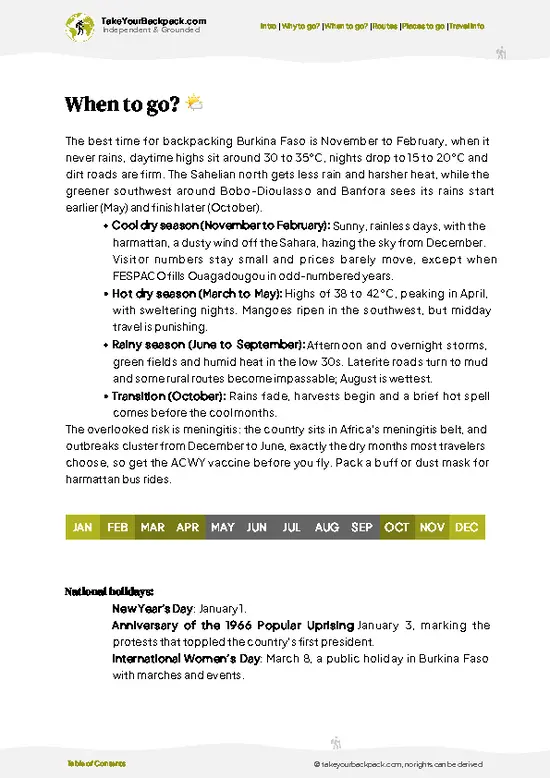
🌤️ When to go?Best time to visit Royal Court of Tiébélé

  • Cool dry months (November to February): Mornings sit around 18 to 22°C (64 to 72°F) and afternoons reach 32 to 35°C (90 to 95°F). Harmattan wind can haze the sky and coat everything in fine dust, which dulls photos but makes walking comfortable. Days run roughly 11 to 12 hours. This is the busiest window, though "busy" here means a handful of vehicles at the compound.
  • Hot season (March to May): Afternoons hit 38 to 42°C (100 to 108°F). Visit at opening and be back in the shade by midday. Crowds thin out and guides have more time to explain the painted symbols.
  • Rainy season (June to October): Highs of 30 to 34°C (86 to 93°F) with heavy afternoon downpours. The earthen walls are repaired and re-plastered by local women around this time of year, and dirt roads from Po turn muddy. Prices for guides
… read more 👉
  • Cool dry months (November to February): Mornings sit around 18 to 22°C (64 to 72°F) and afternoons reach 32 to 35°C (90 to 95°F). Harmattan wind can haze the sky and coat everything in fine dust, which dulls photos but makes walking comfortable. Days run roughly 11 to 12 hours. This is the busiest window, though "busy" here means a handful of vehicles at the compound.
  • Hot season (March to May): Afternoons hit 38 to 42°C (100 to 108°F). Visit at opening and be back in the shade by midday. Crowds thin out and guides have more time to explain the painted symbols.
  • Rainy season (June to October): Highs of 30 to 34°C (86 to 93°F) with heavy afternoon downpours. The earthen walls are repaired and re-plastered by local women around this time of year, and dirt roads from Po turn muddy. Prices for guides and rooms barely move, but transport is slower.
Aim for the cool months, and arrive in the first hour after opening for soft light on the wall patterns.


source: climatestotravel.comJANJanuary: highly recommended for travelingFEBFebruary: excellent for travelingMARMarch: good for travelingAPRApril: fair for travelingMAYMay: fair for travelingJUNJune: below average for travelingJULJuly: below average for travelingAUGAugust: below average for travelingSEPSeptember: fair for travelingOCTOctober: good for travelingNOVNovember: excellent for travelingDECDecember: highly recommended for traveling
when-to-go

✈️ The backpacker research shortcutBurkina Faso Travel Guide

An offline-friendly backpacking guide with optimized travel routes, ranked highlights, transport advice, and the best areas to stay.
example page 0 from our offline Travel Guide for Burkina Faso
example page 1 from our offline Travel Guide for Burkina Faso
example page 2 from our offline Travel Guide for Burkina Faso
example page 3 from our offline Travel Guide for Burkina Faso
example page 4 from our offline Travel Guide for Burkina Faso
example page 5 from our offline Travel Guide for Burkina Faso
example page 6 from our offline Travel Guide for Burkina Faso
example page 7 from our offline Travel Guide for Burkina Faso
The digital guide (273 pages) contains:
✅ 63 highlights, ranked by travel appeal
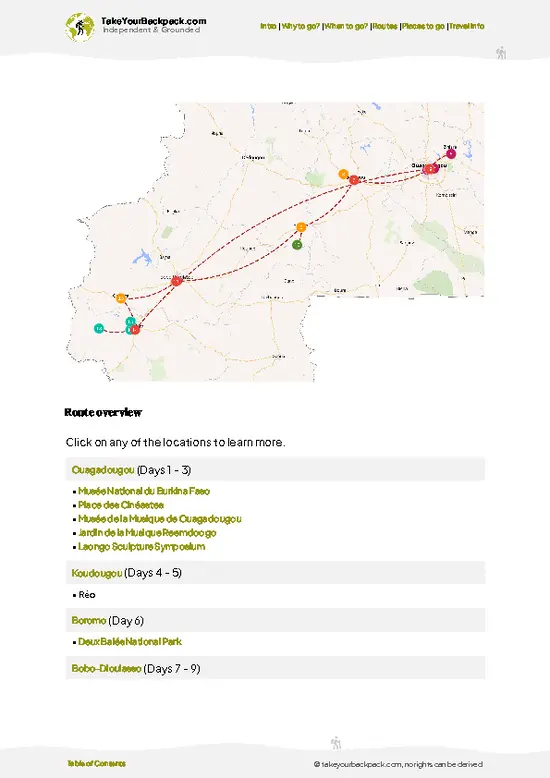
✅ Optimized 5, 10 & 15-day travel routes
✅ Cities, national parks, landmarks, beaches
✅ How to get around
✅ Offline-friendly for travel without Wi-Fi
👉 Click to see all 30+ guide features

📅 Plan smarter in minutes, not weeks
✅ Month by month travel advice
✅ Festivals & national holidays
✅ Budget expectations

🗺️ Go to the right places, skip the overrated ones
✅ Honest pros & cons of destinations
✅ Top hikes, parks & viewpoints
✅ Lesser-known places most travelers miss
✅ Clear “worth it vs skip it” guidance

🛏️ Travel smoothly without rookie mistakes
✅ Best areas to stay
✅ Transport systems explained simply
✅ Common scams & safety advice
✅ SIM cards, money & practical tips

🌍 Understand the country, not just visit it
✅ Culture & traditions
✅ 52 Essential phrases & customs
✅ Festivals worth planning around
✅ Traveler-friendly historical context
✅ Insights that make places more meaningful

📱 Built for real travel conditions
✅ Fully downloadable PDF
✅ Works completely offline
✅ Optimized for phone use
✅ Useful in remote areas & buses
✅ Everything in one place
Stop searching, start planning
Get instant access to your full guide. 30‑day money-back guarantee.
+ Add another guide for just

By proceeding you agree to our terms.
Sent to your inbox immediately after payment • 100% Secure Checkout
Best Backpacking Travel Advisor 2025 tourism awardBest Backpacking
Travel Advisor
2025
What others say about Take Your Backpack Guides:
⭐⭐⭐⭐⭐
Fantastic, amazing amount of information!
⭐⭐⭐⭐⭐
My goodness this is amazing, it's what I've been looking for hats off too you!
⭐⭐⭐⭐⭐
I think this is absolutely BRILLIANT
⭐⭐⭐⭐
Very complete and informative. It's still missing places, but I gotta to commend you
⭐⭐⭐⭐⭐
This is truly amazing, thank you, can't wait to explore it with my kids!
⭐⭐⭐⭐⭐
Awesome resource, thank you!
⭐⭐⭐⭐⭐
This is amazing! Can't wait to explore the ones I haven't seen
⭐⭐⭐⭐
I love this! Well done, great idea.
⭐⭐⭐⭐⭐
Thanks for taking the time to make this gem!
⭐⭐⭐⭐⭐
This might be the best website I've ever seen.
⭐⭐⭐⭐⭐
Congratulations, and thank you so much for your work; it's incredibly valuable.
⭐⭐⭐⭐
In all seriousness I think you did a great job pointing out the important spots
⭐⭐⭐⭐⭐
10/10 very good
⭐⭐⭐⭐⭐
As someone who's only just starting to visit regularly this is awesome, thank you.
⭐⭐⭐⭐
Thank you very much! I'm going to visit my dad, it's going to be very useful!
⭐⭐⭐⭐⭐
This is really cool! We'll be travelling for the first time and this definitely come in handy.
⭐⭐⭐⭐⭐
You are now our minister of culture, congratulations 👨‍💼
⭐⭐⭐⭐⭐
Just wanted to tell you that this is a pearl! Going to follow your recommendations.
⭐⭐⭐⭐⭐
This is so cool. I'll definitely be using the resource for my travels soon.
⭐⭐⭐⭐⭐
This is very impressive! Good work.
⭐⭐⭐⭐⭐
This is an amazing and informative site. Very well done!

🛏️ Where to stay?Best areas and accommodation options

Most backpackers sleep in Tiébélé town itself or in Po, the larger town about 30 km north, and each suits a different style of trip. Staying in Tiébélé puts you within a few minutes' walk of the compound, so you can visit early before tour groups arrive and again in the late afternoon when the walls glow. Options here are simple guesthouses and a few basic rooms with fans, run by locals who are happy to chat over dinner. Expect a quiet evening, a small market, and a few maquis (open-air eateries) serving grilled chicken, rice and tô. The social scene is the family you end up talking to, not a … read more 👉
Most backpackers sleep in Tiébélé town itself or in Po, the larger town about 30 km north, and each suits a different style of trip. Staying in Tiébélé puts you within a few minutes' walk of the compound, so you can visit early before tour groups arrive and again in the late afternoon when the walls glow. Options here are simple guesthouses and a few basic rooms with fans, run by locals who are happy to chat over dinner. Expect a quiet evening, a small market, and a few maquis (open-air eateries) serving grilled chicken, rice and tô. The social scene is the family you end up talking to, not a hostel bar. Po offers more choice, with a wider range of cheap rooms, better food stalls and easier onward transport toward Ghana, which sits just across the border. It also has the nearby Nazinga and Kassena culture connections, making it handy if you plan to see more of the south. Both places feel calm and safe for solo travelers, with friendly locals and little hassle. Choose Tiébélé if you want atmosphere and early access, and Po if you value variety, reliable phone signal and transport connections. Book ahead in neither; just ask on arrival.

👛 Costs (as of 22 October 2026)Typical daily expenses

A day at Royal Court of Tiébélé costs roughly €22 to 38 for a backpacker, with the daily total sitting at about €30 once you count a simple room, local meals, transport and the guided visit. Travelers pay in West African CFA francs, and cash is needed since there are no ATMs in the village.
CategoryBudget RangeLocal Reality
Entry and guide€3 to 5A guided tour of the compound is compulsory and takes about an hour. Photo fees may apply.
Accommodation (high season)€8 to 15Basic guesthouse rooms with a fan, shared or private bathroom. Low season is about €6 to 12.
Food€4 to 8Rice, beans, grilled chicken and tô at roadside maquis. Bottled water is around €0.50 to 1.
Local transport€3 to 8Shared minibuses from Ouagadougou to Po, then a short ride on to Tiébélé. Motorbike taxis for short hops.
Extras€2
… read more 👉
A day at Royal Court of Tiébélé costs roughly €22 to 38 for a backpacker, with the daily total sitting at about €30 once you count a simple room, local meals, transport and the guided visit. Travelers pay in West African CFA francs, and cash is needed since there are no ATMs in the village.
CategoryBudget RangeLocal Reality
Entry and guide€3 to 5A guided tour of the compound is compulsory and takes about an hour. Photo fees may apply.
Accommodation (high season)€8 to 15Basic guesthouse rooms with a fan, shared or private bathroom. Low season is about €6 to 12.
Food€4 to 8Rice, beans, grilled chicken and tô at roadside maquis. Bottled water is around €0.50 to 1.
Local transport€3 to 8Shared minibuses from Ouagadougou to Po, then a short ride on to Tiébélé. Motorbike taxis for short hops.
Extras€2 to 5Small tips for the guide, a cold drink, and handmade crafts from the village.
Total Daily Budget€30Comfortable for one traveler spending one night locally.
⚠️ Prices can change and everyone travels differently, so take this as a rough guide. Hope it helps you plan your adventure!

FAQTraveler FAQ

Royal Court of Tiébélé is the traditional home of the Kassena chief, a walled compound of mud-built houses decorated with geometric black, white and red patterns painted by the women of the family. It lies in the far south of Burkina Faso near the Ghana border, and it is often counted among the country's most photographed cultural sites. Entry is by guided tour only, usually costing about €3 to 5.
Plan on one to two hours for Royal Court of Tiébélé itself, since the guided walk through the courtyards and huts takes about an hour. Add time for the village and craft stalls if you like, which brings it to half a day. Most travelers arrive from Po or Ouagadougou and either stay one night or return the same day if they start early.
From Ouagadougou, Royal Court of Tiébélé is a drive of roughly 3.5 to 4.5 hours south by road, passing through Po. Buses or shared minibuses run to Po for about €5 to 10, then you take a local ride or motorbike taxi for the last 30 km, around €2 to 4. A hired car with driver is easier and runs about €60 to 90 a day.
⚠️ Things can change over time, so always validate details locally before you go.

Other Burkinabé landmarks near Royal Court of Tiébélé

Explore more nearby:

  • Ruins of Loropéni—Laterite ramparts, roofless courtyards, gold-trade lore, quiet savanna| 297 km away
  • Lac de Tengrela—hippopotamus habitat, tranquil lake, pirogue excursions| 423 km away
  • Cascades de Karfiguéla—Tiered sandstone falls, swimming pools, mango-shaded track, upper-ledge views| 424 km away

💡 Not sure where to go next?
Create a personalized itinerary for Burkina Faso including Royal Court of Tiébélé and the places that fit your trip.

Generate my itinerary

👉 Discover all landmarks

Or checkout all Burkina Faso has to offer (think cities, towns, villages, national parks, hikes, beaches, festivals)
Country photo of Burkina Faso

We 💚 feedbackWhat to keep in mind

Royal Court of Tiébélé works best as the centerpiece of a southern loop, paired with the Nazinga game ranch for elephants and the crossing into northern Ghana. I would arrive early, hire the guide for the full tour, and leave time to walk the village lanes afterward rather than treating it as a quick photo stop.

✍️ Help improve this page!
The information on this page is based on in-depth research, insights shared by experienced travelers, and feedback from the local travel community in Burkina Faso. While every effort is made to keep the information accurate and current, conditions can change — so if you spot anything incorrect or outdated, please get in touch.


🙋‍♂️ Give feedback

👋 Meet the founderWho’s Behind Take Your Backpack?

Johan, backpacker and founder of TakeYourBackpackHi, I’m Johan (Netherlands 🇳🇱), the creator of TakeYourBackpack. Over the past 3 decades, I’ve backpacked through 90+ countries across six continents, gaining extensive experience with independent travel, long-term trips, and overland routes.

This site is built on a combination of firsthand travel experience and carefully curated insights from other backpackers. Many guides are based on places I’ve personally visited, while others bring together tips, observations, and practical advice shared by trusted travelers I’ve met along the way.

The goal is to provide realistic, experience-driven guidance — not generic itineraries — so you can explore destinations with better context, clearer expectations, and more confidence.