×

Canada🇨🇦 | beachesLong BeachWide hard sand, surf lessons, storm watching, Pacific Rim forest edge | things to do and best time to go

Explore Kitsilano BeachExplore Parksville Beach

Backpacking in Long Beach
🏆 Top pickbeach ranked #1
By Johan Kruseman 🇳🇱 | Updated October 22, 2026

The sand at Long Beach is hard-packed and wide enough that surfers, dog walkers and kids chasing sandpipers rarely tangle, and the long, flat sweep of it is what people come for. It sits inside Pacific Rim National Park Reserve on the west coast of Vancouver Island, Canada, between Tofino and Ucluelet. I came in over Sutton Pass and pulled off where the Douglas-fir forest suddenly opened. I smelled kelp and wet cedar before I saw any water. The beach itself is clean, with driftwood piled in bleached heaps and almost no litter. Swimming is the weak point, since rip currents and heavy surf mean wading is smarter than diving in. Snorkeling and diving are not worth planning here. Surf lessons are, and so is a slow walk at low tide. Crowds thin out fast once you leave the parking lots. Cheap beds and food are in the towns on either side, not on the sand. Surfers, walkers and wildlife watchers will love it. Party seekers and calm-water swimmers won’t.

Discover everything you want to know in the 📖 Canada Travel Guide.


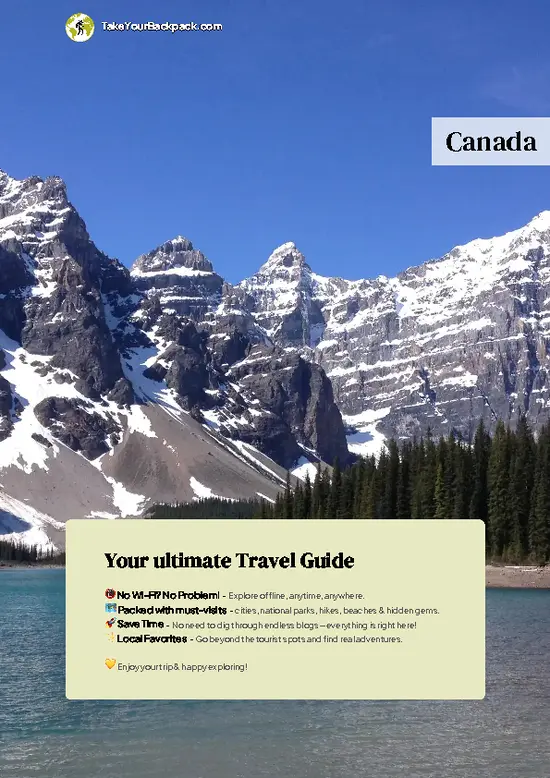
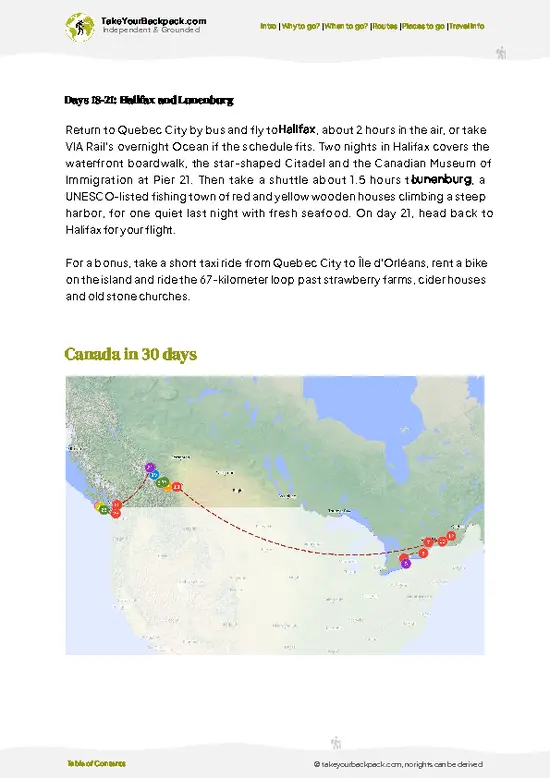
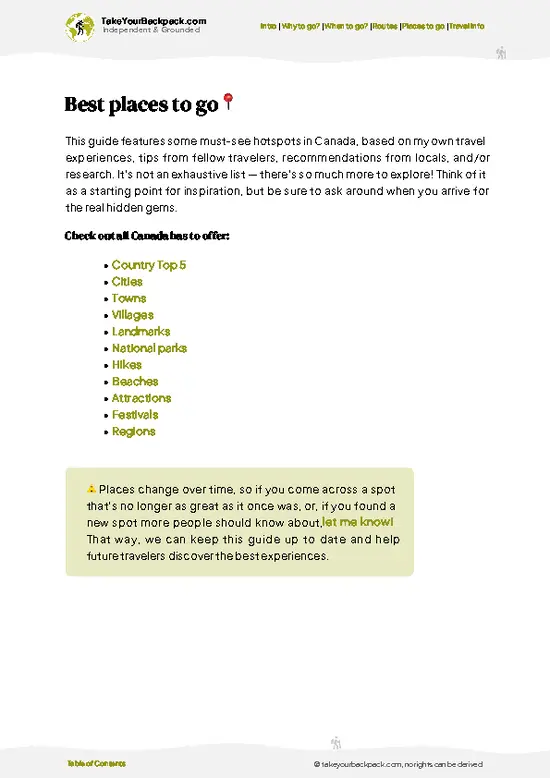
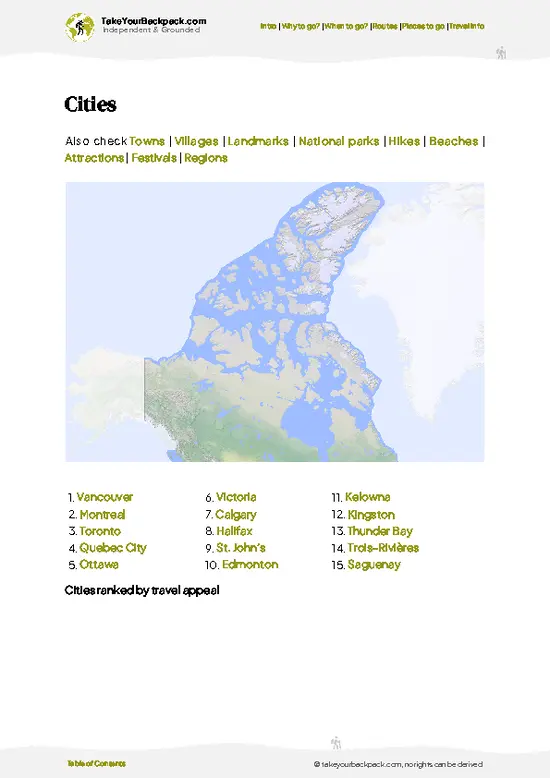
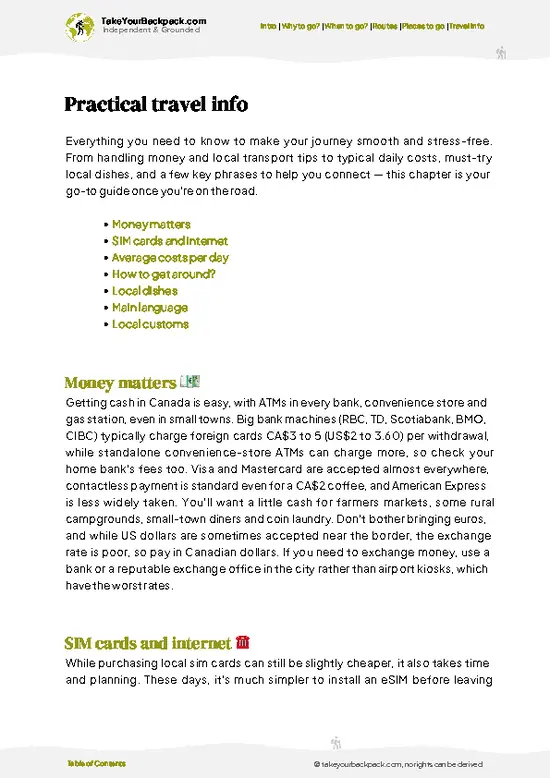
example page 0 from our offline Travel Guide for Canada
example page 1 from our offline Travel Guide for Canada
example page 2 from our offline Travel Guide for Canada
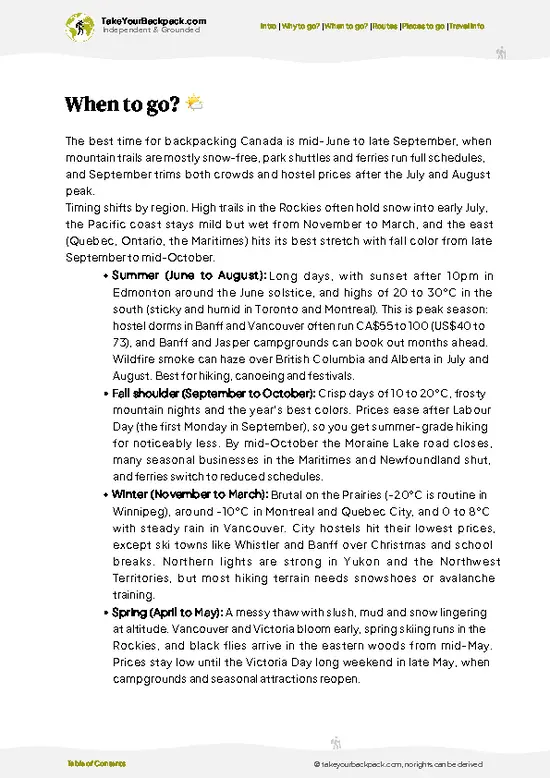
example page 3 from our offline Travel Guide for Canada
example page 4 from our offline Travel Guide for Canada
example page 5 from our offline Travel Guide for Canada
example page 6 from our offline Travel Guide for Canada
example page 7 from our offline Travel Guide for Canada
Loading the map 🌍
CLICK TO FILTER
cities
towns
villages
landmarks
national parks
hikes
beaches
attractions
festivals
regions
SHOW COUNTRY’S BESTSHOW ALL

✨ Why go?
Ranked #1 beach in Canada
What sets this place apart

Long Beach works as a pause between Tofino and Ucluelet, two towns that sit at opposite ends of the same stretch of highway. Backpackers stop because the beach is the one place on this coast where you can spend a full day outside without spending much. A Parks Canada day pass is all you pay, and after that the walking, the sunsets and the tide pools are free. The waves are the second reason. The break near Incinerator Rock is forgiving enough for first-timers on rented boards, and the sandy bottom is kinder than rocky points. Wetsuit rentals in Tofino keep the cost low if you split a gear day with hostel mates. The third reason is the setting, a 16 km curve of open sand backed by temperate rainforest. You can drift between a beach walk and a boardwalk trail in the trees without getting back … read more 👉
Long Beach works as a pause between Tofino and Ucluelet, two towns that sit at opposite ends of the same stretch of highway. Backpackers stop because the beach is the one place on this coast where you can spend a full day outside without spending much. A Parks Canada day pass is all you pay, and after that the walking, the sunsets and the tide pools are free. The waves are the second reason. The break near Incinerator Rock is forgiving enough for first-timers on rented boards, and the sandy bottom is kinder than rocky points. Wetsuit rentals in Tofino keep the cost low if you split a gear day with hostel mates. The third reason is the setting, a 16 km curve of open sand backed by temperate rainforest. You can drift between a beach walk and a boardwalk trail in the trees without getting back in a vehicle. Evenings are quiet, with campfire-style socializing happening in town rather than on the beach itself. That suits travelers who want to recharge between hostel stops.

💡 HighlightsThe experiences that define the visit

  1. Long Beach walk: This is the reason the place has a name. Hard sand at low tide makes it easy to walk the whole open stretch, and you will pass razor clam shells, kelp strands and sandpipers working the foam line. Go in the late afternoon when the surf haze softens the forest edge.
  2. Surfing near Incinerator Rock: The most consistent beginner waves in the area roll in here. Surf schools run group lessons with wetsuit and board included. Experienced surfers paddle out farther north along the beach where the crowd thins.
  3. Combers Beach: A short forest trail with stairs leads down to this section, where giant driftwood logs are stacked like fallen timber. It is a good place for photos and for poking around small tide pools on the rocky edge.
  4. Kwisitis Visitor Centre: Sitting at the southern end on Wickaninnish
… read more 👉
  1. Long Beach walk: This is the reason the place has a name. Hard sand at low tide makes it easy to walk the whole open stretch, and you will pass razor clam shells, kelp strands and sandpipers working the foam line. Go in the late afternoon when the surf haze softens the forest edge.
  2. Surfing near Incinerator Rock: The most consistent beginner waves in the area roll in here. Surf schools run group lessons with wetsuit and board included. Experienced surfers paddle out farther north along the beach where the crowd thins.
  3. Combers Beach: A short forest trail with stairs leads down to this section, where giant driftwood logs are stacked like fallen timber. It is a good place for photos and for poking around small tide pools on the rocky edge.
  4. Kwisitis Visitor Centre: Sitting at the southern end on Wickaninnish Beach, this Parks Canada building covers local Nuu-chah-nulth culture and the ecology of the coast. The windows frame the surf, so it is a solid choice for a rainy hour. It keeps shorter hours in winter.
  5. Winter storm watching: From November through February, big Pacific swells slam the sand and the logs. People bundle up in rain gear and watch from the bluffs, with a thermos if they are smart. It is loud, salty and humbling.
Long Beach costs the least when you simply walk it, since the only expense is the Parks Canada day pass, around US$8 for an adult, and that same pass covers the interpretive centre too.
Spotted a mistake or missing something? Contact us.

Things to do near Long Beach

Ratings based on Tripadvisor reviews. When you book through this link, you support our work at no extra cost to you.

🌤️ When to go?Best time to visit Long Beach

  • Summer (July to September): Long Beach is at its driest and busiest, with highs around 18 to 20°C (64 to 68°F) and lows near 10°C (50°F). Fog often sits on the coast until midday, and the sun usually arrives in the afternoon. Expect the highest prices and full campgrounds.
  • Fall (October to November): Rain returns and the first big Pacific swells roll in. Temperatures run 8 to 13°C (46 to 55°F), crowds thin, and room rates drop.
  • Winter (December to February): Storm-watching season. Highs are 6 to 9°C (43 to 48°F), rain is heavy and daylight is short, at roughly 8 to 9 hours. Surfers in thick wetsuits stay on, and rooms are cheapest.
  • Spring (March to June): Gray whales pass the coast from March to May, with highs climbing from 9 to 15°C (48 to 59°F). Rain eases by May, and prices stay moderate
… read more 👉
  • Summer (July to September): Long Beach is at its driest and busiest, with highs around 18 to 20°C (64 to 68°F) and lows near 10°C (50°F). Fog often sits on the coast until midday, and the sun usually arrives in the afternoon. Expect the highest prices and full campgrounds.
  • Fall (October to November): Rain returns and the first big Pacific swells roll in. Temperatures run 8 to 13°C (46 to 55°F), crowds thin, and room rates drop.
  • Winter (December to February): Storm-watching season. Highs are 6 to 9°C (43 to 48°F), rain is heavy and daylight is short, at roughly 8 to 9 hours. Surfers in thick wetsuits stay on, and rooms are cheapest.
  • Spring (March to June): Gray whales pass the coast from March to May, with highs climbing from 9 to 15°C (48 to 59°F). Rain eases by May, and prices stay moderate until June.
Book summer campsites and beds months ahead, or arrive in September for the same sun with fewer people.


source: climatestotravel.comJANJanuary: fair for travelingFEBFebruary: fair for travelingMARMarch: good for travelingAPRApril: good for travelingMAYMay: highly recommended for travelingJUNJune: highly recommended for travelingJULJuly: excellent for travelingAUGAugust: excellent for travelingSEPSeptember: highly recommended for travelingOCTOctober: good for travelingNOVNovember: fair for travelingDECDecember: fair for traveling
canada-beach-long-beach
© Google | Vivy Raj

✈️ The backpacker research shortcutCanada Travel Guide

An offline-friendly backpacking guide with optimized travel routes, ranked highlights, transport advice, and the best areas to stay.
example page 0 from our offline Travel Guide for Canada
example page 1 from our offline Travel Guide for Canada
example page 2 from our offline Travel Guide for Canada
example page 3 from our offline Travel Guide for Canada
example page 4 from our offline Travel Guide for Canada
example page 5 from our offline Travel Guide for Canada
example page 6 from our offline Travel Guide for Canada
example page 7 from our offline Travel Guide for Canada
The digital guide (385 pages) contains:
✅ 128 highlights, ranked by travel appeal
✅ Optimized 14, 21 & 30-day travel routes
✅ Cities, national parks, landmarks, beaches
✅ How to get around
✅ Offline-friendly for travel without Wi-Fi
👉 Click to see all 30+ guide features

📅 Plan smarter in minutes, not weeks
✅ Month by month travel advice
✅ Festivals & national holidays
✅ Budget expectations

🗺️ Go to the right places, skip the overrated ones
✅ Honest pros & cons of destinations
✅ Top hikes, parks & viewpoints
✅ Lesser-known places most travelers miss
✅ Clear “worth it vs skip it” guidance

🛏️ Travel smoothly without rookie mistakes
✅ Best areas to stay
✅ Transport systems explained simply
✅ Common scams & safety advice
✅ SIM cards, money & practical tips

🌍 Understand the country, not just visit it
✅ Culture & traditions
✅ Local customs
✅ Festivals worth planning around
✅ Traveler-friendly historical context
✅ Insights that make places more meaningful

📱 Built for real travel conditions
✅ Fully downloadable PDF
✅ Works completely offline
✅ Optimized for phone use
✅ Useful in remote areas & buses
✅ Everything in one place
Stop searching, start planning
Get instant access to your full guide. 30‑day money-back guarantee.
+ Add another guide for just

By proceeding you agree to our terms.
Sent to your inbox immediately after payment • 100% Secure Checkout
Best Backpacking Travel Advisor 2025 tourism awardBest Backpacking
Travel Advisor
2025
What others say about Take Your Backpack Guides:
⭐⭐⭐⭐⭐
Fantastic, amazing amount of information!
⭐⭐⭐⭐⭐
My goodness this is amazing, it's what I've been looking for hats off too you!
⭐⭐⭐⭐⭐
I think this is absolutely BRILLIANT
⭐⭐⭐⭐
Very complete and informative. It's still missing places, but I gotta to commend you
⭐⭐⭐⭐⭐
This is truly amazing, thank you, can't wait to explore it with my kids!
⭐⭐⭐⭐⭐
Awesome resource, thank you!
⭐⭐⭐⭐⭐
This is amazing! Can't wait to explore the ones I haven't seen
⭐⭐⭐⭐
I love this! Well done, great idea.
⭐⭐⭐⭐⭐
Thanks for taking the time to make this gem!
⭐⭐⭐⭐⭐
This might be the best website I've ever seen.
⭐⭐⭐⭐⭐
Congratulations, and thank you so much for your work; it's incredibly valuable.
⭐⭐⭐⭐
In all seriousness I think you did a great job pointing out the important spots
⭐⭐⭐⭐⭐
10/10 very good
⭐⭐⭐⭐⭐
As someone who's only just starting to visit regularly this is awesome, thank you.
⭐⭐⭐⭐
Thank you very much! I'm going to visit my dad, it's going to be very useful!
⭐⭐⭐⭐⭐
This is really cool! We'll be travelling for the first time and this definitely come in handy.
⭐⭐⭐⭐⭐
You are now our minister of culture, congratulations 👨‍💼
⭐⭐⭐⭐⭐
Just wanted to tell you that this is a pearl! Going to follow your recommendations.
⭐⭐⭐⭐⭐
This is so cool. I'll definitely be using the resource for my travels soon.
⭐⭐⭐⭐⭐
This is very impressive! Good work.
⭐⭐⭐⭐⭐
This is an amazing and informative site. Very well done!

🛏️ Where to stay?Choosing the right base

Tofino is the best base for backpackers, sitting about 10 to 25 minutes by car or shuttle from the beach, with the widest choice of hostels and shared accommodation. Expect dorm beds around US$40 to 70 in summer and lower in winter. The town has the surf shops, the cafés, the bars and the traveler crowd, so solo visitors meet people easily. The main surf strip around Chesterman Beach and Cox Bay, on the Tofino side of the park, has a more laid-back, beachfront feel, and it suits anyone who wants to surf at dawn and sleep near the sand. Rooms here are pricier, and many are self-catering, which … read more 👉
Tofino is the best base for backpackers, sitting about 10 to 25 minutes by car or shuttle from the beach, with the widest choice of hostels and shared accommodation. Expect dorm beds around US$40 to 70 in summer and lower in winter. The town has the surf shops, the cafés, the bars and the traveler crowd, so solo visitors meet people easily. The main surf strip around Chesterman Beach and Cox Bay, on the Tofino side of the park, has a more laid-back, beachfront feel, and it suits anyone who wants to surf at dawn and sleep near the sand. Rooms here are pricier, and many are self-catering, which helps if you cook to save money.
Ucluelet, roughly 30 to 40 minutes south, is quieter and cheaper, with a small harbor, a few budget stays and access to the Wild Pacific Trail. It is less social but good for a calmer base.
Camping inside Pacific Rim National Park Reserve is the closest option. Green Point Campground sits right above the beach and costs about US$25 to 30 a night, but it needs reservations well ahead for summer. Wild camping on the beach is not allowed.

🛡️ SafetyTraveler Safety Guide

Long Beach is a wide, open Pacific surf beach, and the main hazard is the water itself. Waves are consistent, rip currents form near channels and rocky edges, and the water stays cold year-round at roughly 8 to 14°C (46 to 57°F), so most swimmers wade or stay in a wetsuit. Beginners do best in the whitewater near lifeguard-patrolled spots in summer, and surf schools in Tofino handle the learning curve. Check tide tables before beach walks, because incoming tides can cut off rocky headlands and sneaker waves sometimes push logs around, so keep clear of driftwood piles. Fog can hide the sun, yet UV still burns, and weather turns fast with wind and rain. Black bears and wolves occasionally appear near the coast, so keep food stored. Car break-ins happen at trailheads and parking lots, so leave … read more 👉
Long Beach is a wide, open Pacific surf beach, and the main hazard is the water itself. Waves are consistent, rip currents form near channels and rocky edges, and the water stays cold year-round at roughly 8 to 14°C (46 to 57°F), so most swimmers wade or stay in a wetsuit. Beginners do best in the whitewater near lifeguard-patrolled spots in summer, and surf schools in Tofino handle the learning curve. Check tide tables before beach walks, because incoming tides can cut off rocky headlands and sneaker waves sometimes push logs around, so keep clear of driftwood piles. Fog can hide the sun, yet UV still burns, and weather turns fast with wind and rain. Black bears and wolves occasionally appear near the coast, so keep food stored. Car break-ins happen at trailheads and parking lots, so leave nothing visible in a vehicle. Surfers and locals gather near the main parking areas, which makes them good people to ask about conditions that day.

FAQCommon questions from travelers

Long Beach lies on Vancouver Island’s west coast, between Tofino and Ucluelet along Highway 4. From Vancouver, take a BC Ferries sailing from Tsawwassen to Duke Point or from Horseshoe Bay to Departure Bay (about 2 hours), then drive roughly 3 to 3.5 hours to the park. Tofino is about 20 to 25 minutes north and Ucluelet about 30 minutes south, and seasonal shuttles run between towns and beaches. Most backpackers drive or rent a car, since public transport is limited.
Long Beach is mainly a surfing beach, with steady breaks that suit beginners and intermediates, and surf schools in Tofino rent boards and wetsuits for about US$30 to 60 a day. Swimming is possible but cold, with water at roughly 8 to 14°C (46 to 57°F), so a wetsuit makes sense. Snorkeling is not a draw here because the surf stirs up the water and visibility is poor. Summer has the gentlest conditions, while winter brings large swells for experienced surfers.
Long Beach sits inside Pacific Rim National Park Reserve, so you need a Parks Canada pass to visit. A day pass costs about US$8 to 10 per adult, and the Parks Canada Discovery Pass for all national parks runs about US$50 to 55 a year. Parking is covered by the pass, and children and youth under 17 enter free. Beach access itself has no extra charge, and you can buy passes at the kiosk or at automated machines at the main lots.
⚠️ Things can change over time, so always validate details locally before you go.

Other Canadian beaches near Long Beach

Explore more nearby:

  • Parksville Beach—Kilometer-wide tidal flats, sand dollars, tide pools, sandcastle contest| 108 km away
  • Kitsilano Beach—Skyline backdrop, saltwater pool, volleyball courts, Granville Island path| 190 km away
  • English Bay Beach—Driftwood logs, freighter views, Inukshuk, fireworks nights| 191 km away

💡 Not sure where to go next?
Create a personalized itinerary for Canada including Long Beach and the places that fit your trip.

Generate my itinerary

👉 Discover all beaches

Or checkout all Canada has to offer (think cities, towns, villages, national parks, hikes, beaches, festivals)
Country photo of Canada

We 💚 feedbackKey takeaways before you go

Long Beach rewards a stay of two nights. That gives you one day for surfing or a long beach walk, and another for the forest trails and a tide-pool wander. A single afternoon feels rushed, and more than three nights pushes you toward Tofino’s extras. I would book a lesson on day one and leave the second day open so the tide and the weather can dictate the plan.

✈️ When did I visit Canada?
As part of my 1.5 year travel around the world trip, I visited Canada in 2016.

✍️ Help improve this page!
The information on this page is based on my own backpacking experience in Canada, supplemented with up-to-date research and feedback from other travelers. Travel details can change, so if you notice anything outdated or incomplete, feel free to let me know.


🙋‍♂️ Give feedback

👋 Meet the founderWho’s Behind Take Your Backpack?

Johan, backpacker and founder of TakeYourBackpackHi, I’m Johan (Netherlands 🇳🇱), the creator of TakeYourBackpack. Over the past 3 decades, I’ve backpacked through 90+ countries across six continents, gaining extensive experience with independent travel, long-term trips, and overland routes.

This site is built on a combination of firsthand travel experience and carefully curated insights from other backpackers. Many guides are based on places I’ve personally visited, while others bring together tips, observations, and practical advice shared by trusted travelers I’ve met along the way.

The goal is to provide realistic, experience-driven guidance — not generic itineraries — so you can explore destinations with better context, clearer expectations, and more confidence.