×

DR Congo🇨🇩 | beachesLake Tanganyikafreshwater expanse, mountain backdrop, fishing villages, clear shallows | things to do and best time to go

Explore Marché d’Art de GomaExplore Moanda Beach

Backpacking in Lake Tanganyika
👍 Recommendedbeach ranked #2
By Johan Kruseman 🇳🇱 | Updated September 3, 2026

Here’s the twist nobody tells you: Lake Tanganyika beach in DR Congo isn’t some untouched, Robinson Crusoe fantasy—it’s where you’ll find local families picnicking, fishermen mending nets, and the occasional goat wading in for a dip. You’ll find it on the eastern edge of DR Congo, near Uvira, where the lake’s glassy surface stretches so far you’d swear you’re staring at the ocean. Backpackers expecting pristine sand will get a reality check: the beach is more “lively lakeshore” than Instagram paradise, with patchy cleanliness and a soundtrack of motorbikes and laughter. The water is warm, clear, and swimmable—if you’re not squeamish about the odd fish brushing your leg—but don’t expect much in the way of surf. Snorkeling is possible, but visibility is hit-or-miss. Food and beds are basic, cheap, and close by, but don’t expect a party scene. Compared to the more remote, emptier beaches near Kalemie, Tanganyika’s Uvira stretch is the social, slightly scruffy heart—less postcard, more people-watching.

Discover everything you want to know in the 📖 DR Congo Travel Guide.
Safety warning

The current risk level for DR Congo is high. Check the advice before going.


Get your DR Congo guide
95 ranked highlights, routes & tips, works offline (372 pages)
Loading the map 🌍
CLICK TO FILTER
cities
towns
landmarks
national parks
hikes
beaches
attractions
festivals
regions
SHOW COUNTRY’S BESTSHOW ALL

✨ Why go?
Ranked #2 beach in DR Congo
The unique appeal for travelers

Lake Tanganyika beach in DR Congo is a must-stop for backpackers, and not just because it’s a beach. First off, the laid-back atmosphere is like a warm hug after a long trek. You can kick back, sip a local brew, and watch the world go by without a care.

Affordability is another big draw. You won’t need to break the bank here; your wallet will thank you while you indulge in some tasty street food. Plus, the social scene is buzzing. Travelers from all over gather to swap stories, share laughs, and maybe even plan the next leg of their journey.

Water access? Absolutely. Whether you’re in for a swim or just dipping your toes, the lake is a refreshing escape from the heat. But here’s the kicker: this beach isn’t just a place to swim; it’s a connector along a coastal route. It’s a pause in the … read more 👉
Lake Tanganyika beach in DR Congo is a must-stop for backpackers, and not just because it’s a beach. First off, the laid-back atmosphere is like a warm hug after a long trek. You can kick back, sip a local brew, and watch the world go by without a care.

Affordability is another big draw. You won’t need to break the bank here; your wallet will thank you while you indulge in some tasty street food. Plus, the social scene is buzzing. Travelers from all over gather to swap stories, share laughs, and maybe even plan the next leg of their journey.

Water access? Absolutely. Whether you’re in for a swim or just dipping your toes, the lake is a refreshing escape from the heat. But here’s the kicker: this beach isn’t just a place to swim; it’s a connector along a coastal route. It’s a pause in the grind, a chance to recharge before diving back into the wilds of DR Congo. So, if you find yourself wandering this way, don’t just pass through—embrace the beach life.
Want to include Lake Tanganyika in your DR Congo route?
Create a personalized DR Congo itinerary that includes Lake Tanganyika and the places that fit your trip — based on your travel style, budget, and available time. Get your route in seconds.

Generate my trip

💡 HighlightsEssential experiences to have while visiting Lake Tanganyika

  • Freshwater snorkeling and diving among endemic cichlids — Lake Tanganyika is basically an underwater museum: unbelievably clear water, rock gardens and dozens of bizarre, colorful cichlids you won’t find anywhere else. Go in daylight when visibility is best, and ask a local guide about the best shallow reefs and safe entry points (also check about schistosomiasis risk and where locals swim).
  • Dawn and dusk fishing with traditional dugout canoes — Watching or hitching a ride in a hand-carved canoe as fishermen set nets at first light is a proper local experience: ritual, technique and a real slice of lake life. If you stick around after sunset you might also see the lantern-lit night fishing methods — moody, close to shore and very photogenic.
  • Rocky cove exploration and cliff viewpoints
read more 👉
  • Freshwater snorkeling and diving among endemic cichlids — Lake Tanganyika is basically an underwater museum: unbelievably clear water, rock gardens and dozens of bizarre, colorful cichlids you won’t find anywhere else. Go in daylight when visibility is best, and ask a local guide about the best shallow reefs and safe entry points (also check about schistosomiasis risk and where locals swim).
  • Dawn and dusk fishing with traditional dugout canoes — Watching or hitching a ride in a hand-carved canoe as fishermen set nets at first light is a proper local experience: ritual, technique and a real slice of lake life. If you stick around after sunset you might also see the lantern-lit night fishing methods — moody, close to shore and very photogenic.
  • Rocky cove exploration and cliff viewpoints — The shore isn’t just sand: there are rocky coves, small islets and cliffs you can scramble to for views. These pockets hold weird rockfish habitats and tiny beaches to yourself; the panoramas at sunset are a different kind of ocean-watching — steep land dropping into impossibly deep water.
  • Lakeside fish markets and smokehouses — The morning landing and smokehouse clusters are where the lake meets daily life: fresh catch being gutted, salted and smoked, bargaining with fishermen, and the chance to try grilled or smoked fish cooked the local way. It’s less “touristy market” and more honest economy — great for people-watching and cheap, fresh food.
  • Night sky and lakeshore calm — Far from city lights, the beach becomes a cathedral for stars; the Milky Way reflected on the dark water is unforgettable. Locals may gather around small fires to talk, play music or share food — simple, slow, and the kind of night you actually remember.
Spotted a mistake or missing something? Contact us.

🌤️ When to go?Choosing the right time of year


  • Topic: Weather – The dry season from June to September is your best bet. Expect less mud, fewer mosquitoes, and a break from the relentless humidity that turns you into a walking sweat lodge. The rainy season (October to May) can flood trails and turn the beach into a soggy mess.

  • Topic: Temperature – Daytime highs hover around 25-28°C (77-82°F) during the dry months, which is perfect for beach lounging without feeling like you’re roasting a marshmallow. Nights dip to a comfortable 15-18°C (59-64°F), so pack a light jacket.

  • Topic: Daylight Hours – DR Congo sits near the equator, so daylight is pretty consistent year-round, roughly 12 hours. No need to rush your beach time; you’ll have plenty of sun to soak up.

  • Topic: Crowds – This isn’t exactly a tourist hotspot, but the dry season
read more 👉

  • Topic: Weather – The dry season from June to September is your best bet. Expect less mud, fewer mosquitoes, and a break from the relentless humidity that turns you into a walking sweat lodge. The rainy season (October to May) can flood trails and turn the beach into a soggy mess.

  • Topic: Temperature – Daytime highs hover around 25-28°C (77-82°F) during the dry months, which is perfect for beach lounging without feeling like you’re roasting a marshmallow. Nights dip to a comfortable 15-18°C (59-64°F), so pack a light jacket.

  • Topic: Daylight Hours – DR Congo sits near the equator, so daylight is pretty consistent year-round, roughly 12 hours. No need to rush your beach time; you’ll have plenty of sun to soak up.

  • Topic: Crowds – This isn’t exactly a tourist hotspot, but the dry season sees a slight uptick in local visitors. Still, expect solitude compared to more famous lakeside beaches.

  • Topic: Seasonal Activities – Dry months are prime for hiking nearby hills and exploring fishing villages without getting stuck in mud or rain. Water clarity improves, making swimming and snorkeling more enjoyable.

  • Topic: Price Fluctuations – Prices for local guides and accommodations tend to rise during the dry season, but the trade-off is worth it. Wet season deals exist but come with the risk of canceled plans and soggy gear.


Pro-tip: Aim for early dry season (June-July) to dodge peak prices and crowds while still enjoying near-perfect weather—because soggy socks are never part of the plan.


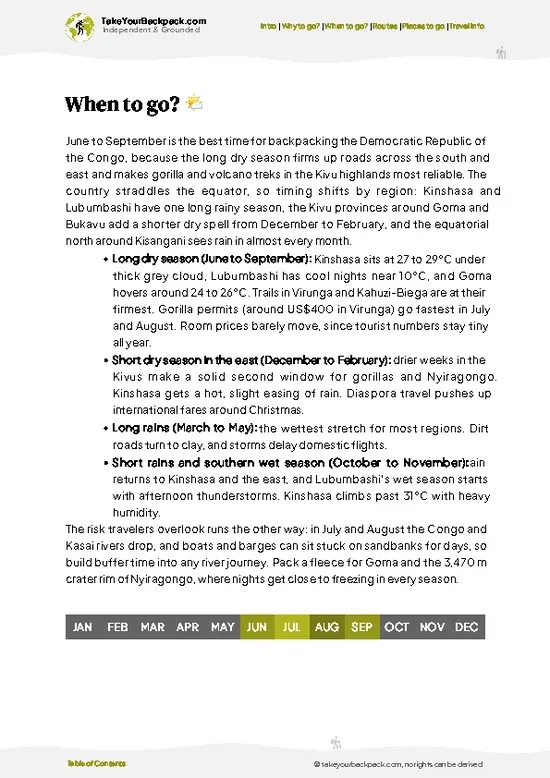
source: climatestotravel.comJANJanuary: fair for travelingFEBFebruary: fair for travelingMARMarch: fair for travelingAPRApril: fair for travelingMAYMay: fair for travelingJUNJune: excellent for travelingJULJuly: excellent for travelingAUGAugust: highly recommended for travelingSEPSeptember: highly recommended for travelingOCTOctober: fair for travelingNOVNovember: fair for travelingDECDecember: fair for traveling
when-to-go

✈️ The backpacker research shortcutDR Congo Travel Guide

An offline-friendly backpacking guide with optimized travel routes, ranked highlights, transport advice, and the best areas to stay.
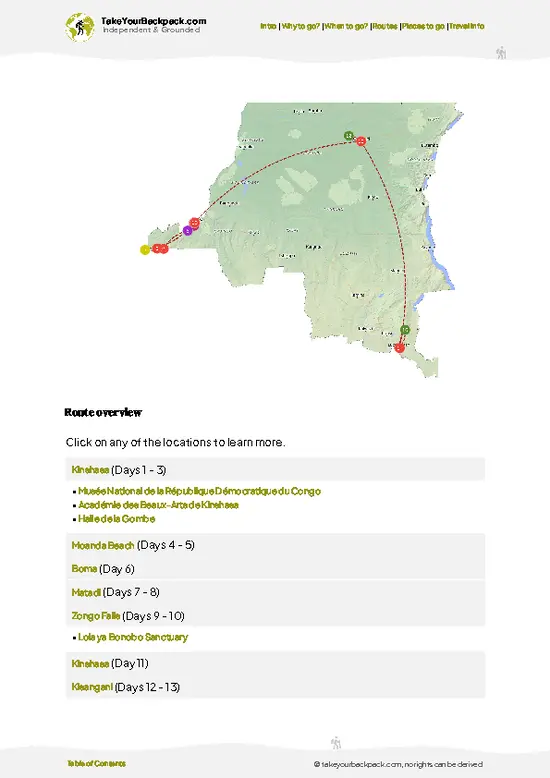
example page 0 from our offline Travel Guide for Democratic Republic of the Congo
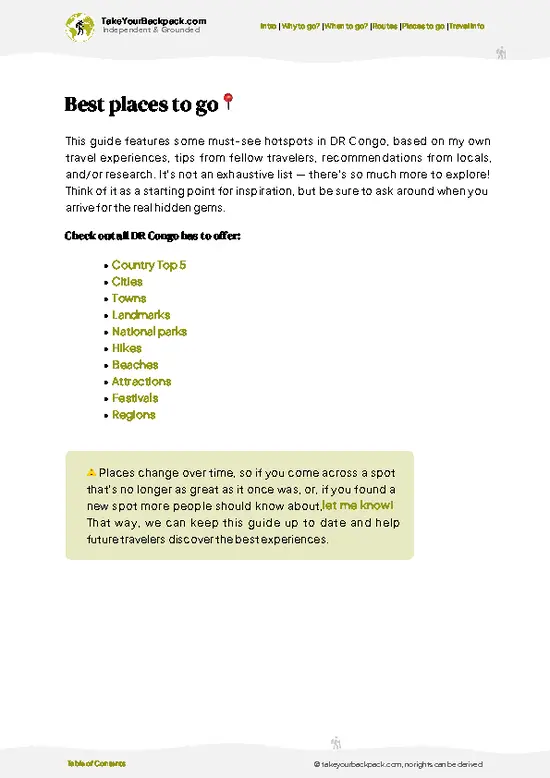
example page 1 from our offline Travel Guide for Democratic Republic of the Congo
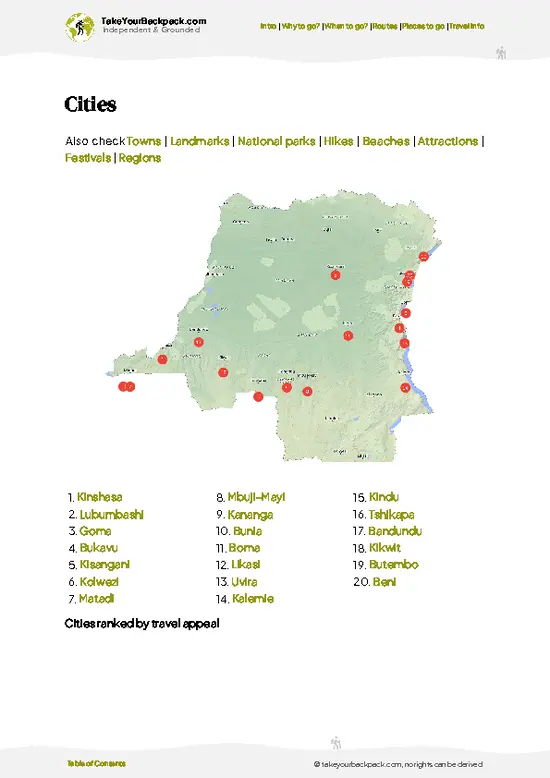
example page 2 from our offline Travel Guide for Democratic Republic of the Congo
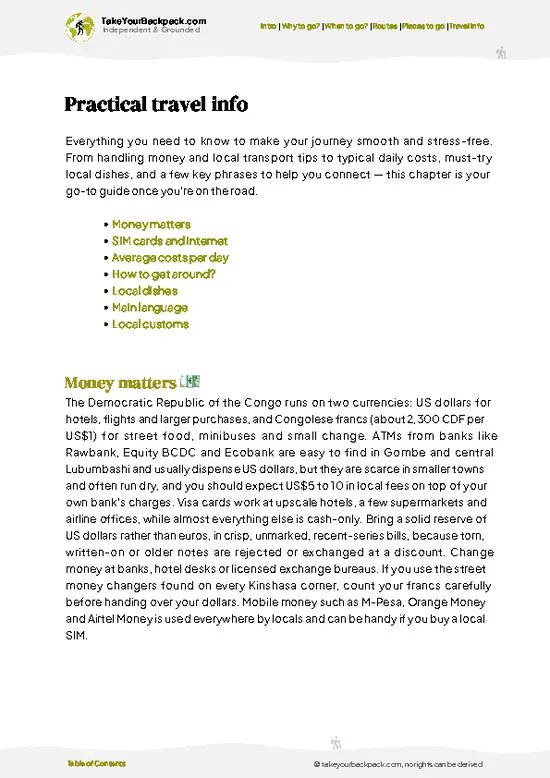
example page 3 from our offline Travel Guide for Democratic Republic of the Congo
example page 4 from our offline Travel Guide for Democratic Republic of the Congo
example page 5 from our offline Travel Guide for Democratic Republic of the Congo
example page 6 from our offline Travel Guide for Democratic Republic of the Congo
example page 7 from our offline Travel Guide for Democratic Republic of the Congo
The digital guide (372 pages) contains:
95 highlights, ranked by travel appeal
Optimized 7, 14 & 21-day travel routes
Cities, national parks, landmarks, beaches
How to get around
Offline-friendly for travel without Wi-Fi
👉 Click to see all 30+ guide features

📅 Plan smarter in minutes, not weeks
Month by month travel advice
Festivals & national holidays
Budget expectations

🗺️ Go to the right places, skip the overrated ones
Honest pros & cons of destinations
Top hikes, parks & viewpoints
Lesser-known places most travelers miss
Clear “worth it vs skip it” guidance

🛏️ Travel smoothly without rookie mistakes
Best areas to stay
Transport systems explained simply
Common scams & safety advice
SIM cards, money & practical tips

🌍 Understand the country, not just visit it
Culture & traditions
52 Essential phrases & customs
Festivals worth planning around
Traveler-friendly historical context
Insights that make places more meaningful

📱 Built for real travel conditions
Fully downloadable PDF
Works completely offline
Optimized for phone use
Useful in remote areas & buses
Everything in one place
Save weeks of stressful planning
Get instant access to your full guide. 30‑day money-back guarantee.
+ Add another guide for just US$7.80

By proceeding you agree to our terms.
Sent to your inbox immediately after payment • 100% Secure Checkout
Best Backpacking Travel Advisor 2025 tourism awardBest Backpacking
Travel Advisor
2025
What others say about Take Your Backpack Guides:
⭐⭐⭐⭐⭐
Fantastic, amazing amount of information!
⭐⭐⭐⭐⭐
My goodness this is amazing, it's what I've been looking for hats off too you!
⭐⭐⭐⭐⭐
I think this is absolutely BRILLIANT
⭐⭐⭐⭐
Very complete and informative. It's still missing places, but I gotta to commend you
⭐⭐⭐⭐⭐
This is truly amazing, thank you, can't wait to explore it with my kids!
⭐⭐⭐⭐⭐
Awesome resource, thank you!
⭐⭐⭐⭐⭐
This is amazing! Can't wait to explore the ones I haven't seen
⭐⭐⭐⭐
I love this! Well done, great idea.
⭐⭐⭐⭐⭐
Thanks for taking the time to make this gem!
⭐⭐⭐⭐⭐
This might be the best website I've ever seen.
⭐⭐⭐⭐⭐
Congratulations, and thank you so much for your work; it's incredibly valuable.
⭐⭐⭐⭐
In all seriousness I think you did a great job pointing out the important spots
⭐⭐⭐⭐⭐
10/10 very good
⭐⭐⭐⭐⭐
As someone who's only just starting to visit regularly this is awesome, thank you.
⭐⭐⭐⭐
Thank you very much! I'm going to visit my dad, it's going to be very useful!
⭐⭐⭐⭐⭐
This is really cool! We'll be travelling for the first time and this definitely come in handy.
⭐⭐⭐⭐⭐
You are now our minister of culture, congratulations 👨‍💼
⭐⭐⭐⭐⭐
Just wanted to tell you that this is a pearl! Going to follow your recommendations.
⭐⭐⭐⭐⭐
This is so cool. I'll definitely be using the resource for my travels soon.
⭐⭐⭐⭐⭐
This is very impressive! Good work.
⭐⭐⭐⭐⭐
This is an amazing and informative site. Very well done!

🛏️ Where to stay?Choosing the right base

When it comes to Lake Tanganyika in DR Congo, you want to find a spot that balances safety, social vibes, and budget-friendliness. The beach areas around Kalemie are your best bet. This town has a laid-back atmosphere, perfect for those who want to kick back after a day of exploring.

Kalemie’s waterfront is dotted with local eateries where you can grab a fish dinner that’s fresher than your last Tinder date. Plus, the beach scene is lively enough to meet fellow travelers without feeling like you’re in a crowded tourist trap.

If you’re feeling adventurous, head to the nearby village of Mbala. … read more 👉
When it comes to Lake Tanganyika in DR Congo, you want to find a spot that balances safety, social vibes, and budget-friendliness. The beach areas around Kalemie are your best bet. This town has a laid-back atmosphere, perfect for those who want to kick back after a day of exploring.

Kalemie’s waterfront is dotted with local eateries where you can grab a fish dinner that’s fresher than your last Tinder date. Plus, the beach scene is lively enough to meet fellow travelers without feeling like you’re in a crowded tourist trap.

If you’re feeling adventurous, head to the nearby village of Mbala. It’s a bit more off the beaten path, but the local culture is rich, and you’ll find fewer tourists. Just be prepared for some logistical quirks—like negotiating transport that might feel more like a game of Tetris than a smooth ride.

Avoid the more commercialized spots that promise luxury but deliver disappointment. Instead, embrace the charm of local guesthouses or community-run lodges. They often have the best stories and connections to the area. Plus, you’ll leave with memories that are worth every ounce of effort.

🛡️ SafetyStaying Safe: What Travelers Should Know

Lake Tanganyika beach in DR Congo is a unique spot, where the water feels more like a lake than an ocean, but don’t let that fool you. The swimming conditions can vary. Generally, the waves are gentle, but watch for occasional currents that might surprise you. Locals know the best spots, so follow their lead.

Marine life here isn’t a horror movie. You’re unlikely to encounter anything too menacing, but keep an eye out for the occasional jellyfish. They’re not usually a big deal, but a sting can ruin your day.

Weather-wise, the sun can be relentless. Mornings are usually calm, but by midday, you’ll want to slather on sunscreen and seek shade. As for theft, keep your valuables close. It’s not a crime hotspot, but common sense goes a long way.

So, enjoy the beach, swim where the locals … read more 👉
Lake Tanganyika beach in DR Congo is a unique spot, where the water feels more like a lake than an ocean, but don’t let that fool you. The swimming conditions can vary. Generally, the waves are gentle, but watch for occasional currents that might surprise you. Locals know the best spots, so follow their lead.

Marine life here isn’t a horror movie. You’re unlikely to encounter anything too menacing, but keep an eye out for the occasional jellyfish. They’re not usually a big deal, but a sting can ruin your day.

Weather-wise, the sun can be relentless. Mornings are usually calm, but by midday, you’ll want to slather on sunscreen and seek shade. As for theft, keep your valuables close. It’s not a crime hotspot, but common sense goes a long way.

So, enjoy the beach, swim where the locals do, and soak in the experience without overthinking it.

FAQFrequently asked questions about Lake Tanganyika

You get to Lake Tanganyika beach by traveling to the eastern part of the Democratic Republic of the Congo, near the city of Kalemie. The nearest major airport is Kalemie Airport, and from there you can take local transport or arrange a boat to reach the beach area. The journey from Kalemie to the beach typically takes a few hours depending on your exact destination along the lake.
Lake Tanganyika beach is good for swimming and snorkeling due to its clear freshwater and diverse aquatic life, but it is not suitable for surfing as the lake does not have ocean waves. Water temperatures are generally warm year-round, making swimming comfortable. Snorkeling is best during the dry season from June to September when water clarity improves.
Yes, Lake Tanganyika beach is generally free to visit, especially in less developed areas along the lake. Some private or resort beaches may charge a small entrance fee, usually under $5. Always carry some local currency for incidental costs or small fees.
⚠️ Things can change over time, so always validate details locally before you go.

Where to go next

Lake Tanganyika isn’t the only highlight in DR Congo. Explore all what DR Congo has to offer.
Country photo of DR Congo

We 💚 feedbackParting advice and final tips

Lake Tanganyika beach in DR Congo is a wild card. The vibe? Laid-back, with locals who’ll share a smile and maybe even a fishing tale. The best surprise? Those sunsets—like someone set the sky on fire. But here’s the kicker: the logistics can be a real grind. Roads are rough, and getting there might test your patience. Pack your sense of humor and a good book. You’ll need both while waiting for that boat to show up. Trust me, it’s worth it.

✍️ Help improve this page!
The information on this page is based on in-depth research, insights shared by experienced travelers, and feedback from the local travel community in DR Congo. While every effort is made to keep the information accurate and current, conditions can change — so if you spot anything incorrect or outdated, please get in touch.


🙋‍♂️ Give feedback

👋 Meet the founderWho’s Behind Take Your Backpack?

Johan, backpacker and founder of TakeYourBackpackHi, I’m Johan (Netherlands 🇳🇱), the creator of TakeYourBackpack. Over the past decade, I’ve backpacked through 80+ countries across six continents, gaining extensive experience with independent travel, long-term trips, and overland routes.

This site is built on a combination of firsthand travel experience and carefully curated insights from other backpackers. Many guides are based on places I’ve personally visited, while others bring together tips, observations, and practical advice shared by trusted travelers I’ve met along the way.

The goal is to provide realistic, experience-driven guidance — not generic itineraries — so you can explore destinations with better context, clearer expectations, and more confidence.

Get full DR Congo guide •
Instant download • 95 highlights • Full Offline guide